

 Boris Pasternak, Wole Soyinka, Isaak Babel
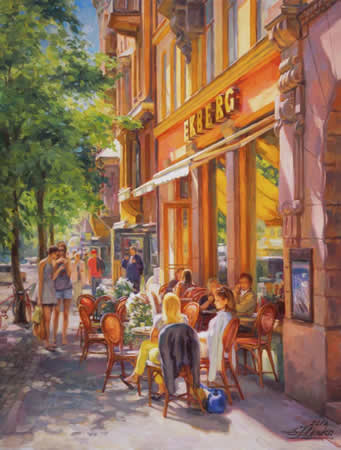
Dolce far niente
Zomer in de stad door Serguei Zlenko, 2012
Summer in the City
Soft exchanges fill the air
And in some fervent rush,
From the forehead, strands of hair
Were gathered with a brush.
Helmed, she casts a single glance
Upon your face and waits,
Throwing back her head at once
With her dangling braids.
While the humid, muggy night
Insinuates a storm,
All the passersby outside
Quickly scatter home.
And the thunder can be heard now.
There, resounding, it rings.
By the widow-frame, the curtain,
In the crosswinds, swings.
All is silent, all is hushed now
And it’s humid all the while,
And the lightning’s golden flashes
Are still groping in the skyline…
But the sunrise will ensue
With a breaking light, so stifling,
And dry the puddled avenues,
From the downpours and lightning.
You will see a look still stagnant,
From the lack of sleep, sedate,
On those age-old, on those fragrant
Limes that simply will not fade.
Vertaald door Andrey Kneller

Boris Pasternak (10 februari 1890 - 30 mei 1960)
Zomers Moskou, de stad waar Pasternak werd geboren.
De Nigeriaanse dichter, schrijver en voorvechter van democratie Akinwande Oluwole "Wole" Soyinka werd geboren op 13 juli 1934 in Abeokuta. Zie ook alle tags voor Wole Soyinka op dit blog.
Uit: Aké. The Years of Childhood
“There were far too many aspects of the schoolroom and the compound to absorb in the regular school hours, moreover, an empty schoolroom appeared to acquire a totally different character which changed from day to day. And so, new discoveries began to keep me behind at lunch-time after everyone had gone. I began to stay longer and longer, pausing over objects which became endowed with new meanings, forms, even dimensions as soon as silence descended on their environment. Sometimes I simply wandered off among the rocks intending merely to climb a challenging surface when no one was around. Finally, Osiki lost patience. He would usually wait for me at home even while Tinu had her own food. On this day however, being perhaps more hungry than usual, Osiki decided not to wait. Afterwards he tried to explain that he had only meant to eat half of the food but had been unable to stop himself. I returned home to encounter empty dishes and was just in time to see Osiki disappearing behind the croton bush in the backyard, meaning no doubt to escape through the rear gate. I rushed through the parlour and the front room, empty dishes in hand, hid behind the door until he came past, then pelted him with the dishes. A chase followed, with Osiki instantly in front by almost the full length of the school compound while I followed doggedly, Finally, I stopped. I no longer saw Osiki but - Speed, Swiftness! I had not given any thought before then to the phenomenon of human swiftness and Osiki's passage through the compound seemed little short of the magical. The effect of his dansiki which flowed like wings from his sides also added to the illusion of him flying over the ground. This, more than anything else, made it easy enough for the quarrel to be settled by my mother. It was very difficult to cut oneself off from a school friend who could fly at will from one end of the compound to the other. Even so, some weeks elapsed before he returned to the pounded-yam table, only to follow up his perfidy by putting me out of school for the first time in my career.
There was a birthday party for one of the Canon's children. Only the children of the parsonage were expected but I passed the secret to Osiki and he turned up at the party in his best buba. The entertain ments had been set up out of doors in front of the house. I noticed that one of the benches was not properly placed, so that it acted like a see-saw when we sat on it close to the two ends. It was an obvious idea for a game, so, with the help of some of the other children, we carried it to an even more uneven ground, rested its middle leg on a low rock outcrop and turned it into a proper see-saw. We all took turns to ride on it.”
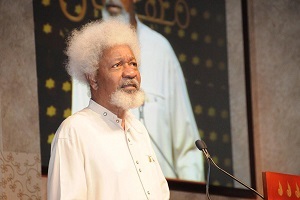
Wole Soyinka (Abeokuta, 13 juli 1934)
De Russische schrijver Isaak Emmanuïlovitsj Babel werd geboren in Odessa op 13 juli 1894. Zie ook mijn blog van 13 juli 2010 en eveneens alle tags voor Isaak Babel op dit blog.
Uit: Old Shloyme
“But to leave, to leave one's God completely and forever, the God of an oppressed and suffering people--that he could not understand. Thoughts rolled heavily inside his head, he comprehended things with difficult, but these words remained unchanged, hard, and terrible before him: "This mustn't happen, it mustn't!" And when Shloyme realized that disaster was inevitable, that his son couldn't hold out, he said to himself, "Shloyme, old Shloyme! What are you going to do now?" The old man looked around helplessly, mournfully puckered his lips like a child, and wanted to burst into the bitter tears of an old man. But there were no relieving tears. And then, at the moment his heart began aching, when his mind grasped the boundlessness of the disaster, it was then that Shloyme looked at his warm corner one last time and decided that no one was going to kick him out of here, they would never kick him out. "They will not let old Shloyme eat the dried-up piece of honey cake lying under his pillow! So what! Shloyme will tell God how he was wronged! After all, there is a God, God will take him in!" Shloyme was sure of this.
In the middle of the night, trembling with cold, he got up from his bed. Quietly, so as not to wake anyone, he lit a small kerosene lamp. Slowly, with an old man's groaning and shivering, he started pulling on his dirty clothes. Then he took the stool and the rope he had prepared the night before, and, tottering with weakness, steadying himself on the walls, went out into the street. Suddenly it was so cold. His whole body shivered. Shloyme quickly fastened the rope onto a hook, stood up next to the door, put the stool in place, clambered up onto it, wound the rope around his thin, quivering neck, kicked away the stool with his last strength, managing with his dimming eyes to glance at the town he had not left once in sixty years, and hung.”
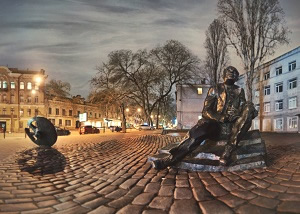
Isaak Babel (13 juli 1894 – 27 januari 1940)
Standbeeld in Odessa
Zie voor nog meer schrijvers van de 13e juli ook mijn blog van 13 juli 2016 en ook mijn blog van 13 juli 2014 deel 1 en ook deel 2.
