Naar de inhoud

Romenu

Over literatuur, gedichten, kunst en cultuur
seniorennet.beseniorennet.be

Berichten van 25 oktober 2015

Willem Wilmink, Anne Tyler, Elif Shafak, Daniel Mark Epstein, Peter Rühmkorf, Jakob Hein
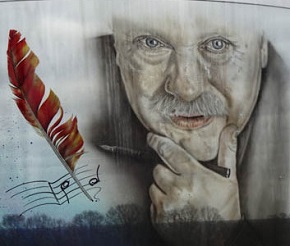
De Nederlandse dichter, schrijver en zanger Willem Andries Wilmink werd geboren in Enschede op 25 oktober 1936. Zie ook mijn blog van 25 oktober 2010 en eveneens alle tags voor Willem Wilmink op dit blog.


Zomeravond
(Naar het Portugees)

Kindje, slaap maar, kindje,
't was ook zo warm deze dag.
In de schemer
zit nu een kleine egel
met zijn mooie stekels
eenzaam in het gras.

Het gras wacht op regen.
Geen takje beweegt er.
Luister naar de merel,
hoog op ons dak.

Avond vol verlangen.
De maan maakt zich klaar voor de nacht.
In de avondschemer
komt strakjes onze egel
nog een egel tegen,
liefkoost haar vacht.

Van ver wordt de merel
antwoord gegeven.
Morgen komt de regen
waar het gras op wacht.

Kindje, slaap maar, kindje,
in de avondschemer.
Hebt al slaap gekregen.
Slaap maar mijn schat.


Uitreiking van diploma’s

Onder de meisjes menig stevig stuk,
maar er zijn ook van die nog hele tere,
onder de jongens veel in herenkleren,
en allen, allen stralend van geluk.

Niet langer meer gebukt onder het juk
van heel veel saais om uit het hoofd te leren:
niemand zal ooit nog bij hen informeren
naar passé défini of overdruk.

Maar ’t is meteen ook de examenklas,
die vol saamhorigheid en warmte was,
waarvan men zich zo zorgeloos ontdoet.

Nu slaat voor ’t laatst de grote schooldeur dicht,
en kijk, daar gaan ze: blij en doelgericht
een toekomst met veel heimwee tegemoet.


 1830642-fcf1580da7d293804a95bb2f7c8ca441.jpg
Willem Wilmink (25 oktober 1936 – 2 augustus 2003)
Portret door Desirée Groot Koerkamp in Oostmarsum


De Amerikaanse schrijfster Anne Tyler werd geboren op 25 oktober 1941 in Minneapolis, Minnesota. Zie ook mijn blog van 25 oktober 2010 en eveneens alle tags voor Anne Tyler op dit blog.

Uit:A Spool of Blue Thread

“It took a total of five vehicles to carry them all to the beach. They could have managed with fewer, but Red insisted, as usual, on driving his pickup. How else could they bring everything they needed, he always asked—the rafts and boogie boards, the sand toys for the children, the kites and the paddle-ball racquets and the giant canvas shade canopy with its collapsible metal frame? (In the old days, before computers, he used to include the entire Encyclopaedia Britannica.) So he and Abby made the three-hour trip in the pickup, while Denny drove Abby’s car with Susan in the passenger seat and the food hampers in the rear. Stem and Nora and the three little boys came in Nora’s car, and Jeannie and Jeannie’s Hugh started out separately from their own house with their two children, though not with Hugh’s mother, who always spent the beach week visiting Hugh’s sister in California.
Amanda and Amanda’s Hugh and Elise traveled on a whole different day—Saturday morning instead of Friday afternoon, since Amanda always had trouble getting away from her law office—and they stayed in a different cottage, because Amanda’s Hugh couldn’t tolerate what he called the hurly-burly.
None of the dogs came. They were all boarding at Penpals.
The house the Whitshanks rented every summer stood right on the beach—a comparatively uncrowded stretch of the Delaware coast—but it wasn’t what you’d call luxurious. The walls were tongue-and-groove, painted a depressing pea-soup green; the floor- boards were so splintery no one dared go barefoot; the kitchen dated from the 1940s. But it was big enough for all of them, and far homier than the glittering new mansions with giant Palladian windows that had popped up elsewhere along the shore. Besides, Red could always use a few fix-it jobs to keep him occupied. (He wasn’t a natural vacationer.) Even before Abby and Nora had unpacked the food, he had happily catalogued half a dozen minor household emergencies. “Will you look at this outlet!” he said. “Practically dangling by a thread!” And off he went to the truck for his tools, with Jeannie’s Hugh not far behind.
“The next-door people are back,” Jeannie called, stepping in from the screen porch.
Next door was almost the only house as unassuming as theirs was, and the people she was referring to had been renting it for at least as long as the Whitshanks had been renting theirs. Oddly enough, though, the two families never socialized.”
 

 1830642-e72981c2da288270fa78e2b43b5a5263.jpg
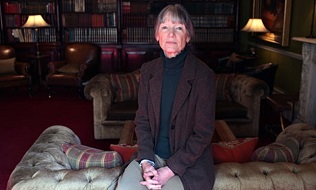
Anne Tyler (Minneapolis, 25 oktober 1941)


De Turkse schrijfster Elif Shafak (eigenlijk Elif Şafak) werd geboren in Straatsburg op 25 oktober 1971. Zie ook alle tags voor Elif Shafak op dit blog.

Uit: The Bastard of Istanbul

“At the moment, however, it was still pouring and Zeliha had little, if any, forgiveness in her heart. She did not have an umbrella, for she had promised herself that if she was enough of an imbecile to throw a bunch of money to yet another street vendor for yet another umbrella, only to forget it here and there as soon as the sun came back, then she deserved to be soaked to the bone. Besides, it was too late now anyway. She was already sopping wet. That was the one thing about the rain that likened it to sorrow: You did your best to remain untouched, safe and dry, but if and when you failed, there came a point in which you started seeing the problem less in terms of drops than as an incessant gush, and thereby you decide you might as well get drenched.
Rain dripped from her dark curls onto her broad shoulders. Like all the women in the Kazancı family, Zeliha had been born with frizzy raven-black hair, but unlike the others, she liked to keep it that way. From time to time her eyes of jade green, normally wide open, and filled with fiery intelligence, squinted into two lines of untainted indifference inherent only to three groups of people: the hopelessly naïve, the hopelessly withdrawn, and the hopelessly full of hope. She being none of these, it was hard to make sense of this indifference, even if it was such a flickering one. One minute it was here, canopying her soul to drugged insensibility, the next minute it was gone, leaving her alone in her body.”

 

 1830642-861c39d1ba927da1be839c61963efbba.jpg
Elif Shafak (Straatsburg, 25 oktober 1971)


De Amerikaanse dichter, schrijver en biograaf Daniel Mark Epstein werd geboren op 25 October 1948 in Washington, D.C. Zie ook mijn blog van 25 oktober 2010 en eveneens alle tags voor Daniel Mark Epstein op dit blog.


The Comb-Bearers

Some windless nights on Narragansett Bay,
The deep inlet seems a meadow of fireflies
As multitudes of the luminous jellyfish
Called “comb-bearers” float to the surface
For no evident purpose
But to amaze the fishermen and scientists

Who know them only slightly, each one no more
Than a pear-shaped living sack of liquid
With skin thinner than cellophane, a sheer piece
Of moonlight on the sea, so fragile
The least ripple may tear it
To bits. Calm evenings, the amber-green species

May spread out over a thousand yards square,
An island made of bright individuals
Who usually live in the depths, a zone where
Wave movement ceases. Only on nights
Like these do the comb-bearers
Rise, when the bay lies still as a sheet of slate.

 Loveliest of sea beings, the color
Of wild geranium, rose-pink, or beach pea,
As some pass beneath the surface of the water
The effect is of rainbow glory
More seductive than moonlight
To the naturalist who might try to scoop one up

 Ever-so-gently in his fine net and
Hold it awhile in a clear beaker of brine-
Perhaps the giant of the race, “Venus’s girdle,”
Come from the Mediterranean-
An iridescent ribbon
Which vanishes en route to the laboratory.


Hope

In winter the crescent moon vanishes
So quickly in the blue, down the horizon,
Between the starry darkness and morning,

Like the hull of a ship without rigging
That I was meaning to load with wishes,
O not for me, my dear, wishes for you,

And you and you, my friends, all of us, 
Such cargo as could only ride upon
The silver shell of that hallowed galleon.
 
I daydreamed, got bewildered by my muse,
Sun on the lace of frost, and fading Venus.
I looked up, and the reckless moon had gone.

 

 1830642-0c14b10c0080657c4f72e221b92826f9.jpg
Daniel Mark Epstein (Washington, 25 oktober 1948)


De Duitse dichter en schrijver Peter Rühmkorf werd geboren op 25 oktober 1929 in Dortmund. Zie ook mijn blog van 25 oktober 2010 en eveneens alle tags voor Peter Rühmkorf op dit blog.


Aufbruch vor Morgen

Wieviel Uhr? Es kommen auf einmal so viele
              fipsige Vögel auf, verflucht!
Bald wird mir die Sonne ihr Zitronenlicht
              ins verkniffene Auge träufeln. . .
Und keine Lehre wird mal daraus-nachhaus
              und kein Gedanke an
Bewegung / Besserung.

Aufwachen? – Wozu?
Es ist doch so, laut EMNID folgt für 44%
              aller Bundesbürger auf den Tod das Nichts.
Von denen völlig zu schweigen, für die nach dem Nichts
              gleich der Tod kommt –
Hab leider vergessen, was ich damit eigentlich
              aussagen wollte, achja:
Wer das kapiert hat,
den versteht bald keiner mehr.

Im Verhältnis kannst du natürlich nicht klagen
             (das nebenbei) –
Man soll aber auch nicht glauben, hier läg noch derselbe rum
              wie damals im letzten Jahr.
Oder wüßtest du grad ne Idee, für die du bedenkenlos
              deinen Kopf hinhalten würdenst?
Na-bong, ein Präser hängt sich aus. . .
Das muß aber ja nicht gleich Zustand werden.

Wie ich immer gesagt hab, in solcher Verfassung soll man
              eigentlich keine Gedichte schreiben.
Da muß der Kunde doch unvermittelt denken,
              hier wär der Ausguck verstopft,
beziehungsweise gar kein Leben mehr
              in dieser Rolle –

S o  i s t  e s  a b e r  n i c h t!
Der Tag lehnt in der Drehtür:
Wo es meine Lieblingsbouletten gibt, ist noch erleuchtet,
mein Fuß schon unterwegs. . .
Gleich wird – dein Telefon – im Schlaf – aufschrein!
und dir den Aufbruch meiner Leiche
feierlich eröffnen: - : - : -
 

 1830642-72533ea33dfed3d8ea70257aa5216581.jpg
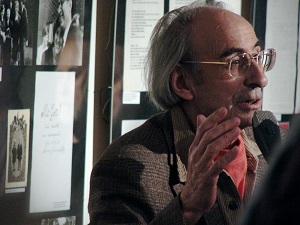
Peter Rühmkorf (25 oktober 1929 – 8 juni 2008)


De Duitse schrijver en arts Jakob Hein werd geboren op 25 oktober 1971 in Leipzig. Zie ook alle tags voor Jakob Hein op dit blog en ook mijn blog van 25 oktober 2010

Uit: Liebe ist ein hormonell bedingter Zustand

„Die erste Zeile war immer gleich. sie lautete: »Jimmy Clitschi, der Mann ohne Knochen-« Auch die zweite Zeile kannte nur minimale Abweichungen. Es variierten lediglich die Tätigkeit und derKörperteil den sich Jimmy angeblich gebrochen hatte. Ein typisches Beispiel:
Jimmy Glitschi, der Mann ohne Knochen, hat sich beim Furzen den Hintern gebrochen.«
Trotz der stets tragisch endenden Geschichten entbehrten die Gedichte über Jimmy Clitschi nicht einer gewissen Komik. die sich vor allem Menschen unter acht Jahren erschloss.
In meinen ersten Sommerferien verschifften mich meine Eltern ins Ferienlager. In einem Brief, den ich ihnen am zweiten Tag schickte, schrieb ich über das Ferienlager: »Alles Scheißdreck«, mein Befinden beschrieb ich mit den Worten: »Es geht mir scheiße.« Dann kam die erste Diskothek meines Lebens. Der dicke Harald hatte seinen Koffer mit Tonbandkassetten in den Esssaal getragen und zwei Kassettenrekorder mit den Lautsprechern auf volle Lautstärlke gedreht. Da brach es aus mir heraus: Ich bewegte meine Gliedmaßen im Takt der Musik. allerdings jeden meiner Arme. jedes Bein in seinem eigenen Rhythmus, die Augen hinter den Brillengläsern fest geschlossen und den Mund leicht geöffnet. Für einen Aufsenstehenden mag es vielleicht so ausgesehen haben, als hätte ich gerade einen KrampfanfalL aber ich tanzte den Jimmy Glitschi. All mein Heimweh und meine Wut ließ ich aus mir heraus und identifizierte mich in meinem Tanz mit dem berühmten Helden, der sich der Legende nach beim Beischlaf sein Geschlechtsteil gebrochen haben sollte.
Ich sah bestimmt schrecklich aus, ich sah bestimmt lächerlich aus, ich sah erbärmlich aus, aber ich fühlte mich groißartig denn an diesem Nachmittag, hinter den geschlossenen Gardinen des Gemeinschattsraums, entdeckte ich die Kraft des Tanzes, wie Musik die Seele dazu bringen kann, in direkte Verbindung Zum Körper zu treten, um durch Bewegungen Dinge auszudrücken, die der Mund nicht sagen kann.
Danach wurde alles besser.
Als meine Eltern, aufgeschreckt durch meinen Brief, drei Tage später vor dem Ferienlager standen, um mich vorzeitig abzuholen, schaute ich sie nur verständnislos an.“
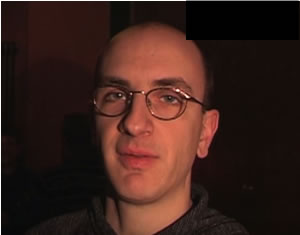
 

 1830642-12cec9cd01b58a68813cd28d0d651600.jpg
Jakob Hein (Leipzig, 25 oktober 1971)


Zie voor nog meer schrijvers van de 25e oktober ook mijn vorige blog van vandaag.


Geschreven door Romenu om 13:27 Reageer op dit bericht

Christine D'haen, John Berryman, Hélène Swarth, Harold Brodkey, Karl Emil Franzos, Benjamin Constant, Geoffrey Chaucer

De Vlaamse dichteres en prozaschrijfster Christine D'Haen werd geboren in Sint-Amandsberg op 25 oktober 1923. Zie ook alle tags voor Christine D’Haen op dit blog en ook mijn blog van 25 oktober 2009 en ook mijn blog van 25 oktober 2010


Roos
Prélude

Schaamte van zoovele vrouwen, hoe zou
wistet gij heden reeds al jet ontbladeren
morgen, o roos, bij uw verouden
het blozen vermeerderen van uwe aderen!

Uw blos, o roos, het wederbeeld
van die mij steeg naar keel en wang,
onthullend wat tot hun verheeld:
hartstochtelijkheid en tegendwang.

Eenmaal ontplooid, o roos, verwacht
geen wederkeer: diep in den nacht
blijft heel uw hart ontbloot, en slaat uw geur
mij tegen aan de kamerdeur.

Uw lippen willen alles, roos, verkonden,
en ik moet zwijgende de mijne sluiten;
alles verzwijgt gij woordloos met uw monden,
al het verborgene wil ik uiten, uiten.

Een geil, o roos, een zeer geheime
vergun mij voor mijn stil vervoeren:
zij vinden slechts die u bezoeken
volmaaktheid in uw omslagdoeken.

Uw lippen wil ik pletten tusschen tanden,
u eten en uw geurig vleesch aanranden,
dat zoeter is naarmate witter,
het witte zoet, het roode bitter.

Vervulling overstelpend, volte
van onverwoordbaarheid, geheel
uw lichaam ligt rond en holten
onthullend nauwlijks uw teveel.

Menschelijker dan andere bloemen
omdat gij met meerdere lippen zwijgt:
vegetaler ik door u niet te noemen.

Uw zilveren floers op purperlak
Uw grein van fijne maas en twijn
Uw ongefronst geglimd fustein
Uw gouden huive en paarlen jak.

Gij uw gedorend halsje buigt
door uw extremen overstelpt.
Gij bergt uw fonklende overmoed
deemoedig in uw bottelzoet.

Verbrand van regen is uw blad
verrot uw kleedsel en verdord uw hart
de storm vermorzelde u met overmacht
geen letsel hebt gijzelf u toegebracht.

Orgasme o roos binnen zooveel lippen
verborgen betooverd tot zooveel droom
van zoovele oogleden slapend geloken
met tranen bepareld hun zachtste zoom.


 1830641-f916179e61f313660eb25005a59bfb80.jpg
Christine D'haen (25 oktober 1923 – 3 september 2009)


De Amerikaanse dichter en schrijver John Allyn Berryman (eig. John Allyn Smith) werd geboren op 25 oktober 1914 in McAlester, Oklahoma. Zie ook alle tags voor John Berryman op dit blog en ook mijn blog van 25 oktober 2009 en ook mijn blog van 25 oktober 2010


Dream Song 10

There were strange gatherings. A vote would come
that would be no vote. There would come a rope.
Yes. There would come a rope.
Men have their hats down. "Dancing in the Dark"
will see him up, car-radio-wise. So many, some
won't find a rut to park.

It is in the occasions, that-not the fathomless heart-
the thinky death consists;
his chest is pinched. The enemy are sick,
and so is us of. Often, to rising trysts,
like this one, drove he out

and gasps of love, after all, had got him ready.
However things hurt, men hurt worse. He's stark
to be jerked onward?
Yes. In the headlights he got' keep him steady,
leak not, look out over. This' hard work,
boss, wait' for The Word.


Dream Song 14

Life, friends, is boring. We must not say so.  
After all, the sky flashes, the great sea yearns,  
we ourselves flash and yearn,
and moreover my mother told me as a boy  
(repeatingly) ‘Ever to confess you’re bored  
means you have no

Inner Resources.’ I conclude now I have no  
inner resources, because I am heavy bored.
Peoples bore me,
literature bores me, especially great literature,  
Henry bores me, with his plights & gripes  
as bad as achilles,

who loves people and valiant art, which bores me.  
And the tranquil hills, & gin, look like a drag  
and somehow a dog
has taken itself & its tail considerably away
into mountains or sea or sky, leaving           
behind: me, wag.


 1830641-7dd9aa7e6bd2260a6ed79d7d833bf5ba.jpg
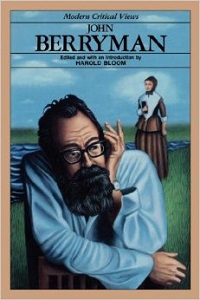
John Berryman (25 oktober 1914 – 7 januari 1972)
Cover 


De Nederlandse dichteres Hélène Swarth werd geboren op 25 oktober 1859 in Amsterdam. Zie ook mijn blog van 25 oktober 2010 en eveneens alle tags voor Hélène Swarth op dit blog.


Het gele huis

Ik ben ziek van heimwee naar 't gele huis,
In het lommer van groene linden,
Waar zongen belovend hun neurie-geruis
De dromige zomerwinden.

Nu wilde ik wel reizen naar 't gele huis
En luistren naar 't suizlen der linden
En dromen van liefde in mijn zonnige kluis
En omhelzen wie trouw mij beminden.

Doch zo ik nu belde aan het gele huis,
Wie zou ik er wedervinden?
- In een zwarte kluis zijn mijn lieven thuis
En geveld zijn de zingende linden.


Ik vond een vogel, stervende in de tuin
Kinderjaren.

I
Ik vond een vogel, stervende in de tuin.
Geen koestren hielp, hij drinken wou noch eten.
Gelijk een bloem, wier stengel werd gereten,
Aan 't slappe halsje hing het kopje schuin.

Eén siddering - en dan, in niets meer weten,
Verstrakte 't lijfje, als de aarde grijzigbruin.
Wij hebben 't stil begraven in de tuin -
Die kleine vogel kan ik nooit vergeten.

Zo zag 'k voor 't eerst het wonder van de dood
- Nu moest die vogel zang en vliegspel derven,
Weerloos vergaan tot aarde in aardeschoot.

Toen wist ik: - Nu nog zijn mijn wangen rood,
Nog zing en dans ik, maar ook ik moet sterven -
'k Voel nog de kou, die héél mijn zijn doorvloot.


 1830641-1c60239169a51302eb686d05061c10fe.jpg
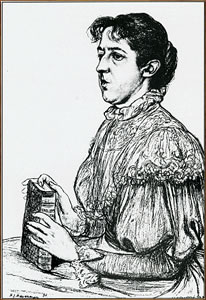
Hélène Swarth (25 oktober 1859 - 20 juni 1941)
Portret door H.J. Haverman, 1896


De Amerikaanse schrijver Harold Brodkey werd geboren op 25 oktober 1930 als Aaron Roy Weintraub in Staunton, Illinois. Zie ook alle tags voor Harold Brodkey op dit blog en ook mijn blog van 25 oktober 2009 en ook mijn blog van 25 oktober 2010

Uit: Old In Venice

“This morning I woke at dawn. and the place announced itself immediately even in the near dark through the windows of my room. water and facades. moored boats. boats at work upon the glimmering surface of dark water. I wake nowadays once or twice before I wake. I often dream I am waking and feel the half-dark air and myself as real when it isn't yet the real world . . . I'm not my age. I feel something like the silent clatter of my dreams. like horses on a shore. on the Lido. or the inland rim of the Lagoon. horses and armed men. often Oriental. usually silent.
l have discussed this with myself. who the silent Orientals are - perhaps Huns. I am mean. hungry alter a night's sleep. But men of the East and not Lombards and the lumbering bombardment of the feudal wars of one's career. Of one's polities. Goths and Vandals Milanese. But Death.
Or the dead. Or the barbarian young arriying in force during the night as Tartars and Mongols. And the sound of my ow n harsh breath is the snorting and clanging of war. of rage. left over from my night's dreams. from such invasion. Ruskin writes that Venice in the mid-nineteenth century was. at low tide. in the middle of a lagoon of mud. of seaweed and quaking. unstable muck, Desolation and uncrossability. There were miles of kreeks and rills and wandering channels of deeper water which when the tide changed rose and oyerflowed among the seaplants and stirred them and made the mud of the higher knolls gleam. and then it covered all of it w ith its own shiyering. reflectant symmetry. With reflections of the sky. Beauty arrives. The beauty of the city in the sea.
In the dream I had just before waking. l was rescued from being hung on a gibbet in Carmaregro by masked figures. and then I fought in single combat like Sohrab and Rustum with my father or my brother Carlo on the edge of the Lagoon. swords elanging on metal. eyes mad with quarrelling. with neryes. The sky was deep red. maroon-termillion. dark crimson. and purple. flames or sunset And the dream. like most dreams. was shot through with emotion very clearly. with passion and fear. but this one was also full of contest and evidence of fatality. the fatality of close relationship.”


 1830641-b76e52a7d9230e0ac34c76611b49b3f9.jpg
Harold Brodkey (25 oktober 1930 - 26 januari 1996)


De Oostenrijkse schrijver Karl Emil Franzos werd geboren op 25 oktober 1848 in Czortków (Galicië). Zie ook alle tags voor Karl Emil Franzos op dit blog en ook mijn blog van 25 oktober 2010

Uit:Der Pojaz

„Dort also bin ich, wie gesagt, zur Welt gekommen, vorzeitig; meine arme Mutter war ja in tödlicher Angst und Sorge um den Gatten. Die Gefahr ging gnädig an ihm vorbei; schon im November war der Aufstand der Polen zu Ende, und sie konnte heimkehren. Man sieht, ich bin deshalb in Rußland zur Welt gekommen, weil mein Vater sich als Deutscher fühlte und danach handelte.
Auch bei meiner Erziehung. Das deutsche Nationalgefühl, das mich erfüllt, das auch ich mein Leben lang betätigt habe, ist mir von Kindheit auf eingeprägt worden. Ich war noch nicht drei Käse hoch, als mir mein Vater bereits sagte: »Du bist deiner Nationalität nach kein Pole, kein Ruthene, kein Jude – du bist ein Deutscher.« Aber ebenso oft hat er mir schon damals gesagt: »Deinem Glauben nach bist du ein Jude.« Mein Vater erzog mich wie mein Großvater ihn erzogen, in denselben Anschauungen, sogar zu demselben Endzweck, ich sollte meine Heimat nicht in Galizien finden, sondern im Westen. Und auch die Gründe, die meinen Vater dazu bewogen, waren dieselben.
Ich besuchte die einzige Schule des Städtchens, die im Kloster der Dominikaner; dort lernte ich Polnisch und Latein. Im Deutschen unterrichtete mich mein Vater selbst. Für das Hebräische hatte ich einen besonderen Lehrer. Dieser Mann war zugleich der einzige meiner Czortkower Glaubensgenossen, mit dem ich bis in mein zehntes Jahr in nähere Berührung kam. Meine Mitschüler, meine Spielgefährten waren Christen. Ich betrat selten ein jüdisches Haus, nie die Synagoge. Religiöse Bräuche sowie die Speisegesetze wurden im elterlichen Hause nicht gehalten. Ich wuchs wie auf einer Insel auf. Von meinen Mitschülern schieden mich Glaube und Sprache, und genau dasselbe schied mich von den jüdischen Knaben. Ich war ein Jude, aber von anderer Art als sie, und ihre Sprache war mir nicht ganz verständlich.“


 1830641-7097407b5cb2f198bc0f7c7c5c78c9fc.jpg
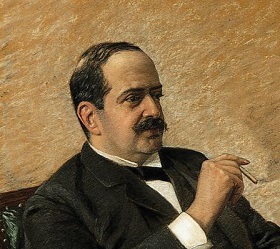
Karl Emil Franzos (25 oktober 1848 - 28 januari 1904)
Portret door P. Levy, 1893


De Franse schrijver Benjamin Henri Constant de Rebecque werd geboren op 25 oktober 1767 in Lausanne. Zie ook alle tags voor Benjamin Constant op dit blog en ook mijn blog van 25 oktober 2010

Uit: Adolphe

« Je ne me souviens pas, pendant mes dix-huit premières années, d’avoir eu jamais un entretien d’une heure avec lui. Ses lettres étaient affectueuses, pleines de conseils, raisonnables et sensibles; mais à peine étions-nous en présence l’un de l’autre qu’il y avait en lui quelque chose de contraint que je ne pouvais m’expliquer, et qui réagissait sur moi d’une manière pénible. Je ne savais pas alors ce que c’était que la timidité, cette souffrance intérieure qui nous poursuit jusque dans l’âge le plus avancé, qui refoule sur notre coeur les impressions les plus profondes, qui glace nos paroles, qui dénature dans notre bouche tout ce que nous essayons de dire, et ne nous permet de nous exprimer que par des mots vagues ou une ironie plus ou moins amère, comme si nous voulions nous venger sur nos sentiments mêmes de la douleur que nous éprouvons à ne pouvoir les faire connaître. Je ne savais pas que, même avec son fils, mon père était timide, et que souvent, après avoir longtemps attendu de moi quelques témoignages d’affection que sa froideur apparente semblait m’interdire, il me quittait les yeux mouillés de larmes et se plaignait a d’autres de ce que je ne l’aimais pas.
Ma contrainte avec lui eut une grande influence sur mon caractère. Aussi timide que lui, mais plus agité, parce que j’étais plus jeune, je m’accoutumai à renfermer en moi-même tout ce que j’éprouvais, à ne former que des plans solitaires, à ne compter que sur moi pour leur exécution, à considérer les avis, l’intérêt, l’assistance et jusqu’à la seule présence des autres comme une gêne et comme un obstacle. Je contractai l’habitude de ne jamais parler de ce qui m’occupait, de ne me soumettre à la conversation que comme à une nécessité importune et de l’animer alors par une plaisanterie perpétuelle qui me la rendait moins fatigante, et qui m’aidait à cacher mes véritables pensées. De là une certaine absence d’abandon qu’aujourd’hui encore mes amis me reprochent, et une difficulté de causer sérieusement que j’ai toujours peine à surmonter. Il en résulta en même temps un désir ardent d’indépendance, une grande impatience des liens dont j’étais environné, une terreur invincible d’en former de nouveaux."


 1830641-850381514c729589a249ada869f78f11.jpg
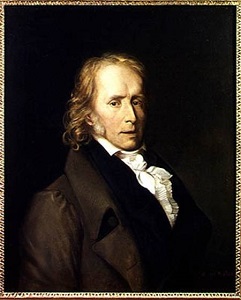
Benjamin Constant (25 oktober 1767 – 8 december 1830)
Portret door Hercule de Roche. 1830


De Engelse dichter Geoffrey Chaucer werd vermoedelijk rond het jaar 1343 geboren in Londen. Zie ook alle tags voor Geoffrey Chaucer op dit blog.

Uit:The Canterbury Tales

The Miller’s Tale (Fragment)

This carpenter hadde wedded newe a wyf,
Which that he lovede moore than his lyf;
Of eighteteene yeer she was of age.
Jalous he was, and heeld hire narwe in cage,
For she was wylde and yong, and he was old,
And demed hymself been lik a cokewold.
He knew nat catoun, for his wit was rude,
That bad man sholde wedde his simylitude.
Men sholde wedden after hire estaat,
For youthe and elde is often at debaat.
But sith that he was fallen in the snare,
He moste endure, as oother folk, his care.
Fair was this yonge wyf, and therwithal
As any wezele hir body gent and smal.
A ceynt she werede, barred al of silk,
A barmclooth eek as whit as morne milk
Upon hir lendes, ful of many a goore.
Whit was hir smok, and broyden al bifoore
And eek bihynde, on hir coler aboute,
Of col-blak silk, withinne and eek withoute.
The tapes of hir white voluper
Were of the same suyte of hir coler;
Hir filet brood of silk, and set ful hye.
And sikerly she hadde a likerous ye;
Ful smale ypulled were hire browes two,
And tho were bent and blake as any sloo.
She was ful moore blisful on to see
Than is the newe pere-jonette tree,
And softer than the wolle is of a wether.
And by hir girdel heeng a purs of lether,
Tasseled with silk, and perled with latoun.


 1830641-7e2727dc59ab980a55dd19d60fbf38f6.jpg
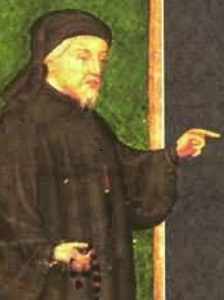
Geoffrey Chaucer (Ca. 1343 - 25 oktober 1400)
Portret door de dichter Hoccleve

Geschreven door Romenu om 13:25 Reageer op dit bericht

Meer van Romenu

↑ Terug naar de berichten