Naar de inhoud

Romenu

Over literatuur, gedichten, kunst en cultuur
seniorennet.beseniorennet.be

Berichten van 26 december 2017

Der Weihnachtsbaum (Hoffmann von Fallersleben)


Aan alle bezoekers en mede-bloggers een Prettig Kerstfeest!


 2105238-1c1d4b7a80d67721c5f9ebf2275d9387.jpg
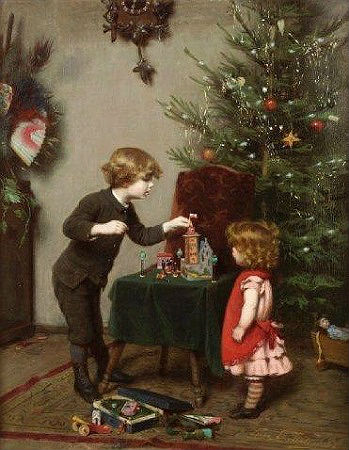
Kerstmis door Felix Ehrlich, 1889


Der Weihnachtsbaum

Ich lag und schlief, da träumte mir
ein wunderschöner Traum;
es stand auf unserm Tisch vor mir
ein hoher Weihnachtsbaum.

Und bunte Lichter ohne Zahl,
die brannten ringsumher,
die Zweige waren allzumal
von goldnen Äpfeln schwer.

Und Zuckerpuppen hingen dran:
Das war mal eine Pracht!
Da gab´s, was ich nur wünschen kann
und was mir Freude macht.

Und als ich nach dem Baume sah
und ganz verwundert stand,
nach einem Apfel griff ich da,
und alles, alles schwand.

Da wacht´ ich auf aus meinem Traum.
Und dunkel war´s um mich:
Du lieber, schöner Weihnachtsbaum,
sag an, wo find´ ich dich?

Da war es just, als rief er mir:
“Du darfst nur artig sein,
dann steh´ ich wiederum vor dir —
jetzt aber schlaf nur ein!

Und wenn du folgst und artig bist,
dann ist erfüllt dein Traum,
dann bringet dir der Heil´ge Christ
den schönsten Weihnachtsbaum.”


 2105238-6b34068df46f9d9c8f470d57cab16afd.jpg
Hoffmann von Fallersleben (2 april 1798 – 19 januari 1874)
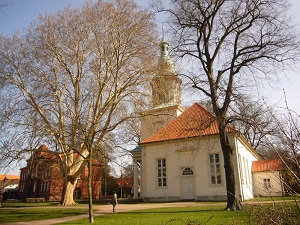
De Michaeliskirche in Fallersleben. De kerk werd in 1805 gebouwd door de vader van de dichter


Zie voor de schrijvers van de 26e december ook mijn drie vorige blogs van vandaag.

Geschreven door Romenu om 09:49 Reageer op dit bericht

David Sedaris, Elizabeth Kostova, Henry Miller, Rainer Malkowski, Mani Beckmann, Alejo Carpentier

De Amerikaanse schrijver David Sedaris werd geboren in Binghamton, New York, op 26 december 1956. Zie ook alle tags voor David Sedaris op dit blog.

Uit: Theft By Finding

„December 28, 1984
Raleigh
Amy, Tiffany, and I sat in the kitchen and talked until three thirty this morning. One of the things we laughed about was an old episode of The Newlywed Game. The host asked the wives, “What’s the most exotic place you’ve ever made love?” He was likely expecting “the kitchen” or “on a tennis court at night,” but one woman didn’t quite understand the question and answered, “In the butt.”
David Sedaris: ‘There are things nobody wants to hear. But the disturbing things are great’

June 19, 1987
Chicago
I ran into Walt on the L this morning. He owes me $450 and said he was just going to call me the other day because Gail, his wife, is always saying, “We need to pay that David Sedaris.”
I actually don’t hold anything against him. I miss Walt and Gail. Walt said that last week she got a profit-sharing check for $10,000. That was why he planned to call — to pay me. He said he took the check to the bank but lost it along the way. It was physically big, he told me. “I folded it in my top pocket, and wouldn’t you know!”
He called the bank to cancel it, then he called New York for a replacement check, but the woman whose job it would be to write it was on vacation. “Wouldn’t you know it!”
At around five, I took the L home. A woman near me had a three-year-old child on her lap, a girl, who looked at me and said, “Mommy, I hate that man.”
Hours later, walking up Leland, I heard someone running up behind me. It was a guy who lives in the halfway house next door. He is black and wore a long-sleeved shirt buttoned all the way to the neck. The man called me sir and asked how I was doing.
“All right,” I said.
He told me that he had a taste for a steak sandwich and asked me if I’d buy him one. You can’t pull money out of your pocket on Leland Avenue. It’s like ringing a bell, so I said no and he ran across the street to ask a woman the same question.
Later still I saw two men sitting in a car in front of the halfway house. They had the door open and were listening to the radio. As I passed, one of them asked me for a cigarette.
“I don’t smoke,” I told them. Then I thought of the guy who wanted a steak sandwich and of the little girl who hated me and thought, What the hell. I handed the guy in the car one of my cigarettes, and he scowled at me and said, “Fucking liar.”


 2105237-eda5a128c1791a1d752c3a6aeb7fbf37.jpg
David Sedaris (Binghamton, 26 december 1956)


De Amerikaanse schrijfster Elizabeth Kostova werd geboren op 26 december 1964 in New London, Connecticut. Zie ook alle tags voor Elizabeth Kostova op dit blog.

Uit:The Shadow Land

“Sofia, the year 2008. The month of May, impeccable spring weather, and the goddess Capitalism sitting on her long-­since-­tawdry throne. On the top step outside Hotel Forest hovered a young woman, more a girl than a woman, and more a foreigner—­which she also was—­than anything else. The hotel looked out over NDK, the former communist regime’s palace of culture, a giant concrete blossom now patrolled by teenagers; sunlight falling across the plaza glinted off their spiky heads. Alexandra Boyd, exhausted from an endless plane ride, stood watching the Bulgarian kids on their skateboards and trying to tuck her long straight hair behind one ear. To her right rose apartment buildings of ochre and gray stucco, as well as more recent glass-­and-­steel construction and a billboard that showed a woman in a bikini whose breasts surged out toward a bottle of vodka. Stately trees bloomed near the billboard, white and magenta—­horse chestnuts, which Alexandra had seen during a trip to France in college, her only other time on the European continent. Her eyes were gritty, her scalp grimed with the sweat of travel. She needed to eat, shower, sleep—­yes, sleep, after the final flight from Amsterdam, that jerking awake every few minutes into self-­exile across an ocean. She glanced down at her feet to make sure they were still there. Except for a pair of bright red sneakers, her clothes were simple—­thin blouse, blue jeans, a sweater tied around her waist—­so that she felt dowdy next to the tailored skirts and stilettos that made their way past her. On her left wrist, she wore a wide black bracelet; in her ears, spears of obsidian. She gripped the handles of a rolling suitcase and a dark satchel containing a guidebook, a dictionary, extra clothes. Over her shoulder she carried a computer bag and her loose multicolored purse with a notebook and a paperback of Emily Dickinson at the very bottom. »


 2105237-58e0ca42cd036e3f506148a4aa814173.jpg
Elizabeth Kostova (New London, 26 december 1964)
Cover


De Amerikaanse schrijver Henry Miller werd geboren op 26 december 1891 In New York. Zie ook alle tags voor Henry Miller op dit blog.

Uit: Tropic of Cancer

“Well, I'll take these pages and move on. Things are happening elsewhere. Things are always happening. It seems wherever I go there is drama. People are like lice - they get under your skin and bury themselves there. You scratch and scratch until the blood comes, but you can't get permanently deloused. Everywhere I go people are making a mess of their lives. Everyone has his private tragedy. It's in the blood now - misfortune, ennui, grief, suicide. The atmosphere is saturated with disaster, frustration, futility. Scratch and scratch, until there's no skin left. However, the effect upon me is exhilarating. Instead of being discouraged or depressed, I enjoy it. I am crying for more and more disasters, for bigger calamities, grander failures. I want the whole world to be out of whack, I want every one to scratch himself to death.”
(...)

“I am a free man―and I need my freedom. I need to be alone. I need to ponder my shame and my despair in seclusion; I need the sunshine and the paving stones of the streets without companions, without conversation, face to face with myself, with only the music of my heart for company. What do you want of me? When I have something to say, I put it in print. When I have something to give, I give it. Your prying curiosity turns my stomach! Your compliments humiliate me! Your tea poisons me! I owe nothing to any one. I would be responsible to God alone―if He existed!”
(…)

“Show me a man who over-elaborates and I will show you a great man! What is called their 'overelaboration' is my meat: it is the sign of struggle, it is struggle itself with all the fibers clinging to it, the very aura and ambiance of the discordant spirit. And when you show me a man who expresses himself perfectly I will not say that he is not great, but I will say that I am unattracted . . . I miss the cloying qualities. When I reflect that the task which the artist implicitly sets himself is to overthrow existing values, to make of the chaos about him an order which is his own, to sow strife and ferment so that by the emotional release those who are dead may be restored to life, then it is that I run with joy to the great and imperfect ones, their confusion nourishes me, their stuttering is like divine music to my ears.”


 2105237-662c94212b575224520bdee223437244.jpg
Henry Miller (26 december 1891 – 7 juni 1980)
Cover 


De Duitse dichter Rainer Malkowski werd geboren op 26 december 1939 in Berlijn-Tempelhof. Zie ook alle tags voor Rainer Malkowski op dit blog.


Unerwarteter Gesang

Die Treue zu Bäumen,
die nicht in den Himmel wachsen.

Alles, was du nicht kannst.

Nachsicht und Unnachgiebigkeit
im richtigen Verhältnis.

Schlecht rechnen
in Menschendingen.


Später Nachruf auf Auden

Sein rissiges Gesicht: Erde
in der Trockenzeit.
Flüssig, manchmal allzusehr,
seine Gedichte.

Muß man sich nicht schämen,
weil es einem nicht
die Sprache verschlägt?

Oft,
in wütender Bewunderung
seiner Meisterschaft,
starrte ich auf das Zeitungsfoto
über meinem Bett.

Streng war ich als junger Mann −
und tadelte, wovon ich nicht
genug bekam.


 2105237-7200e5a35966c2735cff73dc90cdb0d0.jpg
Rainer Malkowski (26 december 1939 – 1 september 2003)
Cover


De Duitse schrijver Mani Beckmann (pseudoniem Tom Finnek) werd geboren op 26 december 1965 in Alstätte/Westfalen. Zie ook alle tags voor Mani Beckmann op dit blog.

Uit: Sodom und Gomera

»Der Hafen«, antwortete sie, »das hascht schon gesagt.« Allmählich glaubte ich zu verstehen, worauf das Mädchen hinauswollte, und sagte: »Ich möchte gern nach Gomera.« »Da wollen wir auch hin. Kannscht gleich mitkommen.« Sie nickte mir zu und winkte einem Taxi. »Zu dritt isch billiger.« Bevor ich mich recht versah oder dagegen wehren konnte, saß ich mit dem Schwabenpärchen in einem klapprigen Toyota und fuhr an der unansehnlichen und durch betonierte Hotelanlagen verschandelten Südküste Teneriffas entlang gen Westen. Das verspätete Hippiemädchen (sie hieß Sandra, nannte sich aber Sunny oder Sandy) redete ohne Unterlass auf mich ein, während ihr blond gelockter und schlaksiger Begleiter (den Sandy als Michael oder besser: Mike beziehungsweise Micki vorstellte) die ganze Zeit über keine Silbe sagte. Er starrte dümmlich vor sich hin und schaukelte mit dem Oberkörper (Hospitalismus, vermutete ich). Während der Taxifahrt erfuhr ich, dass die beiden aus Böbingen an der Rems stammten, im Frühjahr Abitur gemacht hatten und im kommenden Monat ihr Studium in Berlin beginnen wollten: Sandy hatte sich für Germanistik entschieden (»Deutsch als Fremdsprache?«, hätte ich beinahe gefragt, ließ es dann aber), und Micki wollte Psychologie studieren (ausgerechnet!). Allerdings erhielt ich auch einige nützliche Informationen über die Insel Gomera. Ich zeigte Sandy die Postkarte, die Ute mir mitgegeben hatte, und deutete auf den Stempel mit dem Schriftzug »La Calera«. Sandy nahm mir die Karte aus der Hand, las interessiert die Adresse und fragte: »Wer ischen Ute Ikemann?« Ich antwortete, das ginge sie gar nichts an, und tippte erneut auf den Stempel. »Des isch im Valle«, erklärte Sandy desinteressiert und kümmerte sich wieder um die handschriftlichen Zeilen auf der Karte. Sie las den Text und die Unterschrift und fragte: »Und wer isch Julia?« Obwohl sie es mir nicht sehr leicht machte, erfuhr ich von Sandy, dass La Calera ein Ortsteil der Gemeinde Valle Gran Rey war, unweit der Südwestküste der Insel. Das Tal des großen Königs (so lautete wohl die Übersetzung) bestand aus einem guten Dutzend kleinerer Dörfer und Siedlungen und war das Zentrum des Tourismus auf Gomera, vor allem des Alternativtourismus. »Alle sind da so grell abgefahren und voll cool, viele Freaks und Aussteiger und Leute wie wir«, wie Sandy nicht ohne Genugtuung betonte. »Die sind ungeheuer easy drauf, weischt?« Klar gebe es auch normalos und sogar einige wenige Pauschalreisende (dass meine Wenigkeit ebenfalls zu diesen gehörte, verschwieg ich tunlichst), aber insgesamt sei das Valle doch noch »ziemlich freakig und voll krass, gell!«


 2105237-26a942865d36caab0b02646fb90bd8bd.jpg
Mani Beckmann (Alstätte, 26 december 1965)
Kerstsfeer in Alstätte


De Cubaanse schrijver, essayist en musicoloog Alejo Carpentier werd geboren in Havana op 26 december 1904. Zie ook alle tags voor Alejo Carpentier op dit blog.

Uit:The Kingdom of This World (Vertaald door Harriet de Onís)

“Marco Polo allowed that certain birds could fly carrying elephants in their talons; Martin Luther saw the Devil right before his eyes and threw an inkwell at his head. Victor Hugo, so exploited by the sellers of marvelous books, believed in apparitions, because he was sure of having spoken, while in Guernsey, with the ghost of Leopoldina.
All Van Gogh needed was faith in the Sunflower (19) to capture its revelation on a canvas. Thus, the idea of the marvelous invoked in the context of disbelief--which is what the surrealists did for so many years--was never anything but a literary trick, and a boring one at that for having been prolonged, as is the literature that is oneiric by "arrangement," or the praises of folly now back in fashion. But, by the same token, we are not, for all that, going to yield to those who advocate a return to the realism--a term that takes on, in this context, a slavishly political agenda--because they are merely replacing the magician's tricks with the commonplaces of academics or the scatological delights of some existentialists.
There is clearly no excuse for poets and artists who praise sadism without practising it, who admire the supermacho because of their own impotence, who invoke spirits without believing they answer to incantations, and who found secret societies, literary sects, or vaguely philosophic groups with passwords and arcane goals that are never achieved, without being able to conceive a valid mysticism or to abandon their pettiest habits in order to risk their souls on the frightening card of faith.”

 2105237-86e93f9a53cb95fbd97ecd0671fd2a03.jpg
Alejo Carpentier (26 december 1904 - 24 april 1980)
Cover


Zie voor nog meer schrijvers van de 26e december ook mijn vorige twee blogs van vandaag.

Zie voor bovenstaande schrijvers ook mijn blog van 26 december 2008 en eveneens mijn blog van 26 december 2007 en mijn mijn blog van 26 december 2006.

Geschreven door Romenu om 09:47 Reageer op dit bericht

Jean Toomer, Hans Brinkmann, Willy Corsari, Alfred Huggenberger, René Bazin, Julien Benda

De Amerikaanse dichter en schrijver Jean Toomer werd geboren op 26 december 1894 in Washington, D.C. Zie ook alle tags voor Jean Toomer op dit blog.


Georgia Dusk

The sky, lazily disdaining to pursue
The setting sun, too indolent to hold
A lengthened tournament for flashing gold,
Passively darkens for night’s barbecue,

A feast of moon and men and barking hounds,
An orgy for some genius of the South
With blood-hot eyes and cane-lipped scented mouth,
Surprised in making folk-songs from soul sounds.

The sawmill blows its whistle, buzz-saws stop,
And silence breaks the bud of knoll and hill,
Soft settling pollen where plowed lands fulfill
Their early promise of a bumper crop.

Smoke from the pyramidal sawdust pile
Curls up, blue ghosts of trees, tarrying low
Where only chips and stumps are left to show
The solid proof of former domicile.

Meanwhile, the men, with vestiges of pomp,
Race memories of king and caravan,
High-priests, an ostrich, and a juju-man,
Go singing through the footpaths of the swamp.

Their voices rise . . the pine trees are guitars,
Strumming, pine-needles fall like sheets of rain . .
Their voices rise . . the chorus of the cane
Is caroling a vesper to the stars . .

O singers, resinous and soft your songs
Above the sacred whisper of the pines,
Give virgin lips to cornfield concubines,
Bring dreams of Christ to dusky cane-lipped throngs.
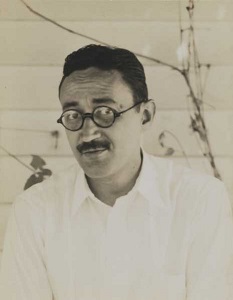
 

 2105236-8d3799c58af79ae790040c8af2add4c0.jpg
Jean Toomer (26 december 1894 – 30 maart 1967)


De Duitse dichter, schrijver en criticus Hans Brinkmann werd geboren op 26 december 1956 in Freiberg in Sachsen. Zie ook alle tags voor Hans Brinkmann op dit blog.

Uit: Gesang auf mein Messer

Ihr habt um Statements gebeten. Was soll ich da sagen? Daß ich ein Provinzdichter bin, daß ich in einer stinkenden umweltverdreckten Stadt wohne, die man nicht lieben kann. Daß ich die weite Welt aus den Medien kenne. Daß meine Zähne, wie man mir gerade versichert, Kalzium brauchen. Daß es gut ist, daß es McDonalds gibt. Und Klaus Höpke. Vielleicht, daß ich eine gemeinsame Sprache suche mit allen, denen das Mitdenken mehr einbringt als die gehörigen Depressionen. Vielleicht, daß ich hoffe, eines Tages auch auf mündige DDR-Bürger zu treffen, nicht nur auf schnauzende Berliner und murrende Sachsen. Ich habe mein Heimatland als Provinz begriffen und Frau Welt als ein Sex-Symbol in Richtung Porno. Nun isses entweder eingeschnappt oder rastet aus. Ach, was soll ich Euch vorquasseln? Daß ich von Erich Fried herkomm. Gelernt hab ich von ihm etliches. Und ich hab auch zwei oder drei Leuten Verse von ihm ausm Kopp vorgesagt. Das ist nämlich wichtig, weil ja ganz wenige, die Lyrik brauchen, das Zeug lesen. Die Mündigkeit ist keine fixe Idee von mir; daß ich mich drauf versteife hat Sinn. Ich glaube, wer mit Sprache umgehn kann, kanns auch mit Vater Staat, und dessen Absterben ist ja unser aller Bedürfnis. Randy Newman kenne ich aus dem Westfernsehen und von Stimme der DDR, von Rolf Dieter Brinkmann ist sogar was in der DDR erschienen, fünf Gedichte oder sechs. Den Rest hab ich mir von Freunden geholt. Ich weiß nicht, ob Ihr mich versteht, aber das ist es, was ich Provinz nenne. Nun schimpft mich nicht borniert. Es ärgert mich eben, daß ich nicht mal einen Band Chlebnikow besitze, ja nicht mal ausgiebig gelesen habe. Dazu regt man sich hierzuort sogar noch über meine langen Haare auf; das ist absurd, aber heute passiert; eine Frau sprach mich diesbezüglich empört auf der Straße an (ca. 8 Jahre nach den Sex Pistols / ca. 20 Jahre nach den Beatles). Ich weiß nicht, aber vielleicht schreibe ich deshalb nur harmloses Zeug. Also, ein Statement war das nicht. Druckt lieber meine Gedichteln. Oder nichts davon. Ich grüße Euch herzlich.


 2105236-a7b44c6a3a51f6caaedf85807b781794.jpg
Hans Brinkmann (Freiberg, 26 december 1956)


De Nederlandse schrijfster Willy Corsari (pseudoniem van Wilhelmina Angela Douwes-Schmidt) werd geboren in Sint-Pieters-Jette, Brussel, op 26 december 1897. Zie ook alle tags voor Willy Corsari op dit blog.

Uit: Het mysterie van de Mondscheinsonate

`Is er iets?' vroeg zijn vrouw en verwachtte een kermisherrietje of dronkenschap-met-verzet. `Er schijnt een dienstmeisje op het bureau te zitten, "helemaal d'r senewe kwijt", zoals Harms dat noemt, een meisje van villa Maerlant... Er is daar geschoten en gegild maar 't zal wel blijken niets te zijn. De mooie mevrouw Maerlant heeft zeker op een muis geschoten.' In de ogen van de inspecteur glinsterde toch een sprankje hoop, toen hij zijn vrouw kuste. `Ik heb haar vanmiddag nog gezien in de bibliotheek,' zei z'n vrouw, `met haar zuster, die dikke lobbes. Ze ruilde boeken... allemaal detective-boeken wou ze hebben, ze leest niets anders, zei de juffrouw later.' Jij zeker wèl!' spotte Lund nog gauw en toen hoorde ze hem al haastig weggaan. `Ik hoop dat het een moord is,' dacht ze on-Christelijk en begon zich te ontkleden. Toen haar man om één uur nog niet terug was, wist ze dat het iets ernstigs was. Goeie hemel, dacht ze, het licht uitdraaiend, wie zouden ze daar vermoord hebben? En in haar gedachten zag ze de mooie villa van de rijke Maerlant, twintig jaren geleden gebouwd, sindsdien gemoderniseerd. Vroeger, met zijn eerste vrouw, woonde hij daar het hele jaar en ging elke dag met zijn auto naar Amsterdam. Sinds hij hertrouwd was, vier jaar geleden, bezat hij ook een woning in Amsterdam en zag men hem en zijn gezin alleen in de zomermaanden hier. Het was de jonge mevrouw Maerlant te stil in het mooie dorp. Vorige zomers wemelde het van gasten op de afgelegen villa, tussen heide en bos, een half uur van de eerste dorpshuizen gelegen. Nu was er nog pas één logé, de jongere broer van Maerlant, die priester was en sinds lange jaren des zomers een paar weken hier doorbracht. Wiè zou het zijn? De vrouw van de inspecteur liet de verschillende bewoners der villa in gedachten de revue passeren. Wel vreselijk zou het wezen, als er inderdaad iets ergs gebeurd was... zo'n gelukkig gezin... “


2105236-614e0379e6e02c922b9263c775646793.jpg
Willy Corsari (26 december 1897 – 11 mei 1998)
Brussel in de kersttijd 


De Zwitserse dichter en schrijver Alfred Huggenberger werd geboren op 26 december 1867 in Bewangen nabij Bertschikon. Zie ook alle tags voor Alfred Huggenberger op dit blog.


Wegspruch

Die Erde sei ein Sorgenhaus,
Wer grämt sich einen Himmel draus?
Du magst dich ärgern und klagen,
Musst doch dein Bündel tragen.

Oft türmt ein Berg sich, riesengross,
Bei Licht ist’s eine Wolke bloss.
Warum, fragst du mit Lachen,
Liess ich mir bange machen?

Und wenn im Dunkel liegt dein Weg –
Das Glück kommt über Stein und Steg!
Lass ihm ein Pförtlein offen!
Wer leben will, muss hoffen.


Mutter

Nun gingst auch du den stillen Gang,
Ein Licht verglomm, ein Ton verklang.
Es war ein Leben, schlicht und recht,
Sein Sinn war gut, sein Kern war echt.

Umfangen noch vom Kindheitstraum,
Nahm Arbeit dich in Pflicht und Zaum.
Die Arbeit blieb dein Teil und Gut,
Du wusstest nie, wie Wohlsein tut.

Den Mädchenstrauss in deiner Hand,
Du pflücktest ihn im Sorgenland.
Die Hochzeitsglocke, bang und klar,
Sang nicht das Lied vom Märchenjahr.

Der plumpe Alltag zwingt die Welt –
Du hast dein Gärtlein doch bestellt!
Du schütztest mit verwerkter Hand
Für uns das Flämmchen, Glück genannt.

Wann gab ein Wort den Dank dir Kund ?
Das Wort quillt schwer aus sprödem Mund.
Doch Liebe ahnt, wo Liebe schweigt,
Du hast getrost dein Haupt geneigt.


 2105236-a5d53b91af3762acfd3907f2846d9eec.jpg
Alfred Huggenberger (26 december 1867 – 14 februari 1960)
Alfred Huggenberger Haus in Bewangen


De Franse schrijver René Bazin werd geboren op 26 december 1853 in Angers. Zie ook alle tags voor René Bazin op dit blog.

Uit: Les Noëllet

"– Réponds donc, mon Noellet, dit la métayère, dont un peu de fierté, comme une flamme,
illumina le visage: puisque M. Hubert te parle, réponds donc!
Le jeune gars, sans lever la tête, leva à demi les yeux, le temps de montrer qu’ils étaient plus
clairs et plus durs que ceux du père, et, d’un ton où perçait la vanité blessée:
– Je fais même du grec, dit-il.
– Voyez-vous cela: même du grec! L’an prochain, tu seras au collège de Beaupréau, je parie?
– Puisque c’est son idée, répondit le père.
– J’en suis ravi, dit M. Laubriet. Lis, travaille, instruis-toi, mon Pierre: intelligent comme tu l’es, tu auras bientôt rattrapé les autres. Et vous tous, bon appétit! Je n’ai pas voulu passer ma
première journée à la Landehue sans dire bonjour à la Genivière. Voilà qui est fait: je me sauve.
Et, tandis que M. Laubriet se retirait, salué par un concert de voix jeunes, disant: «Bonsoir,
monsieur Hubert; adieu, monsieur Hubert; à vous revoir, monsieur Hubert», il se pencha vers
le métayer qui l’accompagnait.
– Toi, mon bonhomme, dit-il, je te félicite: un fils prêtre, un autre laboureur, l’image de notre
Vendée. Il est gentil, ton Pierre.
– Je ne dis pas non; un peu trop fiérot seulement. Ça lui passera, j’espère, puisque le bon Dieu le veut pour lui. Mais Jacques sera plus facile, monsieur Hubert.
– Vraiment!
– Plus chérissant pour la mère. Et vaillant au travail avec ça, comme un poulain: il n’arrête qu’à bout de forces.
– Un vrai métayer, alors?
– Tout à fait.
– Tu es un heureux homme, Julien, ne te plains pas. Le paysan était arrivé au bord du chemin qui longe la grange. Il serra la main de M. Laubriet, et répondit, de son ton tranquille, un peu traînant:
– Je ne me plains pas non plus, allez!
Puis il revint vers la maison, où tout était bruit de voix et de rires d’enfants et de sabots claquant sur la terre battue. Un valet de ferme rentra derrière lui. Les hommes allèrent prendre leurs cuillers attachées au mur par une bride de cuir. Ils s’assirent autour de la soupe fumante."


 2105236-2913feb2efdc5a40bd391a1b4062a568.jpg
René Bazin (26 december 1853 – 19 juli 1932)
Angers in de kersttijd


De Franse schrijver en filosoof Julien Benda werd geboren op 26 december 1867 in Parijs. Zie ook alle tags voor Julien Benda op dit blog.

Uit: The Treason of the Intellectuals (Vertaald door Richard Aldington)

“A true "clerk" (Renan) says excellently: "The mother-country is a worldly thing; the man who wants to play the angel will always be a bad patriot." Thus we see that the "clerk" who claims to secure the works of the world has a choice between two consequences. Either he secures them and transgresses all his principles, which is the case with the Church supporting the nation and property; or he maintains his principles and causes the ruin of the institutions he claimed he was supporting, which is the case with the humanitarian who claims to safeguard what is national. In the first case the "clerk" is despised by the just man, who denounces him as cunning and strikes him out of the rank of "clerk"; and in the second case he collapses under the hooting of the nations who call him inefficient, while he provokes a violent and loudly acclaimed reaction on the part of the realist, which is what is now happening in Italy. From all this it follows that the "clerk" is only strong if he is clearly conscious of his essential qualities and his true function, and shows mankind that he is clearly conscious of them. In other words he declares to them that his kingdom is not of this world, that the grandeur of his teaching lies precisely in this absence of practical value, and that the right morality for the prosperity of the kingdoms which are of this world, is not his, but Caesar's. When he takes up this position, the "clerk" is crucified, but he is respected, and his words haunt the memory of mankind. The need to remind the modern "clerks" of these truths (for every one of them is angry at being called Utopian) is one of the most suggestive observations in connection with our subject. It shows that the desire to be practical has become general, that the claim to be so has now become necessary in order to obtain an audience, and that the very notion of "clerkdom" has become obscured even in those who still tend to exercise that function.”


 2105236-3c1d93fb3e49fab23a1ccd5f9570d2be.jpg
Julien Benda (26 december 1867 – 7 juni 1956)
Cover Franse uitgave 


Zie voor nog meer schrijvers van de 26e december ook mijn vorige blog van vandaag.

Zie voor bovenstaande schrijvers ook mijn blog van 26 december 2008 en eveneens mijn blog van 26 december 2007 en mijn mijn blog van 26 december 2006.


Geschreven door Romenu om 09:46 Reageer op dit bericht

Thomas Gray, Jean Galtier-Boissière, Ernst Moritz Arndt, Johann Gaudenz von Salis-Seewis, E. D. E. N. Southworth, Jean-François de Saint-Lambert

De Engelse dichter en geleerde Thomas Gray werd geboren op 26 december 1716 in Londen. Zie ook alle tags voor Thomas Gray op dit blog.


The Bard

II.1.
"'Weave the warp, and weave the woof,
The winding sheet of Edward's race.
Give ample room, and verge enough
The characters of hell to trace.
Mark the year, and mark the night,
When Severn shall re-echo with affright
The shrieks of death, thro' Berkley's roofs that ring,
Shrieks of an agonising King!
She-Wolf of France, with unrelenting fangs,
That tear'st the bowels of thy mangled mate,
From thee be born, who o'er thy country hangs
The scourge of Heav'n. What terrors round him wait!
Amazement in his van, with Flight combin'd,
And Sorrow's faded form, and Solitude behind.


II.2.
"'Mighty victor, mighty lord,
Low on his funeral couch he lies!
No pitying heart, no eye, afford
A tear to grace his obsequies.
Is the Sable Warrior fled?
Thy son is gone. He rests among the dead.
The swarm, that in thy noon-tide beam were born?
Gone to salute the rising Morn.
Fair laughs the Morn, and soft the Zephyr blows,
While proudly riding o'er the azure realm
In gallant trim the gilded vessel goes;
Youth on the prow, and Pleasure at the helm;
Regardless of the sweeping Whirlwind's sway,
That, hush'd in grim repose, expects his evening prey.


 2105235-c07dfced23d8d723051db38a0637556a.jpg
Thomas Gray (26 december 1716 – 30 juli 1771)
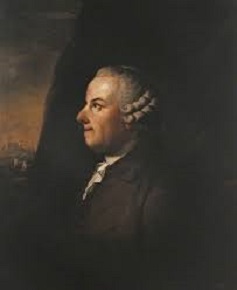
Portret door Benjamin Wilson, ca. 1772


De Franse schrijver, polemist en journalist Jean Galtier-Boissière werd geboren op 26 december 1891 in Parijs. Zie ook alle tags voor Jean Galtier-Boissière op dit blog.

Uit: Mon journal dans la Drôle de paix

« 3 Décembre 1945.
L'assassinat du père Denoël.
Robert Denoël conduisait l'auto de Mme Loviton, ex-Frondaie, en littérature Jean Voilier. Un pneu éclate boulevard des invalides; et tandis que Mme Loviton va demander un taxi au commissariat, Robert Denoël s'affaire à démonter la roue.
On retrouve son corps percé d'une balle. Crime crapuleux, disent les feuilles. Mais on a retrouvé 12000 francs dans son portefeuille et, de toute évidence, l'agresseur n'a pas été dérangé. Alors, règlement de comptes ? Exécution ?
Le premier succès de Denoël avait été Hôtel du Nord de Eugène Dabit ; puis le fameux Voyage au bout de la nuit, le roman-torrent du docteur Destouches, alias Céline, fit la fortune de la maison.
Pendant l'occupation, Denoël publia Les Beaux Draps du même Céline et l'étonnant pamphlet de Lucien Rebattet Les Décombres.
Et aussi Le Cheval Blanc de Mme Elsa Triolet.

Mai 1946.
Je ramène Léautaud place de la Sorbonne où Charlotte nous sert le dîner. Et le voilà lancé comme toujours, dans les plus étonnantes et les plus cruelles anecdotes :
- Vous connaissez C..., eh ! bien un jour, au Mercure, devant cinq ou six personnes, je l'ai entendu raconter ses amours avec la femme du grand écrivain L...qui était sur sa fin, très malade et aveugle. Un jour que dans la chambre même du moribond, il besognait la future veuve, le vieil écrivain, dans son lit, se mit à pousser des gémissements : " De l'eau ! à boire ! à boire !"
Alors la femme excédée lâcha ces mots : "Ah ! ce vieux, ce qu'il peut nous emmerder !"


 2105235-031e3ae2c593f7765d581cefa604d8c5.jpg
Jean Galtier-Boissière (26 december 1891 – 22 januari 1966) 
Cover


De Duitse dichter en schrijver Ernst Moritz Arndt werd op 26 december 1769 in Groß-Schoritz geboren op het eiland Rügen. Zie ook alle tags voor Ernst Moritz Arndt op dit blog.


Friedensgebet

Gib Frieden, Herr, gib Frieden,
Du milder Liebeshort!
Einst bist du abgeschieden
Mit süßem Freudenwort:
Ich geb' euch meinen Frieden,
Wie ihn die Welt nicht gibt,
Verheißen und beschieden
Dem, der mich glaubt und liebt.

Gib Frieden, Herr, gib Frieden!
Die Welt will Streit und Krieg,
Der Stille wird gemieden,
Der Wilde hat den Sieg,
Und Unruh' herrscht auf Erden
Und Lug und Trug und List –
Ach! Laß es stille werden,
Du stiller Jesus Christ!

Gib Frieden, Herr, gib Frieden,
Du milder Liebeshort!
Dann wird es schon hienieden
Ein Paradiesesort,
Und Sorgen fliehn und Schmerzen
Aus jeder schweren Brust,
In Freuden glühn die Herzen,
In Lieb' und Himmelslust.


Lerchengesang

Hast du noch einen Ton, du altes Herz,
So spann' ihn auf, und laß es klingen,
Laß deine Liebe, deinen Schmerz
Ihr volles Leid den Sternen singen.

Was hoch empor schlug, hallet tief zurück,
Es hallt in deinem Busen wieder,
Es weiß kein Lied vom Erdenglück,
Von Engelwonnen singt es Lieder.

Empor, du Lerche, zur gestirnten Höh'!
Was flatterst du im Erdgewimmel?
Dort klingt ein Echo für dein Weh:
Du bist vom Himmel, suche Himmel.


 2105235-02ed9d525bfc8eda9aeada2247c5dcf6.jpg
Ernst Moritz Arndt (26 december 1769 – 29 januari 1860)
Monument bij de universiteit van Greifswald


De Zwitserse dichter en schrijver Freiherr Johann Gaudenz von Salis-Seewis werd geboren op 26 december 1762 op slot Bothmar bei Malans. Zie ook alle tags voor Johann Gaudenz von Salis-Seewis op dit blog.


Auf! es dunkelt...

Auf! es dunkelt; silbern funkelt
Dort der Mond ob Tannenhöh´n!
Auf! und tanzt in froher Runde; diese Stunde
Dämmert unbewält und schön!

Im Gewässer strahlen blässer
Felsen, deren Rot verblich;
Und mit dunklem Violette malt die Kette
Schroffer Schneegebirge sich.

Hüpft geschwinde um die Linde,
Die uns gelbe Blüten streut.
Laßt uns frohe Lieder singen, Ketten schlingen,
Wo man traut die Hand sich beut.

Also schweben wir durch´s Leben
Leicht wie Rosenblätter hin.
An den Jüngling, dunkelt´s bänger, schließt sich enger
Seine traute Nachbarin.


Tändelei

Ich ward zum Turteltäubchen
Im allerschönsten Traum;
Und saß bei meinem Weibchen,
Auf einem grünen Baum:
Zwar Liebchen that sehr spröde
Und schien vor mir zu fliehn;
Doch ich war nicht so blöde,
Als ich sonst, wachend, bin.

Ich gurrte meine Klagen
Und trippelt' um sie her;
Sie nickt' und schien zu sagen:
Begehre nur noch mehr!
Wir flogen girrend beide
Aufs nächste Halmendach:
Sie duckte sich: - O Freude!
Und ich - schnell ward ich wach.


Trag ein Herz...

Trag ein Herz, den Freuden offen,
Doch zum Lebenskampf bereit:
Lern im Mißgeschicke hoffen;
Denk´des Sturm´s bei heit´rer Zeit.


 2105235-589e4360222214b38236dca45727bf19.jpg
Johann Gaudenz von Salis-Seewis (26 december 1762 – 29 januari 1834)


De Amerikaanse schrijfster Emma Dorothy Eliza Nevitte Southworth werd geboren op 26 december 1819 in Washington, D.C. Zie ook alle tags voor E. D. E. N. Southworth op dit blog.

Uit: Ishmael or In The Depths

“That sister might well have answered in the affirmative had she considered personal beauty a merit of high order; for few palaces in this world could boast a princess so superbly beautiful as this peasant girl that this poor hut contained.  Beneath those rich sable tresses was a high broad forehead as white as snow; slender black eyebrows so well defined and so perfectly arched that they gave a singularly open and elevated character to the whole countenance; large dark gray eyes, full of light, softened by long, sweeping black lashes; a small, straight nose; oval, blooming cheeks; plump, ruddy lips that, slightly parted, revealed glimpses of the little pearly teeth within; a well-turned chin; a face with this peculiarity, that when she was pleased it was her eyes that smiled and not her lips; a face, in short, full of intelligence and feeling that might become thought and passion.  Her form was noble—­being tall, finely proportioned, and richly developed.
Her beauty owed nothing to her toilet—­her only decoration was the coronet of her own rich black hair; her only hair pin was a thorn; her dress indeed was a masterpiece of domestic manufacture,—­the cotton from which it was made having been carded, spun, woven, and dyed by Miss Hannah’s own busy hands; but as it was only a coarse blue fabric, after all, it would not be considered highly ornamental; it was new and clean, however, and Nora was well pleased with it, as with playful impatience she repeated her question:
“Say! aint you proud of me now?”
“No,” replied the elder sister, with assumed gravity; “I am proud of your dress because it is my own handiwork, and it does me credit; but as for you—­”
“I am Nature’s handiwork, and I do her credit!” interrupted Nora, with gay self-assertion.
“I am quite ashamed of you, you are so vain!” continued Hannah, completing her sentence.
“Oh, vain, am I? Very well, then, another time I will keep my vanity to myself. It is quite as easy to conceal as to confess, you know; though it may not be quite as good for the soul,” exclaimed Nora, with merry perversity, as she danced off in search of her bonnet."


 2105235-a7e876f8d20f5d8756ae827ec4cffb7b.jpg
E. D. E. N. Southworth (26 december 1819 – 30 juni 1899)
Cover


De Franse dichter, schrijver en filosoof Jean-François de Saint-Lambert werd geboren op 26 december 1716 in Nancy. Zie ook alle tags voor Jean-François de Saint-Lambert op dit blog.


L’Hiver (Fragment)

L’hiver, l’ombre & la mort étendent leur empire,
Leur joug s’apésantit sur tout ce qui respire ;
Des nuages glacés suspendus dans les airs,
D’un voile épais & noir couvrent les champs déserts,
Et la voûte des cieux qui semble être abaissée,
Dépose avec lenteur la vapeur condensée.
Le fermier qui parcourt les guérets confondus,
Au milieu de ses champs ne les reconnoît plus.
Une vaste blancheur, sur le monde étendue,
Est la seule couleur qu’il présente à la vue ;
Ce voile universel dérobe à tous les yeux
Les ouvrages de l’homme, & les bienfaits des dieux ;
Et c’est à ce moment que la terre engourdie
De l’élément du feu ne reçoit plus la vie.

Les végétaux mourants sous la neige enfermés,
N’offrent plus la pâture aux êtres animés.
J’ai vu de la forêt l’hôte le plus sauvage
Courir de son asyle au centre du village.
Innocents animaux, avez-vous oublié
Et les pièges mortels, & l’homme sans pitié ?
Hélas ! L’homme ou la faim vont leur ôter la vie.
L’ours, au sein des frimats de la libre Helvétie,

S’instruit à triompher des horreurs des saisons :
Il marche d’un pas lent, hérissé de glaçons,
Où dans un antre obscur, fiérement impassible,
Il oppose au besoin son courage infléxible.


 2105235-19c2938b1342d8e44de8ff43bd9aec2a.jpg
Jean-François de Saint-Lambert (26 december 1716 – 9 februari 1803)
Kersttijd in Nancy


Zie voor bovenstaande schrijvers ook mijn blog van 26 december 2008 en eveneens mijn blog van 26 december 2007 en mijn mijn blog van 26 december 2006.

Geschreven door Romenu om 09:45 Reageer op dit bericht

Nigel Cliff

De Britse schrijver, historicus, biograaf, criticus en vertaler Nigel Cliff werd geboren op 26 december 1969 in Manchester. Cliff studeerde met een beurs aan het Winchester College en Harris Manchester College, Oxford University, waar hij een eersteklas diploma behaalde en de Beddington Prize for English Literature. ontving. Hij was film- en theatercriticus voor The Times en medewerker aan The Economist. Hij schrijft voor een reeks publicaties waaronder The New York Times. Cliff geeft veel lezingen, onder andere aan de universiteit van Oxford, het Harry Ransom Center en de British Library.
Cliff's eerste boek, “The Shakespeare Riots: Revenge, Drama, and Death in Nineteenth-century America” werd in 2007 in de Verenigde Staten uitgegeven. Het boek was Washington Post boek van het jaar en was een finalist voor de Nationale Award for Arts Writing. Het tweede boek van Cliff was “Holy War: How Vasco da Gama's Epic Voyages Turned the Tide in a Centuries-old Clash of Civilisations” uit 2011. Het werd vervolgens uitgegeven als “The Last Crusade: The Epic Voyages of Vasco da Gama” in 2012. Cliff's derde boek was een nieuwe vertaling en kritische editie van “Marco Polo’s Travels” voor Penguin Classics, die in 2015 werd uitgebracht in het Verenigd Koninkrijk en de VS. Voor deze eerste geheel nieuwe vertaling sinds een halve eeuw, ging hij terug naar de originele teksten in Frans, Latijn en Italiaans. Cliff's vierde boek, “Moscow Nights: The Van Cliburn Story - How One Man and His Piano Transformed the Cold War” werd in september 2016 uitgegeven. De Boston Globe noemde het het boek van het jaar. In januari 2017 werd als finalist genoemd voor de National Book Critics Circle Award. Het won de Nautilus Gold And Silver Awards.

Uit: Moscow Nights

““ON MAY 28, 1958, ticker tape snowed from the sky above Broadway, darkening an already gray New York City day and flurrying around rapturous, flag-waving crowds. High school bands marched, Fire Department colors trooped, and at the center of it all was a young American perched on the back of an open-top Continental, grinning in disbelief and crossing his hands over his heart. He was as tall, thin, and blond as Charles Lindbergh, but he was not a record-setting aviator. Nor was he an Olympic athlete or a world statesman or a victor in war. The cause of the commotion was a twenty-three-year-old classical pianist from a small town in Texas who had recently taken part in a music competition.
"What's goin' on here?" a stalled taxi driver yelled to a cop. "A
parade? Fer the piano player?"
The cabbie had a point. No musician had ever been honored like this. No American pianist had been front-page news, let alone a household name. But the confetti was whirling, the batons were twirling,
and on a damp morning a hundred thousand New Yorkers were cheering and climbing on cars and screaming and dashing up for a kiss. In the summer of 1958, Van Cliburn was not only the most famous musician in America. He was just about the most famous person in America—and barring the president, quite possibly the most famous American in the world.
Things got stranger. At a time when the United States and the Soviet Union were bitter enemies in a perilous Cold War, the Russians had gone mad for him before Americans had. Two months earlier he had arrived in Moscow, a gangly, wide-eyed kid on his first overseas trip, to try his luck in the First International Tchaikovsky Competition. Such was the desperate state of world affairs that even musical talent counted as ammunition in the battle of beliefs, and everyone understood that the
Soviets had cranked open the gates only to prove that their virtuosos were the best. Yet for once in the tightly plotted Cold War, the authors had to tear up the script, for the real story of the Tchaikovsky
Competition was beyond the imagination of the most ingenious propagandist. The moment the young American with the shock of flaxen curls sat before the piano, a powerful new weapon exploded across the Soviet Union. That weapon was love: one man's love for music, which ignited an impassioned love affair between him and an entire nation. It came at a critical time. Five months earlier the Soviet Union had sensationally beaten the United States into space."


 2112327-089392e463e17b70061fafb133897150.jpg
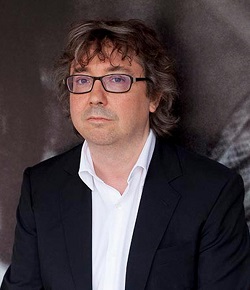
Nigel Cliff (Manchester, 26 december 1969)

Geschreven door Romenu om 00:00 Reageer op dit bericht

Meer van Romenu

↑ Terug naar de berichten