Naar de inhoud

Romenu

Over literatuur, gedichten, kunst en cultuur
seniorennet.beseniorennet.be

Irvine Welsh, Kay Ryan, Josef Škvorecký, Esther Verhoef, Christian Schloyer
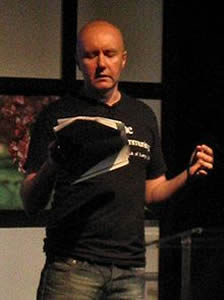
De Schotse schrijver Irvine Welsh werd geboren op 27 september 1958 in Leith, Edinburgh. Zie ook mijn blog van 27 september 2010 en eveneens alle tags voor Irvine Welsh op dit blog.


Uit: Glue


“Davie briskly shook his head. - Naw, take it while ye can get it. This is Scotland, mind, it's no gaunny last. Taking in a deep breath, Davie picked up the table, recommencing his arduous struggle towards the kitchen. It was a tricky, bugger: a smart new Formica-topped job which seemed to constantly shift its weight and spill all over the place. Like wrestling wi a fuckin crocodile, he thought, and sure enough, the beast snapped at his fingers forcing him to withdraw them quickly and suck on them as the table clattered to the floor.

- Sh ... sugar, Davie cursed. He never swore in front of women. Certain talk was awright for the pub, but no in front of a woman. He tiptoed over to the cot in the corner. The baby still slept soundly.

- Ah telt ye ah'd gie ye a hand wi that Davie, yir gaunny huv nae fingers and a broken table the wey things are gaun, Susan warned him. She shook her head slowly, looking over to the crib. - Surprised ye dinnae wake her.

Picking up her discomfort, Davie said, - Ye dinnae really like that table, dae ye?

Susan Galloway shook her head again. She looked past the new kitchen table, and saw the new three-piece suite, the new coffee table and new carpets which had mysteriously arrived the previous day when she'd been out at her work in the whisky bonds.

- What is it? Davie asked, waving his sore hand in the air. He felt her stare, open and baleful. Those big eyes of hers.

- Where did ye get this stuff, Davie?

He hated when she asked him things like that. It spoiled everything, drove a wedge between them. It was for all of them he did what he did; Susan, the baby, the wee fellay. - Ask no questions, ah'll tell ye no lies, he smiled, but he couldn't look at her, as unsatisfied himself with this retort as he knew she would be. Instead, he bent down and kissed his baby daughter on the cheek.

Looking up, he wondered aloud, - Where's Andrew? He glanced at Susan briefly.

Susan turned away sourly. He was hiding again, hiding behind the bairns.”


1244719-dae034ab288797a1dabea76a48cea241.jpg
Irvine Welsh (Edinburg, 27 september 1958)


De Amerikaanse dichteres Kay Ryan werd geboren op 27september 1945 in San Jose, California. Zie ook mijn blog van 27 september 2010 en eveneens alle tags voor Kay Ryan op dit blog.


A CAT/A FUTURE


A cat can draw
the blinds
behind her eyes
whenever she
decides. Nothing
alters in the stare
itself but she's
not there. Likewise
a future can occlude:
still sitting there,
doing nothing rude.


BLANDEUR

If it please God,
let less happen.
Even out Earth's
rondure, flatten
Eiger, blanden
the Grand Canyon.
Make valleys
slightly higher,
widen fissures
to arable land,
remand your
terrible glaciers
and silence
their calving,
halving or doubling
all geographical features
toward the mean.
Unlean against our hearts.
Withdraw your grandeur
from these parts.


 1244719-c7aec27fcc2456d02defdfb4157a9f38.jpg

Kay Ryan (San Jose, 27 september 1945)


De Nederlandse dichter, schrijver, kunstenaar en huisarts Ignace Schretlen werd geboren in Tilburg op 27 september 1952. Zie eveneens alle tags voor Ignace Schretlen op dit blog.


HEYENDAAL

De strakgetrokken welpjestrui
- te vaak gewassen, te snel gegroeid ­
om het hijgend hart, in spurt
‘t pad grootvaders berg op
naar die eeuwenoude eik, die met
zijn brede rug beschutting bood

na jaren haas, hert en wolf
te zijn geweest, keer ik terug
naar dit versteende woud,
dat troost aan zieken biedt;
nu schuilt die oude eik in mij
en knelt er iets van binnenuit.


Een onvermoede bocht


Slaap, mijn kind, word water
ik blijf hier bij je waken, kijk
naar de deining van het laken

rek je uit, breek open, word vloed
verslind wat je kunt verzwelgen
en laat geen haven ongemoeid

morgen vind ik jou weer terug
in je eigen bedding aangespoeld
als mijn allerliefste drenkeling

zo begon het ooit, zo begint het
steeds opnieuw tot ergens onderweg
een onvermoede weg, waarna zee.


 1244719-b19a440ec8ddcceef20f3670bfdd3ea4.jpg

Ignace Schretlen (Tilburg, 27 september 1952)


De Tsjechische schrijver en uitgever Josef Škvorecký werd geboren op 27 september 1924 in Náchod. Zie ook mijn blog van 27 september 2010 en eveneens alle tags voor Josef Škvorecký op dit blog.


Uit: The Bass Saxophone (Vertaald door Kaca Polackova-Henley).


“The wallpaper was old and stained, but faded pictures of doves still showed against the beige background. I put my ear to their delicate breasts. The voice came close; it was repeating a nasty, unintelligible litany of anger and irritation, of imperious, spit-polished, boot-shod hysterics. I recognized it. I couldn't understand what he was saying, but I knew who it was talking behind the gentle doves in the next, equally beige hotel room: it was Horst Hermann Kühl: it was the same voice that screeching along ahead of him had penetrated all the way up the iron staircase to the roof of the Sokol Hall, where you had to climb down another iron staircase to reach the projection booth of the movie house (I wasn't there at the time, but Mack, who operated the projector, told me about it). A pair of black boots had appeared on the iron rungs, the voice lashing in ahead of them. "What is this supposed to mean?" he had rasped like a poisonous firecracker. "This is a provocation!" Such was the terrific power of that dark voice (not the voice of Horst Hermann Kühl, but the black singer's - they even said it was Ella Fitzgerald, I didn't know, they were old records, Brunswick, before the era of stars, and the label said nothing but "Chick Webb and his Orchestra with Vocal Chorus"; there was a short sobbing saxophone solo - they said that was Coleman Hawkins - and they said the other was Ella Fitzgerald, that voice) it had forced Horst Hermann Kühl, omnipotent within the wartime world of Kostelec, to leave the seat in which he was enjoying the intermission between the newsreel and the film starring Christine Söderbaum or maybe it was Heidemarie Hathayer; when he heard black Ella ("I've got a guy. He don't dress me in sable, He looks nothing like Gable, But he's mine") he flew out of his comfortable seat and squealing like a rutting male mouse (it all took on the dimensions of the microworld of Kostelec) he tore down the aisle between the seats to the lobby and up the steps and up the iron staircase to the roof and down the iron ladder (more ladder than staircase) to the projection booth and, still squealing, confiscated the record and took it away with him. Mack told on me; yes, he did; what was he supposed to do? He could have said he didn't know where the Chick Webb record came from, he could have played stupid, that tried and tested Czech prescription; sometimes they fell for it; they almost loved stupid Schweiks - in contrast, they themselves glowed with vociferous wisdom. But it didn't occur to Mack, so he told on me”.


 1244719-d97eb9bc8ba77b01ca46de03d15293ba.jpg

Josef Škvorecký (Náchod, 27 september 1924)


De Nederlandse schrijfster Esther Verhoef-Verhallen werd geboren in ’s-Hertogenbosch op 27 september 1968. Zie ook mijn blog van 27 september 2010 en eveneens alle tags voor Esther Verhoef op dit blog.


Uit: Hingabe (Vertaald door Stefanie Schäfer)


“Dass wir uns so gut kannten, machte die Sache einfacher. Dadurch arbeitete sie ohne ihr Wissen mit, und es wurde intim, beinahe liebevoll.

Drei Monate lang hatte ich mich darauf vorbereitet. Zuerst habe ich den Plan von allen Seiten beleuchtet. Versucht, ihn vor meinem inneren Auge zu visualisieren. Als ich mir sicher war, dass es möglich sein musste, war es kein Hirngespinst mehr, sondern wurde zu einem Teil meiner selbst. Es war herrlich, sich damit zu beschäftigen. Schon allein die Vorbereitungen, die aus Gesprächen mit ihr sowie mit Freunden und Bekannten bestanden, bis hin zur Anschaffung des nötigen Zubehörs.

Zugegeben, viel brauchte ich nicht. Sie selbst brachte mich auf die Idee.

Edith konnte schlaflose Nächte nicht gut ertragen, weil ihre Augen am nächsten Morgen rot und geschwollen waren. Und obwohl sie viel mehr zu bieten hatte als nur ihre Schönheit, war es für sie das Aller wichtigste, gut auszusehen. Ich fand sie einfach immer schön, ob sie nun in voller Pracht auf einem Empfang erschien und allen anderen die Schau stahl oder ob sie gerade aus dem Bett kam und, unter Ent schuldigungen für ihr ungepflegtes Aussehen, im Bademantel Tee für mich aufbrühte. Ein Schlafmittel war für sie die einzige Möglichkeit, nicht jede Nacht durch irgendeinen Lärm geweckt zu werden.

Ich freute mich darauf, fühlte mich wie ein Kind, das in der Schlange vor der Achterbahn wartet. Immer wieder ein Schrittchen nach vorn, immer näher heran. Die Aufregung wuchs und wuchs und erreichte ihren Höhepunkt an jenem Abend, als sich alles wie ein perfekt passendes Puzzle ineinan derfügte.”


 1244719-184241da11610889de72b027a8de95a1.jpg

Esther Verhoef ('s-Hertogenbosch, 27 september 1968)


De Duitsedichter en schrijver Christian Schloyer werd geboren op 27 september 1976 in Erlangen. Zie ook mijn blog van 27 september 2010 en eveneens alle tags voor Christian Schloyer op dit blog.


im stadtplan notiert


wie etwas
  zu etwas anderem wird · die

absperrung markiert eine indifferenz
  am ufer · das knistern
vom umspannwerk

    schilf · -flimmern & eine herde

die man am ufer grasen lässt, last
wagen & wohn

burgen
häusliche herde plötzlich
  scharf gestellt am horizont · gärten

auf dächer gepflanzt & über die pflanzen dächer
  gestellt · wie nach plan


 1244719-cc990c2c79ead0c5ca239cfefdebd6ad.jpg

Christian Schloyer (Erlangen, 27 september 1976)


Zie voor nog meer schrijvers van de 27e september ook
mijn blog van 27 september 2011 deel 2 en eveneens deel 3.

Geschreven door Romenu om 19:34 Reageer op dit bericht
Reageer op dit bericht

Reageer op dit bericht

Een titel of je eigen website toevoegen

De blogger leest alles eerst na: je tekst verschijnt zodra die goedgekeurd is.

Thomas van Aalten, Christoph W. Bauer, T. S. Eliot

De Nederlandse schrijver Thomas van Aalten werd geboren in Huissen bij Arnhem op 26 september 1978. Zie ook mijn blog van 26 september 2010 en eveneens alle tags voor Thomas van Aalten op dit blog.


Uit: De schuldigen


“De motor van de bestelbus maakt een ratelend geluid. Je hoort hem al van ver komen. Als de bus aan het begin van de straat is, blijft hij stilstaan. De bestuurder draait zijn raampje open en kijkt verwilderd om zich heen. Hij claxonneert eenmaal en rijdt stapvoets verder. Mijn vader steekt zijn hand op, om aan te geven dat de man hier moet zijn. aquarama, onderhoud en reiniging van zwembad en spa staat er in blauwe letters op de zijkant van de bus.
De bestuurder heeft een rode, schilferige huid. Roosvlokken bedekken de schouders van zijn overall. Hij kreunt getergd als hij zijn apparatuur uit de bestelbus laadt. Het enige aan zijn lichaam dat niet lijkt getroffen door een ziekte of infectie is een zwart snorretje, dat als een strakke streep het centrum van zijn gezicht markeert. Ondanks de geïrriteerde huid en gewrichtspijn tijdens het tillen, heeft de man een vrolijk voorkomen. Hij stelt zich voor als Cornald. Mijn vader zegt dat Cornald zijn bus gewoon op de oprit kan zetten. ‘Daar is-ie voor gemaakt, niet waar.’

We nemen plaats op het terras. Cornald bladert door zijn multomap, die beplakt is met stickers. Behalve een sticker met het logo van Aquarama zie ik ook stickers met teksten als ‘Effe wachten... Pizza!’ en ‘I Love Natte Keek’ en afbeeldingen van cartooneske vrouwen in bikini.
‘Mijn collega was hier drie jaar geleden voor het laatst. In mei 2007, lees ik hier.’
Mijn vader knikt. ‘Toen heetten jullie nog anders.’
‘Dat klopt. Ik werkte er toen nog niet.’ Cornald concentreert zich op het handschrift van deze collega uit het verleden. ‘Ik zie dat hij hier twee keer per jaar kwam.’
‘Aan het einde en aan het begin van de zomer, ja.’
Ik kijk naar mijn vader en vraag me af of hij nog ooit in zijn leven gaat zwemmen.
‘Ik zal het zo eens even uitzoeken, maar het is gebruikelijk dat bij drie jaar slecht onderhoud de inlaatstraalbuizen en skimmers vervangen moeten worden.”


 1244109-a9af37e17f3c46e9cbd64a5bbbd01b9f.jpg

Thomas van Aalten (Huissen, 26 september 1978)


De Oostenrijkse dichter, schrijver en vertaler Christoph W. Bauer werd geboren in Kolbnitz op 26 september 1968. Zie ook mijn blog van 8 juni 2009 en ook mijn blog van 26 september 2010 en eveneens alle tags voor Christoph W. Bauer op dit blog.


krach ist ein anfang glück ein simpler akkord
im rücken der augen rollen bässe wuchten
uns ineinander jahrelang bin ich gelaufen für
dieses konzert du kamst aus der gleichen
richtung und den rest könnt ich mir denken


sagst du so leis dass ichs kaum versteh und
vielleicht nur annehmen will weil deine
hände den meinen die reisen ablesen als
wären es ihre eignen und der himmel rockt
und lärmt und bleibt in allem ein punk der


sich seinen irokesen in regenbogenfarben
lackiert metaphorisch gesehen tanzen wir auf
dünnem seil hören die wellenreiter lästern
keinen cent wert ist uns ihr geblöke vivamus
atque amemus campino krakeelt was zählt


Supersonic

XLVII


abgehängt was sie rahmte wurden ränder zur
meute und verbissen sich in ihren augen als
wollten sie beweisen dass die form den
inhalt schafft kehrten bilder wieder standen
sie vor mauern durchbellt von aporien und
erhöhten die schrittzahl im tanz mit fee
morgane lösten grenzen sich auf wie
tabletten im glas zerging die ahnung sich
akzeptieren zu wollen in so manchem
gehts schlechter gerede der bodensatz indes
blieb passepartout in ihrem schauen und aus
welchen wänden auch immer hechelte Fix
einem helden ihrer kindheit auf der spur


 1244109-4029661e549d14239ed3c5b96a101f56.jpg

Christoph W. Bauer (Kolbnitz, 26 september 1968)


De Engels-Amerikaanse dichter en schrijver T. S. Eliot werd op 26 september 1888 geboren in St.Louis, Missouri. Zie ook mijn blog van 26 september 2010 en eveneens alle tags voor T. S. Eliot op dit blog.


THE HIPPOPOTAMUS


THE broad-backed hippopotamus

Rests on his belly in the mud;

Although he seems so firm to us

He is merely flesh and blood.


Flesh-and-blood is weak and frail,

Susceptible to nervous shock;

While the True Church can never fail

For it is based upon a rock.


The hippo's feeble steps may err

In compassing material ends,

While the True Church need never stir

To gather in its dividends.


The 'potamus can never reach

The mango on the mango-tree;

But fruits of pomegranate and peach

Refresh the Church from over sea.


At mating time the hippo's voice

Betrays inflexions hoarse and odd,

But every week we hear rejoice

The Church, at being one with God.


The hippopotamus's day

Is passed in sleep; at night he hunts;

God works in a mysterious way--

The Church can sleep and feed at once.


I saw the 'potamus take wing

Ascending from the damp savannas,

And quiring angels round him sing

The praise of God, in loud hosannas.


Blood of the Lamb shall wash him clean

And him shall heavenly arms enfold,

Among the saints he shall be seen

Performing on a harp of gold.


He shall be washed as white as snow,

By all the martyr'd virgins kist,

While the True Church remains below

Wrapt in the old miasmal mist.


HYSTERIA


AS she laughed I was aware of becoming involved

in her laughter and being part of it, until her

teeth were only accidental stars with a talent

for squad-drill. I was drawn in by short gasps,

inhaled at each momentary recovery, lost finally

in the dark caverns of her throat, bruised by

the ripple of unseen muscles. An elderly waiter

with trembling hands was hurriedly spreading

a pink and white checked cloth over the rusty

green iron table, saying: "If the lady and

gentleman wish to take their tea in the garden,

if the lady and gentleman wish to take their

tea in the garden ..." I decided that if the

shaking of her breasts could be stopped, some of

the fragments of the afternoon might be collected,

and I concentrated my attention with careful

subtlety to this end.


 1244109-84cf33ee10f48dddce3a605f70e7189f.jpg

T. S. Eliot (26 september 1888 – 4 januari 1965)


Zie voor nog meer schrijvers van de 26e september ook mijn vorige blog van vandaag.

Geschreven door Romenu om 19:46 Reageer op dit bericht

Bart Chabot, Luís Fernando Veríssimo

De Nederlandse dichter en schrijver Bart Chabot werd geboren in Den Haag op 26 september 1954. Zie ook mijn blog van 26 september 2010 en eveneens alle tags voor Bart Chabot op dit blog.


Uit: Broodje gezond


„‘Dinsdag, 14 januari 1992
We zitten in een café. Eentje van 'alle tijden'. Bruin, kleedjes op tafel, nieuwerwetse lampenkappen en een dor biljart. Zo hebben we in honderden cafés gezeten. We zijn niet de enigen, maar het is er ook niet druk. Amsterdammers. De bekkies staan niet stil. Het is vroeg in de ochtend. We hebben de nacht overgeslagen.
'Wat ik me altijd heb afgevraagd, Herman,' zeg ik. 'Je vader en je moeder, je zussen, je broer?'
'Voor mijn geboorte,' antwoordt hij, 'bestond er niets.'

Met hoge snelheid rijdt de taxi, als besmet door Broods gejaagdheid, via de trambaan de Overtoom af.
'Ik heb een verrassing voor je,' zegt Herman. Hij gebaart de chauffeur te stoppen op de hoek van een zijstraat. Brood springt uit de wagen en belt aan bij een deur waar met glimmende letters HUIZE RIA op staat.
Ik wil uitstappen, maar de taxichauffeur draait zich om en zegt met Amsterdamse tongval: 'Ik heb Herman al heel wat keren in de wagen gehad. Ik vind 't wel een aardige gozer, hoor. Ik mag 'm ergens wel. Maar toch, ik weet het niet. Laatst had ik 'm ook in mijn wagen, zat-ie achterin, ik kijk in mijn spiegel, had-ie een colbertjasje aan en een stropdas, met verder niks d'ronder. Moest ik hem ook naar een seksclub brengen. Hij lulde wel met me en hij gaf me ook een slokkie uit de fles die hij bij zich had, daar niet van, maar? Weet je wat 't is? Je ken geen hoogte van hem krijgen.'

Als ik me bij Brood voeg, valt mijn oog op een klein goudkleurig bordje naast de deur met de tekst: Huize Ria. Discrete Ingang Om De Hoek.
'Het mooie van het leven, vind ik,' zegt Herman,'dat je, terwijl je midden in je zoektocht maar Jezus zit, toch nog goed terecht kunt komen.'
Daarop wijkt de deur.
Ria zelve doet ons open. Iggy, Broods hond, die vanmiddag meemag van zijn baas, is het eerste binnen. Terwijl madam Ria ons voorgaat de smalle gang in en ons uit onze jassen helpt, drukt Iggy met zijn snuit de tussendeur open en meldt zich bij de meisjes. Iggy is geen onbekende hier, Iggy weet de weg.
Ik tel acht meisjes, die op en om een halvemaanvormige bank zitten of hangen. We zijn de enige klanten.”


 1244104-32075452cea7bff51564a66839dd928e.jpg

Bart Chabot (Den Haag, 26 september 1954)

DVD Cover van Herman Brood, Bart Chabot en Jules Deelder


De Braziliaanse schrijver Luís Fernando Veríssimo werd geboren op 26 september 1936 in Porto Alegre, Rio Grande do Sul. Zie ook mijn blog van 26 september 2010 en eveneens alle tags voor Luís Fernando Veríssimo op dit blog.


Uit: The Club of Angels: (Vertaald door Margaret Jull Costa)


“After the funeral, we went back to my apartment, where we gathered in the study. The full complement of the surviving Beef Stew Club membership: all five of us. At the funeral, Lívia kept saying: "This is madness, Zi, madness. You must stop holding these suppers." The matter to be discussed was, should we stop holding the suppers or not? The next host would be Pedro. In alphabetical order—Since Saulo had chosen to die out of order—Paulo should be the next to die.

"So, do we cancel the supper?" I asked.

"No," said Paulo without a moment's hesitation.

"I think we should take a vote," said Samuel.

"I'm the main interested party," said Paulo. "The supper will go ahead."

Pedro suggested that he, rather than Lucídio, should choose the menu. Paulo disagreed. Lucídio would decide what to make. I suggested that we supervise the making of the meal, especially the last fateful portion. Paulo vetoed that too. Lucídio must have full freedom in which to do his work.

"Be honest," said Paulo, "the deaths aside, have you ever eaten so well in your entire life as at Lucídio's suppers?"

"No, but…"

"And there's another thing. If we start interfering in his work, he'll disappear. He'll go away. He'll leave us."

"We're the ones who are disappearing," said Tiago. "One by one. One a month. The Beef Stew Club will come to an end not for lack of a cook, but for lack of members. We're all dying!"

And then Paulo leaned back on the sofa—beneath one of Marcos' paintings which, according to the artist, depicted the struggle of the One Being to free itself from the duality of body and spirit—and said:

"Well, I don't know about you, but I don't really care."


 1244104-d0c0f2bb07638c681cfff950252578bc.jpg

Luís Fernando Veríssimo (Porto Alegre, 26 september 1936)


Zie voor nog meer schrijvers van de 26e september ook mijn blog van 26 september 2011 deel 2.

Geschreven door Romenu om 19:41 Reageer op dit bericht

Carlos Ruiz Zafón, Andrzej Stasiuk, William Faulkner, Rebecca Gablé

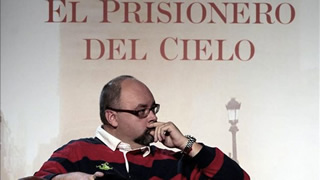
De Spaanse schrijver Carlos Ruiz Zafón werd geboren op 25 september 1964 in Barcelona. Zie ook mijn blog van 25 september 2010 en eveneens alle tags voor Carlos Ruiz Zafón op dit blog.


Uit: The Prisoner Of Heaven (Vertaald door Lucia Graves)


“That year at Christmas time, every morning dawned laced with frost under leaden skies. A bluish hue tinged the city and people walked by, wrapped up to their ears and drawing lines of vapour with their breath in the cold air. Very few stopped to gaze at the shop window of Sempere & Sons; fewer still ventured inside to ask for that lost book that had been waiting for them all their lives and whose sale, poetic fancies aside, would have contributed to shoring up the bookshop’s ailing finances.

‘I think today will be the day. Today our luck will change,’ I proclaimed on the wings of the first coffee of the day, pure optimism in a liquid state.

My father, who had been battling with the ledger since eight o’clock that morning, twiddling his pencil and rubber, looked up from the counter and eyed the procession of elusive clients disappearing down the street.

‘May heaven hear you, Daniel, because at this rate, if we don’t make up our losses over the Christmas season, we won’t even be able to pay the electricity bill in January. We’re going to have to do something.’

‘Fermín had an idea yesterday,’ I offered. ‘He thinks it’s a briljant plan that’ll save the bookshop from imminent bankruptcy.’

‘Lord help us.’

I quoted Fermín, word for word:

‘Perhaps if by chance I was seen arranging the shop window in my underpants, some lady in need of strong literary emotions would be drawn in and inspired to part with a bit of hard cash. According to expert opinion, the future of literature depends on women and as God is my witness the female is yet to be born who can resist the primal allure of this stupendous physique,’ I recited.

I heard my father’s pencil fall to the floor behind me and I turned round.

‘So saith Fermín,’ I added.”


 1243408-90286704659736c80de76db7d72e9d6e.jpg

Carlos Ruiz Zafón (Barcelona, 25 september 1964)


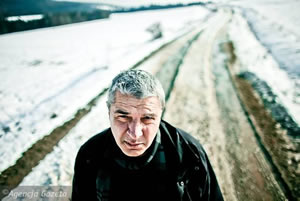
De Poolse schrijver en letterkundige Andrzej Stasiuk werd geboren op 25 september 1960 in Warschau. Zie ook mijn blog van 25 september 2010 en eveneens alle tags voor Andrzei Stasiuk op dit blog.


Uit: Nine (Vertaald door Bill Johnston)


„Snow had fallen in the night.

           Pawel got out of bed and went into the bathroom. The light was on, the mirror was broken. Tubes and brushes and bottles had been swept off the shelf, were all over the floor. A stream of white toothpaste had shot out and dried on the willow-green wall. Disposable razors had been snapped in two and stepped on into a torn box of soap powder. The cracked toilet seat lay in the corner. It occurred to him there was a lot of glass, so he went back to the hallway for his shoes.

           He picked up one of the toothbrushes, rinsed it under the faucet, scraped some toothpaste off the wall. Then he squatted and chose a razor with a cracked handle. He found the can of shaving cream under the bathtub. It was dented but something still swished inside it. He shaved in what was left of the mirror. He splashed water on his face. The Old Spice had been crushed, but there was still something left in the white plastic cover. He shook the crumpled container. It made a grating sound like a deaf-and-dumb version of a childs rattle. A few drops splashed onto his palm. He rubbed them on his cheeks. It hardly stung, so this time he must have managed not to cut himself. He took a leak and went back into the living room.

           Things were no better here. More smashed stuff. The cracked silver casing of the cassette player emptied its colorful guts onto the floor. He flicked the light switch. The lamp was in pieces. The light of early morning hung like dust in the air. Something white poked from the ripped upholstery of the sofa. He smoothed it with his hand and went to the pile of clothes spilling out of the wardrobe. He sniffed a few things to find something clean in the semidarkness. He put on a shirt and sweater. By the bed he found his pants; he dug out some socks from an untouched drawer and pulled them on, and at last stopped shivering.

He sipped at his coffee and gazed through the window. Snow lay on the roofs and on the sidewalk; the black trees were white now, and everything resembled a distant Christmas. A red bus cautiously made a turn. Sleepily and soundlessly it straightened, receded down the avenue of lime trees. The treetops faded into the low sky. He listened for the patter of drops in the gutters. There was no sound. “Itll lie for a while,” he thought.”


 1243408-ff6f5838fd6a25a202ad1e7df58f5fdc.jpg

Andrzej Stasiuk (Warschau, 25 september 1960)


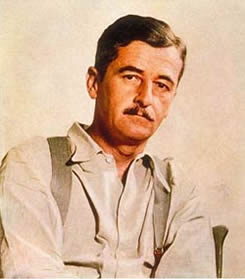
De Amerikaanse schrijver William Faulkner werd geboren op 25 september 1897 in New Albany, Mississippi. Zie ook mijn blog van 25 september 2010 en eveneens alle tags voor William Faulkner op dit blog.


Uit: A Fable


“Wednesday

Long before the first bugles sounded from the barracks within the city and the cantonments surrounding it, most of the city was already awake. These did not need to rise from the straw mattresses and thin pallet beds of their hive-dense tenements, because few of them save the children had ever lain down. Instead, they had huddled all night in one vast tongueless brotherhood of dread and anxiety, about the thin fires of braziers and meagre hearths, until the night wore at last away and a new day of anxiety and dread had begun.

Because the original regiment had been raised in this district, raised in person, in fact, by one of the glorious blackguards who later became Napoleon's marshals, who delivered the regiment into the Emperor's own hand, and along with it became one of the fiercest stars in that constellation which filled half the sky with its portent and blasted half the earth with its lightning. And most of its subsequent replacements had been drawn from this same district, so that most of these old men were not only veterans of it in their time, and these male children already dedicated to it when their time should come, but all these people were parents and kin, not only the actual old parents and kin of the doomed men, but fathers and mothers and sisters and wives and sweethearts whose sons and brothers and husbands and fathers and lovers might have been among the doomed men except for sheer blind chance and luck.

Even before the bugles' echoes died away, the warrened purlieus were already disgorging them. A French or British or American aviator (or a German either for that matter, if he had had the temerity and the luck) could have watched it best: hovel and tenement voiding into lane and alley and nameless cul-de-sac, and lane and alley and cul-de-sac compounding into streets as the trickles became streams and the streams became rivers, until the whole city seemed to be pouring down the broad boulevards converging like wheelspokes into the Place de Ville, filling the Place and then, pressed on by the weight of its own converging mass, flowing like an unrecoiling wave up to the blank gates of the Hôtel where the three sentries of the three co-embattled nations flanked the three empty flagstaffs awaiting the three concordant flags”.


 1243408-8dac44275c36a12cabc6bb0ad98b4f18.jpg

William Faulkner (25 september 1897 - 6 juli 1962)


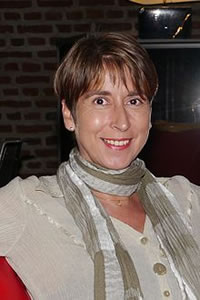
De Duitse schrijfster Rebecca Gablé (pseudoniem van Ingrid Krane-Müschen) werd geboren op 25 september 1964 in Wickrath / Mönchengladbach. Zie ook mijn blog van 25 september 2010 en eveneens alle tags voor Rebecca Gablé op dit blog.


Uit: Von Ratlosen und Löwenherzen


“Am 28. Juni 1461 wurde Edward of March mit nicht einmal zwanzig Jahren zu Edward IV. von England gekrönt – der erste König aus dem Hause York. Die meisten Engländer waren erleichtert. Den einfachen Leuten war nämlich völlig egal, wie ihr König mit Nachnamen hieß. Sie wollten nur, dass nach 116 Jahren Krieg gegen Frankreich und den sich nahtlos anschließenden sechs Jahren Bürgerkrieg endlich mal Ruhe herrschte und niemand in ihre Dörfer kam, um ihre Scheunen zur Versorgung der Truppen zu plündern oder ihre Väter, Ehemänner und Söhne als Bogenschützen anzuwerben, die dann entweder gar nicht oder mit einem Arm, Bein oder Auge weniger nach Hause kamen. Und König Edward machte seine Sache hervorragend. Nach dem jämmerlichen Henry VI. (den seine Königin mitsamt ihrem Sohn in Schottland in Sicherheit gebracht hatte), war es doch irgendwie sehr beruhigend, einen König auf dem Thron zu haben, der auch wie ein König aussah, redete und handelte.
Edward IV. hatte in vieler Hinsicht Ähnlichkeit mit seinen strahlenden Vorgängern Edward III. und Henry V. Genau wie sie legte er keinen Wert auf Rachefeldzüge gegen die besiegten politischen Gegner, sondern setzte auf Aussöhnung. Genau wie sie war er ein König, dem Recht und Rechtsprechung sehr am Herzen lagen, der aber auf dem Schlachtfeld ordentlich hinlangen konnte, wenn es sein musste. Und genau wie sie sah er – so wird berichtet – unverschämt gut aus und ließ nichts, aber auch gar nichts anbrennen. Und genau das wurde sein größtes Problem. Während sein wichtigster Ratgeber, sein Cousin Richard Earl of Warwick, ihn zu einer Ehe mit einer französischen Prinzessin drängte, der kaum weniger einflussreiche Earl of Pembroke auf eine Verbindung mit Burgund setzte, hatte der König sich rettungslos in die Witwe eines unbedeutenden Landritters verliebt, Elizabeth Woodville.”


 1243408-28b2681d699565f1458c5cdbd632403b.jpg

Rebecca Gablé (Wickrath, 25 september 1964)


Zie voor nog meer schrijvers van de 25e september ook nog mijn blog van 25 september 2011 deel 2 en eveneens deel 3.

Geschreven door Romenu om 19:26 Reageer op dit bericht

David Benioff

De Amerikaanse schrijver David Benioff (pseudoniem van David Friedman) werd geboren in New York City op 25 september 1970. Zie ook alle tags voor David Benioff op dit blog.


Uit: City of Thieves


“Off we go, then, on a tour into the haunted theme park of modern European history. It is January 1942, the first winter of what would become a 900-day siege, and David's grandfather, Lev Beniov, at that time a skinny 17-year-old, is trying to survive on his own. Lev's mother and sister left Leningrad before the Germans closed in; his father, a Jewish poet, had been arrested by the Soviet secret police four years earlier and was never heard from again. After looting the corpse of a German soldier, Lev himself is arrested and thrown into the city's huge and silent prison, where he expects to be killed. His cellmate, Kolya, is an insouciant Cossack full of literary pretensions and braggadocio who is in jail for deserting his regiment.
To their infinite surprise, the two young men are sent on a mission instead of being executed. A local army colonel whose daughter is getting married surmises that Lev and Kolya are schooled enough in petty thievery to procure a dozen eggs for the wedding cake. No matter that eggs have not been seen anywhere in Leningrad in months. The lads are given five days, a curfew waiver, and 400 rubles and told that if they fail to deliver the goods, they will be shot.
Talk about your wild goose chase. There are no animals of any kind here; even the pigeons have long since been eaten. In the outdoor food stalls, what's for sale are pricey glasses of dirt mixed with melted sugar and something called "library candy," made by boiling the binding glue from books: "[T]here was protein in the glue, protein kept you alive, and the city's books were disappearing like the pigeons."


 1420354-13507b4a552c3d097310820b91b7cab1.jpg

David Benioff (New York, 25 september 1970)

Geschreven door Romenu om 00:00 Reageer op dit bericht

Mark Boog, A.L. Snijders, F. Scott Fitzgerald, Shamim Sarif

De Nederlandse dichter en schrijver Mark Boog werd geboren op 24 september 1970 in Utrecht. Zie ook mijn blog van 24 september 2010 en eveneens alle tags voor Mark Boog op dit blog.


Onbegrepen offer


Elke stelling verdient het
gebeeldhouwd te zijn.
Steeds weer ben ik aan zet, of jij -
wie raakt nooit de tel kwijt -

en sla. 'Voor je beurt!' 'Niet.'
Ik sla je weer. Onbegrepen offer.

Het spel valt in stukken uiteen. Geen partij.
Als een schaap, met open ogen
naar de scheerder, mug op weg naar web,
de held zijn slagveld tegemoet.


De dagelijkse taken


De dagelijkse taken: het oprichten van het standbeeld
dat ik ben geworden, het bedekken van het lijf, drinken

van koffie, het ontmantelen van de plannen van gisteren,
het enzovoort. Het nogmaals opschorten van ongeloof.

Ik geef me over aan je onthutsende aanwezigheid, je
ogen. Dat ze me zien is nog het vreemdste, dat ze

leven zijn en vol van tijd. De morgen bloeit onwetend
in je spiegel. Ik weet niet precies waarin je gelooft.

Volgt het handwerk van elke dag, het met almaar groter
vakmanschap vervaardigen van redenen en van excuses,

volgt de avond, dan de dood, die we ontwijken in ons
haveloze bed, die we bedriegen door heel stil te liggen.


Atleet


Alle ramen zijn open. De geluiden van binnen en buiten
mengen zich; mengen zich met het licht en de gedachten.

Uiterst verwonderlijk is deze lijdzaamheid. Met handen
waarin geen zand en ogen onder leden wachten we lang.

Het zeggen is bijkomstig. In de verste stilste hoeken
is er plaats voor, tussen het gebeuren, naast het wachten.

Er beweegt zich een atleet door de gangen van het huis,
langs de kamers waarin we zitten, er klinkt voorbijgaan.


1242753-79d0709011297ae9f1e892214b1fea35.jpg
Mark Boog (Utrecht, 24 september 1970)


De Nederlandse schrijver A.L. Snijders (pseudoniem van Peter Cornelis Müller) werd geboren op 24 september 1937 in Amsterdam. Zie ook mijn blog van 20 novemberr 2010 en eveneens alle tags voor A.L. Snijders op dit blog.


Passie


Hij vertelde zijn dochters over de passie, maar ze wilden er niets van weten. Ze verlieten hem in de dageraad en liepen in tien uur zonder te rusten naar zee. Daar bleven ze drie maanden, ze hielpen met de strandstoelen en de tenten, en ze maakten muziek om wat te verdienen. Maar toen de oorlog dreigde liepen ze terug naar huis waar hun vader nog steeds de passie preekte. Nu, omdat ze wat ouder waren geworden, wilden ze er het fijne van weten, ze wilden het fijne van de passie weten. Ze gingen bij hem zitten en spraken hem aan met het woord vader. Hij legde ze uit hoe ze moesten leven, wat ze moesten doen. Ze moesten hun brandglas richten op een willekeurig doel, ze moesten zich vastbijten en niet loslaten, ze moesten geen aandacht schenken aan het hoofdschudden en de woorden 'toe maar, die durft'. Zo moesten ze leven, zo zou het wat worden. De dochters waren woedend dat een vader zich er op zo'n eenvoudige wijze van afmaakte, alsof hij een cursus in een vormingscentrum gaf. Ze gaven hem de raad geen woorden meer te gebruiken en verlieten voor de tweede keer het huis. Aan het strand zagen ze de zandzuigers en graafmachines die de kust versterkten, maar zelf zaten ze met hun voeten in het zand omdat dat zo'n heerlijk gevoel gaf.


1242753-d4eb6925a8d55e78e14840888411fb6c.jpg 

A.L. Snijders (Amsterdam, 24 september 1937)


De Amerikaanse schrijver Francis Scott Fitzgerald werd geboren op 24 september 1896 in Saint Paul, in de staat Minnesota. Zie ook mijn blog van 24 september 2010 en eveneens alle tags voor F. Scott Fitzgerald op dit blog.


Uit: The Beautiful and Damned


“Anthony drew as much consciousness of social security from being the grandson of Adam J. Patch as he would have had from tracing his line over the sea to the crusaders. This is inevitable; Virginians and Bostonians to the contrary notwithstanding, an aristocracy founded sheerly on money postulates wealth in the particular.
Now Adam J. Patch, more familiarly known as “Cross Patch,” left his father’s farm in Tarrytown early in sixty-one to join a New York cavalry regiment. He came home from the war a major, charged into Wall Street, and amid much fuss, fume, applause, and ill will he gathered to himself some seventy-five million dollars.
This occupied his energies until he was fifty-seven years old. It was then that he determined, after a severe attack of sclerosis, to consecrate the remainder of his life to the moral regeneration of the world. He became a reformer among reformers. Emulating the magnificent efforts of Anthony Comstock, after whom his grandson was named, he levelled a varied assortment of uppercuts and body-blows at liquor, literature, vice, art, patent medicines, and Sunday theatres. His mind, under the influence of that insidious mildew which eventually forms on all but the few, gave itself up furiously to every indignation of the age. From an armchair in the office of his Tarrytown estate he directed against the enormous hypothetical enemy, unrighteousness, a campaign which went on through fifteen years, during which he displayed himself a rabid monomaniac, an unqualified nuisance, and an intolerable bore. The year in which this story opens found him wearying; his campaign had grown desultory; 1861 was creeping up slowly on 1895; his thoughts ran a great deal on the Civil War, somewhat on his dead wife and son, almost infinitesimally on his grandson Anthony.

Early in his career Adam Patch had married an anæmic lady of thirty, Alicia Withers, who brought him one hundred thousand dollars and an impeccable entré into the banking circles of New York. Immediately and rather spunkily she had borne him a son and, as if completely devitalized by the magnificence of this performance, she had thenceforth effaced herself within the shadowy dimensions of the nursery. The boy, Adam Ulysses Patch, became an inveterate joiner of clubs, connoisseur of good form, and driver of tandems—at the astonishing age of twenty-six he began his memoirs under the title “New York Society as I Have Seen It.” On the rumor of its conception this work was eagerly bid for among publishers, but as it proved after his death to be immoderately verbose and overpoweringly dull, it never obtained even a private printing”.


1242753-ec9fbeb8a312632ca50d02953a4fce55.jpg 

F. Scott Fitzgerald (24 september 1896 - 21 december 1940)


De Britse schrijfster en filmmaakster Shamim Sarif werd geboren op 24 september 1969 in Londen. Zie ook mijn blog van 24 september 2010 en eveneens alle tags voor Shamim Sarif op dit blog.


Uit: The World Unseen


“She walked over to the counter and picked up her apron. She was caught in the glow of the lamp light now, and Amina patted the baby’s back and watched Miriam, a slight frown on her face. She had never in her life felt so disconcerted by anyone, and as she stood in the gloom by the open door, she examined Miriam as though she were a framed picture on a wall. She watched her slender hands place the apron around her waist, saw the slim muscles that flickered like thin fish beneath the skin of her forearm. She watched the lit face intent on tying the bow, watched the shadowed angles of her cheekbones, and the long eyelashes that brushed the tops of her cheeks when she blinked. Miriam felt the eyes upon her and looked up. The shop was dark beyond the circle of the lamp, and she walked away from the light, towards the door.

“I can’t believe you drove through all this rain,” she said. The baby was restless, and Amina handed her back. Miriam felt the girl’s hands brushing hers as the child moved between them and wondered for a moment why she was so aware of such small things where Amina was concerned.

“I’m used to driving in the rain.”

“Oh, yes. I forgot that you used to do taxi-driving,” replied Miriam.

“I still do,” Amina corrected. “I’m leaving again next week, in fact. To Cape Town.”

“Cape Town,” Miriam repeated, and the tone of wonder in her voice made Amina turn to look at her again. “What is it like, in Cape Town?” asked Miriam.

“It’s beautiful,” Amina said. “Lovely small towns. And the mountains and the beaches. There are some beautiful beaches ‘ especially if you’re White, especially.” She paused and looked out again.

“I don’t stay there long,” she said. “I like the drive more than anything even when it’s not picturesque, like the Garden Route, there are always things to see. Even driving past townships, you see all these people living very different lives from your own.”


 1242753-3cbc273cdc2f9b113a3866ed727d28eb.jpg

Shamim Sarif (Londen, 24 september 1969)


Zie voor nog meer schrijvers van de 24e september ook mijn vorige blog van vandaag.

Geschreven door Romenu om 20:30 Reageer op dit bericht

Fernand Ouellette, Yves Navarre, Hendrik Tollens

De Canadese dichter, essayist en schrijver Fernand Ouellette werd geboren in Montreal, Quebec, op 24 septenber 1930. Zie ook mijn blog van 24 september 2010 en eveneens alle tags voor Fernand Ouellette op dit blog.


TOTEM ANTÉHUMAIN


Mon totem

ma femme héraldique bien enfouie.

Très attentif l'ai retirée de ma tourbe,

suspendue sur un cintre beau vermillon.

Il suffit parfois de la dépendre sous

le coup d'un élancement plus dur.

Certes la belle étoffe s'est fort refroidie,

et même amplifiée comme une morte naissant

de l'onde ô voisine de la morte Aphrodite.

Mais quelle image, quelle grande dame

se laisse encor partager

quelle fragile s'accoutume aux séismes

du froid profanateur

du fol adorateur ?


LA CONNAISSANCE


Alors que le coeur ému et lumineux

se distendait jusqu'au

Soleil:

déferla le plus noirci regard

de la crue la puissante ;

et tristement, avec vigilance,

on empala le neigeux

du corps fait femme.

Puis nous glissâmes dans la spirale,

dans l'étuve à jouissance, les incendiaires,

crispés par les cris du sexe blessé,

nous aggrippant aux matières marbrées

qui nos épaules chargeaient de connaissance.


 1242749-13672ef051ea92202fa1f3d83614fdaf.jpg

Fernand Ouellette (Montreal, 24 septenber 1930)


De Franse schrijver Yves Navarre werd geboren op 24 september 1940 in Condom. Zie ook mijn blog van 24 september 2010. en eveneens alle tags voor Yves Navarre op dit blog.


Uit: L'Espérance de beaux voyages, 1 : Eté-automne


“Il peut prendre une histoire, encore, pour ce qu'elle est, pour ce qu'elle dit, sans forcément vouloir savoir pourquoi. Enfant, si un grand te lit cette histoire, dis-toi qu'il te la lit pour la comprendre. Et il n'y arrivera jamais. Si tu la lis, seul, comme un grand, prends-la, toi, sans trop t'interroger. Il va y avoir un oiseau bleu, merveilleux. Lis les images comme le texte. Dis-toi que tu y trouveras ce que les grands n'y trouvent plus et ce que plus tard, en la racontant à tes enfants, tu chercheras et ne trouveras pas à ton tour. Il était une fois une histoire tellement unique que tous prétendaient la raconter pour la première fois. Une histoire incomprise. Incomprise comme toi quand on ne te comprend pas.

Pierre avait sept ans depuis un mois. Mais j'aurais pu te raconter l'histoire de Pedro, de Petrik, de Piotr, de Peter, de Piero. C'est toujours la même histoire. Celle de Pierre est peut-être la nôtre, plus proche et familière. Il a neigé. Pierre va à l'école en traînant derrière lui un petit bateau. Il rêve d'être marin. Il tient de son grand-père cette chanson Ohé, matelot. j'ai fait trois fois le tour du monde en bateau, je peux te raconter Valparaiso. Ses frères aînés se moquent de lui. Ils lui donnent des coups de poing. «C'est quoi Valparaiso ? » « C’est un port » répond Pierre « à l'autre bout du monde. » « Mais tu n'y es jamais allé ? » Pierre répond : « J'irai. C'est décidé. » Et Pierre part pour l'école en traînant son petit bateau. Qu'il a appelé Valparaiso. Pour un peu, la neige ferait des vagues.


 1242749-48b7ab8d3295dbcd1e9cb0e492adc797.jpg

Yves Navarre (24 september 1940 – 24 januari 1994)


De Nederlandse dichter Hendrik Tollens werd op 24 september 1780 te Rotterdam geboren. Zie ook mijn blog van 24 september 2010 en eveneens alle tags voor Hendrik Tollens op dit blog.


Bede


Wél hem, die 't wislend lot te ontzien heeft noch te duchten;

Die zelf zijn erfgrond bouwt en 't werken zich niet schaamt;

Die, onbekend en vrij, in vaderlandsche luchten,

Op eigen bodem aâmt.


Hem, wien zijn kudde kleedt, hem, wien zijn wingerds drenken,

Hem, wien zijn akker voedt en graan tast in zijn schuur;

Hem, wien, bij zomerbrand, zijn boomen schaduw schenken,

Bij winterkoude, vuur.


Gezegend, die dus leeft, die, met zijn lot te vreden,

Voor vloed noch ebbe schroomt in 's werelds ranke kiel;

Gezegend, die dus zwoegt, met onvermoeide leden

En onbezwaarde ziel.


Gelukkig boven peil, die, wars van aardsche zorgen,

Des daags met ijver zwoegt en 's nachts verkwikkend rust;

Wien de onschuld wiegt in slaap en wien zij, elken morgen,

Weer vrolijk wakker kust!


Schenk, hemel! mij dat lot: schenk, na zoo zoet een leven,

Mij eens een kalmen dood, in diep vergeten staat;

En dat geen marmren praal, voor trotschaards opgeheven,

Mijn needrig graf verraad'.


Naar het Engelsch van Pope.


 1242749-1774976bd925a28924153b5a9d09f744.jpg

Hendrik Tollens (24 september 1780 -21 oktober 1856)


Zie voor nog meer schrijvers van de 24e september ook mijn blog van 24 september 2011 deel 2.

Geschreven door Romenu om 20:24 Reageer op dit bericht

Constantijn Huygensprijs 2012 voor Joke van Leeuwen


Constantijn Huygensprijs 2012 voor Joke van Leeuwen

De Nederlandse dichteres, schrijfster en illustrator Joke van Leeuwen heeft de Constantijn Huygensprijs 2012 gewonnen. Dat heeft de Jan Campert-stichting laten weten. Joke van Leeuwen werd geboren op 24 september 1952 in Den Haag. Zie ook alle tags voor Joke van Leeuwen op dit blog.


Geschenk

Dit zit goed vastgeplakt. Wel mooi papier. Een lint
met krullen. Doen ze met een schaar. Ik weet niet
wat jij hiervan vindt, of jij dit hebt, dat ik het ruil,
dat jij dan wacht op mij, dat ik dan onderwijl wat
anders voor je koop, of, want, tenzij, dat jij het
houden wilt of bij vergissing denkt dat jij het
toch al had, maar niet dus of niet meer of
dat het brak en dat jij dacht als nog een
keer moet ik voorzichtig zijn, of dat
iets dubbels helemaal niet geeft
wat jou betreft. Hier. Neem
een mes. Dit heft.


Binnen

Die wachtte was te goed in doodverzinnen.
Weghelften weg, begroeide grond verschoven,
meren gezwollen, als bij wie ver, met
tijdelijke namen, in de slaap verrast.

Die wachtte dacht een strand, had zich
in zand verpakt, nat zand dat plakte,
hoofd eruit, een hand om plat te slaan,
dat elke vrouw beschreven in een mal.

Pak dit maar uit. Stel maar die vraag.
Een mal? Maar alles druk met scheppen, innen,
spetten, mobiel bellen, nieuwer weer
voorspellen en daar was het al.

Die komen moest kwam lachend, natte voeten,
tas vol groeten, wakker en verwacht.
Ik ben het. Ben je boven?
Nam die verdampte vast.


Perron

Het is weer scharreldag voor kruimelduiven.
Die hoeven niet weg. Die missen een pootje.
Die zwijgen: 'Kijk naar je eige, zeik niet
over aankomst en hoe laat.'

Er zal een trein zijn en eruitgetuimel en
iemand die wuift en sprongetjes maakt en
onverstaanbaar van een reis gaat roepen
naar wie daar al jaren staat.


 1674829-e7c85e900e0cbfa994fa56441a5b5d52.jpg
Joke van Leeuwen (Den Haag, 24 september 1952)

Geschreven door Romenu om 00:00 Reageer op dit bericht

Antonio Tabucchi, Mary Coleridge, Theodor Körner, Euripides

De Italiaanse schrijver, vertaler, en literatuurwetenschapper Antonio Tabucchi werd op 23 september 1943 geboren in Pisa. Zie ook mijn blog van 23 september 2010 en eveneens alle tags voor Antonio Tabucchi op dit blog.


Uit: The Missing Head (Vertaald door Patrick Creagh) 


“Manolo the Gypsy opened his eyes, peered at the dim light creeping through the cracks in his hovel, and got to his feet trying not to make a sound. He had no need to dress because he slept fully clothed, and the orange jacket given him the year before by Agostinho da Silva, known as Franz the German, tamer of toothless lions in the Wonder Circus, now served him for both day and night. In the faint glimmer of dawn he groped around for the battered sandals-cum-slippers that were his only footwear. He found them and slid his feet in. He knew every inch of the hut, and could move about in its murk knowing perfectly well where its few wretched sticks of furniture were. He took a confident step towards the door, and in so doing his right foot clashed against an oil-lamp standing on the floor.

Damn the woman! exclaimed Manolo between his teeth. He was of course referring to his wife, who the previous evening had insisted on leaving this lamp beside her bed on the pretext that the blackness of night gave her nightmares and she dreamt of her dead. If she kept the flame burning as low as can be, she said, the ghosts of her dead dared not to haunt her, and so she could sleep in peace.

“And what is El Rey about at this hour of the morning, O afflicted spirit of our Andalusian dead?”

His wife’s voice was muffled and drowsy, as it is with anyone still half asleep. She always spoke to him in geringonça, a hotch-potch of Romany, Portuguese and Andalusian. And she called him El Rey—the King.

King of a heap of shit, Manolo felt the urge to answer, but he said nothing. King of a shitheap. To be sure he had once been El Rey, when the gypsies were honoured, when his people freely roamed the plains of Andalusia, when they made copper trinkets to sell in the villages and dressed in black and wore fine felt hats, and their knives were not weapons to fight for your life with, but peerless treasures fashioned in chased silver.”


1241791-962183e6cd1ecb37f6f331e4d532c97c.jpg
Antonio Tabucchi (Pisa, 23 september 1943)


De Engelse dichteres en schrijfster Mary Elizabeth Coleridge werd geboren in Londen op 23 september 1861. Zie ook mijn blog van 23 september 2010 en eveneens alle tags voor Mary Colderidge op dit blog.


‘He came unto His own, and His own received Him not’


As Christ the Lord was passing by,
He came, one night, to a cottage door.
He came, a poor man, to the poor;
He had no bed whereon to lie.

He asked in vain for a crust of bread,
Standing there in the frozen blast.
The door was locked and bolted fast.
‘Only a beggar!’ the poor man said.

Christ the Lord went further on,
Until He came to a palace gate.
There a king was keeping his state,
In every window the candles shone.

The king beheld Him out in the cold.
He left his guests in the banquet-hall.
He bade his servants tend them all.
‘I wait on a Guest I know of old.’

‘’Tis only a beggar-man!’ they said.
‘Yes,’ he said; ‘it is Christ the Lord.’
He spoke to Him a kindly word,
He gave Him wine and he gave Him bread.

Now Christ is Lord of Heaven and Hell,
And all the words of Christ are true.
He touched the cottage, and it grew;
He touched the palace, and it fell.

The poor man is become a king.
Never was man so sad as he.
Sorrow and Sin on the throne make three,
He has no joy in mortal thing.

But the sun streams in at the cottage door
That stands where once the palace stood.
And the workman, toiling to earn his food,
Was never a king before.


1241791-6d01223990e54cf98408ae885a93dbe2.jpg 

Mary Coleridge (23 september 1861 – 25 augustus 1907)

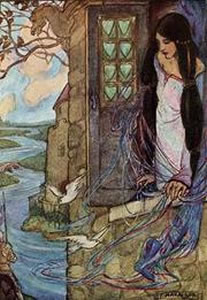
Illustratie door Eleanor Vere Boyle in Voices from Fairyland, the fantastical poems of Mary Coleridge Charlotte Mew and Sylvia Townsend Warner.


De Duitse dichter en schrijver Theodor Körner werd geboren op 23 september 1791 in Dresden. Zie ook mijn blog van 23 september 2010 en eveneens alle tags voor Theodor Körner op dit blog.


Die drei Sterne


Es blinken drei freundliche Sterne

  Ins Dunkel des Lebens herein;

Die Sterne, die funkeln so traulich,

  Sie heißen: Lied, Liebe und Wein.


Es lebt in der Stimme des Liedes

  Ein treues, mitfühlendes Herz;

Im Liede verjüngt sich die Freude,

  Im Liede verweht sich der Schmerz.


Der Wein ist der Stimme des Liedes

  Zum freudigen Wunder gesellt

Und malt sich mit glühenden Strahlen

  Zum ewigen Frühling der Welt.


Doch schimmert mit freudigem Winken

  Der dritte Stern erst herein,

Dann klingt’s in der Seele wie Lieder,

  Dann glüht es im Herzen wie Wein.


Drum blickt denn, ihr herzigen Sterne,

  In unsre Brust auch herein!

Es begleite durch Leben und Sterben

  Uns Lied und Liebe und Wein!


Und Wein und Lieder und Liebe,

  Sie schmücken die festliche Nacht!

Drum leb’, wer das Küssen und Lieben

  Und Trinken und Singen erdacht!


1241791-4688ac3617d3de8386648e7d2e8dc08f.jpg
Theodor Körner (23 september 1791 - 26 augustus 1813)

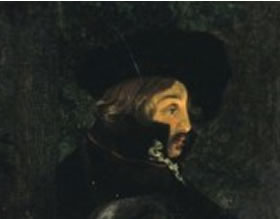
Körner, detail van het schilderij “Vorposten” van Georg Friedrich Kersting 1815


De Griekse schrijver Euripides werd geboren in 480 of 484 voor Christus. Zie ook mijn blog van 23 september 2010 en eveneens alle tags voor Euripises op dit blog.


Uit: Alcestis


“Apollo
Huis van Admetus, waarin ik mij schik aan tafel,
geduldig als een dagloner, ik die een god ben.
Want Zeus heeft door mijn zoon te dooden daaraan schuld,
Asclepius: Zeus dreef de bliksems in zijn borst.
Vertorend om zijn lot doodde ik de smeden van
Zeus' vuur: ik doodde de Cyclopen, daarom dwong
mijn vader mij tot arbeid voor een sterveling, als boete.
Gekomen in dit land, weidde ik voor mijn gastheer
de runderen en hield zijn huis tot nu in stand.
Want ik, die zelf ook vroom ben, vond gelijke vroomheid
in Pheres' zoon, dien ik beschermde tegen sterven.
De Moiren overtroefde ik: zij stonden toe:
Admetus mocht voor 't oogenblik de Hades mijden,
als hij een and're doode in zijn plaats liet gaan.
En al zijn vrienden ging hij lang, hij vroeg hen en
zijn vader en zijn oude moeder, die hem baarde,
en hij vond niemand, die voor hem wel sterven wilde
en nooit het licht meer zien, vond niemand dan zijn vrouw.
Nu steunen in 't paleis zijn armen haar, nu zij
daar worstelt met den dood: want dezen dag, staat vast,
moet zij den dood ingaan en 't leven achterlaten.
En ik, om niet besmet te worden in 't paleis,
verlaat het dak van deze woning, die ik lief kreeg.
Reeds zie ik hoe de Dood nabij gekomen is,
hij, priester der gestorvenen, naar Hades' huis
zal hij haar voeren: juist op tijd is hij gekomen,
loerende op den dag, waarop zij sterven moest.”


Vertaald door J. C. Kamerbeek


1241791-a2593eef035ba12397a59efcaf6c7578.jpg
Euripides (484 v. Chr – 406 v. Chr)

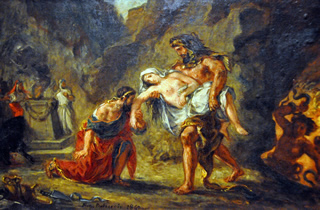
Hercules en Alcestis door Eugène Delacroix, 1862


Zie voor nog meer schrijvers van de 23e september ook mijn vorige blog van vandaag.

Geschreven door Romenu om 15:34 Reageer op dit bericht

Jaroslav Seifert, Emma Orczy, Leni Saris, Daniel Czepko von Reigersfeld

De Tsjechische dichter Jaroslav Seifert werd op 23 september 1901 geboren en groeide op in de arbeiderswijk Žižkov in Praag. Zie ook mijn blog van 23 september 2010 en eveneens alle tags voor Jaroslav Seifert op dit blog.


Lied


Mit weißem tüchlein winkt,

wer abschied nimmt,

etwas geht mit jedem tag zu ende,

etwas wunderbares geht zu ende.


Die taube kehrt, der botschaft botin,

windauf, windab nach haus zurück;

mit und ohne hoffnung kehren

ewig wir nach haus zurück.


Lächle mit verweinten augen,

das tüchlein, ach, verwahr es,

mit jedem tag beginnt etwas,

beginnt etwas wunderbares.


Vertaald door Rainer Kunze


Métamorphoses


Le garçon se change en un blanc buisson;
le buisson, en pâtre en train de dormir;
ses cheveux si fins, en cordes de lyre ;
et la neige, en neige sur son front blond.


Les mots se changent en questions ;
sagesse et gloire en rudes rides ;
à reculons corde de lyre
se change en fin cheveu; et le garçon
en poète, le poète en buisson,
sous lequel il dormait au temps où
il aimait la beauté d’amour fou.


Quiconque de beauté se toque
sans fin l’aime sa vie durant,
la poursuit toute son époque —
la beauté a des pieds charmants
qu’elle chausse de fines socques.


Le fier carrousel des métamorphoses
change le poète en amant maudit,
car il suffira d’une courte pause :
le voici changé en eau d’alambic,
dont l’alchimiste fait vapeur chimique,
et qu’après, tout au fond il précipite.


Vertaald door Jana Boxberger


 1241789-c2cca3d4fd7dbf8c517d469b620accdf.jpg

Jaroslav Seifert ( 23 september 1901 – 10 januari 1986)

Hier links met fotograaf en regisseur Otakar Mrkvička


De Hongaarse schrijfster Emmuska Orcy de Orczi, ook wel Baronesse Orczy of Baronesse d'Orczy werd geboren in Tarnaörs op 23 september 1865. Zie ook mijn blog van 23 september 2010 en eveneens alle tags voor Emma Orczy op dit blog.


Uit: The Scarlet Pimpernel


“No one had seen these mysterious Englishmen; as for their leader, he was never spoken of, save with a superstitious shudder. Citoyen Foucquier-Tinville would in the course of the day receive a scrap of paper from some mysterious source; sometimes he would find it in the pocket of his coat, at others it would be handed to him by someone in the crowd, whilst he was on his way to the sitting of the Committee of Public Safety. The paper always contained a brief notice that the band of meddlesome Englishmen were at work, and it was always signed with a device drawn in red—a little star-shaped flower, which we in England call the Scarlet Pimpernel. Within a few hours of the receipt of this impudent notice, the citoyens of the Committee of Public Safety would hear that so many royalists and aristocrats had succeeded in reaching the coast, and were on their way to England and safety.

The guards at the gates had been doubled, the sergeants in command had been threatened with death, whilst liberal rewards were offered for the capture of these daring and impudent Englishmen. There was a sum of five thousand francs promised to the man who laid hands on the mysterious and elusive Scarlet Pimpernel.

Everyone felt that Bibot would be that man, and Bibot allowed that belief to take firm root in everybody's mind; and so, day after day, people came to watch him at the West Gate, so as to be present when he laid hands on any fugitive aristo who perhaps might be accompanied by that mysterious Englishman.

"Bah!" he said to his trusted corporal, "Citoyen Grospierre was a fool! Had it been me now, at that North Gate last week . . ."

Citoyen Bibot spat on the ground to express his contempt for his comrade's stupidity.

"How did it happen, citoyen?" asked the corporal.

"Grospierre was at the gate, keeping good watch," began Bibot, pompously, as the crowd closed in round him, listening eagerly to his narrative. "We've all heard of this meddlesome Englishman, this accursed Scarlet Pimpernel. He won't get through MY gate, MORBLEU! unless he be the devil himself. But Grospierre was a fool. The market carts were going through the gates; there was one laden with casks, and driven by an old man, with a boy beside him. Grospierre was a bit drunk, but he thought himself very clever; he looked into the casks—most of them, at least—and saw they were empty, and let the cart go through."


 1241789-6b3ab40560eb9d81cf15538a15abb156.jpg

Emma Orczy (23 september 1865 – 12 november 1947)

Anthony Andrews als “the Scarlet Pimpernel” in de gelijknamige film uit 1982


De Nederlandse schrijfster Leni Saris werd geboren in Rotterdam op 23 september 1915. Zie ook mijn blog van 23 september 2010 en eveneens alle tags voor Leni Saris op dit blog.


Uit: Hollands Dagboek


„Maandag

In enkele dagen heb ik vier fotografen bij mij thuis gezien en heb ik mijn gezicht in alle mogelijke en onmogelijke standen gevouwen.

Toen ik de hondjes nog had, werden alle foto's bijzonder ontspannen gemaakt. Ik pakte een hondje op en de foto was gemaakt, omdat er met die kleine dingen altijd iets te lachen viel.

Nu hebben we ook met de poes deze pose geprobeerd. Aangezien zij alleen maar kwaad krijst en wringt als ze wordt opgepakt, zal dit beslist geen charmante foto zijn geworden.

Nu wordt het dus soms een foto achter mijn kleine, rode schrijfmachientje, waar ik het prettigst op werk; ik wil geen tekstverwerker en mijn diverse electronische - en de oude elektrische - machines zijn moordend voor mijn inspiratie. Geef mij mijn eenvoudige ouderwetse machientje maar, dat, in de huls geschoven, na afloop van het werkfestijn, iets heeft van een rode lolly-zonder-stok... het gekke ding!

De afspraak voor een voorbereidend gesprek voor de televisie moet worden verschoven want er is iets mis gegaan met stukken die 'ergens' zijn blijven hangen... ook dat nog!

Waar... oh, waar haal ik de tijd vandaan om een kleine honderd kerstkaarten te schrijven, waar ik anders zo vroeg mee ben? Zakenbrieven blijven liggen, alleen fanpost wordt beantwoord.“


1241789-a62dbde7dd1e8d962b20854bd4fab37a.jpg 

Leni Saris (23 september 1915 – 9 december 1999)


De Duitse dichter en schrijver Daniel Czepko von Reigersfeld werd op 23 september 1605 in Koischwitz (Pools: Koskowice) geboren. Zie ook mijn blog van 23 september 2010 en eveneens alle tags voor Daniel Czepko von Reigersfeld op dit blog.


Jugend trachte nach Tugend!

An ein Kind der Welt


Du Kind der Welt, erkenne deine Plagen,

Die Sinnen, die dich schützen und verjagen:

Denn was du suchst Lust, Ehre Gut und Geld,

Dis ist ein Trost, der selbst sich quält und fällt,

Du Kind der Welt.


Ein Rauch und Traum ist sonst dein Wolbehagen,

Der eitle Wind pflegt es stracks zu verjagen,

Und dich darzu: So schlecht ist es bestellt,

Drumb eile fort, die Tugend sey dein Zelt,

Du Kind der Welt.


Drumb auff und komm der Tugend nachzujagen,

Die Tugend ist, wiltu recht nach ihr fragen,

Ein fester Thurm, den keine Macht zerschellt,

Ein Kriegs Mann, welcher siegt und allzeit Platz behält.

Du Kind der Welt.


1241789-10998f3452239eb9e2eab22da5a0374a.jpg 

Daniel Czepko von Reigersfeld (23 september 1605 – 8 september 1660)

Geschreven door Romenu om 15:28 Reageer op dit bericht

Dannie Abse, Lodewijk van Deyssel, Fay Weldon, György Faludy

De Britse dichter en schrijver Dannie Abse werd geboren op 22 september 1923 in Cardiff, Wales. Zie ook mijn blog van 22 september 2010 en eveneens alle tags voor Dannie Abse op dit blog.


The Water Diviner


Late, I have come to a parched land   

doubting my gift, if gift I have,   

the inspiration of water

spilt, swallowed in the sand.


To hear once more water trickle,   

to stand in a stretch of silence

the divining pen twisting in the hand:   

sign of depths alluvial.


Water owns no permanent shape,   

sags, is most itself descending;

now, under the shadow of the idol,   

dry mouth and dry landscape.


No rain falls with a refreshing sound   

to settle tubular in a well,

elliptical in a bowl. No grape

lusciously moulds it round.


Clouds have no constant resemblance   

to anything, blown by a hot wind,   

flying mirages; the blue background,   

light constructions of chance.


To hold back chaos I transformed   

amorphous mass—and fire and cloud—   

so that the agèd gods might dance   

and golden structures form.


I should have built, plain brick on brick,   

a water tower. The sun flies on

arid wastes, barren hells too warm   

and me with a hazel stick!


Rivulets vanished in the dust

long ago, great compositions

vaporized, salt on the tongue so thick   

that drinking, still I thirst.


Repeated desert, recurring drought,   

sometimes hearing water trickle,   

sometimes not, I, by doubting first,   

believe; believing, doubt.


The Uninvited, by Dannie Abse


They came into our lives unasked for.
there was light momentarily, a flicker of wings,
a dance, a voice, and then they went out
again, like a light, leaving us not so much
in darkness, but in a different place
and alone as never before

so we have been changed.
and our vision no longer what it was,
and our hopes no longer what they were;
so a piece of us has gone out with them also,
a cold dream subtracted without malice,

the weight of another world added also,
and we did not ask, we did not ask ever
for those who stood smiling
and with flowers before the open door.

We did not beckon them in, they came in uninvited,
the sunset pouring from their shoulders;
so they walked through us as they would through water,
and we are here, in a different place,
changed and incredibly alone,
and we did not know, we do not know ever.


1241160-84fa3fd65ad3b51bf7b73d3e67c268e2.jpg
Dannie Abse (Cardiff, 22 september 1923)

Portret door Josef Herman, rond 1973


De Nederlandse schrijver Lodewijk van Deyssel werd geboren op 22 september 1864 in Amsterdam. Zie ook mijn blog van 22 september 2010 en eveneens alle tags voor Lodewijk van Deyssel op dit blog.


Uit: Gedenkschriften


“Maar Rolduc was véél mooier! Rolduc was een pracht-oord. Voor iemand, die zelden of nooit bergen gezien had - ik kende toen alleen die van Theux en die van Luik, waar wij mijne zuster in haar kloosters bezochten -, een voortdurend verblijf in een oude abdij, afzonderlijk gelegen in een gebergte. Zelfs de gewone manieren van huizen-bouwen, met steensoorten, metselspecie en metselwijze, geschiedde te Rolduc anders dan in Holland, zoo dat ook nieuw aangebouwde gedeelten van het gesticht iets aan zich hadden, waardoor zij ook vreemd en als uit ouden tijd schenen te zijn. Een oude abdij in een gebergte, met de schoonste kerk van het geheele land, een dertiende-eeuwsche. Een oude abdij in een gebergte, met Limburgsche geestelijken, Limburgsche jongens, en Limburgsche knechts, die elk voor een derde Duitscher, voor een derde Belg, en voor een derde Nederlanders uit een ver gewest waren. Een pachtige in zich zelf volledige gemeenschap, aan welks leden men ter nauwer nood bespeurde, dat zij soms verbindingen met dorpen of andere gemeenschappen in de, overigens óók vreemde, streek hadden.           

Iets moois, iets om te beminnen, lijkt mij de positie van Directeur van zulk eene instelling. Al die jongens, bij het Bestuur van wier opvoeding hij vóor-zit, zullen over tien, over twintig jaar de mannen zijn, die het menschen-leven uitmaken, aanvoeren, voort-planten in de verschillende streken van Nederland. Al die innerlijke en uiterlijke, bewegelijke en onbewegelijke, levensvormen, door welke in en om de dorpen en steden, dit leven ons zoo veel beter lijkt dan waar vooral het afkeurenswaardige en beklagenswaardige te zien is en de geheele stand van het leven dus lager of valsch is, - zullen de leeraren der opvoedingsgestichten, met hun Directeur aan het hoofd, hebben voorbereid en dus mede veroorzaakt.”


 1241160-e1f42fc428fa05ec2aa3a5a2211df673.jpg

Lodewijk van Deyssel (22 september 1864 - 26 januari 1952)

Rolduc, Kerkrade 


De Britse schrijfster Fay Weldon werd geboren op 22 september 1931 in Alvechurch, Engeland. Zie ook mijn blog van 22 september 2010 en eveneens alle tags voor Fay Weldon op dit blog


Uit: Run Daddy And Ask If He Has Any More Money

“Well now! It was Easter and my friend David was helping his wife Milly Frood in the shop when he heard a voice he recognised crying loud and clear across the crowded room, "Run and ask Daddy if he has any more money," and his blood ran cold.

Easter is upon us now. It is a season when we should reflect upon our sins and consider the pain we cause others, especially those who have no choice but to put up with us; this trauma of self-knowledge, self-revelation, culminating on Easter Friday, leaving us Saturday to shop and recover, so that on Sunday we can wake exhilarated to our new selves--and then have Monday to calm down a bit and prepare to get back to work. Should, should! Mostly we just give each other cards and Easter eggs and are grateful for the holiday.

David is in his early forties. He has not very much reddish hair and an abundant, very red beard. He wears a tweed jacket. He is now a professor. He used to be a mere lecturer but his Polytechnic turned into a University and voila! there he was, Professor Frood, a pillar of society: looked up to and trusted: a family man.

A really nice guy, too: the trustful kind, prone to loving not wisely but too well, as the best people are. But that is all in the past, of course. Professors can't muck about. There's too much at stake. All that a man can do is hope that the past, burrowing away like some mole through the pleasant green fields of his present, doesn't surface and spoil everything in an explosion of mud and dirt.

This particular Thursday before Easter, at two minutes past four in the afternoon, it seemed as if it very well might.

Milly Frood is sometimes spoken of by friends as Frilly Mood. They're being ironic. She's a really un-frilly, serious, nice, good woman. She has straight hair and a fringe and a plump, rather expressionless, round face and a body well draped in unnoticeable clothes. The Frood children, Sherry and Baf, now in their teenage years, have never wittingly eaten sugar or meat under their own roof: Frilly Mood has seen to that. The kids are healthy if a little thin, and very polite. Frilly Mood's done well by them. It is no crime to be serious.”


 1241160-2c6b6ca8b9bbd9908af90afca31ff16c.jpg

Fay Weldon (Alvechurch, 22 september 1931)


De Hongaarse dichter en schrijver György Faludy werd geboren op 22 september 1910 in Boedapest. Zie ook mijn blog van 22 september 2010 en eveneens alle tags voor György Faludy op dit blog.


LOVE POEM
            (To F. K.)

She was far from the first. We lay there naked
and, with one arm, I lightly caressed her body.
I hoped it should be quite agreeable
with just a touch of customary boredom.

It turned out to be more. I leaned above
her small left nipple musing what to compare
it with: a speck of coral? or a wild strawberry?
a tiny tulip still in bud perhaps?    

Only an instant had passed and I entered a different
reality. Had I fainted or just awoken?
Around us stillness prevailed and blue, insane
wildflowers began to whirl behind my forehead.    

It was the taste and fragrance of your skin,
not your perfume, that utterly triumphed. They thrust
away my troubles, cares and fears and sorrows,
my past and memories, leaving only this love.

Packed into one another, we two alone
inhabit the earth, our shoulders spliced in stages.
We lose our way in one another’s hair.
We meditate on one another’s navel.

You can go away but will remain with me holding
between my teeth a single strand of your hair.
I use your body’s shadow for my cover.
Say not a word, for all our secrets are shared.

Many people are never touched by such passion
and many would never dare to risk it, even
though this is all that I recognize as love:
soaring all the way from our bedsheets to heaven. 


Vertaald door Thomas Ország-Land


 1241160-cbeca3bd8a09cf8fe058d19884e6f405.jpg

György Faludy (22 september 1910 – 1 september 2006)


Zie voor nog meer schrijvers van de 22e september ook
mijn blog van 22 september 2012 deel 2.

Geschreven door Romenu om 14:57 Reageer op dit bericht

Peter Drehmanns

De Nederlandse dichter en schrijver Peter Drehmanns werd op 22 september 1960 in Roermond geboren. Hij recenseerde jarenlang Italiaanse literatuur voor NRC Handelsblad en maakt korte films, die de afgelopen jaren op literaire festivals als Crossing Border zijn vertoond. In 2009 verscheen zijn veelgeprezen roman De begeleider. Van hem verschenen o.a. vier romans en een verhalenbundel:
De blindganger (roman, 1999), Gemaskerd land (roman, 2002), Schaduwboksen (verhalen, 2003), Erfsmet (roman, 2004),  Blackpool (roman, 2005), De begeleider (roman, 2009), De schrijver en zijn meisjes (roman, 2012). In 2011 debuteerde hij als dichter met de bundel Hedendaags reisadvies. Afgelopen jaar volgde de bundel Onder nog onopgehelderde omstandigheden.


Voor het aangezicht van Ezechiël


Een rood ski-jack

lag in de berm

en het waaide en al het gras –

er was iets met de rits

en het rook naar lachgas,

nee naar oud papier.


Een rood ski-jack zonder mens

lag in het gras.

Het had geregend

en de feiten spraken voor zich uit

en de auto’s reden

zwart en bijziend voorbij


alsof de graven niet

kalm op ons lagen te wachten

alsof geen slotsom ooit

wordt getrokken

zoals een gezonde kies wordt getrokken


Te bestemder tijd


Laten we naar de parken gaan

daar liggen gaan

met opengeknoopte hawaïhemden

tussen de onthoofde beelden

en het wiegelied van de schommels horen

en de wolken zich zien vergissen

in de hemel

totdat de nacht

de nacht die naar paardenzweet ruikt komt

en zich leeggrijnst


Incasso


In de ochtend ontkom je niet

langer aan je tam geknarste tanden

aan de scherprechterlijke oogopslag

het natgeregende uitzicht

in de ochtend ontkom je

niet aan het lostrekken van de hechtingen

het openvouwen van de bouwplannen

niet aan het meisje dat naast je ligt

vermalen zaad tussen haar benen

de dood in haar mond

niet ontkom je in de ochtend

aan de optelsom

van de vervaldagen

aan de aandacht

van het grondpersoneel

aan de maalboezem van de brievenbus

en de mierendans rond wat je vergat

weg te gooien

in de avond


1288019-ebca2d8665715aa01e03dac999aefdea.jpg 

Peter Drehmanns (Roermond,  22 september 1960)

Geschreven door Romenu om 00:00 Reageer op dit bericht

Leonard Cohen, Stephen King, Frédéric Beigbeder, Fannie Flag, H.G. Wells, Johann Peter Eckermann

De Canadese dichter, folk singer-songwriter en schrijver Leonard Cohen werd geboren op 21 september 1934 te Montréal. Zie ook mijn blog van 21 september 2010 en eveneens alle tags voor Leonard Cohen op dit blog..


I Have Not Lingered In European Monosteries

I Have Not Lingered In European Monosteries
and discovered among the tall grasses tombs of knights
who fell as beautifully as their ballads tell;
I have not parted the grasses
or purposefully left them thatched.

I have not held my breath
so that I might hear the breathing of God
or tamed my heartbeat with an exercise,
or starved for visions.
Although I have watched him often
I have not become the heron,
leaving my body on the shore,
and I have not become the luminous trout,
leaving my body in the air.

I have not worshipped wounds and relics,
or combs of iron,
or bodies wrapped and burnt in scrolls.

I have not been unhappy for ten thousands years.
During the day I laugh and during the night I sleep.
My favourite cooks prepare my meals,
my body cleans and repairs itself,
and all my work goes well.


The only tourist in Havana turns his thoughts homeward


let us govern Canada,
let us find our serious heads,
let us dump asbestos on the White House,
let us make the French talk English,

not only here but everywhere,
let us torture the Senate individually

until they confess,
let us purge the New Party,
let us encourage the dark races

so they'll be lenient

when they take over,
let us make the CBC talk English,
let us all lean in one direction

and float down

to the coast of Florida,
let us have tourism,
let us flirt with the enemy,
let us smelt pig-iron in our back yards,
let us sell snow

to under-developed nations,
(It is true one of our national leaders
was a Roman Catholic?)
let us terrorize Alaska,
let us unite

Church and State,
let us not take it lying down,
let us have two Governor Generals

at the same time,
let us have another official language,
let us determine what it will be,
let us give a Canada Council Fellowship

to the most original suggestion,
let us teach sex in the home

to parents,
let us threaten to join the U.S.A.

and pull out at the last moment,
my brothers, come,
our serious heads are waiting for us somewhere

like Gladstone bags abandoned

after a coup d'état,
let us put them on very quickly,
let us maintain a stony silence

on the St. Lawrence Seaway.


1240755-f1da112e20d83f38979d061f0778d198.jpg
Leonard Cohen (Montréal, 21 september 1934)


De Amerikaanse schrijver
Stephen Edwin King werd geboren in Portland, Maine, op 21 september 1947. Zie ook mijn blog van 21 september 2010 en eveneens alle tags voor Stephen King op dit blog.


Uit: The Wind Through The Keyhole


“During the days after they left the Green Palace that wasn’t Oz after all—but which was now the tomb of the unpleas- ant fellow Roland’s ka-tet had known as the Tick-Tock Man—the boy Jake began to range farther and farther ahead of Roland, Eddie, and Susannah.

“Don’t you worry about him?” Susannah asked Roland. “Out there on his own?”

“He’s got Oy with him,” Eddie said, referring to the billy-bumbler who had adopted Jake as his special friend. “Mr. Oy gets along with nice folks all right, but he’s got a mouthful of sharp teeth for those who aren’t so nice. As that guy Gasher found out to his sorrow.”

“Jake also has his father’s gun,” Roland said. “And he knows how to use it. That he knows very well. And he won’t leave the Path of the Beam.” He pointed overhead with his reduced hand. The low-hanging sky was mostly still, but a single corridor of clouds moved steadily southeast. Toward the land of Thunderclap, if the note left behind for them by the man who styled himself RF had told the truth.

Toward the Dark Tower.

“But why—” Susannah began, and then her wheelchair hit a bump. She turned to Eddie. “Watch where you’re pushin me, sugar.”

“Sorry,” Eddie said. “Public Works hasn’t been doing any maintenance along this stretch of the turnpike lately. Must be dealing with budget cuts.”

It wasn’t a turnpike, but it was a road . . . or had been: two ghostly ruts with an occasional tumbledown shack to mark the way. Earlier that morning they had even passed an abandoned store with a barely readable sign: TOOK’S OUT- LAND MERCANTILE. They investigated inside for supplies—Jake and Oy had still been with them then—and had found nothing but dust, ancient cobwebs, and the skeleton of what had been either a large raccoon, a small dog, or a billy-bumbler. Oy had taken a cursory sniff and then pissed on the bones before leaving the store to sit on the hump in the middle of the old road with his squiggle of a tail curled around him. He faced back the way they had come, sniffing the air”.


1240755-e6b3c540930bf635d1ca10ae4b945767.jpg
Stephen King (Portland, 21 september 1947)


De Franse schrijver
Frédéric Beigbeder werd geboren op 21 september 1965 in Neuilly-sur-Seine. Zie ook mijn blog van 21 september 2010 en eveneens alle tags voor Frédéric Beigbeder op dit blog.


Uit: L'Amour dure trois ans


" Au début, tout est beau, même vous. Vous n'en revenez pas d'être aussi amoureux. Pendant un an, la vie n'est qu'une succession de matins ensoleillés, même l'après-midi quand il neige. Vous écrivez des livres là-dessus. Vous vous mariez, le plus vite possible - pourquoi réfléchir quand on est heureux ? La deuxième année, les choses commencent à changer. Vous êtes devenu tendre. Vous faites l'amour de moins en moins souvent et vous croyez que ce n'est pas grave. Vous défendez le mariage devant vos copains célibataires qui ne vous reconnaissent plus. Vous-même, êtes-vous sûr de bien vous reconnaître, quand vous récitez la leçon apprise par coeur, en vous retenant de regarder les demoiselles fraîches qui éclairent la rue ? La troisième année, vous ne vous retenez plus de regarder les demoiselles fraîches qui éclairent la rue. Vous sortez de plus en plus souvent : ça vous donne une excuse pour ne plus parler. Vient bientôt le moment où vous ne pouvez plus supporter votre épouse une seconde de plus, puisque vous êtes tombé amoureux, d'une autre. La troisième année, il y a une bonne et une mauvaise nouvelle. La bonne nouvelle : dégoûtée, votre femme vous quitte. La mauvaise nouvelle : vous commencez un nouveau livre. " --


1240755-a231390495ebe0b923698ca9edd4f21b.jpg
Frédéric Beigbeder (Neuilly-sur-Seine, 21 september 1965)


De Amerikaanse schrijfster en actrice Fannie Flag (eig. Patricia Neal) werd geboren op 21 september in Birmingham (Alabama). Zie ook mijn blog van 21 september 2010 en evenneens alle tags voor Fannie Flag op dit blog.


Uit: Welcome To The World, Baby Girl

““In the late forties Elmwood Springs, in southern Missouri, seems more or less like a thousand other small towns scattered across America.
Downtown is only a block long with a Rexall drugstore on one end and the Elmwood Springs Masonic Hall on the other. If you walk from the Masonic Hall to the Rexall, you will go by the Blue Ribbon cleaners, a Cat's Paw shoe repair shop with a pink neon shoe in the window, the Morgan Brothers department store, the bank, and a little alley with stairs on one side of a building leading up to the second floor, where the Dixie Cahill School of Tap and Twirl is located. If it is a Saturday morning you'll hear a lot of heavy tapping and dropping of batons upstairs by the Tappettes, a troop of blue-spangled Elmwood Springs beauties, or at least their parents think so. Past the alley is the Trolley Car diner, where you can get the world's best chili dog and an orange drink for 15 cents. Just beyond the diner is the New Empress movie theater, and on Saturday afternoons you will see a group of kids lined up outside waiting to go in and see a Western, some cartoons, and a chapter in the Buck Rogers weekly serial. Next is the barber shop and then the Rexall on the corner. Walk down on the other side of the street and you'll come to the First Methodist Church and then Nordstrom's Swedish bakery and luncheonette, with the gold star still in the window in honor of their son. Farther on is Miss Alma's Tea Room, Haygood's photographic studio, the Western Union, and the post office, the telephone company, and Victor's florist shop. A narrow set of stairs leads up to Dr. Orr's "painless" dentist's office. Warren and Son hardware is next. The son is eighteen-year-old Macky Warren, who is getting ready to marry his girlfriend, Norma, and is nervous about it. Then comes the A & P and the VFW Hall on the corner.”


1240755-bd7da160f20136d5c360c1c9e4fb74ba.jpg
Fannie Flag (Birmingham, 21 september 1944)


De Britse schrijver Herbert George Wells werd geboren op 21 september 1866 in Bromley, Kent. Zie ook mijn blog van 21 september 2010 en eveneens alle tags voor H. G. Wells op dit blog.


Uit:The Outline Of History

“For centuries Assyria was restrained from expansion towards Egypt by a fresh northward thrust and settlement of another group of Semitic peoples, the Arameans, whose chief citiy was Damascus, and whose descendants are the Syrians of to-day.  (There is, we may not, no connection whatever between the words Assyrian and Syrian.  It is an accidental similarity.)  Across these Syrians the Assyrian kings fought for power and expansion south-westward.  In 745 B.C. arose another Tiglath Pileser, Tiglath Pileser III, the Tiglath Pileser of the Bible (II Kings sv.29 & xvi.7 et seq.).  He not only directed the transfer of the Israelites to Media (the 'Lost Ten Tribes' whose ultimate fate has exercised so many curious minds) but he conquered and ruled Babylon, so founding what historians know as the New Assyrian Empire.  His son, Shalmaneser IV (II Kings xvii.3), died during the siege of Samaria, and was succeeded by a usurper, who, no doubt to flatter Babylonian susceptibilities, took the ancient Akkadian Sumerian name of Sargon, Sargon II.  He seems to have armed the Assyrian forces for the first time with iron weapons.  It was probably Sargon II who actually carried out the deportation of the Ten Tribes.Such shiftings about of population became a very distinctive part of the political methods of the Assyrian new empire.  Whole nations wh owere difficult to control in theri native country would be shifted en masse to unaccustomed regions and amidst strange neighbours, where their only hope of survival would lie in obedience to the supreme power.”


1240755-e263ab8a3e096982663ca1cd05718237.jpg
H. G. Wells (21 september 1866 - 13 augustus 1946)


De Duitse dichter Johann Peter Eckermann werd geboren op 21 september 1792 in Winsen (Luhe). Hij was bovenal de medewerker en vriend van Johann Wolfgang von Goethe.Zie ook mijn blog van 21 september 2010 en eveneens alle tags voor Johann Peter Eckermann op dit blog.


Uit: Gespräche mit Goethe


WEIMAR, DIENSTAG DEN 10. Juni 1823.
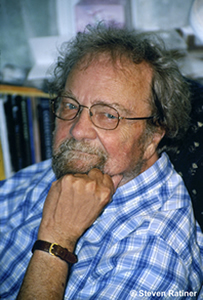
Vor wenigen Tagen bin ich hier angekommen, heute war ich zuerst bei Goethe. Der Empfang seinerseits war überaus herzlich und der Eindruck seiner Person auf mich der Art, dass ich diesen Tag zu den glücklichsten meines Lebens rechne.
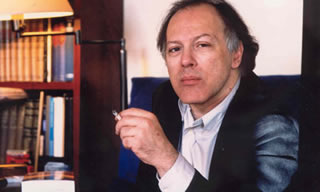
Er hatte mir gestern, als ich anfragen ließ, diesen Mittag zwölf Uhr als die Zeit bestimmt, wo ich ihm willkommen sein würde. Ich ging also zur gedachten Stunde hin und fand den Bedienten auch bereits meiner wartend und sich anschickend mich hinaufzuführen.

Das Innere des Hauses machte auf mich einen sehr angenehmen Eindruck; ohne glänzend zu sein war alles höchst edel und einfach; auch deuteten verschiedene an der Treppe stehende Abgüsse antiker Statuen auf Goethes besondere Neigung zur bildenden Kunst und dem griechischen Altertum. Ich sah verschiedene Frauenzimmer, die unten im Hause geschäftig hin und wieder gingen; auch einen der schönen Knaben Ottiliens, der zutraulich zu mir herankam und mich mit großen Augen anblickte.

Nachdem ich mich ein wenig umgesehen, ging ich sodann mit dem sehr gesprächigen Bedienten die Treppe hinauf zur ersten Etage. Er öffnete ein Zimmer, vor dessen Schwelle man die Zeichen SALVE als gute Vorbedeutung eines freundlichen Willkommenseins überschritt. Er führte mich durch dieses Zimmer hindurch und öffnete ein zweites, etwas geräumigeres, wo er mich zu verweilen bat, indem er ging, mich seinem Herrn zu melden. Hier war die kühlste erquicklichste Luft, auf dem Boden lag ein Teppich gebreitet, auch war es durch ein rotes Kanapee und Stühle von gleicher Farbe überaus heiter möbliert; gleich zur Seite stand ein Flügel, und an den Wänden sah man Handzeichnungen und Gemälde verschiedener Art und Größe”.

 
1240755-bf11c575e76ed019bf6803784b7f7dc6.jpg
Johann Peter Eckermann (21 september 1792 - 3 december 1854)
Eckermann en Goethe (l), krijttekening door Johann Joseph Schmeller, 1828

Geschreven door Romenu om 20:21 Reageer op dit bericht

Donald Hall, Javier Marías, Cyriel Buysse, Upton Sinclair

De Amerikaanse dichter en schrijver Donald Hall werd geboren in Hamden, New Haven County, Connecticut op 20 september 1928. Zie ook mijn blog van 20 september 2010 en eveneens alle tags voor Donald Hall op dit blog.


Gold


Pale gold of the walls, gold
of the centers of daisies, yellow roses
pressing from a clear bowl. All day
we lay on the bed, my hand
stroking the deep
gold of your thighs and your back.
We slept and woke
entering the golden room together,
lay down in it breathing
quickly, then
slowly again,
caressing and dozing, your hand sleepily
touching my hair now.

We made in those days
tiny identical rooms inside our bodies
which the men who uncover our graves
will find in a thousand years,
shining and whole.


Je Suis une table


It has happened suddenly,
by surprise, in an arbor,
or while drinking good coffee,
after speaking, or before,

that I dumbly inhabit
a density; in language,
there is nothing to stop it,
for nothing retains an edge.

Simple ignorance presents,
later, words for a function,
but it is common pretense
of speech, by a convention,

and there is nothing at all
but inner silence, nothing
to relieve on principle
now this intense thickening.


 1240091-e75e0dd5e1b44d630b4adcdcb42038b5.jpg

Donald Hall (Hamden, 20 september 1928)


De Spaanse schrijver Javier Marías Franco werd op 20 september 1951 in Madrid geboren. Zie ook mijn blog van 20 september 2010 en eveneens alle tags voor Javier Marías op dit blog.


Uit: Your Face Tomorrow. Poison, Shadow and Farewell (Vertaald door Margaret Jull Costa)


“It’s true that there are still a few people who harbor this deep - seated belief and to whom it does matter, and they are, in fact, acting so that the person they are saving can bear witness, so that he or she will think well of them and remember them with eternal admiration and gratitude; what they don’t realize at that decisive moment, or at least not fully, is that they will never enjoy that admiration or gratitude because they will be the ones who, a moment later, will be dead.’

And what came into my head while he was talking was an expression that was both diffi cult to grasp and possibly untranslatable, which is why, at fi rst, I didn’t mention it to Tupra, it would have taken me too long to explain. My initial thought was: ‘It’s what we call “vergüenza torera,” literally “a bullfi ghter’s sense of shame,” ’ and then: ‘Because bullfi ghters, of course, have loads of witnesses, a whole arenaful, plus sometimes a TV audience of millions, so it’s perfectly understandable that they should think: “I’d rather leave here with a ruptured femoral artery or dead than be thought a coward in the presence of all these people who will go on to talk about it endlessly and forever.” Bullfi ghters fear narrative horror like the plague, that fi nal defi ning wrong move, they really care about how their lives end, it’s the same with Dick Dearlove and almost any other public fi gure, I suppose, whose story is played out in full view of everyone at every stage or chapter, right up to the dénouement that can mark a whole life and give it an entirely false and unfair meaning.’ And then I couldn’t help saying it out loud, even though it meant briefl y interrupting Tupra. But it did, after all, add to what he was saying and was also a way of pretending that this was a dialogue:

‘That’s what we call “vergüenza torera.” ’ And I said the two words in Spanish, then immediately translated them. ‘I’ll explain to you exactly what it means another day, since you don’t have bullfighters here.’ Although at that moment, I wasn’t even sure there would be another day, another day at his side, not one.

‘OK, but don’t forget. And no, you’re right, we don’t have bullfi ghters here.’ Tupra was always curious to hear the turns of phrase in my own language about which I occasionally enlightened him, whenever they seemed relevant or were particularly striking. Now, however, he was enlightening me (I knew where he was heading, and both he and the path he was taking aroused my curiosity over and above the foreseeable revulsion I would feel at the end of the journey), and so he continued: ‘From there to letting someone die in order to save yourself is only a step, and trying to ensure that someone else dies in your place or even bringing that about (you know the kind of thing, it’s him or me) is just one more short step, and both steps are easily taken, especially the fi rst, in fact, in an extreme situation, almost everyone takes that step.”


 1240091-8d8873036a21da37c09e1d71b2a49a4d.jpg

Javier Marías (Madrid, 20 september 1951)


De Vlaamse schrijver Cyriel Buysse werd geboren op 20 september 1859 in Nevele. Zie ook mijn blog van 20 september 2007. Zie ook mijn blog van 20 september 2010 en eveneens alle tags voor Cyriel Buysse op dit blog.


Uit: De zwarte kost


“Het sloeg juist elf, die zondagmorgen, en in de enkele straat van het dorpje was alles stil en vreedzaam, toen, in een plotselinge opschudding, van huis tot huis de deuren openvlogen, en de bewoners met uitroepingen van verbazing op hun dorpels kwamen.

Er moest voorwaar geen gewichtige gebeurtenis in het rustig Akspoele plaatsgrijpen, om er terstond de lieden op de straat te lokken: de enkele voorbijtocht van een ongewoon rijtuig of de verschijning van een onbekende waren daartoe ruim voldoende. Doch ditmaal gold het iets zó buitengewoon ontzettends, dat het er terstond als een klein oproer werd.

Dáár, aan het uiteinde van de straat, komend in het dorp langs de weg van het station Bavel, naderde met rasse tred, vergezeld van een joelende bende knapen en meisjes, een groep van drie personen.

Hij, die in het midden liep, werd dadelijk herkend. Het was Massijn, Fortuné Massijn, de klerk van notaris Potvlieghe. Maar of de twee anderen mensen of dieren waren, dat konden de stomverbaasde dorpelingen nog niet bevestigen.

Zij hadden de gestalte en de lichaamsvormen van twee magere, te vroeg opgeschoten vijftienjarige knapen. Beiden droegen een zwartfluwelen pak, met korte broek en koperen knopen op het wambuis; beiden hadden lange rode kousen aan, en op het hoofd een zonderlinge rode pet, met zwarte, schuins afhangende kwast. Doch wat volstrekt op niets menselijks meer leek was hun gezicht: een glimmend-zwarte, monsterlelijke tronie met vervaarlijke ogen en vingerdikke lippen; en hun handen: afschuwelijke handen, zwart, lang en mager gelijk beestenklauwen. Een soort van zwarte, dicht-kroezende wol bedekte hun slapen; en door hun oorlellen staken overgrote koperen ringen, woest schitterend in de ochtend-zonneglans.

Massijn was in het dorp bekend als een allerzonderlingste kerel. Het greintje hoogmoedswaanzin, waaraan hij laboreerde, openbaarde zich bij hem in een zeer curieus verschijnsel: hij was bezeten door de manie der kennismaking met vreemdelingen. Men wist maar niet waar hij die steeds vandaan haalde, doch weinig zondagen gingen er voorbij dat hij niet de een of andere onbekende bij zich had, waarmee hij, opgeblazen van trots, de herbergen van Akspoele bezocht, met zijn verwarde uitspraak van hakkelaar de vreemdeling aan zijn kennissen voorstellend als ‘zij...ijn bêêêsten vri...iend’ van deze of gene, door de dorpelingen nooit gehoorde stad of streek; hem gul onthalend op al wat hij maar drinken wilde; hem eindelijk aan tafel uitnodigend en hem zelfs vaak met een rijtuig naar het naastgelegen station terugbrengend, dit alles tot grote ergernis van zijn moeder en zuster, die in dergelijke kennismakingen niet het minste genoegen vonden, en er integendeel zeer tegen opzagen een deel van het beperkt huiselijk inkomen zo nutteloos te zien verspillen.


 1240091-f8ad2977c1fd9d42fba07abb3c55f1aa.jpg

Cyriel Buysse (20 september 1859 - 25 juli 1932)

Gedenkplaat van Cyriel Buysse aan zijn voormalige woning in Nevele.


De Amerikaanse schrijver Upton Beall Sinclair werd geboren op 20 september 1878. Zie ook mijn blog van 20 september 2010 en eveneens alle tags voor Upton Sinclair op dit blog.


Uit: The Jungle


"Z. Graiczunas, Pasilinksminimams darzas. Vynas. Sznapsas. Wines and Liquors. Union Headquarters"—that was the way the signs ran. The reader, who perhaps has never held much converse in the language of far-off Lithuania, will be glad of the explanation that the place was the rear room of a saloon in that part of Chicago known as "back of the yards." This information is definite and suited to the matter of fact; but how pitifully inadequate it would have seemed to one who understood that it was also the supreme hour of ecstasy in the life of one of God's gentlest creatures, the scene of the wedding feast and the joy-transfiguration of little Ona Lukoszaite!

She stood in the doorway, shepherded by Cousin Marija, breathless from pushing through the crowd, and in her happiness painful to look upon. There was a light of wonder in her eyes and her lids trembled, and her otherwise wan little face was flushed. She wore a muslin dress, conspicuously white, and a stiff little veil coming to her shoulders. There were five pink paper roses twisted in the veil, and eleven bright green rose leaves. There were new white cotton gloves upon her hands, and as she stood staring about her she twisted them together feverishly. It was almost too much for her—you could see the pain of too great emotion in her face, and all the tremor of her form. She was so young—not quite sixteen—and small for her age, a mere child; and she had just been married—and married to Jurgis,* (*Pronounced Yoorghis) of all men, to Jurgis Rudkus, he with the white flower in the buttonhole of his new black suit, he with the mighty shoulders and the giant hands.

Ona was blue-eyed and fair, while Jurgis had great black eyes with beetling brows, and thick black hair that curled in waves about his ears—in short, they were one of those incongruous and impossible married couples with which Mother Nature so often wills to confound all prophets, before and after. Jurgis could take up a two-hundred-and-fifty-pound quarter of beef and carry it into a car without a stagger, or even a thought; and now he stood in a far corner, frightened as a hunted animal, and obliged to moisten his lips with his tongue each time before he could answer the congratulations of his friends.


 1240091-c62dad7e41215c85d6c68c5972981725.jpg

Upton Sinclair (20 september 1878 – 25 november 1968)


Zie voor nog meer schrijvers van de 20e september ook mijn blog van 20 september 2011 deel 1 en eveneens deel 2.

Geschreven door Romenu om 19:55 Reageer op dit bericht

Crauss, William Golding, Ingrid Jonker, Orlando Emanuels

De Duitse dichter en schrijver Crauss werd geboren in Siegen op 19 september 1971. Zie ook mijn blog van 19 september 2010 en eveneens alle tags voor Crauss op dit blog.


WETTERUMSCHWUNG


jetzt regnet es,

jetzt liegt wieder schnee, und

jetzt bilden sich kristalle

in deinem auge. ich

versuche, zurück zu gelangen,

die stapfen im matsch aber

sind nirgends zu finden.


jetzt erinnere ich wind,

der so mild war, dass er uns formte.

versuche, mit meinem herzschlag

die reifwirbel zu wärmen.

ich drehe mich um und

                wir brechen.


DEIN NAME


ich habe deinen namen

an die wand meines zimmers gekritzelt: hungrig halb

über den akt über das photo ein brettbauch

schwarz weiss und ein schwanz

wie ich ihn schöner nicht mag. dein name bricht auf daran

wie ein brot und ich speise die träne aus beidem

der akt ist ganz kopflos wie ich er hat einen arm

den darf man nicht streichen will man

das licht nicht zerstören das aufliegt.

man denkt ja vor ebenmasz garnicht an haare an härchen

mit diesem arm gibt es kein pärchen (der akt ist nur halb)

und ich liege unterleibfrei mit stift in der hand (ein edding,

fett) und denke den arm, nicht das photo:

den namen kann man wohl streichen.


RUSSISCHE VLECHT/EN DAN IN NOVEMBER


iemand kijkt sceptisch naar je

cacao en gaat pissen. heel gele gestalten stromen

vanaf het trottoir het lokaal in, de heupbenige jongen
kan amper waarmaken wat de schommelende jeans je

beloven. twee kaneelwangen lijken ’t te weten,

aan de muur straalt egoïste in enorme minuskels,

blauw, breed, dronken zoekt iemand een plaats, dan

mateloze regen, vrouw sredzki, verdiept, aan de arm van een

gouden rushhour.


iemand eigent zich iets toe, rent hard ervandoor

naar de husemannstrasse, de russische lokken al

nat, dan een pauze in het vermoeide geklater, de

stemming heel mild, de blaas alleen vol, wie net nog

lachte, bestelt snel opnieuw, de dorstige spuugt, dan

komt er iets vrij, (jouw cacao bijna koud). een paartje staat stil:

het venster weerspiegelt de appelrode kroegbazenzoon.

het staande betalen, de balans op de terugweg – het is

overal mooi, alleen hier is het eender.


Vertaald door Frans Roumen


 1239448-64b7f5486cff196edee23a55c1b36e6e.jpg

Crauss (Siegen, 19 september 1971)


De Engelse schrijver
Sir William Gerald Golding werd geboren in St. Columb Minor, Newquay, Cornwall, op 19 september 1911. Zie ook mijn blog van 19 september 2010 en eveneens alle tags voor William Golding op dit blog.


Uit: Lord of the flies


„Out there, perhaps a mile away, the white surf flinked on a coral reef, and beyond that the open sea was dark blue. Within the irregular arc of coral the lagoon was still as a mountain lake-blue of all shades and shadowy green and purple. The beach between the palm terrace and the water was a thin stick, endless apparently, for to Ralph’s left the perspectives of palm and beach and water drew to a point at infinity; and always, almost visible, was the heat.

   He jumped down from the terrace. The sand was thick over his black shoes and the heat hit him. He became conscious of the weight of clothes, kicked his shoes off fiercely and ripped off each stocking with its elastic garter in a single movement Then he leapt back on the terrace, pulled off his shirt, and stood there among the skull-like coconuts with green shadows from the palms and the forest sliding over his skin. He undid the snake-clasp of his belt, lugged off his shorts and pants, and stood there naked, looking at the dazzling beach and the water.


1239448-d13f277fefe3284f4dd0a383f97f0dec.jpg
Scene uit de film van Harry Hook uit 1990


He was old enough, twelve years and a few months, to have lost the prominent tummy of childhood; and not yet old enough for adolescence to have made him awkward. You could see now that he might make a boxer, as far as width and heaviness of shoulders went, but there was a mildness about his mouth and eyes that proclaimed no devil. He patted the palm trunk softly, and, forced at last to believe in the reality of the island, laughed delightedly again and stood on his head. He turned neatly on to his feet, jumped down to the beach, knelt and swept a double armful of sand into a pile against his chest. Then he sat back and looked at the water with bright, excited eyes.

   “Ralph-”

   The fat boy lowered himself over the terrace and sat down carefully, using the edge as a seat.

   “I’m sorry I been such a time. Them fruit-”

   He wiped his glasses and adjusted them on his button nose. The frame had made a deep, pink “V” on the bridge. He looked critically at Ralph’s golden body and then down at his own clothes. He laid a hand on the end of a zipper that extended down his chest.

   “My auntie-”

   Then he opened the zipper with decision and pulled the whole wind-breaker over his head.

   “There!”

   Ralph looked at him sidelong and said nothing.“


 1239448-8cb6b900b3f72a8199a0185409911920.jpg

William Golding (19 september 1911 – 19 juni 1993)


De Zuidafrikaanse dichteres en schrijfster Ingrid Jonker werd geboren op 19 september 1933 bij Komberley (Noord Kaap). Zie ook mijn blog van 19 september 2010 en eveneens alle tags voor Ingrid Jonker op dit blog.


Ik had gedacht


Ik had gedacht dat ik je kon vergeten,
en in de zachte nacht alleen kon slapen,
maar in mijn onschuld heb ik niet geweten
dat ik bij elke windvlaag zou ontwaken:

Dat ik de lichte trilling van je hand
weer langs mijn sluimerende hals zou voelen -
Ik dacht dat het vuur dat in me brandde
als de witte sterrenbaan zou zijn afgekoeld.

Nu weet ik dat onze levens zijn als een lied
waarin de smarttoon van onze scheiding klinkt
en waar alle vreugde terugvloeit in verdriet
en uiteindelijk in onze eenzaamheid verzinkt.


Tokkelliedje


Waar ik maar ga
ligt een pad voor me open
secuur in mijn blik
zoals littekens lopen

Hoe de dag ook verblauwt
of opvlamt om mij
ik volg niets dan mijn hartzeer
en het naambord ben jij


 1239448-4f08ea5c1289fa5e3176d4eb55c24dfb.jpg

Ingrid Jonker (19 september 1933 – 19 juli 1965)

Carice van Houten als Ingrid Jonker in de film Black Butterflies uit 2011


De Surinaamse dichter en schrijver Orlando Emanuels werd geboren in Paramaribo op 19 september 1927. Zie ook mijn blog van 19 september 2010 en eveneens alle tags voor Orlando Emanuels op dit blog.


Uit: Getuige à decharge


When before long
you bid us farewell
is it fare well of pocket
you're running after
neglecting fare well of soul,


you bid us farewell
dumping worn out shoes
a dirty towel
ragged shirts,
beware of the dustbin
collecting also memories
and love.


Don't defile yourself
turn not your back
upon this country
walk softly
when before long you bid us farewell.


Vertaald door Monique S. Pool


Soms schrijf ik gedichten

met water in mijn pen

en uit ik beschuldigingen

achter gesloten deuren

in tegenwoordigheid van

slechts één luisteraar

die uit de spiegel

beschaamd

naar mij blikt

Met mij zijn er zoveel

levende lafaards

die niet als dode held

de historie verkiezen

Zelfchantage als overlevingsmiddel

is ons niet vreemd


 1239448-edcc7390bfaa15b86499e2ae51129b95.jpg

Orlando Emanuels (Paramaribo, 19 september 1927)


Zie voor nog meer schrijvers van de 19e september ook mijn blog van 19 september 2011 deel 1 en eveneens deel 2.
Geschreven door Romenu om 19:24 Reageer op dit bericht

Armando, Ton Anbeek, Michaël Zeeman

De Nederlandse kunstschilder, beeldhouwer, dichter, schrijver, violist, acteur, journalist, film-, televisie- en theatermaker Armando werd geboren op 18 september 1929 in Amsterdam. Zie ook mijn blog van 18 september 2010 en eveneens alle tags voor Armando op dit blog.


Licht


Terwijl het licht zich probeert te
ontvouwen, is de stad opstandig,
de verschrikking heeft zichzelf overleefd,
het einde nadert de onderdanen,
nadert de onontkoombaarheid.

Het grillige licht wil bezitten
wil veinzen,
maar het licht is machteloos,
het licht is ontmanteld.


 1238848-97a4ae77116295f070af7417fac64d9e.jpg

Armando, Paysage criminel, 1955


Het laatste gesprek


'Heer, herken ik u? Zijn wij niet dezelfde van weleer?'
'Wie riep mij dan? Zijn uw wapens niet de mijne?'
'Ik wacht op woorden, Heer.'
'Ik was Dader, u het Offer. De medemens is leeg.'
'Sterven Daders niet.'
'Neen. Zij kunnen niet. Zij verwoorden.'
'Heeft u ginds gesproken, Heer?'
'De dagen zijn beschreven.'
'Heeft de Tijd nog kwaad gewild?'
'Ja, het slagveld is begroeid.'
'Geen spoor van oorlog meer?'
'Geen. Maar ik doorzie de stilte. Oog en oor vergaan.'
'Nadert weer de Dood, o heer?'
'Neen. Hij was er al.'


1238848-4cdfdef13cc5737093d147b8bb194049.jpg 

Armando (Amsterdam, 18 september 1929)


De Nederlandse schrijver en letterkundige Ton Anbeek werd geboren in Ede op 18 september 1944. Zie ook mijn blog van 18 september 2010 en eveneens alle tags voor Ton Anbeek op dit blog.


Uit: Vestdijks beeld van de tweede wereldoorlog: ‘Pastorale 1943’ en ‘Bevrijdingsfeest’


“Intussen verscheen in het tijdschrift Centaur in afleveringen de roman van Vestdijk, Pastorale 1943, die pas in 1948 in boekvorm uitkwam. Vestdijk kan men moeilijk van clichématigheid beschuldigen. In het derde hoofdstuk staat het zinnetje: ‘Sommige Nederlanders werden door de oorlog helden, anderen misdadigers, weer anderen grote kinderen (...)’ (p.26). Je zou kunnen zeggen dat in Pastorale vooral de derde categorie, die van de grote kinderen, de aandacht krijgt.Natuurlijk, Vestdijk is een meester van de ironie (men moet er niet aan denken met welke besmuikte spot hij een gezelschap dat alleen om wille van zijn werk bijeenkomt, zou hebben beschreven), maar ik ken geen boek van hem dat zo van de eerste tot de voorlaatste bladzijde ironisch is.Het is ironisch in zijn beschrijvingen, en dan met name als het gaat om de verzetsmensen die de aanslag op Poerstamper beramen en uitvoeren. ‘“Bij de distributieoverval”, zei Eskens, “plakten we knevels en baardjes op ons gezicht, en smeerden ons gezicht zo'n beetje in. Ik had  'n hangsnor, Mertens, die stakker, 'n soort Hitlersnorretje, maar dan in 't blond. En we hadden zwarte maskers voor onze ogen, dat wil zeggen niet in de auto natuurlijk. Je moet zo iets niet te gek maken, anders trekt 't juist de aandacht...”’ (p. 162).En dus moet Schults alles doen om al te gekke maskerades te voorkomen: ‘Met veel moeite was hij erin geslaagd het aantal snorren zoveel mogelijk te beperken: Ballegooyen mocht zijn baard houden, Eskens werd toegestaan het blonde Hitlersnorretje van Mertens te gebruiken, dat hij van diens vrouw had losgekregen; zelf droeg hij een snor; maar Hammer en Van Dale hadden zich op een andere manier moeten toetakelen’ (p. 165).De aanslag mislukt, zoals men weet, tot twee keer toe: eerst omdat de zoon van Poerstamper verschijnt, de tweede keer omdat men in de haast slordig schiet. De hele onderneming is buitengewoon amateuristisch, en Vestdijk laat geen kans voorbijgaan om de knulligheid van de actie te onderstrepen.”


1238848-82550a2c9938e37a849e743072f25671.jpg 

Ton Anbeek (18 september 1944)


De Nederlandse dichter, schrijver, journalist en literair criticus Michaël Zeeman werd geboren op Marken op 12 september 1958. ook mijn blog van 18 september 2010 en eveneens alle tags voor Michaël Zeeman op dit blog.


De canapé van Pamela


Zo dichtbij als mijn kamerjas,
vanwege de kou onder de deken
gelaten en tegen mij aan gelegd,
voor de morgen, als zijn komst
zo betrouwbaar,

zo naast mij in aarzelende zinnen
van adem in en adem weer uit met
telkens dat even onneembare obstakel
dat weloverwogen weg wordt geslapen,
zo luisterrijk,

zo naar binnen gedropen als muziek,
al die adem samengekruld en deinend
van minuut tot minuut op een snaar
in mijn hoofd, een spinnende fuga,
zo nabij.


Uit: Halverwege, de liefde; halverwege, de dood


Halverwege, de liefde

Nooit stort men zich zo vol overgave

op haar staart, om haar hals en moeiteloos

neer op haar bed, legt het hoofd

in haar schoot, de buik in haar billen,

de handen als rijglijf om haar borsten,


en ook nooit zal zij zo geduldig ontvankelijk,

noch mededeelzaam en mild en tevreden,

evenmin goed gemutst en opgeruimd,

van belangstellend naar gretig naar gulzig,

naar ruggelings buitelend in vergetelheid,


Men is de vogel en de vogelaar, de twijfel

en de twijfelaar, het scherm en de kijker.

Men loopt als een eend en koert als een duif,

men paart als een reiger en schreeuwt als een meeuw.


 1238848-4f877d66433262bf4daea82e2a8db42e.jpg

Michaël Zeeman (18 september 1958 - 27 juli 2009)


Zie voor nog meer schrijvers van de 18e september ook mijn blog van 18 september 2011 deel 1 en eveneens deel 2.
Geschreven door Romenu om 19:27 Reageer op dit bericht

H.H. ter Balkt, William Carlos Williams

De Nederlandse dichter H.H. (Herman Hendrik) ter Balkt werd geboren in Usselo op 17 september 1938. Zie ook mijn blog van 17 september 2010 en eveneens alle tags voor H. H. Ter Balkt op dit blog.


Hoera! De Herfst komt


De roodkoperen kont van de kunst
wordt door velen gekust,
zo komen ook op de 60watts gloeilamp
vliegen en torren af bij miriaden

denkend: waar 't licht is is 't lekker
De schrik van de torren ontlaadt zich
in minuscule stippen, hun altaren
die zij bouwen op het glas van de gloeilamp

Hoera! de herfst komt! veel duister
veel lampen veel vleugelslag
Lezer onder je gloeil  amp hef je hoofd op:
de trekvogels gaan, de uiltjes komen.


IJzel en brem


In de hoekjes van de ogen huilt het
Zienderogen werd de winter een keel
Het is de keel van de winter die krast
De brem op de akkerrand lijkt bevroren

De brem op de akkerrand leek geelzwart
Winter hurkte als een kraai op het dak
Zwart en geel en kraste uitzinnig
Toen ijzel op de straatweg tokkelde

IJzel tokkelde op de straatwegen toen
De gele brem strakgespannen, een harp!
Twijgen hingen zwaarder van de ijzel
Tokkelend in de benige oostenwind

In de dunvingerige wind tinkelend
Zulke ijle muziek klonk op uit de tuinen
Brem bij je akker weersta de winter!
In de hoekjes van de ogen huilde het


Urnenvelden; hazenhemelen


Wit wollegras, lavendelheide gluurden uit
hun hoogveen naar aaneengestikte hazenvellen
grauw als de vergleden en naderende eeuwen
boven nederzettingen, rechthoekig, met

twee ingangen in de lange zijden; middenin
die hoeven één rij dragende palen: dat is wat
wij vonden en dat hun bewoners de as van hun
doden in urnen bewaarden, de urnen bijzetten

in heuvels, altijd door kringgreppels omringd.
Hier en daar in 't zand een vorstengraf, met
koninklijke gaven: geknakt zwaard; paardentuig.

Soms zag een kiespijnlijder of visionair tegen
de hazenvellenhemel metropolen geprojecteerd;
neon; en op de urnenvelden drupte zijn lach.


 1238227-b3a21885b3f6966608db3c284676cf61.jpg

H.H. ter Balkt (Usselo, 17 september 1938)


De Amerikaanse dichter William Carlos Williams werd geboren in Rutherford (New Jersey) op 17 september 1883. Zie ook mijn blog van 17 september 2010 en eveneens alle tags voor William Carlos Williams op dit blog.


On Gay Wallpaper


The green-blue ground
is ruled with silver lines
to say the sun is shining

And on this moral sea
of grass or dreams lie flowers
or baskets of desires

Heaven knows what they are
between cerulean shapes
laid regularly round

Mat roses and tridentate
leaves of gold
threes, threes and threes

Three roses and three stems
the basket floating
standing in the horns of blue

Repeating to the ceiling
to the windows
where the day

Blows in
the scalloped curtains to
the sound of rain


Backward


A three-day-long rain from the east--
an terminable talking, talking
of no consequence--patter, patter, patter.
Hand in hand little winds
blow the thin streams aslant.
Warm. Distance cut off. Seclusion.
A few passers-by, drawn in upon themselves,
hurry from one place to another.
Winds of the white poppy! there is no escape!--
An interminable talking, talking,
talking . . .it has happened before.
Backward, backward, backward.


Thursday


I have had my dream--like others--
and it has come to nothing, so that
I remain now carelessly
with feet planted on the ground
and look up at the sky--
feeling my clothes about me,
the weight of my body in my shoes,
the rim of my hat, air passing in and out
at my nose--and decide to dream no more.


 1238227-a4ff30ecfd4e437b4bd549173b8fa848.jpg

William Carlos Williams (17 september 1883 - 4 maart 1963)


Zie voor nog meer schrijvers van de 17e september ook mijn blog van 17 september 2011 deel 1 en eveneens deel 2.
Geschreven door Romenu om 19:52 Reageer op dit bericht

Dolce far niente (Daan de Ligt, Jan Kal)

Dolce far niente


1237567-e57407959d9c54d7ae0366f8a432464c.jpg
De "Zes min" van Bisschoppelijk College Schöndeln, Roermond


Reünie


de lange gangen met de vale tegels
-er hing nog steeds de geur van natte jassen-
leidden onveranderd naar de klassen
waar ik zuchtte onder strenge regels

ik had gezworen nooit terug te keren
tot ik die lijst zag met daarop jouw naam
het stille meisje bij het hoge raam
dat mij geduldig hielp Latijn te leren

je ogen glansden vurig als voorheen
dezelfde zachte stem, nog steeds verlegen
waarom gingen de wegen toch uiteen

ik voelde het werd tijd voor klare wijn
en zei wat ik die jaren had verzwegen:
we zijn nog niet aan ‘t eind van ons Latijn


 1237567-001f56a8580c7f275e32631f5b70d104.jpg

Daan de Ligt (Den Haag, 1953)


Oud-leerlingenorkest, eerste repetitie


'Violen zijn de glans van een orkest,'
zei dirigent Ed Spanjaard, en ik kleurde.
Hoewel verguld dat hij mij waardig keurde,
vind ik het notenbeeld een rohrschachtest.

Maar naast me horend waar mijn blik naar speurde,
wordt Verdi mij na één keer manifest.
Tsjaikovski en Vivaldi volg ik best.
Poulenc is lastiger. En dan Van Beurden!

Ed, dat ik mee mag doen op mijn viool
bij 't zesde eeuwfeest onzer oude school,
doet mij nog meer dan dat ik toch al wist.

Maar na 't concert berg ik hem in de kist
tot over tien of vijfentwintig jaar.
Ben ik niet zelf gekist, dan zit ik klaar.


1237567-3b98a4679a79cb579189fbeb8538e49f.jpg
Jan Kal (
Haarlem, 18 december 1946)


Zie voor de schrijvers van de 16e september ook mijn blog van 16 september 2011 deel 1 en eveneens deel 2.
Geschreven door Romenu om 20:30 Reageer op dit bericht

Frans Kusters

De Nederlandse schrijver Frans Kusters werd geboren in Nijmegen op 16 september 1949. Zie ook alle tags voor Frans Kusters op dit blog.


Uit: Hachee met sambal


‘En toen, ruim een jaar later, kreeg ik die prijs en verscheen mijn debuut en mijn kop stond in de kranten en die schreven dat het een interessant boek was en toen riepen zij, de vrienden en vriendinnen, dat zij het altijd al prachtig hadden gevonden.’
‘Ach ja, debuten’, merkte de uitgever op. Het zonlicht was uit de kamer verdwenen. Weer zwegen wij, om beurten naar Willem kijkend, zodat het erop leek dat we iets vermakelijks voor hem hadden ingestudeerd en het moment afwachtten waarop we hem daarmee konden verblijden.

(…)


‘Ach ja, debuten’, merkte de uitgever op.
Het zonlicht was uit de kamer verdwenen. Ik stond op en liep naar het erkerraam. Ik moest Vera bellen, nu, ogenblikkelijk, Frank zou mij met alle plezier voor een paar minuten in zijn kamer alleen willen laten, hortend en stotend en desnoods geloofwaardig jankend zou ik (eindelijk) bekennen dat ze gelijk had, dat ik niet zomaar vanwege het minste of geringste van haar weg kon gaan en dat de vertoning lang genoeg had geduurd. Ik liep terug naar mijn stoel en ging weer tegenover hem zitten. We bleven zwijgen, om beurten naar Willem kijkend, zodat het erop leek dat we iets vermakelijks voor hem hadden ingestudeerd en het moment afwachtten waarop we hem daarmee konden verblijden.


1280268-f9366b856bcac7b5bc1a3c4e059c7d23.jpg
Frans Kusters (Nijmegen, 16 september 1949)

Geschreven door Romenu om 00:00 Reageer op dit bericht

Jan Slauerhoff, Lucebert, Chimamanda Ngozi Adichie, Agatha Christie

De Nederlandse dichter en schrijver Jan Jacob Slauerhoff werd geboren in Leeuwarden op 15 september 1898. Zie ook mijn blog van 15 september 2010 en eveneens alle tags voor Jan Slauerhoff op dit blog.


De laatste herfst


Ver stond de strakke lucht
Als een grijszijden scherm
Gespannen voor de dood.
Aan deze zijde een vlucht
Vogelen met gekerm,
Onze hoofden over, vlood.

De grond bekroop wat groen.
Schril staken stengels riet.
De wereld stond ontbladerd
Uitstervend in seizoen,
Dat zon voorgoed verliet,
Weer tot de maan genaderd.
Wij vonden nog een zoen.
Ergens zijn wij ons toen
Ontweken of genaderd?


Eenzaamheidsverlangen


Ik wilde alleen zijn met mijn droefenis
En ik verborg mij in 't gewoekerd gras.
Maar tevergeefs: mijn droefenis verried mij,
Mijn smartkreet overstemt de roep der vogels.
Waarom kan men niet lijden ongehoord
En ongezien, terwijl men toch alleen,
Alleen de lange levensweg moet gaan,
En toch nooit eenzaam leven kan: altijd
Zijn broeders, zusters, zonen, dochters, ouders
Aanwezig en bewijzen zorg en aandacht.
Ontvlucht men in de tempel, dan moet men
Voorouders aandacht wijden, offers brengen,
Om door demonen niet omringd te worden.
Ach, alles, eer en welstand, wilde ik offren
Om met mijn droefenis alleen te zijn.


De wijze


Mijn huis is vuil, mijn kinderen, talrijk, krijsen.
De varkens wroeten ronkend in de hof.
Maar bergen, blauw en ver verheven, eisen
Mijn aandacht op, die stijgt uit stank en stof.


1236413-08961d97326a91fda0f4996e06256027.jpg 

Jan Slauerhoff (15 september 1898 – 5 oktober 1936)


De Nederlandse dichter Lucebert werd in Amsterdam geboren op 15 september 1924 onder de naam Lubertus Swaanswijk. Zie ook mijn blog van 15 september 2010 en eveneens alle tags voor Lucebert op dit blog.


Van de econoom


onverschrokken bij braindrain de schoonprater
springt van nest naar vogel en blijft opgetogen
in de spaghetti van glossolalie lepelen

bepaalde aspecten moeten worden meegenomen
als je niet bepaalde effecten voorkomt
maar kunnen ook blijven liggen als vorm van antwoord
zoals de schepping ook is bepaald die met mensen in de supermarkt
al te toevallige offers heeft afgewend daar komen we onszelf tegen
in de ethiek van het economisch leven

zorgvuldig produceren en consumeren
er is een omslag ontstaan in de omgang
een kwestie van gewenning
invulling van verantwoordelijkheden meer vulsel
dat uitspruit tot vullus
toegevoegde waarde
strijkstok van strijkages


1236413-14431cba4fd65da1e7f939128bde1e55.jpg 

Lucebert, ‘I can’t dance I’ve got ants in my pants’, 1984


Landjuweel


met een broodkorst als corsage gaat
de blijde zwerver door het wijde land
hij wuift naar de koeien in de weiden
naar het bloeiende koren hem terzijde
terwijl leeuweriken eten uit zijn hand

's avonds stralend staan de boerenmaagden
aan de dorpspomp en brengen hem hun groet
zij kussen zijn bewete konen zelfs bedaagde
maagden vlijen warm hun harten aan zijn voet
omdat hun oude moeders zeggen dat het moet

laat in het hooi prevelt de zwerver zijn gebeden
en leest wat lezenswaardigs in het oude boek
terwijl pooiers en hoeren strompelen door de steden
hun gore ratten rennen radeloos van hoek naar hoek
strekt hij verzadigd zijn gelooide leden


het lied van een eenzame vrouw


toen haar gelaat nog maar een kamerplant was
en zijn wrokkig gezicht een ondoordringbare baard
en de laatste resten van het wrak
door de kinderen verbrast
verging ook dit gezin
tot nog maar een herinnering
aan lentedagen op een zonnig terras
toen alle bomen donker opvlogen
achter blakende oogkleppen
een een noodklok bombamde
tussen blozende dovemansoren


 1236413-1abac4d3a9e574b39f03368104aeb090.jpg

Lucebert (15 september 1924 - 10 mei 1994)


De Nigeriaanse schrijfster Chimamanda Ngozi Adichie werd geboren op 15 september 1977 in Enugu. Zie ook mijn blog van 15 september 2010 en eveneens alle tags voor Chimamanda Ngozi Adichie op dit blog.


Uit: Half of a Yellow Sun


"I told Master you will learn everything fast, osiso-osiso," his aunty said. Ugwu nodded attentively although she had already told him this many times, as often as she told him the story of how his good fortune came about: While she was sweeping the corridor in the mathematics department a week ago, she heard Master say that he needed a houseboy to do his cleaning, and she immediately said she could help, speaking before his typist or office messenger could offer to bring someone.

"I will learn fast, Aunty," Ugwu said. He was staring at the car in the garage; a strip of metal ran around its blue body like a necklace.

"Remember, what you will answer whenever he calls you is Yes, sah!"

"Yes, sah!" Ugwu repeated.

They were standing before the glass door. Ugwu held back from reaching out to touch the cement wall, to see how different it would feel from the mud walls of his mother's hut that still bore the faint patterns of molding fingers. For a brief moment, he wished he were back there now, in his mother's hut, under the dim coolness of the thatch roof; or in his aunty's hut, the only one in the village with a corrugated iron roof.

His aunty tapped on the glass. Ugwu could see the white curtains behind the door. A voice said, in English, "Yes? Come in."

They took off their slippers before walking in. Ugwu had never seen a room so wide. Despite the brown sofas arranged in a semicircle, the side tables between them, the shelves crammed with books, and the center table with a vase of red and white plastic flowers, the room still seemed to have too much space. Master sat in an armchair, wearing a singlet and a pair of shorts. He was not sitting upright but slanted, a book covering his face, as though oblivious that he had just asked people in.

"Good afternoon, sah! This is the child," Ugwu's aunty said.

Master looked up. His complexion was very dark, like old bark, and the hair that covered his chest and legs was a lustrous, darker shade. He pulled off his glasses. "The child?"

"The houseboy, sah."


 1236413-559b0bb12335930638285b796d2ee3ac.jpg

Chimamanda Ngozi Adichie (Enugu, 15 september 1977)


De Britse schrijfster Agatha Christie werd geboren in Torquay (Devon) op 15 september 1890. Zie ook mijn blog van 15 september 2010 en eveneens alle tags voor Agatha Christie op dit blog.


Uit; The Clock


I sidled through the doorway. It was necessary to sidle, since precariously arranged books impinged more and more every day on the passageway from the street. Inside, it was clear that the books owned the shop rather than the other way about. Everywhere they had run wild and taken possession of their habitat, breeding and multiplying and clearly lacking any strong hand to keep them down. The distance between bookshelves was so narrow that you could only get along with great difficulty. There were piles of books perched on every shelf or table. On a stool in a corner, hemmed in by books, was an old man in a pork-pie hat with a large flat face like a stuffed fish. He had the air of one who has given up an unequal struggle. He had attempted to master the books, but the books had obviously succeeded in mastering him. He was a kind of King Canute of the book world, retreating before the advancing book tide. If he ordered it to retreat, it would have been with the sure and hopeless certainty that it would not do so.


 1236413-f254dc01522472ed06466b9924fd3e03.jpg

Agatha Christie (15 september 1890 – 12 januari 1976)


Zie voor nog meer schrijvers van de 15e september ook mijn blog van 15 september 2011 deel 1 en eveneens deel 2.
Geschreven door Romenu om 08:29 Reageer op dit bericht

Meer van Romenu

↑ Terug naar de berichten