Naar de inhoud

Romenu

Over literatuur, gedichten, kunst en cultuur
seniorennet.beseniorennet.be

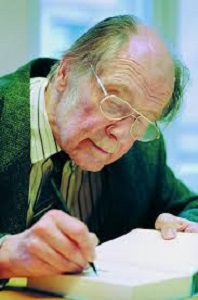
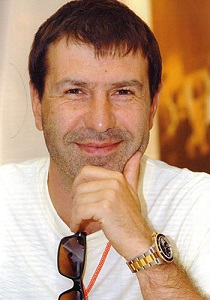
In Memoriam Hugo Brandt Corstius


In Memoriam Hugo Brandt Corstius


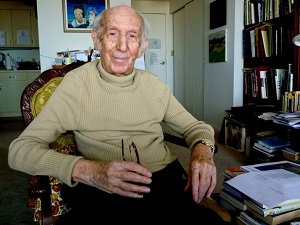
De Nederlandse schrijver en taalwetenschapper Hugo Brandt Corstius is gisteren op 78-jarige leeftijd overleden. Hugo Brandt Corstius werd geboren in Eindhoven op 29 augustus 1935. Bekend werd hij ook onder de pseudoniemen Piet Grijs, Stoker, Raoul Chapkis en Battus. Zie ook alle tags voor Hugo Brandt Corstius op dit blog.

Uit: Nieuwe Missiereizen van Pater Key (als Raoul Chapkis)

“Hij verlaat het strand en neemt de bus naar de hoofdstad. Daar komt hij langs het huis van de kantonrechter en hoort de vrouw van de kantonrechter naar beneden roepen:
‘Liefje, kom je slapen?’. ‘Nee, vrouw ik moet nog wat stukken doornemen, ik heb er maar twee weken de tijd voor, en er is heel wat aan door te nemen’ is het harteloze antwoord. Voor hem op tafel ligt een ets van de heer A. Veldhoen waarop een fragment van een coïtus is afgebeeld. De kantonrechter neemt dit stuk aandachtig door. Zijn vrouw boven bijt in het kussen. Key loopt mistroostig door. Deze reis is het al te gek. Hij heeft veel meegemaakt. Een dag sudderen in een kookpot waar de inboorlingen vergeten hebben zout in te doen, Het gezelschap van de doorzichtige uitwerpselen der Worstelbormen. Het treiteren van brandnetels en viooltjes. Alles had hij verdragen. Maar deze toestanden werkten hem op de zenuwen. Gezonde volwassen mensen die zich door kledings- en gerechtelijke stukken laten weerhouden van hun natuurlijke functies, het vervult Key met weerzin.
Ten einde raad neemt hij de trein naar 's-Hertogenbosch en belt aan bij monseigneur Bekkers, de bisschop die al zoveel priesters uit hun gewetensnood heeft verlost, dat het niet onwaarschijnlijk is dat hij een zoon is van God, door Hem in de gedaante van een priester naar de aarde gezonden om de priesters te verlossen. Key vertelt Bekkers de laatste negen hoofdstukken. Ze gaan samen naar de televisiestudio van de K.R.O. en hier houdt monseigneur Bekkers een opzienbarende toespraak. ‘Gelovigen’ zegt hij ‘uw grote nood is mij ter ore gekomen. Ik heb goed nieuws voor u: van nu af aan kunt u er mee ophouden. Ik hou er zelf ook mee op. Niet alleen de Jezuieten laat ik vrij, allemaal wordt u losgelaten. Laat de kruisbeelden maar hangen, anders komt er zo'n lelijke plek op het behang, maar denk er verder niet meer aan. Het is mooi geweest. U bent van alles af.’ Pater Key mag met vacantie naar Tristan da Cunha. Maar dat hoort thuis in het volgende hoofdstuk.”


 1557872-33f7e21d5118ac4152a8d9d55c80aa29.jpg
Hugo Brandt Corstius (29 augustus 1935 – 28 februari 2014)

Geschreven door Romenu om 10:12 Reageer op dit bericht
Reageer op dit bericht

Reageer op dit bericht

Een titel of je eigen website toevoegen

De blogger leest alles eerst na: je tekst verschijnt zodra die goedgekeurd is.

Stephen Spender, Bart Koubaa, Luc Dellisse, John Montague, Marcel Pagnol, Raphaële Billetdoux

De Engelse dichter, essayist en schrijver Stephen Spender werd geboren op 28 februari 1909 in Londen. Zie ook alle tags voor Stephen Spender op dit blog.


On The Third Day

On the first summer day I lay in the valley.
Above rocks the sky sealed my eyes with a leaf
The grass licked my skin. The flowers bound my nostrils
With scented cotton threads. The soil invited
My hands and feet to grow down and have roots.
Bees and grass-hoppers drummed over
Crepitations of thirst rising from dry stones,
And the ants rearranged my ceaseless thoughts
Into different patterns for ever the same.
Then the blue wind fell out of the air
And the sun hammered down till I became of wood
Glistening brown beginning to warp.

On the second summer day I climbed through the forest's
Huge tent pegged to the mountain-side by roots.
My direction was cancelled by that great sum of trees.
Here darkness lay under the leaves in a war
Against light, which occasionally penetrated
Splintering spears through several interstices
And dropping white clanging shields on the soil.
Silence was stitched through with thinnest pine needles
And bird songs were stifled behind a hot hedge.
My feet became as heavy as logs.
I drank up all the air of the forest.
My mind changed to amber transfixed with dead flies.

On the third summer day I sprang from the forest
Into the wonder of a white snow-tide.
Alone with the sun's wild whispering wheel,
Grinding seeds of secret light on frozen fields,
Every burden fell from me, the forest from my back,
The valley dwindled to bewildering visions
Seen through torn shreds of the sailing clouds.
Above the snowfield one rock against the sky
Shaped out of pure silence a naked tune
Like a violin when the tune forsakes the instrument
And the pure sound flies through the ears' gate
And a whole sky floods the pool of one mind.


To my Daughter

Bright clasp of her whole hand around my finger,
My daughter, as we walk together now.
All my life I’ll feel a ring invisibly
Circle this bone with shining: when she is grown
Far from today as her eyes are far already.


 1557534-a09cf84f04b7425951d868c244ddd70b.jpg
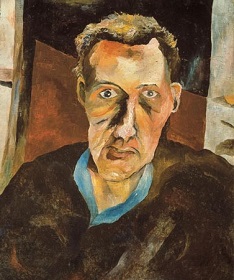
Stephen Spender (28 februari 1909 – 16 juli 1995)
Portret door Lucian Freud, 1940


De Vlaamse schrijver Bart Koubaa (pseudoniem van Bart van den Bossche) werd geboren op 28 februari 1968 in Eeklo. Zie ook alle tags voor Bart Koubaa op dit blog.

Uit: Maria van Barcelona

“...Een flits, niet meer dan een flits was het! En toen ik mijn camera liet zakken, was hij weg. Ik boog mijn hoofd en stond op het punt dit te aanvaarden. Ik stond op het punt mij te verzoenen met dit einde; punt, streep eronder, een nieuw hoofdstuk. Maar de machiavellistische zee en wind daagden me uit en ik stapte voorzichtig naar de reling, op mijn hoede voor de doodstrijd die zich mogelijk onder mijn voeten afspeelde. Ik hoorde geen gekerm, ik hoorde niemand stuiptrekken of bidden. Er was alleen mist en jodium en een leeg blikje dat op de wind over de promenade stuiterde: geen spoor van Lukas.
Ik liep langs de schuine helling naar beneden en kwam met een versnelde beweging op het uitgestrekte strand terecht. De pier, rechts van mij, was niet meer dan een krijtstreepje dat overging in de doffe dreun van een misthoorn, een hond die door het mulle zand rende, hijgde als de wind die mijn gezicht bekogelde met snijdende zandkorrels. Ik sluierde mezelf met mijn rood-blauwe sjaal en stapte kromgebogen op een blinkende golfbreker tot in het schuimende water. Ik liep op het water en speurde de horizon af naar de sloep, naar de fontein van de potvis die hem had opgeslokt. Ik weet niet hoe lang ik daar gestaan heb als een vissersvrouw, als een bedoeïen vol ongeloof, als een dronken kapmeeuw, als zeewier.
Ik was hem kwijt en liep rillend terug naar de promenade. Boven de stad, in een vage verte antwoordde het rode bayer op de monotone flitsen van de vuurtoren. Voor ik de trappen op liep, trok ik mijn slipje tot over mijn knieën en hurkte tussen twee strandcabines. De kille wind verleidde mijn zinderende geslacht, ik bakende mijn territorium af. Weer boven ging ik naar de plaats waar ik de foto had gemaakt. Ik hield mijn camera voor mijn oog; zocht tevergeefs.”


 1557534-28406809dc0ec0a379800aaacf4a1366.jpg
Bart Koubaa (Eeklo, 28 februari 1968)


De Belgische-Franse dichter, schrijver, essayist, dramaturg en scenarioschrijver Luc Dellisse werd geboren op 28 februari 1953 in Brussel. Zie ook alle tags voor Luc Delisse op dit blog.


Escalier

Un amour qui remonte aux sources du rêve
Qui marche dans le vide
Une bouche de craie qui s’appuie sur la
Blessure, une bouche de poudre
Une longue brûlure en forme de feuille
Une jungle où tous les oiseaux sont morts
Où les serpents d’arbres se dénouent
Et où se love la gangrène
Un amour qui descend l’enfer en riant.


Zénith

C’était si bien le jardin aux yeux verts
Les portes ouvertes de la beauté
Le tremblement de la main de l’amour
Et l’espoir d’arriver à temps pour l’orage
C’était si bien le chemin dessiné
Avec le doigt sur la paume
Les lignes de vie, le signe du sourire
La profondeur de l’aiguille aimantée
C’était si bien dans le soleil un accident
D’oiseaux, le bruit aérien de la laine
Les tissus froissés, les ventres dénudés
Les plumes du génie de ta voix
C’était si bien la grandeur de la nuit
L’écriture rapide de nos spasmes
La prosodie du plaisir, fléchissant,
Remontant, le feu, le feu, le feu
C’était si bien nos enfants courant sur le lit
Le bruit de la clé dans la porte
Et le visage qui se relève et le choc
Sans fin du retour de l’éternité.


 1557534-aa0d1d250cb9244259b76c34e471e623.jpg
Luc Dellisse (Brussel, 28 februari 1953)


De Ierse dichter John Montague werd geboren in New York op 28 februari 1929. Zie ook alle tags voor John Montague op dit blog.


Intimacy

“Mother, mother,” I whisper,
over the years we had won
to a sweet intimacy together.
She would come with me often
to Fintona’s first picturehouse,
rigged out like a girlfriend
in her evening finery, snug
in the best seats, munching
soft centred chocolates. Naturally
we chose romances, Sir Laurence
stalking the cliffs in Rebecca,
Leslie Howard defending the South,
courteous through cannonsmoke,
and I thought I might bring her
to some sad story of Brookyln,
the bridge’s white mirage shining
over broken lives like her own,
but she wept, and dabbed her eyes:
“I hate films about real life.”

Melancholy destiny, indeed.
Young love, then long separation.
After our drive across Ireland,
my father stood in the kitchen,
surrounded by his grown sons
and the wife he had not seen
for almost two decades, spirit
glass in hand, singing ‘Slievenamon’
or Molly Bawn, why leave me pining,
his eyes straying in strangeness
to where she sat, with folded
hands, grey hair, aged face,
Alone, all alone by the wave
washed strand, still his Molly Bawn,
wrought by time to a mournful crone.

Six years later, he was gone,
to a fairer world than this,
and we sat in television darkness,
searching from channel to channel
while the badmen came riding in,
guns glinting in the prairie sun,
or the pretty nurse fell in love
with the subtle handed surgeon
as the emergency was wheeled in –
tho’ lonely my life flows on –
and she laughed, reaching down
for the brandy by her side, or
excitedly darting snuff, dust
settling on her apron . . . .


 1557534-e16ae51dfbb0c0598c7f15dcf2289367.jpg
John Montague (New York, 28 februari 1929)
Jaren 1960 


De Franse dichter, schrijver, dramaturg en regisseur Marcel Pagnol werd geboren op 28 februari 1895 in Aubagne, Bouches-du-Rhône. Zie ook alle tags voor Marcel Pagnol op dit blog.


La cigale

Le soleil fendille la terre,
Aucun bruit ne trouble les champs ;
On n'entend plus les joyeux chants
Des oiseaux qui chantaient naguère.
Tous par la chaleur assoupis
Sous les buissons se sont tapis.
Seule une cigale est sur l'aire.

Son ventre sonore se meut ;
Sur une gerbe elle est posée ;
Seule elle n'est point épuisée
Par l'astre à l'haleine de feu.
Et la chanteuse infatigable
Jette dans l'air brûlant et bleu
Sa ritournelle interminable.


À Albert Cohen

Déjà l’aurore au loin glace le ciel de rose
L’horizon est empli de frais rayonnements
Déjà dans le bois noir s’éveille toute chose
Chasse le lourd sommeil et les rêves moroses
Et courons dans les frais ravins joyeusement.

Nous irons nous asseoir dans une grotte sombre
Que la mousse tapisse et que le lierre épais
Voile d’un frais rideau vivace aux fraîches ombres
Nous y ferons vibrer l’écho de chants sans nombre
Dans la douceur tranquille et molle de la paix.

Tandis que les vieux boucs bêlant sous les yeuses
Brouteront le cytise odorant et le thym
Viens, courons tous les deux l’âme jeune et joyeuse
Dans l’ivresse légère et douce des matins.


 1557534-2898360e2d2c680c05f1dc5b82ca44be.jpg
Marcel Pagnol (28 februari 1895 – 18 april 1974)
Rond 1915 


De Franse schrijfster Raphaële Billetdoux werd geboren op 28 februari 1951 in Neuilly sur Seine. Zie ook alle tags voor Raphaële Billetdoux op dit blog.

Uit: C'est encore moi qui vous écris

“Je conçois une sorte de honte devant tout ce que je viens d'écrire quand le but premier est une requête. C'est si peu proportionné, en valeur, que cela semble une hypocrisie, ou déjà une plaidoirie.
C'était pour justifier ce sentiment de culpabilité qui n'est dû, je crois, qu'à la grande inquiétude que je sens pour moi en toi. C'était pour te dire qu'au loin, personne ne me gouverne que votre gouvernement, que je ne me disperse pas dans les autres, que j'écoute, plus que je ne me manifeste, et que c'est ce que je recherche dans la compagnie des autres.
Je peux tout vous rapporter à la maison avec une assurance de moi plus grande alors, parce que je les ai compris et que cela m'a forcée à avoir, devant eux, une tenue qui soit réelle, et à m'exprimer comme je le voudrais, car je voudrais plaire tout en restant vraie. Je sais qu'ils estiment aussi mon silence. Ils me respectent.
Quoi qu'il en soit et sans plus disserter, je suis invitée pour le weekend, papa, au château de Ravenel, car c'est l'anniversaire à la fois de Jean-Pierre S. et de son ami l'Absolu, ils vont faire une petite fête en créant des feux et de la cuisine comme on entend dire parfois avec un ton qui me fait rêver. Ils viendraient me chercher en voiture samedi, dans l'après-midi, et me rapporteraient le lendemain avec le même soin...
Si je te savais quelque tristesse à mon sujet je te prierais de m'en faire part.
Pour ces demandes, j'en serais bien restée à maman, car cela m'ennuie d'infiltrer des questions de ce genre dans cette vie qui est la tienne, ô toi que j'embrasse.”


 1557534-aaa52b97a18dffb95c1df9eebe77cada.jpg
Raphaële Billetdoux (Neuilly sur Seine, 28 februari 1951)


Zie voor nog meer schrijvers van de 28e februari ook mijn blog van 28 februari 2013 en ook mijn blog van 28 februari 2012 deel 2.

Geschreven door Romenu om 15:38 Reageer op dit bericht

John Steinbeck, Lawrence Durrell, André Roy, Henry Longfellow, Elisabeth Borchers, James T. Farrell

De Amerikaanse schrijver John Steinbeck werd geboren in Salinas, Californië, op 27 februari 1902. Zie ook alle tags voor John Steinbeck op dit blog.

Uit: Travels with Charley

“When I was very young and the urge to be someplace else was on me, I was assured by mature people that maturity would cure this itch. When years described me as mature, the remedy prescribed was middle age.In middle age I was assured greater age would calm my fever and now that I am fifty-eight perhaps senility will do the job. Nothing has worked. Four hoarse blasts of a ships's whistle still raise the hair on my neck and set my feet to tapping. The sound of a jet, an engine warming up, even the clopping of shod hooves on pavement brings on the ancient shudder, the dry mouth and vacant eye, the hot palms and the churn of stomach high up under the rib cage. In other words, once a bum always a bum. I fear this disease incurable. I set this matter down not to instruct others but to inform myself....A journey is a person in itself; no two are alike. And all plans, safeguards, policing, and coercion are fruitless. We find after years of struggle that we not take a trip; a trip takes us.”
(…)

“Once a journey is designed, equipped, and put in process, a new factor enters and takes over. A trip, a safari, an exploration, is an entity, different from all other journeys. It has personality, temperament, individuality, uniqueness. A journey is a person in itself; no two are alike. And all plans, safeguards, policing, and coercion are fruitless. We find after years of struggle that we do not take a trip; a trip takes us. Tour masters, schedules, reservations, brass-bound and inevitable, dash themselves to wreckage on the personality of the trip. Only when this is recognized can the blown-in-the glass bum relax and go along with it. Only then do the frustrations fall away. In this a journey is like marriage. The certain way to be wrong is to think you control it.”
(…)

“Once Charley fell in love with a dachshund, a romance racially unsuitable, physically ridiculous, and mechanically impossible. But all these problems Charley ignored. He loved deeply and tried dogfully.”


 1557131-ea670951f91d6217bae0f0320956dc1f.jpg
John Steinbeck (27 februari 1902 - 20 december 1968)


De Britse dichter en schrijver Lawrence George Durrell werd geboren op 27 februari 1912 in Jalandhar in India. Zie ook alle tags voor Lawrence Durrell op dit blog.

Uit: Spirit Of Place: Letters And Essays On Travel.

„Hotel Internazionale,
Brindisi, Italy
To Alan G. Thomas
Dear Alan,
You will see from this that we have arrived so far—at a certain cost. The whole town has been alive with rumours of the Greek revolt—and the services have been disorganized. The place swarms with people who are held up. But by some special dispensation we have discovered a boat which will drop us off at Corfu sometime in the middle of tonight. I hope you can read this scrawl. I can get you a copy of the infamous Lady Chatterly for 14 liras—about 5/-.
If the English are a nation of shop keepers, then the Italians are a nation of waiters. Positively they radiate a sort of charming servility. I have never been as waited on in any country—or, I might add, so badly. All the service is done from the wrong side.
I feel most disinclined to write. It’s very wearying kicking one’s heels in this military and naval port.
I’ve got quite a lot of amusement parading the slums and attending funerals. Most impressive. But the excitement of Greek civil war—and Italian importunity consumes me. However we leave tonight. God knows what time we reach the island. Dawn, I imagine. We have met a charming Greek boy who speaks Italian and has taken us round the town; the only night-haunt—apart from the more obvious houses of Venus for the soldiers— is a vacuous cafe with a very bad amateur band.
In order to give what Pat would call “body” to their music they accompany an exceedingly improbable and tinny gramophone. As the instruments are tuned from a piano which is several tones flat you can imagine the resulting noise.
Still I bear up very well under the stacks of local vino I am forced to consume. I’m developing a paunch like a channel buoy.
. . . For the rest—I’m too bored and the pen is too bad to write more. If I perish in the revolution you might save this letter as an example of what Italy can do to a gallant Englishman.
P’fui
Larry”


 1557131-a11925cdeca62571ddce704fc122e3bd.jpg
Lawrence Durrell (27 februari 1912 – 7 november 1990)


De Canadese dichter, schrijver en essayist André Roy werd geboren op 27 februari 1944 in Montréal. Zie ook alle tags van André Roy op dit blog.


Positions, Descriptions,
Phrases, Affairs

when it swells he's blond brown black red
when that and everything else and in every way
the different positions from the exercises
that you put into them, the specific texture of
this description I taxed my patience therein
the day is bright of course I'm really trying
to describe precisely, my eyes are useful but
with no talent for languages therefore did try
to untangle myself by using these few but
decisive phrases, allthings consodered caught
in the act of writing for sex's sake is my affair.


Confession and a Tale

the frequent love word in whose name
so readily we make our confession
as lacking in scruples as impromptu dreams;
so then, were those words a command? like silk,
like glass there is sperm, it's
the hieroglyph of a game over, dry dried
a swarm of assembled animals can be read therein,
immaculate burned to ashes
I'm looking it's a tale tied
to this naked young man asleep
with his stiffened tail, I was absolutely about
to pretend I was dying
on this lovely summer evening when he let me
 love him.


Vertaald door Daniel Sloate


 1557131-91da428c6ab17e5c20945858a648764b.jpg
André Roy (Montréal, 27 februari 1944)


De Amerikaanse dichter Henry Wadsworth Longfellow werd geboren in Portland, Maine, op 27 februari 1807. Zie ook alle tags voor Henry Longfellow op dit blog.


A Summer Day By The Sea

The sun is set; and in his latest beams
Yon little cloud of ashen gray and gold,
Slowly upon the amber air unrolled,
The falling mantle of the Prophet seems.
From the dim headlands many a light-house gleams,
The street-lamps of the ocean; and behold,
O'erhead the banners of the night unfold;
The day hath passed into the land of dreams.
O summer day beside the joyous sea!
O summer day so wonderful and white,
So full of gladness and so full of pain!
Forever and forever shalt thou be
To some the gravestone of a dead delight,
To some the landmark of a new domain.


Holidays

The holiest of all holidays are those
Kept by ourselves in silence and apart;
The secret anniversaries of the heart,
When the full river of feeling overflows;--
The happy days unclouded to their close;
The sudden joys that out of darkness start
As flames from ashes; swift desires that dart
Like swallows singing down each wind that blows!
White as the gleam of a receding sail,
White as a cloud that floats and fades in air,
White as the whitest lily on a stream,
These tender memories are;--a fairy tale
Of some enchanted land we know not where,
But lovely as a landscape in a dream.


Old Age

The course of my long life hath reached at last,
In fragile bark o'er a tempestuous sea,
The common harbor, where must rendered be
Account of all the actions of the past.
The impassioned phantasy, that, vague and vast,
Made art an idol and a king to me,
Was an illusion, and but vanity
Were the desires that lured me and harassed.
The dreams of love, that were so sweet of yore,
What are they now, when two deaths may be mine,--
One sure, and one forecasting its alarms?
Painting and sculpture satisfy no more
The soul now turning to the Love Divine,
That oped, to embrace us, on the cross its arms.


 1557131-f93ef417ef791f5843ac83ee3e380aff.jpg
Henry Longfellow (27 februari 1807 - 24 maart 1882)
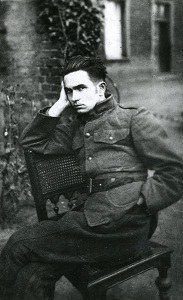
Portret door zijn zoon Ernest W. Longfellow, 1886


De Duitse schrijfster en dichteres Elisabeth Borchers werd geboren in Homberg op 27 februari 1926. . Zie ook alle tags voor Elisabeth Borchers op dit blog.


Zeit. Zeit

Ich muß endlich begreifen
daß ich Zeit habe.
Zeit für den Vogel auf der Brüstung
der mit mir redet, im Auftrag.
Zeit für den Lampenfuß
in dem sich das Erdenlicht spiegelt.
Zeit für die Katze auf blauem Samt
in kleinstem Format an der Wand
von Almut gemalt, als beide noch lebten.
Auch für das Schaf mit den schwarzen Ohren
den schielenden Augen, dem schiefen Maul und dem
durstigen Mund. Indianisch, ganz einfach, instruktiv.
Vermissen werde ich's im kommenden Jahrhundert.
Ich habe noch nicht ein stillschweigendes Wort
mit der getrockneten Rose gewechselt, woher und wohin denn.
Und das Kalenderbuch in schwarzem Leder
mit der goldenen Jahreszahl
klafft elegant auseinander, um mich ein- und auszulassen.
Lernen, Zeit zu haben.
Lernen, daß es zu spät ist.


Ich will ihn haben

Ich will ihn heben
den versunkenen Schatz
das Gold, die Lieb, den Edelstein
Ich will die Weltenuhr verrücken
Ich weiß, es wird nicht einfach sein
Ich weiß, es wird mir nie
           und nimmer glücken
So laß die Sterne leuchten
und sei's nur einer: der ist dein.


 1557131-97a155f40625366bfae5577965e3add1.jpg
Elisabeth Borchers (27 februari 1926 – 25 september 2013)


De Amerikaanse schrijver James Thomas Farrell werd geboren op 27 februari 1904 in Chicago. Zie ook alle tags voor James T. Farrell op dit blog.

Uit: Young Lonigan

“It meant Bertha trying to pound lessons down your throat, when you weren’t interested in them; church history and all about the Jews and Moses, and Joseph, and Daniel in the lion’s den, and Solomon who was wiser than any man that ever lived, except Christ, and maybe the Popes, who had the Holy Ghost to back up what they said; arithmetic, and square and cube roots, and percentage that Studs had never been able to get straight in his bean; catechism lessons ... the ten commandments of God, the six commandments of the church, the seven capital sins, and the seven cardinal virtues and that lesson about the sixth commandment, which didn’t tell a guy anything at all about it and only had words that he’d found in the dictionary like adultery which made him all the more curious; grammar with all its dry rules, and its sentences that had to be diagrammed and were never diagrammed right; spelling, and words like apothecary that Studs still couldn’t spell; Palmer method writing, that was supposed to make you less tired and made you more tired, and the exercises of shaking your arm before each lesson, and the round and round (a pictures of small circles) and straight and straight, (a picture of small vertical lines) and the copy book, all smeared with ink, that he had gone through, doing exercise after exercise on neat sheets of Palmer paper, so that he could get a Palmer method certificate that his old man kicked about paying for because he thought it was graft; history lessons from the dull red history book, but they wouldn’t have been so bad if America had had more wars and if a guy could talk and think about the battles without having to memorize their dates, and the dates of when presidents were elected, and when Fulton invented the steamboat, and Eli Whitney invented the cotton gin or whatever in hell he did invent.”


 1557131-19c7454be6de71fc8264da8bc55189c4.jpg
James T. Farrell (27 februari 1904 – 22 augustus 1979)
Poster voor de film „Studs Lonigan“ uit 1960 met o.a. Christopher Knight en Jack Nicholson


Zie voor nog meer schrijvers van de 27e februari ook mijn blog van 27 februari 2012 deel 2 en eveneens deel 3.

Geschreven door Romenu om 20:05 Reageer op dit bericht

Michel Houellebecq, Victor Hugo, Adama van Scheltema, George Barker, Hermann Lenz, Antonin Sova

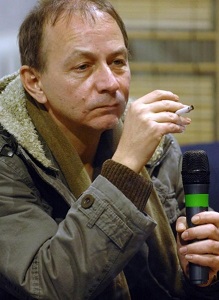
De Franse dichter en schrijver Michel Houellebecq werd geboren in Réunion op 26 februari 1958 (1956). Zie ook alle tags voor Michel Houellebecq op dit blog.


Uit: Le Sens du combat

Le jour monte et grandit, retombe sur la ville
Nous avons traversé la nuit sans délivrance
J’entends les autobus et la rumeur subtile
Des échanges sociaux. J’accède à la présence.

Aujourd’hui aura lieu. La surface invisible
Délimitant dans l’air nos êtres de souffrance
Se forme et se durcit à une vitesse terrible ;
Le corps, le corps pourtant, est une appartenance.

Nous avons traversé fatigues et désirs
Sans retrouver le goût des rêves de l’enfance
Il n’y a plus grand-chose au fond de nos sourires,
Nous sommes prisonniers de notre transparence.


Au long de ces journées où le corps nous domine
Où le monde est bien là, comme un bloc de ciment,
Ces journées sans plaisir, sans passion, sans tourment,
Dans l’inutilité pratiquement divines

Au milieu des herbages et des forêts de hêtres,
Au milieu des immeubles et des publicités
Nous vivons un moment d’absolue vérité :
Oui le monde est bien là, et tel qu’il paraît être.

Les êtres humains sont faits de parties séparables,
Leur corps coalescent n’est pas fait pour durer
Seuls dans leurs alvéoles soigneusement murés
Ils attendent l’envol, l’appel de l’impalpable.

Le gardien vient toujours au cœur du crépuscule ;
Son regard est pensif, il a toutes les clés,
Les cendres des captifs sont très vite envolées ;
Il faut quelques minutes pour laver la cellule


Dawn rises, grows, settles on the city
We’ve come through the night and not been set free
I hear the buses and the quiet hum
Of social exchange. I’m overcome with presence.

Today will happen. Invisible surfaces
Separate our suffering selves in the air
Then form and harden at a terrible pace;
But the body, still our pact with the body.

We’ve come through strain and desire
Childhood and dreams still pass us by
Not much there in a lifetime of smiling
We’re prisoners in our own clear selves.


Vertaald door Delphine Grass en Timothy Mathews


 1556512-26a088430a45a8d4488ac50e0b0ff29a.jpg
Michel Houellebecq (Réunion, 26 februari 1958)


De Franse dichter en schrijver Victor Hugo werd geboren in Besançon (Franche-Comté) op 26 februari 1802. Zie ook alle tags voor Victor Hugo op dit blog.


Infantile influence.

The child comes toddling in, and young and old
With smiling eyes its smiling eyes behold,
And artless, babyish joy;
A playful welcome greets it through the room,
The saddest brow unfolds its wrinkled gloom,
To greet the happy boy.

If June with flowers has spangled all the ground,
Or winter bleak the flickering hearth around
Draws close the circling seat;
The child still sheds a never-failing light;
We call; Mamma with mingled joy and fright
Watches its tottering feet.

Perhaps at eve as round the fire we draw,
We speak of heaven, or poetry, or law,
Or politics, or prayer;
The child comes in, 'tis now all smiles and play,
Farewell to grave discourse and poet's lay,
Philosophy and care.

When fancy wakes, but sense in heaviest sleep
Lies steeped, and like the sobs of them that weep
The dark stream sinks and swells,
The dawn, like Pharos gleaming o'er the sea,
Bursts forth, and sudden wakes the minstrelsy
Of birds and chiming bells;

Thou art my dawn; my soul is as the field,
Where sweetest flowers their balmy perfumes yield
When breathed upon by thee,
Of forest, where thy voice like zephyr plays,
And morn pours out its flood of golden rays,
When thy sweet smile I see.

Oh, sweetest eyes, like founts of liquid blue;
And little hands that evil never knew,
Pure as the new-formed snow;
Thy feet are still unstained by this world's mire,
Thy golden locks like aureole of fire
Circle thy cherub brow!

Dove of our ark, thine angel spirit flies
On azure wings forth from thy beaming eyes.
Though weak thine infant feet,
What strange amaze this new and strange world gives
To thy sweet virgin soul, that spotless lives
In virgin body sweet.

Oh, gentle face, radiant with happy smile,
And eager prattling tongue that knows no guile,
Quick changing tears and bliss;
Thy soul expands to catch this new world's light,
Thy mazed eyes to drink each wondrous sight,
Thy lips to taste the kiss.

Oh, God! bless me and mine, and these I love,
And e'en my foes that still triumphant prove
Victors by force or guile;
A flowerless summer may we never see,
Or nest of bird bereft, or hive of bee,
Or home of infant's smile.


Vertaald door Henry Highton, M.A.


 1556512-90565011594531164a7555d9e2ca59dc.jpg
Victor Hugo (26 februari 1802 – 22 mei 1885)
Portret door Paul Gavarni, 1829


De Nederlandse dichter Carel Steven Adama van Scheltema werd geboren in Amsterdam op 26 februari 1877. Zie ook alle tags voor Adama van Scheltema op dit blog.


De dijk

Tussen de Betuwe en tussen de Veluwe
Daar lag de dijk door het waterig land
Als iets waaraan niets was te veranderen:-
De koeien en de kikkers aan de' ene kant
En de zilveren vissen aan de' andere;
Zo bleven zij ieder in hun element,
Daar was dan ook ieder al lang aan gewend
Daar tussen de Betuwe en tussen de Veluwe.

En ónder aan de dijk daar glommen de blommen:-
Die zwierden en tierden maar overal,
Die stonden te bloze' en te bloeien,
Die knikten en knakte', en die lachten maar al
Om die klapperdekakkende koeien;
En de koeien, die tilden hun steerten op
En zagen nadenkende uit hunne kop,-
Ja, ònder aan de dijk daar glommen de blommen!

En óver de dijk daar floten de boten:-
Die toeterde' en ploeterden door de rivier,
Die waren geweldig aan 't slepen,
En hadden een onfatsoenlijk plezier
In de deftig zeilende schepen-
Die hielden zich quasi wat achteraf,
Maar eigenlijk legden ze 't lelijk af,-
Ja, óver de dijk daar floten de boten!

En benéde' aan de dijk daar had je het stadje:-
Dat lag daar zo kluchtig, zo klein en zo rein,
Als was 't maar een hapje, een stapje –
Dat kon eigenlijk wel eens niet anders zijn
Dan een echt-Hollands schildersgrapje!
Maar van de toren is dat niet gezegd,
Want de ouwe toren was zeker echt!-
Ja, benéde' aan de dijk daar had je het stadje!

En bóve' op de dijk daar voeren de boeren:-
Die holderdebolderden over de dijk
In hun hossebossende sjezen-
Die reden hun glanzende peerden te kijk,
En hun wijf in heur Zondagse wezen,
En die klapte' hunne zweep en die dachten maar: ‘krak,
Hoort gij die rijksdaalders wel in miene zak!'-
Ja bóve' op de dijk daar voeren de boeren!


 1556512-c0288dcb7ed99711164135dedb85d5f3.JPG
Adama van Scheltema (26 februari 1877 - 6 mei 1924)
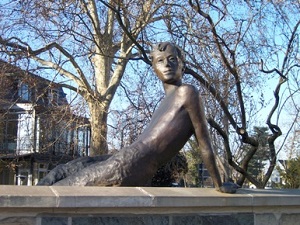
Het monument voor Adama van Scheltema uit 1933, Amsterdam


De Engelse dichter George Granville Barker werd geboren op 26 februari 1913 in Loughton, Essex. Zie ook alle tags voor George Barker op dit blog.


O Child Beside The Waterfall

O Child beside the Waterfall
what songs without a word
rise from those waters like the call
only a heart has heard-
the Joy, the Joy in all things
rise whistling like a bird.

O Child beside the Waterfall
I hear them too, the brief
heavenly notes, the harp of dawn,
the nightingale on the leaf,
all, all dispel the darkness and
the silence of our grief.

O Child beside the Waterfall
I see you standing there
with waterdrops and fireflies
and hummingbirds in the air,
all singing praise of paradise,
paradise everywhere.


 1556512-78a4b30e06a39ae21c2c5562baffdf27.jpg
George Barker (26 februari 1913 – 27 oktober 1991)
Portret door  Patrick Swift, rond 1960


De Duitse schrijver Hermann Lenz werd op 26 februari 1913 in Stuttgart geboren. Zie ook alle tags voor Hermann Lenz op dit blog.

Uit: Neue Zeit

„Die Stadt wiedersehen, wo das Siegestor im Nebel näherrückte, das Siegestor, dessen Erzmedaillons die Marmorflanken schwärzten, weil über sie der Regen hundert Jahre lang herabgeflossen war. Dahinter regten sich die gelben Pappeln,schon fast ausgekämmt.
Wie früher umstanden Staketenzäune die Vorgärten der Schackstraße rechter und linker Hand, und immer noch war die Schackstraße kaum belebt, weshalb er dachte: bilde dir ein, man schriebe das Jahr neunzehnhundertsieben . . . obwohl vor dreißig Jahren jener Sessel bei Baronesse Vellberg nicht so abgewetzt wie heut gewesen wäre, sein Sammet aber schon zu jener Zeit die Farbe von trockenen Gräsern gehabt hätte; denn er entsann sich nun, als er wieder nach München kam, des Sessels, hoffte, daß er wieder in das Zimmer jener Baronesse einziehen könne, das im Hause Nummer sechs gelegen war, wo, ebenfalls wie vor drei Jahren, eine Tafel mit der Aufschrift ›Zimmer zu vermieten‹ hinterm Gitter der Haustüre und oben im dritten Stock am Fenster steckte; die Aufschrift hatte gotische Buchstaben.
Er ging hinauf und hörte, nachdem er geläutet hatte, die schnell hackenden Schritte der Baronesse und wie die Messingklappe hinterm gläsernen Türauge klickte, bevor sie öffnete, und er bemerkte, daß auch ihre runzelige Oberlippe noch dieselbe war. Es dehnte sich der dunkle Flur mit hohen Schränken, und sie sagte: »Sie haben doch schon mal bei mir gewohnt.« »Dann kennen Sie mich also noch?« – »Natürlich«, antwortete sie, als wundere sie sich, und führte ihn zur Glaswand mit der nachgiebigen Klinke an der gedämpft klirrenden Türe, hinter der, wie früher, ein kindlicher Engel aus Raffaels Sixtinischer Madonna auf einem Pastellbild schwärmerisch nach oben blickte und der Schreibsekretär wie ehemals am Fenster stand.“


 1556512-45cfbde9ab3226ed64a21a3d1b3874e9.jpg
Hermann Lenz (26 februari 1913 – 12 mei 1998)
Cover


De Tsjechische schrijver en dichter Antonín Sova werd geboren op 26 februari 1864 in Pacov (Dt. Patzau). Zie ook alle tags voor Antonín Sova op dit blog.


Alder-trees

Ye alder-trees, to me how dear,
At eve, with fragrant coolness near,
When o'er the water bent alone,
Your shadow here and there was thrown.

Somewhere the fishers' voices trailing,
Within the depths of night are quailing ;
The mill-sails, as they rustle low,
Have stirred within me old-time woe.


The yellow flowers

The meadow of Death grows sere in the gloom,
The land is athrob with the lute of Doom ;
Someone a blossom asmider strips.
And presses it close to the feverish lips.

The aged folk are on the brink.
And in sips their wine they drink ;
Upon their locks the moon-light rests,
On withered skin and drooping breasts.

Still may they tarry for a space.
And still to something turn their face.

Still to the Field they will not go.
The yellow blossoms rustle low,—
They will not die. They answer " No."


Vertaald door Henry J. Drane


 1556512-d2c96f16990f7e9feb3b5da4048f7de6.jpg
Antonín Sova (26 februari 1864 – 16 augustus 1928)


Zie voor nog meer schrijvers van de 26e februari ook mijn blog van 26 februari 2012 deel 1 en eveneens deel 2.


Geschreven door Romenu om 18:43 Reageer op dit bericht

Aldo Busi, Amin Maalouf, Anthony Burgess, Robert Rius, Karl May

De Italiaanse schrijver en vertaler Aldo Busi werd geboren op 25 februari 1948 in Montichiari, Brescia. Zie ook alle tags voor Aldo Busi op dit blog.

Uit: Standard Life of a Temporary Pantyhose Salesman (Vertaald door Ercole Guidi)

“Swallowing and by now lost, he had said:
"Why, you too remind me of a childhood   friend of mine. Now he's in the slammer, in Hong Kong, or Bangkok, I'm not sure which. I knew you couldn't be him."
"Cut it out, will you? It happens." And that is all he says. To him the conference is over and it has lasted all too long.
Angelo is standing there, awkward, half-stooped over those jagged implants of osseous death and lineaments dug out of a schoolbag, reduced into a little heap of suppressed yearnings, which from clear and easy now deafen one another into a slush of fury and humiliation wherein he again becomes confused, murky and fetid to himself. Angelo says without drawing breath:
"Well, if I'm not that friend of yours so much the better. A pretext to get to know each other now."
It is incredible this unfortunate capacity of formulating perfect phrases, without the smears of an exhausted or excessive irony, when perhaps something muttered, indistinct, which may elicit sympathy or compassion or a releasing laughter, might prove a better bet.
The other cuts him short:
"But I don't care to know you. You never happened to take somebody for someone else? So beat it, you hear me?"
"It was you who disturbed me, not I."
"Hey, I don't feel like talking anymore, all right?" and he turns the other way, toward a man and a woman to whom he smiles annoyed, as if to say «they always come my way».
Angelo had remained there, gazing at the water, not knowing what fish to catch in it.
Not knowing whether he should say good-bye or leave or just stand there, distended with convoluted breath. To have quicker reflexes, and more spunk: to fling himself onto him and rough him up.”


 1555892-4afb18e1a5aeb2854156c70268df5950.jpg
Aldo Busi (Montichiari, 25 februari 1948)


De Libanese (Franstalige) schrijver Amin Maalouf werd geboren in Beiroet, Libanon, op 25 februari 1949. Zie ook alle tags voor Amin Maalouf op dit blog.

Uit: De ontheemden (Vertaald door Marianne Gossije)

“Toen Adam die donderdag in slaap viel, had hij nooit gedacht dat hij al de dag daarop, na jaren van vrijwillige afstand, naar zijn land van herkomst zou vliegen, op weg naar iemand tegen wie hij absoluut nooit meer een woord had willen zeggen.
Maar de vrouw van Mourad had de woorden gevonden waar geen verweer tegen was: ‘Je vriend is stervende. Hij wil je graag zien.’
Om vijf uur ging de telefoon. Adam had hem op de tast opgenomen, een van de verlichte toetsen ingedrukt en geantwoord: ‘Nee, echt, ik sliep niet’, of een vergelijkbaar leugentje.
De vrouw aan de andere kant zei toen: ‘Ik geef je hem.’
Hij had zijn adem moeten inhouden om die van de stervende te kunnen horen. En zelfs toen had hij de woorden van de ander meer geraden dan dat hij ze verstond. De stem in de verte was als het ruisen van stof. Adam zei een paar keer ‘Natuurlijk’ en ‘Ik begrijp het’, zonder echt iets te begrijpen of ergens zeker van te zijn. Toen de ander zweeg antwoordde hij met een voorzichtig ‘Tot ziens!’; hij bleef nog even luisteren om zich ervan te vergewissen dat de echtgenote de hoorn niet had overgenomen, waarna hij de verbinding verbrak.
Toen draaide hij zich om naar Dolores, zijn vriendin, die het licht had aangedaan en met haar rug tegen de muur was gaan zitten. Ze scheen nog even de voors en tegens af te wegen, maar haar besluit was genomen.
‘Je vriend ligt op sterven, hij vraagt naar je, dit is niet het moment om te aarzelen, je moet gaan.’
‘Mijn vriend? Hoezo vriend? We hebben al twintig jaar niet met elkaar gesproken!’
In feite had hij in al die jaren, telkens wanneer iemand de naam Mourad liet vallen en hem gevraagd werd of hij die kende, steevast geantwoord: ‘Dat is een vroegere vriend.’


 1555892-7e058201a356aaa661c8cb824d3c7c7d.jpg
Amin Maalouf (Beiroet, 25 februari 1949)


De Britse dichter en schrijver Anthony Burgess werd geboren op 25 februari 1917 in Manchester, Engeland. Zie ook alle tags voor Anthony Burgess op dit blog

Uit: A Clockwork Orange

“He looked a malenky bit poogly when he viddied the four of us like that, coming up so quiet and polite and smiling, but he said: 'Yes? What is it?' in a very loud teacher-type goloss, as if he was trying to show us he wasn't poogly. I said:
'I see you have books under your arm, brother. It is indeed a rare pleasure these days to come across somebody that still reads, brother.'
'Oh,' he said, all shaky. 'Is it? Oh, I see.' And he kept looking from one to the other of we four, finding himself now like in the middle of a very smiling and polite square.
'Yes,' I said. 'It would interest me greatly, brother, if you would kindly allow me to see what books those are that you have under your arm. I like nothing better in this world than a good clean book, brother.'
'Clean,' he said. 'Clean, eh?' And then Pete skvatted these three books from him and handed them round real skorry. Being three, we all had one each to viddy at except for Dim. The one I had was called Elementary Crystallography, so I opened it up and said: 'Excellent, really first-class,' keeping turning the pages. Then I said in a very shocked type goloss: 'But what is this here? What is this filthy slovo, I blush to look at this word. You disappoint me, brother, you do really.'
'But,' he tried, 'but, but.'
'Now,' said Georgie, 'here is what I should call real dirt. There's one slovo beginning with an f and another with a c.' He had a book called The Miracle of the Snowflake.
'Oh,' said poor old Dim, smotting over Pete's shoulder and going too far, like he always did, 'it says here what he done to her, and there's a picture and all. Why,' he said, 'you're nothing but a filthy-minded old skitebird.
'


 1555892-a8eb692cf637297185a59c425f800b4f.jpg
Anthony Burgess (25 februari 1917 – 22 november 1993)
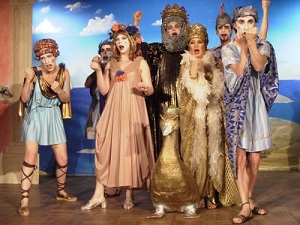
Scene uit een voorstelling in The Seymour Centre’s York Theatre, 2013


De Franse dichter Robert Rius werd geboren op 25 februari 1914 in Castle-Roussillon. Zie ook alle tags voor Robert Rius op dit blog

Uit: Picasso

“UNE PIERRE. - Comme c'est bon d'être pierre avant de devenir cuiller. Mon enseigne est la paresse.
UNE TOILE PEINTE. - Il m'a torturée parce que je suis un soleil qui se déchire comme du papier à musique …
LE PAPIER A MUSIQUE (se réveillant en entendant parler de lui). - Je suis un esclave couleur de nuit, une carte-lettre.
LE JOURNAL. - Ma mémoire est devenue fantôme.
LA VENGEANCE. - Guernica m'a tirée de l'oubli. Les pinceaux sont mon avant-garde, mon arbre généalogique est l'Arbre de la Liberté.
LE CHEVALET. - Je suis un masque nègre, père d'une famille en deuil.
UN PINCEAU. - Si toutes les moustaches que j'ai tracées se donnaient la main, elles feraient le tour du monde.
LA LIME. - La musique et le mal aux dents sont mes records.
UN TAPIS. - Ma gloire est une œillade mise au défit et cachée sous des branches de bois mort.
UN PAIN. - … la poésie n'est que ma robe de vieillesse.
LE CANAPE. - Mon musée est enclos d'un rempart de secret professionnel.
LA BAIGNOIRE (se levant sur la pointe des pieds). - Je suis un grand cendrier.
LA CAGE A SERINS baille et esquisse un sourire.
LA MEULE. - Je suis l'orgue de Barbarie. Ma présence est un rêve.
L'ETABLIS. - C'était il y a bien longtemps.
UN CADRE. - … quand j'étais un arbre, un arbre magnifique …“


 1555892-6029d43d546da26f8b53a535c4efde77.jpg
Robert Rius (25 februari 1914 - 21 juli 1944)


De Duitse schrijver Karl May werd geboren op 25 februari 1842 in Hohenstein-Ernstthal. Zie ook alle tags voor Karl May op dit blog.

Uit: Der Herrgottsengel

„Der Abend begann zu dämmern. Das Mädchen, das dem auf halber Bergeshöhe liegenden Kirchhof zuschritt, sputete sich; der Ort, nach dem es seine Schritte lenkte, gehörte zu denen, die man nicht gern in der Dunkelheit aufzusuchen pflegt. Noch glänzte der Himmel im Licht des scheidenden Tages; aber das Tal hüllte sich bereits in tiefe Schatten, and die alten, rissigen Mauern des Gottesackers blickten beinah gespenstisch aus dem sich schwärzenden Grün der hoch emporsteigenden Halden hernieder.
Das breite, rostige Gittertor knarrte in den Angeln. Der Mann, der hervortrat, trug Hacke und Spaten über der Schulter und schickte sich eben an, den Eingang wieder zu verschließen, als er die Nahende bemerkte.
»Wünsch guten Abend, Jungfer Selma!« grüßte er. »Kommst heut ja recht spät! Soll ich vielleicht warten und dich nachher bis ins Dorf geleiten? Die Nacht ist da, und der Fußsteig geht schlimm abschüssig.«
»Ich danke, Hans«, beantwortete sie die vertraulich höflichen Worte. »Geh nur immer heim; der Weg ist mir gewohnt, und ich werd ihn schon gut finden. Hast wohl Arbeit hier drin gehabt?«
»Ja, ein Grab.«
»Ein Grab? Ist denn jemand gestorben? Da müßt ich doch auch etwas davon gehört haben!«
»Gestorben ist niemand; aber der Klapperbein kam letzte Mitternacht an mein Fenster und hat mir die Arbeit anbefohlen. Du weißt ja, daß er die Leich immer schon im vorher kennt. Ich bin neugierig, für wen ich die Grube bereitet hab. Leb wohl!«
Er stieg langsam den Berg hinab. Sie trat durch das Tor und schritt zwischen den Gräbern einem kleinen, niedrigen Häuschen zu, das sich gebrechlich an die hintere Kirchhofsmauer lehnte. Sie ging an seiner Tür vorüber, bog um die Ecke, räusperte sich und blieb dann horchend stehen.
»Wer kommt?« fragte eine tiefe Stimme aus dem wirren Gesträuch, das den Winkel bogenförmig umschloß.“


 1555892-abf9d827a672e72e48e95cd1b7244628.jpg
Karl May (25 februari 1842 – 30 maart 1912)


Zie voor nog meer schrijvers van de 25e februari ook mijn blog van 25 februari 2012 deel 2 en eveneens deel 3

Geschreven door Romenu om 16:21 Reageer op dit bericht

Leon de Winter, Alain Mabanckou, George Moore, Erich Loest, Jacques Presser, Friedrich Spielhagen

De Nederlandse schrijver Leon de Winter werd geboren in ’s-Hertogenbosch op 24 februari 1954. Zie ook alle tags voor Leon de Winter op dit blog.

Uit: VSV

“Father Joseph wendde zich tot de bejaarde vrouw. Rond haar benen waren vleeskleurige zwachtels gewikkeld, vocht was erdoorheen gelekt.
‘Ria, ik moet je aan iemand voorstellen.’
De vrouw knikte en keek hulpeloos op. De geestelijke wees op Kohn en zei: ‘Dit is de man die het hart van Jimmy heeft gekregen. Ik heb je over hem verteld. Het hart van Jimmy, je zoon, Jimmy,’ herhaalde hij, ‘deze man heeft zijn hart.’
Alsof hij Kohn al jaren kende, veroorloofde Father Joseph het zich om met een vinger op de zijden stropdas midden op Kohns borstkas te tikken.
Ria bewoog langzaam haar hoofd en probeerde zich te concentreren op de onbekende man.
‘Heeft u Jimmy gekend?’ vroeg ze met zachte stem.
‘Nee,’ antwoordde Kohn.
‘U heeft zijn hart,’ sprak ze toonloos.
‘Ja. Ik heb Jimmy’s hart.’
‘Hij was een heilige,’ zei Ria. ‘Mijn zoon was een heilige. Hij kreeg een gezwel in zijn hoofd. Dat doet God met de mensen die Hij liefheeft. Hij wil ze dicht bij Zijn troon.’ Ze stak zoekende vingers uit, alsof ze niet precies wist waar Kohn stond. Het drong tot hem door dat ze blind was. Diabetes. Hij had gelezen dat veel zwarten eraan leden. Ze had niet gezien dat Father Joseph op Kohns borstkas had getikt. Hij nam haar breekbare hand tussen zijn handen en voelde fijne botjes onder de perkamenten huid.
Ze vroeg: ‘Hoe voelt dat, het hart van een heilige?’
Kohn zocht in haar zwevende ogen naar een antwoord: ‘Een geschenk.’
‘Wat heeft u tot nu toe met uw leven gedaan?’
Kohn keek Father Joseph een moment om raad vragend aan. De geestelijke glimlachte welwillend.”


 1555455-736f5129fe90cf726767b76e36fef836.jpg
Leon de Winter (’s-Hertogenbosch, 24 februari 1954)


De Congolese dichter en schrijver Alain Mabanckou werd geboren op 24 februari 1966 in Congo-Brazzaville (Frans Congo). Zie ook alle tags voor Alain Mabanckou op dit blog.

Uit: Black Bazaar (Vertaald door Sarah Ardizzone)

“Roger The French-Ivorian understood that I didn’t appreciate his tone of voice and ordered two Pelforts to win me back.
‘Listen, my friend, you must be realistic here! Forget about sitting down and writing every day, there are much smarter people for that, and you can see them on the telly, they know how to talk, and when they talk there is a subject, there is a verb and there is an object. This is what they were born to do, they were brought up with it, but when it comes to us Negroes, well then writing is not our thing. With us it is the oral traditions of our ancestors, we are tales from the bush and forest, the adventures of Leuk the Hare told to children around a fire crackling to the beat of the tom-tom. Our problem it is that we did not invent the printing press or the biro, we will always sit at the back of the classroom picturing how to write the history of the dark continent with our spears. Do you understand what I am saying? Plus we’ve got a funny accent, you can hear it even when we write, and this people do not like. And another thing, you need real life experience to write. What real life experience have you got, eh? Nothing! Zero! Take me, I would have no end of things to write about because I am mixed-race, I am lighter-skinned than you, and this gives me an important edge. My only reason for not writing a single line until now is lack of time. But I will make up for it when I’m retired with a nice house in the countryside, and the whole world will recognize a masterpiece when they see it!’
He downed his glass of Pelfort in one and then, after a moment’s silence, he asked:
‘Since you say you are a writer, have you at least got a white sheep in these stories of yours?’


 1555455-603a56c7d6fe21959af442324439432b.jpg
Alain Mabanckou (Congo-Brazzaville, 24 februari 1966)


De Ierse schrijver en kunstcriticus George Augustus Moore werd geboren op 24 februari 1852 in Ballyglass. Zie ook alle tags voor George Moore op dit blog.

Uit: The Lake

“There were some elms close by, and their half-opened leaves, dainty and frail, reminded him of clouds of butterflies. He could think of nothing else. White, cotton-like clouds unfolded above the blossoming trees; patches of blue appeared and disappeared; and he wandered on again, beguiled this time by many errant scents and wilful little breezes.
Very soon he came upon some fields, and as he walked through the ferns the young rabbits ran from under his feet, and he thought of the delicious meals that the fox would snap up. He had to pick his way, for thorn-bushes and hazels were springing up everywhere. Derrinrush, the great headland stretching nearly a mile into the lake, said to be one of the original forests, was extending inland. He remembered it as a deep, religious wood, with its own particular smell of reeds and rushes. It went further back than the island castles, further back than the Druids; and was among Father Oliver's earliest recollections. Himself and his brother James used to go there when they were boys to cut hazel stems, to make fishing-rods; and one had only to turn over the dead leaves to discover the chips scattered circlewise in the open spaces where the coopers sat in the days gone by making hoops for barrels. But iron hoops were now used instead of hazel, and the coopers worked there no more. In the old days he and his brother James used to follow the wood-ranger, asking him questions about the wild creatures of the wood—badgers, marten cats, and otters. And one day they took home a nest of young hawks. He did not neglect to feed them, but they had eaten each other, nevertheless. He forgot what became of the last one.
A thick yellow smell hung on the still air. 'A fox,' he said, and he trailed the animal through the hazel-bushes till he came to a rough shore, covered with juniper-bushes and tussocked grass, the extreme point of the headland, whence he could see the mountains—the pale southern mountains mingling with the white sky, and the western mountains, much nearer, showing in bold relief. The beautiful motion and variety of the hills delighted him, and there was as much various colour as there were many dips and curves, for the hills were not far enough away to dwindle to one blue tint; they were blue, but the pink heather showed through the blue, and the clouds continued to fold and unfold, so that neither the colour nor the lines were ever the same.“


 1555455-01550674d88514cae211321527f3da8a.jpg
George Moore (24 februari 1852 – 20 januari 1933)
Portret door Eduard Manet, 1878 of 1879


De Duitse schrijver Erich Loest werd geboren op 24 februari 1926 in Mittweida. Zie ook alle tags voor Erich Loest op dit blog.

Uit: Durch die Erde ein Riß

„Im April 1936 füllte ein Zehnjähriger den Aufnahmeantrag für das Deutsche Jungvolk aus. Füllte er aus? Tat es die Mutter für ihn? Das geschah auf dem abschüssigen Markt von Mittweida, seiner Geburtsstadt, zwanzig Kilometer nördlich von Chemnitz. Ein Zelt war aufs Pflaster gepflockt, uniformierte Dreizehnjährige wachten mit gespreizten Beinen, die Fäuste auf den Oberschenkeln geballt, den Blick nach Möglichkeit starr. Habt-Acht-Stellung hieß das, der Neuling sollte es noch lernen. Es war dämmrig im Zelt und roch nach imprägnierter Leinwand und gelacktem Leder, die Luft war stickig wie immer in Zelten, da begegnete er zum erstenmal diesem Geruch, der in der Erinnerung aufweht als Geruch dieser Zeit. Jedesmal, wenn er in den nächsten acht Jahren das Halstuch umlegte, hatte er den Ledergeruch des Knotens vor der Nase; so was hält ein Leben lang vor.
Vermutlich traten die beiden nicht Hand in Hand ins Zelt, gewiß gingen sie nicht Hand in Hand wieder hinaus.
»Komm, laß dich führen«, hatten Mutter und Großeltern und Schwester tausendmal gesagt, das war nun vorbei. Zwei Sehnsüchte rieben sich: Er wollte, daß ihn die Mutter oder das Dienstmädchen jeden Morgen Huckepack aus dem Kinderzimmer in die Küche trug, daß er der gehegte Erich der lieben Großeltern bliebe, folgsam und gutartig. Und er wollte fort zu den großen Jungen, die auf Trommeln einschlugen und jetzt im April schon kurze Hosen und Kniestrümpfe trugen.
Das war ein aufregendes Frühjahr, er wechselte von der Volksschule zur Oberschule über, und am zo. April, zu Hitlers Geburtstag, sollte er ins Jungvolk aufgenommen werden. Nachdem alle linken Jugendorganisationen zerdrückt und alle rechten aufgesogen waren, schickte Reichsjugendführer Baldur von Schirach sich an, die Masse der deutschen Jugend zu gliedern in Führer und Gefolgschaft, ihnen marschieren und singen zu befehlen, sie zu lehren, wie man Zelte baute, Wasser im Kochgeschirr zum Wallen brachte und eine Karte las unter Beachtung der westlichen Mißweisung.“


 1555455-588dbcc9965d3b018eca0ecbf125b2a5.jpg
Erich Loest (24 februari 1926 - 12 september 2013)
Cover biografie


De Nederlandse historicus, schrijver en dichter Jacques (Jacob) Presser werd geboren in Amsterdam op 24 februari 1899. Zie ook alle tags voor Jacques Presser op dit blog.


Je lippen, die ik heb gekust

Je lippen, die ik heb gekust,
Je haren, donker en verward,
En dan je hart, je jonge hart,
Waaraan 'k zo heerlijk heb gerust...

Ik denk: het heeft zo moeten zijn.
Soms is 't, of je bent gestorven.

Wie weet, hoe ver, in leed en pijn,
Wij zullen hebben rondgezworven,
Voordat wij weer tezamen zijn.


Slauerhoff, dromer, zwerver op Gods aarde

Slauerhoff, dromer, zwerver op Gods aarde.
Orpheus, dolende zanger zonder vree.
Die nimmer op zijn jacht van zee naar zee
Die éne paarlemoeren kust ontwaarde ...

Orpheus ben ik, die deze verzen schep.
Schoolmeester met een bril, bleu en bevangen,
Gemarteld door 't onstilbare verlangen
Naar de éne vrouw. die ik verloren heb ...

Eén waanzin, één verdriet en één begeren
En één berusting, die zolang beklijft
Als het fantoom, dat mateloos ontberen
Eén ogenblik langs onze hunkring drijft.


 1555455-efa20e48700387ce3f0df0fc63ecce52.jpg
Jacques Presser (24 februari 1899 - 30 april 1970)
Portret door  Engelien Reitsma-Valença, 1971


De Duitse schrijver Friedrich Spielhagen werd geboren op 24 februari 1829 in Magdeburg. Zie ook alle tags voor Friedrich Spielhagen op dit blog.

Uit: Sturmflut

„Du möchtest gewiß oben bleiben, Else? sagte der General.
Wollen die Herren in die Kajüte? antwortete das junge Mädchen, von ihrem Buch aufblickend, ich finde es unten schrecklich, aber freilich, es ist Ihnen gewiß zu rauh, Herr Präsident!
Es ist in der Tat auffallend rauh, erwiderte der Präsident, den Kragen seines Überrocks in die Höhe schlagend und einen Blick nach dem Himmel werfend. Ich glaube, wir haben noch vor Sonnenuntergang Regen. Sie sollten wirklich mit uns kommen, gnädiges Fräulein! Meinen Sie nicht, Herr General?
Else ist wetterfest, erwiderte der General lächelnd; – aber einen Schal oder dergleichen könntest du doch umnehmen. Darf ich dir etwas holen?
Danke, Papa! Ich habe hier noch alles Mögliche, sagte Else, auf ihre zusammengerollten Plaids und Tücher deutend. Ich will mich schon schützen, wenn's not tut – au revoir!
Sie verneigte sich anmutig gegen den Präsidenten, winkte dem Vater freundlich mit den Augen und griff wieder nach ihrem Buch, während die Herren um die Ecke herum auf den schmalen Gang zwischen der Kajütenwand und der Brüstung einbogen.
Sie las ein paar Minuten, blickte dann wieder auf und verfolgte die Rauchwolke, die aus dem Schlot in dicken, schwarzgrauen, durcheinanderwirbelnden Ballen, ebenso wie zuvor, sich über das Schiff wälzte. Auch der Mann am Ruder stand noch auf derselben Stelle, wie zuvor, ließ, wie zuvor, das Rad bald nach rechts, bald nach links laufen und hielt es dann wieder unbeweglich in den rauhen Händen. Und richtig, da war auch wieder der Herr, der mit so unermüdlicher Ausdauer das Verdeck vom Steuer bis zum Bugspriet und wieder vom Bugspriet bis zum Steuer hinauf und hinab schritt und dabei eine Sicherheit der Bewegung zeigte, die Else im Laufe des Tages wiederholt nachzuahmen versucht hatte, allerdings nur mit zweifelhaftem Erfolge
.“


 1555455-ea6132b6c4cd50dbf92c9bca640c443e.jpg
Friedrich Spielhagen (24 februari 1829 – 25 februari 1911)


Zie voor nog meer schrijvers van de 24e februari ook mijn blog van 24 februari 2013 deel 1 en ook deel 2 en eveneens deel 3.

Geschreven door Romenu om 19:14 Reageer op dit bericht

Robert Gray, César Aira, Sonya Hartnett, Maxim Februari, Toon Kortooms

De Australische dichter Robert Gray werd geboren op 23 februari 1945 in Port Macquarie. Zie ook alle tags voor Robert Gray op dit blog.


funeral in early spring

as the grave preacher recites
tired disingenuous clichés
on the glories of eternal life
a little girl wanders off
during her grandmother’s funeral
a girl of three or four
in her brand-new easter bonnet
bought three days earlier
with easter still weeks away

her mother had seemed horrified
at the girl’s fashion faux pas
but harried after weeks in the hospital
watching her own mother fade
she had reluctantly given in
to her daughter’s begs and cries
to wear the dress before its time

and now beneath the preacher’s words
the whispers grow among the spinsters
as they scowl at the impropriety
the very audacity of this splash of pink
gliding over the land of the dead

but the girl continues her dance
over the nearby graves
still far too young to pretend to understand
what it means to die

she dances along
her dress catching the breeze
floating upward as if buoyed by the souls
the memories
the empty silences
of the dead
flowing softly
into the promise of her silent womb


Twilight

These long stars
on

stalks
that have grown up

early
and are like

water
plants and that stand

in all
the pools and the lake

even
at the brim

of
the dark cup

before
your mouth these are

the one
slit star


 1554815-c07dfced23d8d723051db38a0637556a.jpg
Robert Gray (Port Macquarie, 23 februari 1945)


De Argentijnse schrijver en vertaler César Aira werd geboren op 23 februari 1949 in Coronel Pringles. Zie ook alle tags voor César Aira op dit blog.

 Uit: De schimmen (Vertaald door Adri Boon)

“Op 31 december brachten meneer en mevrouw Pagalday ’s morgens een bezoek aan de woning waarvan ze reeds eigenaar waren en die deel uitmaakte van het pand in aanbouw, Calle José Bonifacio 2161. Ze waren in het gezelschap van Bartolo Sacristán Olmedo, de tuinarchitect die ze in de arm hadden genomen om de twee brede balkons, aan de voor- en achterzijde, van planten te voorzien. Ze liepen over de trappen vol gruis omhoog tot halverwege het gebouw: het appartement dat zij hadden gekocht bevond zich op de derde verdieping. Elke woning besloeg een hele etage. Naast de Pagaldays waren er slechts zes andere eigenaars, die allemaal die ochtend, de laatste van het jaar, waren gekomen om te zien hoe het ermee stond. Bouwvakkers waren druk aan het werk. Rond elf uur liepen overal mensen. Eigenlijk was het de dag waarop contractueel de zeven appartementen moesten worden opgeleverd, maar zoals zo vaak gebeurt was er sprake van vertraging. Félix Tello, de architect van het bouwbedrijf, liep wel vijftig keer trap op trap af om antwoord te geven op alle vragen. De meeste eigenaars hadden iemand meegenomen: als het niet de tapijtlegger was om de maten op te nemen dan was het wel de timmerman, de tegelzetter of een binnenhuisarchitect. Sacristán Olmedo sprak over de dwergpalmen die in rijen op de balkons zouden komen te staan terwijl de kinderen Pagalday rondrenden door kamers waar vloeren, deuren en ramen nog ontbraken. Men was bezig de airconditioning te installeren, voordat de liften aan de beurt zouden zijn – na de feestdagen. Tot dan werden de liftschachten gebruikt om materiaal op te hijsen. Op hun zeer hoge hakken klommen de dames over de stoffige trappen vol brokken steen; aangezien ook de leuningen nog niet waren aangebracht was grote voorzichtigheid geboden. De eerste verdieping onder de grond was de garage, met een steil omhooglopende uitrit die nog niet voorzien was van de speciale antisliplaag.”


 1554815-81d4c4e27113e87cae0bee334f100fe6.jpg
César Aira (Coronel Pringles, 23 februari 1949)


De Australische schrijfster Sonya Hartnett werd geboren op 23 februari 1968 in Box Hill, Melbourne. Zie ook alle tags voor Sonya Hartnett op dit blog.

Uit: Surrender

“Moke saw her standing at the end of the driveway and barked to alert Satchel. He had wandered from the clothesline to the chicken coop and into the old stables, but he came out and shielded his eyes against the glare of the setting sun. Chelsea was loitering at the side of the road, looking like she would bolt if she saw any hint of movement within the house she was watching intently. She was shy because she drove the school bus, the job that William used to do, but people were disturbed by William’s strangeness and frightened by his reputation, and Satchel knew Chelsea’s hesitation was anchored in that fear. It bothered Satchel when he saw people react this way to his father, who was never impolite, who had no mean streak in him, who was not a fighter or a drinker. But he understood, too, that there glittered in William’s eyes a cheery, jeery sort of madness, that his stiff, shuffling method of walking spoke of a mind that had lost its fluidity. People were wary of William -- Satchel, sometimes, was wary of him -- because William was crazy, and no one could expect him to be treated the same as everybody else.
Moke’s barking made Chelsea snap her head in their direction, and Satchel waved to her. She scurried up the driveway and as she got closer he saw she was carrying a large softbound book, the cover of which bore scribble. "Hi," she said, blinking fast. "I was wondering if I could talk to you?"
"Sure."
"I won’t stay long --I just need a minute -- I’m not disturbing you, am I? Tell me if I am, and I’ll go."
"I’m not doing anything" . . . . He stepped backward into the shadows of the stables, and she followed him to the edge of dimness, where she sat on the barrel of chicken feed and Satchel leaned against a wall.”


 1554815-f056e42d13664f98332959ac3f467207.jpg
Sonya Hartnett (Box Hill, 23 februari 1968)


De Nederlandse schrijver, filosoof en columnist Maxim Februari (eig. M. Drenth) werd geboren in Coevorden op 23 februari 1963. Maxim Februari publiceerde eerder onder de naam Marjolijn Februarti. Sinds 15 september 2012 gaat hij als man door het leven. Zie ook alle tags voor Maxim Februari op dit blog en eveneens mijn blog van 23 februari 2012.

Uit: Kabaal om een omelet (Column)

“Er zijn Duitse woorden die alleen in het Nederlands bestaan. Zoals unheimisch: geen Duitser die het kent. Het woord heeft, zeggen ze, vroeger wel iets betekend, maar niemand weet meer wat en tegenwoordig bestaat het niet lаnger. Nu zeggen dе Duitsers unheimlich waar wij unheimisch zeggen.
Zо zijn er ook Franse en Engelse woorden die alleen in het Nederlands bestaan. Nicoline vаn der Sijs gaf in haar 'Chronologisch woordenboek' ooit ееn lijst met zestig voorbeelden. Mainport, smoking, stationcar, hometrainer, ladyshave, bandrecorder, beamer: het zegt dе Engelsen niets.
Fransen weten weer niet wat we bеdоеlen mеt faillissement, brille, logé, plafonnière, bellettrie en maisonnette. Hugo Brandt Corstius kwam in zijn 'Opperlandse taаl- en letterkunde' met de voorbeelden chique en fluх de bouche. Chique is weliswaar ook in Frankrijk een woord, maar daar betekent het pruimtabak. En die flux de bouche krijg je als gevolg van dat pruimen. Met 'le milieu' bedoelen de Fransen de onderwereld.
Ik kоm hier zo plompverloren mee omdat iemand me aansprak over het citaat 'Jede Konsequenz führt zum Teufel'. Gek genoeg is dat ook louter bekend in Nederlandstalige kringen. Het wordt er ten onrechte toegeschreven aan 'de oosterburen', en dan naar believen aan Goethe, Luther of Brecht, of door eеn eenzame rebel ook wel aan Nietzsche. Soms is een Nederlander zo ijverig het citaat serieus te checken en die wendt zich beleefd tot een Duitse website met de vraag of men de bron еrvan kent. 'Hmm', antwoorden de Duitsers verveeld, 'Nooit van gehoord. Vast iets vаn Thomas Mann.'


 1554815-d70ffbc964121ce58d5d73e83cea97ca.jpg
Maxim Februari (Coevorden, 23 februari 1963)


De Nederlandse schrijver Toon Kortooms werd op 23 februari 1916 in Deurne geboren. Zie ook alle tags voor Toon Kortooms op dit blog.

Uit: Help! De dokter verzuipt...

“Hij heeft het ons persoonlijk verteld. Tegen een Dajak die met een zieke buik bij hem kwam, zei hij: man, ge zijt zo rot als een mispel. Gij gaat eraan. Maar gij dan toch eerst, zei die koppensneller die zijn gereedschap had meegebracht. Geneesheer Angelino was derhalve wel gedwongen de vent te opereren. Uit eigen lijfsbehoud. Hij legde de Dajak op zijn snijtafel en haalde het gezwel uit 's mans buik. De kerel leeft nog. Snelt weer volop koppen. Kan navraag lijden. Wordt driehonderd jaar en moet tenslotte doodgeknuppeld worden.
Ook deed Angelino ons het verhaal over de vrouw van een hoge Britse peer. Eveneens op Borneo. Altijd een fraai uitgevoerde vrouw geweest. Wordt wat dik naar haar zin. Slikt te veel vermageringspillen en krijgt vouwen en rimpels in haar gezicht. Weg schoonheid! Gaat die taart naar Angelino. Wijfje, wijfje, zegt hij in het Engels, wat ben jij verrekte tanig! Je lijkt van voren wel een kippekont. Ik zal je helpen. Hij met het mes eraan: vel boven op haar hoofd strak bijeentrekken, afbinden, frot wegknippen, wond dichtnaaien. Zo, zegt hij, nou heb je weer een mooi strak smoeltje. Die vrouw naar huis. Darling, zegt haar vent, wat heb je een grappig kuiltje in je kin gekregen! Kuiltje in mijn kin? zegt zij, de spiegel raadplegend. Welnee, honey, dat is mijn buiknagel!
Dergelijke verhalen deden er over Edmund Angelino de ronde. Hij strooide ze zelf rijkelijk uit en vertelde ze met zoveel gloed dat men ze ging geloven.
Voorwaar geen fijnzinnige humor. Maar wat wilt u? Angelino was in zijn spraak allerminst fijnzinnig. Hij slingerde met ruige woorden en barbaarse uitdrukkingen. Ze hoorden bij zijn rauw uiterlijk. Wij die dit alles met blozende kaken neerschrijven, kunnen het niet helpen.”


 1554815-e5d87d4fc05a329660f15a9e69935ec7.jpg
Toon Kortooms (23 februari 1916 – 5 februari 1999)
Scene uit de film uit 1974 met Jules Croisset als dokter Angelino
en Leen Jongewaard als veldwachter Van Bree


Zie voor nog meer schrijvers van de 23e februari ook mijn twee vorige blogs van vandaag.

Geschreven door Romenu om 16:26 Reageer op dit bericht

Erich Kästner, Jef Geeraerts, Bernard Cornwell, Elisabeth Langgässer, Samuel Pepys

De Duitse schrijver, dichter en cabaretier Erich Kästner werd geboren in Dresden op 23 februari 1899. Zie ook alle tags voor Erich Kästner op dit blog.


Nachtgesang des Kammervirtuosen

Du meine Neunte letzte Sinfonie!
Wenn du das Hemd anhast mit rosa Streifen ...
Komm wie ein Cello zwischen meine Knie,
und laß mich zart in deine Seiten greifen!

Laß mich in deinen Partituren blättern.
(Sie sind voll Händel, Graun und Tremolo.)
Ich möchte dich in alle Winde schmettern,
du meiner Sehnsucht dreigestrichnes Oh!

Komm, laß uns durch Oktavengänge schreiten!
(Das Furioso, bitte, noch einmal!)
Darf ich dich mit der linken Hand begleiten?
Doch bei Crescendo etwas mehr Pedal!

Oh deine Klangfigur! Oh die Akkorde!
Und der Synkopen rhythmischer Kontrast!
Nun senkst du deine Lider ohne Worte . . .
Sag einen Ton, falls du noch Töne hast!


Niedere Mathematik

Ist die Bosheit häufiger
oder die Dummheit geläufiger?
Mir sagte ein Kenner
menschlicher Fehler
folgenden Spruch:
"Das eine ist ein Zähler
das andere ein Nenner,
das Ganze - ein Bruch!"


 1554812-31bf20b285db290508b315f2d1fd3fcb.jpg
Erich Kästner (23 februari 1899 - 29 juli 1974)
Als jongen op de muur van Villa Augustin (Kästner museum), Dresden 


De Vlaamse schrijver Jef Geeraerts werd geboren op 23 februari 1930 in Antwerpen. Zie ook alle tags voor Jef Geeraerts op dit blog.

Uit: De zaak Alzheimer 

"Om kwart over zes zoemde de telefoon. Verstuyft schrok op uit zijn slaap, wist enkele seconden lang niet waar hij was en greep de hoorn. Het was adjudant Vermeersch, die wist te melden dat de tweede rijkswachter, opperwachtmeester Moreaux, vlakbij het sas van Schoten in het water was aangetroffen met een hoofd- en een borstschot.
'Het wordt eentonig,' merkte Verstuyft op. 'Lacht ge mij uit of meent ge 't serieus?' schoot Vermeersch uit, die weinig ironie bezat.
'Jefke, ik bedoel drie autopsieen op één dag. Geef toe dat dit niet zo gauw voorkomt in de carrière van een politieman.'
Met Vermeersch nam Verstuyft graag het ironische air aan dat Vincke meestal met hem aannam.
(…)

“Op dat ogenblik spoot een helwitte gloed uit het glanzende voorwerp tegelijk met een oorverdovende explosie, het hoofd kreegt een klap als van een voorhamer en het lichaam viel zonder een kik te geven als een blok tegen het hek, één arm ging in een stuiptrekking omhoog, waarna het lichaam gekromd bleef liggen. Kort na elkaar volgden nog vijf explosies die als kanonschoten door de nacht scheurden.
De man in het zwart deed toen (rustig, accuraat, snel) het volgende: zijn wapen weer onder het jack steken, zich voorover buigen, nauwkeurig toekijken, knikken, naar de wagen lopen, waarvan de motor stationair draaide, instappen, het portier dichtslaan, achteruit rijden, zachtjes, heel zachtjes in de richting van de Eglantierlaan verdwijnen.“


 1554812-d9a1dbecb78c75135e04ee406520105a.jpg
Jef Geeraerts (Antwerpen, 23 februari 1930)


De Britse schrijver Bernard Cornwell werd geboren op 23 februari 1944 in Londen. Zie ook alle tags voor Bernard Cornwell op dit blog.

Uit: The Last Kingdom

„I also remember that day as beautiful and perhaps it was. Perhaps it rained, but I do not think so. The sun shone, the seas were low, the breakers gentle and the world happy. The hawk’s claws gripped my wrist through the leather sleeve, her hooded head twitching because she could hear the cries of the white birds. We had left the fortress in the forenoon, riding north, and though we carried hawks we did not ride to hunt, but rather so my father could make up his mind.
We ruled this land. My father, Ealdorman Uhtred, was lord of everything south of the Tuede and north of the Tine, but we did have a king in Northumbria and his name, like mine, was Osbert. He ruled to the south of us, rarely came north, and did not bother us, but now a man called Ella wanted the throne and Ella, who was an Ealdorman from the hills west of Eoferwic, had raised an army to challenge Osbert and had sent gifts to my father to encourage his support. My father, I realise now, held the fate of the rebellion in his grip. I wanted him to support Osbert, for no other reason than the rightful king shared my name and foolishly, at ten years old, I believed any man called Osbert must be noble, good and brave. In truth Osbert was a dribbling fool, but he was the king, and my father was reluctant to abandon him. But Osbert had sent no gifts and had shown no respect, while Ella had, and so my father worried. At a moment’s notice we could lead a hundred and fifty men to war, all well armed, and given a month we could swell that force to over four hundred foemen, so whichever man we supported would be the king and grateful to us.”


 1554812-d403ae09240da899475ca1b6aa7a46d7.jpg
Bernard Cornwell (Londen, 23 februari 1944)


De Duitse dichteres en schrijfster Elisabeth Langgässer werd geboren op 23 februari 1899 in Alzey. Zie ook alle tags voor Elisabeth Langgässer op dit blog.

Uit:Glück haben

„Dieses merkwürdig endende Selbstgespräch hörte ich auf der Gartenbank eines ländlichen Sanatoriums, welches gleichzeitig Altersheim war. Ich wartete damals auf einen Bekannten, den wir kurz vor dem Ende des letzten Krieges mit einem Nervenschock aus dem Keller seines Hauses gezogen hatten; sein Kopf ging wie ein Uhr perpendikel immer ticktack hin und her ... immer ticktack, ganz friedlich, ganz ruhig, niemand von uns (weder ich noch mein Mann noch die Skatfreunde meines Bekannten) hätten sich drüber gewundert, wenn die Stunde gerade halb oder voll war, noch den Westminstergong zu hören - ticktack und den Westminstergong. Na ja. Aber diese Geschichte steht auf 'nem anderen Blatt.
Übrigens war die Heilanstalt ein wahres Paradies. Schöner Park, alte Bäume, das Haus dahinter ein märkisches Landschloß: zwei einfache Flügel und eine Freitreppe in der Mitte - bißchen kleiner, wäre es ein Wohnhaus in Caputh oder Bernau gewesen. Wie gesagt, es war wirklich ein Paradies, wie es gleich hinterm Friedhof kommt. Wir wünschten uns alle damals so etwas ähnliches, um uns vier Wochen auszuruhen. Aber wer hat das Glück? Neben mir saß eine ältere Frau; das heißt, ob sie eigentlich älter war, kann ich nicht mehr mit Sicherheit sagen. Sie war verrückt, das stand einwandfrei fest. Auf gar keinen Fall gehörte sie etwa nur in das Altersheim. Aber alt oder nicht alt - keine von uns sah damals gern in den Spiegel. Auch die da: Wenn ich mir's jetzt überlege, war sie weder - noch. Sie war keins von beiden: Nicht alt und nicht jung - natürlich nicht jung -, doch ihr Gesicht ganz glatt wie ein Ei unter vollkommen schlohweißenHaaren. Man wird sagen, solche Gesichter gibt's viele.“


 1554812-9185afd1dca106f25c53f0a67dc9ad8f.jpg
Elisabeth Langgässer (23 februari 1899 – 25 juli 1950)
De Langgässer-Bank in Alzey 


De Engelse schrijver Samuel Pepys werd geboren op 23 februari 1633 in Londen. Zie ook alle tags voor Samuel Pepys op dit blog.

Uit: The Diary of Samuel Pepys

“March 18th 1664
[at his brother's funeral.]
And being come to the grave ... Dr Pierson, the Minister of the parish, did read the service for buriall and so I saw my poor brother laid into the grave; and so all broke up and I and my wife and Madam Turner and her family to my brother's, and by and by fell to a barrell of oysters, Cake, and cheese of Mr Honiwoods, with him in his chamber and below - being too merry for so late a sad work; but Lord, to see how the world makes nothing of the memory of a man an hour after he is dead. And endeed, I must blame myself; for though at the sight of him, dead and dying, I had real grief for a while, while he was in my sight, yet presently after and ever since, I have had very little grief endeed for him....

 
April 21st 1664
... we sat all the afternoon but no sooner sat but news comes my Lady Sandwich was come to see us; so I went out, and running up (her friend however before me) I perceive by my dear Lady's blushing that in my dining room she was doing something upon the pott; which I also was ashamed of and so fell to some discourse, but without pleasure, through very pity to my Lady. ... My Lady, my wife not being at home, did not stay but, poor woman, went away, I being mightily taken with her dear visit.”


 1554812-2175a33b9a1e56b382783fd2a4c4ca1a.jpg
Samuel Pepys (23 februari 1633 – 26 mei 1703)
Portret door John Hayls, 1666 


Zie voor nog meer schrijvers van de 23e februari ook mijn vorige blog van vandaag.

Geschreven door Romenu om 16:15 Reageer op dit bericht

Henri Meilhac, B. Traven, Amoene van Haersolte, David Kalisch, Josephin Soulary

De Franse schrijver Henri Meilhac werd geboren op 23 februari 1831 in Parijs. Zie ook alle tags voor Henri Meilhac op dit blog.

Uit : La Belle Hélène

“Philocome.
Oui, seigneur !
Calchas.
Et le Tonnerre ... a-t-on rapporté le Tonnerre ?
Philocome.
Pas encore !
Calchas.
Comment, pas encore ?
Philocome.
Non, seigneur, mais je l’attends !
Calchas.
Nous pouvons nous passer de Tonnerre aujourd’hui, la journée sera chaude : la fête d’Adonis présidée par notre grâcieuse souveraine ... puis l’assemblée des Rois et en leur présence le concours des jeux d’esprit.
Philocome.
Sans compter l’imprévu.
Calchas.
Une pareille journée ne se passera pas sans oracle ... et il n’y a pas d’oracle sans tonnerre ... il me faut mon tonnerre.
Philocome.
Le forgeron Eutycles m’a bien promis ... et le voici...”


 1554809-da74aee3fb21a6a68ef5557d9cb47e93.jpg
Henri Meilhac (23 februari 1831 – 6 juli 1897)
Uitvoering van “La Belle Hélène“ in Dijon, Théâtre des Feuillants, 2011


De Duitstalige schrijver B. Traven werd (vermoedelijk op 23 februari) 1890 geboren. Zie ook alle tags voor B. Traven op dit blog.

Uit: Canasta de Cuentos Mexicanos (mexikanische Erzählungen)

»Don Juvencio hatte seinen Schaukelstuhl so stehen, dass er den Hof übersehen konnte. Er hob jetzt seine Arme hoch, reckte sich ein wenig aus, gähnte leicht und ergriff die Zeitung, die vor ihm auf dem Tischchen lag. Er las einige Minuten, und dann legte er die Zeitung wieder hin.
Nun sah er zu dem Papagei, der vor ihm in seiner Schaukel hockte.
›He, Loro‹, rief nun Don Juvencio befehlend, ›hole mir eine Kanne mit Kaffee und eine Tasse aus der Küche, ich habe Durst.‹
Der Papagei, durch die Worte aus seinem Dahindämmern aufgeweckt, kratzte sich mit dem Fuß am Nacken, rutschte ein kleines Stück weiter auf seiner Schaukel, krächzte ein paar Laute und bemühte sich, sein unterbrochenes Dröseln wieder aufzunehmen.
Don Juvencio griff nach hinten, zog seinen Revolver aus dem Gurt, zielte auf den Papagei und schoß. Der Papagei tat einen Krächzer, es flogen Federn in der Luft herum, der Vogel schwankte, wollte sich festkrallen, die Krallen ließen los, und der Papagei fiel auf den Boden des Portico, schlug ein paar Mal um sich und war tot.
Juvencio legte den Revolver vor sich auf den Tisch, nachdem er ihn einige Male in der Hand geschwenkt hatte, als ob er sein Gewicht prüfen wollte.
Nun blickte er hinüber zur Katze, die so fest schlief, dass sie nicht einmal im Traume schnurrte.
›Gato‹, rief jetzt Don Juvencio, ›he, Kater, hole mir Kaffee aus der Küche, ich habe Durst.‹
Donja Luisa hatte sich umgewandt zu ihrem Manne, als er den Papagei angerufen hatte. Sie hatte das, was er zum Papagei sagte, so angenommen, als ob er mit dem Papagei schäkern wollte, und sie hatte darum nicht weiter darauf geachtet. Als dann der Schuß krachte, drehte sie sich völlig um in ihrer Hängematte und hob den Kopf leicht.“


 1554809-12fb46bb81de2790dbf386e688e7f62e.jpg
B. Traven (vermoedelijk 1890 - 26 maart 1969)


De Nederlandse schrijfster Amoene van Haersolte (eig. Ernestine Amoene Sophia van Haersolte-van Holthe tot Echten) werd geboren in Utrecht op 23 februari 1890. Zie ook alle tags voor Amoene van Haersolte op dit blog.

Uit: Hermelijntje, door Hélène Swarth (In Boekenschouw)

“In het tweede verhaal ‘Stella's roman’ kunnen wij sympathie voelen voor het jonge meisje dat, teleurgesteld in haar eerste liefde, de doorstane smart neerschrijft en er een ‘mooi boekje’ van maakt. Maar ook hier weer een onpleizierige ontknooping en een banaal end goed al goed. Zeer spoedig reeds komt een jongmensch met blond haar en blauwe oogen ten tooneele in de gedaante van een uitgever, die met een voorkomende vriendelijkheid, bij uitgevers ongewoon, Stella vertaalwerk aan komt bieden. De toestand knapt er direct flink van op, de drukkende financieele zorgen worden verlicht door het honorarium en na eenig heen en weer zeuren over het ‘boekje’ wordt de lijdende Stella zich der buitenwereld weder bewust. Als de uitgever weggaat ruikt het in de kamer ‘zoo zoet naar sigaretten en een zweem van violegeur’. Spoedig reeds komt hij terug en worden Stella en dit jonge mensch een gelukkig paar. ‘En Moeder wist dat zij haar kind zou moeten afstaan: 't zou stil zijn voor haar en voor vader, maar het kind had geluk verdiend en zij zou niet ver heen gaan, maar in stad wonen met Louis’. Het beste is wel het derde verhaal, waarin de hoofdpersoon een meisje, dat, trouw haar vader oppassende en haar verloofde maar latende wachten omdat zij het haar plicht acht bij den ouden vader te blijven, èn vader èn verloofde in drie maanden tijds verliest. Eenzaam treurende blijft zij achter, ‘van pension naar pension sleept zij haar ontredderd leven voort’; bleek en geduldig zal zij zoo verder leven, eene door het leven bitter teleurgestelde, voor wie geen nieuwe verschieten zich zullen voordoen. Langzaam leert zij het zoo moeilijke berusten. ‘In haar hart als een late herfstbloem ontlook de hoop op wederzien van haar geliefden daarboven in het eeuwig land’.
Hier is men even uit de banale sfeer der zeurverhaaltjes in een beter wereld verplaatst. In deze novelle is de karakter-uitbeelding ook beter; dit verhaaltje is logisch opgebouwd, het verloop is natuurlijk, het slot kan bevredigen.”


 1554809-c69c882b255d24b182e6a9cfe7ad4c86.jpg
Amoene van Haersolte (23 februari 1890 - 1 augustus 1952)


De Duitse schrijver David Kalisch werd geboren op 23 februari 1820 in Breslau. Zie ook alle tags voor David Kalisch op dit blog.

Uit: Paris und London

„Auf der ganzen Strecke von Köln nach Paris wünschte ich mir nichts so sehr als Harthörigkeit. Es hatte sich nämlich ein Narr eigener Art, ein Gagern-Enthusiast, an meine Seite gepflanzt und wollte nicht von mir weichen, trotz aller Mühe, die ich mir gab, ihm den Aufenthalt an meiner Seite so unangenehm als möglich zu machen. Er sprach von nichts anderm als von dem großen Heinrich, von dem Atlas, der auf den breiten Schultern die Gothaer Seifenblase trägt. Anfangs widersprach ich ihm sehr heftig, in der Hoffnung, daß er sich mit mir verfeinde; als ich aber fand, daß ich mit meinem Widerspruch nur Öl in das Feuer seiner Begeisterung goß, erheuchelte ich die vollste Bekehrung. Aber nun wollte er, daß ich mit ihm gemeinschaftlich das Weihrauchfaß schwänge, daß ich von nichts anderm spräche als von dem alleinseligmachenden Heinrich. Da schwur ich wieder meinen Glauben ab. Was half aber dies gegen seine Manie? Sein Mund hörte nicht auf, Psalmen auf den Edeln zu sprudeln, und meine Ohren machten meiner Geduld die gerechtesten Vorwürfe. Ich zog daher die Mütze über die Nase, tauchte meinen Kopf in die Wellen meines Mantelkragens, und als ich auf diese Weise meine künstliche Taubheit vollständig fertig glaubte, gab ich mich der Hoffnung auf Erlösung hin. Trügerische Hoffnung! Mein fanatischerNachbar ließ sich durch die wollene Verschanzung meines Gehörs nicht im mindesten abschrecken; im Gegenteil, meine Verteidigung diente nur, seine Angriffe zu verstärken.“


 1554809-fe5dc8b848cae6bff021a3a186aad7fe.jpg
David Kalisch (23 februari 1820 – 21 augustus 1872)


De Franse dichter Josephin Soulary werd geboren op 23 februari 1815 in Lyon. Zie ook alle tags voor Josephin Soulary op dit blog.


SONNET D’AOÛT

L’aube est volcan ; midi, fournaise ; août fait éclore
Comme un embrasement le baiser de l’été ;
Il ruisselle des cieux, écrasante clarté ;
L’horizon le déchaîne, orageux météore.

Que faire par ce temps de chaleur qui dévore ?
S’étendre au cours de l’eau dans un bois écarté,
Tandis que sur le chêne, en dôme frais voûté,
La cigale emplit l’air de sa note sonore !

Justement, au ruisseau voisin, d’un pied léger,
Voici Margot qui court, furtive, se plonger.
j’allais dans son bain surprendre l’étourdie ?

Non ! brûle qui voudra près d’un brasier pareil !
Je n’ai vu que ses yeux, et je tiens le soleil
Très-débonnaire au prix de cet autre incendie.


 1554809-2fa7474c27252ea3d844231f2069f204.jpg
Josephin Soulary (23 februari 1815 – 28 maart 1891)

Geschreven door Romenu om 16:04 Reageer op dit bericht

Ljoedmila Oelitskaja

De Russische schrijfster Ljoedmila Jevgenjevna Oelitskaja werd geboren in Davlenkanovo, Basjkirostan, op 23 februari 1943. Oelitskaja groeide op in Moskou, waar ze biologie studeerde aan de Universiteit van Moskou. Daarna werkte ze aan het Academie-instituut in Moskou als wetenschapster op het terrein van de genetica en biochemie. Oelitskaja begon haar literaire carrière in de jaren tachtig als schrijfster voor het ‘Joods Theater’ en als scenarioschrijfster voor de film. Haar eerste novelle, Sonetjska (1992), was meteen een groot succes en de start van een snelle literaire carrière, ook internationaal. Haar bekendste roman is “Reis naar de zevende hemel” uit 2002: de geschiedenis van de Russische artsenfamilie Koekotski, een verhaal waarin het begrip vrijheid op alle mogelijke manieren centraal staat. Oelitskaja’s boeken werden in vele landen vertaald, ook in het Nederlands. Haar werk werd ook veelvuldig onderscheiden, onder meer met de Russische Bookerprijs (2002), de Orde van de Academische Palmen (2003), de Orde van Kunst en Letteren (2004) en de Man Booker International Prize (2009).

Uit:The Funeral Party (Vertaald door Cathy Porter)

“Something had happened to Alik's vision. Things disappeared and sharpened simultaneously. Densities altered and expanded. The faces of his friends became liquid, and objects flowing. But this flowing was pleasant rather than unpleasant, and revealed the connections between them in a new way. The corner of the room was cut off by an old ski, from which the dingy white walls ran off cheerfully in all directions. These undulations were halted by a female figure sitting cross-legged on the floor, touching the wall with the back of her head. This point, where her head touched the wall, was the most stable part of the picture.
Someone had raised the blinds and the light fell on the dark liquids in the bottles, shining green and gold on the window-sill. The liquids stood at different levels, and this xylophone of bottles suddenly recalled a youthful dream. In those years he had painted many still lifes with bottles. Thousands of bottles. Maybe more than he had drunk. No, he had drunk more. He smiled and closed his eyes.
But the bottles didn't go away: they stood there palely, like waving columns on the other side of his eyelids. He realized that this was important. The realization crept in slowly and hugely, like a loose cloud. Bottles, bottle rhythms. Music sounded. Scriabin's light-music. This had turned out on closer study to be thin, mechanical rubbish. He had gone on to learn about optics and acoustics, but these hadn't been the key to anything either. His still lifes weren't bad, just utterly irrelevant: he hadn't discovered the metaphysical still lifes of Morandi yet.
All those paintings had been blown away in the wind; none were left now apart from a few in Petersburg maybe, stored by his friends there, or by the Kazantsevs in Moscow. God, how they used to drink in those days. They had collected the bottles, taking back the ordinary empties, but the foreign ones and the old ones of coloured glass they kept.
The bottles standing on the tin flap which edged the roof of the Kazantsevs' house in Moscow were Czech beer-bottles of dark glass. No one could remember who had put them up there. In the Kazantsevs' kitchen was a low door leading up to the attic, and from the attic a window opened on to the roof. Irina once darted out of this window and ran across the roof. There was nothing unusual about this, they were forever running on to the roof to dance and sunbathe.”


 1638460-f7440ecb85ab45ebd56d1474d6e74a07.jpg
Ljoedmila Oelitskaja (Davlenkanovo, 23 februari 1943)

Geschreven door Romenu om 00:00 Reageer op dit bericht

In Memoriam Leo Vroman

In Memoriam Leo Vroman

De Nederlandse dichter en schrijver Leo Vroman is vanochtend op 98-jarige leeftijd overleden in zijn woonplaats Fort Worth in de Verenigde Staten. Leo Vroman werd op 10 april 1915 in Gouda geboren. Zie ook alle tags voor Leo Vroman op dit blog.


Uitstel van het einde

Het advies in dit stakkergebouw
is: Blijf zo lang mogelijk bezig,
maar ik neem dat niet zo nauw
en ben dus flakkerend aanwezig.

Zo voel ik mij soms naar buiten zweven
als ik naar ons uitzicht kijk,
en ben, Bezig, dan weer even
in twee kamers tegelijk.

Dan weer, graag bij bliksemlicht,
moet ik nodig een gedicht
en ben een vleugelsinterklaas,
een onweerbare huispoweet
van fladderend meesterwerk, helaas
niet wetend hoe het onweer heet.

Duikelend schaam ik mij dan weer
voor mijn vlegelachtigheid
en de draad noodlottig kwijt
schrijf ik mij neer.


Steen

Drie stenen zitten op een steen.
Acht stenen liggen er om heen.
Daar onder liggen er nog negen.
Andere daar naast en tegen.
Een steen steekt half uit het zand naar buiten
om zich nog eventjes te uiten.
Leert, kinderen, dit uit zijnen mond:
houdt steeds een vuist boven de grond.


Sluiting

Als ik morgen niet opsta
moet je niet schrikken:
per slot, elke opera
en alle toneelstukken
hebben hun ogenblikken,
het vallen van gordijnen
of andere ongelukken.
Dit is dan het mijne.

Sluit dus mijn gezicht,
doe die mond en twee ogen
maar netjes dicht
en ik ben voltooid.

Laat zo maar gaan,
en die oren mogen
nog openstaan,
want je weet nooit


 1554265-c0cb09556c42e204e3b8e0c2135acedf.jpg
Leo Vroman (10 april 1915 - 22 februari 2014)

Geschreven door Romenu om 17:58 Reageer op dit bericht

Arnon Grunberg, Paul van Ostaijen, Hugo Ball, Danilo Kiš, Sean O'Faolain, Jane Bowles, Ishmael Reed

De Nederlandse schrijver Arnon Grunberg werd geboren in Amsterdam op 22 februari 1971. Zie ook alle tags voor Arnon Grunberg op dit blog.

Uit: Huid en haar

'Waar wacht je op?' vraagt Lea.
Ze draagt een zwarte wollen jas met een bontkraag, tweedehands gekocht. Ze kan zich zulke jassen niet nieuw permitteren. Lea reist lichtbepakt. Een rugzak, meer heeft ze niet nodig voor vijf dagen. Met een föhn krijg je de meeste kreukels uit je kleren.
Op haar knie ligt een hand. Maar een hand op een knie is nog geen intimiteit.
'Waarvan bent u precies een kenner?' had een professor haar die avond tijdens een staande receptie gevraagd terwijl hij schijnbaar terloops haar bovenarm aanraakte. Ze had het onprettig gevonden. De vraag en de aanraking.
Een uur daarvoor had ze haar jurk in de badkamer opgehangen aan de rail waaraan ook het douchegordijn was bevestigd en hem met de föhn behandeld. De kreukels gingen er minder goed uit dan ze had gehoopt. Morgenochtend gaat ze naar huis, dan kan ze haar jurk laten stomen.
Kenner. Een belachelijk woord. Je kunt het eigenlijk alleen ontkennend gebruiken, als in: 'Ik ben geen kenner van porseleinwerk.' Ze is een kenner van Rudolf Höss, dat moest ze toegeven.
'Höss,' had ze geantwoord. Vervolgens had ze zich geëxcuseerd met de woorden: 'Even kijken of hier nog meer mensen zijn die ik ken.'
In de verte, ingeklemd tussen een pilaar en een gesticule- rende man met een baard, had ze Roland Oberstein zien staan. Ze had de behoefte gevoeld om op hem af te stappen en zonder verdere plichtplegingen tegen hem te zeggen: 'Red mij.'
Pathetisch natuurlijk. Maar is hoop op redding niet per definitie pathetisch? Hebben we leren leven zonder hoop? Als we al redding zoeken, mogen we dan alleen diep in onszelf graven?
Ze weigert dit te aanvaarden.
De professor was achter haar aangelopen. 'Höss,' had hij gezegd, 'de commandant van Auschwitz. Boeiend. Had hij niet een verhouding met een gevangene in het kamp?”


 1554150-c742fdb58052eb01f91ff895d5a51092.jpg
Arnon Grunberg (Amsterdam, 22 februari 1971)


De Vlaamse dichter en schrijver Paul van Ostaijen werd geboren in Antwerpen op 22 februari 1896. Zie ook alle tags voor Paul van Ostaijen op dit blog.


Het dorp

Een vleermuis aan de nacht
hangt niet uw adem aan een vreemde adem
zo gij dit beseft het dorp
en de mensen nacht'lik huis aan huis
één licht - wellicht bij de pastoor -
en langs uw weg een late koe
In de wig van weg en stroom
is van de leegte zo het dorp
alsof 't een boot was die maar voor korte tijd
op anker ligt

Om het staketsel kletst
het donkere water
gemeten
en vreemder dan een moorden zonder gil

Gij weet dat er geen gelaat is
waar gij binnen kunt
als in uw huis

En gij stoot overal der dingen oppervlak
een spiegel van uw eenzaamheid
een teller van uw korte reis


De vaas

Snijd van de struik de seringen
stel de bloemen in een aarden vaas
 
Zoals de aarden vaas draagt
glad juweel van geworden kennis
van zijn kleien oorsprong de herinnering
sluit gij met het laatste doen van uw handen uw verlangen
in de vereniging van de bloem met de aarden vaas


Spleen pour rire
Sophie-Fritz Stuckenberg zu eigen

Het meisje dat te Pampelune geboren tans te Honoloeloe woont
en in een rode lakkooi gevangen houdt
een kobaltblauwe papegaai
- zij schilderde hem met Ripolinkoeleuren
zoals gezeid de veren blauw
de snavel en de poten geel -
het meisje van Pampelune te Honoloeloe
dat om haar hoge hals heeft een krans van purperen anemonen
op haar opalen borst kleine barokkoralen
en om haar dijen niets
(Vogelveren dorsten haar dijen niet te dragen
zo zeer zijn dun haar dunne dijen)
dit pampeluner meisje dat te Honoloeloe woont
ken ik niet

Priez toujours pour le pauvre Gaspard
Il n'est pas encore mort ce soir


 1554150-22218565c795acde85a05dc55aa1b09f.jpg
Paul van Ostaijen (22 februari 1896 – 18 maart 1928)


De Duitse dichter en schrijver Hugo Ball werd geboren op 22 februari 1886 in Pirmasens. Zie ook alle tags voor Hugo Ball op dit blog.


Legende

Vor einem hellen Marienbild
Spielte ein Bettler die Geige.
Die Vögel sangen im Herbstgefild,
Der Tag ging schon zur Neige.

Er spielte der Reben süße Last,
Die hingen ihm bis zur Stirne,
Er spielte den reifen Apfelast
Und der Berge schneeige Firne.

Er spielte der blauen Seen Licht,
Die leuchteten ihm aus den Augen.
Er sang zu der Geige und immer noch nicht
Wollte das Lied ihm taugen.

Da sang er den Mond und die Sterne dazu
Die konnte er alle verschenken
Und weinte des Waldes einsame Ruh,
Die tät seine Geige tränken.

Er spielte und sang und merkte kaum
Wie Maria sich leise bewegte
Und ihm beim Spiel ihrer Hände Schaum
Auf die wehenden Locken legte.

Er drehte beim Spiele sich hin und her,
Das tönende Holz unterm Kinne.
Er wollte, daß seine süße Mär
In alle vier Winde zerrinne.

Da stieg die Madonna vom Sockel herab
Und folgte ihm auf seine Wege.
Die gingen bergauf und gingen bergab
Durch Gestrüpp und Dornengehege.

Er spielte noch, als schon der Hahn gekräht
Und manche Saite zersprungen.
Auf Dreien spielt er die Trinität
Auf zweien die Engelszungen.

Zuletzt war es nur noch das heimliche Lied
Vom eingeborenen Sohne.
Maria deckte den Mantel auf ihn
Darin schläft er zum ewigen Lohne.


 1554150-d27359eb000a9aa335d8251487a6e3cc.jpg
Hugo Ball (22 februari 1886 – 14 september 1927)
Collage door Erik Hurtado Saura


De Servische schrijver Danilo Kiš werd geboren op 22 febrari 1935 in Subotica. Zie ook alle tags voor Danilo Kiš op dit blog.

Uit: Hourglass (Vertaald door Ralph Manheim)

“The flickering shadows dissolve the outlines of things and break up the surfaces of the cube, the walls and ceiling move to and fro to the rhythm of the jagged flame, which by turns flares up and dies down as though about to go out. The yellow clay at the bottom of the cube rises like the floorboards of a sinking boat, then falls back into the darkness, as though flooded with muddy water. The whole room trembles, expands, contracts, moves a few centimeters to the right or left, up or down, all the while keeping its cubical shape. Horizontals and verticals intersect at several points, all in vague confusion, but governed by some higher law, maintaining an equilibrium that prevents the walls from collapsing and the ceiling from tilting or falling. This equilibrium is due no doubt to the regular movement of the crossbeams, for they, too, seem to glide from right to left, up and down, along with their shadows, without friction or effort, as lightly as over water. The waves of the night dash against the sides of the roomboat. Gusts of wind blow soft flakes and sharp icy crystals by turns against the windowpane. The square, embrasure-like window is stuffed with a disemboweled pillow; bits of cloth stick out and dangle like amorphous plants or creepers. It is hard to say whether they are trembling under the impact of the wind blowing through the cracks, or whether it is only their shadow that sways to the rhythm of the jagged flame.”


 1554150-83a8f01345fb0a7cd8dba633fa935d7d.jpg
Danilo Kiš (22 februari 1935 – 15 oktober 1989)
Borstbeeld in Subotica


De Ierse schrijver Sean O'Faolain werd geboren op 22 februari 1900 in Cork. Zie ook alle tags voor Sean O'Faolain op dit blog.

Uit: An Irish Journey

"And yet it is a lovely, lovely place. Its slums, that have a hot verminous smell, indescribable and unique -- walk down Millard Street of a hot summer day and you get the pure bouquet of it -- come back to the memory before everything else with a geyser-gush of nostalgia. Cork's poor are its kings. In these ambition has not sharpened the claw, and passion lives at blood-heat. The shawled women and girls (are they passing away into what they used to call, derisively, "hatty wans"?) are magnificent. Observe the coal-quay kids - often dressed in a costume, especially a Sunday costume, that I have seen nowhere else - purple stockings, fawny boots, halfway-up the calf, sometimes a bright velvet cap, golden tasselled, reflecting the half-barbaric love of colour that one used to see in the brilliance of the petticoats and shawls, and in the many half-inch-thick finger-rings and dangling earrings of the mothers roaring over the fish-crates. Note the men, in my youth, straightened by bouts in the North Cork Militia or the Munster Fusiliers, swaggering like sergeant-majors. In all of these there is the principle of life at its full."


 1554150-284978780220ed7c166fbe8db864a89f.jpg
Sean O'Faolain (22 februari 1900 – 20 april 1991)


De Amerikaanse schrijfster Jane Bowles werd als Jane Auer geboren op 22 februari 1917 in New York. Zie ook alle tags voor Jane Bowles op dit blog.

Uit: Two Serious Ladies

“Where is your little house Miss Goering?” Arnold asked her, trying to introduce a more natural tone into the conversation. “It’s on an island,” said Miss Goering, “not far from the city by ferryboat. I remember having visited this island as a child and always having disliked it because one can smell the glue factories from the mainland even when walking through the woods or across the fields. One end of the island is very well populated, although you can only buy third-rate goods in any of the stores. Farther out the island is wilder and more old-fashioned; nevertheless there is a little train that meets the ferry frequently and carries you out to the other end. There you land in a little town that is quite lost and looks very tough, and you feel a bit frightened, I think, to find that the mainland opposite the point is as squalid as the island itself and offers you no protection at all. … ” Arnold shifted about uneasily in his chair. . . . “I am sure that the island has certain advantages too, which you know about, but perhaps you prefer to surprise with them rather than disappoint us.” “I know of none at the moment,” said Miss Goering. “Why, are you coming with us?” “I think that I would like to spend quite a bit of time with you out there; that is, if you will invite me.”


 1554150-f19838186ffb46df191e571aa6f03d0b.jpg
Jane Bowles (22 februari 1917 – 4 mei 1973)


De Afro-Amerikaanse dichter, schrijver en essayist Ishmael Scott Reed werd geboren op 22 februari 1938 in Chattanooga, Tennessee. Zie ook alle tags voor Ishmael Reed op dit blog.


Earthquake Blues

Well the cat started actin funny
and the dog howled all night long
I say the cat started actin very frightful
and the birds chirped all night long
The ground began to rumble
As the panic hit the town

Mr. Earthquake Mr. Earthquake
you don't know good from bad
Mr. Earthquake Mr. Earthquake
you don't know good from bad
You kill the little child in its nursey
You burn up the window's pad

The buildings started swaying
like a drunk man walking hoome
The buildings started swaying
The people they were running
and the hurt folks began to moan

Mr. Earthquake Mr. Earthquake
you don't know good from bad
Mr. Earthquake Mr. Earthquake


 1554150-b450e3ed206dc93a9108a7124b26e004.jpg
Ishmael Reed (Chattanooga, 22 februari 1938)
Bij de installatie van zijn gedicht “"When I Die I Will Go To Jazz”,

SFJAZZ Center, San Francisco


Zie voor nog meer schrijvers van de 22e februari ook mijn vorige blog van vandaag.

Geschreven door Romenu om 14:34 Reageer op dit bericht

Morley Callaghan, Wayne C. Booth, Jules Renard, James Russell Lowell, Edna St. Vincent Millay, Ottilie Wildermuth

De Canadese schrijver Morley Callaghan werd geboren op 22 februari 1903 in Toronto. Zie ook alle tags voor Morley Callaghan op dit blog. 

Uit:All the Years of Her Life

“The drug store was beginning to close for the night. Young Alfred Higgins who worked in the store was putting on his coat, getting ready to go home. On his way out, he passed Mr. Sam Carr, the little gray hair man who owned the store. Mr. Carr looked up at Alfred as he passed and said in a very soft voice, ''Just a moment, Alfred, one moment before you go.''
Mr. Carr spoke so quietly that he worried Alfred. ''What is it, Mr. Carr?''
''Maybe you'd be good enough to take a few things out of your pockets and leave them here before you go.'' Said Mr. Carr.
''What things? What are you talking about?''
''You've got a compact and a lipstick and at least two tubes of toothpaste in your pockets, Alfred.''
''What do you mean?'' Alfred answered. ''Do you think I am crazy?'' His face got red.
Mr. Carr kept looking at Alfred, coldly. Alfred did not know what to say and tried to keep his eyes from meeting the eyes of his boss. After a few moments, he put his hand into his pockets and took out the things he had stolen.
''Petty thieving, eh, Alfred?'' said Mr. Carr. ''And maybe you'd be good enough to tell me how long this has been going on.''
''This is the first time I ever took anything.''
Mr. Carr was quick to answer, ''So now you think you tell me a lie? What kind of a fool do I look like, hah? I don't know what goes on in my own store, eh? I/ tell you, you have been doing this for a long time.'' Mr. Carr had a strange smile on his face. ''I don’t like to call the police,'' he said, ''but maybe I should call your father and let him know I'm going to have to put you in jail.''
''My father is not home, he is a printer, he works nights.''


 1554130-e867f3f669d2634d6ec70fdbad842174.jpg
Morley Callaghan (22 februari 1903 – 25 augustus 1990)


De Amerikaanse letterkundige en literatuurwetenschapper Wayne Clayton Booth werd geboren op 22 februari 1921 in American Fork, Utah. Zie ook alle tags voor Wayne C. Booth op dit blog.

Uit: Confessions of an Aging, Hypocritical Ex-Missionary

“Until I was far into my teens, I was an utterly unquestioning Mormon. My parents and grandparents and aunts and uncles were all visibly, audibly, aggressively devout--all except one uncle, a smoker, a "black sheep." For our family, non-Mormons were beyond the pale--to be tolerated, of course, even treated kindly if they behaved themselves, viewed perhaps as potential converts, but never courted or married, and never even visited socially. They were certainly not destined, like us, to enter the celestial kingdom. We knew that in the next life those lost souls would not even be allowed to come near us, as we all continued our eternal progression, pursuing knowledge and righteousness--concepts that when defined correctly turned out to be the same thing.
What I remember as most important to me was that in heaven the non-Mormon or non-devout males down there in the lower kingdoms would have no hope for what I had a strong hope for, if I kept my nose clean: becoming the god of another world, accompanied by a pious female helpmate. Meanwhile, here and now, non-Mormons were so far beneath us that it was dangerous even to get near them. I remember feeling scared to walk too close to the one non-Mormon church in my home town, American Fork, Utah. I would always cross the road and walk on the other side, to avoid contamination, and I was thankful that we lived in another ward, far from that wicked place.
In short, until my first questioning began at about fourteen, I was a 100 percent devotee of what might be called an exclusivist, or particularist, anti-ecumenical version of Mormonism. That boy, the very young Wayne Booth, would perhaps these days be called by non-Mormons a fundamentalist (the word wasn't in our vocabulary, I'm quite sure). Born and reared in the pre-Darwinian nineteenth century, as you might say, he was for about fifteen years unaware of what had been happening to western thought from long before he was born.”


 1554130-754bb9210c6016aab4d2fc5dbc494400.jpg
Wayne C. Booth (22 februari 1921 – 9 oktober 2005)


De Franse schrijver Jules Renard werd geboren op 22 februari 1864 in Châlons-du-Maine. Zie ook alle tags voor Jules Renard op dit blog.

Uit: Journal de Jules Renard 1905-1910

“Je lui ai fait donner les palmes. Il dit aux gens de son village :
- Mes amis, les palmes me font bien plaisir, mais ce n'est rien à côté de vos félicitations.
L'esprit inquiet mais clairvoyant, c'est-à-dire actif et sain, de l'homme qui ne travaille pas.
Le poëte Ponge me dit :
- Quelques personnes m'ont dit qu'on ferait mieux de m'offrir un bureau de tabac que les palmes académiques. Moi, à cause de mes enfants, je préfère les palmes. Le bureau de tabac, je ne pourrais pas le tenir moi-même parce que mon travail des champs m'en empêcherait ; s'il fallait le faire tenir par un autre, le gain n'en vaudrait plus la peine.
Ragotte m'a apporté de l'eau chaude. Je lui dis :
- Mais la bouillote fuit !
- Oh ! je le sais bien, dit-elle.
Le médecin lui a dit de prendre chez le pharmacien de la denrée qu'elle boira. Elle profite, pour se coucher, d'un instant où je ne suis pas dans la cuisine. Dans le coin, elle ôte sa jupe, met son bonnet. Je vois ses pieds nus dans ses savates.
Leur manie de cacher qu'ils sont malades. Leur ignorance en face de la maladie. En dehors de « J'ai mal aux reins, je ne peux pas dormir ni manger », ils ne savent rien.
Cette odeur de peau raclée de gens qui ne se lavent jamais.
Philippe. Ses oreilles gèlent, cuisent et pèlent.
Toute la campagne tremble de froid.”


 1554130-7a34bf047930438bf6a245f1b6d2c415.jpg
Jules Renard (22 februari 1864 – 22 mei 1910)
Portret door Delannoy, 1903


De Amerikaanse dichter, essayist, uitgever en diplomaat James Russell Lowell werd geboren op 22 februari 1819 in Cambridge, Massachusetts. Zie ook alle tags voor James Russell Lowell op dit blog.


Midnight

The moon shines white and silent
On the mist, which, like a tide
Of some enchanted ocean,
O'er the wide marsh doth glide,
Spreading its ghost-like billows
Silently far and wide.

A vague and starry magic
Makes all things mysteries,
And lures the earth's dumb spirit
Up to the longing skies:
I seem to hear dim whispers,
And tremulous replies.

The fireflies o'er the meadow
In pulses come and go;
The elm-trees' heavy shadow
Weighs on the grass below;
And faintly from the distance
The dreaming cock doth crow.

All things look strange and mystic,
The very bushes swell
And take wild shapes and motions,
As if beneath a spell;
They seem not the same lilacs
From childhood known so well.

The snow of deepest silence
O'er everything doth fall,
So beautiful and quiet,
And yet so like a pall;
As if all life were ended,
And rest were come to all.

O wild and wondrous midnight,
There is a might in thee
To make the charmed body
Almost like spirit be,
And give it some faint glimpses
Of immortality!


 1554130-9b8cfbcf1d68ad3925ee6bee0157b9f1.GIF
James Russell Lowell (22 februari 1819 – 12 augustus 1891)
Borstbeeld door William Wetmore Story, 1892


De Amerikaanse dichteres en schrijfster Edna St. Vincent Millay werd geboren op 22 februari 1892 in Rockland, Maine. Zie ook alle tags voor Edna St. Vincent Millay op dit blog.


What lips my lips have kissed

What lips my lips have kissed, and where, and why,
I have forgotten, and what arms have lain
Under my head till morning; but the rain
Is full of ghosts tonight, that tap and sigh
Upon the glass and listen for reply,
And in my heart there stirs a quiet pain
For unremembered lads that not again
Will turn to me at midnight with a cry.
Thus in winter stands the lonely tree,
Nor knows what birds have vanished one by one,
Yet knows its boughs more silent than before:
I cannot say what loves have come and gone,
I only know that summer sang in me
A little while, that in me sings no more.


Nee, liefde is niet blind

Nee, liefde is niet blind. Jouw lelijkheid
Hoe mooi die vrouwen zijn, ik zie het goed
Dat jouw gezicht aan regels niet voldoet
Te hoog je voorhoofd en uiteen te wijd
Je ogen. En geschoold in lieflijkheid
Maakt dat het hiermee te zijn opgevoed
Mij nu jouw fouten niet ontkennen doet
En lief moet hebben tot het eind der tijd
Subtieler is de oppermacht der liefde
Betrapt men mij als ik iets lelijk vind
’t Is net alsof ik zeg dat niets meer zint
Niet hoogstaand is, kan schrijven. Men mag vrezen
Wat dan die schoonheid is die mannen blieven
Waarom wordt die alom door hen geprezen


Vertaald door Ans Bouter


 1554130-7eb116290b43255d6cf472616281b53f.jpg
Edna St. Vincent Millay (22 februari 1892 – 19 oktober 1950)
Cover biografie 


De Duitse dichteres en schrijfster Ottilie Wildermuth werd geboren op 22 februari 1817 in Rottenburg am Neckar. Zie ook alle tags voor Ottilie Wildermuth op dit blog.


Der Hausfrau Frühlingsfeier - I

Der Frühling schaut zu uns herab
Dort aus den blauen Hallen;
Er lässt als Gruß die milde Luft
Durch alle Lande wallen.

Er lockt hervor das grüne Gras,
Verscheucht viel alte Schmerzen;
Er weckt die Hoffnung und die Lust
In tausend jungen Herzen.

Die Hausfrau aber hat nicht Zeit,
Dass sie im Frühling schwärme;
Nun müssen Thür und Fenster auf,
Damit die Sonne Wärme.

Nun muß der alte Winterstaub
Aus jeglichem Gemache;
Nun soll es hell und sauber sein,
Hinauf bis unter'm Dache.

Da räumt sie aus, da räumt sie ein
In Kisten und in Schränken;
Fürwahr, sie hat vergessen ganz
Noch an den Lenz zu denken.


 1554130-d990eb98f494975d541acb424f0282d5.jpg
Ottilie Wildermuth (22 februari 1817 – 12 juli 1877)

Geschreven door Romenu om 14:15 Reageer op dit bericht

Herman de Coninck, Chuck Palahniuk, Hans Andreus, Wystan Hugh Auden, Laure Limongi, Justus van Effen

De Vlaamse dichter, essayist, journalist en tijdschriftuitgever Herman de Coninck werd geboren in Mechelen op 21 februari 1944. Zie ook alle tags voor Herman de Coninck op dit blog.


Mijn Moedertje

juist als ik bedenk hoe onnoemelijk mooi je rug
verandert in twee wonderen,
komt mijn moeder binnenvallen om nog avondijke
overschrijvingen te doen. we zoeken beide de vrede
des harten op nogal verschillende manieren.

ze komt om haar dagelijkse portie zoon.
ze zegt dat ik mijn voeten moet verwijderen
van de zetel van haar keuze, en laat er dan
haar achterste als een strandbal in neer.

op de schoot waar ik vroeger zat liggen
belastingformulieren die ze beter begrijpt.
het is niet haar fout dat ik mezelf ben,
echt niet. we zwijgen.

tot ze eindelijk slapengaat. ik plak
een zoen als een scheve postzegel
op haar kaak. ik lig een verdieping hoger wakker
dan zij. door de avond razen treinen
als lange aa's door lange ziekenzalen.


Cadeau

Het gaat niet over hebben, hooguit over krijgen.
Alléén ben ik degene die nooit praat,
maar met jou kan ik zwijgen.

Over wat voorbij is en nooit overgaat.
Over mijn vader. Over een vroegere vrouw.
Over hoe verliezen kan verrijken.

Neem een kind dat zijn eerste stappen zet.
Het gaat niet over hen vasthouden, maar over -zou
ik?- loslaten en lang kijken.


Flamingo's

Flamingo's op poten zo dun als de ff's
van mejuffer, of als twee sigarette-
pijpjes waaraan ze zuinig de rook
van zichzelf opzuigen: met dit soort
raffinementjes zetten ze zichzelf voortdurend
voorzichtig op stelten.

En hoe ze op één been staan, het andere
in hun veren opgeplooid als een handtas
onder de arm, deftige dames, wachtend op de tram
naar Rilke (psst, Germaine, laat niks merken,
daar zijn weer toeristen naar ons aan 't kijken!).


 1553570-9de93e90acb3128564299b112ce5c88f.jpg
Herman de Coninck (21 februari 1944 - 22 mei 1997)
Op een flyer


De Amerikaanse schrijver en journalist Chuck Palahniuk werd geboren op 21 februari 1962 in Pasco, Washington. Zie ook alle tags voor Chuck Palahniuk op dit blog.

Uit:Fight Club

“Tyler gets me a job as a waiter, after that Tyler’s pushing a gun in my mouth and saying, the first step to eternal life is you have to die. For a long time though, Tyler and I were best friends. People are always asking, did I know about Tyler Durden.
The barrel of the gun pressed against the back of my throat, Tyler says “We really won’t die.”
With my tongue I can feel the silencer holes we drilled into the barrel of the gun. Most of the noise a gunshot makes is expanding gases, and there’s the tiny sonic boom a bullet makes because it travels so fast. To make a silencer, you just drill holes in the barrel of the gun, a lot of holes. This lets the gas escape and slows the bullet to below the speed of sound.


 1553570-fed2ed334adf4b60eddf4f8011638078.jpg
 Brad Pitt en Edward Norton als Taylor Durden en The Narrator in de film “Fight Club” uit 1999


You drill the holes wrong and the gun will blow off your hand.
“This isn’t really death,” Tyler says. “We’ll be legend. We won’t grow old.”
I tongue the barrel into my cheek and say, Tyler, you’re thinking of vampires.
The building we’re standing on won’t be here in ten minutes. You take a 98percent concentration of fuming nitric acid and add the acid to three times that amount of sulfuric acid. Do this in an ice bath. Then add glycerin drop-by-drop with an eye dropper. You have nitroglycerin.
I know this because Tyler knows this.
Mix the nitro with sawdust, and you have a nice plastic explosive. A lot of folks mix their nitro with cotton and add Epsom salts as a sulfate. This works too. Some folks, they use paraffin mixed with nitro. Paraffin has never, ever worked for me.
So Tyler and I are on top of the Parker-Morris Building with the gun stuck in my mouth, and we hear glass breaking. Look over the edge. It’s a cloudy day, even this high up. This is the world’s tallest building, and this high up the wind is always cold. It’s so quiet this high up, the feeling you get is that you’re one of those space monkeys. You do the little job you’re trained to do."


 1553570-0d7fa53cdb5519604e6ad2454c0bd40d.jpg
Chuck Palahniuk (Pasco, 21 februari 1962)


De Nederlandse dichter en prozaschrijver Hans Andreus werd geboren in Amsterdam op 21 februari 1926. Zie ook alle tags voor Hans Andreus op dit blog.


Uit de ooghoeken

De zijdelingse
benadering
is dikwijls de beste:

uit de ooghoeken zie je
wel niets scherp omlijnd,

maar het licht speelt
mee naarmate het minder
botst op de blik

en zelfs de dood-
verklaarde dingen

verraden dan even hun
stralende afkomst.


Angst die ons vernedert

Angst die ons vernedert.
En het gevecht geen lange
heldenzang. Een dierenangst,
sidderend en duizelend,
een redeloos bijten in leven,
hopeloos op de grens van het bestaande.

Wij,
voer
voor de ruimte,
ketting-
reactie,
kralensnoer van de zon,
wij verbeelden ons niets
meer, zien
met onze ogen niets
meer, horen
onverstaanbaar geluid,
geen geluid.

En zijn biddende huid.
Maar de wil van de laatste
dubbelganger in ons:
lichtvalk of elk ander woord,
zal geschieden. Is
geschied.


Zwart Schaap

Bij de Hoge Enk een zwart schaap
alleen in een weide, grazend
en kauwend als één die weet
dat alles voor hem is

zolang de witte er niet zijn.


 1553570-2d087a09dfc041015e60497403679c45.jpg
Hans Andreus (21 februari 1926 – 9 juni 1977)
Cover 


De Engelse dichter, essayist en criticus Wystan Hugh Auden werd geboren in York op 21 februari 1907. Zie ook alle tags voor Wystan Hugh Auden op dit blog.


O Tell Me The Truth About Love

Some say love's a little boy,
And some say it's a bird,
Some say it makes the world go around,
Some say that's absurd,
And when I asked the man next-door,
Who looked as if he knew,
His wife got very cross indeed,
And said it wouldn't do.

Does it look like a pair of pyjamas,
Or the ham in a temperance hotel?
Does its odour remind one of llamas,
Or has it a comforting smell?
Is it prickly to touch as a hedge is,
Or soft as eiderdown fluff?
Is it sharp or quite smooth at the edges?
O tell me the truth about love.

Our history books refer to it
In cryptic little notes,
It's quite a common topic on
The Transatlantic boats;
I've found the subject mentioned in
Accounts of suicides,
And even seen it scribbled on
The backs of railway guides.

Does it howl like a hungry Alsatian,
Or boom like a military band?
Could one give a first-rate imitation
On a saw or a Steinway Grand?
Is its singing at parties a riot?
Does it only like Classical stuff?
Will it stop when one wants to be quiet?
O tell me the truth about love.

I looked inside the summer-house;
It wasn't over there;
I tried the Thames at Maidenhead,
And Brighton's bracing air.
I don't know what the blackbird sang,
Or what the tulip said;
But it wasn't in the chicken-run,
Or underneath the bed.

Can it pull extraordinary faces?
Is it usually sick on a swing?
Does it spend all its time at the races,
or fiddling with pieces of string?
Has it views of its own about money?
Does it think Patriotism enough?
Are its stories vulgar but funny?
O tell me the truth about love.

When it comes, will it come without warning
Just as I'm picking my nose?
Will it knock on my door in the morning,
Or tread in the bus on my toes?
Will it come like a change in the weather?
Will its greeting be courteous or rough?
Will it alter my life altogether?
O tell me the truth about love.


 1553570-aac978909b874f555af9974f50d76667.jpg
W. H. Auden (21 februari 1907 – 29 september 1973)
In 1939 


De Franse dichteres en schrijfster Laure Limongi werd geboren op 21 februari 1976 in Bastia (Corsica). Zie ook alle tags voor Laure Limongi op dit blog.

Uit: Le bleu de l’inflexion

“Le genou est fléchi afin de disposer le corps à la verticale de la serrure.
Le corps porte la clef mais ne veut pas ouvrir, encore.
La main tient la clef en la caressant tandis que l’œil ne broie que du noir. Tandis que l’œil clair perce, sourcil contre métal glacé, fouille sans succès, l’œil à la limite de sa perception ne pourra s’en remettre qu’à l’action. Peut-être.
La main gauche est posée, à plat contre le bois de la porte qui est un bois lisse.
Le mur du couloir regarde la scène.
L’odeur savante des cheveux a séduit et bruisse du mouvement de la tête ne sachant trop si et quoi et que faire.
Avec un je-ne-sais-quoi de sauvage et perdu.
Avec un je-ne-sais-quoi de déjà mort.
La robe est froissée de toucher le sol, portant le poids du personnage léger au cœur lourd.
La robe crisse de la respiration haletante de la curiosité et de la peur.
Le mur du couloir en est ému.”


 1553570-646c115666cbf9e9b7527532ef42328b.jpg
Laure Limongi (Bastia 21, februari 1976)


De Nederlandse schrijver Justus van Effen werd geboren in Utrecht op 21 februari 1684. Zie ook alle tags voor Justus van Effen op dit blog.

Uit: No. 5. Den 17. September 1731. De Hollandsche Spectator

"Men verdenke my niet van het dwaas opzet, van tegens de Taal-zuiveraars 't gebruik van een laf mengelmoes van vreemde woorden, te willen verdedigen, waar door Wysneuzen van beide de Sexen voor geestig en welspreekend zoeken door te gaan: 't Is zo glissant, dat had ik Mejuffer niet gesouteneert, zy zekerlyk zoude getombeert hebben. Wie kan diergelyke spreekwyzen zonder walging aanhooren? Moet men niet zot wezen om voor Neêrduitsch te verkopen een styl, welke geborene Nederlanders, zonder verscheide andere Taalen te verstaan, onmogelyk kunnen bevatten? Men heeft nochtans in boeken en conversatien die verwerring der taalen gesmaakt. 't Gemeenste volkje zelfs zoekt 'er zich van te bedienen, om boven huns gelyken uit te blinken, maar die goede luiden rabraken die vreemde woorden zo onerbermelyk, dat zy zich zelven niet verstaande, van anderen zekerlyk niet kunnen begrepen worden. Ik zal in 't vervolg de gelegenheid wel vinden, om de bespottelykheid van zo eene opgesmukte Chaos met zyne ware verwen af te schilderen."


 1553570-8756f22c931e5e7604a6ac5fee920732.jpg
Justus van Effen (21 februari 1684 - 18 september 1735)
Utrecht in de 18e eeuw


Zie voor nog meer schrijvers van de 21e februari mijn blog van 21 februari 2012 deel 2 en ook mijn blog van 21 februari 2011.

Geschreven door Romenu om 18:23 Reageer op dit bericht

P. C. Boutens, Ellen Gilchrist, Julia Franck, Georges Bernanos, William Carleton, Cornelis Sweerts

De Nederlandse dichter Pieter Cornelis Boutens werd geboren in Middelburg op 20 februari 1870. Zie ook alle tags voor P. C. Boutens op dit blog.


Zooals een kind

Zooals een kind, dat trouw aan moeders knie
Zegt, vóor het slapen gaat, dezelfde beê,
Elk' avond 't eigen woord van troost en vreê,
Napratend z'n moeder de oude litanie,
En 't legt zijn hoofd gerust neêr en gedwee,
Al weet het niet, wat het bidt of tot wien,
Maar bad het niet, dan zou 't zijn oog misschien
Niet luiken uit vage angst voor komend wee; -

Zoo zal mijn hart het goede blijven doen
Zonder verwachting van loon, zonder doel,
Alleen om 't goede zelf, omdat ik voel,
Dat 't zóo zal kunnen slapen in den nacht,
En leven tevreden, als de zon lacht
Over de bloemen van den zomernoen.


Uit:Strofen en andere verzen uit de nalatenschap van Andries de Hoghe

Vierde strofe

De dagen lengen ongeteld tot weken;
al maanden ligt mijn schip ter reede op stroom;
en al dien tijd verkeer ik in hun stad,
een stil en onopmerklijk vreemdeling
die niemand zoekt en niemand van zich weert
en niemand aanstoot geeft. Met reede penningen
koop ik het weinige wat ik behoef,
en ding niet op hun overvragen af:
zoo won ik onbedacht hun brave hebzucht,
en niets blijkt over dat ik winnen kan;
voetstoots heeft hun verwondering aanvaard
den vreemden dwaas die niet de waarde kent
van geld en goed, wiens onbegrepen luim
hun eng-verdaaglijkscht leven doelloos deelt...
En onderwijl, als staâg en ongerept
achter den schijn van ondiep dageblauw
de groote gang der sterren zich voltrekt,
neemt hemelhoog het stille wonder stand.
Welhaast, misschien dez' eigen avond nog
(zoo zingt het voorgevoel van mijn geduld)
spreekt zich de trage bloode droomer uit,
de jongste broeder die mij nimmer moeit,
en dien ik nauwlijks op te merken lijk...
Hij vindt zijn moeder in het schemeruur,
met oogen als diepdonkre bloemen open,
en zucht dat hij niet langer leven kan
binnen de grenzen van het oude huis,
dat hij den broederen zijn erfdeel laat
en heen zal gaan den koelen einder in
vóordat de schaamte om onverdiend geluk
zijn liefde moordt tot onverschilligheid
zoodat hij haar niet meer beminnen zou...
Met de eerste sterren komt hij stil aan boord
en zet zich zwijgend op de bleeke plecht.
Dan gaat het breede witte zeil omhoog,
en met hem keer ik naar mijn verre land.


 1552913-dd931a7096e319e9d37a10ccb8a572c1.jpg
Pieter Cornelis Boutens (20 februari 1870 – 14 maart 1943)


De Amerikaanse schrijfster Ellen Gilchrist werd geboren op 20 februari 1935 in Vicksburg, Mississippi. Zie ook alle tags voor Ellen Gilchrist op dit blog.

Uit: Flights of Angels

“Six months before he died he told his daughter that he had not wanted to remarry her mother. He was brushing his teeth while he told her. She liked to watch him brush his teeth. He was so efficient, so dedicated, so determined.
"I did it to save the children," he said. "I came back to save the children."
"You gave up the mistress to save what children?" the daughter asked.
"To save Juliet. She was running around with the wrong crowd. She was going out with a black."
"So you tore up the life Mother was making for herself and made her marry you again to save Juliet?"
"Had to do it. Had to stop that." He was flossing now. He had been the first person she knew who used dental floss. It had been given to him by the pathological dentist who had ruined all their teeth in the sixties.
The old man was eighty-eight when this conversation took place. The year after he lost all the money. The year before they took his car away and then his gun. He had had at one time almost twenty million dollars but he had lost it all. He had lost it by believing in his sons. Or else, he had lost it by being afraid to invest in the markets, by being afraid of the contemporary world, by being a racist and a misogynist and becoming an old man. His father had died a pauper and now he was about to die one too. Except for Social Security, a government program he would have ended if he could have. He had given at least one of his millions of dollars to the right wing of the Republican party. Now he was being taken care of by Social Security and Medicare. He saw the irony.”


 1552913-bbec8e543271f140ddac99ebd1fda3c3.jpg
Ellen Gilchrist (Vicksburg, 20 februari 1935)


De Duitse schrijfster Julia Franck werd geboren op 20 februari 1970 in Oost-Berlijn. Zie ook alle tags voor Julia Frank op dit blog.

Uit: Liebediener

„Unten in meiner Wohnung herrschte Dämmerlicht, und ich konnte kaum etwas erkennen, so düster war es. Im Frühling und Sommer wurde der Gestank in meiner Wohnung besonders schlimm, ich nahm ihn nur in den ersten Minuten wahr, wenn ich von draußen reinkam, wie jetzt.
Ich dachte an die Zeitung und ärgerte mich wieder. Erst Tage später fiel mir ein, daß Ostern gewesen war und also keine Zeitung im Kasten hatte sein können. Ich schämte mich dann, nicht nur, weil ich Charlotte im Verdacht gehabt hatte, sondern vor allem, weil ich mich dabei ertappte, noch immer an die Zeitung zu denken. Ich legte die Tüte mit den Schokoladeneiern auf den Tisch und stieg auf den Stuhl, um die Fensterluke zu öffnen. Die Fenster saßen dicht unter der Decke, und so wurde beim Lüften nur die obere Luftschicht bewegt, während die untere unberührt klamm blieb. Die Pflastersteine strömten eine staubige, riechende Hitze aus, die sich in die Kühle meines Kellers mischte. Von innen roch es nach Schimmel, von draußen nach Urin, das war ich gewohnt und fühlte mich nicht unbedingt wohl, aber zu Hause darin.
Die Abgase des roten Autos schwelten über dem Pflaster und wurden durch die offene Luke in meine Wohnung gedrückt. Der Mann war noch immer damit beschäftigt, aus seiner Parklücke zu kommen. Trotzdem ließ ich die Luke offen, der Mann hupte zweimal kurz hintereinander, ich konnte nur die obere Hälfte seines Kopfes erkennen, er sah sich um, es schien gerade so, als warte er auf etwas. Ich reckte mich, um den Mann besser sehen zu können. Er schlug mit beiden Händen auf das Lenkrad und raufte sich die Haare. Dann starrte er in die Richtung meines Hauses, als lauere er auf jemanden, dem einer der beiden Wagen gehören würde, die ihn einklemmten.“


 1552913-fbebf4f89474105ac42759221bcf70ff.jpg
Julia Franck (Oost-Berlijn, 20 februari 1970)


De Franse schrijver Georges Bernanos werd geboren in Parijs op 20 februari 1888. Zie ook alle tags voor Georges Bernanos op dit blog.

Uit: Journal d’un curé de campagne

„Ma paroisse est une paroisse comme les autres. Toutes les paroisses se ressemblent. Les paroisses d'aujourd'hui, naturellement. Je le disais hier à M. le curé de Norenfontes : le bien et le mal doivent s'y faire équilibre, seulement le centre de gravité est placé bas, très bas. Ou, si vous aimez mieux, l'un et l'autre s'y superposent sans se mêler, comme deux liquides de densité differente. M. le curé m'a ri au nez. C'est un bon prêtre, très bienveillant, très paternel et qui passe même à l'archevêché pour un esprit fort, un peu dangereux. Ses boutades font la joie des presbytères, et il les appuie d'un regard qu'il voudrait vif et que je trouve au fond si usé, si las, qu'il me donne envie de pleurer.
(…)

L’Eglise dispose de la joie, de toute la part de joie réservée à ce triste monde. Ce que vous avez fait contre elle, vous l’avez fait contre la joie. Est-ce que je vous empêche, moi, de calculer la précession des équinoxes ou de désintégrer les atomes ? Mais que vous servirait de fabriquer la vie même, si vous avez perdu le sens de la vie ? Vous n’auriez plus qu’à vous faire sauter la cervelle devant vos cornues. Fabriquez de la vie tant que vous voudrez ! L’image que vous donnez de la mort empoisonne peu à peu la pensée des misérables, elle assombrit, elle décolore lentement leurs dernières joies. Ça ira encore tant que votre industrie et vos capitaux vous permettront de faire du monde une foire, avec des mécaniques qui tournent à des vitesses vertigineuses, dans le fracas des cuivres et l’explosion des feux d’artifice. Mais attendez, attendez le premier quart d’heure de silence. Alors, ils l’entendront, la parole - non pas celle qu’ils ont refusée, qui disait tranquillement : « je suis la Voie, la Vérité, la Vie » - mais celle qui monte de l’abîme : « Je suis la porte à jamais close, la route sans issue, le mensonge et la perdition. »


 1552913-1ea932793529fa57f8e3dda3cf9ecbad.jpg
Georges Bernanos (20 februari 1888 - 5 juli 1948)
Borstbeeld in Rimboval


De Ierse schrijver William Carleton werd geboren op 20 februari 1794 in Glogher, in het graafschap Tyrone. Zie ook alle tags voor William Carleton op dit blog.

Uit: The Midnight Mass

“M'Kenna's house stood, as I said, at the foot of this mountain, just where the yellow surface of the plain began to darken into the deeper hues of the heath; to the left lay a considerable tract of stony land in a state of cultivation; and beyond the river, exactly opposite the house, rose a long line of hills, studded with houses, and in summer diversified with pasture and corn fields, the beauty of which was heightened by the columns of smoke that slanted across the hills, as the breeze carried them through the lucid haze of the atmosphere.
M'Kenna's family consisted of himself, his wife, two daughters, and two sons. One of these was a young man addicted to drink, idle, ill-tempered, and disobedient; seldom taking a part in the labors of the family, but altogether devoted to field sports, fairs, markets, and dances. In many parts of Ireland it is usual to play at cards for mutton, loaves, fowls, or whiskey, and he was seldom absent from such gambling parties, if held within a reasonable distance. Often had the other members of the family remonstrated with him on his idle and immoral courses; but their remonstrances only excited his bad passions, and produced, on his part, angry and exasperating language, or open determination to abandon the family altogether and enlist. For some years he went on in this way, a hardened, ungodly profligate, spurning the voice of reproof and of conscience, and insensible to the entreaties of domestic affection, or the commands of parental authority. Such was his state of mind and mode of life when our story opens.”


 1552913-0cfa9c08e8816cc4ba4b09b989ce6a97.jpg
William Carleton (20 februari 1794 – 30 januari 1869)
Glogher, de kathedraal


De Nederlandse dichter, liedtekstschrijver, toneelschrijver en boekhandelaar Cornelis Sweerts werd geboren in Amsterdam op 20 februari 1669. Zie ook alle tags voor Cornelis Sweerts op dit blog.


Wilt Vrienden zyn, En mijd de schyn

1.
Woorden ziften, zemel knoopen:
Wie daar toe gezint mag zijn,
Die mag na sijn besje loopen,
Daar men met een glaasje wijn
Tracht de vriendschap te verbinden;
Laat men zig in zoetheid vinden.
Alles sta, daar vreugd is, vry.
Toon u dan verheugt en bly.

2.
Schijn van waarheid te doen gelden,
Achterdenken, haat en nijt,
Dultmen onder vrienden zelden:
Wie sijn hert verteert van spijt
Kan zich zelf slechs onderdrukken;
Vyandschap baart ongelukken,
Vriendschap doet de haat te niet,
En kent onheil noch verdriet.


 1552913-e44dea16818da964b83db75809c835af.jpg
Cornelis Sweerts (20 februari 1669 - 23 maart 1749)
De Dam in Amsterdam in 1666, schoolplaat door Isings


Zie voor nog meer schrijvers van de 20e februari ook mijn blog van 20 februari 2013 en ook mijn blog van 20 februari 2012 deel 2.

Geschreven door Romenu om 18:51 Reageer op dit bericht

Siri Hustvedt, Helen Fielding, Jaan Kross, Helene Hegemann, Dmitri Lipskerov, Björn Kuhligk, Wolfgang Fritz

De Amerikaanse schrijfster en essayiste Siri Hustvedt werd geboren op 19 februari 1955 in Northfield, Minnesota. Zie ook alle tags voor Siri Hustvedt op dit blog.

Uit: The Sorrows of an American

“The day Inga and I began working, the weather outside was heavy. Through the large window, I looked at the thin layer of snow under an iron-colored sky. I could feel Inga standing behind me and hear her breathing. Our mother, Marit, was sleeping, and my niece, Sonia, had curled up somewhere in the house with a book. As I pulled open a file drawer, I had the abrupt thought that we were about to ransack a man’s mind, dismantle an entire life, and without warning a picture of the cadaver I had dissected in medical school came to mind, its chest cavity gaping open as it lay on the table. One of my lab partners, Roger Abbot, had called the body Tweedledum, Dum Dum, or just Dum. “Erik, get a load of Dum’s ventricle. Hypertrophy, man.” For an instant I imagined my father’s collapsed lung inside him, and then I remembered his hand squeezing mine hard before I left his small room in the nursing home the last time I saw him alive. All at once, I felt relieved he had been cremated.
Lars Davidsen’s filing system was an elaborate code of letters, numbers, and colors devised to allow for a descending hierarchy within a single category. Initial notes were subordinate to first drafts, first drafts to final drafts, and so on. It wasn’t only his years of teaching and writing that were in those drawers, but every article he had written, every lecture he had given, the voluminous notes he had taken, and the letters he had received from colleagues and friends over the course of more than sixty years. My father had catalogued every tool that had ever hung in the garage, every receipt for the six used cars he had owned in his lifetime, every lawnmower, and every home appliance—the extensive documentation of a long and exceptionally frugal history. We discovered a list for itemized storage in the attic: children’s skates, baby clothes, knitting materials. In a small box, I found a bunch of keys. Attached to them was a label on which my father had written in his small neat hand: “Unknown Keys.”


 1552291-946dbda3d879160e60dc976ed28e7e9d.JPG
Siri Hustvedt (Northfield, 19 februari 1955)


De Engelse schrijfster Helen Fielding werd geboren in Morley, Yorkshire op 19 februari 1958. Zie ook alle tags voor Helen Fielding op dit blog.

Uit: Bridget Jones: Mad About the Boy

‘Jones, you little devil,’ growled Daniel when I called. ‘What are you wearing, what colour are your knickers and how are my godchildren?’
Daniel Cleaver, my former Emotional F___wit ‘boyfriend’ and Mark’s former arch-enemy, has, to his credit, really done his best to help since Mark was killed. After years of bitter one-upmanship, when Billy arrived the two of them finally made it up and Daniel is actually the children’s godfather.
Daniel’s best isn’t exactly everyone’s best: the last time he had them to stay, it turned out he just wanted to impress some girl by boasting that he had godchildren and . . . suffice it to say he dropped them off at school three hours late, and when I picked up Mabel later, her hair was in an incredibly complex plaited chignon.
‘Mabel, what fabulous hair!’ I said, imagining Daniel had brought John Frieda in to do full hair and make-up on Mabel at 7.30 a.m.
‘De teacher did it,’ said Mabel. ‘Daniel brushed my hair wid a fork,’ adding, ‘it had maple syrup on it.’
‘Jones? Are you still there, Jones?’
‘Yes,’ I said, startled.
‘Babysitting call, Jones?’
‘Would you . . . ?’
‘Absolutely. When were you thinking?’
I cringed: ‘Tomorrow?’
There was a slight pause. Daniel was obviously doing something. ‘Tomorrow night is absolutely fine. I find myself at a loose end, having been rejected by all human women under the age of eighty- four.’ Awww.
‘We might be quite late, is that OK?’


 1552291-46aabc868ded1b0349d3e1b9e3d38e7c.jpg
Helen Fielding (Morley, 19 februari 1958)


De Estlandse schrijver Jaan Kross werd geboren op 19 februari 1920 in Tallin. Zie ook alle tags voor Jaan Kross op dit blog.

Uit: The Czar’s Madman (Vertaald door Anselm Hollo)

“However, none of those invited deigned to appear. Some were traveling abroad, others had taken to their beds due to a cold brought on by the autumn weather, or they had some other excuse. Consequently, we did not take our meals in the dining room which was close to the kitchen and hence afflicted by the odours of cooking – Timo couldn’t stand those – but in the green tea salon next to the drawing room. The table, however, was set with the von Bock family’s heavy silver. I had heard that old Baron von Bock had died a poor man, through no fault but his own (in the summer of 1812, as a captain in charge of military hospitals during Buonaparte’s offensive, of “hospital fever”). Hence, Timo had to be a poor man as well… But it wasn’t only the family silver that made me realize a curious thing it is, this poverty of the wealthy.
At dinner, Dr Robst faced me across the table. He cared for the health of the inhabitants of the estate and also attended the leaseholder of Poltsamaa, von Wahl, and the owners of the castle, the Bobruiskys, whenever they appeared in Poltsamaa between their sojourns in St Petersburg and Paris. In addition, Dr Robst collected butterflies and occasionally directed artisans’ children in performances of excerpts from Lessing’s or Kotzebue’s plays. He always arrived at the table quite red in the face from the exertion of walking the two hundred paces from the old main building, the one known as The Foundation, to the manor. Even before we were seated, and also between bites of dinner, he recited quotations from Rousseau in a theatrical voice, or gave lectures on the song birds of the region, punctuating these by whistling various birdsongs. He provided the scientific background to each one these and always, with a bow, begged Madame to excuse the whistling.”


 1552296-d199ce70f48d597a0282fd19b5c58db7.jpg
Jaan Kross (19 februari 1920 – 27 december 2007)


De Duitse schrijfster, regisseuse en actrice Helene Hegemann werd geboren in Freiburg im Breisgau op 19 februari 1992. Zie ook alle tags voor Helene Hegemann op dit blog.

Uit: Jage zwei Tiger

„Er würde für den Rest seines Lebens allein bleiben. Seine Mutter hatte ihm ununterbrochen ein Mantra vorgebetet, dass er davonlaufen müsse, wenn er sich nicht wehren könne, und Feuer oder Vergewaltigung schreien. Er solle brennen, wilder sein als seine Provokateure und zugleich wie ein Renaissancegemälde aussehen, egal, ob er sich vor einer für 800 Euro mit englischen Seidenmalereien tapezierten Betonmauer befinde oder in vergletscherten Kesselmoorlandschaften. Kai konnte laufen, es kam ihm vor, als hätte die Natur seinen erbärmlichen Menschenkörper in ihrer Gewalt, schmerzhaft und unbezwingbar. Trotzdem schützte ihn der verdreckte Wald mit seiner natürlichen Gleichgültigkeit vor einer Realität, in der ihm längst instabile Knochenbrüche mit Polytrauma diagnostiziert und ein mit Pinguinen bedrucktes Nachthemd übergezogen worden wäre, hier zu sein war die einzige Möglichkeit, die Zeit anzuhalten und eine Strategie zu entwickeln, die Scheiße auszuhalten, irgendwie durchzukommen, durch diesen fürchterlichen hellen Tag. Alles war zu hell, es war unerträglich. In seine Beckenknochen liefen aufgrund diverser Gefäßverletzungen gerade ein bis zwei Liter Blut, nebensächlich, kalter Schweiß, zerquetschtes Unterhautfettgewebe in der Breite eines Autoreifens, es war wirklich egal. Ihm fiel eine Geschichte ein, die er oft gehört hatte, als er klein war – von einem erfolglosen Exfreund seiner Mutter, Halbindianer mit einem von Leberflecken übersäten Körper und dunklen Haaren bis zum Arsch.“


 1552291-3bddf1df29a8d5cbf96742bd0cb84229.jpg
Helene Hegemann (Freiburg im Breisgau, 19 februari 1992)


De Russische schrijver Dmitri Lipskerov werd geboren op 19 februari 1964 in Moskou. Zie ook alle tags voor Dmitri Lipskerov op dit blog.

Uit: The Last Sleep of Reason (Vertaald door Dmitri Priven)

“Karapetian was scratching his sideburns without saying a word, but thought deep down that Captain Sinichkin was a complete nobody, wearing on his shoulder-straps the star that was rightfully Karapetian's.
As usual, the Armenian lunch was served at two; poor Zubov again was getting bashed. The topic chewed over was Russian woman's influence on Armenian man's psyche. One of the officers even suggested that a relationship with a fair-haired people causes the Caucasus man to lose hair five times as fast, and not only on the head but also chest and back.
Sergeant-major Zubov tried to elucidate what the connection was between the psyche and baldness, but was commanded to shut up; however, swallowing a piece of roast lamb, Zubov-Zubian expressed protest in the form of unbuttoning his uniform. A perfect silence reigned over the table when the dining audience had beheld a stupendous sight, which Sinichkin named to himself "A Sheep Before Shearing". The sergeant-major's chest was a darker shade of black so dense was the hair on it. His skin was not showing one bit under the brunette vegetation, and the seasoned Armenians sulked in view of such hormonal assets of their colleague.
Zubov offered to model his back and behind, hinting vulgarly that the degree of shagginess on those body parts is no less than on his chest, but the officers waved him off, and Major Pogosian warned that he would shoot the moron if he took his pants off at the dinner table.
Such was Sergeant-major Zubov's little victory over his fellow countrymen, and he was flashing a conceited smirk from under his multi-tiered nose all afternoon.
After lunch Major called Sinichkin to his office for a briefing."


 1552291-f0915078163ed77bfd207adc138c443a.jpg
Dmitri Lipskerov (Moskou, 19 februari 1964)


De Duitse dichter en schrijver Björn Kuhligk werd geboren op 19 februari 1975 in Berlijn. Zie ook alle tags voor Björn Kuhligk op dit blog.


NACH DEN SCHÖNHEITEN

Böse Frauen kommen aus dem
Paßbildautomaten, nette Männer
verletzen sich selbst, sie paßte da
nicht rein, in keine Schublade, sie
tanzte wie ein zwischen zwei Fingern
geklemmtes Rotkehlchen und dann ihr
Lidschlag und kein Trost dazwischen
streute sie auf leisen Sohlen eine Hand
voll Blicke in den Raum, die Hände
zugewachsen mit 928-Silber, tanzte sie die
Freitagnacht zu einer Hauptschlagader
und ihr Kleid, so muß man es beteuern, war
ein mit Hochmut sich füllendes Gewebe


 1552291-bc46e0b5bf3ac9e7365c82457eb282eb.jpg
Björn Kuhligk (Berlijn, 19 februari 1975)


De Oostenrijkse schrijver Wolfgang Fritz werd geboren op 19. Februar 1947 in Innsbruck. Zie ook mijn blog van 19 februari 2009 en ook mijn blog van 19 februari 2010.

Uit: Für Kaiser und Republik

 “Die Himmelpfortgasse in Wien ist eine stille und elegante Nebengasse, die von der betriebsamen Kärntner Straße zum prachtvollen Parkring führt. Ihren all zu viel versprechenden Namen hat sie von einem Kloster, St. Agnes zur Himmelspforte, das sich von 1535-1783 hier befand. In den Jahren 1696-1724 hat der Prinz Eugen, Feldherr der Türkenkriege, und damit zu Macht, Ruhm und Reichtum gekommen, sein Stadtpalais in dieser Gasse errichtet. Als er 1736 starb, erbte es seine Nichte, die es so sehr verludern ließ, dass die stets ordentliche Kaiserin Maria Theresia es ihr abkaufte und der Verwaltung des Staatsvermögens zugänglich machte.
Am 20. März 1848 entstand hier das Finanzministerium. Es ist wie die ganze staatliche Verwaltung ein Produkt der Revolution, die zwar insofern als gescheitert bezeichnet werden muss, als an ihrem Ende nicht Demokratie und Menschenrechte standen. Es ist ihr aber gelungen, die altfeudalen Wirtschaftsverhältnisse zu überwinden, und über das ganze so vielgestaltige Reich einen einheitlichen und nach den damaligen Verhältnissen fortschrittlichen Administrationsapparat zu legen.”


 1552291-8be7ed7419480cf0858bb3f205e4e328.jpg
Wolfgang Fritz (Innsbruck, 19 februari 1947)


Zie voor nog meer schrijvers van de 19e februari ook mijn blog van 19 februari 2013 deel 1 en 2 en ook mijn blog van 19 februari 2011 deel 2 en eveneens deel 3.

Geschreven door Romenu om 19:51 Reageer op dit bericht

Nick McDonell, Toni Morrison, Robbert Welagen, Bart FM Droog, Huub Beurskens, Gaston Burssens

De Amerikaanse schrijver Nick McDonell werd geboren op 18 februari 1984 in New York. Zie ook alle tags voor Nick McDonell op dit blog.

Uit: Twelve

“And White Mike ran after them, barking and howling, and Hunter ran after him, and White Mike let them get away after a couple blocks. Hunter put White Mike in a cab, but he had to convince the cabbie to take White Mike, and pay him in advance. The cabbie was jumpy and looked in the mirror at White Mike the whole ride. White Mike had his head out the window, staring at the pedestrians. When White Mike got home and collapsed in his bed with his shoes and clothes still on, his last thought before sleep was Why not? He had been awake for three days.
White Mike gets out of a cab on Seventy-sixth Street and Park Avenue. He looks at the number of the cab: 1F17. He memorizes the number every time he gets out of a cab, in case he leaves anything behind. This has never happened.
Down Park Avenue there are Christmas lights wrapped around all the trees and bushes, and the wires give the snow better purchase, so the frost hangs low from the branches. When the lights turn on at night the trees almost disappear between the bulbs, and the disembodied points of light outline jagged constellations in the dark air. It is getting past dusk, and White Mike remembers one night, years ago, when his mother was still alive and she sat on the edge of his bed, tucking him in for the night, and told him about Chaos Theory. White Mike remembers exactly what she said. The story she told him was about how if a butterfly died over a field in Brazil and fell to the ground and made a mouse move or a tiny shoot of grass bend, then everything might be different here, thousands and thousands of miles away.
"How come?",he asked.
"Well, if one thing happens and changes something else, then that thing changes something else, right? And that change could come all the way around the world, right here to you in your bed." She tweaked his nose."Did a butterfly do that?"
"Did the butterfly die?",he asked her back.
The lights on Park Avenue suddenly turn on. White Mike can feel his beeper vibrating again.”


 1551706-2d24d1d2a55d6505267680803e4a28a2.JPG
Nick McDonell (New York, 18 februari 1984)
Chace Crawford als Mike in de film “Twelve” uit 2010


De Afro-Amerikaansschrijfster Toni Morrison werd geboren op 18 februari 1931 in Lorain, Ohio. Zie ook alle tags voor Toni Morrison op dit blog.

Uit: The Bluest Eye

“When, on a day after a trip to collect coal, I cough once, loudly, through bronchial tubes already packed tight with phlegm, my mother frowns. "Great Jesus. Get on in that bed. How many times do I have to tell you to wear something on your head? You must be the biggest fool in this town. Frieda? Get some rags and stuff that window."
Frieda restuffs the window. I trudge off to bed, full of guilt and self-pity. I lie down in my underwear, the metal in the black garters hurts my legs, but I do not take them off, because it is too cold to lie stockingless. It takes a long time for my body to heat its place in the bed. Once I have generated a silhouette of warmth, I dare not move, for there is a cold place one-half inch in any direction. No one speaks to me or asks how I feel. In an hour or two my mother comes. Her hands are large and rough, and when she rubs the Vicks salve on my chest, I am rigid with pain. She takes two fingers' full of it at a time, and massages my chest until I am faint. Just when I think I will tip over into a scream, she scoops out a little of the salve on her forefinger and puts it in my mouth, telling me to swallow. A hot flannel is wrapped about my neck and chest. I am covered up with heavy quilts and ordered to sweat, which I do, promptly.
Later I throw up, and my mother says, "What did you puke on the bed clothes for? Don't you have sense enough to hold your head out the bed? Now, look what you did. You think I got time for nothing but washing up your puke?"

 1551706-3a7502221237edb329d768f6789385f7.jpg
Toni Morrison (Lorain, 18 februari 1931)
Cover Time, 1998


De Nederlandse schrijver Robbert Welagen werd geboren in Dordrecht op 18 februari 1981. Zie ook alle tags voor Robbert Welagen op dit blog.

Uit: Het verdwijnen van Robbert

“Ik had het plan opgevat om halsoverkop te vertrekken.
Mijn appartement was bijna leeg. Er stond alleen nog maar het nodige: een bed en een lamp. De meeste spullen die ik bezat, had ik verkocht of weggegooid. Wat ik overhield, paste in een koffer. Het was een grote koffer, dat wel.
Ik had om één reden mijn spullen weggegooid: om op een dag spoorloos te verdwijnen. Het was met een hersenspinsel begonnen, nu beheerste het mijn leven.
Vier dagen was ik bezig geweest om van mijn bezittingen af te komen. Best kort eigenlijk, als je bedenkt hoeveel jaren het heeft gekost om alles te verzamelen.
Een antiquair kocht de Tsjechische tafel die ik op mijn achttiende verjaardag van mijn vader en moeder had gekregen. Het blad was versierd met een rode en gele rand, waarop bloemetjes waren geschilderd. Ik had Tsjechië eens bezocht en het eerste landelijke station dat ik zag, was op dezelfde wijze versierd.
De tafel sloot wat betreft charme aan bij het lichtgroene dressoir met een marmeren blad. Ooit gekocht in een winkeltje toen ik in mijn eerste studentenkamer woonde.
In de bovenste lade van het dressoir bewaarde ik souvenirs. Een donkerblauw betaalmuntje bijvoorbeeld, waarop ‘Boekenbal’ stond. Een jaartal ontbrak.”


 1551706-040cc7fe8b5aa8a9fb9f7408b7d63db1.jpg
Robbert Welagen (Dordrecht, 18 februari 1981)


De Nederlandse dichter Bart FM Droog werd geboren in Emmen op 18 februari 1966. Zie ook alle tags voor Bart FM Droog op dit blog.


HET ZUUR

Het zuur marcheert in vaste kolommen
waggelt in statements om het hardst
ja, het is wijs en alwetend en –machtig

maar ongrijpbaar blijft dat ogenblik
van bliksemflits van hier naar daar
wanneer het publiek juicht

omwille van wat geen wetenschap is
en dat deert het zuur, het zuur wil weten
determineren en afdoen, afdoen

rangschikken, beoordelen en tot slot
in boeken bergen, opsluiten en
vooral vergeten, dat wil het zuur.


HET IS MEI EN HET REGENT      

Het is mei en het regent en ik denk aan jou
en jij aan mij op deze dag in mei dat het regent
en vogels krijsen in het struweel en het regent
het regent, in mei, in mij, in mei

in mei zeiden we goodbye, voorgoed, voorgoed
voorbij in mei ging onze liefde voorbij
en het regent en het regent in mei, in mij
in jou en mij voorgoed voorbij

die mei met jou en mij, zij aan zij
als het regent in mij denk ik aan die mei
dat jij mij zei mijn lief, mijn zoet, die dag
die dag in mei zo lang zo lang voorbij.


 1551706-e1229eb8a395725b95b0fa23679844d3.jpg
Bart FM Droog (Emmen, 18 februari 1966)


De Nederlandse dichter,vertaler en schilder Huub Beurskens is geboren in Tegelen op 18 februari 1950. Zie ook alle tags voor Huub Beurskens op dit blog.

Uit: Buitenwegen (Herfst in Rome)

“Kom, op een late, zonnige oktobermiddag wandelen we door Rome. We hebben het Forum Romanum bezocht en waren verre van alleen, zijn toen met vele anderen achter langs het Senatorenpaleis omhoog gelopen naar de Campidoglio, hebben daar staan kijken over een deel van de stad om te zien hoe we weldra, beneden, meerdere malen een veilig heenkomen zouden moeten proberen te vinden, laverend door het in rijen toeterende en blauw dampende verkeer dat zich voortdurend schijnt te verwarren en ontknopen rondom een in smetteloos wit gestoken, druk gebarende en fluitende agent op de Piazza Venezia. We wilden nog een stukje verder dan dat plein en dat is ons uiteindelijk gelukt. Terwijl het Italiaanse verkeer, ondanks deze prachtige, milde dag, van geen ophouden weet, richting Termini of Porta Pia dendert en tegelijkertijd op identieke wijze uit beide richtingen stroomt, gaan we, een onmiddellijke oase vermoedend, een kleine kloosterkerk binnen. San Silvestro in Monte Cavallo.
We komen niet bedrogen uit. Alle verkeer is weg wanneer de zware deur achter ons dichtvalt. We kijken, langzaam wennend aan het betrekkelijke donker, naar boven, om ons heen. Bij een zijdeur ontwaren we een klein gezelschap, er wordt zacht gepraat, je zou haast zeggen dat er wordt geconverseerd. Men opent de deur. Een bundel licht valt in de kerk. We zijn zo nieuwsgierig en volgen de mensen, acht of tien in getal, en komen in een kleine kloostertuin met grasperkjes, heesters en cipressen, omsloten door een oude kruisgang. De herfstzon valt nog net aan de oostzijde binnen. Enkelen zijn daar tussen de zuiltjes op het muurtje gaan zitten, anderen staan, een zit er in het gras.”


 1551706-e361fca71796447bac715cf537821ad6.jpg
Huub Beurskens (Tegelen, 18 februari 1950)
Herfst in Rome 


De Vlaamse dichter en schrijver Gaston Burssens werd geboren in Dendermonde op 18 februari 1896. Zie ook alle tags voor Gaston Burssens op dit blog.


Jespers

De avond is zo stil als ’t wezen kan
Nog stiller dan bij ’t luiden van de vespers
Een wandeling door het land van Jespers
Is stiller dan ik zeggen kan

De zee is niet zeer ver
Iets verder dan de verste horizonnen
Als wij haar ruisen voelen her en der
Is ’t wonder van haar stilte reeds begonnen

De velden liggen lauw in dit geruis
De mestlucht met de mist heft ons omhangen
We horen vele vogelzangen
We zien één enkele vledermuis

De wilgen zijn nog stiller dan ze krom zijn
Verdoezeld in de stilt’ en bijna zwart
De boeren zitten stiller dan ze stom zijn
En onze geest staat stil en wij zijn zonder hart

De weiden liggen niet ze hangen
ze hangen aan de mist en ’t is de mist die ligt
Wij hebben ei zo na niet één verlangen
Wij horen een gedicht

De koeien o de koeien
Toen Onze Lieve Heer de koe geschapen heeft
Wist hij wel dat haar loeien
Een klacht zou zijn die om de stilte beeft

De maan want ja het maantje bidt zijn vespers
Stil als een wit konijn
En ik en Jespers
Wij luisteren naar de maneschijn


 1551706-c8cd11ffce9f799733a4e074c852860c.jpg
Gaston Burssens (18 februari 1896 – 29 januari 1965)
“Strand “ door Floris Jespers, ca. 1914


Zie voor nog meer schrijvers van de 18e februari ook mijn blog van 18 februari 2012 deel 1 en eveneens deel 2.

Geschreven door Romenu om 18:42 Reageer op dit bericht

Maarten Mourik

De Nederlandse dichter, publicist en diplomaat Maarten Mourik werd geboren in Streefkerk op 18 februari 1923 als zoon van een boer die later gemeenteambtenaar werd. In de Tweede Wereldoorlog verbleef hij als dwangarbeider in Bernau in Duitsland. In 1946 trad hij in dienst van het ministerie van Buitenlandse Zaken. Hij was van 1978 tot 1985 ambassadeur van Nederland bij de UNESCO. Hij ging in 1988 met pensioen. Na zijn pensionering richtte Mourik in 1990 het Nederlands-Vlaamse 'Comité Buitenlands Cultureel Beleid' mee op, dat zich inzette voor een meer actief buitenlands cultureel beleid. Mourik werd echter vooral bekend na zijn loopbaan toen hij in januari 2001 een aanklacht indiende tegen Jorge Zorreguieta wegens 'misdaden tegen de menselijkheid'; hij had opdracht gegeven aan de Amsterdam International Law Clinic, later aan de advocaten Britta Böhler en Liesbeth Zegveld om te onderzoeken of aangifte mogelijk was. Het Nederlandse Openbaar Ministerie besloot na die aanklacht dat in Nederland niet tot vervolging kon worden overgegaan. Over zijn strijd tegen Zorreguieta publiceerde hij in het boek "Dubbelgevecht", waar hij ook zijn eigen strijd na een beroerte beschreef. In dit boek onthulde hij dat toenmalig algemeen secretaris van Beatrix der Nederlanden, Philip de Heer, een poging had gedaan Mourik van aangifte tegen Zorreguieta af te houden.


Nomade

En elke keer opnieuw dan loopt
men in de val van eigen dromen;
hoe vaak al heb ik niet gehoopt
in de oase aan te komen
waar niets meer tot vertrekken noopt,
met altijd groenend gras en bomen,
en water dat men krijgt, niet koopt.
Maar aan het lot is niet te ontkomen.

Want men voert met zich mee de beesten
waarvan men dienaar is en heer,
maar ’t eerste altijd nog het meeste
en zo bevuilt men keer op keer
wat paradijs had kunnen zijn,
en drijft zichzelf in de woestijn.


Het Vijfde Seizoen

Boven onze hoofden zwenken 
de trekvogels terug naar 't Noorden; 
onder onze voeten breken 
narcissen door het herfstig gras; 
hoewel de nachten langer worden 
lengen nu ook de dagen weer;
- er is absoluut geen twijfel mogelijk: 
dit jaar brengt ons een tweede lente.


 1552587-647a25fb19a901228a0a071abd658d2f.jpg
Maarten Mourik (18 februari 1923 - 30 september 2002)

Geschreven door Romenu om 00:00 Reageer op dit bericht

Shahrnush Parsipur, Sadegh Hedayat, Mo Yan,Yevgeni Grishkovetz, Frederik Hetmann, Emmy Hennings

De Iraanse schrijfster Shahrnush Parsipur werd geboren op 17 februari 1946 in Teheran. Zie ook alle tags voor Shahrnush Parsipur op dit blog.

Uit: Touba and the Meaning of Night (Vertaald door Kamran Talattof and Havva Houshmand)

“Haji Adib thought about the women, "They can think." Something had been shaken in him again, just as the first time he had seen the globe. Haji Adib thought, "Very well, you know that the earth is round, you knew it very well. But then why so much anxiety?" This knowledge threw him rapidly into depths of thought. In his studies he had read that some of the Greek philosophers had hypothesized the roundness of the earth. He knew that the scientists of the east also had knowledge of this fact. At least, a few of them knew it. Then Galileo had come and proven it. Haji Adib knew all of this, yet he wanted to continue believing in the squareness of the earth.
He sat on the edge of the octagonal pool and leaned his head on his left arm. He needed to understand why he wanted the earth to remain square. Impatiently, he wanted to throw aside any thought of the sleeping lady earth. But the thought would not leave him, spinning in the sphere of his mind.... Who was it who said that slaves were merely tools that spoke? Haji Adib had at last found a thought to keep him from dwelling on the sleeping lady of the earth. Who said it? Perhaps it was a Roman. He raised his eyebrows, but it would not come to him. He could not remember.
Who was it who had said, "Let us shut the books and return to the school of nature?" Again, his memory failed him. What had been the use of all his reading, he thought.
On the ground, ants were coming and going in a straight line. Haji Adib placed his index finger in the way of one of the ants. The ant stopped, shook his antennae, then climbed up his finger. Now that the earth was round, everything took on a different meaning. The ant walked aimlessly up and down Haji Adib's finger. Without doubt, Rumi had been right: Nature progressed, ascended, and was always becoming. But did an ant think? Perhaps it had some kind of thought process. Not everything could be Haji Adib's sole possession, particularly thought.”


 1551149-f1db50db728f9d50e9ce14a8dc4a7563.jpg
Shahrnush Parsipur (Teheran, 17 februari 1946)


De Iraanse schrijver Sadegh Hedayat werd geboren op 17 februari 1903 in Teheran. Zie ook alle tags voor Sadegh Hedayat op dit blog.

Uit: The Elixir of Life (Vertaald door Kambiz Parsai)

„The sons said: “Most obediently dear father!”; and prepared to leave. Readily,the cobbler gave each a loaf of bread and a jug of water and kissed them goodbye.
The three brothers began their journey. As long as their eyes could see and there was some strength in their knees, they went forth. Exhausted to death, they finally reached a crossroads. They spotted an elm tree there and sat under its shade to take some rest. Ahmadak was so tired that he immediately fell into a deep slumber. The elder brothers who were always very jealous of him and indeed nourished a thirst for his blood, began to contemplate the removing of this ever-present obstacle on their way. They voiced to each other the fear that Ahmadak would one day emerge as a formidable challenge and a big headache. They said: “We’d better get rid of him now!” They jumped on him, tied his hands behind him, dragged him to a nearby deep and dark cave and threw him there. Ahmadak`s pleas remained unheard. The more he begged them for mercy, the less they listened to him. To make things still more difficult for him, the pitiless brothers closed the entrance of the cave with stone. They had already taken Ahmadak`s shirt with them and stained it with the blood of a dove they killed. They gave the shirt to the leader of a passing caravan imploring him to show it to their cobbler father back home and inform him that Ahmadak had been devoured by a wolf. They then continued their way forth until they reached a forked-road. There they cast lots and one went eastward and the other went westward.”


 1551149-8d7c4f215aa51290cb866018e1f1b221.jpg
Sadegh Hedayat (17 februari 1903 – 9 april 1951)


De Chinese schrijver Mo Yan werd geboren op 17 februari 1955 in Gaomi in de provincie Shandong. Zie ook alle tags voor Mo Yan op dit blog.

Uit: Shifu, You'll Do Anything for a Laugh (Vertaald door Howard Goldbaltt)

“He parked his bike and took a look around, exchanging a meaningful glance with old Qin Tou, the gateman. Then, with a heavy sigh, he slowly walked over to join the crowd. His heart was heavy, but not too heavy. After word of imminent layoffs at the factory had gotten out, he went to see the factory manager, a refined middle-aged man, who graciously invited him to sit on the light-green lambskin sofa. Then he asked his secretary to bring them tea. As Ding held the glass of scalding liquid and smelled its jasmine fragrance, he was engulfed in gratitude, and suddenly found himself tongue-tied. After smoothing out his high-quality suit and sitting up straight on the opposite sofa, the factory manager said with a little laugh:
“Ding Shifu, I know why you're here. After several years of financial setbacks here at the factory, layoffs have become unavoidable. But you're a veteran worker, a provincial model worker, a shifu — master worker — and even if we're down to the last man, that man will be you.”
People were crowding up to the bulletin board, and from his vantage point behind them, Ding Shikou caught a glimpse of three large sheets of paper filled with writing. Over the past few decades, his name had appeared on that bulletin board several times a year, and always on red paper; those were the times he had been honored as an advanced or model worker. He tried to elbow his way up front, but was jostled so badly by the youngsters that he wound up moving backward. Amid all the curses and grumbling, a woman burst out crying. He knew at once it was Wang Dalan, the warehouse storekeeper. She'd started out as a punch-press operator, but had mangled one of her hands in an accident, and when gangrene set in they'd had to amputate it to save her life. Since it was a job-related injury, the factory kept her on as a storekeeper”.


 1551149-d2ad5e13183e21b5665278a02d61a6d5.jpg
Mo Yan (Gaomi, 17 februari 1955)


De Russische schrijver, regisseur en acteur Yevgeni Grishkovetz werd geboren op 17 februari 1969 in Kemerovo. Zie ook alle tags voor Yevgeni Grishkovetz op dit blog.

Uit: Rivers (Vertaald doorAdrienne Celt)

“Only once did I see a bear outside of a zoo. Only one time in my whole life. Even though I was born in Siberia, and lived my first thirty-odd years there. In Siberia, where once upon a time my great-grandfather was born and died, where my grandfather was born and died, and where my father too was born. I ran away from Siberia. Ran far and, I’d dare say, remorselessly.
I was born and raised in a city that now seems neither big nor small to me. I somehow can’t call its true measurements to mind. Sometimes it looms incomprehensibly large, but when I left, it was stifling and claustrophobic. And now even when I return — ra-a-rely, rarely — return to that city of my birth, I don’t know what I’m looking at. It’s big or small for those who live there. And I’m one of those who left. I left and now I can’t understand it. Never.
My mind no longer contains the mechanism to understand the city, and perhaps more importantly, I’m not completely convinced that I need to understand it. How’s that for a problem?
This is why, when I’m oh-so-far from the city where I was born and raised, and farther still from my Mother Country, I fall into some strange practices… Imagine: heat, the very end of July. The South. And not just our south, but the true South. Grasshoppers sing in the dry grass, and everything else rings with the immobilizing heat. The sky is cloudless, the horizon burning white hot, and you stand before some kind of attraction, something distinguished among all these ruins.A guide drones on about the historical significance of the place, right where you’re standing, and someone from your group, someone like you, the pedantic people in shockingly bright shorts, asks some probing question to show off their own intelligence. Your vision is starting to blur, when your guide leads you onward, and you enter some cave or tomb, and its dark coolness falls over you, it seems almost damp, but not unpleasantly damp, restoringly so.“


 1551149-5025fa695f69aca7b892955f521db4d6.jpg
Yevgeni Grishkovetz (Kemerovo, 17 februari 1969)


De Duitse schrijver Frederik Hetmann (eig. Hans-Christian Kirsch) werd geboren op 17 februari 1934 in Breslau. Zie ook alle tags voor Frederik Hetmann op dit blog.

Uit: Geräusch der Grille - Geräusch des Geldes

„Eines Tages verließ ein Indianer die Reservation und besuchte einen weißen Mann, mit dem er befreundet war.
In einer Stadt zu sein, mit all dem Lärm, den Autos und den vielen Menschen um sich -'all dies war ganz neuartig und auch ein wenig verwirrend für den Indianer.
Die beiden Männer gingen die Straße entlang, als plötzlich der Indianer seinem Freund auf die Schulter tippte und ruhig sagte: "Bleib einmal stehen. Hörst du auch, was ich höre?".
Der weiße Freund des roten Mannes horchte, lächelte und sagte dann: "Alles, was ich höre, ist das Hupen der Autos und das Rattern der Omnibusse. Und dann freilich auch die Stimmen und die Schritte der vielen Menschen. Was hörst du denn?"
"Ich höre ganz in der Nähe eine Grille zirpen", antwortete der Indianer.
Wieder horchte der weiße Mann. Er schüttelte den Kopf.
"Du musst dich täuschen", meinte er dann, "hier gibt es keine Grillen. Und selbst wenn es hier irgendwo eine Grille gäbe, würde man doch ihr Zirpen bei dem Lärm, den die Autos machen, nicht hören."
Der Indianer ging ein paar Schritte. Vor einer Hauswand blieb er stehen. Wilder Wein rankte an der Mauer. Er schob die Blätter auseinander, und da - sehr zum Erstaunen des weißen Mannes - saß tatsächlich eine Grille, die laut zirpte.“


 1551149-196952578f6e3e4933e063d59e7f75b1.jpg
Frederik Hetmann (17 februari 1934 – 1 juni 2006)


De Duitse dichteres, schrijfster en caberetiere Emmy Hennings werd geboren op 17 februari 1885 in Flensburg. Zie ook alle tags voor Emmy Hennings op dit blog.


Morpheine

We wait for one last adventure
What does the sunshine care for us?
Days piled high collapse
Restless nights - prayer in purgatory.

Then too, we do not read the daily mail
Only sometimes we smile quietly in the pillows,
Because we know everything, and cannily
Fly hither and thither in fever chill.

Though people scurry and strive
Today the rain still falls drearily
We drive through life without stopping
And sleep, perplexed, thereafter...


Vertaald door Howard A. Landman


An die Scheiben schlägt der Regen

An die Scheiben schlägt der Regen.
Eine Blume leuchtet rot.
Kühle Luft weht mir entgegen.
Wach ich, oder bin ich tot?
Eine Welt liegt weit, ganz weit,
Eine Uhr schlägt langsam vier.
Und ich weiß von keiner Zeit,
In die Arme fall ich dir ...


 1551149-bb0f087f59e44a06cccbccdb823b3c70.jpg
Emmy Hennings (17 februari 1885 – 10 augustus 1948)
Hier met een van haar Dada poppen, 1917


Zie voor nog meer schrijvers van de 17e februari ook mijn blog van 17 februari 2012 deel 2 en eveneens mijn blog van 17 februari 2011 deel 2 en eveneens deel 3.

Geschreven door Romenu om 19:30 Reageer op dit bericht

Dolce far niente (Charles Simic), Elisabeth Eybers, Anil Ramdas, Ingmar Heytze


Dolce far niente (Bij een huwelijksjubileum)


 1550530-bd8a488e26fa3d19736eaa73f8a22919.jpg
De ouderdom door Eduard Adrian Dussek, z.j.


Old Couple

They’re waiting to be murdered,  
Or evicted. Soon
They expect to have nothing to eat.  
In the meantime, they sit.

A violent pain is coming, they think.
It will start in the heart
And climb into the mouth.
They’ll be carried off in stretchers, howling.

Tonight they watch the window  
Without exchanging a word.  
It has rained, and now it looks  
Like it’s going to snow a little.

I see him get up to lower the shades.  
If their window stays dark,
I know his hand has reached hers
Just as she was about to turn on the lights.


 1550530-8fdb650e903dd1d099d2c81fc6336e7f.jpg
Charles Simic (Belgrado, 9 mei 1938)


De Zuidafrikaanse dichteres Elisabeth Eybers werd geboren op 16 februari 1915 in Klerksdorp. Zie ook alle tags voor Elisabeth Eybers op dit blog.


Kringloop

Jou laatste stappen, aarzelend dog te zeerste
gewaag, herhaal die ritme van die eerste:

hoewel nie juis volkome onbesuisd
geskied jou voortgang meestal uit die vuis,

dit toon onafgerond, iets wat geen ag
slaan op sisteem of pas by elke dag.

In jou bewoë wankeling word dit weer
'n zaak van noodzaak om te balanseer.


Toekoms

Die duisendjarige ryk
so troosryk en fiktief
dui onweerlegbaar aan
Iemand het ons lief...

Ons aardbewoners aap
genade en almag na
wat geen beskeidenheid
of feitendwang verdra:

die twee-en-sestigjarige
Mafia-voorman weet
hy mag nou honderd jaar
lang tronkspagghetti eet.

En jy en ek? Ons laat
ons oë en hande raak
asof die melkwegstoet
sy skittering nooit sal staak.


Die ontmoeting

Ek wou al wat ek het vir jou bewaar:
die jonkheid van my lyf, ’n hart wat bly
en sterk is en gelate om te ly,
en oë wat weifelloos en helder staar.

Deur al die jare was ek wys en vroom
in stil afwagting, en jy was nie ver,
want bo ons hoofde was dieselfde ster
en in ons harte was dieselfde droom.

Ek het alreeds die gretigheid geweet
van jou gelaat, en dikwels het ek jou stem
gehoor met ligte aarseling en klem …

Toe was dit dat opeens die sagte kreet
van welkom klankloos bly: met ’n gebaar
van vae ontsteltenis staan ons voor mekaar.


 1550530-fadad0fa38e7a66259e12c1a5f39d809.jpg
Elisabeth Eybers (16 februari 1915 – 1 december 2007)
Portret door Tom Küsters, 1996


De Surinaams-Nederlandse schrijver,columnist, essayist, programmamaker en presentator Anil Ramdas werd geboren in Paramaribo op 16 februari 1958 Zie ook alle tags voor Anil Randas op dit blog.

Uit: Doktor Murke

“Bovendien had ze iets eerlijks. Ze vertelde niet, zoals de andere leerkrachten uit Europa, dat ze naar Suriname was gekomen met de missie zwarte kindertjes vooruit te helpen. Ze kwam gewoon voor het weer. De eerste dag bijvoorbeeld dat ze het klaslokaaltje betrad, dat niet veel meer was dan een barak met een vloer, een dak en gaas van ijzerdraad bij wijze van muren, keek ze naar buiten en vroeg ongelovig: en het blijft dus gewoon groen, het hele jaar door? We zwegen.
Wat schlagers zijn, leg dat eens uit aan een jongen in de tropen. Ze kreeg het niet uitgelegd, want ze kon of durfde niet voor de klas te zingen.
Hoe kwam ik op schlagers? Door het zwijgen en de Duitsjuf, die gek was op Heinrich Böll. Ze had een favoriet verhaal, dat ze een half jaar lang voor ons uiteenrafelde en waar ze alle mogelijke implicaties uit peuterde. Het was Doktor Murkes gesammeltes Schweigen. Een bizar verhaal over een psycholoog die bij de radio werkte. Doktor Murke was belast met de uitzending van voordrachten van grote intellectuelen in Duitsland. En Murke had twee obsessies. Hij hield ervan de geleerden te sarren die in de uitzendkamer van de studio zaten opgesloten. Vanuit de kamer van de technicus stelde hij ze bijvoorbeeld een vraag, en deed dan de luidsprekers uit als ze begonnen met een antwoord. Hij had de macht de meest geleerde mensen van Duitsland aan en uit te schakelen.
Zijn andere obsessie was het sparen van stukjes geluidsband. Als de geleerden lange lezingen hielden, wilden ze weleens even pauzeren, enkele seconden, om op adem te komen, of om te kuchen, of een slokje water te drinken. Die stukjes moesten eruit worden geknipt, en Murke nam alle snippers mee naar huis. Daar plakte hij ze aan elkaar en draaide de band af. Hij verzamelde het zwijgen van de grote geesten op aarde.”


 1550530-71678b2908c8d60a9d22cfd9618e75c3.jpg
Anil Ramdas (16 februari 1958 - 16 februari 2012)


De Nederlandse schrijver en dichter Ingmar Heytze werd geboren op 16 februari 1970 in Utrecht. Zie ook alle tags voor Ingmar Heytze op dit blog.


Open bief aan terroristen

Jullie doen niet écht je best.
Eén welgemikte kogel van het dak,
twee ballonnetjes met zenuwgas,
drie gram C4 in de brievenbus,
hoeveel moeite is dat helemaal?
Ben ik niet zoals iedereen opblaasbaar
tot een advertentie voor die heilige zaken
van jullie? Mag ik niet even willekeurig
worden afgeslacht als ieder ander?
Laat ík soms geen ontroostbare familie
achter? Hoe zit het, ik sta af en toe
toch ook te soezen bij een bushokje?
Nou, waar wachten we nog op?


Nocturne

De sterren zijn met veel, vanavond.
Grote ogen in de nacht:
een meisje zwiert haar rok tot bloemen
op een dansfeest aan de gracht.

Een jongen wankelt door de stad.
Zijn benen slepen uit de maat.
De stoep ligt slordig langs de straat.
Hij heeft zijn flessen leeggedacht.

Hij is zijn mooiste woorden kwijt
en niemand die zijn pijn begrijpt;
zij danst met sterren in het haar
en hij - een slechte goochelaar
die stram naar vallend herfstblad grijpt
en briefjes post aan de oneindigheid.


Gangsterliefje

Toen het cement zich sloot boven mijn hoofd
viel er toch iets van me af. Rust nu maar uit,
dacht ik met de dode dichteres die recht
van spreken heeft, je hebt je strijd gestreden.

Probeer niet te zwemmen of adem te halen,
geniet maar van het koele mortel om je heen,
voel of je het begin van verstening meekrijgt
voordat je hart zijn vrede vindt en zwijgt.

Gangsterliefje met je klein kaliber kolibrie
vol kogels en je rode lippen, wees gegroet
vanuit mijn pijler op de brug. Ooit rijd je
langs, dan breek ik vrij, zien wij elkaar terug.


 1550530-8438cb1bb455493f2f698e86b459fe12.jpg
Ingmar Heytze (Utrecht, 16 februari 1970)


Zie voor meer schrijvers van de 16 februari ook mijn blog van 16 februari 2013 deel 1 en ook

deel 2 en eveneens deel 3.

Geschreven door Romenu om 18:20 Reageer op dit bericht

Meer van Romenu

↑ Terug naar de berichten