Dominick Dunne, Aleksandr Zinovjev, Georg Engel, Jean Giraudoux, André Chénier
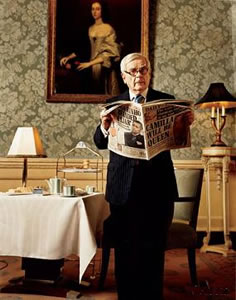
De Amerikaanse schrijver Dominick Dunne werd geboren op 29 oktober 1925 in Hartford, Connecticut. Zie ook mijn blog van 29 oktober 2008 en ook mijn blog van 29 oktober 2009.
Uit: Too Much Money
„Elias Renthal’s release from the federal prison in Las Vegas, Nevada, did not make the front pages of any of the New York papers. While Elias was living out his final moments as a convict, Adele Harcourt died at her apartment on Park Avenue, all alone except for Lil Altemus, who had just told Adele of the name change of the Manhattan Public Library, which would now be called the Konstantin and Perla Zacharias Library, in return for a $100 million gift, to be paid in the full amount, not in increments, from the Konstantin Zacharias Foundation. “She just closed her eyes and died, poor darling,” said Lil.
The next day Adele’s picture was on the front page of every New York paper, and her death was the lead story on all the local news programs. To the relief of Ruby Renthal, who had social aspirations, her husband Elias’s release-from-prison pictures were on the financial pages only and took second place in that section to the story of Leonard Watson’s prison sentence of 24 years for robbing his stockholders of $100 million.
Simon Cabot, in London, heard the news of Adele Harcourt’s death from Perla Zacharias, whose cook was a friend of Adele’s former butler, George, who had been relieved of his job by Mrs. Harcourt’s nephew from Wyoming, who felt that since Adele no longer went about in society she didn’t need a butler. George, whom Ruby had recently hired to be her butler at the house on 78th Street, kept up through hourly telephone calls with the maids still in Mrs. Harcourt’s employ, so concerned was he over the great lady, whom he had served for so many years. George called Perla’s cook one minute after Adele drew her last breath, and one and a half minutes later Perla Zacharias, who admired Adele Harcourt over any person and whose mantle she wanted to assume in New York society, loved having the news of such a piece of social history to pass on to Simon Cabot.“
Dominick Dunne (29 oktober 1925 - 26 augustus 2009)
De Russische schrijver en wetenschapsfilosoof Aleksandr Aleksandrovitsj Zinovjev werd geboren in Pachtino op 29 oktober 1922. Zie ook mijn blog van 29 oktober 2006 en ook mijn blog van 29 oktober 2008 en ook mijn blog van 29 oktober 2009.
Uit: Perestroika in Partygrad (Vertaald door Charles Janson)
„In the old days Partygrad was closed to foreigners. For two reasons.
First, because there was nothing to show them. True, there were a few churches, but without any historical or architectural interest. And all were shut except the most wretched one of all. There was
indeed an old monastery, but they'd put an anti-religious museum in it. In Partygrad one couldn't even find painted spoons, saucers or matryoshka dolls (which the West regards as the highest achievements of Russian national culture, though they've been made in Finland for a long time now). In the whole of Partygrad there was only one samovar, and that was in the museum of folklore.
The second reason why Partygrad was closed to foreigners was that it had a lot that foreigners shouldn't see: many military factories and schools, a chemical complex which turned out not so much
washing-powder as - more to the point - a secret weapon, a microbiological centre for ultra-secret research and a psychiatric hospital with the most lurid reputation in dissident circles. Corrective labour camps were sited round the town, also well known to dissidents; and an atomic factory which, though devoted to peaceful ends, had still managed to turn the whole region into a highly radioactive zone. But what foreigners above all must not see were the monstrous dwellings of the people, the empty shops, the long queues and all the other attributes of Russian provincial life. But when Gorbachev began his perestroika there a fundamental change came about. Not in the sense that the country or the life got bettersometimes they became worse. What did happen was that the government's view of the country and its life worsened. Thus the first period of Soviet history ended: the fault-hiding period; and a new epoch began when deficiencies were laid bare and officially acknowledged. Moreover, the authorities laid the faults bare not so much to their own citizens, who'd been quite aware of them without official guidance, but also to the West. It is not too much to say that the Soviet authorities initiated an orgy of admiration of their own ulcers and of boasting about them to the West.
This breakthrough coincided with the breakthrough in Soviet- Western relations. The West became interested not in the defects of the Soviet way of life but in the fact that Soviet officials recognized the presence of the defects; so that the recognition itself became the greatest virtue of the Soviet way of life.“
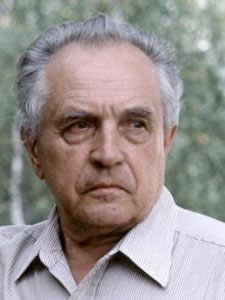
Aleksandr Zinovjev (29 oktober 1922 - 10 mei 2006)
De Duitse schrijver Georg Julius Leopold Engel werd geboren op 29 oktober 1866 in Greifswald.
Zie ook mijn blog van 29 oktober 2008.
Uit: Die Last
„Es war Tag geworden.
Noch immer rieselte der Regen und troff an den kleinen Fenstern der Krankenstube herunter. Bleigraues Licht stahl sich zögernd durch die Gardinen und mischte sich mit dem Schein der Lampe, die auch jetzt noch vor dem Bette brannte.
Auf dem großen Bauerngutshof erwachte einiges Leben. Man hörte zuweilen ein dumpfes Aufbrüllen der Kühe, und dazwischen das vereinzelte Rufen der Knechte. Doch klang alles gedämpft, als fürchte man, die Kranke zu stören.
Etwas Totes, Gedrücktes lag über dem Gehöft; und je mehr das trübe Sonnenlicht vorrückte, in desto größere Lautlosigkeit verfiel das Anwesen.
In dem weiten, zur ebenen Erde gelegenen Zimmer wurde ein schwacher Ruf laut. Kränklich, hohl, gebrochen, ein wenig gereizt klang er, aber so leise die Stimme auch flüsterte, sofort fuhr aus dem ledernen Sessel neben dem Bette ein Mann von mächtiger, imposanter Gestalt auf, rieb sich ein wenig die Augen, strich ein paarmal energisch über seine dicken, kurzgeschorenen Haare und legte dann seine Finger behutsam auf die Hand der leidenden Frau.
»Na, Elsing,« forschte er aufmunternd, wobei er seine Stimme soviel als möglich herabdämpfte, »geht’s ein bißchen besser?«
Statt einer Antwort rang die Angeredete die Hände und vergrub ihr Antlitz in die Kissen: »Du lieber Gott,« stöhnte sie leise, und es war beinahe, als ob aus dem weißen Linnen ein Schluchzen dränge.
Der Mann ließ seine Hand aufs Knie sinken und starrte auf den hellen, sandbestreuten Estrich der Stube.
Plötzlich warf sich das junge Weib herum und forschte hastig: »Du bist wohl eingeschlafen, Wilms?«
Seltsam, – neidisch fast schien die Frage.
»Ja, ich bin ein wenig eingenickt,« gab der Gatte zu. Und wieder konnte man leise Entschuldigung aus den Worten hören. »Ich sitz’ ja nun auch bald die vierte Nacht so,« murmelte er halb für sich.“
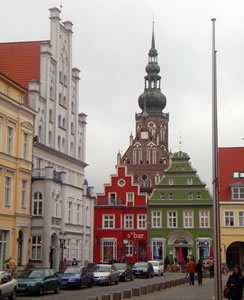
Georg Engel (29 oktober 1866 – 19 oktober 1931)
Greifswald, Fischmarkt (Geen portret beschikbaar)
De Franse schrijver, toneelauteur en beroepsdiplomaat Jean Giraudoux werd geboren op 29 oktober 1882 in Bellac/Haute-Vienne. Zie ook mijn blog van 29 oktober 2006 en ook mijn blog van 29 oktober 2008.
Uit: La guerre de Troie n'aura pas lieu
„HECTOR
Écoute-là, Cassandre, Écoute ce bloc de négation qui dit oui ! Tous m’ont cédé. Pâris m’a cédé, Priam m’a cédé, Hélène me cède. Et je sens qu’au contraire dans chacune de ces victoires apparentes, j’ai perdu. On croit lutter contre des géants, on va les vaincre, et il se trouve qu’on lutte contre quelque chose d’inflexible qui est un reflet sur la rétine d’une femme. Tu as beau me dire oui, Hélène, tu es comble d’une obstination qui me nargue !
HÉLÈNE
C’est possible. Mais je n’y peux rien. Ce n’est pas la mienne.
HECTOR
Par quelle divagation le monde a-t-il été placé son miroir dans cette tête obtuse.
HÉLÈNE
C’est regrettable, évidemment. Mais vous voyez un moyen de vaincre l’obstination des miroirs ?
HECTOR
Oui. C’est à celà que je songe depuis un moment.
HÉLÈNE
Si on les brise, ce qu’ils reflètaient n’en demeure peut-être pas moins ?
HECTOR
C’est là toute la question.
AUTRE MESSAGER
Hector, hâte-toi. La plage est en révolte. Les navires des Grecs sont en vue, et ils ont hissé leur pavillon non au ramat mais à l’écoutière. L’honneur de notre marine est en jeu. Priam craint que l’envoyé ne soit massacré à son débarquement.
HECTOR
Je te confie Hélène, Cassandre. J’enverrai mes ordres.“
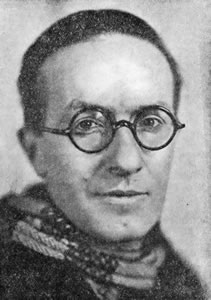
Jean Giraudoux (29 oktober 1882 - 31 januari 1944)
De Franse dichter André Chénier (eigentlich André Marie Chénier ofde Chénier) werd geboren op 29 oktober 1762 in Galata bij Constantinopel. Zie ook mijn blog van 29 oktober 2008.
Art d'aimer, fragment III
Ainsi le jeune amant, seul, loin de ses délices,
S'assied sous un mélèze au bord des précipices,
Et là, revoit la lettre où, dans un doux ennui,
Sa belle amante pleure et ne vit que pour lui.
Il savoure à loisir ces lignes qu'il dévore ;
Il les lit, les relit et les relit encore,
Baise la feuille aimée et la porte à son coeur.
Tout à coup de ses doigts l'aquilon ravisseur
Vient, l'emporte et s'enfuit. Dieux ! il se lève, il crie,
Il voit, par le vallon, par l'air, par la prairie,
Fuir avec ce papier, cher soutien de ses jours,
Son âme et tout lui-même et toutes ses amours.
Il tremble de douleur, de crainte, de colère.
Dans ses yeux égarés roule une larme amère.
Il se jette en aveugle, à le suivre empressé,
Court, saute, vole, et l'oeil sur lui toujours fixé,
Franchit torrents, buissons, rochers, pendantes cimes,
Et l'atteint, hors d'haleine, à travers les abîmes.
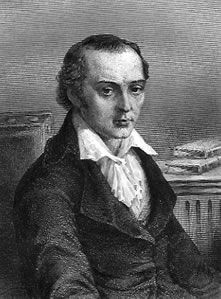
André Chénier (29 oktober 1762 – 25 juli 1794)