Bodenski, James Jones, Galaktion Tabidze, Jonas Lie, Johannes Jørgensen

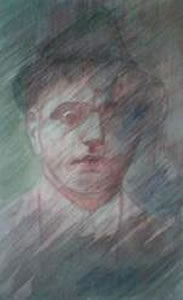
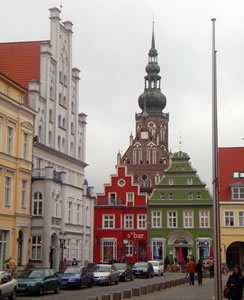
De Duitse dichter, componist en musicus Bodenski (eig. Michael Boden) werd geboren op 6 november 1965 in Potsdam. Zie ook mijn blog van 6 november 2008.
Duell im Morgengrauen
Gewählte Waffe: Alphabet
Eine Salve heller Vokale
Jage ich dir in dein Bein
Du strauchelst
Antwortest pfeilschnell
Katapultierst Konsonanten
Es folgen Worte
Ganze Sätze
Reime Verse
Für Stanzen oder Nonarime wird
Die Zeit nicht reichen
Geschweige denn für Episches
Schon fühle ich mich ausgelaugt
Trocken schmerzt die Kehle
Wenn ich Genugtuung erhalten will
Muss ich dir standhaft zusetzen
So versuche ich
Ruhig Blut zu sein
Probiere es
Mit einer Drehung der Perspektive
Mit einer härteren Grammatik
Einem kälteren Ton
Schneller parierend
Mit jedem weiteren Wort
Als du eine meiner Phrasen
Mit einem Stoßseufzer durchbohrst
Begehst du eine klare Verletzung
Der Regeln
Ich bedauere die Disqualifikation
Wenigstens sind wir
Im Gegensatz zu Puschkin
Mit dem Leben davon gekommen
Bodenski (Potsdam, 6 november 1965)
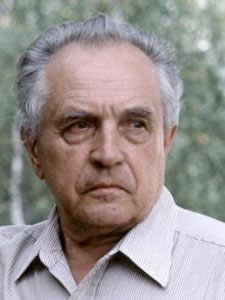
De Amerikaanse schrijver James Jones werd geboren op 6 november 1921 in Robinson, Illinois. Zie ook mijn blog van 6 november 2008 en ook mijn blog van 6 november 2009.
Uit: The Thin Red Line
“The two transports had sneaked up from the south in the first graying flush of dawn, their cumbersome mass cutting smoothly through the water whose still greater mass bore them silently, themselves as gray as the dawn which camouflaged them. Now, in the fresh early morning of a lovely tropic day they lay quietly at anchor in the channel, nearer to the one island than to the other which was only a cloud on the horizon. To their crews, this was a routine mission and one they knew well: that of delivering fresh reinforcement troops. But to the men who comprised the cargo of infantry this trip was neither routine nor known and was composed of a mixture of dense anxiety and tense excitement.
Before they had arrived, during the long sea voyage, the cargo of men had been cynical--honestly cynical, not a pose, because they were part of an old regular division and knew that they were cargo. All their lives they had been cargo; never supercargo. And they were not only inured to that; they anticipated it. But now that they were here, were actually confronted with the physical fact of this island that they had all read so much about in the papers, their aplomb deserted them momentarily. Because though they were from a pre-war regular division, this was nevertheless to be their baptism of fire.
As they prepared themselves to go ashore no one doubted in theory that at least a certain percentage of them would remain on this island dead, once they set foot on it. But no one expected to be one of these. Still it was an awesome thought and as the first contingents came struggling up on deck in full gear to form up, all eyes instinctively sought out immediately this island where they were to be put, and left, and which might possibly turn out to be a friend's grave.
The view which presented itself to them from the deck was a beautiful one. In the bright, early morning tropic sunshine which sparkled off the quiet water of the channel, a fresh sea breeze stirred the fronds of minute coconut palms ashore behind the dun beach of the nearer island. It was too early yet to be oppressively hot. There was a feeling of long, open distances and limitless sea vistas. The same sea-flavored breeze sifted gently among the superstructures of the transports to touch the ears and faces of the men. After the olfactory numbness caused by the saturation of breath, feet, armpits and crotches below in the hold, the breeze seemed doubly fresh in their noses. Behind the tiny cocopalms on the island masses of green jungle rose to yellow foothills, which in turn gave place in the bright air to hulking, blue-hazed mountains.“
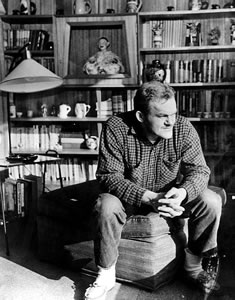
James Jones (6 november 1921 – 9 mei 1977)
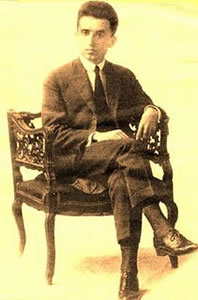
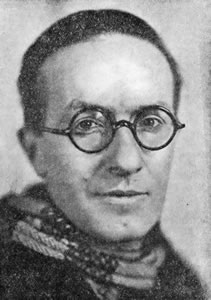
De Georgische diichter en schrijver Galaktion Tabidze werd geboren op 6 november 1891 in Chqvishi, in de buurt van Vani. Zie ook mijn blog van 6 november 2008 en ook mijn blog van 6 november 2009.
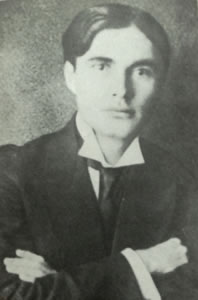
Galaktion Tabidze (6 november 1891 – 17 maart 1959)
De Noorse schrijver Jonas Laurits Idemil Lie werd geboren op 6 november 1833 in Eiker bij Drammen. Zie ook mijn blog van 6 november 2008.
Uit: The Pilot and his Wife (Vertaald door Ole Bull)
„On the stern, pine-clad southern coast of Norway, off the picturesquely-situated town of Arendal, stand planted far out into the sea the white walls of the Great and Little Torungen Lighthouses, each
on its bare rock-island of corresponding name, the lesser of which seems, as you sail past, to have only just room for the lighthouse and the attendant's residence by the side. It is a wild and lonely situation,--the spray, in stormy weather, driving in sheets against the walls, and eagles and sea-birds not unfrequently dashing themselves to death against the thick glass panes at night; while in winter all
communication with the land is very often cut off, either by drift or patchy ice, which is impassable either on foot or by boat.
These, however, and others of the now numerous lights along that dangerous coast, are of comparatively recent erection. Many persons now living can remember the time when for long reaches the only lighting was the gleam of the white breakers themselves. And the captain who had
passed the Oxö light off Christiansand might think himself lucky if he sighted the distant Jomfruland up by Kragerö.
About a score of years before the lighthouse was placed on Little Torungen there was, however, already a house there, if it could be dignified by that name, with its back and one side almost up to the eave of the roof stuck into a heap of stones, so that it had the appearance of bending forward to let the storm sweep over it. The low entrance-door opened to the land, and two small windows looked out upon the sea, and upon the boat, which was usually drawn up in a cleft above the sea-weed outside.
When you entered, or, more properly speaking, descended into it, there was more room than might have been expected; and it contained sundry articles of furniture, such as a handsome press and sideboard, which no one would have dreamt of finding under such a roof. In one corner there stood an old spinning-wheel covered with dust, and with a smoke-blackened tuft of wool still hanging from its reel; from which, and from other small indications, it might be surmised that there had once been a woman in the house, and that tuft of wool had probably been her last spin.“ 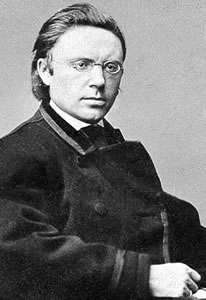
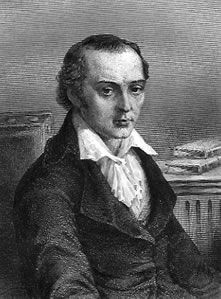
Jonas Lie (6 november 1833 – 5 juli 1908)
De Deense schrijver Johannes Jörgensen werd geboren in Svendborg op 6 november 1866 geboren. Zie ook mijn blog van 6 november 2008.
Uit: St. Francis and His Brethren (Vertaald door T. O'Conor Sloane)
„The Franciscan Order (Friars Minor) was founded by the Poverello of Assisi (1182-l226) in the little church of Portiuncula in 1209. It was given oral approval by Pope Innocent III in 1210, and the Rule was formally approved by Pope Honorius III in 1221.
Francis found himself one day in Bishop Guido's private room. As was customary with him, he had gone to the man he regarded as "the father of souls" to get advice-perhaps also to pray for alms. It was a period of hard times for the Brotherhood. After the return from the mission journeys, four new Brothers had joined the ranks-Philipp Lungo, John of San Costanzo, Barbarus, and Bernard of Vigilanzio. Francis himself had brought a fifth new Brother with him from Rieti-Angelo Tancredi, a young knight whom Francis had met in the streets of Rieti, and whom he had won by suddenly calling out to him: "Long enough hast thou borne the belt, the sword and the spurs! The time has now come for you to change the belt for a rope, the sword for the Cross of Jesus Christ, the spurs for the dust and dirt of the road! Follow me and I will make you a knight in the army of Christ!"
Thus it was that there were no longer so few men to have food daily. In the beginning the people of Assisi had been seized with a kind of wonder, and the Brothers had got considerable alms as they went from door to door. Now people began to grow weary of them; now the relatives of the Brothers were ready to persecute them. "You have given away what you had, and now you come and want to eat up other people's things!"
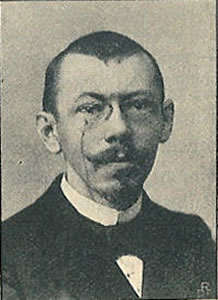
Johannes Jørgensen (6 november 1866 - 29 mei 1956)