Naar de inhoud

Romenu

Over literatuur, gedichten, kunst en cultuur
akke.beakke.be

Berichten van 21 november 2010 tot 22 november 2010

André Gide, George Eliot, Viktor Pelevin, Suresh en Jyoti Guptara
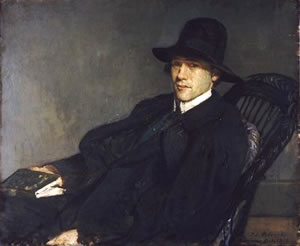
De Franse schrijver André Gide werd geboren op 22 november 1869 in Parijs. Zie ook mijn blog van 22 november 2006 en ook mijn blog van 22 november 2007 en ook mijn blog van 22 november 2008 en ook mijn blog van 22 november 2009.


Uit: La symphonie pastorale


“Mais je crois inutile de noter ici tous les échelons premiers de cette instruction qui, sans doute, se retrouvent dans l’instruction de tous les aveugles. C’est ainsi que, pour chacun d’eux, je pense, la question des couleurs a plongé chaque maître dans un même embarras. (Et à ce sujet je fus appelé à remarquer qu’il n’est nulle part question de couleurs dans l’Évangile.) Je ne sais comment s’y sont pris les autres ; pour ma part je commençai par lui nommer les couleurs du prisme dans l’ordre où l’arc-en-ciel nous les présente ; mais aussitôt s’établit une confusion dans son esprit entre couleur et clarté ; et je me rendais compte que son imagination ne parvenait à faire aucune distinction entre la qualité de la nuance et ce que les peintres appellent, je crois, « la valeur ». Elle avait le plus grand mal à comprendre que chaque couleur à son tour pût être plus ou moins foncée, et qu’elles pussent à l’infini se mélanger entre elles. Rien ne l’intriguait davantage et elle revenait sans cesse là-dessus.
Cependant il me fut donné de l’emmener à Neuchâtel où je pus lui faire entendre un concert. Le rôle de chaque instrument dans la symphonie me permit de revenir sur cette question des couleurs. Je fis remarquer à Gertrude les sonorités différentes des cuivres, des instruments à cordes et des bois, et que chacun d’eux à sa manière est susceptible d’offrir, avec plus ou moins d’intensité, toute l’échelle des sons, des plus graves aux plus aigus. Je l’invitai à se représenter de même, dans la nature, les colorations rouges et orangées analogues aux sonorités des cors et des trombones, les jaunes et les verts à celles des violons, des violoncelles et des basses ; les violets et les bleus rappelés ici par les flûtes, les clarinettes et les hautbois. Une sorte de ravissement intérieur vint dès lors remplacer ses doutes :
– Que cela doit être beau ! répétait-elle.
Puis, tout à coup :
– Mais alors : le blanc ? Je ne comprends plus à quoi ressemble le blanc...
Et il m’apparut aussitôt combien ma comparaison était précaire. – Le blanc, essayai-je pourtant de lui dire, est la limite aiguë où tous les tons se confondent, comme le noir en est la limite sombre. – Mais ceci ne me satisfit pas plus qu’elle, qui me fit aussitôt remarquer que les bois, les cuivres et les violons restent distincts les uns des autres dans le plus grave aussi bien que dans le plus aigu. Que de fois, comme alors, je dus demeurer d’abord silencieux, perplexe et cherchant à quelle comparaison je pourrais faire appel.”


 789299-d70a494c456e62e5adeb997903726027.jpg

André Gide (22 november 1869 – 19 februari 1951)

Portret door Jacques Emile Blanche, 1912


De Engelse schrijfster George Eliot werd geboren op 22 november 1819 in Nuneaton in Warwickshire. Zie ook mijn blog van 22 november 2006 en ook mijn blog van 22 november 2008 en ook mijn blog van 22 november 2009.


Count That Day Lost 


If you sit down at set of sun

And count the acts that you have done,

And, counting, find

One self-denying deed, one word

That eased the heart of him who heard,

One glance most kind

That fell like sunshine where it went --

Then you may count that day well spent.


But if, through all the livelong day,

You've cheered no heart, by yea or nay --

If, through it all

You've nothing done that you can trace

That brought the sunshine to one face--

No act most small

That helped some soul and nothing cost --

Then count that day as worse than lost.


In a London Drawingroom 


The sky is cloudy, yellowed by the smoke.

For view there are the houses opposite

Cutting the sky with one long line of wall

Like solid fog: far as the eye can stretch

Monotony of surface & of form

Without a break to hang a guess upon.

No bird can make a shadow as it flies,

For all is shadow, as in ways o'erhung

By thickest canvass, where the golden rays

Are clothed in hemp. No figure lingering

Pauses to feed the hunger of the eye

Or rest a little on the lap of life.

All hurry on & look upon the ground,

Or glance unmarking at the passers by

The wheels are hurrying too, cabs, carriages

All closed, in multiplied identity.

The world seems one huge prison-house & court

Where men are punished at the slightest cost,

With lowest rate of colour, warmth & joy.


 789299-d4be94415420acab207e16ef6610fb84.jpg

George Eliot (22 november 1819 – 22 december 1880)

Op 30-jarige leeftijd, portret door François D'Albert Durade


De Russische schrijver Viktor Pelevin werd geboren op 22 november 1962 in Moskou. Zie ook mijn blog van 22 november 2006 en ook mijn blog van 22 november 2008 en ook mijn blog van 22 november 2009.


Uit: The Life Of Insects (Vertaald door Andrew Browmfield)


„The main building of the old resort hotel, half hidden from view behind a screen of old poplars and cypresses, was an oppressive, gray structure which seemed to have turned its back to the sea at the bidding of some crazed fairy-tale conjuror. The facade, with its columns, cracked stars, and sheaves of wheat bent eternally before a plaster wind, faced into a shallow courtyard where the smells of the kitchen, the laundry, and the hairdresser's mingled; the massive wall which faced onto the shoreline had only two or three windows. A few yards from the colonnade there was a high concrete wall, beyond which the rays of the sunset glinted on the smokestacks of the local power plant. The tall formal doors concealed in the shade on the cyclopean balcony had been locked for so long that even the crack between them had disappeared under several layers of caked paint, and the yard was usually empty, except when an occasional truck cautiously squeezed its way in, bringing milk and bread from Feodosia.

This evening there wasn't even a truck in the yard, so there was no one to notice the individual leaning on the molded balustrade of the balcony, except perhaps for a pair of seagulls out on patrol, two white specks drifting across the sky. The stranger was looking down and to the right, toward the shelter on the dock and the cone of a loudspeaker lodged under the edge of its roof. The sea was noisy, but when the wind blew toward the hotel, it carried audible snatches of a radio broadcast directed at the deserted beach.

"... not at all the same as each other, not cut to the same pattern ... created us all different; is not this part of the grand scheme of things, counted, unlike the transient plans of man, in many ... What does the Lord expect of us, as He turns His hopeful gaze in our direction? Will we be able to make use of His gift? ... For He Himself does not know what to expect from the souls that He has sent to ..."


 789299-b1c98015fe0130415650f79149325f6d.jpg

Viktor Pelevin (Moskou, 22 november 1962)


De Brits-Indische schrijverstweeling Suresh en Jyoti Guptara werd geboren op 22 november 1988 in Frimley, Hants in het zuidoosten van Engeland. Zie ook mijn blog van 22 november 2008 en ook mijn blog van 22 november 2009.


Uit: Conspiracy of Calaspia


„After throwing a wary look around him, Galar stooped to look at the man.  He was in a nasty state, battered and bloody – however, miraculously all in one piece.  Alive, but barely so.  Although the fight had not taken place all that long ago, the man’s wounds had already dried.  That wasn’t much of a surprise in this accursed heat.

A sigh escaped the man’s lips.  He tried to sit up, but collapsed under the strain and gasped in pain.

‘Monsters,’ he finally stammered.

‘O’course,’ Galar rumbled.  ‘What did yeh expect, butterflies?’ 

The Dwarf felt sorry for the man, but what had he expected?  Anyone nosing around this part of Calaspia was asking for trouble.  It was home to the worst of creatures, although thankfully it no longer supported certain predators.  A ludicrous thought popped into Galar’s mind, and he chuckled at the notion of the Ministry for Ecology or whatever the Numenii now called it, labelling the monsters here ‘endangered species’.  No, nobody was sad that these beasts were dying out.  And no one regretted obliterating the monstrous Ostentum.

‘Come on, let’s get yeh outta here,’ the Dwarf said gently to the whimpering man, ‘before they return.’  He would get to ask him who he was and what stroke of insanity had led him here later.  But the man resisted Galar’s powerful arms, shaking his head and muttering, as if to ward off a nightmare.

‘Sun must’ve got to yeh head, but we’ll have yeh sorted in no time.  Here, this’ll help.’  Galar fumbled around in his beard until he found what he was looking for.  Retrieving a crystal vial, Galar bent over his wounded charge and prepared to administer the liquid.  Again a feeble protest ensued, and so instead the Dwarf cradled the man’s head in one enormous hand and helped him to sit up.  The man took several gulps of the scorched air.  His eyelids fluttered as he fought to keep them open.  He opened his mouth to speak and his cracked lips struggled to form the words.”


789299-6701b7e85fd27b84713646da871a27e3.jpg
Suresh en Jyoti Guptara (Frimley, 22 november 1988)


Zie voor nog meer schrijvers van de 22 november ook
mijn vorige blog van vandaag.
Geschreven door Romenu om 21:45 Reageer op dit bericht

Endre Ady, William Kotzwinkle, George Robert Gissing, Elisabeth Maria Post


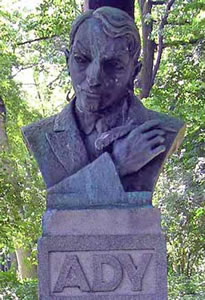
De Hongaarse dichter Endre Ady werd geboren op 22 november 1877 in het huidige Adyfalva. Zie ook mijn blog van 22 november 2008 en ook mijn blog van 22 november 2009.


Benediction from a Train


The express is hurtling at full speed,
the sun explodes into the sea,
my memories flash a millisecond,
and I bless you.


"May God bless
all your goodness,
your unresponsiveness,
and all your wickedness.
May your words of torment
return to you in benediction.
May your coldness
leap into flames.
All is at an end.
I have a thousand cares,
and for my folly
the bier is spread.
Well, I bless you,
and meanwhile
kiss me softly,
in silence and peace.
I wish to leave you
with a memory and a kiss
to freeze for warmth,
to be alone,
to feel alone,
to die alone.
May God bless you."


The express is hurtling at full speed,
the sun explodes into the sea,
my memories flash a millisecond,
and I bless you.


Vertaald door Gábor Lendvai


789292-c824349b4952871124f9d6ff6c016c15.jpg
Endre Ady (22 november 1877 – 27 januari 1919)

Buste in de Hungarian Cultural Gardens, Cleveland, Ohio


De Amerikaanse schrijver
William Kotzwinkle werd geboren op 22 november 1943 in Scranton, Pennsylvania. Zie ook mijn blog van 22 november 2008
en ook mijn blog van 22 november 2009.


Uit: The Amphora Project


"Sky mines," hissed Lizardo, his throat inflating nervously as he gazed out the flight deck window at the ornaments of doom flickering in the darkness. His armored scales made a scraping sound as he wrapped his tail around the pedestal of his seat. "No one mentioned minefields."
"You worry too much," said Commander Jockey Oldcastle, his formidable paunch pressed against the controls of their descending ship.
"That's why we haven't been killed until now," hissed Lizardo. He was a navigator from Planet Serpentia. The pupils of his eyes were shaped like keyholes in an ancient lock, glowing with menace. In the rooms of his brain were recipes for poisons in all dilutions, from mild to murderous. Two fangs lay backward against the roof of his mouth. When they swung forward, they filled with venom and the recipient of it was going to go to sleep, for hours, days, or forever, depending on the mixture.
Jockey looked beyond the sky mines to the little moon below.
"Made for pleasure."
"Only fools seek pleasure on such places. We don't need this job."
"We need any job we can get." Jockey touched the controls lightly, taking the ship closer to the minefield.
Lizardo's scaly claws clicked on the control face of his naviga�tional equipment. He was preparing a flight plan for escape, back out through the minefield. Serpentians receive vibratory patterns from the metabolic processes of other brains, and metabolic tremors were now reaching him from the moon below. Amid the usual garbage of human and alien emotion he discerned the emanation of a hunting party--highly focused individuals on the prowl. As there was no game on the little moon, what were they hunting?“


789292-413497bcbca0919020bf144b3bf5b10c.jpg
William Kotzwinkle (Scranton 22 november 1943)


De Engelse schrijver George Robert Gissing werd geboren op 22 november 1857 in Wakefield, Yorkshire. Zie ook mijn blog van 22 november 2008 en ook mijn blog van 22 november 2009.


Uit: Our Friend the Charlatan


„As he waited for his breakfast, never served to time, Mr. Lashmar drummed upon the window-pane, and seemed to watch a blackbird lunching with much gusto about the moist lawn of Alverholme Vicarage. But his gaze was absent and worried. The countenance of the reverend gentleman rarely wore any other expression, for he took to heart all human miseries and follies, and lived in a ceaseless mild indignation against the tenor of the age. Inwardly, Mr. Lashmar was at this moment rather pleased, having come upon an article in his weekly paper which reviewed in a very depressing strain the present aspect of English life. He felt that he might have, and ought to have, written the article himself a loss of opportunity which gave new matter for discontent.

The Rev. Philip was in his sixty-seventh year; a thin, dry, round-shouldered man, with bald occiput, straggling yellowish beard, and a face which recalled that of Darwin. The resemblance pleased him. Privately he accepted the theory of organic evolution, reconciling it with a very broad Anglicanism; in his public utterances he touched upon the Darwinian doctrine with a weary disdain. This contradiction involved no insincerity; Mr. Lashmar merely held in contempt the common understanding, and declined to expose an esoteric truth to vulgar misinterpretation. Yet he often worried about it -- as he worried over everything.

Nearer causes of disquiet were not lacking to him. For several years the income of his living had steadily decreased; his glebe, upon which he chiefly depended, fell more and more under the influence of agricultural depression, and at present he found himself, if not seriously embarrassed, likely to be so in a very short time. He was not a good economist; he despised everything in the nature of parsimony; his ideal of the clerical life demanded a liberal expenditure of money no less than unsparing personal toil. He had generously exhausted the greater part of a small private fortune; from that source there remained to him only about a hundred pounds a year. His charities must needs be restricted; his parish outlay must be pinched; domestic life must proceed on a narrower basis. And all this was to Mr. Lashmar supremely distasteful.“


 789292-ae93196feba91b6e73077f344031502d.jpg

George Robert Gissing (22 november 1857 – 28 december 1903)


De Nederlands dichteres en schrijfster Elisabeth Maria Post werd geboren in Utrecht op 22 november 1755. Zie ook mijn blog van 22 november 2006.en ook mijn blog van 22 november 2008 en ook mijn blog van 22 november 2009.


De bosch-duif


 Lief duifjen! in uw' ted'ren toon,

 Hoor ik een liefdeklagt;

 Gij zucht uw koe koe roe roe roe,

 Zoo innig smachtend uit;

 Het galmt door 't hol en statig bosch;

 Een Echo baauwt het na;

 Ik luister; en ook in mijn hart

 Roept nog een Echo na.

 Werd u uw gaaiken ongetrouw?

 Of nam een roofdier 't weg?

 Zit ge op 't verlaaten nest alleen?

 Is uw geluk nu weg?

 Zij geeft geen antwoord, hoe gij roept;

 Uw klagt verscheurt mijn hart;

 Veelmeer misschien dan iemant ooit,

 Deel 'k in uw treurigheid. 


 Ook ik, gescheiden van mijn' vriend,

 Den eengen in 't heelal,

 Die mijn geheele hart bezit,

 Ben hier zoo gantsch alleen:

 Onzeker of het lot ons ooit

 Elkander geeven zal,

 Ga ik mistroostig door dit bosch;

 Zijn groen lacht mij niet aan.

 Der vooglen wildzang zij zoo blij

 Als ooit, ik word niet blij;

 Alleen uw koe koe roe roe roe,

 O! das gevalt mijn hart!


789292-736d5a120642f38f3fc7e0bf251c770c.jpg
Elisabeth Maria Post (22 november 1755 - 3 juli 1812)

Het landhuis Emminkhuizen waar de fam. Post waarschijnlijk enige jaren heeft gewoond

Geschreven door Romenu om 16:56 Reageer op dit bericht

Isaac Bashevis Singer, Marilyn French, Margriet de Moor, Veza Canetti, Freya North

De Amerikaans-Poolse schrijver Isaac Bashevis Singer werd geboren op 21 november 1904 als Isaac Hertz Singer in Radzymin, Polen. Zie ook mijn blog van 21 november 2006 en ook mijn blog van 21 november 2007 en ook mijn blog van 21 november 2008 en ook mijn blog van 21 november 2009.

Uit: Fool's Paradise


„Somewhere, sometime, there lived a rich man whose name was Kadish. He had an only son who was called Atzel. In the household of Kadish there lived a distant relative, an orphan girl, called Aksah. Atzel was a tall boy with black hair and black eyes. Aksah was somewhat shorter than Atzel, and she had blue eyes and golden hair. Both were about the same age. As children, they ate together, studied together, played together. Atzel played the husband; Aksah, his wife. It was taken for granted that when they grew up they would really marry.

But when they had grown up, Atzel suddenly became ill. It was a sickness no one had ever heard of before: Atzel imagined that he was dead.

How did such an idea come to him? It seems it came from listening to stories about paradise. He had had an old nurse who had constantly described the place to him. She had told him that in paradise it was not necessary to work or to study or make any effort whatsoever. In paradise one ate the meat of wild oxen and the flesh of whales; one drank the wine that the Lord reserved for the just; one slept late into the day; and one had no duties.

Atzel was lazy by nature. He hated to get up early in the morning and to study languages and science. He knew that one day he would have to take over his father's business and he did not want to.

Since his old nurse had told Atzel that the only way to get to paradise was to die, he had made up his mind to do just that as quickly as possible. He thought and brooded about it so much that soon he began to imagine that he was dead.

Of course his parents became terribly worried when theysaw what was happening to Atzel. Aksah cried in secret. The family did everything possible to try to convince Atzel that he was alive, but he refused to believe them. He would say, "Why don't you bury me? You see that I am dead. Because of you I cannot get to paradise."

Many doctors were called in to examine Atzel, and all tried to convince the boy that he was alive. They pointed out that he was talking, eating, and sleeping. But before long Atzel began to eat less and he rarely spoke. His family feared that he would die.“


 788592-9905f0703930270e1a51bf64e9c8400a.jpg

 Isaac Bashevis Singer (21 november 1904 – 24 juli 1991)

 Portret door Sylvia Ary, 1935


De Amerikaanse schrijfster en literatuurwetenschapster Marilyn French werd geboren op 21 november 1929 in New York. Zie ook mijn blog van 21 november 2007  en ook mijn blog van 21 november 2008 en ook mijn blog van 21 november 2009.


Uit: Frauen (Vertaald door Barbara Duden, Monika Schmid, Gesine Strempel)


“Wir hatten uns damals alle ein Wort angewöhnt, das Wort die, und wir meinten damit alle das gleiche: die Männer. Jede von uns fühlte sich von einem reingelegt, aber das allein war es nicht. Jede von uns hatte Freundinnen, und unsere Freundinnen waren genauso von ihnen reingelegt worden. Und jede von unseren Freundinnen hatte Freundinnen... Und es waren nicht nur Ehemänner. Wir hatten von Lilys Freundin Ellie gehört, deren Mann ein brutaler Rohling war; sie hatte mühsam eine Trennung von ihm durchgesetzt, aber danach drang er regelmäßig ins Haus ein und verprügelte sie mitten in der Nacht, und sie konnte nichts dagegen unternehmen. Buchstäblich nichts. Die Polizei wollte nicht eingreifen, da er noch immer der Besitzer des Hauses war. Ihr Rechtsanwalt sagte, er könne nichts tun. Vielleicht hätte er etwas tun können, aber Bruno hatte auch ihn bedroht, und vielleicht hatte er einfach nur Angst. Sie konnte niemanden dazu bewegen, ihr zu helfen. Sie wollte nicht zur Polizei gehen und Anzeige gegen Bruno erstatten. Sie meinte, dann würde er vielleicht seinen Job verlieren und sie wollte ihn ja auch nicht unbedingt ins Gefängnis wandern sehen. Aber schließlich blieb ihr nichts anderes übrig. Und er verlor seinen Job. Er kam nicht ins Gefängnis, aber er hörte auf, ihr auch nur einen Cent zu zahlen. Ein großartiger Handel. Sie hatte gewonnen. Was gewonnen? Den Status einer fürsorgeempfangenden Mutter. Oder Doris. Roger wollte die Scheidung, und sie war so wütend, dass sie ihn regelrecht schröpfte. Sie verlangte fünfzehntausend Dollar im Jahr für sich und die drei Kinder. Aber immerhin verdiente er auch fünfunddreißigtausend, und sie hatte ihre Ausbildung aufgegeben, als sie heirateten, und ihn drei Jahre lang ernährt, während er zu Ende studierte.“


788592-7a8714890f16cd8f47aacd8653b7d235.jpg
Marilyn French (New York, 21 november 1929 – 2 mei 2009)


De Nederlandse schrijfster Margriet de Moor werd als Margaretha Maria Antonetta Neefjes op 21 november 1941 in Noordwijk geboren. Zie ook mijn blog van 21 november 2008 en ook mijn blog van 21 november 2009.

Uit: Als een hond zijn blinde baas


'Er heeft ten tijde van de zwaarste ogenblikken van het beleg van Sarajevo een foto in de krant gestaan waar ik heel lang naar heb gekeken. Een cellist zit te spelen op het kerkhof van Sarajevo. Hij draagt het zwarte kostuum, het witte overhemd en het strikje van de concertmusicus. Zijn positie deed me onmiddellijk denken aan die van een solist op het podium, met achter zijn rug de orkestleden, zerken in dit geval. Terwijl ik naar de foto keek, dacht ik niet: houden de sluipschutters nu soms op?

Je kunt, door je handen, de oorlog geweld aandoen. Door je handen die spelen en je handen die schrijven, daar, in die geïsoleerde kamer in je huis, waar je je weleens heel dubbelhartig voelt en waar de term ivoren toren kan bovenkomen. Waar is je betrokkenheid?

Dan is er de foto en die gaat domweg over integriteit. En over het feit dat de mens een verschrikkelijk schepsel mag zijn, maar wel zijn beste ogenblikken kent, ogenblikken die soms na een massa arbeid en geduld doorgetrokken kunnen worden in een kunst, een vak, een ambacht.’


788592-0974a3188f11f49ce527dbb48d632548.jpg
Margriet de Moor (Noordwijk, 21 november 1941)


De Oostenrijkse schrijfster en vertaalster Veza Canetti werd als Venetiana Taubner-Calderon geboren op 21 november 1897 in Wenen. Zie ook mijn blog van 21 november 2008 en ook mijn blog van 21 november 2009.

Uit:
Briefe an Georges


„Veza an Georges 7. Mai 1948 Liebstes Kind, you are telling me – kann ich da nur sagen. Du  beurteilst ihn vollkommen richtig, nur eben auch im Zorn, wie ich es tat, als ich den Brief   schrieb, was ich hinterher bereute, weil er so verwundbar ist und ganz so, wie Du ihn schilderst, aber ohne die verächtlichen Beweggründe. Er ist ein unentwickeltes bezauberndes geniales   Kind, glaubs mir. Und darum musste ich eine Megäre werden und ich kann Dir versichern, ich   hab vollkommen recht mit den »Aphorismen«. Kirkegaard hat gehungert, ehe er etwas   herausbrachte was ein »seller« war. Das klingt Dir hässlich von Deiner Höhe herab, doch da er ja Ruhe haben soll seine grossartigen Arbeiten fertig zu machen, verlang ich nicht, dass er wie   Kirkegaard das »Tagebuch eines Verführers« schreibt, sondern nur druckt, was schon da ist. Er kriegt von Deutschland sterlings ausbezahlt. Er hätte es freilich leichter, wenn er nicht auch für mich sorgen müsste, aber andererseits muss er das, weil ich durch ihn so heruntergekommen  war, dass ichs nicht selbst konnt, und erst jetzt, seit er weg ist, habe ich alles für mich unternommen, erst jetzt hatt ich den Mut. Ich habe auf Anfragen für meine  Arbeiten nicht

einmal geantwortet, weil es mir schon schrecklich schwer war, seine  Korrespondenzen und Geschäfte zu erledigen. Es ist ein Kern Wahrheit an dem was ich ihm  über Amersham schrieb und doch ist er unschuldig – so ist ein richtiger Dichter. Goethe ist  immer zusammengeklappt  und war reich. Jetzt erst er, der so schwer zu kämpfen hatte und in  eine so furchtbare Zeit  hineingeboren wurde. Lies doch, was er über Dich schreibt, wie nobel,  wie verständnisvoll, wie  gerecht. Er will immer gerecht sein und darum verteidigt er sich nie und er ist ein Heiliger, glaubs mir. Leider hat er  sich so auch mit dieser Bauerndirne benommen,  Du wirst ja sehen ... was Du jetzt sehen wirst.  Jetzt wird er nicht Proust lesen, jetzt arbeitet er  an ihrem Roman.“


788592-f2c5a21985043b5dc4cc09fb1d6bc83f.jpg
Veza Canetti (21 november 1897 – mei 1963)


De Britse schrijfster Freya North werd geboren op 21 november 1967 in Londen. Zie ook mijn blog van 21 november 2008 en ook mijn blog van 21 november 2009.
 

Uit: Chloë (Vertaald door Peter Barnaart)


„Twee dagen voor haar vertrek is Chloë vroeg naar bed gegaan. Ze heeft nu de envelop met 'Ierland'. Mr&Mrs. Andrews waken erover. Ze heeft naar de inhoud gegluurd. Weer een landkaart die uit dezelfde autogids gescheurd lijkt te zijn. Weer een brief, nog steeds ongelezen.

Tijdens een bijzonder fijne droom werd Chloë wakker van een luid gekraak. Eerst dacht ze dat dat bij haar droom hoorde, dus bleef ze stilletjes liggen in een poging zich te herinneren wat dat te betekenen had. Ze stelde zich tevreden met het feit dat het waarschijnlijk die potige houthakker met het voorschoot was, die brandhout aan het hakken was (zijn gespierde armen waren schitterend).“


788592-479f75e59085cbce063f1ea54fd3f086.jpg
Freya North (Londen, 21 november 1967)


Zie voor nog meer schrijvers van de 21e november ook mijn vorige blog van vandaag.
Geschreven door Romenu om 19:50 Reageer op dit bericht

Arthur Quiller-Couch, Wilhelm Waiblinger, Voltaire, Franz Hessel

De Engelse schrijver en crticus Sir Arthur Thomas Quiller-Couch werd geboren op 21 november 1863 in Bodmin, Cornwall. Zie ook mijn blog van 21 november 2008 en ook mijn blog van 21 november 2009.


Uit: The Astonishing History of Troy Town

"Any news to-night?" asked Admiral Buzza, leading a trump.

"Hush, my love," interposed his wife timidly, with a glance at the Vicar.  She liked to sit at her husband's left, and laid her small cards before him as so many tributes to his greatness.

"I will not hush, Emily.  I repeat, is there any news to-night?"

Miss Limpenny, his hostess and vis-a-vis, finding the Admiral's eye fierce upon her, coughed modestly and announced that twins had just arrived to the postmistress.  Her manner, as she said this, implied

that, for aught she knew, they had come with the letters.

The Vicar took the trick and gathered it up in silence.  He was a portly, antique gentleman, with a fine taste for scandal in its proper place, but disliked conversation during a rubber.

"Twins, eh?" growled the Admiral.  "Just what I expected.  She always was a wasteful woman."

"My love!" expostulated his wife.  Miss Limpenny blushed.

"They'll come to the workhouse," he went on, "and serve him right for making such a marriage."

"I have heard that his heart is in the right place," pleaded Miss Limpenny, "but he used--"

"Eh, ma'am?"

"It's of no consequence," said Miss Limpenny, with becoming bashfulness.  "It's only that he always used, in sorting his cards, to sit upon his trumps--that always seemed to me--"

"Just so," replied the Admiral, "and now it's twins.  Bless the man! what next?"


 788587-cc16111f9250a8fce1d1c7b7ac8fd022.jpg

Arthur Quiller-Couch (21 november 1863 – 12 mei 1944)


De Duitse dichter en schrijver Wilhelm Friedrich Waiblinger werd geboren op 21 november 1804 in Heilbronn. Zie ook mijn blog van 21 november 2008 en ook mijn blog van 21 november 2009.


Der Abendstern


Alle Freud' und Trauer, o du holdselig

Wesen, so voll züchtigen Lichts und süßer

Keuscher Klarheit, wohnet in dir, im sanften

Sterne der Liebe.


Schön warst du, wenn einsam der Dichter oftmals

Seines Baches Erlen entlang im Thale,

Ach mit düstrem Sinnen und namenloser

Sehnsucht gewandelt.


Schön warst du, als endlich dies Herz gestillt war,

Als ein Auge, schwarz wie des Himmels lautre

Tiefe Nacht, aufblickte mit mir zum lieben

Sterne der Liebe!


Schön warst du, als träumend mit großen Menschen

Großen Freunden, schwärmend in Vorgefühlen

Künft'gen Ruhms, das Auge voll Gluth in deinem

Strahle sich kühlte.


Schön warst du, als endlich mein Schicksal nahte.

Als ich mehr verlor, denn ein Mensch gewinnen

Kann, kehrt' oft wehmüthig zurück im stillen

Sterne die Liebe.


Doch am schönsten dünkst du mir wohl vor Allem

Wenn ich oft im Schmerz und der Trauer meiner

Einsamkeit, in Schutt und in Säulentempeln

Heimathlich wandle,


Und zumal dein freundliches Licht des schwarzen

Colosseums Schauern, wie eine Seele

Ihrem Grab am Tag des Gerichts, entstrahlt, o

Stern du der Liebe.


788587-90845445907c53d26b0d0d8e6d9cf1f9.jpg
Wilhelm Waiblinger (21 november 1804 – 17 januari 1830)

Heilbronn


De Franse schrijver
Voltaire, (pseudoniem van François-Marie Arouet) werd werd op 21 november 1694 geboren in Parijs. Zie ook mijn blog van 21 november 2006 en ook mijn blog van 21 november 2007 en ook mijn blog van 21 november 2008
en ook mijn blog van 21 november 2009.


Uit: Candide of het Optimisme (Vertaald door M.J. Premsela)


„'Ja, mijnheer,' zei de neger, 'dat is zo het gebruik. Wij krijgen als enige kleding tweemaal per jaar een linnen broek. Als we werken in de suikerfabrieken en de molensteen onze vingers te pakken krijgt, snijden ze ons onze hand af; willen wij ontvluchten, dan zetten ze ons een been af; voor mij is het allebei het geval geweest. Dat is de prijs die wij betalen om jullie in Europa suiker te laten eten. En toch zei mijn moeder mij, toen ze mij op de kust van Guinea voor tien Patagonische daalders verkocht: "Mijne lieve jongen, zegen onze fetisjen, aanbid ze steeds, zij zullen je gelukkig laten leven, je hebt de eer, de slaaf te zijn van onze blanke meesters en maak daardoor je vader en moeder welvarend." Helaas! Ik weet niet of ik hen welvarend heb gemaakt [maar zij hebben het mij niet gemaakt. De honden, de apen en de papegaaien zijn duizend keer minder ongelukkig dan wij.] De Hollandse fetisjen die mij bekeerd hebben, zeggen me elke zondag, dat wij allen kinderen van Adam zijn, zowel de blanken als zwarten. Ik ben geen stamboomkundige, maar als de predikers de waarheid spreken, zijn we alle volle neven van elkaar. Nu, ge zult moeten toegeven, dat men niet gruwelijker jegens zijn naaste bloedverwant zou kunnen optreden.'


 788587-8ec29da2d2d2a0c960f4bb746dead737.jpg

Voltaire (21 november 1694 – 30 mei 1778)

Portret door Nicolas de Largillière, 1718


De Duitse schrijver en vertaler Franz Hessel werd geboren op 21 november 1880 in Stettin. Zie ook mijn blog van 21 november 2006 en ook mijn blog van 21 november 2008 en ook mijn blog van 21 november 2009.

Uit: 
Spazieren in Berlin


"Langsam durch belebte Straßen zu gehen, ist ein besonderes Vergnügen. Man wird überspült von der Eile der anderen, es ist ein Bad in der Brandung. Aber meine lieben Berliner Mitbürger machen einem das nicht leicht. Wenn man ihnen auch noch so geschickt ausweicht. Ich bekomme misstrauische Blicke ab, wenn ich versuche, zwischen den Geschäftigen zu flanieren. Ich glaube, man hält mich für einen Taschendieb".


 788587-9f68f00ceb52030bbb393fe96859b19a.jpg

Franz Hessel (21 november 1880 – 6 januari 1941)

Geschreven door Romenu om 19:30 Reageer op dit bericht

Kerstin Preiwuß

De Duitse dichteres en schrijfster Kerstin Preiwuß werd geboren op 21 november 1980 in Lübz en groeide op in Plau am See en Rostock. Zie ook mijn blog van 14 juli 2009 en ook mijn blog van 14 juli 2010.


einmal sind von anatomischen tischen


einmal sind von anatomischen tischen
die apokalyptischen reiter durch mein gesicht gezogen
nun ist es verbogen
habe es abgenommen und in eine hand gelegt
kann's kaum verwinden
dass sie ein stillleben trägt

warte, bis mir ein neues wächst
die reiter warten mit mir mit
ihr rückzug steht fest
dann hab ich zwei schalen, eine waage
in die ich mein leben werfen kann
soweit zum wiedergang


najade (na ja)

wasserweib nur meerschaum weiß
davon: woher ich komm
wohin ich ging: vorhin
war ich noch viel zu schwer
jetzt bekleidet mich das meer


952417-a3aa210abf46f1dce7d7485cd35d4a2a.jpg
Kerstin Preiwuß (Lübz, 21 november 1980)

Geschreven door Romenu om 00:00 Reageer op dit bericht

Meer van Romenu

↑ Terug naar de berichten