Naar de inhoud

Romenu

Over literatuur, gedichten, kunst en cultuur
akke.beakke.be

Berichten van 7 december 2010 tot 8 december 2010

Louis de Bernières, Bill Bryson, Mary Gordon, Delmore Schwartz
De Britse schrijver Louis de Bernières werd geboren in Londen op 8 december 1954. Zie ook mijn blog van 8 december 2008 en ook mijn blog van 8 december 2009.


Uit: Corelli's Mandolin


„Dr Iannis had enjoyed a satisfactory day in which none of his patients had died or got any worse. He had attended a surprisingly easy calving, lanced one abscess, extracted a molar, dosed one lady of easy virtue with Salvarsan, performed an unpleasant but spectacularly fruitful enema, and had produced a miracle by a feat of medical prestidigitation.
He chuckled to himself, for no doubt this miracle was already being touted as worthy of St Gerasimos himself. He had gone to old man Stamatis' house, having been summoned to deal with an earache, and had found himself gazing down into an aural orifice more dank, be-lichened, and stalagmitic even than the Drogarati cave. He had set about cleaning the lichen away with the aid of a little cotton, soaked in alcohol, and wrapped about the end of a long matchstick. He was aware that old man Stamatis had been deaf in that ear since childhood, and that it had been a constant source of pain, but was nonetheless surprised when, deep in that hairy recess, the tip of his matchstick seemed to encounter something hard and unyielding; something, that is to say, which had no physiological or anatomical excuse for its presence. He took the old man over to the window, threw open the shutters, and an explosion of midday heat and light instantaneously threw the room into an effulgent dazzle, as though some importunate and unduly luminous angel had misguidedly picked that place for an epiphany. Old Stamatis' wife tutted; it was simply bad housekeeping to allow that much light into the house at such an hour. She was sure that it stirred up the dust; she could clearly see the motes rising up from the surfaces.

Dr Iannis tilted the old man's head and peered into the ear. With his long matchstick he pressed aside the undergrowth of stiff grey hairs embellished with flakes of exfoliated scurf. There was something spherical within. He scraped its surface to remove the hard brown cankerous coating of wax, and beheld a pea. It was undoubtedly a pea; it was light green, its surface was slightly wrinkled, and there could not be any doubt in the matter. 'Have you ever stuck anything down your ear?' he demanded.”


802505-9d31ecd050b9aabe722f646076a606fb.jpg
Louis de Bernières (Londen, 8 december 1954)


De Amerikaanse schrijfster Mary Catherine Gordon werd geboren op 8 december 1949 in Far Rockaway, New York. Zie ook mijn blog van 8 december 2008 en ook mijn blog van 8 december 2009.


Uit: Circling My Mother


„In the year 1908, Pierre Bonnard painted The Bathroom and my mother was born. The posture of the young woman in the painting is that of someone enraptured by the miracle of light. The light is filtered through the lace curtains, and its patterning is reflected in the water that fills the tub into which she is about to step. Even the floral spread on the divan from which she has just risen is an emblem of prosperity and joy. Bonnard is famous for painting bathing women; in all her life my mother has never taken a bath. At three, she was stricken with polio, and she never had the agility to get in or out of a bathtub. She told me that once, after I was born, my father tried to lift her into a bath, but it made them both too nervous.

Ninety years after the painting of The Bathroom, ten days before my mother's ninetieth birthday, I am looking at the works of Bonnard at the Museum of Modern Art, a show I've been waiting for with the excitement of a teenager waiting for a rock concert. I was not brought to museums as a child; going to museums wasn't, as my mother would have said, "the kind of thing we went in for." It is very possible that my mother has never been inside a museum in her life. As a family we were pious, talkative, and fond of stories and the law. Our preference was for the invisible.

I can no longer remember how looking at art became such a source of solace and refreshment for me. Art history wasn't anything I studied formally. I think I must have begun going to museums as a place to meet friends. However and wherever it happened, a fully realized painterly vision that testifies in its fullness to the goodness of life has become for me a repository of faith and hope, two of the three theological virtues I was brought up to believe were at the center of things. It is no accident, I suppose, though at the time I might have said it was, that I've arranged to meet two friends at the Bonnard show at the same time that I'm meant to phone the recreation therapist at my mother's nursing home to plan her birthday party. Fifteen minutes after I arrive, I'll have to leave the show. The therapist will be available only for a specific half-hour; after that, she's leaving for vacation.“


802505-64ff20c50d00e22b830e951af8759674.jpg
Mary Gordon (Far Rockaway, 8 december 1949)


De Amerikaanse schrijver Bill Bryson werd geboren in Des Moines (Iowa) op 8 december 1951. Zie ook mijn blog van 8 december 2007 en ook mijn blog van 8 december 2008 en ook mijn blog van 8 december 2009.


Uit: African Diary


„In the late 1940s and early 1950s after he became a little too saggy to fit into a Tarzan loincloth without depressing popcorn sales among cinema audiences, the great Johnny Weissmuller filled the twilight years of his acting career with a series of low-budget adventure movies with titles like Devil Goddess and Jungle Moon Men, all built around a character called Jungle Jim. These modest epics are largely forgotten now, which is a pity because they were possibly the most cherishably terrible movies ever made. The plots seldom got anywhere near coherence. My own favorite, called Pygmy Island, involved a lost tribe of white midgets and a strange but valiant fight against the spread

of Communism. But the narrative possibilities were practically infinite since each Jungle Jim feature consisted in large measure of scenes taken from other, wholly unrelated adventure movies. Whatever footage was available—train crashes, volcanic eruptions, rhino charges, panic scenes involving large crowds of Japanese—would be snipped from the original and woven into Jungle Jim's wondrously accommodating story lines. From time to time, the ever-more-fleshy Weissmuller would appear on the

scene to wrestle the life out of a curiously rigid and unresisting crocodile or chase some cannibals into the woods, but these intrusions were generally brief and seldom entirely explained.

I wouldn't be at all surprised to learn that no more than four people at a time ever paid money to watch a Jungle Jim movie. The series might well have escaped my own attention except that in about 1959 WOI-TV, a television station well known in central Iowa for its tireless commitment to mediocrity, acquired the complete Jungle Jim oeuvre and for the next dozen or so years showed two of them back to back late every Friday night. What is especially tragic about all this is that I not only watched these movies with unaccountable devotion, but was indelibly influenced by them. In fact, were it not for some scattered viewings of the 1952 classic Bwana Devil and a trip on the Jungle Safari ride at Disneyland in 1961, my knowledge of African life, I regret to say, would be entirely dependent on Jungle Jim movies.“


802505-46823541d9e151fbbea72a01d8988c77.jpg
Bill Bryson (Des Moines, 8 december 1951)


De Amerikaanse dichter en schrijver Delmore Schwartz werd geboren op 8 december 1913 in New York. Zie ook mijn blog van 8 december 2008 en ook mijn blog van 8 december 2009.


Archaic Bust Of Apollo 


(After Rilke)


We cannot know the indescribable face

Where the eyes like apples ripened. Even so,

His torso has a candelabra's glow,

His gaze, contained as in a mirror's grace,


Shines within it. Otherwise his breast

Would not be dazzling. Nor would you recognize

The smile that moves along his curving thighs,

There where love's strength is caught within its nest.


This stone would not be broken, but intact

Beneath the shoulders' flowing cataract,

Nor would it glisten like a stallion's hide,


Brimming with radiance from every side

As a star sparkles. Now it is dawn once more.

All places scrutinize you. You must be reborn.


Cambridge, Spring 1937 


At last the air fragrant, the bird's bubbling whistle

Succinct in the unknown unsettled trees:

O little Charles, beside the Georgian colleges

And milltown New England; at last the wind soft,

The sky unmoving, and the dead look

Of factory windows separate, at last,

From windows gray and wet:

for now the sunlight

Thrashes its wet shellac on brickwalk and gutter,

White splinters streak midmorning and doorstep,

Winter passes as the lighted streetcar

Moves at midnight, one scene of the past,

Droll and unreal, stiff, stilted and hooded.


Sonnet: O City, City 


To live between terms, to live where death

has his loud picture in the subway ride,

Being amid six million souls, their breath

An empty song suppressed on every side,

Where the sliding auto's catastrophe

Is a gust past the curb, where numb and high

The office building rises to its tyranny,

Is our anguished diminution until we die.


Whence, if ever, shall come the actuality

Of a voice speaking the mind's knowing,

The sunlight bright on the green windowshade,

And the self articulate, affectionate, and flowing,

Ease, warmth, light, the utter showing,

When in the white bed all things are made.


 802505-45ba06db9ff7fb70c3acbece47b8f516.jpg

Delmore Schwartz (8 december 1913 – 11 juli 1966)


Zie voor nog meer schrijvers van de 8e december ook mijn vorige blog van vandaag en eveneens mijn eerste blog van vandaag.
Geschreven door Romenu om 19:36 1 reactie Reageer op dit bericht

James Thurber, Hervey Allen, Georges Feydeau, Horatius

De Amerikaanse schrijver James Thurber werd geboren op 8 december 1894 in Columbus, Ohio. Zie ook mijn blog van 8 december 2006 en ook mijn blog van 8 december 2008 en ook mijn blog van 8 december 2009.


Uit: The Last Clock


„In a country the other side of tomorrow, an ogre who had eaten a clock and had fallen into the habit of eating clocks was eating a clock in the clockroom of his castle when his ogress and their ilk knocked down the locked door and shook their hairy heads at him.

“Wulsa malla?” gurgled the ogre, for too much clock oil had turned all his “t”s to “l”s.

“Just look at this room!” exclaimed the ogress, and they all looked at the room, the ogre with eyes as fogged as the headlights of an ancient limousine. The stone floor of the room was littered with fragments of dials, oily coils and springs, broken clock hands, and pieces of pendulums. “I’ve brought a doctor to look at you,” the ogress said.

The doctor wore a black beard, carried a black bag, and gave the ogre a black look. “This case is clearly not in my area,” he said.

The ogre struck three, and the doctor flushed.

“This is a case for a clockman,” the doctor said, “for the problem is not what clocks have done to the ogre but what the ogre has done to clocks.”

“Wulsa malla?” the ogre gurgled again.

“Eating clocks has turned all his ‘t’s to ‘l’s,” the ogress said. “That what clocks have done to him.”

“Then your clockman may have to call in consultation a semanticist or a dictionist or an etymologist or a syntaxman,” the non-clock doctor said, and he bowed stiffly and left the room.

The next morning, the ogress brought into the clockroom a beardless man with a box of tools under his arm. “I’ve brought a clockman to see you,” she told the ogre.

“No, no, no,” said the beardless man with a box of tools under his arm. “I’m not a clockman. I thought you said clogman. I’m a clogman. I cannot ethically depart from my area, which is clogged drains and gutters. I get mice out of pipes, and bugs out of tubes, and moles out of tiles, and there my area ends.” The clogman bowed and went away.“


 802499-0e76371962a5f5ce9760a78d546ed027.jpg

James Thurber (8 december 1894 – 2 november 1961)


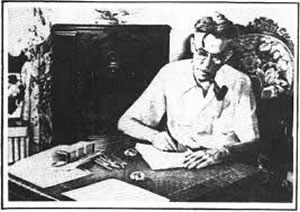
De Amerikaanse dichter en schrijver William Hervey Allen werd geboren op 8 december 1889 in Pittsburgh. Zie ook mijn blog van 8 december 2008 en ook mijn blog van 8 december 2009.


Uit: Action at Aquila


„Southward, two mighty ranges of the Appalachians shouldered their way into the blue distance like tremendous caravans marching across eternity.  Between those parallel ridges the Valley of the

Shenandoah lay, apparently, as serene and beautiful as the interior of the Isle of Aves.

From a high shoulder of the Blue Ridge, where Colonel Nathaniel Franklin of the 6th Pennsylvania Cavalry had stopped for a moment to breathe his horse, he could see almost into North Carolina.

"Rebel country," for the Confederates still held the upper part of the Valley and the horizons beyond.

Not that the colonel thought of it as rebel country, exactly.  The sight of that magnificent landscape--despite its great beauty, perhaps because of it--brought to his eyes a mist of sorrow that threatened momentarily to overcast the countryside which rolled away southward before him.  He brushed that mist indignantly away-- and swore softly.  He regarded all the country he was looking at as

still a part of the United States, some of the inhabitants of which needed to be reconverted to the faith of their fathers—by apostolic blows and knocks if necessary.  But there was nothing personal about the process to the colonel.  The problem posed by the horizons rolling before him was, he liked to think, purely a military one.  And in the old days he had had too many true friends on the yon side of the Potomac to lump them all under the one indignant epithet of "rebels," even now, after several years of desperate fighting.

There were not many Americans left, however, who still felt as the colonel did.  He was naturally possessed of that state of being which in the eighteenth century would have been described as an

amiable soul.  There was nothing weak about his amiability, but it did make hate and blind bitterness about anything hard to bear.

Now, in the early autumn of 1864, he sat looking down into the peaceful, because devastated, theatre of civil war with a dull ache about his heart.“


802499-b1fedd00e0bb8e3d415d45a81231e9a4.jpg
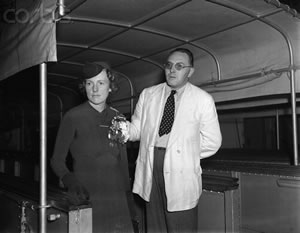
Hervey Allen (8 december 1889 – 28 december 1949)

Hier met zijn vrouw tijdens een scheepsreis


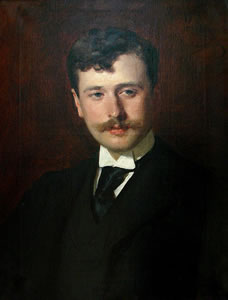
De Franse theaterauteur Georges Feydeau werd geboren op 8 december 1862 in Parijs. Zie ook mijn blog van 8 december 2006 en ook mijn blog van 8 december 2008 en ook mijn blog van 8 december 2009.


Uit : Le dindon

Acte I


„LUCIENNE. – Ah ! quelle fatuité !

PONTAGNAC. – Ce n’est pas de la fatuité, c’est de l’observation. LUCIENNE. – Mais enfin, monsieur, je ne vous connais pas. PONTAGNAC. – Mais moi non plus, madame, et je le regrette tellement que je veux faire cesser cet état de choses... Ah ! Madame...

LUCIENNE. – Monsieur ! PONTAGNAC. – Ah ! Marguerite ! 8

LUCIENNE,s’oubliant. – Lucienne, d’abord ! PONTAGNAC. – Merci ! Ah ! Lucienne ! LUCIENNE. – Hein ! Mais, monsieur, je vous défends !... Qui vous a permis ?... PONTAGNAC. – Ne venez-vous pas de me dire comment je devais vous appeler ! LUCIENNE. – Enfin, monsieur, pour qui me prenez- vous ? Je suis une honnête femme ! PONTAGNAC. – Ah ! tant mieux ! J’adore les honnêtes femmes !... LUCIENNE. – Prenez garde, monsieur ! Je voulais éviter un esclandre, mais puisque vous ne voulez pas partir, je vais appeler mon mari.

PONTAGNAC. – Tiens ! vous avez un mari ?

LUCIENNE. – Parfaitement, monsieur !

PONTAGNAC. – C’est bien ! Laissons cet imbécile de côté !

LUCIENNE. – Imbécile ! mon mari !

PONTAGNAC. – Les maris des femmes qui nous plaisent sont toujours des imbéciles. LUCIENNE,remontant. – Eh bien ! vous allez voir comment cet imbécile va vous traiter ! Vous ne voulez pas sortir ?...“

PONTAGNAC. – Moins que jamais ! LUCIENNE, appelant à droite. – C’est très bien !... Crépin !...

PONTAGNAC. – Oh ! vilain nom !...

LUCIENNE. – Crépin !...


Scène II Les mêmes, Vatelin. VATELIN. – Tu m’appelles ? ma chère amie...

PONTAGNAC, à part. – Vatelin ! fichtre !

VATELIN, reconnaissant Pontagnac. – Ah ! tiens !

Pontagnac ! ce cher ami !

LUCIENNE. – Hein !

PONTAGNAC. – Ce bon Vatelin !

VATELIN. – Ça va bien ?

PONTAGNAC. – Mais très bien !

LUCIENNE, à part. – Il le connaît.“


802499-d9dd744bcdabfd4e6cb06266165076fe.jpg
Georges Feydeau (8 december 1862 - 5 juni 1921)

Portret door Emile Carolus-Duran


De Romeinse dichter en schrijver Quintus
Horatius Flaccus werd geboren op 8 december 65 v. Chr. Zie ook mijn blog van 8 december 2006 en ook mijn blog van 8 december 2008 en ook mijn blog van 8 december 2009.


Ode II.3


Bewaar in tegenspoed uw evenwicht

en blijf gespeend aan uitgelatenheid,

wanneer het goed gaat! Sterven, Dellius,


dat doen wij allemaal, wie zich verkniest,

en wie een feest maakt van den langen dag,

in 't gras verscholen met een fijne flesch.


Hoe lokt de schaduw, waar het berkenloof

de hooge stammen van de dennen kust,

het beekje kabb'lend langs de helling vliet!


Laat hier den wijn, laat hier het reukwerk brengen,

den korten bloei der wondermooie roos,

zoolang uw beurs, uw jeugd, uw ster gedoogt!


Uw grondbezit, uw huis, uw buitenplaats

moet gij eens afstaan; en uw erfgenaam

graait in de schatten, die gij hebt vergaard.


Het geeft niet, of gij rijk zijt en van adel

of arm als Job en zonder voorgeslacht;

want onmeedoogend eischt de dood u op.


Een einde wacht ons allen. Vroeg of laat

treft ons het lot, dat in de ranke boot

ons inscheept naar het eeuwig ballingsoord.


Vertaald door Dr. A. Rutgers van der Loeff


 802499-757e461c74d57637708c34ea8a1efc75.jpg

Horatius (8 december 65 v. Chr. - 27 november 8 v. Chr.)

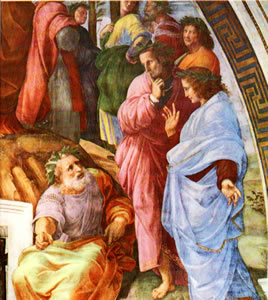
Dichters in gesprek met Horatius,

Fresco van Rafaël Santi in het Apostolisch Paleis, Vaticaanstad.


Geschreven door Romenu om 19:25 Reageer op dit bericht

Carmen Martín Gaite, Nikos Gatsos, Jura Soyfer, Bjørnstjerne Bjørnson, Joel Chandler Harris

De Spaanse schrijfster, vertaalster en journaliste  Carmen Martín Gaite werd geboren op 8 december 1925 in Salamanca. Zie ook mijn blog van 8 december 2008.


Uit: Rotkäppchen in Manhattan (Vertaald door Anne Sorg-Schumacher)  


„Sarah bückte sich und tastete ihr Söckchen ab. Sie fingerte nervös zwischen dem weißen Gewebe und ihrem Knöchel, bis sie an ihre Fußsohle kam. Dahin war die magische Münze gerutscht. Ein Stein fiel ihr vom Herzen. Miranfu! Nicht auszudenken, wenn sie die Münze verloren hätte.
Plötzlich musste sie lächeln. Sie hatte eine wunderbare Idee. Sie hatte ihre Entscheidung getroffen.

Sie steckte den Schlüssel ins Türschloss und öffnete sie ganz langsam. Die Kälte draußen machte sie hellwach. Sie strotzte vor Tatendrang. Jetzt ging es darum, Peter nicht in die Hände zu fallen, der für ihr Vorhaben nur ein Hindernis war, wie sich ja bereits gezeigt hatte.
Sie duckte sich und schlich hinter den Fahrzeugen vorbei, die auf ihrer Straßenseite standen, manchmal auch hinter den Mülltonnen, und erreichte über ausgehobene Erdhaufen und Seitenstraßen den Abhang vom Morningside Park, der an die Südfassade von Saint-John-Divine grenzte. Sie dachte flüchtig daran, dass es in dieser Gegend, vielleicht nicht weit von hier, einst eine Buchhandlung gab, die sie nie kennengelernt hatte: das Königreich der Bücher.“


 802497-16b9cd9722733784d53d57b8ade35d26.jpg

Carmen Martín Gaite (8 december 1925 – 22 juli 2000)  


De Griekse dichter en schrijver Nikos Gatsos werd geboren op 8 december 1911 in Kato Asea in Arcadië. Zie ook mijn blog van 8 december 2008.


Song Of Old Times

For George Seferis


Times change, years pass

the river of the world is muddy

but I go out on the balcony of a dream

to see you bent over your clay

embroider ships and swallows.


The sea is bitter, our land small

the water in the clouds dear

the cypress wrapped in bareness

the grass burns to ashes in silence

and the hunt of the sun is endless.


And you came and carved a fountain

for the old shipwrecked man of the sea

who vanished but a memory of him

remains

a gleaming shell on Amorgos

a salty pebble on Santorini.


From the dew that shakes on a fern

I have taken the drop of a pomegranate

so I can in this notebook

spell out the longings of a heart

with the first star of a fable.


But now that Holy Tuesday arrives

and Easter will come slowly

I want you to go to Mani and to Crete

with your company there perpetually

the wolf the eagle and the asp.


And when you see the shooting star

from another time shine on your face

secretly with delicate twinkle, stand up

bring back again a spring

that wells up in your own rock

. . . . . . . . . . . . . . . . . . . . . . . . . .

Times change, years pass

the river of the world clouds over

but I go out on the balcony of a dream

to see you bent over your clay

embroider ships and swallows.


Vertaald door Diana Gilliland Wright


 802497-df3839e9d7c2af8d8018ff8fe2c5dd02.jpg

Nikos Gatsos (8 december 1911 – 12 mei 1992)


De Oostenrijkse schrijver Jura Soyfer werd op 8 december 1912 in Charkov, Oekraïne, geboren. Zie ook mijn blog van 8 december 2006 en ook mijn blog van 8 december 2008.


Uit: Weltuntergang


“WACHMANN: He, Sie!

GUCK (schläfrig) : Lass mich, Titze-Tante, jetzt is alles egal.

WACHMANN : Hören S', wer is bei Ihna a Tant? Oder soll des a Amtsehrenbeleidigung sein?

GUCK : Mir hat geträumt, daß ein Plakat zu mir geredet hat -

WACHMANN : No, des wär no schöner, wann die Plakate reden täten. Da käm vor lauter öffentliche Ärgernis die öffentliche Sicherheit überhaupt am Hund. Was machen S' da auf der Straßen! Ham S' eine bestimmte Beschäftigung?

GUCK: Ich warte auf den Weltuntergang.

WACHMANN : Wissen S' nicht, dass die Benützung öffentlicher Institutionen als Ruhestätten ungehörig ist?

GUCK: Das sagen Sie mir? Ach was - egal.

WACHMANN : Wer san Se überhaupt? Wo ist Ihre Identitätskarte? (Leuchtet ihm ins Gesicht.) Ach so, Sie brauchen eh kane. Sie san eh identisch. Se san der Guck, net?

GUCK : Und ob! Aber das ist alles egal. Morgen nachmittags wird vielleicht ein Molekül Ihres Körpers einem meiner Moleküle im Weltraum begegnen ...

WACHMANN : Herr, das verbiet' ich mir! Ich als Amtsperson hab kane Moleküle, geschweige denn, daß ich wüßt, was des is!

GUCK : Egal - egal -

WACHMANN : Dem ist alles egal. Ein idealer Staatsbörger. Ach so, Sie meinen, weil murgen die Erde um die Erd' g'haut wern wird?

GUCK : Ja. Um 12 Uhr, Herr Inspektor. Große Geschäftssperre für den gesamten irdischen Betrieb -

WACHMANN : Segn S', I glaub net dran!

GUCK : Hab ich mir gedacht!

WACHMANN : Sö ham nix zu denken'

GUCK : Auch das weiß ich schon.

WACHMANN : Sö ham nix zu wissen!

GUCK : Auch das hab ich schon gelernt. Drum geht ja die Welt unter.

WACHMANN : I glaub net dran, sag i! Es ist noch keinerlei Dienstorder diesbezüglich ausgeb'n wor'n. Wissen S' , was Se san, Herr?

GUCK : Hoffnungslos.

WACHMANN: Sehr richtig. Verrückt, nämlich. Se g'hören nach Amerika!.”


 802497-7cd31709cabe69ce515ffc467af6b857.jpg

Jura Soyfer (8 december 1912 – 16 februari 1939)


De Noorse dichter, schrijver, journalist en politicus
Bjørnstjerne Bjørnson werd geboren op 8 december 1832 in Kvikne bij Tynset. Zie ook mijn blog van 8 december 2006 en ook mijn blog van 8 december 2008.


The Angels Of Sleep


Asleep the child fell
When night cast its spell;
The angels came near
With laughter and cheer.
Her watch at its waking the mother was keeping:
"How sweet, my dear child, was your smile now while sleeping!"


To God mother went,
From home it was rent;
Asleep the child fell
'Neath tears' troublous spell.
But soon it heard laughter and mother-words tender;
The angels brought dreams full of childhood's rare splendor.


It grew with the years,
Till gone were the tears;
Asleep the child fell,
While thoughts cast their spell.
But faithful the angels their vigils were keeping,
The thoughts took and whispered: "Have peace now, while sleeping!"


Secret Love


He gloomily sat by the wall,
As gaily she danced with them all.
Her laughter's light spell
On every one fell;
His heartstrings were near unto rending,
But this there was none comprehending.


She fled from the house, when at eve
He came there to take his last leave.
To hide her she crept,
She wept and she wept;
Her life-hope was shattered past mending,
But this there was none comprehending.


Long years dragged but heavily o'er,
And then he came back there once more.
--Her lot was the best,
In peace and at rest;
Her thought was of him at life's ending,
But this there was none comprehending.


Vertaald door Arthur Hubbell Palmer


 802497-6b96b92ad1bc3ea283ba476173c1ef0b.jpg

Bjørnstjerne Bjørnson (8 december 1832 – 26 april 1910)

Standbeeld in Oslo


De Amerikaanse schrijver Joel Chandler Harris werd geboren op 8 december 1848 in Eatonton, Georgia. Zie ook mijn blog van 8 december 2008.


Uit: Nights With Uncle Remus (Mr. Fox And Miss Goose)


“It had been raining all day so that Uncle Remus found it impossible to go out. The storm had begun, the old man declared, just as the chickens were crowing for day, and it had continued almost without intermission. The dark gray clouds had blotted out the sun, and the leafless limbs of the tall oaks surrendered themselves drearily to the fantastic gusts that drove the drizzle fitfully before them. The lady to whom Uncle Remus belonged had been thoughtful of the old man, and 'Tildy, the house-girl, had been commissioned to carry him his meals. This arrangement came to the knowledge of the little boy at supper time, and he lost no time in obtaining permission to accompany 'Tildy.

Uncle Remus made a great demonstration over the thoughtful kindness of his "Miss Sally."

"Ef she ain't one blessid w'ite 'oman," he said, in his simple, fervent way, "den dey ain't none un um 'roun' in deze parts."

With that he addressed himself to the supper, while the little boy sat by and eyed him with that familiar curiosity common to children. Finally the youngster disturbed the old man with an inquiry:--

"Uncle Remus, do geese stand on one leg all night, or do they sit down to sleep?"

"Tooby sho' dey does, honey; dey sets down same ez you does. Co'se, dey don't cross der legs," he added, cautiously, "kase dey sets down right flat-footed."

"Well, I saw one the other day, and he was standing on one foot, and I watched him and watched him, and he kept on standing there."

"Ez ter dat," responded Uncle Remus, "dey mought stan' on one foot en drap off ter sleep en fergit deyse'f. Deze yer gooses," he continued, wiping the crumbs from his beard with his coat-tail, "is mighty kuse fowls; deyer mighty kuse. In ole times dey wuz 'mongs de big-bugs, en in dem days, w'en ole Miss Goose gun a-dinin', all de quality wuz dere. Likewise, en needer wuz dey stuck-up, kase wid all der kyar'n's on, Miss Goose wer'n't too proud fer ter take in washin' fer de neighborhoods, en

she make money, en get slick en fat lak Sis Tempy.”


802497-f82a83a872f8071d15e6cb68474caa69.jpg
Joel Chandler Harris (8 december 1848 – 3 juli 1908)


Geschreven door Romenu om 19:18 Reageer op dit bericht

Tatamkhulu Afrika, Johann Nestroy, Friedrich Schlögl

De Zuid-Afrikaanse dichter en schrijver Tatamkhulu Afrika werd geboren op 7 december 1920 in Egypte. Zie ook mijn blog van 7 december 2006 en ook mijn blog van 7 december 2008 en ook mijn blog van 7 december 2009.


Maqabane


Like gnats after rain,

sudden beetles born

of thunder and storm,

we are the creatures of our time,

its passing wind,

murder done,

blood drying in the sun.

We drone,

not with the fat,

mellow hum of bees,

but the thin

snivelling of the fly;

or we roar. Faces turned

to the never-listening sky,

cacophonous as ass or mule,

beaten till the dumb

tongue festers into sound.

We have no song?

How shall we sing?:

as they who, blind

to the blood on their shoes,

sing of lives that never come alive,

mimed and stilled as the moons

in the prisons of their nails,

thrushes in the hedges of their minds?

Does one scream

in careful cadences, stretched

upon a rack of pain,

measure meter when one tells

of the slit throat’s roar,

ripped belly’s gut spilt,

smoking, onto the cold tar,

charred body’s settling

like the timber of a shack torched

by midnight hand?

Beyond the darkness, grey

morning breaks: a bird,

or child,

uncertainly cries, our feet stir

a visible dust, we breathe

a freshening air.

The familiar is suddenly behind.

They grey men, the grey

singers of irrelevant song,

they who hid

behind the stillness of their hands,

slot into the patterns of our heels.

Maqabane – yes –

let us sound that sweet

endearment once

more before the dust

clogs our tongues –

they will have us now,

with the teeth of their laughter tear

the flesh from our bones,

crack them for the marrow they no longer hold.

It is the way.

But still,

within ourselves,

there is the secret hearth

of our love, the place

of the holding of our hands,

and if one harsh note

of our crying woke

a sleeping heart, steeled

a timid spine,

then we, too, sang,

scoring our songs in the flesh

of those that, dead, do not die.


 801636-a58aa754136639ef99312d2857b3ad24.jpg

Tatamkhulu Afrika (7 december 1920 – 23 december 2002)


De Oostenrijkse schrijver Johann Nepomuk Eduard Ambrosius Nestroy werd geboren in Wenen op 7 december 1801. Zie ook mijn blog van 7 december 2006 en ook mijn blog van 7 december 2008 en ook mijn blog van 7 december 2009.


Uit: Höllenangst

“(Es ist Nacht. Reichthal tritt mit Vorsicht von Seite links auf, er ist in einen grauen Mantel gehüllt und hat eine Reisemütze tief in die Augen gedrückt.)

Reichthal. Ich bin am rechten Orte. Nur die Eile, die Ungeduld und hundert schmerzliche Erinnerungen, die meine Sinne fast verwirren, ließen mich nach kaum zweijähriger Abwesenheit die wohlbekannten Häuser und Straßen nicht sogleich erkennen. (Nach dem großen Hause im Prospekte zeigend.) Hier steh' ich vor dem Palais Reichthal, dem einstigen Wohnsitz meiner teuren Schwester, die so schnell ihrem Gatten in jene Welt gefolgt. Ohne Zweifel hat des verstorbenen Strombergs habsüchtiger Bruder, so wie die Güter, auch diesen Stammsitz an sich gerissen, jener Bösewicht, der mich durch seinen Genossen Arnstedt einer Verschwörung verdächtigen und ins Gefängnis werfen ließ. Was mag aus Adelen geworden sein? Hat sie den Tod ihrer Mutter überlebt? Ist sie in ihres bösen Oheims Gewalt? Nur eine Person kann und wird mir auf diese Fragen Antwort geben, die Amme meiner Nichte Adele! In diesem Häuschen wohnt sie. (Zeigt nach dem obbeschriebenen kleinen Hause im Vordergrunde rechts.) Die gute Frau wird mich auch einige Zeit verbergen; als Flüchtling, von mächtigen Feinden bedroht und aller Hilfe entblößt, wüßte ich mir keinen anderen Zufluchtsort. Ich habe zu vorschnell auf die Nachricht von der lebensgefährlichen Krankheit des Ministers das gastfreie England verlassen. (Hat sich der Haustür des kleinen Häuschens genähert und ergreift den Türklopfer.) Soll ich -? (Sich umsehend.) Doch nein - noch ist es zu früh - der Lärm zu dieser ungewöhnlichen Zeit könnte die Nachbarn aufwecken. - Ich will lieber noch ein paar Stunden die Straßen auf und nieder gehen und den Anbruch des Tages erwarten. (Hüllt sich fester in seinen Mantel und geht links durch den Hintergrund ab.)


 801636-3ee48c0aa6ea21363a5cef0a183f6ebc.jpg

Johann Nestroy (7 december 1801 - 25 mei 1862)

Monument in Wenen


De Oostenrijkse schrijver en columnist
Friedrich Kilian Schlögl werd geboren op 7 december 1821 in de Weense voorstad Laimgrube (nu Wenen). Hij werkte van 1840 tot 1849 als militaire klerk en vervolgens tot 1870 in de officiële Hofkriegsbuchhaltung. Schlögl was naast Edward Pötzl en Vincenz Chiavacci een vooraanstaande Weense zedenschetser en humorist. Hij publiceerde in tal van agenda's, tijdschriften en bloemlezingen zijn humoristische sketches, gedichten en essays over de culturele geschiedenis van Wenen, met inbegrip van de Deutsche Zeitung of de „Heimgarten“ van Peter Rosegger. Van 1857 tot de late jaren 1870 werkte hij mee aan de Figaro, in 1867 schreef hij voor het Neue Wiener Tagblatt en de Morgenpost. In 1876 begon hij samen met Karl Sitter de Wiener  Luft, een bijlage van de Figaro.


Uit: Marjampole


„Berlin und Moskau – zwei Stadtschicksale im 20. Jahrhundert »Stadtschicksal« – dieser Titel stammt von Karl Scheffler, dem großartigen Porträtisten des soeben zur Metropole gewordenen Berlin. Er konnte 1912 nicht wissen, wie wahr sich der Terminus vom »Schicksal« für seine Stadt erweisen sollte. Für Moskau gilt es nicht weniger. Beide Städte, die so wuchtig und eindrucksvoll die Bühne des anbrechenden 20. Jahrhunderts betreten hatten, sind im Laufe des Jahrhunderts aus dem Kreis der großen Weltstädte ausgeschieden in einem ganz eigentümlichen und sehr verschiedenen Prozeß der Selbstzerstörung. In vielem kulminiert in diesen Stadtgeschichten die Geschichte der Länder und Völker, deren Hauptstädte sie waren. Wenn man verstehen will, was geschehen ist, muß man an den Ausgangspunkt zurück, in die Zeit vor dem Jahr 1914, in dem das lange 19. Jahrhundert zu Ende ging. Unsere Schilderung der Endzeit des Ancien régime wird nicht ganz frei sein von Anklängen des Nostalgischen und des Gefühls eines tiefen Verlustes. Berlin und Moskau als europäische Metropolen des 20. Jahrhunderts wurden im 19. Jahrhundert geboren. Die Nervosität, die Fieberhaftigkeit und Kraft der beiden Städte, beide latecomer, wenn auch mit verschiedener Ausgangsposition, wurzeln in der Aufbruch-und Boomzeit des Wilhelminismus und des späten russischen Kaiserreiches. Die Anfänge dessen, was erst nach Krieg und Revolution, also in den legendären zwanziger Jahren, größte Klarheit und radikale Stilisierung gefunden hat, liegen bekanntlich in dem so viel geschmähten »Wilhelminismus« und im »Silbernen Zeitalter«, dem Rußland die Geburt seiner modernen Nationalkultur verdankt.

Woran immer wir denken, wenn wir die Blitze und Donnerschläge der Avantgarde und den neuen Ton hören – es begann alles lange vor 1917 und 1918, lange vor russischem Oktober und deutschem

November, die nur Katalysator sind für die Radikalisierung und Findung der endgültigen Form. Keine sowjetische Avantgarde ohne das Silberne Zeitalter, keine Weimarer Kultur ohne Herwarth

Waldens Sturm, Peter Behrens, Ludwig Hoffmann. Alles nahm Anlauf in den dynamischen Zeiten, da Rußland vom »Stern Amerikas« träumte, der über Sibirien aufgehen würde (Alexander Block), und da in Deutschland der massendemokratische Traum vom »Platz an der Sonne« geträumt wurde.“


801636-6924b08ac2b64d9f0552a27c47a447d4.jpg
Friedrich Schlögl (7 december 1821 - 7 oktober 1892)


Zie voor nog meer schrijvers van de 7e december ook mijn vorige blog van vandaag.
Geschreven door Romenu om 19:35 Reageer op dit bericht

Gabriel Marcel, Noam Chomsky, Willa Cather, Samuel Gottlieb Bürde


De Franse filosoof en toneelauteur Gabriel Marcel werd geboren op 7 december 1889 in Parijs. Zie ook mijn blog van 7 december 2006 en ook mijn blog van 7 december 2008 en ook mijn blog van 7 december 2009.


Uit: Journal métaphysique


„Les autres ne sont pas « ma pensée des autres »

[...] Rien ne fera que les autres ne soient pas ma pensée des autres [...]. Je crois que c'est précisément cette position qu'il faut refuser radicalement. Si j'admets que les autres ne sont que ma pensée des autres, mon idée des autres, il devient absolument impossible de briser un cercle qu'on a commencé par tracer autour de soi. – Si l'on pose le primat du sujet-objet – de la catégorie du sujet-objet – ou de l'acte par lequel le sujet pose des objets en quelque sorte au sein de lui-même, l'existence des autres devient impensable – et sans aucun doute n'importe quelle existence quelle qu'elle puisse être.

[...]

Par là s'éclairent mes formules de ce matin. L'autre en tant qu'autre n'existe pour moi qu'en tant que je suis ouvert à lui (qu'il est un toi), mais je ne suis ouvert à lui que pour autant que je cesse de former avec moi-même une sorte de cercle à l'intérieur duquel je logerais en quelque sorte l'autre, ou plutôt son idée ; car par rapport à ce cercle l'autre devient l'idée de l'autre – et l'idée de l'autre ce n'est plus l'autre en tant qu'autre, c'est l'autre en tant que rapporté à moi, que démonté, que désarticulé ou en cours de désarticulation.“


 801631-f136346d6b1e2648ed1c4695da2d60fd.jpg

Gabriel Marcel (7 december 1889 - 8 oktober 1973)


De Amerikaanse taalkundige, mediacriticus en anarchistisch denker Noam Chomsky werd geboren in Philadelphia op 7 december 1928. Zie ook mijn blog van 7 december 2007 en ook mijn blog van 7 december 2008 en ook mijn blog van 7 december 2009.


Uit: Propaganda, American-style


„Pointing to the massive amounts of propaganda spewed by government and institutions around the world, observers have called our era the age of Orwell. But the fact is that Orwell was a latecomer on the scene. As early as World War I, American historians offered themselves to President Woodrow Wilson to carry out a task they called "historical engineering," by which they meant designing the facts of history so that they would serve state policy. In this instance, the U.S. government wanted to silence opposition to the war. This represents a version of Orwell's 1984, even before Orwell was writing.

In 1921, the famous American journalist Walter Lippmann said that the art of democracy requires what he called the "manufacture of consent." This phrase is an Orwellian euphemism for thought control. The idea is that in a state such as the U.S. where the government can't control the people by force, it had better control what they think.. The Soviet Union is at the opposite end of the spectrum from us in its domestic freedoms. It's essentially a country run by the bludgeon. It's very easy to determine what propaganda is in the USSR: what the state produces is propaganda.

That's the kind of thing that Orwell described in 1984 (not a very good book in my opinion). 1984 is so popular because it's trivial and it attacks our enemies. If Orwell had dealt with a different problem-- ourselves--his book wouldn't have been so popular. In fact, it probably wouldn't have been published.

In totalitarian societies where there's a Ministry of Truth, propaganda doesn't really try to control your thoughts. It just gives you the party line. It says, "Here's the official doctrine; don't disobey and you won't get in trouble. What you think is not of great importance to anyone. If you get out of line we'll do something to you because we have force." Democratic societies can't work like that, because the state is much more limited in its capacity to control behavior by force.“


801631-6ee0f54239822dc92530369858e9c782.jpg
Noam Chomsky (Philadelphia, 7 december 1928)


De Amerikaanse schrijfster Willa Cather werd geboren op 7 december 1873 in de buurt van Winchester, Virginia. Zie ook mijn blog van 7 december 2006   en ook mijn blog van 7 december 2009.


Uit: Eric Hermannson`s Soul


„It was a great night at the Lone Star schoolhouse--a night when the Spirit was present with power and when God was very near to man. So it seemed to Asa Skinner, servant of God and Free Gospeller. The schoolhouse was crowded with the saved and sanctified, robust men and women, trembling and quailing before the power of some mysterious psychic force. Here and there among this cowering, sweating multitude crouched some poor wretch who had felt the pangs of an awakened conscience, but had not yet experienced that complete divestment of reason, that frenzy born of a convulsion of the mind, which, in the parlance of the Free Gospellers, is termed "the Light." On the floor before the mourners` bench lay the unconscious figure of a man in whom outraged nature had sought her last resort. This "trance" state is the highest evidence of grace among the Free Gospellers, and indicates a close walking with God.

Before the desk stood Asa Skinner, shouting of the mercy and vengeance of God, and in his eyes shone a terrible earnestness, an almost prophetic flame. Asa was a converted train gambler who used to run between Omaha and Denver. He was a man made for the extremes of life; from the most debauched of men he had become the most ascetic. His was a bestial face, a. face that bore the stamp of Nature`s eternal injustice. The forehead was low, projecting over the eyes, and the sandy hair was plastered down over it and then brushed back at an abrupt right angle. The chin was heavy, the nostrils were low and wide, and the lower lip hung loosely except in his moments of spasmodic earnestness, when it shut like a steel trap. Yet about those coarse features there were deep, rugged furrows, the scars of many a hand-to-hand struggle with the weakness of the flesh, and about that drooping lip were sharp, strenuous lines that had conquered it and taught it to pray. Over those seamed cheeks there was a certain pallor, a greyness caught from many a vigil. It was as though, after Nature had done her worst with that face, some fine chisel had gone over it, chastening and almost transfiguring it. Tonight, as his muscles twitched with emotion, and the perspiration dropped from his hair and chin, there was a certain convincing power in the man.“


 801631-4f9038fa2168622aee2430bdfa316a38.jpg

Willa Cather (7 december 1873 – 24 april 1947)


De Duitse dichter
Samuel Gottlieb Bürde werd geboren op 7 december 1753 in Breslau. In Breslau ging hij naar het Elisabethgymnasium waar de rector hem met poëzie in aanraking bracht. In Halle, studeerde hij rechten. 1776-1778 was hij leraar op een school in Breslau. Later reisde naar Zwitserland en Italië. In 1783 werd hij secretaris van de Poolse grenscommissie. In 1795 werd hij benoemd tot prive-secretaris bij het Silezische ministerie van Financiën
en elf jaar later directeur van de kanselarij. Nog eens negen jaar later, in 1815, werd hij tot koninklijk Hofrat bevorderd.


Uit: Erzählung von einer gesellschaftlichen Reise durch einen Theil der Schweiz


„Tags drauf gegen Abend, passierten wir bey dustrer neblichter Wittrung, die wilden Gebirge des Böhmerwaldes. Es war eine angstliche Fahrt den Berg hinan; zu beyden Seiten sinstre Waldungen, und der Weg so abscheulich, daß wir Mannspersonen uns lieber entschlossen zu Fuss zu gehen. Wir kamen bey schon ganz sinstrer Nacht in den Bayerschen Flecken Waldmünchen, und den andern Morgen nach Regensburg.. Von hier aus ging der Weg eine Strecke ganz nah an steilen Felsenwanden, in einiger Entfernung sahn wir rechts die Donau fliessen, deren jenseitige Ufer einen angenehmen, abwechselnden Prospect von Schlössern und Klostern gaben. In den Dörfern hörten wir überall landliche Tanzmusic. Es war ein herbstlich schöner Sonntag. Des andern Morgens früh waren wir in Augsburg, wo wir über Mittag blieben, einige Gaffen durchliefen, einen schönen Springbrunnen, und an verschleimen Hausern die Ueberbleibsel von guten Fresco Mahlereien sahen. Wir begegneten auch Frauenzimmern, die eben den bisanen Anzug trugen, dergleichen man auf einigen Kupferstichen von Augsburg und Nürnberg findet. Gegen Abend setzten wir unsere Reise weiter fort, beugten aber seitwärts nach Ulm aus, das wir früh, als es noch dunkel war, erreichten. Wir hatten uns kaum im Wirthshause zum Frühstück nieder geswetzt als wir vom Herrn A. freundfchaftlich zum Mittagsessen geladen wurden.“


 801631-e43bbf3df4b65c511814afb22ce0cdad.jpg

Samuel Gottlieb Bürde (7 december 1753 - 28 april 1831)

Breslau (Geen portret beschikbaar)

Geschreven door Romenu om 19:29 Reageer op dit bericht

Meer van Romenu

↑ Terug naar de berichten