Naar de inhoud

Romenu

Over literatuur, gedichten, kunst en cultuur
akke.beakke.be

Berichten van 8 december 2010 tot 9 december 2010

Gioconda Belli, Michael Krüger, Wolfgang Hildesheimer, Anna Gavalda

De Nicaraguaanse schrijfster, dichteres en ex-politica Gioconda Belli werd geboren op 9 december 1948 in Managua. Zie ook mijn blog van 9 december 2006 en ook mijn blog van 9 december 2007 en ook mijn blog van 9 december 2008 en ook mijn blog van 9 december 2009.


Tempi

I
Mein Stück Süße von der Mandarinenschnitte
mein Specht gefiederte Schlange
Kolibrie, der meine Blume schnäbelt meinen Honig trinkt
meinen Zucker schlürft mir die Erde berührt
Anturio die Höhle das Haus der Abenddämmerungen
der Donner der Meere Segelschiff
Legionen von Vögeln Möwe im Tiefflug süße Mispel
Palme die meinen Beinen Strände gebiert
hoher Kokosmast, bebender Obelisk meines Untergangs
Schaum meiner Haut Regen Quelle
Kaskade in meinen Bachbett Brunst meiner Umtriebe
Licht deiner Augen Briese auf meinen Brüsten
verspielter Hirsch in meinem Wald aus Geißblatt und Moos
Wächter meines Lachens Schutz des Pochens
Kastagnette Schelle Jubel meines Rosenhimmels
aus Frauenfleisch mein Mann du einziger Talisman
Zauber meiner wüstenhaften Blätter komm noch einmal
ruf mich drück mich an deinen Hafen der heiseren Wellen
Erfüll mich mit deiner weißen Zärtlichkeit ersticke meine Schreie

Laß mich aufgelöste Frau sein


Tempi
II

Glockengeräusche Sirenengesang
los laß ich die Zügel galoppiere Gelächter
setze die Mauern aus dem Spiel
Staudämme fallen in Stücke ich springe grün
die Hoffnung blau der Himmel sonare Horizonte
die sich in Winden auftun mich hindurchzulassen:
"Gebt frei den Weg der Frau, die nicht die Strudel der
Liebe fürchtet, noch die Orkane der Verachtung"
Gesiegt hat der alte Jahrgangswein der rote der weiße
es kamen es keimten die Trauben mit ihrer weichen Haust
die Rundungen deiner Figur du regnest auf mich
wäscht ab die Trauer erbaust wieder Leuchttürme Bibliotheken
alter Bücher mit wunderschönen Bildern
gibst mir den Grinsekater zurück Alice den Hasen
den verrückten Hut Schnewittchens Zwerge
den Marsch zwischen den Fingern den Hauch der Kindheit
du bist in dem Blick am Fenster aus dem der Baum entsteht,
der Kreisel, die kleinen Tassen, ich liebe dich, berühre dich
entdecke in dir den Hengst Kater Glühwürmchen Libelle
nackter Mann durchscheinend Trommel Trompete ich mach Musik
tanze stampfe entkleide mich umhülle dich du umhüllst mich
Küsse Küsse Küsse Küsse Küsse Küsse Küsse Küsse
Schweigen Schlaf.


Vertaald door Anneliese Schwarzer de Ruize e.a


803176-90f7f98c288cc462f35539235ff5129b.jpg 

Gioconda Belli (Managua, 9 december 1948)


De Duitse dichter, schrijver en vertaler Michael Krüger werd geboren op 9 december 1943 in Wittgendorf. Zie ook mijn blog van 9 december 2008 en ook mijn blog van 9 december 2009.


Flohkraut


Manchmal denke ich an Flohkraut,

das, wenn ich mich richtig erinnere,

in meiner Jugend an Grenzsteinen wuchs,

die zu eigenen Gunsten versetzt worden waren.


Darauf stand Todesstrafe in manchen Fällen.


Flohkraut, eine nicht besonders liebliche Pflanze,

die heute kaum mehr erkannt wird.

Aber sie existiert noch! Als ich kürzlich versuchte,

mein Leben etwas zu ändern, sah ich sie blühen.


Sommerwende


Der Sommer hält eine Vorlesung

über den Tod, und alles hört zu.

Am Brunnen steht ein alter Mann

und trinkt, von der Hand in den Mund,

mit sich im Reinen. Die unerträgliche Last,

eine Sprache zu finden, die entspricht.

Ein Kind läuft vorbei, die Knie aufgeschlagen.

Es schweigt. Es will die Stille nicht stören.


 803176-1a253005863ed40fbf030f67fa42086a.jpg

Michael Krüger (Wittgendorf, 9 december 1943)


De Duitse schrijver en schilder Wolfgang Hildesheimer werd geboren op 9 december 1916 in Hamburg. Zie ook mijn blog van 9 december 2008 en ook mijn blog van 9 december 2009.


Uit: Tynset


„Hier liege ich in meinen Sommernächten, in diesem Bett, das sieben Schläfern Platz bot –, in dem aber schon lange, lange keine sieben Schläfer mehr gelegen haben, nicht seit jener Nacht im späten Frühling oder sagen wir im frühen Sommer des Jahres 1522, da lagen vielleicht sieben Schläfer in diesem Bett, zum letzten Mal – da kam früh abends ein Mann, vielleicht ein Mönch, schmächtig und dünn bis auf seine großen, breitgetretenen, auf entsagungsvollen Wegen erhärteten Barfüße, vor die Herberge, in der dieses Bett stand, er kam müde, er war vielleicht schon wochenlang unterwegs, kam von St. Gallen, und sein Ziel war Irland – betrat das Gasthaus, erbettelte dort einen Eintopf aus Resten, den ihm die Wirtin gern gab, da sie mit der Speisung von dieserart Gästen ihren Platz im Jenseits zu halten hoffte, der ihr aus mancherlei Gründen nicht sicher zu sein schien –, er, der Mönch, isst, verrichtet schnell sein Gebet und seine anderen kärglichen Bedürfnisse, steigt hinauf zum Schlafraum, wo dieses Bett stand, entledigt sich seines Skapuliers, des Zingulum, während sich unten vielleicht schon ein weiterer, diesmal weiblicher Wanderer der Nacht der Haustür nähert –, die Kutte behält er an, dieser Mönch, den Rosenkranz wickelt er fester um das Handgelenk, damit die Devotionalie auch in seiner schlafenden Abwesenheit für ihn bete, er geht zum Bett, schlägt den Belag zurück, um sich an den äußersten Rand zu legen, denn er will der erste sein, der aufstehe, nicht um sich Peinlichkeit zu ersparen, Peinlichkeit gab es damals noch nicht, sondern weil er einen weiten Weg vor sich hat. An Versuchungen denkt er nicht. Schien der Mond? Ja – oder sagen wir, er schien noch nicht, aber er war im Aufgehen, ein Dreiviertelmond vielleicht, er hat das Fenster noch nicht erreicht, hinter dem der Mönch liegt, dafür legt er einen langen Schatten neben den zweiten Gast, die Gästin, die, während der Mönch sich auszieht, vor der Tür steht, während der Mönch sich hinlegt, das Haus betritt und damit den Mondschatten ablegt, eine Dame, die bessere Nächte gekannt hat und schlechtere kennen zu lernen fürchtet, aber nicht mehr kennen lernen wird, eine Courtisane, nenne ich sie Anne.“


803176-6c554a97a020bede5c41ad6c6b97c1e6.jpg
Wolfgang Hildesheimer (9 december 1916 – 21 augustus 1991)


De Franse schrijfster Anna Gavalda werd geboren op 9 december 1970 in Boulogne-Billancourt. Zie ook mijn blog van 9 december 2008 en ook mijn blog van 9 december 2009.


Uit: Je l'aimais


“Larguée ... C'est merveilleux comme expression. Qui a trouvé ça ? Larguer les amarres. Détacher la bonne femme. Prendre le large, déployer ses ailes d'albatros et baiser sous d'autres latitudes.
Parce que le piège, justement, c'est de croire qu'on est amarré. On prend des décisions, des crédits, des engagements et puis quelques risques aussi. On achète des maisons, on met des bébés dans des chambres toutes roses et on dort toutes les nuits enlacés. On s'émerveille de cette ... Comment disait-on déjà ? De cette
complicité. Oui, c'était ça qu'on disait, quand on était heureux... Le piège, c'est de penser qu'on a le droit d'être heureux. Nigauds que nous sommes. Assez naïfs pour croire une seconde que nous maîtrisons le cours de nos vies. Le cours de nos vies nous échappe, mais ce n'est pas grave. L'idéal, ce serait de le savoir plus tôt. Avant de repeindre des chambres en rose ....
Ma grand mère disait souvent que c'était avec de bons petits plats qu'on retenait les gentils maris à la maison.

(...)


Ceux qui restent, on les plaint, on les console, mais ceux qui partent ? Le courage de ceux qui se regardent dans la glace un matin et articulent distinctement ces quelques mots pour eux seuls : "ai-je le droit à l'erreur ?" Juste ces quelques mots ... Le courage de regarder sa vie en face, de n'y voir rien d'ajusté, rien d'harmonieux. Le courage de tout casser, de tout saccager par ... égoïsme ? ... Le  courage de s'affronter. Au moins une fois dans sa vie. De s'affronter, soi-même. Soi seul. Enfin. "Le droit à l'erreur", toute petite expression, tout petit bout de phrase, mais qui te le donnera ? Qui à part toi ?". 


 803176-1cbf3775f8e81bf07708b6e44dd2cba4.jpg

Anna Gavalda (Boulogne-Billancourt, 9 december 1970)


Zie voor nog meer schrijvers van de 9e december ook mijn vorige blog van vandaag.
Geschreven door Romenu om 16:45 Reageer op dit bericht

Ödön von Horváth, John Milton, Jan Křesadlo, Maksim Bahdanovič, Dalton Trumbo

De Hongaars-Duitse schrijver Ödön von Horváth werd geboren op 9 december 1901 in Fiume. Zie ook mijn blog van 9 december 2006 en ook mijn blog van 9 december 2007  en ook mijn blog van 9 december 2008 en ook mijn blog van 9 december 2009.


Uit: Jugend ohne Gott


„25. März.

Auf meinem Tische stehen Blumen. Lieblich. Ein Geschenk meiner braven Hausfrau, denn heute ist mein Geburtstag.

Aber ich brauche den Tisch und rücke die Blumen bei- seite und auch den Brief meiner alten Eltern. Meine Mutter schrieb: »Zu Deinem vierunddreissigsten Geburtstage wünsche ich Dir, mein liebes Kind, das Allerbeste. Gott der Allmächtige gebe Dir Gesundheit, Glück und Zufriedenheit!« Und mein Vater schrieb: »Zu Deinem vierunddreissigsten Geburtstage, mein lieber Sohn, wünsche ich Dir alles Gute. Gott der Allmächtige gebe Dir Glück, Zufriedenheit und Gesundheit!«

Glück kann man immer brauchen, denke ich mir, und gesund bist Du auch, gottlob! Ich klopfe auf Holz. Aber zufrieden? Nein, zufrieden bin ich eigentlich nicht. Doch das ist ja schliesslich niemand.

Ich setze mich an den Tisch, entkorke eine rote Tinte, mach mir dabei die Finger tintig und ärgere mich darüber. Man sollt endlich mal eine Tinte erfinden, mit der man sich unmöglich tintig machen kann!

Nein, zufrieden bin ich wahrlich nicht.

Denk nicht so dumm, herrsch ich mich an. Du hast doch eine sichere Stellung mit Pensionsberechtigung und das ist in der heutigen Zeit, wo niemand weiss, ob sich morgen die Erde noch drehen wird, allerhand! Wie viele würden sich sämtliche Finger ablecken, wenn sie an deiner Stelle wären?! Wie gering ist doch der Prozentsatz der Lehramtskandidaten, die wirklich Lehrer werden können! Danke Gott, dass Du zum Lehrkörper eines Städtischen Gymnasiums gehörst und dass Du also ohne wirtschaftliche Sorgen alt und blöd werden darfst! Du kannst doch auch hundert

Jahre alt werden, vielleicht wirst Du sogar mal der älteste Einwohner des Vaterlandes! Dann kommst Du an Deinem Geburtstag in die Illustrierte und darunter wird stehen: »Er ist noch bei regem Geiste.« Und das alles mit Pension! Bedenk und versündig Dich nicht!

Ich versündige mich nicht und beginne zu arbeiten. Sechsundzwanzig blaue Hefte liegen neben mir, sechsundzwanzig Buben, so um das vierzehnte Jahr herum, hatten gestern in der Geographiestunde einen Aufsatz zu schreiben, ich unterrichte nämlich Geschichte und Geographie.“


803170-87c8ac5c3c811b40800e99fd81f5b717.jpg
Ödön von Horváth (9 december 1901 – 1 juni 1938)


De Engelse dichter en schrijver John Milton werd geboren op 9 december 1608 in Londen. Zie ook mijn blog van 9 december 2006 en ook mijn blog van 9 december 2008 en ook mijn blog van 9 december 2009.


Uit: Paradise Lost, Book IV, [The Argument]


O for that warning voice, which he who saw 

The Apocalypse heard cry in Heaven aloud, 

Then when the Dragon, put to second rout, 

Came furious down to be revenged on men, 

Woe to the inhabitants on Earth! that now,          

While time was, our first parents had been warned 

The coming of their secret Foe, and scaped, 

Haply so scaped, his mortal snare! For now 

Satan, now first inflamed with rage, came down, 

The tempter, ere the accuser, of mankind,           

To wreak on innocent frail Man his loss 

Of that first battle, and his flight to Hell. 

Yet not rejoicing in his speed, though bold 

Far off and fearless, nor with cause to boast, 

Begins his dire attempt; which, nigh the birth           

Now rowling, boils in his tumultuous breast, 

And like a devilish engine back recoils 

Upon himself. Horror and doubt distract 

His troubled thoughts, and from the bottom stir 

The hell within him; for within him Hell           

He brings, and round about him, nor from Hell 

One step, no more than from Himself, can fly 

By change of place. Now conscience wakes despair 

That slumbered; wakes the bitter memory 

Of what he was, what is, and what must be           

Worse; of worse deeds worse sufferings must ensue! 

Sometimes towards Eden, which now in his view 

Lay pleasant, his grieved look he fixes sad; 

Sometimes towards Heaven and the full-blazing Sun, 

Which now sat high in his meridian tower:           

Then, much revolving, thus in sighs began:— 


 803170-8f70f8d2e4665bb564bdc750f08866c8.jpg

John Milton (9 december 1608 – 8 november 1674)

Anoniem portret


De Tsjechische psycholoog, schrijver en dichter Jan Křesadlo (pseudoniem van Václav Jaroslav Karel Pinkava) werd geboren op 9 december 1926 in Praag. Zie ook mijn blog van 9 december 2006 en ook mijn blog van 9 december 2008.


Christmas Rondel


That time of year, that day of days

- always returning, ever fresh,

when the dark night was split, ablaze

by God's Word made incarnate, flesh.


An ancient tale, each year afresh,

that God came down to share our ways,

takes form again, intoning, plays

- always returning, ever fresh.


»Let the news melt hate's icy gaze

scorch ill-will dark to cinders, dash

the bonds of Adam, tear this mesh,

these walls of greed, our human maze ... «

the Call perennial rends the haze

- always returning, ever fresh.


The Night Wanderer Rondel


He walks within night’s moulting coat,

his face is hid in darkness’ cape

drawing him down its lonely throat

yearning, see night’s burnt umber gape.


Bearing his obscure troubles’ shape

through breathless night, in bile he floats

making the covered chalice bloat

his face is hid in darkness’ cape.


Hark to the armoured couplet’s note !

The steel of darkness’ fainting scrape !

Soloist, metered verse you ape

footsteps that thud, as though they wrote

hastening to cross night’s silent moat,

his face is hid in darkness’ cape.


Vertaald door VZJ Pinkava


803170-59d55eae90c9b5bf9f5ac08ab8e0f337.jpg
Jan Křesadlo (9 december 1926 - 13 augustus 1995)


De Wit-Russische (Belarussische) dichter, journalist en criticus Maksim Bahdanovič werd geboren op 9 december 1891 in Minsk. Zie ook mijn blog van 9 december 2006 en ook mijn blog van 9 december 2008.


The Weaver-Women of Słucak


From native home, from native tillage,
To the Big House, for beauty's sake,
Luckless girls taken from their village,
Girdles of woven gold to make.
Long hours of labour they endeavour,
Forgetful of their girlish dreams,
Toiling at the broad weaving ever.
Where the Persian pattern gleams.
Outside the walls is smiling tillage,
The sky shines fair beyond the pane,
And thoughts go wandering, willy-nilly,
There where the spring's in flower again.
There by the rye, in the far distance,
The cornflowers gleam with azure still,
And waves of chilly silver glisten,
Where rivers gush between the hills;
Dark frowns the forest's jagged verdure,
And hands, forgetful at the loom,
Neglecting the designs of Persia,
Weave in the native cornflower bloom.


Triolet


Once I was gazing on the sun,
And the sun blinded all my vision.
What means the dark of night abysmal,
— Once I was gazing on the sun.
Let all men mock me in derision.
To them my answer thus shall run:
Once I was gazing on the sun,
And the sun blinded all my vision.


Vertaald door Vera Rich


 803170-679780602b8de6dbaab51539f14c922d.jpg

Maksim Bahdanovič (9 december 1891 – 25 mei 1917)

Standbeeld in Minsk


De Amerikaanse schrijver en sceenwriter James Dalton Trumbo werd geboren op 9 december 1905 in het plaatsje Montrose in Colorado. Zie ook mijn blog van 9 december 2008.


Uit: Stiltewoorden (Johnny got his gun, vertaald door Fons Oltheten)


„Hij schoot omhoog door het koele water en vroeg zich af of hij de oppervlakte ooit zou bereiken. Het was de grootst mogelijke lariekoek dat mensen drie keer kopje onder gaan voordat ze verdrinken. Hij was dagen weken maanden god weet hoe vaak kopje onder gegaan en weer bovengekomen. Maar hij was niet verdronken. Elke keer als hij de opper vlakte bereikte verloor hij zich in de werkelijkheid en als hij kopje onderging verloor hij zich in het niets. Het waren langdurige fauwtes waarin hij snakte naar adem en vocht voor zijn leven. Hij vocht te intens en dat wist hij. Een man kan niet altijd vechten. Als hij verdrinkt of stikt moet hij verstandig zijn en zijn krachten sparen voor het laatste de finale de doodstrijd.

Hij bleef rustig achterover liggen want hij was niet gek. Als je op je rug ligt kun je drijven. Als kind deed hij dat vaak. Hij wist hoe het moest. Dat gevecht had zijn laatste krachten gevergd terwijl hij alleen maar had moeten drijven. Wat een idioot.

Ze waren met hem bezig. Hij had dat niet meteen in de gaten omdat hij ze niet kon horen. Toen herinnerde hij zich weer dat hij doof was. Het was grappig daar te liggen met mensen in dezelfde ruimte die je aanraken je onderzoeken je verzorgen terwijl je niets hoort. Zijn hoofd zat nog onder de bandages dus hij kon ook niemand zien. Het enige wat hij wist was dat ergens in de duisternis buiten het bereik van zijn oren mensen met hem aan het werk waren en hem probeerden te helpen. Zij haalden een deel van de bandages weg. Hij voelde zijn linkerkant plotseling koel worden door het plotselinge opdrogen van zweet. Ze waren met zijn arm bezig. Hij voelde de druk van een klein scherp instrument dat keer op keer toehapte en telkens een stukje van zijn huid pikte. Hij verroerde zich niet. Hij bleef gewoon liggen omdat hij zijn krachten moest sparen. Hij probeerde uit te puzzelen waarom ze hem zo pikten. Na elke aanval voelde hij het vlees van zijn bovenarm iets trekken en dat gaf een naar heet wrijvingsgevoel. Die korte rukjes gingen maar door en zijn huid werd elke keer heet. Het deed pijn. Hij wilde dat ze ophielden. Het jeukte. Hij wilde dat ze hem krabden.“


803170-7e7e92765ee10b4cf6ba2842fec16ba5.jpg
Dalton Trumbo (9 december 1905 – 10 september 1976)

Geschreven door Romenu om 16:37 Reageer op dit bericht

Louis de Bernières, Bill Bryson, Mary Gordon, Delmore Schwartz

De Britse schrijver Louis de Bernières werd geboren in Londen op 8 december 1954. Zie ook mijn blog van 8 december 2008 en ook mijn blog van 8 december 2009.


Uit: Corelli's Mandolin


„Dr Iannis had enjoyed a satisfactory day in which none of his patients had died or got any worse. He had attended a surprisingly easy calving, lanced one abscess, extracted a molar, dosed one lady of easy virtue with Salvarsan, performed an unpleasant but spectacularly fruitful enema, and had produced a miracle by a feat of medical prestidigitation.
He chuckled to himself, for no doubt this miracle was already being touted as worthy of St Gerasimos himself. He had gone to old man Stamatis' house, having been summoned to deal with an earache, and had found himself gazing down into an aural orifice more dank, be-lichened, and stalagmitic even than the Drogarati cave. He had set about cleaning the lichen away with the aid of a little cotton, soaked in alcohol, and wrapped about the end of a long matchstick. He was aware that old man Stamatis had been deaf in that ear since childhood, and that it had been a constant source of pain, but was nonetheless surprised when, deep in that hairy recess, the tip of his matchstick seemed to encounter something hard and unyielding; something, that is to say, which had no physiological or anatomical excuse for its presence. He took the old man over to the window, threw open the shutters, and an explosion of midday heat and light instantaneously threw the room into an effulgent dazzle, as though some importunate and unduly luminous angel had misguidedly picked that place for an epiphany. Old Stamatis' wife tutted; it was simply bad housekeeping to allow that much light into the house at such an hour. She was sure that it stirred up the dust; she could clearly see the motes rising up from the surfaces.

Dr Iannis tilted the old man's head and peered into the ear. With his long matchstick he pressed aside the undergrowth of stiff grey hairs embellished with flakes of exfoliated scurf. There was something spherical within. He scraped its surface to remove the hard brown cankerous coating of wax, and beheld a pea. It was undoubtedly a pea; it was light green, its surface was slightly wrinkled, and there could not be any doubt in the matter. 'Have you ever stuck anything down your ear?' he demanded.”


802505-9d31ecd050b9aabe722f646076a606fb.jpg
Louis de Bernières (Londen, 8 december 1954)


De Amerikaanse schrijfster Mary Catherine Gordon werd geboren op 8 december 1949 in Far Rockaway, New York. Zie ook mijn blog van 8 december 2008 en ook mijn blog van 8 december 2009.


Uit: Circling My Mother


„In the year 1908, Pierre Bonnard painted The Bathroom and my mother was born. The posture of the young woman in the painting is that of someone enraptured by the miracle of light. The light is filtered through the lace curtains, and its patterning is reflected in the water that fills the tub into which she is about to step. Even the floral spread on the divan from which she has just risen is an emblem of prosperity and joy. Bonnard is famous for painting bathing women; in all her life my mother has never taken a bath. At three, she was stricken with polio, and she never had the agility to get in or out of a bathtub. She told me that once, after I was born, my father tried to lift her into a bath, but it made them both too nervous.

Ninety years after the painting of The Bathroom, ten days before my mother's ninetieth birthday, I am looking at the works of Bonnard at the Museum of Modern Art, a show I've been waiting for with the excitement of a teenager waiting for a rock concert. I was not brought to museums as a child; going to museums wasn't, as my mother would have said, "the kind of thing we went in for." It is very possible that my mother has never been inside a museum in her life. As a family we were pious, talkative, and fond of stories and the law. Our preference was for the invisible.

I can no longer remember how looking at art became such a source of solace and refreshment for me. Art history wasn't anything I studied formally. I think I must have begun going to museums as a place to meet friends. However and wherever it happened, a fully realized painterly vision that testifies in its fullness to the goodness of life has become for me a repository of faith and hope, two of the three theological virtues I was brought up to believe were at the center of things. It is no accident, I suppose, though at the time I might have said it was, that I've arranged to meet two friends at the Bonnard show at the same time that I'm meant to phone the recreation therapist at my mother's nursing home to plan her birthday party. Fifteen minutes after I arrive, I'll have to leave the show. The therapist will be available only for a specific half-hour; after that, she's leaving for vacation.“


802505-64ff20c50d00e22b830e951af8759674.jpg
Mary Gordon (Far Rockaway, 8 december 1949)


De Amerikaanse schrijver Bill Bryson werd geboren in Des Moines (Iowa) op 8 december 1951. Zie ook mijn blog van 8 december 2007 en ook mijn blog van 8 december 2008 en ook mijn blog van 8 december 2009.


Uit: African Diary


„In the late 1940s and early 1950s after he became a little too saggy to fit into a Tarzan loincloth without depressing popcorn sales among cinema audiences, the great Johnny Weissmuller filled the twilight years of his acting career with a series of low-budget adventure movies with titles like Devil Goddess and Jungle Moon Men, all built around a character called Jungle Jim. These modest epics are largely forgotten now, which is a pity because they were possibly the most cherishably terrible movies ever made. The plots seldom got anywhere near coherence. My own favorite, called Pygmy Island, involved a lost tribe of white midgets and a strange but valiant fight against the spread

of Communism. But the narrative possibilities were practically infinite since each Jungle Jim feature consisted in large measure of scenes taken from other, wholly unrelated adventure movies. Whatever footage was available—train crashes, volcanic eruptions, rhino charges, panic scenes involving large crowds of Japanese—would be snipped from the original and woven into Jungle Jim's wondrously accommodating story lines. From time to time, the ever-more-fleshy Weissmuller would appear on the

scene to wrestle the life out of a curiously rigid and unresisting crocodile or chase some cannibals into the woods, but these intrusions were generally brief and seldom entirely explained.

I wouldn't be at all surprised to learn that no more than four people at a time ever paid money to watch a Jungle Jim movie. The series might well have escaped my own attention except that in about 1959 WOI-TV, a television station well known in central Iowa for its tireless commitment to mediocrity, acquired the complete Jungle Jim oeuvre and for the next dozen or so years showed two of them back to back late every Friday night. What is especially tragic about all this is that I not only watched these movies with unaccountable devotion, but was indelibly influenced by them. In fact, were it not for some scattered viewings of the 1952 classic Bwana Devil and a trip on the Jungle Safari ride at Disneyland in 1961, my knowledge of African life, I regret to say, would be entirely dependent on Jungle Jim movies.“


802505-46823541d9e151fbbea72a01d8988c77.jpg
Bill Bryson (Des Moines, 8 december 1951)


De Amerikaanse dichter en schrijver Delmore Schwartz werd geboren op 8 december 1913 in New York. Zie ook mijn blog van 8 december 2008 en ook mijn blog van 8 december 2009.


Archaic Bust Of Apollo 


(After Rilke)


We cannot know the indescribable face

Where the eyes like apples ripened. Even so,

His torso has a candelabra's glow,

His gaze, contained as in a mirror's grace,


Shines within it. Otherwise his breast

Would not be dazzling. Nor would you recognize

The smile that moves along his curving thighs,

There where love's strength is caught within its nest.


This stone would not be broken, but intact

Beneath the shoulders' flowing cataract,

Nor would it glisten like a stallion's hide,


Brimming with radiance from every side

As a star sparkles. Now it is dawn once more.

All places scrutinize you. You must be reborn.


Cambridge, Spring 1937 


At last the air fragrant, the bird's bubbling whistle

Succinct in the unknown unsettled trees:

O little Charles, beside the Georgian colleges

And milltown New England; at last the wind soft,

The sky unmoving, and the dead look

Of factory windows separate, at last,

From windows gray and wet:

for now the sunlight

Thrashes its wet shellac on brickwalk and gutter,

White splinters streak midmorning and doorstep,

Winter passes as the lighted streetcar

Moves at midnight, one scene of the past,

Droll and unreal, stiff, stilted and hooded.


Sonnet: O City, City 


To live between terms, to live where death

has his loud picture in the subway ride,

Being amid six million souls, their breath

An empty song suppressed on every side,

Where the sliding auto's catastrophe

Is a gust past the curb, where numb and high

The office building rises to its tyranny,

Is our anguished diminution until we die.


Whence, if ever, shall come the actuality

Of a voice speaking the mind's knowing,

The sunlight bright on the green windowshade,

And the self articulate, affectionate, and flowing,

Ease, warmth, light, the utter showing,

When in the white bed all things are made.


 802505-45ba06db9ff7fb70c3acbece47b8f516.jpg

Delmore Schwartz (8 december 1913 – 11 juli 1966)


Zie voor nog meer schrijvers van de 8e december ook mijn vorige blog van vandaag en eveneens mijn eerste blog van vandaag.


Geschreven door Romenu om 19:36 1 reactie Reageer op dit bericht

James Thurber, Hervey Allen, Georges Feydeau, Horatius

De Amerikaanse schrijver James Thurber werd geboren op 8 december 1894 in Columbus, Ohio. Zie ook mijn blog van 8 december 2006 en ook mijn blog van 8 december 2008 en ook mijn blog van 8 december 2009.


Uit: The Last Clock


„In a country the other side of tomorrow, an ogre who had eaten a clock and had fallen into the habit of eating clocks was eating a clock in the clockroom of his castle when his ogress and their ilk knocked down the locked door and shook their hairy heads at him.

“Wulsa malla?” gurgled the ogre, for too much clock oil had turned all his “t”s to “l”s.

“Just look at this room!” exclaimed the ogress, and they all looked at the room, the ogre with eyes as fogged as the headlights of an ancient limousine. The stone floor of the room was littered with fragments of dials, oily coils and springs, broken clock hands, and pieces of pendulums. “I’ve brought a doctor to look at you,” the ogress said.

The doctor wore a black beard, carried a black bag, and gave the ogre a black look. “This case is clearly not in my area,” he said.

The ogre struck three, and the doctor flushed.

“This is a case for a clockman,” the doctor said, “for the problem is not what clocks have done to the ogre but what the ogre has done to clocks.”

“Wulsa malla?” the ogre gurgled again.

“Eating clocks has turned all his ‘t’s to ‘l’s,” the ogress said. “That what clocks have done to him.”

“Then your clockman may have to call in consultation a semanticist or a dictionist or an etymologist or a syntaxman,” the non-clock doctor said, and he bowed stiffly and left the room.

The next morning, the ogress brought into the clockroom a beardless man with a box of tools under his arm. “I’ve brought a clockman to see you,” she told the ogre.

“No, no, no,” said the beardless man with a box of tools under his arm. “I’m not a clockman. I thought you said clogman. I’m a clogman. I cannot ethically depart from my area, which is clogged drains and gutters. I get mice out of pipes, and bugs out of tubes, and moles out of tiles, and there my area ends.” The clogman bowed and went away.“


 802499-0e76371962a5f5ce9760a78d546ed027.jpg

James Thurber (8 december 1894 – 2 november 1961)


De Amerikaanse dichter en schrijver William Hervey Allen werd geboren op 8 december 1889 in Pittsburgh. Zie ook mijn blog van 8 december 2008 en ook mijn blog van 8 december 2009.


Uit: Action at Aquila


„Southward, two mighty ranges of the Appalachians shouldered their way into the blue distance like tremendous caravans marching across eternity.  Between those parallel ridges the Valley of the

Shenandoah lay, apparently, as serene and beautiful as the interior of the Isle of Aves.

From a high shoulder of the Blue Ridge, where Colonel Nathaniel Franklin of the 6th Pennsylvania Cavalry had stopped for a moment to breathe his horse, he could see almost into North Carolina.

"Rebel country," for the Confederates still held the upper part of the Valley and the horizons beyond.

Not that the colonel thought of it as rebel country, exactly.  The sight of that magnificent landscape--despite its great beauty, perhaps because of it--brought to his eyes a mist of sorrow that threatened momentarily to overcast the countryside which rolled away southward before him.  He brushed that mist indignantly away-- and swore softly.  He regarded all the country he was looking at as

still a part of the United States, some of the inhabitants of which needed to be reconverted to the faith of their fathers—by apostolic blows and knocks if necessary.  But there was nothing personal about the process to the colonel.  The problem posed by the horizons rolling before him was, he liked to think, purely a military one.  And in the old days he had had too many true friends on the yon side of the Potomac to lump them all under the one indignant epithet of "rebels," even now, after several years of desperate fighting.

There were not many Americans left, however, who still felt as the colonel did.  He was naturally possessed of that state of being which in the eighteenth century would have been described as an

amiable soul.  There was nothing weak about his amiability, but it did make hate and blind bitterness about anything hard to bear.

Now, in the early autumn of 1864, he sat looking down into the peaceful, because devastated, theatre of civil war with a dull ache about his heart.“


802499-b1fedd00e0bb8e3d415d45a81231e9a4.jpg
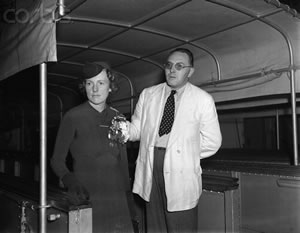
Hervey Allen (8 december 1889 – 28 december 1949)

Hier met zijn vrouw tijdens een scheepsreis


De Franse theaterauteur Georges Feydeau werd geboren op 8 december 1862 in Parijs. Zie ook mijn blog van 8 december 2006 en ook mijn blog van 8 december 2008 en ook mijn blog van 8 december 2009.


Uit : Le dindon

Acte I


„LUCIENNE. – Ah ! quelle fatuité !

PONTAGNAC. – Ce n’est pas de la fatuité, c’est de l’observation. LUCIENNE. – Mais enfin, monsieur, je ne vous connais pas. PONTAGNAC. – Mais moi non plus, madame, et je le regrette tellement que je veux faire cesser cet état de choses... Ah ! Madame...

LUCIENNE. – Monsieur ! PONTAGNAC. – Ah ! Marguerite ! 8

LUCIENNE,s’oubliant. – Lucienne, d’abord ! PONTAGNAC. – Merci ! Ah ! Lucienne ! LUCIENNE. – Hein ! Mais, monsieur, je vous défends !... Qui vous a permis ?... PONTAGNAC. – Ne venez-vous pas de me dire comment je devais vous appeler ! LUCIENNE. – Enfin, monsieur, pour qui me prenez- vous ? Je suis une honnête femme ! PONTAGNAC. – Ah ! tant mieux ! J’adore les honnêtes femmes !... LUCIENNE. – Prenez garde, monsieur ! Je voulais éviter un esclandre, mais puisque vous ne voulez pas partir, je vais appeler mon mari.

PONTAGNAC. – Tiens ! vous avez un mari ?

LUCIENNE. – Parfaitement, monsieur !

PONTAGNAC. – C’est bien ! Laissons cet imbécile de côté !

LUCIENNE. – Imbécile ! mon mari !

PONTAGNAC. – Les maris des femmes qui nous plaisent sont toujours des imbéciles. LUCIENNE,remontant. – Eh bien ! vous allez voir comment cet imbécile va vous traiter ! Vous ne voulez pas sortir ?...“

PONTAGNAC. – Moins que jamais ! LUCIENNE, appelant à droite. – C’est très bien !... Crépin !...

PONTAGNAC. – Oh ! vilain nom !...

LUCIENNE. – Crépin !...


Scène II Les mêmes, Vatelin. VATELIN. – Tu m’appelles ? ma chère amie...

PONTAGNAC, à part. – Vatelin ! fichtre !

VATELIN, reconnaissant Pontagnac. – Ah ! tiens !

Pontagnac ! ce cher ami !

LUCIENNE. – Hein !

PONTAGNAC. – Ce bon Vatelin !

VATELIN. – Ça va bien ?

PONTAGNAC. – Mais très bien !

LUCIENNE, à part. – Il le connaît.“


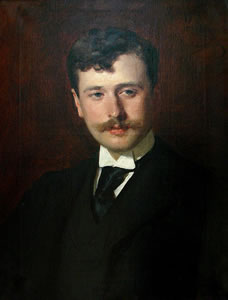
802499-d9dd744bcdabfd4e6cb06266165076fe.jpg
Georges Feydeau (8 december 1862 - 5 juni 1921)

Portret door Emile Carolus-Duran


De Romeinse dichter en schrijver Quintus
Horatius Flaccus werd geboren op 8 december 65 v. Chr. Zie ook mijn blog van 8 december 2006 en ook mijn blog van 8 december 2008 en ook mijn blog van 8 december 2009.


Ode II.3


Bewaar in tegenspoed uw evenwicht

en blijf gespeend aan uitgelatenheid,

wanneer het goed gaat! Sterven, Dellius,


dat doen wij allemaal, wie zich verkniest,

en wie een feest maakt van den langen dag,

in 't gras verscholen met een fijne flesch.


Hoe lokt de schaduw, waar het berkenloof

de hooge stammen van de dennen kust,

het beekje kabb'lend langs de helling vliet!


Laat hier den wijn, laat hier het reukwerk brengen,

den korten bloei der wondermooie roos,

zoolang uw beurs, uw jeugd, uw ster gedoogt!


Uw grondbezit, uw huis, uw buitenplaats

moet gij eens afstaan; en uw erfgenaam

graait in de schatten, die gij hebt vergaard.


Het geeft niet, of gij rijk zijt en van adel

of arm als Job en zonder voorgeslacht;

want onmeedoogend eischt de dood u op.


Een einde wacht ons allen. Vroeg of laat

treft ons het lot, dat in de ranke boot

ons inscheept naar het eeuwig ballingsoord.


Vertaald door Dr. A. Rutgers van der Loeff


 802499-757e461c74d57637708c34ea8a1efc75.jpg

Horatius (8 december 65 v. Chr. - 27 november 8 v. Chr.)

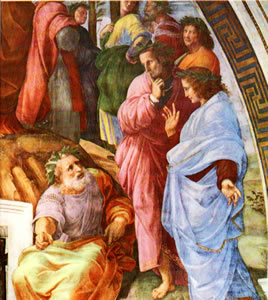
Dichters in gesprek met Horatius,

Fresco van Rafaël Santi in het Apostolisch Paleis, Vaticaanstad.


Geschreven door Romenu om 19:25 Reageer op dit bericht

Carmen Martín Gaite, Nikos Gatsos, Jura Soyfer, Bjørnstjerne Bjørnson, Joel Chandler Harris

De Spaanse schrijfster, vertaalster en journaliste  Carmen Martín Gaite werd geboren op 8 december 1925 in Salamanca. Zie ook mijn blog van 8 december 2008.


Uit: Rotkäppchen in Manhattan (Vertaald door Anne Sorg-Schumacher)  


„Sarah bückte sich und tastete ihr Söckchen ab. Sie fingerte nervös zwischen dem weißen Gewebe und ihrem Knöchel, bis sie an ihre Fußsohle kam. Dahin war die magische Münze gerutscht. Ein Stein fiel ihr vom Herzen. Miranfu! Nicht auszudenken, wenn sie die Münze verloren hätte.
Plötzlich musste sie lächeln. Sie hatte eine wunderbare Idee. Sie hatte ihre Entscheidung getroffen.

Sie steckte den Schlüssel ins Türschloss und öffnete sie ganz langsam. Die Kälte draußen machte sie hellwach. Sie strotzte vor Tatendrang. Jetzt ging es darum, Peter nicht in die Hände zu fallen, der für ihr Vorhaben nur ein Hindernis war, wie sich ja bereits gezeigt hatte.
Sie duckte sich und schlich hinter den Fahrzeugen vorbei, die auf ihrer Straßenseite standen, manchmal auch hinter den Mülltonnen, und erreichte über ausgehobene Erdhaufen und Seitenstraßen den Abhang vom Morningside Park, der an die Südfassade von Saint-John-Divine grenzte. Sie dachte flüchtig daran, dass es in dieser Gegend, vielleicht nicht weit von hier, einst eine Buchhandlung gab, die sie nie kennengelernt hatte: das Königreich der Bücher.“


 802497-16b9cd9722733784d53d57b8ade35d26.jpg

Carmen Martín Gaite (8 december 1925 – 22 juli 2000)  


De Griekse dichter en schrijver Nikos Gatsos werd geboren op 8 december 1911 in Kato Asea in Arcadië. Zie ook mijn blog van 8 december 2008.


Song Of Old Times

For George Seferis


Times change, years pass

the river of the world is muddy

but I go out on the balcony of a dream

to see you bent over your clay

embroider ships and swallows.


The sea is bitter, our land small

the water in the clouds dear

the cypress wrapped in bareness

the grass burns to ashes in silence

and the hunt of the sun is endless.


And you came and carved a fountain

for the old shipwrecked man of the sea

who vanished but a memory of him

remains

a gleaming shell on Amorgos

a salty pebble on Santorini.


From the dew that shakes on a fern

I have taken the drop of a pomegranate

so I can in this notebook

spell out the longings of a heart

with the first star of a fable.


But now that Holy Tuesday arrives

and Easter will come slowly

I want you to go to Mani and to Crete

with your company there perpetually

the wolf the eagle and the asp.


And when you see the shooting star

from another time shine on your face

secretly with delicate twinkle, stand up

bring back again a spring

that wells up in your own rock

. . . . . . . . . . . . . . . . . . . . . . . . . .

Times change, years pass

the river of the world clouds over

but I go out on the balcony of a dream

to see you bent over your clay

embroider ships and swallows.


Vertaald door Diana Gilliland Wright


 802497-df3839e9d7c2af8d8018ff8fe2c5dd02.jpg

Nikos Gatsos (8 december 1911 – 12 mei 1992)


De Oostenrijkse schrijver Jura Soyfer werd op 8 december 1912 in Charkov, Oekraïne, geboren. Zie ook mijn blog van 8 december 2006 en ook mijn blog van 8 december 2008.


Uit: Weltuntergang


“WACHMANN: He, Sie!

GUCK (schläfrig) : Lass mich, Titze-Tante, jetzt is alles egal.

WACHMANN : Hören S', wer is bei Ihna a Tant? Oder soll des a Amtsehrenbeleidigung sein?

GUCK : Mir hat geträumt, daß ein Plakat zu mir geredet hat -

WACHMANN : No, des wär no schöner, wann die Plakate reden täten. Da käm vor lauter öffentliche Ärgernis die öffentliche Sicherheit überhaupt am Hund. Was machen S' da auf der Straßen! Ham S' eine bestimmte Beschäftigung?

GUCK: Ich warte auf den Weltuntergang.

WACHMANN : Wissen S' nicht, dass die Benützung öffentlicher Institutionen als Ruhestätten ungehörig ist?

GUCK: Das sagen Sie mir? Ach was - egal.

WACHMANN : Wer san Se überhaupt? Wo ist Ihre Identitätskarte? (Leuchtet ihm ins Gesicht.) Ach so, Sie brauchen eh kane. Sie san eh identisch. Se san der Guck, net?

GUCK : Und ob! Aber das ist alles egal. Morgen nachmittags wird vielleicht ein Molekül Ihres Körpers einem meiner Moleküle im Weltraum begegnen ...

WACHMANN : Herr, das verbiet' ich mir! Ich als Amtsperson hab kane Moleküle, geschweige denn, daß ich wüßt, was des is!

GUCK : Egal - egal -

WACHMANN : Dem ist alles egal. Ein idealer Staatsbörger. Ach so, Sie meinen, weil murgen die Erde um die Erd' g'haut wern wird?

GUCK : Ja. Um 12 Uhr, Herr Inspektor. Große Geschäftssperre für den gesamten irdischen Betrieb -

WACHMANN : Segn S', I glaub net dran!

GUCK : Hab ich mir gedacht!

WACHMANN : Sö ham nix zu denken'

GUCK : Auch das weiß ich schon.

WACHMANN : Sö ham nix zu wissen!

GUCK : Auch das hab ich schon gelernt. Drum geht ja die Welt unter.

WACHMANN : I glaub net dran, sag i! Es ist noch keinerlei Dienstorder diesbezüglich ausgeb'n wor'n. Wissen S' , was Se san, Herr?

GUCK : Hoffnungslos.

WACHMANN: Sehr richtig. Verrückt, nämlich. Se g'hören nach Amerika!.”


 802497-7cd31709cabe69ce515ffc467af6b857.jpg

Jura Soyfer (8 december 1912 – 16 februari 1939)


De Noorse dichter, schrijver, journalist en politicus
Bjørnstjerne Bjørnson werd geboren op 8 december 1832 in Kvikne bij Tynset. Zie ook mijn blog van 8 december 2006 en ook mijn blog van 8 december 2008.


The Angels Of Sleep


Asleep the child fell
When night cast its spell;
The angels came near
With laughter and cheer.
Her watch at its waking the mother was keeping:
"How sweet, my dear child, was your smile now while sleeping!"


To God mother went,
From home it was rent;
Asleep the child fell
'Neath tears' troublous spell.
But soon it heard laughter and mother-words tender;
The angels brought dreams full of childhood's rare splendor.


It grew with the years,
Till gone were the tears;
Asleep the child fell,
While thoughts cast their spell.
But faithful the angels their vigils were keeping,
The thoughts took and whispered: "Have peace now, while sleeping!"


Secret Love


He gloomily sat by the wall,
As gaily she danced with them all.
Her laughter's light spell
On every one fell;
His heartstrings were near unto rending,
But this there was none comprehending.


She fled from the house, when at eve
He came there to take his last leave.
To hide her she crept,
She wept and she wept;
Her life-hope was shattered past mending,
But this there was none comprehending.


Long years dragged but heavily o'er,
And then he came back there once more.
--Her lot was the best,
In peace and at rest;
Her thought was of him at life's ending,
But this there was none comprehending.


Vertaald door Arthur Hubbell Palmer


 802497-6b96b92ad1bc3ea283ba476173c1ef0b.jpg

Bjørnstjerne Bjørnson (8 december 1832 – 26 april 1910)

Standbeeld in Oslo


De Amerikaanse schrijver Joel Chandler Harris werd geboren op 8 december 1848 in Eatonton, Georgia. Zie ook mijn blog van 8 december 2008.


Uit: Nights With Uncle Remus (Mr. Fox And Miss Goose)


“It had been raining all day so that Uncle Remus found it impossible to go out. The storm had begun, the old man declared, just as the chickens were crowing for day, and it had continued almost without intermission. The dark gray clouds had blotted out the sun, and the leafless limbs of the tall oaks surrendered themselves drearily to the fantastic gusts that drove the drizzle fitfully before them. The lady to whom Uncle Remus belonged had been thoughtful of the old man, and 'Tildy, the house-girl, had been commissioned to carry him his meals. This arrangement came to the knowledge of the little boy at supper time, and he lost no time in obtaining permission to accompany 'Tildy.

Uncle Remus made a great demonstration over the thoughtful kindness of his "Miss Sally."

"Ef she ain't one blessid w'ite 'oman," he said, in his simple, fervent way, "den dey ain't none un um 'roun' in deze parts."

With that he addressed himself to the supper, while the little boy sat by and eyed him with that familiar curiosity common to children. Finally the youngster disturbed the old man with an inquiry:--

"Uncle Remus, do geese stand on one leg all night, or do they sit down to sleep?"

"Tooby sho' dey does, honey; dey sets down same ez you does. Co'se, dey don't cross der legs," he added, cautiously, "kase dey sets down right flat-footed."

"Well, I saw one the other day, and he was standing on one foot, and I watched him and watched him, and he kept on standing there."

"Ez ter dat," responded Uncle Remus, "dey mought stan' on one foot en drap off ter sleep en fergit deyse'f. Deze yer gooses," he continued, wiping the crumbs from his beard with his coat-tail, "is mighty kuse fowls; deyer mighty kuse. In ole times dey wuz 'mongs de big-bugs, en in dem days, w'en ole Miss Goose gun a-dinin', all de quality wuz dere. Likewise, en needer wuz dey stuck-up, kase wid all der kyar'n's on, Miss Goose wer'n't too proud fer ter take in washin' fer de neighborhoods, en

she make money, en get slick en fat lak Sis Tempy.”


802497-f82a83a872f8071d15e6cb68474caa69.jpg
Joel Chandler Harris (8 december 1848 – 3 juli 1908)


Geschreven door Romenu om 19:18 Reageer op dit bericht

Meer van Romenu

↑ Terug naar de berichten