Patrick Modiano, Cherie Priest, Salvador Novo, Emily Brontë, Alexander Trocchi, Pauline van der Lans
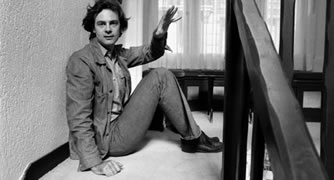
De Franse schrijver Patrick Modiano werd geboren in Boulogne-Billancourt op 30 juli 1945. Zie ook alle tags voor Patrick Mondiano op dit blog.
Uit: Unfall in der Nacht (Vertaald door Elisabeth Edl)
“Vielleicht hatte ich mich bei meinem Sturz am Schädel verletzt. Ich habe mich zu der Frau gedreht. Es überraschte mich, daß sie einen Pelzmantel trug. Mir ist wieder eingefallen, daß Winter war. Außerdem trug der Mann uns gegenüber auch einen Mantel und ich eine von diesen alten Lammfelljacken, wie man sie auf Flohmärkten fand. Ihren Pelzmantel hatte sie bestimmt nicht auf dem Flohmarkt gekauft. Nerz? Zobel? Sie hatte ein sehr gepflegtes Äußeres, was nicht zu den Verletzungen in ihrem Gesicht paßte. Auf meiner Jacke, etwas oberhalb der Taschen, sah ich Blutflecken. Ich hatte eine lange Schramme im linken Handteller, und die Blutflecken auf dem Stoff,
die kamen sicher daher. Sie hielt sich sehr gerade, aber mit geneigtem Kopf, als starre sie auf etwas am Boden. Vielleicht auf meinen schuhlosen Fuß. Die Haare trug sie halblang, und im Licht des Foyers war sie mir blond vorgekommen. Das Polizeiauto war an der Ampel stehengeblieben, auf dem Quai, bei Saint-Germain-l’Auxerrois. Der Mann beobachtete uns immer noch, mal sie und mal mich,
schweigend, mit seinem kalten Blick. Ich fühlte mich langsam an irgend etwas schuldig. Die Ampel wurde nicht grün. Es brannte noch Licht in dem Café an der Ecke Quai/Place Saint-Germain-l’Auxerrois, wo mein Vater sich oft mit mir verabredet hatte. Das war der Augenblick, um zu fliehen. Vielleicht brauchten wir auch nur diesen Typen auf der Bank zu bitten, daß er uns gehen ließ. Aber ich fühlte mich außerstande, das kleinste Wort hervorzubringen. Er hat gehustet, ein schleimiges Raucherhusten, und ich war überrascht, einen Ton zu hören. Seit dem Unfall herrschte tiefe Stille um mich, als hätte ich das Gehör verloren. Wir fuhren den Quai hinunter. Als das Polizeiauto auf die Brücke einbog, spürte ich, wie ihre Finger mein Handgelenk umfaßten. Sie lächelte mich an, wie um mich zu beruhigen, aber ich hatte überhaupt keine Angst. Mir schien sogar, als wären wir, sie und ich, uns schon bei anderer Gelegenheit begegnet und als habe sie immer dieses Lächeln. Wo hatte ich sie schon gesehen?”
Patrick Modiano (Boulogne-Billancourt, 30 juli 1945)
De Amerikaanse schrijfster Cherie Priest werd geboren in Tampa op 30 juli 1975. Zie ook alle tags voor Cherie Priest op dit blog.
Uit: Hellbent
“It sounded like a good idea at the time, which is probably going to be on my tombstone—along with a catty footnote about poor impulse control. But when Horace Bishop called me, practically breathless with delight and greed, telling me he was in Portland so we should get together and have a drink or something, I said okay, even though I probably should’ve said “I’d sooner wear plaid.”
I don’t wear plaid. Ever.
I don’t wear orange, either—not that there’s anything inherently wrong with it. Really, it’s more of a
coloring thing. I’m a solid winter— blue- black hair and so fair I’m practically translucent; it comes with
being undead. Orange always makes me look like I’m having liver problems, so I skip it—just like deep
down I suspected I ought to skip that date with Horace, but what was I going to do? He already knew where I lived (roughly), and he already knew my price scale (more or less), and he was practically my agent. Or my pimp.
Anyway, Horace was vibrating—talking so fast I could hardly understand him. And what was he doing on the West Coast? He promised to tell me in person, and since he was flying back to New York from the Seattle- Tacoma airport, it wasn’t terribly far out of his way to bounce into town for a conspiratorial adult beverage. I waited for him at a bar on Capitol Hill. I don’t live in that neighborhood anymore, but that’s the point. He knows I live in Seattle, but the less specific his knowledge is, the happier I am.
The truth is, I kind of trust him. I mean, if I were wounded and bloody and practically dying in New York City and I had no place else to go, I could probably fling myself onto his couch and generally assume that he wouldn’t stake me in my sleep. After all, I’ve earned him a metric assload of money over the years. And money has to mean something, doesn’t it?”

Cherie Priest (Tampa, 30 juli 1975)
De Mexicaanse dichter, schrijver, vertaler, televisiepresentator en ondernemer Salvador Novo werd geboren op 30 juli 1904 in Mexico City. Zie ook alle tags voor Salvador Novo op dit blog.
Uit: Pillar Of Salt (Vertaald door Marguerite Feitlowitz)
„A few months before, I had begun a casual friendship with a boy in the class ahead of me: the third and fourth years were sharing classrooms off the large patio. I don’t remember how we began seeing each other. Given his inquisitive spirit, it must have been he who approached me, having learned that I had poems published in the school magazine, Policromías, where his first verses had also appeared.
We did not have classes together, but found times to chat; upon learning that he lived at 95 calle Mina, and I on calle Guerrero, I started calling for him at his house whence we would to walk to Preparatoria, which wasn’t far and took us along quiet, little-used streets.
Xavier [Villaurrutia] had a large family: brothers and sisters. They lived on the lower floors of a stone house shaped like a “7,” with patio and corridor bordered by iron railings, a living room with two balconies giving onto the street, a parallel dining room, and then the numerous bedrooms. Once he invited me home to eat, so I met his mother, Doña Julia González, and a few of his brothers and sisters. They all played tennis, and the girls were champions. Their brothers had a sort of small bank or financial firm on Avenida Cinco de Mayo, and a few times I accompanied Xavier when he went there to receive his monthly allowance. Little by little I learned that the family also included writers, artists, and relatives who were very wealthy.. They possessed original Ruelas, which Xavier showed me with pride. I also learned—for he confided, reticently and swearing me to secrecy—that the family had also had conjugal tragedies and pathetic nervous illnesses.
The predilection that Don Ezequiel showed toward me must have induced him to introduce the “distinguished student” to the young secretary of the Preparatoria, a poet, Xavier informed me, who taught literature classes in another school—Advanced Studies—near our own. Between classes, I began visiting Jaime Torres Bodet. In his office he introduced me to another young poet and friend of his, who seemed always to be there: Bernardo Ortiz de Montellano.“

Salvador Novo (30 juli 1904 – 13 januari 1974)
De Engelse dichteres en schrijfster Emily Brontë werd geboren in Thornton in Yorkshire op 30 juli 1818. Zie ook alle tags voor Emily Brontë op dit blog.
Uit: Wuthering Heights
„But Mr. Heathcliff forms a singular contrast to his abode and style of living. He is a dark- skinned gipsy in aspect, in dress and manners a gentleman: that is, as much a gentleman as many a country squire: rather slovenly, perhaps, yet not looking amiss with his negligence, because he has an erect and handsome figure; and rather morose. Possibly, some people might suspect him of a degree of under-bred pride; I have a sympathetic chord within that tells me it is nothing of the sort: I know, by instinct, his reserve springs from an aversion to showy displays of feeling - to manifestations of mutual kindliness. He'll love and hate equally under cover, and esteem it a species of impertinence to be loved or hated again. No, I'm running on too fast: I bestow my own attributes over-liberally on him. Mr. Heathcliff may have entirely dissimilar reasons for keeping his hand out of the way when he meets a would-be acquaintance, to those which actuate me. Let me hope my constitution is almost peculiar: my dear mother used to say I should never have a comfortable home; and only last summer I proved myself perfectly unworthy of one.
While enjoying a month of fine weather at the sea-coast, I was thrown into the company of a most fascinating creature: a real goddess in my eyes, as long as she took no notice of me. I 'never told my love' vocally; still, if looks have language, the merest idiot might have guessed I was over head and ears: she understood me at last, and looked a return - the sweetest of all imaginable looks. And what did I do? I confess it with shame - shrunk icily into myself, like a snail; at every glance retired colder and farther; till finally the poor innocent was led to doubt her own senses, and, overwhelmed with confusion at her supposed mistake, persuaded her mamma to decamp. By this curious turn of disposition I have gained the reputation of deliberate heartlessness; how undeserved, I alone can appreciate.“

Emily Brontë (30 juli 1818 - 19 december 1848)
Laurence Olivier and Merle Oberon in de film “Wuthering Heights” uit 1939
De Schotse schrijver Alexander Trocchi werd geboren op 30 juli 1925 in Glasgow. Zie ook alle tags voor Alexander Trocchi op dit blog.
Uit: Young Adam
„I seldom talked to Ella. She appeared to dislike me and gave the impression that she only put up with me because of her husband.
And then I noticed Ella hanging out some clothes at the stern.
I had often seen her do it before, but it had never struck me in the same way. I had always thought of her as Les's wife--she was always screaming at him about something or calling him Mr. High-and-Mighty in a thick sarcastic voice. I never saw her as a woman who could attract another man. That had never occurred to me--until now.
But there she was, trying very hard not to look round, pretending she wasn't interested in what was going on, and I found myself looking at her in a new way.
She was one of those heavy women, not more than thirty-five, with strong buttocks and big thighs. She was wearing a tight green cotton dress that pulled up above the backs of her knees as she stretched up to put the clothes on the line. I could see the flesh of her pink ankles growing over the rim at the back of her shoes. She was heavy all right, but her waist was small and her legs were not bad. I could imagine being between them, belly to belly, wrapped securely in the oval of their embrace.
I watched her, and I could see her walk through a park at night, her heels clacking, just a little bit hurriedly, and her heavy white calves were moving just ahead of me. Even in the dark I was able to see them. And I imagined the soft sound of her thighs as their surfaces grazed, as whatever she wore beneath her dress was wedged softly in their damp and tremulous moving. As she reached up, her buttocks tightened, the cotton dress fitting itself to their thrust, and then she alighted on her heels, bent down, and shook out the next garment.
My manhood stirred at the sight. The rest of the world slipped away and my mind filled with the thought of her. I longed to possess her and put her body to the test. Inspired by the back view I had now, I thought of raising that thin membrane of material as she bent, forcing her forward and belly down and mounting her from behind.“

Alexander Trocchi (30 juli 1925 – 15 april 1984)
De Nederlandse schrijfster Pauline van der Lans werd geboren op 30 juli 1963 in Den Haag. Zie ook alle tags voor Pauline van der Lans op dit blog.
Uit: Cadeauverpakking
“Ik open het raam en snuif de avondlucht door beide neusgaten naar binnen. Het is donker en het ruikt naar rook en houtsnippers. Morris, onze tuinman heeft een vuurtje aangelegd om gesnoeide takken te verbranden. Met een lange stok pookt hij het vuur op. Het knettert en knispert. Als hij me in het raam ziet staan, zwaait hij naar me.
Ik heb geen idee hoe laat het is. Tegen achten denk ik. De verlichting in en om het huis floept automatisch aan als het begint te schemeren. Ik sluit het raam en ga voor de spiegel zitten. God, wat zie ik eruit. Ben ik het wel? Ja, ik ben het wel. Het zijn mijn rimpeltjes op mijn bovenlip, het zijn mijn kraaienpootjes, mijn uitgroei bij de haargrens. Het zijn mijn oneffenheden die door Michel zo mooi weggewerkt zijn. Op een schilderij kan alles. God, het schilderij. Ik hoef me niet om te draaien om het te zien. De cadeauverpakking zit er nog om. Het was een goed idee toch? Ik vind het nog steeds een wereldidee. Je man wordt tenslotte niet ieder jaar vijftig. Wat zit ik nou te doen? Ik ga gewoon door met poederen en smeren alsof er niets aan de hand is. Alsof hier niet vanaf twee uur vanmiddag twee politieagenten op de rand van mijn chaise longue hebben gezeten.
‘Mevrouw Helène de Vos?’
Ik knikte.
‘Klopt.’
‘Geboren 12 juni 1953?’
‘Tut tut, heren, zoiets vraagt men niet aan een dame.’
‘Gehuwd met Herbert Johan de Vos.’
Ik knikte.
Ze rommelden met allerlei papieren die twee kerels, de een was nog Surinaams ook. Ik kon hen niet goed verstaan, er zat geraas in mijn oren. Het geraas van de branding in zo’n grote toeristische zeeschelp.“

Pauline van der Lans (Den Haag, 30 juli 1963)
Den Haag
Zie voor nog meer schrijvers van de 30e juli ook mijn blog van 30 juli 2011 deel 2.