Naar de inhoud

Romenu

Over literatuur, gedichten, kunst en cultuur
akke.beakke.be

Berichten van 4 oktober 2012 tot 5 oktober 2012

Flann O’Brien, Roberto Juarroz, Václav Havel

De Ierse schrijver Flann O’Brien werd geboren op 5 oktober 1911 in Strabane, County Tyrone. Zie ook mijn blog van 5 oktober 2009 en ook mijn blog van 5 oktober 2010 en eveneens alle tags voor Flann O’Brien op dit blog.


Uit: At Swim-Two-Birds


“HAVING placed in my mouth sufficient bread for three minutes' chewing, I withdrew my powers of sensual perception and retired into the privacy of my mind, my eyes and face assuming a vacant and preoccupied expression. I reflected on the subject of my spare-time literary activities. One beginning and one ending for a book was a thing I did not agree with. A good book may have three openings entirely dissimilar and inter-related only in the prescience of the author, or for that matter one hundred times as many endings.

Examples of three separate openings - the first: The Pooka MacPhellimey, a member of the devil class, sat in his hut in the middle of a firwood meditating on the nature of the numerals and segregating in his mind the odd ones from the even. He was seated at his diptych or ancient two-leaved hinged writing-table with inner sides waxed. His rough long-nailed fingers toyed with a snuff-box of perfect rotundity and through a gap in his teeth he whistled a civil cavatina. He was a courtly man and received honour by reason of the generous treatment he gave his wife, one of the Corrigans of Carlow.

The second opening: There was nothing unusual in the appearance of Mr. John Furriskey but actually he had one distinction that is rarely encountered - he was born at the age of twenty-five and entered the world with a memory but without a personal experience to account for it. His teeth were well-formed but stained by tobacco, with two molars filled and a cavity threatened in the left canine. His knowledge of physics was moderate and extended to Boyle's Law and the Parallelogram of Forces.

The third opening: Finn Mac Cool was a legendary hero of old Ireland. Though not mentally robust, he was a man of superb physique and development. Each of his thighs was as thick as a horse's belly, narrowing to a calf as thick as the belly of a foal. Three fifties of fosterlings could engage with handball against the wideness of his backside, which was large enough to halt the march of men through a mountain-pass.

I hurt a tooth in the corner of my jaw with a lump of the crust I was eating. This recalled me to the perception of my surroundings.

It is a great pity, observed my uncle, that you don't apply yourself more to your studies. The dear knows your father worked hard enough for the money he is laying out on your education. Tell me this, do you ever open a book at all?

I surveyed my uncle in a sullen manner. He speared a portion of cooked rasher against a crust on the prongs of his fork and poised the whole at the opening of his mouth in a token of continued interrogation.


1249868-6e33993b3862424f562bdbbd4bfcc35b.jpg
Flann O’Brien (5 oktober 1911 – 1 april 1966)


De
Argentijnse dichter, essayist en literatuurwetenschapper
Roberto Juarroz werd geboren in Coronel Dorrego op 5 oktober 1925. Zie ook mijn blog van 5 oktober 2009 en ook mijn blog van 5 oktober 2010 en eveneens alle tags voor Roberto Juarroz op dit blog.


Hij tekende overal ramen

Hij tekende overal ramen.
Op te hoge muren,
op te lage muren,
op wanden die stompe hoeken maken,
in de lucht en zelfs op de daken.

Hij tekende ramen alsof het vogels waren.
Op de grond, in de nachten,
in de voelbaar dove blikken,
in de omgeving van de dood,
op de graven, in de bomen.

Hij tekende zelfs ramen op de deuren.
Maar nooit tekende hij een deur.
Hij wilde niet naar binnen en niet naar buiten.
Hij wist dat het onmogelijk is.
Hij wilde alleen zien: zien.

Hij tekende ramen.
Overal.

Vertaald door Mariolein Sabarte Belacortu


Tenth. 3


In every world
there are floating images,
vagabond icons
whose destiny is to float adrift,
figures disquieting to fixed beings
and to everything tied-down.

But there are also worlds
made only of images,
without anchorage or ports,
entirely nomadic,
rootless glimmerings,
fleeting flashes.

Every image tends to stretch out spontaneously,
discard its source
and stand on its own.
And those worlds of floating images
also try to do without the others
in search of a freer space.

Because beyond the weight of bodies,
only images are free.
Therefore man ought
to turn into image.
Or let his image drift freely
and learn to exist with no image.


Vertaald door Mary Crow


1249868-0be54c9a36c0bb343c72289d9c9b38d0.jpg
Roberto Juarroz (5 oktober 1925 – 31 maart 1995)


De Tsjechische schrijver en politicus
Václav Havel werd op 5 oktober 1936 in Praag geboren. Zie ook mijn blog van 5 oktober 2009 en ook mijn blog van 5 oktober 2010 en eveneens alle tags voor Václav Havel op dit blog.


HOOP


Diep in onszelf dragen wij de hoop.
Als dat niet het geval is,
is er geen hoop meer.

Hoop
is een kwaliteit van de ziel
en hangt niet af
van wat er in de wereld gebeurt.

Hoop
is niet voorspellen
of vooruitzien.
Het is een gerichtheid van de geest,
een gerichtheid van het hart,
voorbij de horizon verankerd.

Hoop
in deze diepe en krachtige betekenis
is niet hetzelfde als vreugde
omdat alles goed gaat
of bereidheid je in te zetten
voor wat succes heeft.

Hoop
is ergens voor werken
omdat het goed is,
niet alleen
omdat het kans van slagen heeft.

Hoop
is niet hetzelfde als optimisme.
Evenmin de overtuiging
dat iets goed zal aflopen.
Wel de zekerheid dat iets zinvol is
ongeacht de afloop,
het resultaat.


1249868-01950fc130b54dcd9a1d05b59ad36d77.jpg
Václav Havel (5 oktober 1936 – 18 december 2011)


Zie voor nog meer schrijvers van de 5e oktober ook mijn blog van 5 oktober 2011 deel 1 en eveneens deel 2.
Geschreven door Romenu om 19:13 Reageer op dit bericht

Oek de Jong, Matthieu Gosztola, Charles Frazier, Cynthia Mc Leod

De Nederlandse schrijver Oek de Jong werd geboren in Breda op 4 oktober 1952. Zie ook mijn blog van 4 oktober 2010 en eveneens alle tags voor Oek de Jong op dit blog.

Uit: Een rij handkarren


“Breitner is er vroeg voor opgestaan, zoals hij wel vaker doet wanneer hij in de stad wil fotograferen. Hij houdt van de drukte en beweging in de Amsterdamse straten, maar ook van de ochtendstilte, de lange schaduwen die een nog laagstaande zon werpt, van roerloos water waarin zich de huizen weerspiegelen. Het is ook handig om in alle vroegte te fotograferen: er zijn nog maar weinig mensen op straat, zodat hij zijn stadsgezichten met figuren gemakkelijker kan componeren.

Hij loopt van zijn huis aan de Lauriergracht naar de Wallen en daar zoekt hij zijn weg naar de plek die hij al een tijd in zijn gedachten heeft: een bocht in de Oudezijds Achterburgwal. In de stegen weerklinken zijn voetstappen. Ergens wordt een raam omhoog geschoven. Uit een kelderwoning klinkt kindergekrijs. In een halfdonker café staan de stoelen op de tafels. De bedompte geur van bier en afval mengt zich met de frisse lucht.

Daar gaat Breitner met zijn zwarte bolhoed en zijn camera. Hij is nog geen veertig. Hij ademt. Hij huivert misschien even in de ochtendkilte na te weinig slaap. De ijle schaduwen van bomen, gaslantaarns en brugleuningen glijden over hem heen. Wanneer hij een brug afloopt schuiven zijn voeten in zijn schoenen naar voren, tegen het leer aan.

Nog een steeg, dan is hij ter plaatse en ligt rechts van hem de Oudezijds Achterburgwal. Er zijn toch een paar mensen op de kade. Hij maakt er gebruik van, impulsief als hij is. Hij kiest meteen zijn standpunt, volgt in de zoeker van de camera de bewegingen van zijn figuren en drukt dan af. Uit de camera komt een zacht geluid van werkend mechaniek.

Meer dan honderd jaar later zie je op de foto die bocht in de Oudezijds Achterburgwal. De zon staat nog laag en beschijnt de achtergevels van de huizen aan de Zeedijk. Ruiten blinken. Overal hangt wasgoed buiten de ramen, het heeft daar de hele nacht gehangen, boven de gracht. De houten steunen van lege waslijnen werpen lange, schuinse schaduwen op de gevels. Het is pril licht dat op de oude huizen valt.”


 1249148-4ba12cbfa3c2fcdb86dab9794853d67a.jpg

Oek de Jong (Breda, 4 oktober 1952)


De Franse dichter en schrijver
Matthieu Gosztola werd geboren op 4 oktober 1981 in Le Mans (Sarthe). Zie ook mijn blog van 4 oktober 2010 en alle tags voor Matthieu Gosztola op dit blog.

Uit: Débris de tuer (Rwanda, 1994)


Alors on démarre l’écoute

              un an

                                    avant la fin de la fin

                    on n’a pas de théorie

sur le chemin


                                            ils entendaient communiquer à la radio-Télévision

                                                      libre des Mille-Collines                                                                                                                                                              mais ça n’a pas duré

          ils se sont mis            muhere iruhande

                       à lancer des branches

                       sur la saison en cours


Et le présent de justesse

Parce que l’avenir a déjà mangé


Uit: Une caresse pieds nus


Nos caresses changent le papier peint

Des pièces où nous faisons l'amour


*


La lumière démise

Dans une caresse


La lumière se dévide dans nos caresses


Nos caresses font de chaque instant

La plus haute syllabe de l’été


*


Fulgurance d’une caresse

Portant la nuit à notre oreille


1249148-242bb5f32f94e13dac3413eaf4e659d7.jpg
Matthieu Gosztola (Le Mans, 4 oktober 1981)
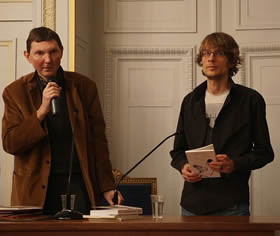
Hier met collega dichter en vertaler Pierre Drogi (links)


De Amerikaanse schrijver
Charles Frazier werd geboren op 4 oktober 1950 in Asheville, North Carolina. Zie ook mijn blog van 4 oktober 2010 en alle tags voor Charles Frazier op dit blog.


Uit: Cold Mountain


“At the first gesture of morning, flies began stirring. Inman's eyes and the long wound at his neck drew them, and the sound of their wings and the touch of their feet were soon more potent than a yardful of roosters in rousing a man to wake. So he came to yet one more day in the hospital ward. He flapped the flies away with his hands and looked across the foot of his bed to an open triple-hung window. Ordinarily he could see to the red road and the oak tree and the low brick wall. And beyond them to a sweep of fields and flat piney woods that stretched to the western horizon. The view was a long one for the flatlands, the hospital having been built on the only swell within eyeshot. But it was too early yet for a vista. The window might as well have been painted grey.
Had it not been too dim, Inman would have read to pass the time until breakfast, for the book he was reading had the effect of settling his mind. But he had burned up the last of his own candles reading to bring sleep the night before, and lamp oil was too scarce to be striking the hospital's lights for mere diversion. So he rose and dressed and sat in a ladderback chair, putting the gloomy room of beds and their broken occupants behind him. He flapped again at the flies and looked out the window at the first smear of foggy dawn and waited for the world to begin shaping up outside.
The window was tall as a door, and he had imagined many times that it would open onto some other place and let him walk through and be there. During his first weeks in the hospital, he had been hardly able to move his head, and all that kept his mind occupied had been watching out the window and picturing the old green places he recollected from home. Childhood places.

The damp creek bank where Indian pipes grew. The corner of a meadow favored by brown-and-black caterpillars in the fall. A hickory limb that overhung the lane, and from which he often watched his father driving cows down to the barn at dusk.”


1249148-f13bc531d38aa8689c6ccb822d0aebbf.jpg
Charles Frazier (Asheville, 4 oktober 1950)


De Surinaamse schrijfster
Cynthia Henri Mc Leod werd geboren op 4 oktober 1936 in Paramaribo als Cynthia Ferrier. Zie ook mijn blog van 4 oktober 2010 en eveneens alle tags voor Cynthia Mc Leod op dit blog.


Uit: The Free Negress Elisabeth (Vertaald door Brian Doyle)


“1 December 1750

Elisabeth sat in her carriage as it lumbered, creaked and squeaked its way along the Heerenstraat. She inhaled the scent of the orange blossoms planted along both sides of the street and brushed a couple of tiny white flowers from her blue dress.

Men and women, the occasional couple, all of them followed by groups of male and female slaves, made their way to the Dutch Reformed Church on the other side of Oranjetuin cemetery. All the slaves were well-dressed; the women in starched and colourful baggy dresses, short smock jackets, ankle bands, bracelets and brightly coloured necklaces, the men in trousers and short jackets, the indispensable Sunday hat, but none of them wore shoes. They held parasols on long poles above their masters’ and mistresses’ heads and carried trays with prayer books wrapped in gold braided velvet on the palms of their hands. A few of the slaves held hands with a white or light brown child or carried such a child on their arm.

Although Elisabeth’s house was not far from the church, she always took her carriage. She passed the procession of people and nodded on occasion when someone greeted her. The carriage stopped in front of the church, a large white wooden construction in which the Police Council and the Council of Criminal Justice met during the week on the ground floor and church services were held on the upper floor on Sundays. It was the custom to have services in the morning in Dutch and in the afternoon in French, but on this occasion, the Walloon minister, Duvoisin, was presiding at the morning service because the Reverend IJver was sick in bed.

Elisabeth stepped down from her carriage, assisted by Present and Venis who had followed on foot. Venis made slight adjustments to her mistress’s dress and presented her with a silver tray bearing a prayer book wrapped in purple velvet. Venis also tried to brush a lock of hair from her mistress’s wig out of sight, but Elisabeth stopped her and muttered: ‘Leave it.’ She slowly ascended the stairs and entered the church.”


1249148-2ba59945c0ff941be1a23edfd82defbc.jpg
Cynthia Mc Leod (Paramaribo, 4 oktober 1936)


Zie voor nog meer schrijvers van de 4e oktober ook mijn blog van 4 oktober 2011 deel 1 en eveneens deel 2.
Geschreven door Romenu om 20:00 Reageer op dit bericht

Meer van Romenu

↑ Terug naar de berichten