Naar de inhoud

Romenu

Over literatuur, gedichten, kunst en cultuur
akke.beakke.be

Berichten van 4 februari 2013 tot 5 februari 2013

Geert Buelens, William S. Burroughs, Joris-Karl Huysmans, Terézia Mora, Philip Weiss, Rikkert Zuiderveld, Luc Indestege

De Vlaamse dichter, essayist en columnist Geert Buelens werd geboren in Duffel op 5 februari 1971. Zie ook alle tags voor Geert Buelens op dit blog.


Het punt (Michelangelo Antonioni)


Streef
naar een minzaam vergelijk
laat het slot
weerklinken
en stijg

neem je schaduw op
voer het naar de hoogste top
en neig dan

naar opzij

achterom

een kwartdraai

rond
het vlak dan af
maak de strop goed strak
trek de draad snel na
loop ook langs de flank en
sta

verstomd van het zicht
ontdaan van je plicht

Zweef moeizaam
verglijd


uur nul


wie hier voorbij is
dan zie
al wat overblijft is ruis
al wat overblijft is gruis vermalen
tot een grijs tapijt
je gooit het puntlood uit en zakt
ermee tot in wat eens schacht vier was
daar rommelt het
niet langer speelt een showorkest ten dans
de hapering lijkt permanent
op hoogspanning gesteld
dat dit blijft duren
zou dat een soort van einde zijn


 1330655-bc8b7a98e016588a56e02d6deaf71702.jpg

Geert Buelens (Duffel, 5 februari 1971)


De Amerikaanse schrijver William S. Burroughs werd geboren in Saint Louis (Missouri) op 5 februari 1914. Zie ook alle tags voor William S. Burroughs op dit blog.


FROM SAN DIEGO UP TO MAINE


Solemn Accountants are jumping ship, sir…All of them, sir… In the last skimpy surplus, sir… ‘Room for one more outside, sir’ they said and plunged Seventh Teen Age Future Molotov Cocktails… Last seen swimming desperately in sewage…


Allies wait on knives…Valiant Crowns drew a short 22 and Heavy Commitments….The Caribbean swells to a roar…A Negro snapped the advantages….Street Gangs Uranian born up from a headline of penniless migrants in the face of appalling conditions:


“Out Show window and we’re Proud of it.”


Her Fourth Grade Class screamed in terror when I looked at the dogs and I looked at the pavement… decided the pavement was safer… Stale streets of yesterday policemen back from shadows to embrace his assailant…pretty familiar. Talk to my medium….Remember my medium of appalling conditions conditi ons?:


Suicide by teen ager…ice food…same day…Blue Note wherever you go… Dietary delusion of death in Tanganyika or was it?


Only this should have been obvious from Her Fourth Grade Class: Only live animals have write door…. Distant…


Secure it firmly with steak sized chucks of cripple drug and throw it in a Liz replica synthesized from cabbage….


Who was Rape and Idleness? Anyone over homicide big enough to take Punishment Wisconsin…Milwauki convicted of later and lesser crimes pudgy and not pretty…The Words included assault murder stratosphere and his feet devoid of reality.


Will Hollywood never learn?


Unimaginable disaster …Royal Kights Teen Age Future Time.


Cut up articles on Juvenile Delinquency

Time and New York Herald Tribune (European adition)


 1330655-c9e18393e82945caa928e7a891478d36.jpg

William S. Burroughs (5 februari 1914 – 2 augustus 1997) 

Hier met David Bowie (links) rond 1974


De Franse dichter en schrijver Charles-Marie-Georges Huysmans werd geboren op 5 februari 1848 in Parijs. Zie ook alle tags voor Joris-Karl Huysmans op dit blog.


Uit: À Rebours


« Le mouvement lui paraissait d’ailleurs inutile et l’imagination lui semblait pouvoir aisément suppléer à la vulgaire réalité des faits. À son avis, il était possible de contenter les désirs réputés les plus difficiles à satisfaire dans la vie normale, et cela par un léger subterfuge, par une approximative sophistication de l’objet poursuivi par ces désirs mêmes. Ainsi, il est bien évident que tout gourmet se délecte aujourd’hui, dans les restaurants renommés par l’excellence de leurs caves, en buvant les hauts crus fabriqués avec de basses vinasses traitées suivant la méthode de M. Pasteur. Or, vrais et faux, ces vins ont le même arôme, la même couleur, le même bouquet, et par conséquent le plaisir qu’on éprouve en dégustant ces breuvages altérés et factices est absolument identique à celui que l’on goûterait en savourant le vin naturel et pur qui serait introuvable, même à prix d’or.
En transportant cette captieuse déviation, cet adroit mensonge dans le monde de l’intellect, nul doute qu’on ne puisse, et aussi facilement que dans le monde matériel, jouir de chimériques délices semblables, en tous points, aux vraies; nul doute, par exemple, qu’on ne puisse se livrer à de longues explorations, au coin de son feu, en aidant, au besoin, l’esprit rétif ou lent, par la suggestive lecture d’un ouvrage racontant de lointains voyages; nul doute aussi, qu’on ne puisse, - sans bouger de Paris - acquérir la bienfaisante impression d’un bain de mer; il suffirait, tout bonnement de se rendre au bain Vigier, situé, sur un bateau, en pleine Seine.”


 1330655-eb50a0a47c94d8cbc7150a9385e19ba5.jpg

Joris-Karl Huysmans (5 februari 1848 – 12 mei 1907)

Cover Engelse vertaling 


De Hongaarse, Duitstalige, schrijfster en vertaalster
Terézia Mora werd geboren op 5 februari 1971 in Sopron. Zie ook alle tags voor Terézia Mora op dit blog.


Uit: Day in Day Out (Vertaald door Michael Henry Heim)


“Let us call the time now; let us call the place here. Let us describe both as follows.

A city, a district somewhat east of the center. Brown streets, warehouses empty or full of no one quite knows what, and jam-packed human residences zigzagging along the railway line, running into brick walls in sudden cul-de-sacs. A Saturday morning, autumn in the air. No park, just a tiny, desolate triangle of so-called green space left over when two streets came together in a point. An empty corner of land. Sudden gusts of early-morning wind resulting from the cleft-like layout of the streets...what you might call a social bite...rattle a playground carousel, an old or merely old-looking wooden toy at the edge of the green space. There is a ring nearby, the kind used to pull litter bins, but free-floating, with no bin attached; there is litter strewn over the nearby undergrowth, which tries to shake it off in attacks of the shivers, but what comes off are mostly leaves whooshing onto cement, sand, glass, and well-worn greenery. Two women and shortly thereafter another on their way to or from work. Taking a short cut, treading the trodden path that cuts the green into two triangles. One of them, corpulent, tugs at the edge of the wooden carousel with two fingers as she passes. The stand it rests on gives a squawk. It sounds like a bird's cry, or maybe it was in fact a bird, one of the hundreds streaming across the sky. Starlings. The carousel twists and staggers.

The man looked something like a bird to us, or a bat, a giant bat hanging there, his black coattails fluttering now and then in the wind. At first theythought...they later said as much...that someone had merely left his coat behind on that carpet-beating frame or whatever it was, jungle gym. But then they saw there were hands hanging out, white hands, the tips of the bent fingers nearly touching the ground.

On an early autumn Saturday morning in a neglected playground not far from the railway station three women found the translator Abel Nema dangling from a jungle gym: feet wound round with silver tape, a long, black trench coat covering the head, swinging slightly in the morning breeze.”


 1330655-a4142411f1e20c82963588bb39ee59ff.jpg

Terézia Mora (Sopron, 5 februari 1971) 


De Oostenrijkse schrijver Philip Weiss werd geboren op 5 februari 1982 in Wenen. Zie ook alle tags voor Philip Weiss op dit blog.


Uit: Blätterliebe


“In dieser Nachlässigkeit, dieser Blöße des Körpers entstehen meine Texte. In dieser Reglosigkeit, Starre, nur in diesem Geschlampe des Körpers, in diesem Körpertheater entstehen meine Texte. Ein Missgriff des Körpers, ein Schachmatt des Körpers, und es entstehen meine Texte. Doch das ist nicht oft der Fall, vielmehr selten, kaum. Es geht dabei um Kleines. Eine Winzigkeit zuviel nur, eine Spur mehr Mattheit, Abgeschlagenheit, eine Prise mehr Trägheit des Körpers, ein Anflug mehr nur an Muskelschwäche, und auch die schreibende Hand erlahmt, sinkt nieder, weiß nichts mehr zu sagen, und kein Text entsteht, kein durchgestrichener, auch kein irgendwie anders gearteter Text, kein Satz, kein Wort mehr. Da sind nur die nebeneinander still liegenden Hände, auf dem Schreibtisch, in der Körperfalle, lustlos und abgeschlagen, weiter nichts.

 Die Zeit gehörte zu den besten, um in die Notaufnahme zu gehen. Es war ein glücklicher Zufall, dass ich gerade um fünf Uhr Früh zur Notaufnahme musste. Es war gut so und weit besser als etwa um sechs oder gar um sieben. Um fünf Uhr Früh gingen die Nachtschichtärzte, die Tagschichtärzte kamen.”


 1330655-597639a84f8ed197cba2d22196b02b5f.jpg

Philip Weiss (Wenen, 5 februari 1982)


De Nederlandse dichter, schrijver en zanger Rikkert Zuiderveld werd geboren in Groningen op 5 februari 1947. Zie ook alle tags voor Rikket Zuiderveld op dit blog.


Job


Ik ben een langzaam dichtgeslagen boek

dat stukgelezen is en kromgebogen.

Ik lees mijzelf met dichtgeslagen ogen,

ik zie geen barst en kruip weer in mijn hoek.


Er is teveel dat ik niet kan vergeten,

ik wil hier weg, mijn hemel nog an toe,

waarheen dan ook. Mijn hele lijf is moe

en ik ben alles wat ik niet wil weten.


Mijn rattenvrienden knagen aan mijn kop,

nog eenmaal, heb nog eenmaal wat geduld.

Maar ik besta niet meer. Ik ben een vloek.


Toe, sla mij dood of hang mijn lichaam op

en zeg mij: het is allemaal jouw schuld.

Ik ben een langzaam dichtgeslagen boek.


1330655-27dae6beea2706af71598f7777c69700.jpg 

Rikkert Zuiderveld (Groningen, 5 februari 1947)


De Vlaamse dichter en schrijver Luc Indestege werd geboren in Zonhoven op 5 februari 1901. Zie ook alle tags voor Luc Indestege op dit blog.


Uit: Een vriendschap in het Groenendaalse klooster ten tijde van Ruusbroec


„Jan Spieghel was de eerste die uit de kleine gemeenschap van Augustijner kloosterlingen werd weggerukt nog vooraleer hij de priesterwijding had ontvangen. Zijn leven was er een geweest van grote eenvoud, van goedheid en zachtmoedigheid, van zelfverloochening. Hij overleed aan de pest, bij het intreden van de Herfst en zijn plotseling verscheiden kan niet anders dan diepe indruk hebben gemaakt op de kleine communiteit, die bestond uit mannen die samengekomen waren om naar de volmaaktheid te streven. Hun gemeenschap streefde het ideaal na van de heiligheid. De mogelijkheid bestond dat er Heiligen uit hun kring zouden voorkomen.

Het verlangen naar heiliging had deze mannen samengebracht in het Zoniënbos, ver van het gewoel der stad. Ze hadden de eenzaamheid gezocht omdat in de afzondering het gemoed zich beter met God kan verenigen. Ze leefden in de nabijheid van een Godsschouwer, Ruusbroec. En nu leek het of de Heer hun een wenk gaf, door een onder hen, de jongste, uit te verkiezen.

In dat licht beschouwd is de Planctus het levensverhaal, de ‘vita’ van een jonge kloosterling, die mogelijk eens tot de eer van de altaren zal verheven worden. Het was van belang dat dit levensverhaal in sprekende, indrukwekkende bewoordingen werd opgesteld en het ligt voor de hand dat het, naar het gebruik van de tijd, ook voor mededeling buiten het klooster van Groenendaal bestemd was, zodat er een roep naar heiligheid uit de beslotenheid van het Groenendaalse klooster, naar buiten, tot over de grenzen, zou doordringen.“


 1330655-7ce3e72722bbcaee8fda29561aa804ef.jpg

Luc Indestege (5 februari 1901 - 11 juli 1974)


Zie voor nog meer schrijvers van de 5e februari ook mijn blog van 5 februari 2011 deel 2.
Geschreven door Romenu om 19:25 Reageer op dit bericht

Stewart O'Nan, Louis Ferron, Robert Coover, Werner Schwab, E. J. Pratt, Norman Ohler, Alfred Andersch

De Amerikaanse schrijver Stewart O'Nan werd geboren op 4 februari 1961 in Pittsburgh, Pennsylvania. Zie ook alle tags voor Stewart O’Nan op dit blog.


Uit: Songs for the Missing


“Inside, the a/c was cranked so high she wore a t-shirt under her uniform. They poached old nametags they found in the junk drawer under the register. She was Angie, Nina was Sam. They spun on their stools and watched the monitors, punching in the pump numbers and making change. They read heavy, insane fashion magazines and called around to see what was going on later — even though they were on camera too — and fought over whose turn it was to refill the nacho pot. Her timecard was in its slot, the clock behind it chunking with every minute, a record of her steadiness. She’d been working seven days a week since graduation and hadn’t missed a shift. Later the police would call this strict pattern a contributing factor. Secretly she was proud of it. She’d never been so determined. She’d never had a reason before.

The Conoco was an oasis of light, drawing cars off the highway like the muffleheads that fluttered against the windows. Drivers came in squinting and rubbing their necks, stopping on the mat inside the door as if this was all new to them, and too much, the bright aisles of candies and chips overloading their brains so they couldn’t read the sign directly in front of them.

They bkinked at her, apologetic. “Where are the–?”

“Straight back.”

Fifty, a hundred times a night. She pointed her whole arm like a ghost.

“It’s true,” Nina said. “The more you drive, the dumber you get.”

“Thank you, thank you, Sam I am.”

The living death had bad breath. They bought coffee and soda and water, cigarettes and gum, Tootsie Pops and jerky, anything to get them to the next stop. In line they nodded their heads and mouthed the lyrics to the dinosaur pop that played endlessly inside and out, a fiendish commercial-free satellite feed pieced together, it seemed, by U2 and the Doobie Brothers.”


 1330031-e9ed7d34dbd231f051c4e2badfbfa8de.jpg

Stewart O'Nan (Pittsburgh,  4 februari 1961)


De Nederlandse dichter en schrijver Louis Ferron werd op 4 februari 1942 geboren in Leiden. Zie ook alle tags voor Louis Ferron op dit blog.


Uit: Tinpest


“Kent u de Dorotheeërgasse? Daar komt een officier als Lauersperg eerst goed tot zijn recht. Die straat: een streng gelede woekering van architraven en timpanen, gebeiteld in grauwe zandsteen. Een barokke pracht die Grieks in haar eenvoud wil zijn en van een voornaamheid die niettemin de indruk wekt dat men zich voor een Berlijnse kapperszaak bevindt. Geen sprankje licht heeft in die straat ooit het plaveisel bereikt. Toch babbelen en kirren de passerende dames, op weg naar theesalon of modezaak, er alsof ze door de Augarten flaneren of in het park van de Belvédère. De pastelkleurige, dan wel sneeuwwitte parasols in lichte, kokette draaiing boven hun hoofden, de lange japonnen met de linkerhand en op kniehoogte net even boven het plaveisel geheven.
Het zijn maar beelden uit een oud boek. Maar wie het ooit heeft ingezien, zullen de gravures en lithografie‰en voor eeuwig... Ach, wat zal men metaforen te hulp roepen waar de pijn knaagt? Liever houde men de blik op Lauersperg gericht die, alle metaforiek omzeilend, zijn nuchtere weg door het leven van zijn tijd ging.
Daar zag hij bijvoorbeeld de vrouw van overste Zaremba met haar vriendin. Rechterhand aan de kepie. En vervolgens niet de burgerlijke buiging voorwaarts, maar de rug daarentegen juist extra gestrekt, voorzover dat bij een in het boksen bedreven officier als Lauersperg nog mogelijk was. Geen uitbundige of familiaire groet, o nee, al had men op bals en soirees menige blik gewisseld. Een kort 'mevrouw overste' en dan een stijve hoofdknik naar de vriendin zodat met het aangename gevoel ervoer van de stijve, staande kraag die als een mes in het vlees onder de kin sneed.
De vreugden van het militaire bestaan werden niet uitsluitend op het slagveld of tijdens de manoeuvres ervaren.”


 1330031-91872f9e932801f67d548a46a1c00bea.jpg

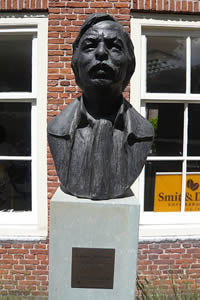
Louis Ferron (4 februari 1942 – 26 augustus 2005)

Borstbeeld door Bart Holt in Haarlem 


De Amerikaanse schrijver Robert Coover werd geboren op 4 februari 1932 in Charles City, Iowa. Zie ook alle tags voor Robert Coover op dit blog.


Uit:  Noir


“At the door, Michiko, one of the local whores, comes over to flirt with you. Hey, Phil-san, she whispers, wrapping her parchmenty arms around your neck. She uses a body powder that makes you think of an airless hothouse. She looks like she is dressed from head to toe in a densely patterned body stocking, but she is actually wearing only her skin and a thong—if that’s not a tattoo, too. She leans close to your ear as though to nibble it and whispers: Go out back door, Phil-san. Somebody waiting for you in front. C’mon, baby, she says more loudly, reaching into your pants. Quickie-quickie? Michiko love you!

Michiko was not always a suffocatingly perfumed bag of old painted bones. She had a certain enigmatic Eastern aura when she was younger and worked the snazzier joints. Before that, while she was still just a kid in schoolgirl clothes and white cotton panties (white panties used to be a big deal; you miss those times), she had been the moll of a notorious yakuza gangster who had his own portrait tattooed on the inside of her tender young thighs. Where he could keep an eye on things, he said. A rival gang leader kidnapped her and “blinded” the portrait with red splotches, and just for good measure added a mustache and blacked out two of the teeth before returning her to her lover. He also had his own hand, recognizable by its don’t-fuck-with-me dragon tattoo on the back and the superhero code ring on his pinkie, tattooed over her plucked pubes, the middle finger disappearing between her lips. Her lover responded by sending her back to the rival with the dragon tattoo reduced to a simpering please-fuck-me position, the ring finger chopped to a bloody stub, signifying a humiliating three-knuckled yubizume, and the middle finger blackened as though torched by its impertinence. The lover also tattooed Michiko’s ears with haikus celebrating the “black mist” of summer and winter’s “ice-heart,” which was a play on his own name, and inked the circles of a target on her buttocks around the bull’s-eye anus with the phrase “You’re next, asshole!” on the right cheek.”


 1330031-4dee340c5a318b7d36c72abc6cb9212d.jpg

Robert Coover (Charles City,  4 februari 1932)


De Oostenrijkse toneelschrijver Werner Schwab werd geboren in Graz op 4 februari 1958. Zie ook alle tags voor Werner Schwab op dit blog.


Uit: Volksvernichtung oder meine Leber ist sinnlos - Eine Radikalkomödie


“Herrmann:  Eine schändliche Sau bist du, die mich vor der ganzen Welt davondenken will. Aber einmal wird ein Tag auftauchen, der sich gezwungen sehen wird, in eine Kenntnis hereinzunehmen, dass der Maler Herrmann Wurm in Graz sein Licht erblickt hat und dass er das gleich auf der ganzen Weltoberfläche abgebildet hat. Graz...wird man sagen...und wurm...wird man sagen...und Erfinder der persönlichen Lichtstrahlen...wird man sagen...und Kleinstadt: Grosskunst...wird man sagen...und ganz einfach Grazkunst...wird man vor sich voraussagen. Weil eiene richtige Grazkunst, die ist keine Mausescheisse, die von einem Hund gefressen wird, der dann von einem Lastkraftwagen zusammengeführt werden muss. Und die Grazkunst, die ist aber auch schon überhaupt keine angefressene Leber, die aus einer alkoholisierten Leiche herausgefallen ist...beim Leichenwashen. Und schon gar nicht ist die Grazkunst für nichts zu gebrauchen...
Niemand kann mir Graz aus dem Leben herausnehmen.

Frau Wurm: Aber was ist das dann denn für eine Sorte von einer Kunst, die Grazkunst?

Herrmann: Also die Grazkunst...diese Kunstsorte, das ist, wenn die künstlerischen Menschen ihre Gefühle in der gefühlvollen Stadt...zusammenreissen...also wenn eine Kunstsorte sich einen einmaligen Anfang herausnimmt aus den gefühlvollen Grazmenschen. Das ist so, wie wenn der Herr Hausherr sagt, dass er ein Farbbild hereinbrauchen will für das Kinderzimmer von den Kindern von Graz.”


 1330031-2a88941e929c2f5308f63e464875114f.jpg

Werner Schwab (4 februari 1958 - 1 januari 1994)


De Canadese dichter E. J. Pratt werd op 4 februari 1882 geboren in Western Bay, Newfoundland. Zie ook alle tags voor E. J. Pratt op dit blog.


Silences


There is no silence upon the earth or under the earth like the silence
    under the sea;
No cries announcing birth,
No sounds declaring death.
There is silence when the milt is laid on the spawn in the weeds and
    fungus of the rock—clefts;
And silence in the growth and struggle for life.
The bonitoes pounce upon the mackerel,
And are themselves caught by the barracudas,
The sharks kill the barracudas
And the great molluscs rend the sharks,
And all noiselessly —
Though swift be the action and final the conflict,
The drama is silent.

There is no fury upon the earth like the fury under the sea.
For growl and cough and snarl are the tokens of spendthrifts who
    know not the ultimate economy of rage.
Moreover, the pace of the blood is too fast.
But under the waves the blood is sluggard and has the same
    temperature as that of the sea.

There is something pre—reptilian about a silent kill.

Two men may end their hostilities just with their battle—cries,
'The devil take you,' says one.
'I'll see you in hell first,' says the other.
 And these introductory salutes followed by a hail of gutturals
    and sibilants are often the beginning of friendship, for who would
    not prefer to be lustily damned than to be half—heartedly blessed?
No one need fear oaths that are properly enunciated, for they
    belong to the inheritance of just men made perfect, and, for all we
    know, of such may be the Kingdom of Heaven.
But let silent hate be put away for it feeds upon the heart of the hater.

Today I watched two pairs of eyes. One pair was black and the
    other grey. And while the owners thereof, for the space of five
    seconds, walked past each other, the grey snapped at the black and
    the black fiddled the grey.
One looked to say — 'The cat,'
And the other— 'The cur.'
But no words were spoken;
Not so much as a hiss or a murmur came through the perfect enamel
    of the teeth; not so much as a gesture of enmity.
If the right upper lip curled over the canine, it went unnoticed.
The lashes veiled the eyes not for an instant in the passing.
And as between the two in respect to candour of intention or
    eternity of wish, there was no choice, for the stare was mutual and
    absolute.
A word would have dulled the exquisite edge of the feeling.
An oath would have flawed the crystallization of the hate.
For only such culture could grow in a climate of silence —
Away back before emergence of fur or feather, back to the unvocal
    sea and down deep where the darkness spills its wash on the
    threshold of light, where the lids never close upon the eyes, where
    the inhabitants slay in silence and are as silently slain.


 1330031-c586c0043697b4702e073deb85fe8503.jpg

E. J. Pratt (4 februari 1882 – 26 april 1964)


De Duitse schrijver en journalist Norman Ohler werd geboren op 4 februari 1970 in Zweibrücken. Zie ook alle tags voor Norman Ohler op dit blog.


Uit:  Ein großes Stück Wasser (Logbuch)


“Weichsel, km 730. Thorun. Die windschiefen Gassen der Geburtsstadt von Kopernikus öffnen sich zum Fluss und lassen Blicke bis zum mittelalterlichen Domplatz hindurch. Doch hier noch nicht anlegen, sondern das Tageslicht voll nutzen. Festmachen zum Sonnenuntergang am Weichselufer km 699. Fische braten am offenen Feuer. Sternenhimmel. Das Murmeln, Plätschern, Glucksen des Flusses. Niemand hat je hier angelegt. Niemand wird es je wieder tun. So fühlt es sich an.

Weichsel, km 520. Die Skyline von Warschau unwirklich schimmernd am Horizont, der Himmel tomatenrot. Von Minute zu Minute wird die Erscheinung realer, Brücken führen über den Fluss, Straßenbahnen fahren darüber. Jugendliche spielen am Ufer Golf: schlagen die Bälle in den Fluss, stellen dies während der Vorbeifahrt der Aton ein. Drei Tage Landgang. Bis hierhin sei die Weichsel noch einigermaßen befahrbar, erzählt ein Fischer im versteckten Hafen nahe der Altstadt. Über den Abschnitt bis nach Krakau könne er nichts sagen. Es gebe zu wenig Informationen. Er denke, dass der niedrige Wasserstand es unmöglich mache, so weit zu kommen.

Weichsel, km 416. Anders als der Rhein wurde die Weichsel nie begradigt und mäandert durch eine Landschaft, die wirkt wie Europa vor Hunderten von Jahren. Mit Höchstgeschwindigkeit von 40 km/h die Kurven ausfahren, durch, wie es scheint, unberührtes Gebiet. Kein Tempolimit. Keine Kontrollen. Keine Regeln. Und dann mit Vollgas, weil ein Uferzeichen verpasst, in eine Sandbank hinein: ein beinahe erhebendes Gefühl. Das ganze Boot wird sanft vom Sande aufgenommen, gleitet wie auf einer großen Hand. Dann ruckt es böse, Tassen und Teller fliegen vom Tisch, der Honda ist aus.”


 1330031-10b35fbb097660f8d1d6602b23d8aea0.jpg

Norman Ohler (Zweibrücken,  4 februari 1970)]


De Duitse schrijver Alfred Andersch werd geboren op 4 februari 1914 in München. Zie ook alle tags voor Alfred Andersch op dit blog.


Uit: Sansibar oder der letzte Grund


“Genauso sind wir in der Lenin-Akademie gesessen, und genauso haben wir gelesen, gelesen, gelesen. Vielleicht haben wir die Arme dabei aufgestützt, vielleicht haben wir Papirossi dabei geraucht - obwohl das nicht erwünscht war -, vielleicht haben wir manchmal aufgeblickt, - aber wir haben den Glockenturm Iwan Weliki* vor dem Fenster nicht gesehen, ich schwöre es, dachte Gregor, so versunken waren wir. So versunken wie er. Er ist wir.

Wie alt ist er? So alt, wie wir waren, als wir genauso lasen. Achtzehn, höchstens achtzehn. Gregor bückte sich tiefer, um dem jungen Mann gänzlich ins Gesicht sehen zu können. Er trägt unser Gesicht, dachte er, das Gesicht unserer Jugend, das Gesicht der Jugend, die ausgewählt ist, die Texte zu lesen, auf die es ankommt. Aber dann bemerkte er auf einmal, daß der junge Mann ganz anders war. Er war gar nicht versunken. Er war nicht einmal an die Lektüre hingegeben. Was tat er eigentlich? Er las ganz einfach. Er las aufmerksam. Er las genau. Er las sogar in höchster Konzentration. Aber er las kritisch. Er sah aus, als wisse er in jedem Moment, was er da lese. Seine Arme hingen herab, aber sie schienen bereit, jeden Augenblick einen Finger auf den Text zu führen, der zeigen würde: das ist nicht wahr. Das glaube ich nicht. Er ist anders, dachte Gregor, er ist ganz anders. Er ist leichter, als wir waren, vogelgleicher. Er sieht aus wie einer, der jederzeit das Buch zuklappen kann und aufstehen, um etwas ganz anderes zu tun.”


 1330031-a0665b84cec0ffc8a8c1f16b6f4c168f.jpg

Alfred Andersch (4 februari 1914 – 21 februari 1980)


Zie voor nog meer schrijvers van de 4e februari ook mijn blog van 4 februari 2011 deel 2.

Geschreven door Romenu om 19:36 Reageer op dit bericht

Meer van Romenu

↑ Terug naar de berichten