Naar de inhoud

Romenu

Over literatuur, gedichten, kunst en cultuur
akke.beakke.be

Berichten van 5 juni 2013 tot 6 juni 2013

Thomas Mann, Aleksandr Poesjkin, Sarah Dessen, Jean Cayrol
De Duitse schrijver Thomas Mann werd geboren in Lübeck op 6 juni 1875. Zie ook mijn blog van 6 juni 2010 en eveneens alle tags voor Thomas Mann op dit blog.


Uit: Buddenbrooks


“Zwei und ein halbes Jahr später, um die Mitte des April schon, war zeitiger als jemals der Frühling gekommen, und zu gleicher Zeit war ein Ereignis eingetreten, das den alten Johann Budden­brook vor Vergnügen trällern machte und seinen Sohn aufs freu­digste bewegte.
Um 9 Uhr, eines Sonntag morgens, saß der Konsul im Früh­stückszimmer vor dem großen, braunen Sekretär, der am Fenster stand und dessen gewölbter Deckel vermittelst eines witzigen Mechanismus zurückgeschoben war. Eine dicke Le­dermappe, gefüllt mit Papieren, lag vor ihm; aber er hatte ein Heft mit gepreßtem Umschlage und Goldschnitt herausgenom­men, und schrieb, eifrig darüber gebeugt, in seiner dünnen, winzig dahineilenden Schrift, - emsig und ohne Aufenthalt, es sei denn, daß er die Gänsefeder in das schwere Metall-Tintenfaß tauchte...
Die beiden Fenster standen offen, und vom Garten her, wo eine milde Sonne die ersten Knospen beschien, und wo ein paar kleine Vogelstimmen einander kecke Antworten gaben, weh­te voll frischer und zarter Würze die Frühlingsluft herein und trieb dann und wann sacht und geräuschlos die Gardinen ein wenig empor. Drüben, auf dem Frühstückstische, ruhte die Sonne blendend auf dem weißen, hie und da von Brosamen ge­sprenkelten Leinen und spielte in kleinen, blitzenden Drehun­gen und Sprüngen auf der Vergoldung der mörserförmigen Tassen ...
Beide Flügel der Tür zum Schlafzimmer waren geöffnet, und von dorther vernahm man die Stimme Johann Buddenbrooks, der ganz leise nach einer alten drolligen Melodie vor sich hin summte:

»Ein guter Mann, ein braver Mann,
Ein Mann von Complaisancen;
Er kocht die Stipp' und wiegt das Kind
Und riecht nach Pomeranzen. «


1405760-ae072ca325f561edb83434ed36a4f089.jpg 

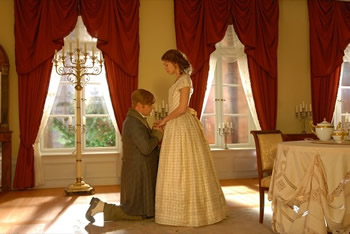
Bendix Grünlich (Justus von Dohnányi) vraagt Tony Buddenbrook (Jessica Schwarz) ten huwelijk.
Scene uit de verfilming van „Buddenbrooks“ uit 2008.


Er saß zur Seite der kleinen Wiege mit grünseidenen Vorhängen, die bei dem hohen Himmelbett der Konsulin stand und die er mit einer Hand in gleichmäßiger Schwingung erhielt. Die Kon­sulin und ihr Gatte hatten sich, der leichteren Bedienung halber, für einige Zeit hier unten eingerichtet, während ihr Vater und Madame Antoinette, die, eine Schürze über dem gestreiften Kleide und eine Spitzenhaube auf den dicken weißen Locken, sich dort hinten am Tische mit Flanell und Linnen zu schaffen machte, das dritte Zimmer des Zwischengeschosses zum Schla­fen benutzten.
Konsul Buddenbrook warf kaum einen Blick in das Neben­zimmer, so sehr war er von seiner Arbeit in Anspruch genom­men. Sein Gesicht trug einen ernsten und vor Andacht beinahe leidenden Ausdruck. Sein Mund war leicht geöffnet, er ließ das Kinn ein wenig hängen, und seine Augen verschleierten sich dann und wann. Er schrieb:
»Heute, d. 14. April 1838, morgens um 6 Uhr, ward meine liebe Frau Elisabeth, geb. Kröger, mit Gottes gnädiger Hilfe aufs glücklichste von einem Töchterchen entbunden, welches in der hl. Taufe den Namen Clara empfangen soll. Ja, so gnädig half ihr der Herr, obgleich nach Aussage des Doktors Grabow die Ge­burt um etwas zu früh eintrat und sich vordem nicht alles zum Besten verhielt und Bethsy große Schmerzen gelitten hat. Ach, wo ist doch ein solcher Gott, wie du bist, du Herr Zebaoth, der du hilfst in allen Nöten und Gefahren und uns lehrst deinen Wil­len recht zu erkennen, damit wir dich fürchten und in deinem Willen und Geboten treu mögen erfunden werden! Ach Herr, leite und führe uns alle, solange wir leben auf Erden ...
« -
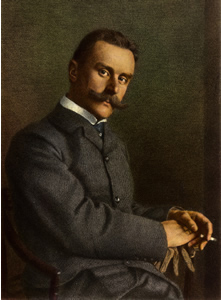


 1405760-64ff53fb8e3660f64c72c96184474ec2.jpg

Thomas Mann (6 juni 1875 - 12 augustus 1955)

Ets door Johannes Lindner, 1905


De Russische dichter en schrijver
Aleksandr Poesjkin werd geboren in Moskou op 6 juni 1799. Zie ook alle tags voor Aleksandr Poesjkin op dit blog.


Uit: Evgeny Onegin


Book 2


I

The estate in which our bored Yevgeny

Now lived, was in fact a fine retreat:

There a lover of the simpler pleasures

Would thank the heavens for his fate.

His mansion house was solitary,

Sheltered by hills in windy weather,

And  stood by a river. Stretching away

Far off the meadows were bright and gay

With flowers, and the cornfields golden.

And here was a hamlet, there another,

And cattle wandered the meadows at random,

While shade was cast both deep and wide

By a huge garden all overgrown,

For the pensive Dryads a secret home.


II

The stately mansion was built and planned

As all good mansions should really be:

Sturdily set in the peaceful land

In the refined taste of an age gone by.

All of the rooms were wide and lofty,

Silk wall paper embellished the drawing room,

And portraits of tsars hung on the walls,

The stoves were bright with ceramic tiles.

All this is nowadays somewhat passé,

Indeed, for what reason, I cannot say,

But of course for my friend, our story's hero

There was no need for these things at all,

Because he would yawn with equal distraction

At an ancient pile or a modern mansion.


III

He settled in the sitting room

Where the old-timer in his country ways

For forty years had gazed from the window

Or balled at the housekeeper, or swatted flies.

A simple room, with oaken floors,

Two cupboards, a table and a stuffed settee,

And not a single spot of ink.

Onegin opened the cupboard doors;

He found in one a book of expenses,

In another a shelf of home brewed brandy,

And apple water in an earthenware jar,

And from eighteen o eight a calendar.

The old man having such a busy life

Found that looking in books brought too much strife.


1405760-a5af269fef0b5a38eec9e1e4eb7d5624.jpg 

Aleksandr Poesjkin (6 juni 1799- 10 februari 1837)

Cover


De Amerikaanse schrijfster Sarah Dessen werd geboren op 6 juni 1970 in Evanston, Illinois. Zie ook alle tags voor Sarah Dessen nop dit blog.


Uit: The Moon and More


“Here they come.
"—or I promise you, we'll turn right around and go back to Paterson!" the woman behind the wheel of the burgundy minivan was shouting as it pulled up beside me. She had her head turned towards the backseat, where I could see three kids, two boys and a girl, staring back at her. A vein in her neck was bulging, looking not unlike the interstate, thick and unmissable, on the map held by the man in the passenger seat beside her. "I am serious. I have had it."
The kids didn't say anything. After a moment of glaring at them, she turned to look at me. She had on big sunglasses with bedazzled frames. A large fountain drink, the straw tinged with lipstick, was parked between her legs.
"Welcome to the beach," I said to her, in my best Colby Realty employee voice. "May I—"
"The directions on your Web site are garbage," she informed me. Behind her, I saw one of the kids frog-punch another, who emitted a stifled shriek. "We've gotten lost three times since getting off the interstate."
"I'm so sorry to hear that," I replied. "If you'd like to give me your name, I'll grab you your keys and get you on the way to your rental."
"Webster," she told me.
I turned, reaching into the small rattan bin that held all the envelopes for that day's check-ins. Miller, Tubman, Simone, Wallace . . . Webster.
"Heron's Call," I read off the envelope, before opening it to make sure the keys were both in it. "That's a great property."

In reply, she stuck out her hand. I gave the envelope to her, along with her complimentary beach bag full of all the free stuff—Colby Realty pen, giveaway postcard, area guide, and cheap drink cooler—that I knew the cleaning crew would most likely find untouched when they checked out. "Have a great week," I told her. "Enjoy the beach!"


1405760-dac65305ac908633bdbe664648273e46.jpg 

Sarah Dessen (Evanston, 6 juni 1970)


De Franse dichter en schrijver Jean Cayrol werd geboren op 6 juni 1911 in Bordeaux. Zie ook alle tags voor Jean Cayrol op dit blog.


Chant Funèbre à la mémoire du Père Jacques (Fragment)


Le vent souvent te délivrait, un vent énorme

dévorant paroles et haleines

ce vent où tu entendais que Christ était vivant ;

mais au milieu de ce secret bourdonnant

comme une veine trop tendre qui se déchire

le filet d’une brise lointaine arrivait jusqu’à toi :


le souffle du levant sur le bras de la Seine

le vent de Port Royal, de la guirlande de Julie,

la voix sourde de Phèdre sous un soleil sans vie

le vent sifflant des hauts pendus qui se démènent

le soupir étouffé d’un enfant sous la lampe,

le frôlement soyeux d’un vers de Lamartine

ou le cri étoilé d’une sainte au bûcher,

un battement de pétales dans un ciel qui te devines

l’orage de Rimbaud sur de pâles armées,

le murmure d’un peuple où Claudel a vécu

quand il a traversé les eaux noires du péché

et l’air pur de Pascal où ton cœur est à nu.


mais le souffle mordant de la mort était en toi,

tu respirais déjà le vent des ombres, ce n’était plus

la risée heureuse du printemps sur tes doigts

mais l’air froid des tombeaux ouverts dans les plaines de l’exil

mais la brise des morts, des branches mortes, des eaux mortes,

tu avais trop respiré dans les sèches vallées de la mort

tu étais trop penché sur le dernier aveu qui s’endort

tu avais permis à tous les morts de vivre en toi,

de respirer en toi la dernière gorgée d’air pur,

O ce vent aigu comme une lame qui entrait dans ta chair

flèche vibrante de l’amour du prochain sur ton sein.


 1405760-c406bd42b7acda413ab39bd574f53253.jpg

Jean Cayrol (6 juni 1911 – 10 februari 2005)


Zie voor nog meer schrijvers van de 6e juni ook
mijn blog van 6 juni 2011 deel 1 en eveneens deel 2.
Geschreven door Romenu om 22:39 Reageer op dit bericht

Federico García Lorca, Adriaan Morriën, Ken Follett, Margo Lanagan, Carel Peeters

De Spaanse dichter en toneelschrijver Federico Garcia Lorca werd geboren op 5 juni 1898 in Fuente Vaqueros, Granada. Zie ook alle tags voor Federico Garcia Lorca op dit blog.


Struikje Struikje


Struikje struikje
dor en groen.

Het meisje met het knappe snoetje
plukt olijven op het veld.
De wind die van de torens houdt,
slaat zijn armen om haar heupen.
Vier ruiters komen voorbij
op Andalusische paardjes,
in het blauw en het groen
met langere donkere mantels.
"Kom mee naar Córdoba, lief kind."
Het meisje luistert niet.
Drie jonge torero's komen voorbij
in oranje pakken
en slank van lijf,
met degens van belegen zilver.
"Kom mee naar Sevilla, lief kind."
Het meisje luistert niet.
Als de avondhemel paars kleurt,
komt in het wazige schemerdonker
een jongeman voorbij
met rozen en mirten van maanlicht.
"Kom mee naar Granada, lief kind."
En het meisje luistert niet.
Het meisje met het knappe snoetje
blijft maar olijven plukken,
met de grijze armen van de wind
om haar heupen.

Struikje struikje
dor en groen.


Vertaald door Bart Vonck


The Poet asks his Love to write


Visceral love, living death,

in vain, I wait your written word,

and consider, with the flower that withers,

I wish to lose you, if I have to live without self.


The air is undying: the inert rock

neither knows shadow, nor evades it.

And the heart, inside, has no use

for the honeyed frost the moon pours.


But I endured you: ripped open my veins,

a tiger, a dove, over your waist,

in a duel of teeth and lilies.


So fill my madness with speech,

or let me live in my calm

night of the soul, darkened for ever.


The Dawn


New York’s dawn holds

four mud pillars,

and a hurricane of black doves,

paddling in foul water.


New York’s dawn

moans on vast stairways,

searching on the ledges,

for anguished tuberoses.


Dawn breaks and no one’s mouth breathes it,

since hope and tomorrow, here, have no meaning.

Sometimes coins, furiously swarming,

stab and devour the abandoned children.


The first to go outside know in their bones

Paradise will not be there, nor wild loves.

They know they go to the swamp of law, and numbers,

to play without art, and labour without fruit.


The light is buried by chains and by noise,

in the shameless challenge, of rootless science.

All across the suburbs, sleepless crowds stumble,

as if saved, by the moment, from a shipwreck of blood.


Vertaald door A. S. Kline


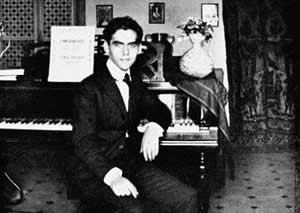
 1405186-6a7cf994821b81cf98b57d3b4a4c6708.jpg

Federico García Lorca (5 juni 1898 – 19 augustus 1936)


De Nederlandse dichter en schrijver Adriaan Morriën werd geboren op 5 juni 1912 in Amsterdam. Zie ook alle tags voor Adriaan Morriën op dit blog.


Een duizendkunstenaar


Hij kan een veer wegblazen,
een vingerhoed optillen,
een bladzij in een boek omslaan
met de namen van alle duivelen.

Hij kan een hand vol zand
leeg laten lopen op het strand
uitkijkend op de golven
die elkaar steeds weer bedelven.

Hij kan een meisje aanzien
met zoveel liefde in zijn blik
dat zij zich tot hem richt
en vuur vraagt voor haar sigaret.


Ik heb mijn vader vergeven


Ik heb mijn vader vergeven
dat hij mij geboren liet worden,
sinds ik mijzelf niet vergeven kan
dat ik mijn dochters liet ontstaan.

Ik ben schuldig aan hun leven.
Alleen zij kunnen, later
als zij hun schuld ontdekken,
mij vergeven.


1405186-eea06d736a9f0fe662291b87db328b24.jpg 

Adriaan Morriën (5 juni 1912 – 7 juni 2002)


De Engelse schrijver Ken Follett werd geboren op 5 juni 1949 in Cardiff, Wales. Zie ook alle tags voor Ken Follett op dit blog.


Uit: The Pillars of the Earth


“When the house was finished it would be the most luxurious home for miles around. The ground floor would be a spacious undercroft, for storage, with a curved vault for a ceiling, so that it would not catch fire. The hall, where people actually lived, would be above, reached by an outside staircase, its height making it hard to attack and easy to defend. Against the hall wall there would be a chimney, to take away the smoke of the fire. This was a radical innovation: Tom had only ever seen one house with a chimney, but it had struck him as such a good idea that he was determined to copy it. At one end of the house, over the hall, there would be a small bedroom, for that was what earls’ daughters demanded nowadays – they were too fine to sleep in the hall with the men and the serving-wenches and the hunting-dogs. The kitchen would be a separate building, for every kitchen caught fire sooner or later, and there was nothing for it but to build them far away from everything else and put up with lukewarm food.

Tom was making the doorway of the house. The doorposts would be rounded to look like columns – a touch of distinction for the noble newly-weds who were to live here. With his eye on the shaped wooden template he was using as a guide, Tom set his iron chisel obliquely against the stone and tapped it gently with the big wooden hammer. A small shower of fragments fell away from the surface, leaving the shape a little rounder. He did it again. Smooth enough for a cathedral.

He had worked on a cathedral once – Exeter. At first he had treated it like any other job. He had been angry and resentful when the master-builder had warned him that his work was not quite up to standard: he knew himself to be rather more careful than the average mason. But then he realised that the walls of a cathedral had to be not just good, but perfect. This was because the cathedral was for God, and also because the building was so big that the slightest lean in the walls, the merest variation from the absolutely true and level, could weaken the structure fatally.”


 1405186-38e36194428e08da03b399cbe03c9b27.jpg

Ken Follett (Cardiff, 5 juni 1949)


De Australische schrijfster Margo Lanagan werd geboren op 5 juni 1960 in Waratah, New South Wales. Zie ook alle tags voor Margo Lanagan op dit blog.


Uit: Red Spikes


“Check for sleeping snakes,” Mum said when they reached the creek side, where the ground was flatter. “Bang about a bit.” So everyone stamped around in their pajamas. It would have been funny if Dylan hadn’t been so frightened. Weren’t they worried about that bear? Weren’t they upset about what had happened? It was eerie that they were positioning air mattresses and spreading blankets and plumping pillows. Titch and Edwin were already asleep–look at them. They hadn’t even cried. It was all a dream to them. Dylan pinched the inside of his elbow hard; he rubbed his arm roughly against a tree trunk; he breathed in and stared at the frills of white water along the creek, at the shadow people and the shadow trees, at the millions of stars above among the needly casuarina twigs. He smelled the smoke from the hut chimney. That funny man must be building up the fire. You needed boiling water when a baby was coming. What for? Dylan couldn’t remember.
“Come on, Dylan. Come and settle down between Dad and me. We’ll protect you against jibber-jabbers.” Her smile was the only part of her face that was moonlit. “Jibber-jabbers,” said Dad dozily. “That’s going back a long way. What were those things, anyway, Dyl? You never told us properly; you were too scared even to talk about that nightmare.” Dylan crawled up the valley between them, laid his head in the pillow cleft, and shuddered. “They were these horrible creatures, hundreds of them, about up to my shoulders. They had big heads, big jaws, lots of teeth. Jibbrah-jibbrah, they said, jibbrah-jibbrah-jibbrah-jibbrah. They rushed at me out of the wardrobe and snapped their teeth.”
Dad snored gently.

“I still don’t like to think about them,” Dylan said to Mum.
“Don’t, then,” said Mum comfortably. “I don’t know where they came from in the first place–some movie? None of the others had such night terrors.” She closed her eyes with decision. She always knew what to do. Dylan tried to be as firm about closing his”.


 1405186-c582962e274693927aaae90a5265bf62.jpg

Margo Lanagan (Waratah, 5 juni 1960)


De Nederlandse literair criticus Carel Peeters werd geboren in Nijmegen op 5 juni 1944. Zie ook alle tags voor Carel Peeters op dit blog.


Uit: Het licht tussen de woorden


“Met Kees Fens heb ik altijd zo mijn problemen gehad als ik zijn kritieken, eerst in het dagblad De Tijd en later in de Volkskrant, las. In het kielzog van het tijdschrift Merlyn vertolkte hij een standpunt dat lijnrecht inging tegen mijn eigen gedachten over de betekenis en de werking van literatuur. De consequentie van het leerstuk van ‘de autonomie van het literaire kunstwerk’ waar Fens zich een aanhanger van toonde, was dat de literatuur zichzelf genoeg was. Wie een boek gelezen had, had een aantal uren op een fictioneel eiland doorgebracht. Dat een boek tijdens en na het lezen een bepaalde invloed op de lezer uitoefende en dat het iets zou kunnen betekenen binnen de cultuur, viel buiten het leerstuk en daar werd dus niet over gepraat. Dat zou al gauw leiden tot filosofie, psychologie, cultuurgeschiedenis en wereldbeschouwing en dat waren nu juist gebieden die Merlyn buiten de literatuur wilde houden. Dat er sprake zou kunnen zijn van wisselwerking tussen literatuur en werkelijkheid werd door Kees Fens en J.J. Oversteegen genegeerd, onder meer op grond van de theorie dat het literaire kunstwerk ‘fictie’ was. Ook het leven van een schrijver mocht op geen enkele manier in de overwegingen van een kritiek betrokken worden en de criticus zelf moest een ‘teruggetrokken’ positie innemen, zich zakelijk bij de tekst houden zodat zijn persoon niet in een kritiek te herkennen zou zijn. Deze instelling vond globaal zijn uitdrukking in de bundels waarin Fens zijn eerste essays en kritieken verzamelde, De eigenzinnigheid van de literatuur en De gevestigde chaos.

Een uitvloeisel van de leer was dat Kees Fens zijn persoonlijke binding met het katholicisme scheidde van zijn werk als literair criticus, wat bij voorbeeld bleek uit zijn verdediging van Jan Wolkers tegen clericale aanvallen.”


 1405186-376e8bfb94443ec4c0a6ce4b7ce53c08.jpg

Carel Peeters (Nijmegen, 5 juni 1944)


Zie voor nog meer schrijvers van de 5e juni ook mijn blog van 5 juni 2012 deel 2.

Geschreven door Romenu om 21:18 Reageer op dit bericht

Meer van Romenu

↑ Terug naar de berichten