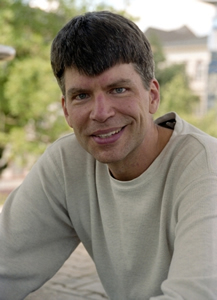
Salman Rushdie, Sybren Polet, Josef Nesvadba, Osamu Dazai, José Rizal, Friedrich Huch, Gustav Schwab
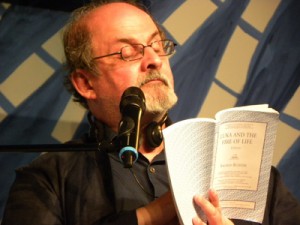
De Indisch-Britse schrijver en essayist Salman Rushdie werd geboren in Bombay op 19 juni 1947. Zie ook alle tags voor Salman Rushdie op dit blog.
Uit: The Satanic Verses
“When Baal proceeded to lay out the plan for the madam, she responded: "It is very dangerous, but it could be damn good for business." While I do not wholly subscribe to the theory that authors tend to write self-fulfilling novels, it seems quite clear to me that "they" did hear and that they are indeed mad enough to "boil his balls in butter." The Ayyatollah Khomeni, who issued the fatwa for Rushdie's death, in fact stated that what Rushdie wrote about the Prophet literally made his blood boil (quoted in Appignanesi and Maitland 1990:73). The whole thing has been very dangerous, and there is little doubt but that the controversy has been "damn good for business."
The question that remains for me is why Rushdie -- being brought up as a Muslim, even a backsliding one -- did not realize what the reaction of his fellow Muslims would be (Baal was certainly not naive about how Mahound would respond to knowing whores were pretending to be his wives), or why Rushdie realized it but went ahead and did it anyway. To a certain extent Rushdie's public presentation of his private doubt came at the wrong time -- it was a convenient lightning rod at a time when anger against the West -- understandable anger at that -- needed to go somewhere.
But the key I think is found in the same passage (p. 380), where Rushdie comments: "Where there is no belief, there is no blasphemy." In an interview ironically broadcast the same day in 1989 as Khomeini's death warrant, Rushdie added: "Doubt, it seems to me, is the central condition of a human being in the 20th century" (quoted in Appignanesi and Maitland 1990:24). Here I think is the crux of the problem. We can readily identify with Rushdie on doubt as the norm in the secular as well as much of the sacred thinking of our West. We can read The Satanic Verses as an exercise in dealing with that doubt, one that Rushdie as an immigrant author in our backyard vigorously defends as viable even though it may be seen as blatant unbelief by his critics. But the problem is that Rushdie, at least up until a recent interview with
David Frost, has never claimed not to have belief. He has simply admitted to doubt.”
Salman Rushdie (Bombay, 19 juni 1947)
De Nederlandse dichter en schrijver Sybren Polet (pseudoniem van Sybe Minnema) werd geboren in Kampen op 19 juni 1924. Zie ook alle tags voor Sybren Polet op dit blog.
Trampolinepoëzie
Mensbeeld als wensbeeld van generatieve
foetussen.
Beweeglijke gevoelshorizonten en hun zelfadaptaties.
In ons lichaam om de 120 dagen geheel nieuw bloed
waarin nog visvormen zwemmen.
Nog maar 70.000 jaar geleden waren we bijna uitgestorven.
De ramp als natuurlijk experiment.
Net als bij gifslangen niet sterven aan je eigen vergif.
Vreedzaam samenleven met je 100 biljoen bacteriën.
Resistent zijn tegen de realiteit,
realiteit
als een onlokaliseerbare bom, die
nooit ontploffend
altijd en overal zijn werking uitoefent.
Diapsalmata
Je loopt met de dood als een hond achter je
aan.
De hond draagt een bril met drie glazen.
Je kijkt strak voor je uit. Draait je om en blikt
in het derde oog als in een duistere rede.
Je zweet geschiedenis uit. Zweert van leven.
Losse tranen lopen als kleine homunculi* voor je uit.
Met vochtige contactlenzen beschouw je het leven.
Je kunt niet zonder je leven. Dus leef je.
In lichaamsvormige luchtgraven houd je je schuil
tot de volgende holle minuut. Je zweet geschiedenis uit.
Je blikt met een voorhoofdsoog in een duistere rede.
En weer zie je álles
niet, of alleen dat
wat vaag aan de gekartelde einder opdoemt.
Je loopt met de dood als een dode hond achter je aan
en je blaft en je blaft tot je in de lucht op bent gegaan.
Sybren Polet (Kampen, 19 juni 1924)
De Tsjechische schrijver Josef Nesvadba werd geboren op 19 juni 1926 in Praag. Zie ook alle tags voor Josef Nesvadba op dit blog.
Uit: The Half-wit of Xeenemuende
“The old teacher was glad to accept Mrs. Habicht's offer. He earned a bit by coaching, because his pension was too small to allow him to buy anything on the black market, even potatoes. They didn't tell him the boy was a half-wit, though. He didn't find it out until the first day they spent together. Bruno was fifteen, with the face of a six-year-old and some of the habits of a toddler. During his first lesson he made a dive for a fly and swallowed it without turning a hair; he pushed his fountain pen up his nose and poured the ersatz coffee his mother had made for the teacher over the poor man's trousers. The latter of course got up and wanted to leave the house at once. The desperate mother spent a long time persuading him to stay; she raised his salary and offered to give him a warm supper every evening if only he would take her son on. And as if he wanted to ingratiate himself with the teacher all of a sudden, Bruno stood to attention and recited in a loud voice the multiplication table, division table, and square roots.
"He's got a wonderful head for figures," said Mrs. Habicht. "He can remember anything. He knows the Xeenemuende telephone directory off by heart." And Bruno promptly recited the first sixty names and addresses and telephone numbers. But he had no head for grammar, he was hopeless at history, and he couldn't read the simplest sentence. And he was fifteen, if you please.”
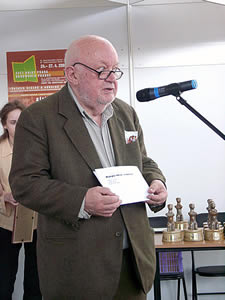
Josef Nesvadba (19 juni 1926 – 26 april 2005)
De Japanse schrijver Osamu Dazai (eig.Shūji Tsushima) werd geboren op 19 juni 1909 in
Tsugaru. Zie ook alle
tags voor Osamu Dazai op dit blog.
Uit: The setting sun (Vertaald door Donald Keene)
“My brother Naoji says that we are no match for Mother, and I have at times felt something akin to despair at the difficulty of imitating her. Once, in the back garden of our house in Nishikata Street — it was a beautiful moonlight evening in the beginning of autumn — Mother and I were sitting in the summer-house by the edge of the pond admiring the moon, when she got up and went into a nearby clump of flowering shrubs. She called to me from among the white blossoms with a little laugh, "Kazuko, guess what Mother is doing now."
"Picking flowers."
She raised her little voice in a laugh. "Wee-wee!"
I felt there was something truly adorable in her which I could not possibly have imitated.
This has been quite a digression from this morning's soup, but I recently learned from a book I was reading how in the days of the French monarchy the court ladies thought nothing of relieving themselves in the palace gardens or in a corner of the corridors. Such innocence really charms me, and I wondered if Mother might not be one of the last of that kind of lady.
At any rate, this morning she let out a little cry — ah — as she sipped the soup, and I asked if it were a hair, only to be informed that it was not.
"Perhaps it was too salty."
The soup this morning was green pea, from an American can I got on the ration and made into a kind of potage. I haven't any confidence in my abilities as a cook, though it is one of the few confidences a girl should have, and couldn't help worrying about the soup, even after Mother said that nothing was wrong.
"You made it very well," Mother said in a serious tone. After she had finished the soup, she ate some rice-balls wrapped in seaweed.”
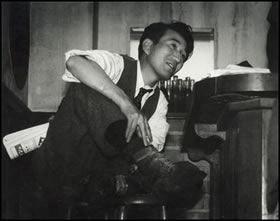
Osamu Dazai (19 juni 1909 – 13 juni 1948)
De Filippijnse schrijver José Rizal (eig. José Protacio Rizal Mercado y Alonso Realonda) werd geboren op 19 juni 1861. Zie ook alle tags voor José Rizal op dit blog.
A Tribute to My Town
When I remember the days
that saw my early childhood
spent on the green shores
of a murmurous lagoon;
when I remember the coolness,
delicious and refreshing,
that on my face I felt
as I heard Favonius croon;
when I behold the white lily
swell to the wind’s impulsion,
and that tempestuous element
meekly asleep on the sand;
when I inhale the dear
intoxicating essence
the flowers exude when dawn
is smiling on the land;
sadly, sadly I recall
your visage, precious childhood,
which an affectionate mother
made beautiful and bright;
I recall a simple town,
my comfort, joy and cradle,
beside a balmy lake,
the seat of my delight.
Ah, yes, my awkward foot
explored your sombre woodlands,
and on the banks of your rivers
in frolic I took part.
I prayed in your rustic temple,
a child, with a child’s devotion;
and your unsullied breeze
exhilarated my heart.
The Creator I saw in the grandeur
of your age-old forests;
upon your bosom, sorrows
were ever unknown to me;
while at your azure skies
I gazed, neither love nor tenderness
failed me, for in nature
lay my felicity.
Tender childhood, beautiful town,
rich fountain of rejoicing
and of harmonious music
that drove away all pain:
return to this heart of mine,
return my gracious hours,
return as the birds return
when flowers spring again!
But O goodbye! May the Spirit
of Good, a loving gift-giver,
keep watch eternally over
your peace, your joy, your sleep!
For you, my fervent pryers;
for you, my constant desire
to learn; and I pray heaven
your innocence to keep!
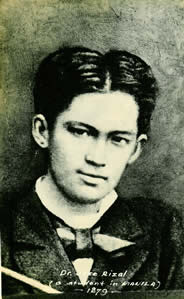
José Rizal (19 juni 1861 - 30 december 1896)
Op 18-jarige leeftijd
De Duitse dichter en schrijver Friedrich Huch werd geboren op 19 juni 1873 in Braunschweig. Zie ook alle tags voor Friedrich Huch op dit blog.
Uit: Enzo
„Ob der Junge ihm wohl selber ähnlich werden würde? Dann konnte er sich nur freuen. – Er verschob etwas den grünen Lichtschirm und trat zum Spiegel. Das war ihm ein gewohnter Gang. Er galt als einer der schönsten Männer in der Stadt und liebte es, sich dieses manchmal vor sich selber zu bestätigen.
Die Stirn war ohne Zweifel fest, stark, schön gebaut, bedeutend; sie paßte gut zu dem eben geformten, großen Mund und zu seiner untersetzten, breiten Gestalt. Auch die Nase gefiel ihm ausnehmend gut: Sie sah geradezu edel aus und bog auch nicht um die kleinste Linie nach links oder nach rechts ab. Dann begegnete er seinen Augen: Groß, schön und sanft . . . Leider etwas zu verschwommen! murmelte er wieder und seufzte leise.
Unwillkürlich sah er zum Flügel hin, auf dem seine letzte Komposition stand. Er war längst in den Reifejahren und sein Name ragte kaum über die Grenzen seines Orts hinaus. Sollte er sich mit den verkannten Genies trösten, oder war es wirklich so, wie er in heimlichen Momenten dachte: daß er zwar ein ganz guter Kapellmeister, aber kein guter Tondichter sei?
Mit halbem Widerwillen trat er zum Flügel, blätterte hie und da in dem beschriebenen Heft, und alle die ihm bis zum Überdruß bekannten, halb wirklich erfundenen, halb ausgedachten Motive starrten ihn so entsetzlich breitspurig und anspruchsvoll an! Er las weiter und immer weiter, stets im Wunsche, abzubrechen, ohne den Zeitpunkt zu finden, denn all dies Zeug hing doch innerlich zusammen, und wenn einmal ein Abschluß kam, so folgte wieder etwas Neues, das dem Vorangegangenen erst die richtige Beleuchtung gab.“
Friedrich Huch (19 juni 1873 – 12 mei 1913)
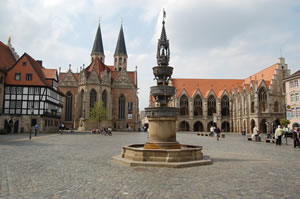
Braunschweig, Altstadtmarkt
De Duitse dichter, schrijver en pastor Gustav Schwab werd geboren op 19 juni 1792 in Stuttgart. Zie ook alle tags voor Gustav Schwab op dit blog.
Das Gewitter
Urahne, Großmutter, Mutter und Kind
In dumpfer Stube beisammen sind;
Es spielet das Kind, die Mutter sich schmückt,
Großmutter spinnet, Urahne gebückt
Sitzt hinter dem Ofen im Pfühl –
Wie wehen die Lüfte so schwül!
Das Kind spricht: »Morgen ist’s Feiertag!
Wie will ich spielen im grünen Hag,
Wie will ich springen durch Tal und Höhn,
Wie will ich pflücken viel Blumen schön;
Dem Anger, dem bin ich hold!« –
Hört ihr’s, wie der Donner grollt?
Die Mutter spricht: »Morgen ist’s Feiertag!
Da halten wir alle fröhlich Gelag‘,
Ich selber, ich rüste mein Feierkleid;
Das Leben, es hat auch Lust nach Leid,
Dann scheint die Sonne wie Gold!« –
Hört ihr’s, wie der Donner grollt?
Großmutter spricht: »Morgen ist’s Feiertag!
Großmutter hat keinen Feiertag.
Sie kochet das Mahl, sie spinnet das Kleid,
Das Leben ist Sorg‘ und viel Arbeit;
Wohl dem, der tat, was er sollt‘!«
Hört ihr’s, wie der Donner grollt?
Urahne spricht: »Morgen ist’s Feiertag!
Am liebsten morgen ich sterben mag:
Ich kann nicht singen und scherzen mehr,
Ich kann nicht sorgen und schaffen schwer,
Was tu‘ ich noch auf der Welt?« –
Seht ihr, wie der Blitz dort fällt?
Sie hören’s nicht, sie sehen’s nicht,
Es flammet die Stube wie lauter Licht:
Urahne, Großmutter, Mutter und Kind
Vom Strahl miteinander getroffen sind,
Vier Leben endet ein Schlag
Und morgen ist’s Feiertag.
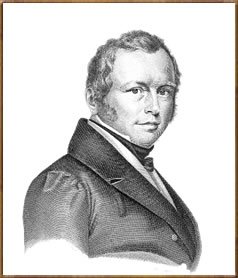
Gustav Schwab (19 juni 1792 – 4 november 1850)