Naar de inhoud

Romenu

Over literatuur, gedichten, kunst en cultuur
akke.beakke.be

Berichten van 5 oktober 2013 tot 6 oktober 2013

Victor Vroomkoning, Ulrike Ulrich, Heinrich Federer, Ludwig Begley, Maria Dąbrowska, Horst Bingel, Peter Gosse

De Nederlandse dichter Victor Vroomkoning (pseudoniem van Walter van de Laar) werd geboren op 6 oktober 1938 in Boxtel. Zie ook mijn blog van 6 oktober 2010 en eveneens alle tags voor Victor Vroomkoning op dit blog.


Zee

Kon je maar beklijven
in de lauwe baai
waaruit je ooit kwam
maar je blijft
de dagelijkse drenkeling
tot aan de laatste schemering.

Kon je je maar in haar
bergen maar je legert je
aan haar rand dolend
in jezelf achteloos
verkerend tussen lotgenoten

die zoals jij de tint
van het land aannamen,
zilten kameleons, vlezen
korrels: loom droog sepia.


Blik


Hoe ziet mijn huis mij arriveren?
Wat hebben de meubels zonder mij
verricht: mijn warmte gekoesterd,
mijn katten vertroeteld?

O, kon ik mijzelf eens vanuit mijn bank
zien naderen, een blik werpen op de man
die vanaf het trottoir naar me zwaait
alsof hij gelukkig huiswaarts keert.


Witheid


In de witte winter in het witte huis
in de witte kamer in het witte bed
op het witte laken fluister ik
in het witte oor dat naast me ligt

de lichte dingen van de liefde.
Wij sluipen de sneeuw in, schuiven
onze lijven warm, schuilen in het
schuim, worden watten poppen.

Terug uit de witte winter in het
witte huis in de witte kamer
in het witte bed op het witte
laken smelten wij mond op

mond samen tot het witte wezen
dat wij zijn als de nacht begint.


1471769-7fa8b355e884d6f286b1b0499d7b8005.jpg
Victor Vroomkoning (Boxtel, 6 oktober 1938)


De Duitse dichteres en schrijfster Ulrike Ulrich werd geboren in op 6 oktober 1968 in Düsseldorf. Zie ook mijn blog van 6 oktober 2010en eveneens alle tags voor Ulrike Ulrich op dit blog.


Durch den Wind


“Durch den Wind sei sie, sagt sie. Durch den Wind sei sie überhaupt nicht mehr hinausgekommen, gar nicht mehr, keinen Schritt vor die Tür. Daheim sei sie und brauche nicht mal hinausschauen, wie der Wind die Wolken vor die Sonne und wieder weg schiebt. Das Licht aus und anknipst. Das sehe sie auch so, ohne hinauszuschauen. Und es sei auch so schlimm genug. Sie fürchtet den Wind. Er weht ihr durch die Gedanken, er wirbelt ihr alle Aufzeichnungen durcheinander und alle Erinnerungen. Wenn sie schon alles gelocht hätte und abgelegt. Abgeordnet. Aber es liegt ja alles lose herum. Wenn so ein Windstoß auf einen Papierstoß trifft, dann ist es zu spät.
Durch den Wind sei sie, sagt sie. Durch den Wind sei sie an die Wohnung gebunden. Und er wehe beständig. Wehe, sagt sie. Und dass sie gegen den Wind sei und der Wind gegen sie. Und immer sei diese Stadt voller Wind, jede einzelne Gasse. Ganz egal um welche Ecke sie biege, immer käme er ihr entgegen. Und sie wisse nicht, warum die Stadt so einen Wind mache. Sie aber wolle das hinter sich lassen. Wind und Wetter.
Und dann geht sie doch hinaus und wendet sich dem Wetter zu und stellt sich dem Wind.
Und da steht sie noch und dreht ihm den Rücken zu. Dem Wind. Soll er doch von hinten kommen, sagt sie. Sie sei gefasst. Sie wird sich jetzt treiben lassen. Sie lässt sich jetzt durch die Gassen schieben, an den Rinnsteinen entlang, über die Kreuzungen. Sie lässt sich unter den Autos hindurchpusten und hält an Laternen fest.
Und dann lässt sie sich wieder los und wird durch den Maschendraht gepresst. Sie wird über Plätze, Brücken und Dächer wirbeln und erst liegen bleiben, wenn er nachlässig wird, der Wind. Wenn er einschläft, dann wird sie sich fortschleichen, ihm davonlaufen, wie der Wind wird sie sich aus dem Staub machen. Sagt sie und steht noch immer da draußen, den Wind im Rücken. Und wenn er dreht, dreht sie sich auch und lächelt. Und dreht sich mit dem Wind.”


 1471769-9556e6ba8adf52a4fa99c543adbc58e1.jpg

Ulrike Ulrich (Düsseldorf, 6 oktober 1968)


De Zwitserse dichter, schrijver en priester
Heinrich Federer werd geboren op 6 oktober 1866 in Brienz. Zie ook mijn blog van 6 oktober 2009 en ook mijn blog van 6 oktober 2010 en eveneens alle tags voor Heinrich Federer op dit blog.


Wie der Abendstern


Ich hatt‘ einen klugen Knaben so gern,

er ist mir so lieb wie der Abendstern

in des Lebens Mühle gewesen.

Ich hielt‘ ihn rein wie das Himmelsbild,

auf seines Herzens sonnigem Schild

mocht ich nur Gutes lesen.


Da flog eine bange Wolke daher,

nicht von ihm, nicht von mir, von ungefähr

und brachte bösen Schaden.

Wir wurden getrennt, ich ward‘ vor Gericht,

als wär es eine heilige Pflicht,

schuldlos mit Schulden beladen.


Nun seufz‘ ich in großer Schmach und Pein,

verstoßen, gefangen, verriegelt, allein,

wo tausend Verbrecher gesessen.

Dem Knaben wurde ein Hündchen geschenkt,

damit er es streichelt und füttert und lenkt,

um den anderen Hund zu vergessen.


 1471769-e3ac503c64874549e056455858ab1584.jpg

Heinrich Federer (6 oktober 1866 – 29 april 1928)

Cover biografie 


De Poolse schrijfster Maria Dąbrowska werd geboren op 6 oktober 1889 in Russów bij Kalisz. Zieook mijn blog van 6 oktober 2009 en eveneens alle tags voor Maria Dąbrowska op dit blog.


Uit: Nights and Days


“These were the parents of Bogumil Niechcic. Bogumil Adrian was their youngest son; he came into the world after many years of marriage. The older children died, one after another, which was, according to local opinion, God's punishment for Lady Florentyna's departure from the road of her holy vocation.

Bogumil grew up healthy, and at the age of fifteen he took part with his father in the rising of 1863.

In point of fact, Michal Niechcic had joined the insurrection not when the gentry finally decided to do so, but at the very beginning, together with the burghers, artisans, and youngsters of all extractions. His participation in the conflict was significant enough to have Jarosty confiscated after the defeat and to send him to Siberia. His wife followed him. The son Bogus was taken care of by some of those relatives who regarded the progeny of Maciej Niechcic as a family of madmen. Their understanding of their educational duties toward the youngster entrusted to their care was such that, shortly afterwards, he fled from them so cleverly that they were unable to find a trace of him. In the meantime, Lady Florentyna, having buried her husband in the remote Siberian forests, came back to Poland and, having cried her eyes out over the lost son, became a housekeeper in a mansion belonging to some acquaintances. She was satisfied with the bread she earned, for she had preserved the serenity of spirit which had never left her whatever her situation. After some time, her health deteriorated from age and the hardships of past life. Then the owners of the estate Krepa where she worked, fixed her a little flat in an outbuilding and settled her there together with her brother Klemens Klicki, also an ex-insurrectionist, who until then, lacking material means and somewhat deranged mentally, had lived in a poorhouse.”


 1471769-4ae94550b9d3dff2db03f74039cc4908.jpg

Maria Dąbrowska (6 oktober 1889 – 19 mei 1965)


De Amerikaanse schrijver
Louis Begley werd geboren als Ludwig Beglejter op 6 oktober 1933 in Stryj (toen Polen, tegenwoordig Oekraïne). Zie ook mijn blog van 6 oktober 2009 en eveneens alle tags voor Louis Begley op dit blog.


Uit: Schmidt Steps Back


“Schmidt's first sight of Alice was at her marriage to Tim Verplanck, a young associate at W & K who had become his favorite. It took place at a church in Washington, Alice's father being then French ambassador to the U.S. That afternoon he danced with her at the embassy reception. She had white freesia in the coils of her hair, which was the color of dark old gold, and wore a veil of billowing ivory lace that Mary had said must have been her grandmother's. In the coming months and years there had been dinners -- Mary would have remembered how many, it was the sort of thing she kept track of -- at the Schmidts' apartment when, according to W & K custom, they entertained associates who worked for him, with their wives or fiancées; there had been also the annual office dinner dances for all lawyers and wives and, after Tim had been taken into the firm, much smaller dinners for partners and wives. Each time Schmidt had been taken aback, truly bowled over, by her beauty, her chic, and her bearing, so perfectly erect, her head held high, the rich mass of her hair twisted into a chignon or gathered by a clasp over the nape of her neck. She had the imperturbable good manners of a diplomat's daughter. Her vertiginously long and perfect legs had a prized place in his memory. An opportunity to inspect them had been offered to the entire firm when she came to an office function wearing a fire-engine-red miniskirt and black mesh tights, no other office wife being attired in anything remotely so eyecatching. But Schmidt was able to swear that he had not coveted her then or at any other time while Tim was alive, office liaisons, not least adulterous ones, being taboo for him and, he believed, all other decent men of his class and generation. There was another, unavowable reason: while Mary lived, all the women who had excited him had something louche about them. They were women he had picked up at hotel bars, a law student with whom he had inexcusably smoked pot while on a recruiting trip to the West Coast.”


 1471769-60135ab00feaa45421ba854ba8bf1195.JPG

Louis Begley (Stryj, 6 oktober 1933)


De Duitse dichter, schrijver, graficus en uitgever Horst Bingel werd geboren in Korbach op 6 oktober 1933. Zie ook mijn blog van 6 oktober 2010 en eveneens alle tags voor Horst Bingel op dit blog.


Deutscher Herbst 1989


Sie rauben dir die Seele, jetzt, die Lust, sie rufen,
meilenweit, schöner, die Glocken, im Wind,

das Pflaster, die Straße, die Faust, die Bombe, die Fenster
aufgebrochen, die Menschen tragen Kerzen, nun, die
Menschen, der Wind, der sie treibt, der Ball, die
Mörder, die Kinder, auf einer Bahre, auferstanden,

im Rabenschrei, die Pferde, im Sturz, im Flug noch, geborgen,
die Kirche, unter den Brücken, schwarz, im Strom,
der Schrei, die Sirenen schweigen,

sie brennen dir diese Stadt in die Haut, das Kutschenrad, die
Speichen, deine Knochen, gestreckt, zum Kranz dir
geflochten, das Holz, morsch, du, in der Marter
auferstanden, niemand, der deine Seele raubt, die
Hölle, abgebrannt, meilenweit.


In einer gelben Kirche


In Lyonel Feiningers gelber Dorfkirche wird
George W. Bush niemals beten, im Raum der
Kunst stirbt Kriegers Lust, Trauer und
Wut, kein Schrei, die
toten Soldaten, alle
Soldaten, in den
Generälen stehen die
Toten stramm, in
der gelben
Dorfkirche
stirbt
Bush.


1471769-787a4e7b86a7c19718b1c4f0e34ad9b2.jpg 

Horst Bingel (6 oktober 1933 – 14 april 2008)


De Duitse dichter, schrijver en essayist Peter Gosse werd geboren in Leipzig op 6 oktober 1938. Zie ook mijn blog van 6 oktober 2010 en eveeneens alle tags voor Peter Gosse op dit blog.


PROVINZBERICHT 1979


M. ist mal ganz Harmonie, mal hormonisch.
Mal gesengte Sau, mal gesenkten Haupts.
Zu zu vielen Gesichtern geteigt oder atomized,
als daß Gesichte blieben. Alptraum wär Gnade.


S. schiebt seine Schicht, und kinderreich,
und gerne im Fernsehn die wackelnden Ärsche der Pferde wackeln
und drüber die Kaffeebohnen der Jockeyärsche
sieht er über schackerschackerreiternden Knien.


W. hat die Witzchen,
die alles Muskeljucken durchs Zwerchfell ablassen,
und gewaltige Gespräche unter vorgehaltener Hand
und das Essen satt .


H., ah, ist Erde heraus aus dem irischen Elend,
und Äolsharfe bläst er naturburschikos, wo’s doch pfeift
auf technologischen Lücken, und Roheit abhanden
und er ausm Schneider.


K. versuchts nun mit älteren Frauen,
von Sehnsucht nach Sehnsucht getrieben
im zählflüssigen Verkehr, geschäftigen Vakuum,
im Sich-Schlagen in die Flucht in die Festwerte.


„Woher Geschichte“, knirscht M., „wie putschen im Punsch!
Zustände!“ knirscht er, „wenige kriegen sie
in Brot und Spüle, taubgespeist im Wettwüsten
die Proleten: mit verschleyertem Blicke, trostlos gesund!“


J. sagt, ein bißchen zu hektisch um zuhörn zu machen,
ein bißchen zu schrill, ein bißchen zu äquatorial:
„Unser Mißmut“, sagt er, „ist provinziell!“
und hat ja sicherlich, sicherlich hat er recht.


1471769-73b6ea48c1f336b3cb2efacaf88edfaa.jpg
Peter Gosse (Leipzig, 6 oktober 1938)


Geschreven door Romenu om 16:02 Reageer op dit bericht

Roberto Juarroz, Václav Havel, Stig Dagerman, Flann O’Brien

De Argentijnse dichter, essayist en literatuurwetenschapper Roberto Juarroz werd geboren in Coronel Dorrego op 5 oktober 1925. Zie ook mijn blog van 5 oktober 2009 en ook mijn blog van 5 oktober 2010 en eveneens alle tags voor Roberto Juarroz op dit blog.


Interior deserts


Interior deserts,

vague litanies for someone who died

leaving all the doors open.

A gray cloak over another cloak of no color.

Excessive densities.

Even the wind casts a shadow.

Mockery of the landscape.

Nothing left to call to

but a flat dark sun

or an endless rain.

Or wipe out the landscape

with the wind and its shadow.

And there is one further resort:

drive the desert mad

until it turns into water

and drinks itself.

It it better to madden the desert

than to live there.


Crack of imminence in the heart


Crack of imminence in the heart,

while the foot of hope

dances its blue dance,

in love with its own shadow.

There is an expectant hymn

that cannot begin

as long as the dance has not finished

its cultivation of time.

It is a hymn backward,

and inverted imminence,

the last thread to tie the fountain

before its flow carries it away.

There are songs that sing,

there are others that are silent,

the deepest of all go backward

from the first letter.


Vertaald door W.S. Merwin


 1471452-cfd0b884929c2b14c9aa8dd1ed5e679e.jpg

Roberto Juarroz (5 oktober 1925 – 31 maart 1995)


De Tsjechische schrijver en politicus
Václav Havel werd op 5 oktober 1936 in Praag geboren. Zie ook mijn blog van 5 oktober 2009 en ook mijn blog van 5 oktober 2010 en eveneens alle tags voor Václav Havel op dit blog.


Uit: The Need for Transcendence in the Postmodern World


“There are thinkers who claim that, if the modern age began with the discovery of America, it also ended in America. This is said to have occurred in the year 1969, when America sent the first men to the moon. From this historical moment, they say, a new age in the life of humanity can be dated.

I think there are good reasons for suggesting that the modern age has ended. Today, many things indicate that we are going thorough a transitional period, when it seems that something is on the way out and something else is painfully being born. It is as if something were crumbling, decaying, and exhausting itself, while something else, still indistinct, were arising from the rubble.

Periods of history when values undergo a fundamental shift are certainly not unprecedented. This happened in the Hellenistic period, when from the ruins of the classical world the Middle Ages were gradually born. It happened during the Renaissance, which opened the way to the modern era. The distinguishing features of such transitional periods are a mixing and blending of cultures and a plurality or parallelism of intellectual and spiritual worlds. These are periods when all consistent value systems collapse, when cultures distant in time and space are discovered or rediscovered. They are periods when there is a tendency to quote, to imitate, and to amplify, rather than to state with authority or integrate. New meaning is gradually born from the encounter, or the intersection, of many different elements.

Today, this state of mind or of the human world is called postmodernism. For me, a symbol of that state is a Bedouin mounted on a camel and clad in traditional robes under which he is wearing jeans, with a transistor radio in his hands and an ad for Coca-Cola on the camel's back. I am not ridiculing this, nor am I shedding an intellectual tear over the commercial expansion of the West that destroys alien cultures.”


1471452-abea8b86c0270eab5b0d4ee04e61366f.jpg 

Václav Havel (5 oktober 1936 – 18 december 2011)

Hier met de Dalai Lama


De Zweedse schrijver en journalist Stig Dagerman werd geboren op 5 oktober 1923 in Älvkarleby. Zie ook alle tags voor Stig Dagerman op dit blog en ook mijn blog van 5 oktober 2010.


One day a year


One day a year let’s all pretend

that death is tucked up, fast asleep.

That no lives meet a tragic end,

no dreams are shattered on the cheap.


The world’s at peace, there are no wars,

we hug our friend, our former foe.

No beggars die outside locked doors,

all cells are empty on death row.


Nobody’s stabbed, nobody’s shot,

no car runs over someone’s friend.

This can’t be true! – Well, maybe not.

All I’m saying is: let’s pretend.


The Big Match


After the latest round England is top of the nuclear league.


The match gets more melodramatic,

we’re all on the edge of our seats.

Reactions get more problematic

as a team first attacks, then retreats.


The Yankees were leading for ages,

but then England scored a great goal.

The pitch is on fire, chaos rages

and the ref’s disappeared down a hole.


The teams are most entertaining,

but whispers are going the rounds:

the Russians are said to be training

in secret, somewhere out of bounds.


In the streets outside the location

paramedics are standing around

with stretchers and strong medication

as the fans stagger out of the ground.


Vertaald door Laurie Thompson


1471452-386a6a7fe78e0290a0cb4473f0fcbfff.jpg 

Stig Dagerman (5 oktober 1923 - 5 november 1954)

Met zijn zoontje René in 1946 


De Ierse schrijver Flann O’Brien werd geboren op 5 oktober 1911 in Strabane, County Tyrone. Zie ook mijn blog van 5 oktober 2009 en ook mijn blog van 5 oktober 2010 en eveneens alle tags voor Flann O’Brien op dit blog.


Uit: Drink and Time in Dublin


“—What do you think happened? What could happen? I get meself into a quiet corner and I start lowering them good-o. I don’t know what happened to me, of course. I met a few pals and there is some business about a greyhound out in Cloghran. It was either being bought or being sold and I go along in the taxi and where we were and where we weren’t I couldn’t tell you. I fall asleep on a chair in some house in town and next thing I wake up perished with the cold and as sick as I ever was in me life. Next thing I know I’m above in the markets. Taxis everywhere of course, no food only the plate of soup in the hotel, and be this time the cheque-book is in and out of the pocket three or four times a day, standing drinks all round, kicking up a barney in the lavatory with other drunks, looking for me “rights” when I was refused drink—O, blotto, there’s no other word for it. I seen some of the cheques since. The writing! A pal carts me home in a taxi. How long this goes on I don’t know. I’m all right in the middle of the day but in the mornings I’m nearly too weak to walk and the shakes getting worse every day. Be this time I’m getting frightened of meself. Lookat here, mister-me-man, I say to meself, this’ll have to stop. I was afraid the heart might give out, that was the only thing I was afraid of. Then I meet a pal of mine that’s a doctor. This is inside the hotel. There’s only one man for you, he says, and that’s sleep. Will you go home and go to bed if I get you something that’ll make you sleep? Certainly, I said. I suppose this was about four or half four. Very well, says he, I’ll write you out a prescription. He writes one out on hotel notepaper. I send for a porter. Go across with this, says I, to the nearest chemist shop and get this stuff for me and here’s two bob for yourself. Of course I’m at the whiskey all the time. Your man comes back with a box of long-shaped green pills. You’ll want to be careful with that stuff, the doctor says, that stuff’s very dangerous. If you take one now and take another when you get home, you’ll get a very good sleep but don’t take any more till to-morrow night because that stuff’s very dangerous.”


1471452-f2dccad967fecaca62ded63e6ba5c225.jpg 

Flann O’Brien (5 oktober 1911 – 1 april 1966)


Zie voor nog meer schrijvers van de 5e oktober ook mijn vorige blog van vandaag.

Geschreven door Romenu om 20:32 Reageer op dit bericht

Denis Diderot, Charlotte Link, José Donoso, Ervin Sinko


De Franse schrijver, filosoof en kunstcriticus
Denis Diderot werd geboren in Langres op 5 oktober 1713. Zie ook alle tags voor Denis Diderot op dit blog en ook mijn blog van 5 oktober 2010.


Uit: Jacques le Fataliste


„Jacques ne connaissait ni le nom de vice, ni le nom de vertu ; il prétendait qu'on était heureusement ou malheureusement né. Quand il entendait prononcer les mots récompenses ou châtiments, il haussait les épaules. Selon lui la récompense était l'encouragement des bons ; le châtiment, l'effroi des méchants. Qu'est-ce autre chose, disait-il, s'il n'y a point de liberté, et que notre destinée soit écrite là-haut ? Il croyait qu'un homme s'acheminait aussi nécessairement  à la gloire ou à l'ignominie, qu'une boule qui aurait la conscience d'elle-même suit la pente d'une montagne ; et que, si l'enchaînement des causes et des effets qui forment la vie d'un homme depuis le premier instant de sa naissance jusqu'à son dernier soupir nous était connu, nous resterions convaincus qu'il n'a fait que ce qu'il était nécessaire de faire. [...] D'après ce système, on pourrait imaginer que Jacques ne se réjouissait, ne s'affligeait de rien ; cela n'était pourtant pas vrai. Il se conduisait à peu près comme vous et moi. Il remerciait son bienfaiteur, pour qu'il fît encore du bien. Il se mettait en colère contre l'homme injuste ; et quand on lui objectait qu'il ressemblait alors au chien qui mord la pierre qui l'a frappé : "Nenni, disait-il, la pierre mordue par le chien ne se corrige pas ; l'homme injuste est corrigé par le bâton". Souvent il était inconséquent comme vous et moi, et sujet à oublier ses principes, excepté dans quelques circonstances où sa philosophie le dominait évidemment ; c'était alors qu'il disait : "Il fallait que cela fût, car cela était écrit là-haut."


 1471450-cf868dacb858165b6bd60f4fe8308bd5.jpg

Denis Diderot (5 oktober 1713 - 31 juli 1784)

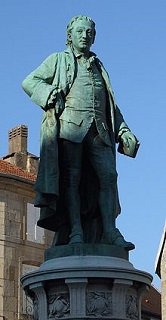
Standbeeld in Langres


De Duitse schrijfster Charlotte Link werd geboren op 5 oktober 1963 in Frankfurt am Main. Zie ook alle tags voor Charlotte Link op dit blog.


Uit: Die letzte Spur


“Es würde schneien an diesem Wochenende. Das hatten die Meteorologen prophezeit, und es sah aus, als könnten sie recht behalten: Es war eisig kalt an diesem Novembernachmittag. Ein scharfer Wind blies aus Nordost. Wer aus dem Haus musste, dem tränten rasch die Augen, und die Haut brannte. Die frühe winterliche Dunkelheit brach bereits herein. Den ganzen Tag war es nicht richtig hell geworden, und nun schien die Dämmerung schon wieder in den Abend überzugehen.
Die junge Frau sah erbärmlich aus. Verfroren, bleich, mit roten Flecken auf den Wangen. Sie hielt beide Arme um ihren Körper geschlungen, als könnte sie der gnadenlosen Kälte, die draußen herrschte, auch hier drin nicht entkommen. Dabei war der Keller des gerichtsmedizinischen Instituts gut geheizt. Jedenfalls der kleine Vorraum, in den Inspector Fielder und seine Mitarbeiterin, Sergeant Christy McMarrow, die Besucherin geleitet hatten, nachdem diese die unbekannte Tote aus dem Epping Forest identifiziert hatte.
Sie hatte nur einen einzigen, kurzen Blick auf das wächserne Gesicht geworfen, sich dann rasch abgewandt und hörbar mit einem Würgen in der Kehle zu kämpfen gehabt. Dabei hatte sie nicht einmal den übel zugerichteten Körper gesehen.
Der, so hatte Fielder gedacht, hätte sie wahrscheinlich in Ohnmacht fallen lassen.
Es hatte ein paar Augenblicke gedauert, bis sie hatte sprechen können.”


1471450-54919fbeb4df07ce983a0c3f3afd136b.jpg

Charlotte Link (Frankfurt am Main, 5 oktober 1963)

Frankfurt,  Dom en Römerberg


De Chileense schrijver José Donoso (eigenlijk Jose Donoso Yáñez) werd geboren op 5 oktober 1924 in Santiago de Chile. Zie ook alle tags voor José Donoso op dit blog en ook mijn blog van 5 oktober 2010.


Uit: Curfew (Vertaald door Alfred MacAdam)


“At the end of her extended arm, the pistol began to weigh heavy, pointing all the while at the square of light at the other end of the room where the three figures stood watching the dog. They released the animal. Judit hid the pistol because she had no time to squeeze the trigger. Manungo and the blonde began to dance, quite closely. Boris bounced his hind legs following Ricardo, who had no other partner than his dog: she was his partner, his bitch. Boris was only a puppy, while they both twisted and swayed and shook to the music of the Police, but Dobermans were a privileged breed, very special, artificially developed by the German army during World War II to chase down Jews who got away from the concentration camps.
"Don't they use Dobermans for the same thing here?"
"There are no concentration camps here."
"No detention centers either?"
"No. Those are stories invented by communists."
"Ah, of course ..."
The great temptation to believe that nothing like that existed except as a lie made up by fanatical proponents of an ideology that was not your own. The cell where she had waited for hours and hours did not exist; neither did the barking, or the echoes of her friends' screams.”


 1471450-5353ff3c7a539b1b000a28815a5eb9c8.jpg

José Donoso (5 oktober 1924 - 7 december 1996)


De Hongaars-sprekende Joegoslavische schrijver Ervin Sinko (eig. Franz Spitzer) werd op 5 oktober 1898 in Apatin (Vojvodina) geboren. Zie ook mijn blog van 5 oktober 2010.


Uit: Roman eines Romans - Moskauer Tagebuch (Vertaald door Edmund Trugly junior)


"Ich verstehe nicht, ich kann nicht begreifen, wie jene, die davon schreiben und reden und singen, welch eine Herrlichkeit und welch ein Glück es ist, heute hier zu leben, nicht wissen oder wenigstens spüren, daß sie mit ihrer unzulässigen Anspruchslosigkeit einen Verrat am Kampfziel selbst, am Morgen begehen. Wenn ich die höchste Daseinsberechtigung und die absolute Entschuldigung dieser heutigen Sowjetunion nicht darin sehen kann, daß sie Voraussetzung und Trägerin eines menschlicheren Morgen ist - was habe ich dann noch mit ihr gemein? Fühle ich mich nicht gerade dadurch der Sowjetunion verbunden, daß ich an einen Morgen glaube, der aus ihr hervorgehen wird, in dem aber all das, was für den Geist dieser heutigen Sowjetunion charakteristisch ist, mit Stumpf und Stil ausgerottet sein wird."


1471450-8e51916c47fe444cf428e86719a5836a.jpg
Ervin Sinko (5 oktober 1898 - 26 maart 1967)

Cover

Geschreven door Romenu om 20:27 Reageer op dit bericht

K.L. Poll

De Nederlandse schrijver en journalist K.L. Poll, (volledige naam Kornelis Lubbertus Poll) werd geboren in Dordrecht op 5 oktober 1927. Poll studeerde rechten aan de Rijksuniversiteit Leiden, was redacteur van Haagse dagblad Het Vaderland en later hoofd van de kunstredactie van het Algemeen Handelsblad dat in 1970 fuseerde met de Nieuwe Rotterdamse Courant. In 1959 richtte Poll het Hollands Maandblad op. Hij publiceerde daarin een aantal van zijn essays en humoristische beschouwingen over filosofie. In een van zijn stukjes pleitte hij voor de invoering van een "ironieteken" als een nieuw leesteken. K.L. Poll was als redacteur de initiatiefnemer van de wetenschapsbijlage van NRC Handelsblad en in 1983 richtte hij een "Vereniging voor Onderwijs, Kunst en Wetenschap" op, in eigen woorden "een onafhankelijke muis (die) niet zou misstaan naast de olifant van de culturele staatszorg" en het culturele leven zou moeten verlevendigen. De vereniging, nu een stichting, organiseert lezingen en geeft boeken uit. Later werd hij tevens initiator van het Cultureel Supplement van de NRC.Zijn bijdragen werden gebundeld in “Zonder mirakels” (1965), “De eigen vorm” (1967) en “Het masker van de redelijkheid “ (1969). In 1973 begon Poll aan het project “Formules voor een moraal”, bestaande uit de essaybundels “Verlangen naar almacht” (1974), “Een dienstreis voor burgers” (1976), “Wennen aan de vrede” (1981), de poëziebundel “De logica van November” (1975) en de roman “Emma Kwartier” (1978).


De bomen steken

De bomen steken
hun takken en twijgen
onverschrokken, aangepast,
in de blauwe vrieslucht
van de gevorderde ochtend.
Het is koud, verhoudingsgewijs,
goed schilderijweer,
oudhollands voor later,
de oude zonden
en gruwelijkheden van God
vergeten en, in zoverre,
vergeven.
De natuur wrokt niet,
draagt de gevolgen
als nieuwe vanzelfsprekendheden
voort in de tijd,
vervult in volle majesteit
het heden in zijn klassieke vluchtigheid,
kent de eigen wetten door en door,
glimlacht om de onvermijdelijke lente.


Juli

Een dag met eigen schaduwen.
In de lucht de zachte
aandrang van een gehandicapte geest.

Langs Wijk bij Duurstede
varen zomerschepen.
Langs het raam trekt de tijd.

Waar komt de grijze kat vandaan,
angstig trillend op een hoog, smal balkon
van een huis in de Sarphatistraat?


 1600930-c22361bb4ae330162a888b338e1bdaaa.jpg
K.L. Poll (5 oktober 1927 - 14 november 1990)

Geschreven door Romenu om 00:00 Reageer op dit bericht

Meer van Romenu

↑ Terug naar de berichten