Naar de inhoud

Romenu

Over literatuur, gedichten, kunst en cultuur
akke.beakke.be

Berichten van 11 december 2013 tot 12 december 2013

Kader Abdolah, Susanna Tamaro, Sophie Kinsella, Gustave Flaubert, John Osborne

De Iraans - Nederlandse schrijver Kader Abdolah (pseudoniem van Hossein Sadjadi Ghaemmaghami Farahani) werd geboren in Arak op 12 december 1954. Zie ook alle tags voor Kader Abdolah op dit blog.

Uit:The House Of The Mosque (Vertaald door Susan Massotty)

“Alef Lam Mim. There was once a house, an old house, which was known as ‘the house of the mosque’. It was a large house with thirty-five rooms. For centuries the house had been occupied by successive generations of the family who served the mosque.
Each room had been named according to its function: the Dome Room, for example, or the Opium Room, the Storytelling Room, the Carpet Room, the Sick Room, the Grandmother’s Room, the Library and the Crow’s Room.
The house lay behind the mosque and had actually been built onto it. In one corner of the courtyard was a set of stone steps leading up to a flat roof, which was connected to the mosque.
In the middle of the courtyard was a hauz ,* a hexagonal basin of water in which people washed their handsand face before prayers.
The house was now occupied by the families of three cousins: Aqa Jaan, the merchant who presided over the city’s bazaar, Alsaberi, the imam of the house and spiritual leader of the mosque, and Aqa Shoja, the mosque’s muezzin.
It was a Friday morning in early spring. The sun felt warm, the air was filled with the rich smell of earth, the trees were in leaf, and the plants were beginning to bud. Birds flew from branch to branch, serenading the garden. The two grandmothers were pulling out the plants that had died in the winter, while the children chased each other and hid behind the thick tree trunks.
An army of ants crawled out from under one of the ancient walls and covered the path by the old cedar tree like a moving brown carpet. Thousands of young ants, seeing the sun for the first time and feeling its warmth on their backs, surged down the path.
The house’s cats, stretched out by the hauz, looked in surprise at the teeming mass. The children stopped playing to stare at the wondrous sight. The birds fell silent and perched in the pomegranate tree, craning their necks to follow the ants’ progress.”


 1511590-cc59e51d94316901044bebe05609e1d3.jpg
Kader Abdolah (Arak, 12 december 1954)


De Italiaanse schrijfster Susanna Tamaro werd geboren in Triëst op 12 december 1957. Zie ook alle tags voor Susanna Tamaro op dit blog.

Uit: Rispondimi (Vertaald door John Cullen)

“I stood there, very still, without crying. I thought, I wonder if I'll ever find her smell again anywhere?
Why do faces disappear from memory as time passes, bu not smells? What was her scent made of, what was in it? Cheap cologne, for sure, mixed with the smell of her skin and the fragrance of soap or talcum powder. My mother was constantly washing herself.
During my first seven years, we were always together. We lived in an apartment. She was cheerful, flamboyant, brightly colored. At night, after she tucked me in, she went to work, and when I woke up there she was again, standing next to the bed. She'd announce, "Now arriving, a shower of kisses!" and throw herself on me, laughing.
That's how it was, and that's how I thought it would always be.
I didn't yet know our names weren't carved in stone, but scribbled on a blackboard. Every so often someone made a pass with the eraser and another name vanished from the list. Did he wield the eraser precisely, purposefully? Did he wield it inadvertently? Was that the very name he wanted to erase, or was it maybe the one just above, or just below?
We had hung a small picture of Jesus over the door in the kitchenette. Below the picture, a tiny light was always on. Although it didn't burn your fingers, it moved like a little flame. Jesus was holding his heart in his hand, but that didn't bother me, because instead of being disheveled and screaming in pain, he had perfectly combed hair and rosy cheeks and he was smiling and didn't seem scared at all. "Who's that man?" I asked, the first time I saw him.
"He's a friend," Mama replied, "a friend who loves you. "
"Does he love you, too?"
"Of course. He loves everybody."


 1511590-79ac764b467a9c621cf49217b17b5f92.jpg
Susanna Tamaro (Triëst, 12 december 1957)


De Britse schrijfster Sophie Kinsella (pseudoniem van Madeleine Wickham) werd geboren in Londen op 12 december 1969. Zie ook alle tags voor Sophie Kinsalla op dit blog.

Uit:Remember Me?

“I mentally prod my brain, but it's a big, stupid, empty balloon. I need a strong cup of coffee. I try peering around the room for clues-but my eyes don't want to peer. They don't want information, they want eyedrops and three aspirin. Feebly I flop back onto the pillows, close my eyes, and wait a few moments. Come on. I have to be able to remember what happened. I can't have been that drunk . . . can I?
I'm holding on to my one fragment of memory like it's an island in the ocean. Banana cocktails . . . banana cocktails . . . think hard . . . think . . .
Destiny's Child. Yes! A few more memories are coming back to me now. Slowly, slowly, in patches. Nachos with cheese. Those crummy bar stools with the vinyl all split.
I was out with the girls from work. At that dodgy club with the pink neon ceiling in . . . somewhere. I can remember nursing my cocktail, totally miserable.
Why was I so down? What had happened-
Bonuses. Of course. A familiar cold disappointment clenches my stomach. And Loser Dave never showed up. Double whammy. But none of that explains why I'm in hospital. I screw up my face tight, trying to focus as hard as I can. I remember dancing like a maniac to Kylie and singing "We Are Family" to the karaoke machine, all four of us, arm in arm. I can vaguely remember tottering out to get a cab.
But beyond that . . . nothing. Total blanko.
This is weird. I'll text Fi and ask her what happened. I reach toward the nightstand-then realize there's no phone there. Nor on the chair, or the chest of drawers.
Where's my phone? Where's all my stuff gone?”


 1511590-7842759877dc6d9ea531a2eedebf7c9b.jpg
Sophie Kinsella (Londen, 12 december 1969)


De Franse schrijver Gustave Flaubert werd op 12 december 1821 geboren in Rouen. Zie ook alle tags voor Gustave Flaubert op dit blog.

Uit Madame Bovary

“Elle songeait quelquefois que c'étaient là pourtant les plus beaux jours de sa vie, la lune de miel, comme on disait. Pour en goûter la douceur, il eût fallu, sans doute, s'en aller vers ces pays à noms sonores où les lendemains de mariage ont de plus suaves paresses! Dans des chaises de poste, sous des stores de soie bleue, on monte au pas des routes escarpées, écoutant la chanson du postillon, qui se répète dans la montagne avec les clochettes des chèvres et le bruit sourd de la cascade. [...] Il lui semblait que certains lieux sur la terre devaient produire du bonheur, comme une plante particulière au sol et qui pousse mal tout autre part. Que ne pouvait-elle s'accouder sur le balcon des chalets suisses ou enfermer sa tristesse dans un cottage écossais, avec un mari vêtu d'un habit de velours noir à longues basques, et qui porte des bottes molles, un chapeau pointu et des manchettes!
Peut-être aurait-elle souhaité faire à quelqu'un la confidence de toutes ces choses. Mais comment dire un insaisissable malaise, qui change d'aspect comme les nuées, qui tourbillonne comme le vent? Les mots lui manquaient donc, l'occasion, la hardiesse.
(…)

La conversation de Charles était plate comme un trottoir de rue, et les idées de tout le monde y défilaient dans leur costume ordinaire, sans exciter d'émotion, de rire ou de rêverie. Il n'avait jamais été curieux, disait-il, pendant qu'il habitait Rouen, d'aller voir au théâtre les acteurs de Paris. Il ne savait ni nager, ni faire des armes, ni tirer le pistolet, et il ne put, un jour, lui expliquer un terme d'équitation qu'elle avait rencontré dans un roman.”


 1511590-45782720bcfc8204e7a57b07e17388c7.jpg
Gustave Flaubert (12 december 1821 – 8 mei 1880)
Isabelle Huppert en Christophe Malavoy in de film Madame Bovaryuit 1991


De Engelse toneelschrijver John James Osborne werd geboren op 12 dezember 1929 in Fulham. Zie ook alle tags voor John Osborne op dit blog.

Uit:Look Back in Anger

“JIMMY. Anyone who’s never watched somebody die is suffering from a pretty bad case of virginity. [His good humour of a moment ago deserts him, as he begins to remember] For twelve months, I watched my father dying — when I was ten years old. He’d come back from the war in Spain, you see. And certain god-fearing gentlemen there had made such a mess of him, he didn’t have long left to live. Everyone knew it — even I knew it. But, you see, I was the only one who cared. His family were embarrassed by the whole business. Embarrassed and irritated. As for my mother, all she could think about was the fact that she had allied herself to a man who seemed to be on the wrong side in all things. My mother was all for being associated with minorities, provided they were the smart, fashionable ones. We all of us waited for him to die. The family sent him a cheque every month, and hoped he’d get on with it quietly, without too much vulgar fuss. My mother looked after him without complaining, and that was about all. Perhaps she pitied him. I suppose she was capable of that. [with a kind of appeal in his voice] But I was the only one who cared! Every time I sat on the edge of his bed, to listen to him talking or reading to me, I had to fight back my tears. At the end of twelve months, I was a veteran. All that that feverish failure of a man had to listen to him was a small, frightened boy. I spent hour upon hour in that tiny bedroom. He would talk to me for hours, pouring out all that was left of his life to one, lonely, bewildered little boy, who could barely understand half of what he said. All he could feel was the despair and the bitterness, the sweet, sickly smell of a dying man. You see, I learnt at an early age what it was to be angry — angry and helpless. And I can never forget it. I knew more about — love … betrayal … and death, when I was ten years old than you will probably every know all your life.“


 1511590-a22c0d05e81fddbbde602591b2e40f56.jpg
John Osborne (12 december 1929 - 24 december 1994)
Scene uit een theatervoorstelling, Theatre Royal Bath, 2005


Zie voor nog meer schrijvers van de 12e december ook mijn blog van 12 december 2011 deel 1 en eveneens deel 2 en ook deel 3.
Geschreven door Romenu om 19:01 Reageer op dit bericht

Andrea De Carlo, Naguib Mahfouz, Paul Rigolle, Ludwig Laher, Janko Ferk

De Italiaanse schrijver.Andrea De Carlo werd geboren in Milaan op 11 december 1952. Zie ook alle tags voor Andrea De Carlo op dit blog.

Uit: Due di Due (Vertaald door Paula Geldenhuys)

“I observe the confused mass of heads and busts in motion, hoping to recognize the hair of a girl whom I saw a few days earlier, and instead I'm struck by the gaze of one who is trying to make his way with an expression of concentrated estrangement.
It is the gaze of an uninvited guest, of a stowaway: a gaze dissociating from his own lineaments, from his own way of turning his head to the right and to the left.
Then in the reconstructed recollection there is a void, wherein Guido Laremi with his extraneous gaze is reabsorbed into the background. I free my motor scooter from the chain and I crank it up, and these simple doings cost me fatigue and repetition, anger against the objects.
I'm on, at length, and I'm trying to cut my way through the people and the cars, and I hit somebody. I feel a knock on one side of the handlebars; I sway and lose my balance; I fly over the scooter dragged by my heavy greatcoat, by the canvas-bag filled with mandatory books.
Some round heads and long necks, some apple or pumpkin or pine-seed-like faces, some bunker-slit or bottle-end or wide-screen-like pair of spectacles turn around in the jumble of movements; they look away as soon as I'm back on my feet with no interesting damage.
A couple of meters from me Guido Laremi is pressing a hand on his flank, says «Damn». He is more or less my age, blue eyes, disheveled, fairish hair. He's wearing an English raincoat, but it wears too short on him; he, too, keeps his collar raised. He is staring at me, and his gaze is now filled with irritation, other than extraneousness.
I tell him «I'm sorry»; I pull up my motor scooter. All about streaming-out students continue to knock and push and press one another, amidst grumbles and squeaks and laughs and guttural cries.”


 1510646-85c6334149409abdb714cf61a4d652bf.jpg
Andrea De Carlo (Milaan, 11 december 1952)


De Egyptische schrijver Naguib Mahfouz werd geboren op 11 december 1911 in Caïro. Zie ook alle tags voor Naguib Mahfouz op dit blog.

Uit: Rhadopis of Nubia

“In only a few days, Abu and its two islands, Biga and Bilaq, were packed with visitors. Houses filled up with guests and tents crowded the public squares. Throngs of people moved through the streets and gathered around the conjurers, singers, and dancers. A multitude of traders hawked their wares in the markets and the fronts of houses were decorated with banners and olive branches. The people's eyes were dazzled by the groups of royal guards from the island of Bilaq with their ornate uniforms and long swords. Bands of pious believers hastened to the temples of Sothis and the Nile, making vows and giving offerings. The songs of the minstrels mixed with the drunken cries of the revelers as a mood of unbridled joy and raucous entertainment pervaded the normally composed atmosphere of Abu.
Finally the day of the festival arrived. Everyone made their way to one place, the long road stretching between Pharaoh's palace and the hill upon which stood the temple of the Nile.
The air was hot from the excitement in their breath and the earth strained under their weight. Many despaired of ever finding a place on land and went down to the boats and set sail to the temple hill, singing Nile songs to the accompaniment of flutes and lyres, and dancing to the beat of drums.
Soldiers lined the edges of the great road lances at the ready. At equal distances apart, life-size statues of the kings of the Sixth Dynasty had been erected, Pharaoh's father and forefathers. Those nearest to the front could see the pharaohs: Userkara, Teti I, Pepi I, Mohtemsawef I, and Pepi II.
The clamor of voices filled the air, each one impossible to distinguish, like the waves on a raging ocean, leaving no trace except an awesome, all-encompassing uproar. Now and then, however, an especially powerful voice would stand out, crying: "Glory be to Sothis who has brought us glad tidings!" or "Glory be to the sacred Nile god who brings life and fertility to our land!" And here and there voices requested the wines of Maryut and the meads of Abu, calling for merriment and forgetfulness”.


 1510646-ecb587b26f3e3fc1c4a9cf32c6f8a5e7.jpg
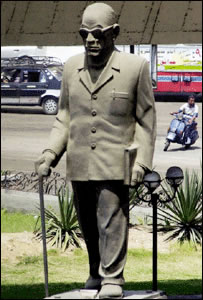
Naguib Mahfouz (11 december 1911 – 30 augustus 2006)
Standbeeld in Caïro


De Vlaanse dichter Paul Rigolle werd geboren in Roeselaere op 11 december 1953. Zie ook mijn blog van 11 december 2010.


Vaart

Is het Stilstand waarvan hij droomt? Een pas op de plaats,
een halt die iemand toegeroepen wordt. Met gebrek
en bomen, neemt hij de vaart uit het leven weg. Stilstand,
het kleine, bleke broertje van de dood, is een verlangen
dat maar even duurt, hij weet het best, maar zijn arm

drukt door wat in zijn hoofd wordt uitgeklaard.
Zichzelf opzij gezet, vriest hij liever vast. Hoe stilte
daarop volgen moet en daarvan overblijft, de zon
die roerloos tussen de populieren hangt, een dooier
in zijn oog, het water ijs geworden waarop

hij staat. Eén en al oor alweer voor de stemmen
die zich ballen tot een schreeuw waarvan hij schrikt.
De eerste schaatsers slijpen hun messen op de vaart.


Oker

Wat goed is komt snel, zegt men,
maar soms duurt alles langer dan verhoopt.
Je zoekt buiten wat wel vaker alleen van binnen zit.

Hartstocht komt en gaat, wat gebeuren moet
gebeurt, een niemandsland is om door te gaan.
Leiden ligt in Nederland, durven is een kunst,
wie bang is wordt gebeten. Luister hazenhart,

maak geen moordkuil van dat hart van jou,
leg de oren aan de grond, raak met oker in de weer
en herbegin. De weg die harten kunnen gaan is kort
het is maar even, maar soms is dat genoeg.


1510646-fde50f27a321f5b61b9874a1e0fca2d8.jpg 
Paul Rigolle (Roeselare, 11 december 1953)


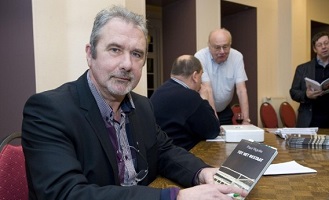
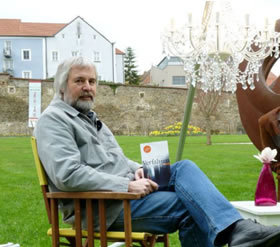
De Oostenrijkse dichter, schrijver en vertaler Ludwig Laher werd geboren op 11 december 1955 in Linz. Zie ook alle tags voor Ludwig Laher op dit blog en ook mijn blog van 11 december 2010.

Uit: Selbstakt vor der Staffelei

„Allgemeingültig, was heißt allgemeingültig. Wer will denn schon sein wie wer anderer, ich will ja nicht mich sehen in dem, den ich sehen will. Aber ich will sehen, will fühlen, daß da einer war, daß da einer ist, und zwar so und nicht irgendwie. Daß da einer sieht, und zwar so und nicht irgendwie. Daß einer, daß etwas unverwechselbar ist, bleibt, unauslöschlich über das Auslöschen hinaus. Nicht ewig, was heißt ewig. Sondern gegen den Schein, gegen die Schublade, gegen den Staub, gegen den Schutt da ist, lebendig, jetzt da ist, weg war, ganz weg war, ganz da ist. Dem Mittelmaß das Maß entgegensetzt, nicht das Übermaß, nicht das Genie, was heißt Genie.
(…)

Janssen will, muß die Arbeit mehrmals unterbrechen. Schmerzen. Mit den Päpsten ist er fertig: Pius sieben, der in Janssens Jugend mit fast dreihundert Jahren Verspätung treuen Katholiken das kopernikanische Weltbild zu erwägen gestattet, Leo zwölf, der Prediger des Pockenstrafgerichts, ein weiterer Kurzzeit-Pius, schließlich Gregor sechzehn, der ist gerade am Ruder, Schluß, aus, Punkt. Noch drei Fensterbilder, da bricht die Geschwulst am Daumen auf, heilt nicht mehr: Chlodwig wird getauft, der Heilige Fridolin erweckt den toten Ursus, der Heilige Arbogast ruft den Sigbert ins Leben zurück. Ins Leben.”


 1510646-7bd83918b62ba24140e5a613c58e740c.jpg
Ludwig Laher (Linz, 11 december 1955)


De Oostenrijkse dichter, schrijver en rechter Janko Ferk werd geboren op 11 december 1958 in Sankt Kanzian am Klopeiner See, Kärnten. Zie ook alle tags voor Janko Ferk op dit blog en ook mijn blog van 11 december 2010.


WILDER WEIN

du behauptest dich
nicht
am weg
deine reife
gilt am ziel

die sonne
ist
deine option
der regen
verschlechtert
den vertrag

die beiden
südlicheren tage
vollenden
die abmachung
und geben
die schwere


JETZT SCHREIBE ICH

auf dem langen weg
durch die kalte stadt
schreibe ich
von den häuserzeilen
ab

chöre in einem anderen licht
buchstabiere ich
das umfassende verstehen
der lieder

und bin doch nur
auf die stimme
des einzelsängers
aus
auf meinen widerklang


 1510646-95390cd250596649edfe7d50464eeca3.jpg
Janko Ferk (Sankt Kanzian, 11 december 1958)
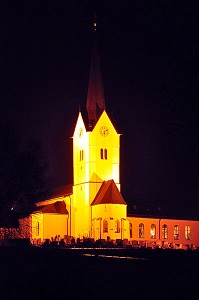
Sankt Kanzian, parochiekerk


Zie voor nog meer schrijvers van de 11e december ook mijn blog van 11 december 2012 en ook mijn blog van 11 december 2011 deel 2 en eveneens deel 3.

Geschreven door Romenu om 10:50 Reageer op dit bericht

J.C. van Schagen

De Nederlandse schrijver, dichter en graficus Johan Christiaan Jacob (Chris) van Schagen werd geboren in Vlissingen op 11 december 1891. Hij volgde de lagere school en de HBS in Middelburg en begon zijn ambtelijke loopbaan in deze Zeeuwse hoofdstad. Van Schagen studeerde rechten in Amsterdam, waar hij zijn vrouw Willy Dalman leerde kennen. Zij trouwden in 1918. Hun dochter Joos werd in 1920 geboren. Het gezin van Schagen verhuisde naar Rotterdam. Zijn gedicht “Narrenwijsheid” werd in 1925 in druk genomen. In 1928 schreef hij “Litanie”. Van Schagen maakte maatschappelijk carrière. Deze carrière werd afgebroken in 1942 wegens 'politieke moeilijkheden'. Hij was toen ambtenaar bij de gemeente Rotterdam. Daarna volgde hij lessen van Antoon Derkzen van Angeren, aan de Rotterdamse Academie voor Beeldende Kunsten, en leerde onder andere etsen en lithograferen. In 1946 publiceerde hij “Onderaardsch” en “Flarden van den wind”, proza en poëzie. Vanaf de jaren vijftig publiceerde van Schagen veel poëzie en proza en maakte ook steeds meer 'prenten'. Het overgrote deel van zijn werk werd door van Schagen zelf uitgegeven. Meer dan twintig titels in de reeks Domburgse Cahiers en de serie schriftsels, poëzie en proza, werden verzonden aan honderden liefhebbers. De 'prenten', schilderijen, etsen, lithografieën, monotypes en vooral unica-drukken, verkocht hij voor een groot deel aan huis. Van Schagen heeft diverse tentoonstellingen van zijn werk gekend. Het hoogtepunt hiervan, achtereenvolgens een overzichtstentoonstelling in Rotterdam, Veere, Middelburg en Domburg, ging gepaard aan de presentatie van een literair drieluik in de serie Archief van Schagen, gepubliceerd door uitgeverij De Prom.


Narrenwijsheid (Fragment)

I

Niets is, dat niet goddelijk is.
Daarom wil ik niets uitzonderen.
Ik geef geen namen.

Ik laat adel en schoonheid liggen, ik vraag niet naar
              recht, ik blijf niet staan bij slecht en leelijk.
Goed en deugdzaam gaan mij niet aan.

De regen regent over bosch en zee en over de stille velden
In de slootjes regent de regen, op de verre buiten-
              wegen en op het zinken platje van de keuken
In de vuile gootjes van de binnenstad regent de
              regen en de regen regent op de keetjes van
              de burgerwacht
En op het trottoir met de natte krant, de uienschil
              en het lucifertje.
De gevangene in zijn cel hoort den regen, de moeder
              staat voor het raam met haar kindje.
De kellner staart in de regen door de spiegelruit,
              voorbij het kleintje koffie.
De politicus loopt op en neer in zijn kamer en
              bedenkt, wat hij zeggen zal, maar hij blijft
              staan en luistert naar den regen.
De regen regent over de schepen in de havens, over
              het station en de emplacementen, over
              de fabrieken buiten de stad.
En over het oude paard van de kolenwagen aan
              den overkant.
Zachtjes ritselt de regen in de graskantjes van de weg,
Hij leekt langs de planken van het fietsenhok en
              langs het warme gezicht van het schoolmeisje,
Langs het gelaat van den ouden man, die heeft liefgehad,
              langs de vale gezichten van den chauffeur
              en den journalist met zijn potloodje.
Op de roode pannendaken der oude huizen, op de
              afdakjes en de binnenplaatsen, in de steegjes
              en de hofjes en in de groene grachten van de
              oude stad regent de regen.
Hij regent pokkeputjes in het kille strand, waar het
              seizoen verkeken is,
Op de daken der hôtels met de rood pluche kamertjes
              regent hij, over de leege ambtenaarsbuurten
              en de bouwterreinen.
Op de tramremise en de kar van den bakker, op den
              werkman van het sintelpad,
En er is een diepe, zwarte toon gekomen in de
              dingen, oud en dromerig en vertrouwd.

Zoo regent de regen.
Daarom geef ik geen namen.
Ik ga maar en ben.


 1598694-e69acc5e1acbe0c66ca7e9111fb77e77.jpg
J.C. van Schagen (11 december 1891 - 17 april 1985)

Geschreven door Romenu om 00:00 Reageer op dit bericht

Meer van Romenu

↑ Terug naar de berichten