Naar de inhoud

Romenu

Over literatuur, gedichten, kunst en cultuur
akke.beakke.be

Berichten van 24 juni 2014 tot 25 juni 2014

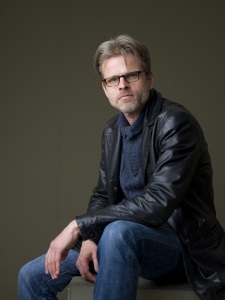
Rob van Essen

De Nederlandse schrijver en vertaler Rob van Essen werd op 25 juni 1963 geboren in Amstelveen en groeide op in Twente en op de Veluwe. Zijn eerste boek verscheen in 1996: “Reddend Zwemmen”. Daarna volgden: “Troje” (2000), “Kwade dagen” (2002), “Engeland is gesloten” (2004), “Het jaar waarin mijn vader stierf” (2006) en “Visser” (2008). Rob van Essen vertaalt vanuit het Engels, zowel fictie als non-fictie. Sinds 2005 maak t hij deel uit van de redactie van het Biografie Bulletin. Ook schrijft hij vanaf oktober 2007 voor NRC Boeken over Engelstalige literatuur.

Uit: In het restaurant (drie gangen)

“1. voorgerecht
Nadat hij mijn soep heeft neergezet, blijft de ober naast mijn tafeltje staan. Hij pakt het mes dat klaar ligt voor het hoofdgerecht en begint met de punt ervan in het tafellaken te tekenen. Hij trekt de lijnen van een slordige rechthoek, waarin hij her en der wat kleine vormen plaatst.
‘De woning van mijn grootmoeder,’ zegt hij zacht, en zonder mij aan te kijken trekt hij nog wat lijnen. Het tafellaken is dik, aan weerszijden van elke lijn bolt de stof een beetje op.
De kok komt naast hem staan en haalt zijn handen over zijn schort. ‘Kwam hij daar vandaan?’ Hij laat een dikke wijsvinger vlak boven de tekening zweven.
‘Nee, nee,’ zegt de ober. ‘Dat is de gang. Hij kwam via het balkon.’  Hij wijst met de punt van het mes.
De kok veegt met zijn hand over zijn ongeschoren kin en kijkt nadenkend naar de tekening.  ‘Soep goed, meneer?’ vraagt hij wanneer hij mijn blik vangt.
‘Ja, ja,’ zeg ik haastig, hoewel ik nog niet heb geproefd. Ik steek mijn hand uit naar de lepel.
De kok richt zich weer naar de ober. ‘En de balkondeuren?’
De ober haalt zijn schouders op. ‘Ze lag ik bed, wat kan ze nou…’
De kok knikt en kijkt weer naar de tekening, waarvan de lijnen langzaam vervagen. De ober ziet het ook en zet met de mespunt sommige lijnen  wat duidelijker aan.
Ik leg mijn lepel neer en strek mijn hand uit naar mijn glas rode wijn. Ik doe het niet goed, in plaats dat ik het glas oppak, gooi ik het om. De tekening van de ober wordt onmiddellijk bedekt door een grote paarsrode vlek.
De ober trekt wit weg. Hij keert zich naar mij, maar voor hij iets kan doen, pakt de kok hem vanachteren bij de schouders en trekt hem mee naar de keuken.
‘Alsof hij erbij was,’ sist de ober, ‘alsof hij erbij was.’ En hij blijft geagiteerd fluisteren. ‘Nee, nee, dat is onzin,’ zegt de kok, en hij blijft de ober kalmerend toespreken tot ze beiden achter de slappe klapdeuren naar de keuken zijn verdwenen.”


 1724133-8448a33ec24d2fdf7ce7d88eaa91b5c7.jpg
Rob van Essen (Amstelveen, 25 juni 1963)

Geschreven door Romenu om 00:00 Reageer op dit bericht

Yann Martel, Michel Tremblay, Nicholas Mosley, Ingeborg Bachmann, Arseny Tarkovsky, George Orwell, Claude Seignolle

De Canadese schrijver Yann Martel werd op 25 juni 1963 geboren in Salamanca. Zie ook alle tags voor Yann Martel op dit blog.

Uit:Life of Pi

„I still smart a little at the slight. When you’ve suffered a great deal in life, each additional pain is both unbearable and trifling. My life is like a memento mori painting from European art: there is always a grinning skull at my side to remind me of the folly of human ambition. I mock this skull. I look at it and I say, “You’ve got the wrong fellow. You may not believe in life, but I don’t believe in death. Move on!” The skull snickers and moves ever closer, but that doesn’t surprise me. The reason death sticks so closely to life isn’t biological necessity—it’s envy. Life is so beautiful that death has fallen in love with it, a jealous, possessive love that grabs at what it can. But life leaps over oblivion lightly, losing only a thing or two of no importance, and gloom is but the passing shadow of a cloud. The pink boy also got the nod from the Rhodes Scholarship committee. I love him and I hope his time at Oxford was a rich experience. If Lakshmi, goddess of wealth, one day favours me bountifully, Oxford is fifth on the list of cities I would like to visit before I pass on, after Mecca, Varanasi, Jerusalem and Paris.
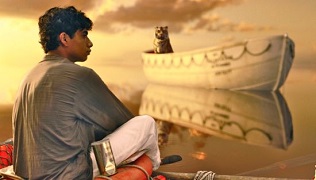
 

 1616931-d9283d9bfd8fb88e5f966776ae7ec33d.jpg
Scene uit de film “Life of Pi” uit 2012


I have nothing to say of my working life, only that a tie is a noose, and inverted though it is, it will hang a man nonetheless if he’s not careful.
I love Canada. I miss the heat of India, the food, the house lizards on the walls, the musicals on the silver screen, the cows wandering the streets, the crows cawing, even the talk of cricket matches, but I love Canada. It is a great country much too cold for good sense, inhabited by compassionate, intelligent people with bad hairdos. Anyway, I have nothing to go home to in Pondicherry.
Richard Parker has stayed with me. I’ve never forgotten him. Dare I say I miss him? I do. I miss him. I still see him in my dreams. They are nightmares mostly, but nightmares tinged with love. Such is the strangeness of the human heart. I still cannot understand how he could abandon me so unceremoniously, without any sort of goodbye, without looking back even once. That pain is like an axe that chops at my heart.”
 

 1616931-bfe2cbd1b77b30511583b7d01b72fe6f.jpg
Yann Martel (Salamanca, 25 juni 1963)


De Canadese schrijver Michel Tremblay werd geboren in Quebec op 25 juni 1942. Zie ook alle tags voor Michel Tremblay op dit blog.

Uit: Crossing the Continent (Vertaald door Sheila Fischman)

“Her grandmother hugged her tight, unable to say a word; her grandfather swallowed his tears; only her sisters let themselves go and cried, copiously. With her big suitcase beside her, she herself hasn’t moved, her lips quivering slightly but not too much. Strangely enough, no goodbyes have been exchanged though both grandparents and granddaughter know that they’ll probably never see one another again. Don’t say things. Avoid them or arrange so that they don’t exist. A calculated chill instead of outpourings, though they are necessary.
She did not turn around when she climbed into the buggy so she hasn’t seen the dejection in the eyes of Josephine and Meo from whom one-third of what is left of their reason for living is being taken away this morning while they wait for the rest to be cut off. Will the other two leave on the same day or will they have to live twice more through this intolerable scene that should be taking place amid heartbreaking sorrow and cries but is actually Image: cover of "Crossing the Continent" by Michel Tremblayhappening in a terrifying silence? Will they be able to bear three departures, three times on the same train?
When Monsieur Sanschagrin’s whistle echoed in the early morning chill, Rheauna held out her ticket to the tall man with a moustache who had just asked her if she was Rheauna Rathier due to leave for Saskatoon, Regina, Winnipeg, Ottawa and Montreal. He spoke each name in a resonant voice as if they were all exotic destinations on the other side of the world. The door of the car closed with a gruesome bang, she ran to the first window, pressed her nose against the glass and then, as the train was starting to move, her sisters and her grandparents on the wooden platform waved desperately, she allowed herself to weep, to cry, to pound her fist. She wished that the other four wouldn’t see her collapse, that she could wait for the train to pull away from the station."


 1616931-333964edbeb4f598d78d7d87c3a555d3.jpg
Michel Tremblay (Quebec, 25 juni 1942)


De Engelse schrijver Nicholas Mosley werd geboren op 25 juni 1923 geboren in Londen. Zie ook alle tags voor Nicholas Mosley op dit blog.

Uit: Children of Darkness and Light

“You know the story of the children in Yugoslavia who said they had seen the Virgin Mary: she appeared to them on the side of a hill and went on talking to them in the village church in the evenings; the hillside and the church became a shrine. I did a piece on this for the newspaper I was working for at the time — about the susceptibilities and projections of adolescent children, the local political situation from which the authorities might welcome a diversion, church rivalries in which the Franciscans might be using the children in their battle with the state-backed clergy. My editor said `But people don't want this analytical stuff; they want a piece about children who say they've seen the Virgin Mary.'
I said `But people don't believe that, do they?'
`Part of them will want to believe. Part of them will think it's rubbish.'
`So they won't have to think at all.'
`You'll learn.'
So I went and wrote a piece about the wonderment of the children on the side of the hill; the ruthlessness of church and state authorities in their treatment of the children. I managed to make the harassment of the children seem vaguely sexual.
My editor said `You're learning.'
I said `But the interesting thing is what the Virgin Mary seemed to be saying. She said that humans, with their greed and violence, are in danger of destroying themselves: this is the last time she's going to appear to give warning.'
The editor said `You don't believe that, do you?'
`She goes on and on about the need for prayer and fasting. But people have been trying that for centuries, and it doesn't seem to work.' I added `I mean, I think this language is some sort of metaphor.'


 1616931-aa7b597ca2991f3ab1e4099294b3a5d4.jpg
Nicholas Mosley (Londen, 25 juni 1923)


De Oostenrijkse dichteres Ingeborg Bachmann werd geboren op 25 juni 1926 in Klagenfurt. Zie ook mijn blog van 25 juni 2010 en eveneens alle tags voor Ingeborg Bachmann op dit blog.


Wie soll ich mich nennen ?

Einmal war ich ein Baum und gebunden,
dann entschlüpft ich als Vogel und war frei,
in einen Graben gefesselt gefunden,
entließ mich berstend ein schmutziges Ei.

Wie halt ich mich? Ich habe vergessen,
woher ich komme und wohin ich geh,
ich bin von vielen Leibern besessen,
ein harter Dorn und ein flüchtendes Reh.

Freund bin ich heute den Ahornzweigen,
morgen vergehe ich mich an dem Stamm . . .
Wann begann die Schuld ihren Reigen,
mit dem ich von Samen zu Samen schwamm?

Aber in mir singt noch ein Beginnen
- oder ein Enden – und wehrt meiner Flucht,
ich will dem Pfeil dieser Schuld entrinnen,
der mich in Sandkorn und Wildente sucht.

Vielleicht kann ich mich einmal erkennen,
eine Taube einen rollenden Stein . . .
Ein Wort nur fehlt! Wie soll ich mich nennen,
ohne in anderer Sprache zu sein.


De havens waren geopend

De havens waren geopend. We scheepten ons in,
de zeilen voor de wind, de droom overboord,
staal aan de knieën en lachen rond onze haren,
Want onze riemen kliefden de zee, sneller dan God.

Onze riemen versloegen de spanen van God en deelden de vloed;
vóór was het dag, en achter bleven de nachten,
boven was onze ster, en onder verzonken de anderen,
buiten verstomde de storm, en binnen groeide onze vuist.

Pas toen een regen ontbrandde, luisterden we weer;
speren vielen neer en engelen traden te voorschijn,
richtten zwartere ogen op ónze zwarte ogen.
Vernietigd stonden we daar. Ons blazoen vloog omhoog;

Een kruis in het bloed en een groter schip boven het hart.


Vertaald door Paul Beers en Isolde Quadflieg


 1616931-aa99474d2e9079e02ff5fe02ea63e97c.jpg
Ingeborg Bachmann (25 juni 1926 – 17 oktober 1973)


De Russische dichter en vertaler Arseny Alexandrovich Tarkovsky werd geboren op 25 juni 1907 in Elisavetgrad. Zie ook alle tags voor Arseny Tarkovsky op dit blog.


Life, Life

3
I tailored the age to fit me.
We walked to the south, raising dust above the steppe;
The tall weeds fumed; the grasshopper danced,
Touching its antenna to the horse-shoes - and it prophesied,
Threatening me with destruction, like a monk.
I strapped my fate to the saddle;
And even now, in these coming times,
I stand up in the stirrups like a child.

I'm satisfied with deathlessness,
For my blood to flow from age to age.
Yet for a corner whose warmth I could rely on
I'd willingly have given all my life,
Whenever her flying needle
Tugged me, like a thread, around the globe.


 1616931-3e540ef52a2600128e4320cc9ca7e22b.jpg
Arseny Tarkovsky (25 juni 1907 – 27 mei 1989)
Hier met zoontje Andrei in de jaren 1930 


De Britse schrijver George Orwell (pseudoniem van Eric Arthur Blair) werd op 25 juni 1903 geboren in Motihari, India. Zie ook mijn blog van 25 juni 2010 en eveneens alle tags voor George Orwell op dit blog.

Uit: 1984

“Winston glanced across the hall. In the corresponding cubicle on the other side a small, precise-looking, dark-chinned man named Tillotson was working steadily away, with a folded newspaper on his knee and his mouth very close to the mouthpiece of the speakwrite. He had the air of trying to keep what he was saying a secret between himself and the telescreen. He looked up, and his spectacles darted a hostile flash in Winston’s direction.
Winston hardly knew Tillotson, and had no idea what work he was employed on. People in the Records Department did not readily talk about their jobs. In the long, windowless hall, with its double row of cubicles and its endless rustle of papers and hum of voices murmuring into speakwrites, there were quite a dozen people whom Winston did not even know by name, though he daily saw them hurrying to and fro in the corridors or gesticulating in the Two Minutes Hate. He knew that in the cubicle next to him the little woman with sandy hair toiled day in day out, simply at tracking down and deleting from the Press the names of people who had been vaporized and were therefore considered never to have existed. There was a certain fitness in this, since her own husband had been vaporized a couple of years earlier. And a few cubicles away a mild, ineffectual, dreamy creature named Ampleforth, with very hairy ears and a surprising talent for juggling with rhymes and metres, was engaged in producing garbled versions — definitive texts, they were called — of poems which had become ideologically offensive, but which for one reason or another were to be retained in the anthologies. »


 1616931-381277ef35fc7f47894034a4ad2c9a40.jpg
George Orwell (25 juni 1903 – 21 januari 1950)
Scene uit de film “1984” uit 1984


De Franse schrijver Claude Seignolle werd geboren op 25 juni 1917 in Périgueux. Zie ook alle tags voor Claude Seignrolle op dit blog.

Uit: Le meneur de loups

“C'est sur la fin d'une journée de ce terrible hiver 1870, frappé d'un triple malheur : l'invasion, la famine et le froid, qui enfantent à leur tour cent et mille autres peines.
Ses grands doigts de glace profondément enfoncés dans la terre, le froid se cramponne sur la Sologne et s'attarde à pondre son frimas sur l'échine du pauvre monde. Visible en buées au contact des bouches, il ballotte son grand corps fluide au gré des vents mordants. Sa souveraineté sur les mois d'hiver a des exigences cruelles. Il se roule, se prélasse sur tout. Dans les bois, ses jeux font naître les douleurs sourdes des grands arbres aux branches déjà blessées par la foudre des jours d'été et brisées par les colères des vents automne. Les jeunes sapins à la chair tendre éclatent à cris secs, sonores. L'homme entend cette annonce de ruine et blêmit, impuissant.
Chez les pauvres gens, cet hiver a achevé bien des vieillards et repris les quelques jours de vie de bien des nouveau-nés. Les fossoyeurs doivent appuyer de toutes leurs forces sur les membres raidis, ces branches d'homme, pour les coucher dans le cercueil de sapin au parfum de printemps. En ouvrant le sol durci, ils jurent contre le froid qui, pour se gausser, mord les oreilles et leur met de ridicules glaçons dans les moustaches. La terre prend un peu de repos entre ses deux peines d'automne et de printemps, avant que la charrue ne vienne déchirer, en longues et fines lanières, son ventre à nouveau mou. Les bonnes bêtes gisent flanc à flanc, sur un épais lit de paille souple, dans la douce chaleur des étables aux murs crépis de bouses. Les bêtes sauvages viennent rôder près des fermes, poussées par la faim qui leur noue les entrailles comme le froid noue le mal dans les poitrines.
Et les bûcherons n'osent guère s'aventurer à des abattages lointains, dans la crainte de rencontrer le loup qui jette la terreur en déchirant ses hurlements sur ses crocs avides d’entrailles et de chair.”


 1616931-5ca0cbb23a2d03a2a410cf976439854c.jpeg
Claude Seignolle (Périgueux, 25 juni 1917)


Zie voor nog meer schrijvers van de 25e juni ook mijn blog van 25 juni 2012 deel 1 en eveneens deel 2 en ook ook mijn blog van 25 juni 2011 deel 2 en eveneens deel 3.


Geschreven door Romenu om 00:00 Reageer op dit bericht

Ernesto Sabato, Yves Bonnefoy, Scott Oden, Matthijs Kleyn, Madelon Székely-Lulofs, Josse Kok

De Argentijnse schrijver Ernesto Sabato werd op 24 juni 1911 geboren in Rojas, een dorp in de provincie Buenos Aires. Zie ook alle tags voor Ernesto Sabato op dit blog.

Uit: The Resistance (Vertaald door D. Ohmans)

“There are days when I arise with a demented hope, moments when I feel that the possibilities of a more human life are within reach of our hands. This is one of those days.
And then, I have set to writing almost groping in the dawn, with urgency, like one who might go into the street to ask for help against the threat of a fire, or like a ship that, at the point of disappearing, were to send a last and fervent signal towards a port it knows is near but deafened by the noise of the city and by the number of billboards that disturb the view.
I ask you that we pause to think of the greatness to which we can still aspire if we dare to value life in another way. I ask that courage of you which situates us on man's true dimension. Everyone, at one time or another, yields. But there is something unfailing and it is the conviction that--only-- spiritual values can save us from this earthquake that threatens the human condition.
While I write to you, I have lingered to touch a rustic statuette that the Tuobas gave to me and which reminded me, like a ray in my memory, of a virtual exposition that they showed me yesterday on a computer, which I should admit seemed to me like something from Mandingo. Because to the extent that we relate in an abstract manner, the further we move from the heart of things and a metaphysical indifference takes charge of us while entities without blood or proper names assume power. Tragically, man is losing dialogue with others and recognition of the world that surrounds him, given that it is there where encounters are made, where love is possible, the supreme gestures of life. Table talk, including the discussions or angers, already seem replaced by the hypnotic vision. Television tantalizes us, we remain almost captivated by it. This effect between magical and malevolent is due, I think, to the excess of its light that overcomes us with its intensity.”


 1616575-622febeb48bbe604ae09901d2f0309e4.jpg
Ernesto Sabato (24 juni 1911 – 30 april 2011)


De Franse dichter, schrijver en vertaler Yves Bonnefoy werd in Tours geboren op 24 juni 1923. Zie ook alle tags voor Yves Bonnefoy op dit blog.


Ici, dans le lieu clair

Ici, dans le lieu clair. Ce n'est plus l'aube,
C'est déjà la journée aux dicibles désirs.
Des mirages d'un chant dans ton rêve il ne reste
Que ce scintillement de pierres à venir.

Ici, et jusqu'au soir. La rose d'ombres
Tournera sur les murs. La rose d'heures
Défleurira sans bruit. Les dalles claires
Mèneront à leur gré ces pas épris du jour.

Ici, toujours ici. Pierres sur pierres
Ont bâti le pays dit par le souvenir.
A peine si le bruit de fruits simples qui tombent
Enfièvre encore en toi le temps qui va guérir.


Psyché devant le château d’Amour

Il rêva qu’il ouvrait les yeux, sur des soleils
Qui approchaient du port, silencieux
Encore, feux éteints ; mais doublés dans l’eau grise
D’une ombre où foisonnait la future couleur.

Puis il se réveilla. Qu’est-ce que la lumière ?
Qu’est-ce que peindre ici, de nuit ? Intensifier
Le bleu d’ici, les ocres, tous les rouges,
N’est-ce pas de la mort plus encore qu’avant ?

Il peignit donc le port mais le fit en ruine,
On entendait l’eau battre au flanc de la beauté
Et crier des enfants dans les chambres closes,
Les étoiles étincelaient parmi les pierres.

Mais son dernier tableau, rien qu’une ébauche,
Il semble que ce soit Psyché qui, revenue,
S’est écroulée en pleurs ou chantonne, dans l’herbe
Qui s’enchevêtre au seuil du château d’Amour.


 1616575-46d93da775aeb0dccfe92bbb70d8592b.jpg
Yves Bonnefoy (Tours, 24 juni 1923)


De Amerikaanse schrijver Scott Oden werd geboren op 24 juni 1967 in Columbus, Indiana. Zie ook alle tags voor Scott Oden op dit blog.

Uit: A Gathering of Ravens

“For two days, under skies hewn from the cold heart of winter, Grimnir guided them south and west.  They left the settled fjord-lands of northern Sjaelland for the wilder country of the south, a land of moors and fens and tangled forests.  They ate what food they had left – hard bread and salt pork and the last of her store of dried figs – and drank from clear running streams.  By night, as the temperatures plunged and snow threatened, Grimnir grudgingly built a small fire.  Étaín would huddle near it for warmth, but the cold had little effect on the now-taciturn skraelingr.  He sat away from the fire, muttering to himself in the harsh tongue of his kind or singing some tuneless chant that echoed with the drums, horns, and wrack of war; he was awake when Étaín dropped off to sleep, and awake when she crawled stiff-limbed from beneath her blanket.  She wondered if he slept at all.
     For the most part, her first impressions were spot on.  Grimnir was as godless and profane as any heathen Northman.  He sneered at her morning prayers and scoffed at her wish to pray at midday, or over her food.  The skraelingr had no time for anything that smacked of Christ – even the sight of the small silver cross Hrolf Asgrimm’s son had cast aside filled Grimnir with sullen rage – but he made an effort to pause by every moss-covered rune stone, poring over each surface like a priest over the Gospel.  What he found there dictated not only the direction they traveled, but also his mood.  Stones commemorating those who had fallen in battle left him nigh upon jubilant, while the few they happened across trumpeting some nameless Dane’s conversion sent him into a curse-laden tirade.”


 1616575-9ccaa74d6ddf14b07e31063be6e58970.jpg
<Scott Oden (Columbus, 24 juni 1967)


De Amerikaanse dichter, vertaler en etymoloog John Anthony Ciardi werd geboren op 24 juni 1916 in Boston. Zie ook alle tags voor John Ciardi op dit blog.


About the Teeth of Sharks

The thing about a shark is—teeth,
One row above, one row beneath.

Now take a close look. Do you find
It has another row behind?

Still closer—here, I’ll hold your hat:
Has it a third row behind that?

Now look in and...Look out! Oh my,
I’ll never know now! Well, goodbye.


Mummy Slept Late and Daddy Fixed Breakfast
 

Daddy fixed the breakfast.
He made us each a waffle.
It looked like gravel pudding.
It tasted something awful.

“Ha, ha,” he said, “I’ll try again.
This time I’ll get it right.”
But what I got was in between
Bituminous and anthracite.

“A little too well done? Oh well,
I’ll have to start all over.”
THAT time what landed on my plate
Looked like a manhole cover.

I tried to cut it with a fork:
The fork gave off a spark.
I tried a knife and twisted it
Into a question mark.

I tried it with a hack-saw.
I tried it with a torch.
It didn’t even make a dent.
It didn’t even scorch.

The next time Dad gets breakfast
When Mommy’s sleeping late,
I think I’ll skip the waffles,
I’d sooner eat the plate!


 1616575-89dbbe08908343af9ca32a4358483946.jpg
John Ciardi (24 juni 1916 – 30 maart 1986)


De Nederlandse schrijver en televisiemaker Matthijs Leonard Kleyn werd geboren in Leiden op 24 juni 1979. Zie ook alle tags voor Matthijs Kleyn op dit blog.

Uit: Vita

‘Is het leuk?’ vraag ik.
‘Ik weet niet wat het is,’ zegt ze zacht.
‘America’s Next Topmodel,’ antwoord ik. ‘Daar kijk je toch wel vaker naar, dat zei je een keer. Dat vond ik nog zo gek omdat je een hekel hebt aan mutserige barbiepopjes.’
Vita knijpt haar ogen samen en lijkt ineens te schrikken.
‘O ja. Topmodel. Dat vind ik leuk, ja.’
‘Had je niet door waar je naar keek?’
‘Nee. Ik was ook niet echt aan ’t kijken.’
‘Wat was je dan aan het doen in het donker?’
‘Luisteren.’
Ze zwijgt even.
‘Of eigenlijk proberen niet te luisteren.’
Ik weet dat ik nu door moet vragen, maar wil dat niet. Niet nu, niet zo. Ik word bang van Vita en wil dat ze contact met me maakt. Ik pak de afstandsbediening uit haar slappe hand en zet de tv zachter. Ik doe een lamp aan en steek met m’n aansteker een paar kaarsen aan.
‘Wil je wat drinken?’ vraag ik.
‘Graag, ik heb dorst.’
Ze zegt weinig, maar luistert enthousiast naar m’n verhalen. Ik praat honderduit over de interviews die ik heb gedaan, de grappen die ik heb gemaakt met de cameraploegen, welk boek ik lees en welke films ik heb gezien. Ze concentreert zich op m’n gezicht, staart naar m’n ratelende lippen en lacht als ze me ineens aankijkt.
Ik wil dat ze uit zichzelf gaat vertellen wat zij de afgelopen weken heeft gedaan, waarom ze me ontweek, of ze me wel miste en of ze kan beschrijven hoe ze zich voelt. Maar ze begint er niet over en ik vraag er niet naar. Dat komt nog wel, zeg ik tegen mezelf. Dat ze anders is, weet ik al. Van haar moeder en van haarzelf.“


 1616575-3e6fefc15b1f1621a93ff37a63366811.jpg
Matthijs Kleyn (Leiden, 24 juni 1979)


De Nederlandse schrijfster en journaliste Magdalena Hermina Székely-Lulofs werd geboren in Soerabaja op 24 juni 1899. Zie ook alle tags voor Madelon Székely-Lulofs op dit blog.

Uit: De hongertocht

“De sergeant van de wacht ondervroeg Toegono’
‘Wat is er nu eigenlijk gebeurd?!’
De fuselier gaf het verslag:
‘Ik kwam uit het wachthuis om Darmo af te lossen. Ik was hier vlak bij de post, opeens viel er een schot en Darmo plofte bijna op mij.’
‘Waar kwam het schot vandaan?’
‘Dáár vandaan!’ Toegono wees de richting aan. In die richting, achter de donkerte van den nacht, lagen de heuvels.
‘Heb je niets gezien... iets bewegen bij de draadversperring?’
‘Nee toewan sersant. Ik heb niets gezien.’
De europeesche sergeant tuurde in de dichte duisternis. Er was niets te zien, alles was stil, bewegingloos. Er kon in die duisternis buiten het bivak één vijand zijn, één Atjeher, die doodstil nabij geslopen daar nu ademloos op de loer lag, er konden er ook duizend zijn. Maar misschien was er niet één meer. Het land, dat van dezen vijand was, hield hen bedekt en beschermd, zij doken er uit op en gleden er in weg als de nevel, dien de aarde uitwasemt en weer inzuigt.
‘Nou...’ zei de sergeant en maakte aanstalten om terug te gaan naar het wachthuis, ‘goed uitkijken hoor, en als je wat ziet, onmiddellijk schieten!’


 1616575-fc6aecb9e6461d5986ba0e7ccceea54b.gif
Madelon Székely-Lulofs (24 juni 1899 – 22 mei 1958)
Cover


Onafhankelijk van geboortedata

De Nederlandse dichter Josse Kok werd geboren in Zeist in 1983.Kok woont in Dordrecht en werkt in een staalmagazijn. Vanaf 2001schrijft hij in zijn vrije tijd gedichten. Begin 2010 is hij aan Poetry Slams mee gaan doen en dat leverde hem een derde plaats op bij het NK Poetry Slam van 2011. In april 2014 debuteerde hij met de gedichtenbundel“Ik heb geslacht”, waarmee hij genomineerd werd voor de C. Buddingh'-prijs.


Binnen

Tussen deze drukke muren
van zelfontworpen algebra
vol helden en momentopnames
borrelt onze wereld.

Hier sturen wij de dwergen aan.
Zij schilderen en schrijven, nemen
foto’s van objecten, dirigeren wat
ons op het lijf geschreven staat.

Buiten is het anders.
Buiten wandelen de reuzen.
Starre stropdasdragers, die
ons willen kneden, taken geven
tot wij hen produkten schenken.

Zij reizen ieder weekend
naar de keizer, een cycloop
en knielen voor zijn lege blik,
getekend door het winstoogmerk.

Wij blijven liever binnen.
De dwergen zijn vrijwilligers.
Wij vieren ieder weekend
al hun luttele creaties.


 1616575-8865b67e13a2432d1e479a2f7a580c40.jpg
Josse Kok (Zeist, 1983)


Zie voor nog meer schrijvers van de 24e juni ook
mijn blog van 24 juni 2013 en ook mijn blog van 24 juni 2011 deel 2.

Geschreven door Romenu om 18:59 Reageer op dit bericht

Meer van Romenu

↑ Terug naar de berichten