Naar de inhoud

Romenu

Over literatuur, gedichten, kunst en cultuur
akke.beakke.be

Berichten van 5 juni 2015 tot 6 juni 2015

Thomas Mann, Aleksandr Poesjkin, Sarah Dessen, Jean Cayrol, Pierre Corneille, Hendrik van Teylingen, V. C. Andrews

De Duitse schrijver Thomas Mann werd geboren in Lübeck op 6 juni 1875. Zie ook mijn blog van 6 juni 2010 en eveneens alle tags voor Thomas Mann op dit blog.

Uit: Der Tod in Venedig

„Gustav Aschenbach oder von Aschenbach, wie seit seinem fünfzigsten Geburtstag amtlich sein Name lautete, hatte an einem Frühlingsnachmittag des Jahres 19.., das unserem Kontinent monatelang eine so gefahrdrohende Miene zeigte, von seiner Wohnung in der Prinz-Regentenstraße zu München aus, allein einen weiteren Spaziergang unternommen. Überreizt von der schwierigen und gefährlichen, eben jetzt eine höchste Behutsamkeit, Umsicht, Eindringlichkeit und Genauigkeit des Willens erfordernden Arbeit der Vormittagsstunden, hatte der Schriftsteller dem Fortschwingen des produzierenden Triebwerks in seinem Innern, jenem »motus animi continuus«, worin nach Cicero das Wesen der Beredsamkeit besteht, auch nach der Mittagsmahlzeit nicht Einhalt zu tun vermocht und den entlastenden Schlummer nicht gefunden, der ihm, bei zunehmender Abnutzbarkeit seiner Kräfte, einmal untertags so nötig war. So hatte er bald nach dem Tee das Freie gesucht, in der Hoffnung, daß Luft und Bewegung ihn wieder herstellen und ihm zu einem ersprießlichen Abend verhelfen würden.


 1774100-f5460f1b50e94d601b73733e9f63132a.jpg
Scene uit de film „Dood in Venetië” van Luchino Visconti uit 1971


Es war Anfang Mai und, nach naßkalten Wochen, ein falscher Hochsommer eingefallen. Der Englische Garten, obgleich nur erst zart belaubt, war dumpfig wie im August und in der Nähe der Stadt voller Wagen und Spaziergänger gewesen. Beim Aumeister, wohin stillere und stillere Wege ihn geführt, hatte Aschenbach eine kleine Weile den volkstümlich belebten Wirtsgarten überblickt, an dessen Rande einige Droschken und Equipagen hielten, hatte von dort bei sinkender Sonne seinen Heimweg außerhalb des Parks über die offene Flur genommen und erwartete, da er sich müde fühlte und über Föhring Gewitter drohte, am Nördlichen Friedhof die Tram, die ihn in gerader Linie zur Stadt zurückbringen sollte. Zufällig fand er den Halteplatz und seine Umgebung von Menschen leer. Weder auf der gepflasterten Ungererstraße, deren Schienengeleise sich einsam gleißend gegen Schwabing erstreckten, noch auf der Föhringer Chaussee war ein Fuhrwerk zu sehen; hinter den Zäunen der Steinmetzereien, wo zu Kauf stehende Kreuze, Gedächtnistafeln und Monumente ein zweites, unbehaustes Gräberfeld bilden, regte sich nichts, und das byzantinische Bauwerk der Aussegnungshalle gegenüber lag schweigend im Abglanz des scheidenden Tages”


 1774100-65f1ec3b3cff0837cc091c9510e1d51d.jpg
Thomas Mann (6 juni 1875 - 12 augustus 1955)
In 1905 


De Russische dichter en schrijver Aleksandr Poesjkin werd geboren in Moskou op 6 juni 1799. Zie ook alle tags voor Aleksandr Poesjkin op dit blog.


Demonen

Wolken razen, kringelen omhoog,
de nacht is waas, gelijk de hemel.
De maan, onttrokken aan het oog,
verlicht het sneeuwvlokkengewemel.
Verder in het vrije veld rijd ik…
Het klokje is aan het klingelen
en of ik wil of niet – ik heb schrik
van de vlakten die me omsingelen.

Komaan, koetsier, wat is dat hier?!’
– ‘Ze zijn ten einde kracht, de paarden.
Door die storm en wind zie ik geen zier,
de weg ligt vol met sneeuw, m’n waarde.
Sla me dood, maar bijster is het spoor;
We zijn goed verdwaald. Wat nu gedaan?
In het veld leidt ons een demon voor,
en wervelt rond. Of is het een waan?
 
Kijk daar: hij gooit zijn remmen los!
Hij spuwt op mij en blaast een mist;
Nu daar: een op hol geslagen ros
drijft hij een kloof in met een list.
Als een nooit geziene bonenstaak
verscheen die duivel voor mijn ogen
en fonkelde als een vonkje raak.
Het duister heeft hem opgezogen.’
 
Wolken razen, kringelen omhoog.
De nacht is waas, gelijk de hemel;
De maan, onttrokken aan het oog,
verlicht het sneeuwvlokkengewemel.
Het klokgetingel dat plots verstomt;
Bijna verschraald zijn onze krachten;
‘Wat zit daar in het veld, verdomd?
Een stronk of wolf?’ – de paarden wachten…
  
Ze snuiven, briesen, voelen wrevel.
De woeste storm raast en huilt en giert;
Kijk daar, hij draaft weg in de nevel,
die door zijn vuuroogjes wordt versierd.
Ze zijn in draf nu, onze beesten;
Klokgetingel terwijl we rijden…
Ik zie: een samenkomst van geesten,
Op wit opflakkerende weiden.
  
Het zijn oneindige gedrochten
die in de troebele maneschijn
rondwervelen in kromme bochten
alsof het novemberblaadjes zijn.
Zoveel zijn er! Waarheen gedreven?
Waarom zingen ze zo triest en hol?
Verliet een huisgeest soms het leven,
of is dit het trouwfeest van een kol?
 
Wolken razen, kringelen omhoog,
de nacht is waas, gelijk de hemel.
De maan, onttrokken aan het oog,
verlicht het sneeuwvlokkengewemel.
De demonen razen in een zwerm
onder de eindeloze hemelschijf;
Kil gekrijs en klagerig gekerm
jagen mij de stuipen op het lijf.

Vertaald door Pieter Boulogne


 1774100-8359021900c8e974b603fb52d419bcb3.jpg
Aleksandr Poesjkin (6 juni 1799- 10 februari 1837) 
Standbeeld in Moskou 


De Amerikaanse schrijfster Sarah Dessen werd geboren op 6 juni 1970 in Evanston, Illinois. Zie ook alle tags voor Sarah Dessen nop dit blog.

Uit: Along for the Ride

“Now, from the other room, I heard a sudden burst of laughter, followed by some clinking of glasses. My mother was hosting another of her graduate student get-togethers, which always began as formal dinners (“Culture is so lacking in this culture!” she said) before inevitably deteriorating into loud, drunken debates about literature and theory. I glanced at the clock—ten-thirty—then eased my bedroom door open with my toe, glancing down the long hallway to the kitchen. Sure enough, I could see my mom sitting at the head of our big butcher-block kitchen table, a glass of red wine in one hand. Gathered around her, as usual, were a bunch of male graduate students, looking on adoringly as she went on about, from the little bit I could gather, Marlowe and the culture of women.
This was yet another of the many fascinating contradictions about my mom. She was an expert on women in literature but didn’t much like them in practice. Partly, it was because so many of them were jealous: of her intelligence (practically Mensa level), her scholarship (four books, countless articles, one endowed chair), or her looks (tall and curvy with very long jet-black hair she usually wore loose and wild, the only out-of-control thing about her). For these reasons, and others, female students seldom came to these gatherings, and if they did, they rarely returned.
“Dr. West,” one of the students—typically scruffy, in a cheap-looking blazer, shaggy hair, and hip-nerdy black eyeglasses—said now, “you should really consider developing that idea into an article. It’s fascinating.”
I watched my mother take a sip of her wine, pushing her hair back smoothly with one hand. “Oh, God no,” she said, in her deep, raspy voice (she sounded like a smoker, although she’d never taken a drag in her life). “I barely even have time to write my book right now, and that at least I’m getting paid for. If you can call it payment.”


 1774100-5a9399a6d8a3452c10d060aee84629d6.jpg
Sarah Dessen (Evanston, 6 juni 1970)


De Franse dichter en schrijver Jean Cayrol werd geboren op 6 juni 1911 in Bordeaux. Zie ook alle tags voor Jean Cayrol op dit blog.


Et pourquoi pas la rose
 
Et pourquoi pas la rose,
dit le poète clos,
avec bien peu de chose
je vous fais un sanglot.

La rose se repent
pétale après pétale
la rose qui se vend
après la bacchanale

la rose au cœur de pierre
qui tombe avec la foudre
la rose qui passe outre
aux amants sans hiver

La rose débusquée
moite, molle, mêlée
aux chardons,
aux liserons
la rose qui m’a quitté.

La rose qui fait des scènes,
tandis que ses épines
sur les tempes divines
n’ont plus rien qui les gênent.

Et la rose empaillée
que la vieillesse oblige
la rose retraitée
où le printemps se fige.

Mais la rose
qui ose sa mort,

la rose
qu’on remet
dans les plis de la Cause.


 1774100-3ee23a435b98e3571497d29dd41bb88c.jpg
Jean Cayrol (6 juni 1911 – 10 februari 2005)


De Franse dichter en schrijver Pierre Corneille werd geboren in Rouen op 6 juni 1606. Zie ook alle tags voor Pierre Corneille op dit blog.


Uit: Le Cid

“Acte 1 , Scène 6

Don Rodrigue
Percé jusques au fond du coeur
D'une atteinte imprévue aussi bien que mortelle,
Misérable vengeur d'une juste querelle,
Et malheureux objet d'une injuste rigueur,
Je demeure immobile, et mon âme abattue
Cède au coup qui me tue.
Si près de voir mon feu récompensé,
Ô Dieu, l'étrange peine !
En cet affront mon père est l'offensé,
Et l'offenseur le père de Chimène !

Que je sens de rudes combats !
Contre mon propre honneur mon amour s'intéresse :
Il faut venger un père, et perdre une maitresse.
L'un m'anime le coeur, l'autre retient mon bras.
Réduit au triste choix ou de trahir ma flamme,
Ou de vire en infâme,
Des deux côtés mon mal est infini.
Ô Dieu, l'étrange peine !
Paut-il laisser un affront impuni ?
Faut-il punir le père de Chimène ?
Père, maitresse, honneur, amour,
Noble et dure contrainte, aimable tyrannie,
Tous mes plaisirs sont morts, ou ma gloire ternie.
L'un me rend malheureux, l'autre indigne du jour.
Cher et cruel espoir d'une âme généreuse,
Mais ensemble amoureuse,
Digne ennemi de mon plus grand bonheur,
Fer qui cause ma peine,
M'es-tu donné pour venger mon honneur ?
M'es-tu donné pour perdre ma Chimène ?


 1774100-5978dd4c77ceffa783774647d2c3308f.jpg
Pierre Corneille (6 juni 1606 – 1 oktober 1684)
Scene uit een opvoering in het Théâtre de Dreux, 2015


De Nederlandse dichter en vertaler Hendrik van Teylingen werd geboren op 6 juni 1938 in IJmuiden. Zie ook alle tags voor Hendrik van Teylingen op dit blog.


Het lezen van gedichten is

Het lezen van gedichten is
Een zaak die over 't algemeen
Zodanige bemoeienis
Van de ogen vergt dat ze getweeën

Van boven tot en met benee
De neergeschreven tekst af gaan
Terwijl 't gevoel van wel of wee
Dat hieruit veelal zal ontstaan

Van onderen naar boven rijst
En wel het krachtigst bij een auteur
Die in het dichten is vergrijsd
En literaire prijzen beurt.


Vibrato

Altblokfluit spelend in de avondstond
Verleid ik de bovenbuurvrouw teder
Tot grove intimiteit: tegader
Daveren haar vuisten op de grond.

O, Bach. Wat onder uw pruik ontstond
Aan helderheid, die verblinding wekt,
Fnuikt mijn woede: van het plafond duikt
Een gipsdruif in mijn schuimende mond.


 1774100-0bd5ebe1b7880161445b8eb47a91d59d.jpg
Hendrik van Teylingen (6 juni 1938 – 25 december 1998)


De Amerikaanse schrijfster V. C. Andrews (eig. Cleo Virginia Andrews) werd geboren in Portsmouth op 6 juni 1923. Zie ook alle tags voor V. C. Andrews op dit blog.

Uit: If There Be Thorns

“Whenever Dad didn't drive me home from school, a yellow school bus would let me off at an isolated spot where I would recover my bike from the nearest ravine, hidden there each morning before I stepped onto the bus.
To reach my home I had to travel a winding narrow road without any houses until I came to the huge deserted mansion that invariably drew my eyes, making me wonder who had lived there; why had they deserted it? When I saw that house I automatically slowed, knowing soon I'd be home.
An acre from that house was our home, sitting isolated and lonely on a road that had more twists and turns than a puzzle maze that leads the mouse to the cheese. We lived in Fairfax, Malin County, about twenty miles north of San Francisco. There was a redwood forest on the other side of the mountains, and the ocean too. Ours was a cold place, sometimes dreary. The fog would roll in in great billowing waves and often shrouded the landscape all day, turning everything cold and eerie. The fog was spooky, but it was also romantic and mysterious.
As much as I loved my home, I had vague, disturbing memories of a southern garden full of giant magnolia trees dripping with Spanish moss. I remembered a tall man with dark hair turning gray; a man who called me his son. I didn't remember his face nearly as well as I remembered the nice warm and safe feeling he gave me. I guess one of the saddest things about growing bigger, and older, was that no one was large enough, or strong enough, to pick you up and hold you close and make you feel that safe again.
Chris was my mother's third husband. My own father died before I was born; his name was Julian Marquet, and everyone in the ballet world knew about him Hardly anyone outside of Clairmont, South Carolina, knew about Dr. Paul Scott Sheffield, who had been my mother's second husband. In that same southern state, in the town of Greenglenna, lived my paternal grandmother, Madame Marisha.”


 1774100-51d06f1bc1fe2adc838f5f0d95c61eac.jpg
V. C. Andrews (6 juni 1923 - 19 december 1986)


 Zie voor nog meer schrijvers van de 6e juni ook mijn vorige blog van vandaag.

Geschreven door Romenu om 12:28 Reageer op dit bericht

Henry Newbolt, Annie Fields, Louis Sébastien Mercier, Lesley Blanch, Eliza Orzeszkowa, Adolf Heyduk, Ignaz Vinzenz Zingerle

De Engelse dichter en schrijver Sir Henry John Newbolt werd geboren op 6 juni 1862 in Bilston, Wolverhampton. Zie ook alle tags voor Henry Newbolt op dit blog.


The Only Son

O bitter wind toward the sunset blowing,
What of the dales tonight?
In yonder gray old hall what fires are glowing,
What ring of festal lights?

In the great window as the day was dwindling
I saw an old man stand;
His head was proudly held and his eyes kindling,
But the list shook in his hand.'

O wind of twilight, was there no word uttered,
No sound of joy or wail?

'A great fight and a good death,' he muttered;
'Trust him, he would not fail.''

What of the chamber dark where she was lying
For whom all life is done?

'Within her heart she rocks a dead child, crying
'My son, my little son.''


Rondel
(from the French of Wenceslas, Duke of Brabant and Luxembourg, who died in 1384.)

Though I wander far-off ways,
Dearest, never doubt thou me:

Mine is not the love that strays,
Though I wander far-off ways:

Faithfully for all my days
I have vowed myself to thee:
Though I wander far-off ways,
Dearest, never doubt thou me.


 1774096-598407d41766bba64320edbeec36ab3e.jpg
Henry Newbolt (6 juni 1862 – 19 april 1938)


De Amerikaanse dichteres en schrijfster Annie Adams Fields werd geboren op 6 juni 1834 in Boston. Zie ook alle tags voor Annie Fields op dit blog.


Midsummer Noon

Confident Summer!
Thou art here, thou radiant comer;
The sumach and bayberry,
Soft sighing of the sea,
The ever-climbing sun,
The pausing of high noon
When early birds have done --
I know them all! I rest
Upon thy dew-fed breast.
The squirrel questions me,
The oak his acorn drops,
Wild-apple boughs bend over me,
Nor ever stops
The sighing, endless sighing of the sea.


Endymion

The moon was up last night, and all the earth
Was gay under the favor of her face;
Secure from wandering footsteps, creatures bred
In lonely clefts sped over grassy lawns,
And sniffed strange odors from exotic blooms;
The wilding blossoms gathered, worshiping,
New whiteness from the silver of her beam,
While fairies spread bright yellow canopies
To shield them from the keenness of her eye.
This morn, how tired out do they all appear!
The forehead of the sky now wears a veil,
The winds have ceased, the fairy shields remain,
The borrowed whiteness of the blossom stays;
But silent are they all and hide their love,
Timid as one first touched by lover's glance,
Who stands half slain with all heaven in her heart.


 1774096-079f8821365c142c88e7983bcb0456b5.jpg
Annie Fields (6 juni 1834 – 5 januari 1915)


De Franse schrijver en politicus Louis Sébastien Mercier werd geboren in Parijs op 6 juni 1740. Zie ook alle tags voor Louis Sébastien Mercier op dit blog.

Uit: Tableau de Paris(Martinistes)

« Nous passerions les jours à redire à nos bons amis de l'autre monde tout ce que nous sentirions pour nos bien-aimés de la terre ; et à nos bien-aimés de la terre, tout ce que nous auraient dit ceux de l'autre monde. Voilà ce que cherchent les martinistes. Ils s'y disposent par l'exercice des vertus ; ils parlent de l'être suprême avec une vénération et un amour qui saisissent l'âme ; et tout ce qu'enseigne le christianisme, ne trouve en eux aucune contradiction formelle. Enfin, ils n'entament aucune question politique. Qui l'eût dit, qu'après les encyclopédistes viendraient les martinistes ? Ceux-ci n'ont aucun trait de la physionomie propre à la hautaine secte philosophique.
Je ne sais comment le clergé, le gouvernement et la littérature s'arrangeront un jour avec eux. La secte qui vit dans un monde intellectuel ne paraît pas vouloir recourir à ce qui choque les hommes. Elle n'ambitionne ni pouvoir, ni richesse, ni renommée ; elle rêve, elle cherche la perfection ; elle est douce et vertueuse, elle veut parler aux morts et aux esprits. Cela n'est pas dangereux. Des jeunes gens distingués par l'éducation et la figure, suivent ces idées extraordinaires. Ils laissent à d'autres les plateaux électriques, les creusets, les vases en fermentation, les recherches sur l'air fixe ; ils tiennent mieux, à ce qu'ils prétendent ; ils acquièrent l'évidence physique sur l'origine du bien et du mal, sur l'homme, sur la nature matérielle, la nature immatérielle et la nature sacrée. Qu'est-ce, après cela, que la base des gouvernements politiques, la justice civile et criminelle, les sciences, les langues et les arts ? Parler aux anges, rappeler son âme aux principes universels de la science, voilà ce qui fait dédaigner la physique et la chimie, qui prenaient une grande faveur."


 1774096-4010f1dfcfcf85ce9363f8a7f816521d.jpg
Louis Sébastien Mercier (6 juni 1740 - 25 april 1814)
Cover


De Engelse schrijfster Lesley Blanch werd geboren op 6 juni 1904 in Londen geboren. Zie ook alle tags voor Lesley Blanch op dit blog.

Uit: Journey into the Mind’s Eye

"The contrôleur arrived to punch our tickets and worked himself into one of those legendary Gallic uproars over the presence of a dog in the compartment. The animal had no ticket and, in any case, must travel in the luggage van, he said. A furious scene ensued.
Although Russian invective is held to be of an unimaginable violence, I observed that in moments of fury the Traveller held to his opinion that the French language best expressed hatred. Sometimes however, he had recourse to those homely English phrases he so much enjoyed acquiring. Now, after a tirade in his mother-tongue which left his family gasping, and which the contrôleur, at last stung beyond officialdom, countered with the more homely ‘Foutez-moi la paix!’ the Traveller capped it with ‘and the same to you with knobs on’. Although this phrase was no doubt incomprehensible to him the contrôleur grew even more livid, lost all semblance of control, and striking an attitude worthy of Talma hissed: ‘Mes compliments à Mademoiselle votre mère!’
The Traveller had now worked up to a histrionic degree of rage and, being almost asphyxiated by the fumes of garlic which the contrôleur diffused about the compartment, threatened to open the outside door and fling himself or the contrôleur on to the line if a hair of the dog’s head was touched. A rush of air, soot, sparks and noise overwhelmed us."


 1774096-436f239222fec254588db363568b0604.jpg
Lesley Blanch (6 juni 1904 - 6 mei 2007)


De Poolse schrijfster Eliza Orzeszkowa werd geboren op 6 juni 1842 in Hrodna in het gouvernement Grodno (tegenwoordig Belarus). Zie ook alle tags voor Eliza Orzeszkowa op dit blog.

Uit: An Obscure Apostle (Vertaald door C. S. De Soissons)

“In this market-place after a week of transactions by the people of the vicinity, there remains an inconceivable quantity of dirt and sweepings, and here is also the high, dusky, strangely-shaped meeting house.
This building is one of the specimens, rare to-day, of Hebrew architecture.
A painter and an archeologist would look upon it with an equal amount of interest. At first glance it can be easily seen that it is a synagogue, although it does not look like other churches. Its four thick walls form a monotonous quadrangle, and its brown colour gives it a touch of dignity, sadness, and antiquity.
These walls must be very old indeed, for they are covered with green strips of moss. The higher parts of the walls are cut with a row of long, narrow, deeply-set windows, recalling, by their shape, the loop-holes of a fortress. The whole building is covered by a roof whose three large heavy turrets, built one upon the other, look like three moss-covered gigantic mushrooms.
Every gathering, whether of greater importance or of common occurrence, was held here, sheltered beneath the brown walls and mushroom-like roof of the temple. Here in the large round courtyard are the heders (Hebrew schools), where the kahals (church committees) gather. Here stands a low black house with two windows, a real mud hovel, inhabited for several centuries and for many generations by Rabbis of the family of Todros, famous in the community and even far beyond it.”


 1774096-46c354916c2b063c9f59f4740a338cdb.jpg
Eliza Orzeszkowa (6 juni 1842 – 18 mei 1910)
Portret door Kazimierz Pochwalski , z.j.


De Tsjechische dichter Adolf Heyduk werd geboren op 6 juni 1836 in Rychmburk.Zie ook alle tags voor Adolf Heyduk op dit blog.


Uit: Gypsy Songs

Songs my mother taught me,
In the days long vanished;
Seldom from her eyelids
Were the teardrops banished.
Now I teach my children,
Each melodious measure.
Oft the tears are flowing,
Oft they flow from my memory's treasure.


Vertaald door Natalia Macfarren


My song of love rings through the dusk,
just as the day is fading,
as pearls of dew upon the grass
are braided into its hair.

My song rings out with longing
as I wander through the world,
but once I’m in my native land
my song sounds clear and strong.

My song rings out in joy and love,
when storms whip across the plains,
when from earth’s grasp
my brother is released by death.


 1774096-019ff97f1d50fae0f0591925acb33a04.jpg
Adolf Heyduk (6 juni 1835 – 6 februari 1923)
Monument in Pisek


De Zuidtiroolse schrijver en germanist Ignaz Vinzenz Zingerle werd geboren op 6 juni 1825 in Meran. Zie ook alle tags voor Ignaz Vinzenz Zingerle op dit blog.

Uit: Sagen aus Tirol

„St. Oswald

A.
Der h. Oswald, der ein christlicher König im Etschlande war, wurde von Heiden und anderen bösen Leuten des Thrones beraubt und vertrieben. Da flüchtete er sich zum Isinger hinauf und wohnte dort,bis er selig im Herrn starb. So lange König St. Oswald regierte, waren die guten Zeiten, denn dagab es weder Hunger, noch Theurung, weder Krieg noch Pest. Die Äcker und Wiesen trugen wenigstensnoch soviel, als heuzutage. Selbst der Arme hatte mehr als genug und mußte sich das Brot nichtsauer verdienen. Friede und Recht herrschten, solange der h. König auf dem Throne saß.

B.
Der h. Oswald hat immer einen Raben bei sich und ist der gewaltigste Wetterherr. Wenn er nicht in geziemender Weise verehrt wird, sendet er Hagel und Regen, daß alles Getreide zu Boden geschlagen wird undverdirbt. Um den mächtigen Herrn zu verehren, ziehen am 5. August die Bauern von Schenna und Haflingin Prozession zur Oswaldkapelle am Isinger hinauf. Von dieser, die nahe am Junkbrunnen steht,wird folgende Legende erzählt: In uralter Zeit, wo der Holzwuchs noch weiter hinaufgieng, war dieStelle der Kapelle dicht von Alpenrosenstauden bewachsen. Im Gesträuche fanden Hirten ein Bild des h.Oswald. Sie trugen es nach dem Dorfe Schenna hinunter und stellten es in der dortigen Kirche auf. Dochsiehe, kaum war die Nacht angebrochen und herrschte ringsum Dunkel, stieg der h. Oswald lichtstrahlendaus der geschlossenen Kirche empor und ritt dem Isinger zu, wo man ihn am folgenden Tag unter denAlpenrosen fand. Man brachte ihn noch öfters nach Schenna, aber jedesmal ritt er, sobald es dunkelward, strahlend auf und davon, denn er wollte nur beim Junkbrunnen am Isinger wohnen. – Weil St. Oswaldunter Alpenrosen gefunden wurde, heißen sie heutzutage noch bei Hafling Oswaldstauden. DerHeilige soll daran großes Wohlgefallen haben. (Meran.)"


 1774096-39c72c44e0d9c5f441b29a7932ba2e78.jpg
Ignaz Vinzenz Zingerle (6 juni 1825 – 17 september 1892)

Geschreven door Romenu om 12:15 Reageer op dit bericht

Federico García Lorca, Adriaan Morriën, Ken Follett, Margo Lanagan, Carel Peeters

De Spaanse dichter en toneelschrijver Federico Garcia Lorca werd geboren op 5 juni 1898 in Fuente Vaqueros, Granada. Zie ook alle tags voor Federico Garcia Lorca op dit blog.


De gitaar

Aanvangt de klaagzang van de gitaar.
Breken doen de bekers van de ochtend.
Aanvangt de klaagzang van de gitaar.
Hem smoren is nutteloos.
Hem smoren is onmogelijk.
Hij huilt eentonig zoals het water huilt,
zoals de wind huilt over de sneeuwvlakte.
Hem smoren is nutteloos.
Hem smoren is onmogelijk.
Hij huilt om dingen ver.
Heet zand uit het zuiden
snakt naar witte camelia's.
Hij huilt om de pijl zonder doel,
om de avond zonder ochtend
en om de eerste vogel dood
op de tak.
O gitaar!
Hart door vijf zwaarden zwaargewond.


Processiebeeld

Maad met hoepelrok,
Maagd der Verlatenheid,
open als een onmetelijke
Op je lichtende schip
klief je
door het hoogwater
van de stad,
tussen roezige saeta's
en kristalsterren.
Maagd met hoepelrok
jij klieft
door de straatrivier
tot in zee!


Vertaald door Bart Vonck


De zigeunernon
                 Voor José Moreno Villa

Stilte van witkalk en mirte.
Kaasjeskruid in de kruidentuin.
De non borduurt violieren
op een strogeel doek.
In de grijze luchter vliegen
zeven vogels van het prisma.
In de verte gromt de kerk
als een beer op zijn rug.
Wat borduurt zij mooi! Hoe fraai!
Op het strogele doek
wil zij de bloemen
van haar fantasie borduren.
Wat een zonnebloem! Wat een magnolia
van pailletten en linten.
Wat een saffraantjes, wat een maantjes
op de altaardwaal!
Vijf pompelmoezen versuikeren
vlakbij in de keuken.
De vijf wonden van Christus
in Alméria geoogst.
In de ogen van de non
galopperen twee ruiters.
Een verre gesmoorde zucht
maakt haar hemd los,
en terwijl ze in verstarde verten
naar wolken en bergen staart,
breekt haar hart
van suiker en citroenverbena.
O, wat een steile vlakte
met twintig zonnen erboven.
Wat een rechtopstaande stromen
dagen in haar fantasie!
Toch gaat zij verder met haar bloemen,
terwijl rechtop, in de bries,
het licht schaakspeelt
hoog in het zonnescherm.


Vertaald door Lepus


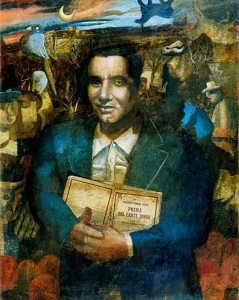
 1773750-6a7cf994821b81cf98b57d3b4a4c6708.jpg
Federico García Lorca (5 juni 1898 – 19 augustus 1936)
Portret door Mick Rooney, 1990-95


De Nederlandse dichter en schrijver Adriaan Morriën werd geboren op 5 juni 1912 in Amsterdam. Zie ook alle tags voor Adriaan Morriën op dit blog.


Spijsvertering

Vergeet je maag niet op een blauwe zomermorgen,
Gevuld met louter aangename dingen:
Sinaasappelsap, bruin brood en yoghurt.
De zuivere nasmaak duurt tot aan de koffie.
Je lichaam is als een tevreden kind,
Verdiept in 't hoge spel der spijsvertering.
Je mond is niet te droog en niet te vochtig.
Je zou nu kunnen praten als er iemand was.
Maar je kunt denken en een droom beginnen.
Je raam staat open en de wereld fladdert binnen.
Zij luistert als een vogel in het pasgemaaide gras.


Terugkeer

Alle revoluties wissen de dood
van mijn moeder niet uit.
En alle vooruitgang hindert niet
dat ik mijn vader heb gehaat.

Ik doe nog altijd, te laat van school,
de stap naar de keukendeur
en licht de klink op, bang
dat de deur weer te hard kraakt.

Alles is mogelijk: mijn vader zwijgt
of leest mij met strenge ogen de les;
mijn moeder glimlacht of kijkt
met een stil gezicht op haar bord.

Ik schik aan tafel aan
en reik, dwars door de verleden tijd
met een hand die weer kinderlijk wordt,
naar de dampende aardappelschaal.


 1773750-1f02271e68144931a8efc86609337702.jpg
Adriaan Morriën (5 juni 1912 – 7 juni 2002)
Borstbeeld door Hans Sassen in het Letterkundig Museum 


De Engelse schrijver Ken Follett werd geboren op 5 juni 1949 in Cardiff, Wales. Zie ook alle tags voor Ken Follett op dit blog.

Uit:Edge Of Eternity

“Rebecca Hoffmann was summoned by the secret police on a rainy Monday in 1961.
It began as an ordinary morning. Her husband drove her to work in his tan Trabant 500. The graceful old streets of central Berlin still had gaps from wartime bombing, except where new concrete buildings stood up like ill-matched false teeth. Hans was thinking about his job as he drove. “The courts serve the judges, the lawyers, the police, the government—everyone except the victims of crime,” he said. “This is to be expected in Western capitalist countries, but under Communism the courts ought surely to serve the people. My colleagues don’t seem to realize that.” Hans worked for the Ministry of Justice.
“We’ve been married almost a year, and I’ve known you for two, but I’ve never met one of your colleagues,” Rebecca said.
“They would bore you,” he said immediately. “They’re all lawyers.” “Any women among them?”
“No. Not in my section, anyway.” Hans’s job was administration: appointing judges, scheduling trials, managing courthouses.
“I’d like to meet them, all the same.”
Hans was a strong man who had learned to rein himself in. Watching him, Rebecca saw in his eyes a familiar flash of anger at her insistence. He controlled it by an effort of will. “I’ll arrange something,” he said. “Perhaps we’ll all go to a bar one evening.”
Hans had been the first man Rebecca met who matched up to her father. He was confident and authoritative, but he always listened to her. He had a good job—not many people had a car of their own in East Germany—and men who worked in the government were usually hard-line Communists, but Hans, surprisingly, shared Rebecca’s political skepticism. Like her father he was tall, handsome, and well dressed. He was the man she had been waiting for.”


 1773750-4b316a68dbb37c9a91e061c36afc5c3d.jpg
Ken Follett (Cardiff, 5 juni 1949)


De Australische schrijfster Margo Lanagan werd geboren op 5 juni 1960 in Waratah, New South Wales. Zie ook alle tags voor Margo Lanagan op dit blog.

Uit: Singing My Sister Down

“We all went down to the tar-pit, with mats to spread our weight.
Ikky was standing on the bank, her hands in a metal twin-loop behind her. She’d stopped sulking; now she looked, more, stare-y and puzzled.
Chief Barnarndra pointed to the pit. Out you go then, girl. You must walk on out there to the middle and stand. When you picked a spot, your people can join you.
So Ik stepped out, very ordinary. She walked out. I thought—hoped, even—she might walk right across and into the thorns the other side; at the same time, I knew she wouldn’t do that.
She walked the way you walk on the tar, except without the arms balancing. She nearly fell from a stumble once, but Mumma hulloo’d to her, and she straightened and walked a straight upright line out to the very middle, where she slowed and stopped, not looking back.
Mumma didn’t look to the chief, but all us kids and the rest did. Right, then, he said.
Mumma stepped straight out, as if she’d just herself that moment happened to decide to. We went after her—only us, Ik’s family, which was like us being punished too, everyone watching us walk out to that girl who was our shame.
In the winter you come to the pit to warm your feet in the tar. You stand long enough to sink as far as your ankles—the littler you are, the longer you can stand. You soak the heat in for as long as the tar doesn’t close over your feet and grip, and it’s as good as warmed boots wrapping your feet. But in summer, like this day, you keep away from the tar, because it makes the air hotter and you mind about the stink.
But today we had to go out, and everyone had to see us go.
Ikky was tall, but she was thin and light from all the worry and prison; she was going to take a long time about sinking. We got our mats down, all the food-parcels and ice-baskets and instruments and such spread out evenly on the broad planks Dash and Felly had carried out.”


 1773750-c582962e274693927aaae90a5265bf62.jpg
Margo Lanagan (Waratah, 5 juni 1960)


De Nederlandse literair criticus Carel Peeters werd geboren in Nijmegen op 5 juni 1944. Zie ook alle tags voor Carel Peeters op dit blog.

Uit: Kan het licht aanblijven?

“Dat de achttiende eeuw de eeuw van de Verlichting en de kritiek was, zoals Kant in de inleiding van zijn Kritik der reinen Vernunft schreef, en dat de Verlichting als filosofie de bedoeling had mensen ‘mondig’ te maken, zoals Kant antwoordde op de vraag ‘Was ist Aufklärung?’ - dat is kennis die weer in herinnering gebracht schijnt te moeten worden, want al wat ik hoor zijn schimpscheuten op de Verlichting. De eeuw van de rede zou de bakermat van de huidige ellende zijn, van de illusoire vooruitgangsgedachte, van staatsbemoeienis, van het verpesten van de natuur en de ongebreidelde woekering van de technologie. Kortom: Der Traum der Vernunft: Vom Elend der Aufklärung, zoals de titel luidde van een reeks lezingen gedurende bijna een jaar lang in 1984-1985 aan de Akademie der Künste in Berlijn.
Tijdens die reeks lezingen waren er ook sprekers als Günter Grass en Oskar Negt die zich niet lieten meeslepen door het enthousiasme de filosofie van de Verlichting om zeep te helpen. Dat is niet zo verbazingwekkend: zelfkritiek is in de Verlichting ingebakken, al ziet men dat graag over het hoofd. ‘Sapere aude!’, de aansporing voor zichzelf te denken die Kant deed, nodigt uit tot een terugkerende ‘Selbstaufklärung der Aufklärung’, zoals de Duitsers dat zo kernachtig kunnen uitdrukken. Maar deze zelfkritiek schijnt niet groot genoeg te zijn geweest, anders zou de Verlichting niet door de Frankfurter Schule, het structuralisme, alle religieuze bewegingen en het postmodernisme zijn aangevallen. Dat zou men kunnen denken, maar alle bijzondere aandacht voor de Verlichting is het gevolg van een gemakzuchtige fixatie. Door de nadruk op de rede en het rationalisme heeft de Verlichting onder meer de industrialisatie voortgebracht, en daarna de technologie en daarmee het misbruik van de technologie. De technologie, in haar vreedzame én verwoestende gedaante, is het meest in het oog lopende gevolg van de Verlichting, en daar richt zich de meeste kritiek op.
De Verlichting heeft niet alleen de technologie voortgebracht, zij heeft ook een rationele instelling tegenover allerlei menselijke en maatschappelijke verschijnselen aangekweekt die men niet met het technologische barbarisme gelijk kan stellen. Wie dat wel doet is als die goudzoeker die zo verblind werd door de glinsteringen van het zand in zijn handen dat hij alles weggooide, ook het goud.”


 1773750-376e8bfb94443ec4c0a6ce4b7ce53c08.jpg
Carel Peeters (Nijmegen, 5 juni 1944) 


Zie voor nog meer schrijvers van de 5e juni ook mijn twee vorige blogs van vandaag.

Geschreven door Romenu om 14:39 Reageer op dit bericht

Margaret Drabble, Kristin Gore, Thomas Kling, Hélène Cixous, Spalding Gray

De Engelse schrijfster Margaret Drabble werd geboren op 5 juni 1939 in Sheffield, Yorkshire. Zie ook alle tags voor Margaret Drabble op dit blog.

Uit: The Millstone

“When, some years after the Hamish episode, I found that I was pregnant, I went through slightly more than the usual degrees of incredulity and shock, for reasons which I doubtless shall be unable to restrain myself from recounting: there was nobody to tell, nobody to ask, so I was obliged once more to fall back on the dimly reported experiences of friends and information I had gleaned through the years from cheap fiction. I never at any point had any intention of going to a doctor: I had not been ill for so many years that I was unaware even of the procedure for visiting one, and felt that even if I did get round to it I would be reprimanded like a school child for my state. I did not feel much in the mood for reproof. So I kept it to myself, and thought that I would try at least to deal with it by myself. It took me some time to summon up the courage: I sat for a whole day in the British Museum, damp with fear, staring blankly at the open pages of Samuel Daniel, and thinking about gin. I knew vaguely about gin, that it was supposed to do something or other to the womb, quinine or something, I believe, and that combined with a hot bath it sometimes works, so I decided that other girls had gone through with it, so why not me. One might be lucky. I had no idea how much gin one was supposed to consume, but I had a nasty feeling that it was a whole bottle: the prospect of this upset me both physically and financially. I grudged the thought of two pounds on a bottle of gin, just to make myself ill. However, I couldn't pretend that I couldn't afford it, and it was relatively cheap compared with other methods, so I grimly turned the pages of Daniel and decided that I would give it a try. As I turned the pages, a very handy image, thesis-wise, caught my attention, and I noted it down. Lucky in work, unlucky in love. Love is of man's life a thing apart, 'tis woman's whole existence, as Byron mistakenly remarked.”


 1773746-514b9a15f8b6ab5cc8b196720b8dbac6.jpg
Margaret Drabble (Sheffield, 5 juni 1939)


De Amerikaanse schrijfster Kristin Carlson Gore werd geboren op 5 juni 1977 in Carthage, Tennessee Zie ook alle tags voor Kristin Gore op dit blog.

Uit: Sammy's House

"Just what is this all about?" he demanded fiercely, painfully aware of all the photos that had already been taken. There wasn't any press aboard; the cruise was for staff only. But though everyone was ostensibly loyally intent on protecting the administration from unnecessary scandal, it was hard to keep a story like this from getting out. I myself could think of five people I planned to regale immediately with this sordid tale. It wasn't often that one attended an office function and got entertained by a scantily clad exhibitionist inked with dancing fantasy creatures. It would be selfish to keep this to myself. "I'm a gift from the Exterminators," the stripper answered. "They say congratulations for making it this far. They didn't think you had it in you." I watched Harry's jawline stiffen. When he got angry, which was distressingly often, he looked like he'd had steel cheek implants. I'd met few people more ripe for a hernia. "Thank you, that will be all," he ground out through clenched teeth.
Harry and a couple Secret Service agents ushered the woman through the still-stunned crowd toward the caterers' station. The hushed silence that had accompanied her performance exploded into the sounds of a hundred and seventy-five people talking at once. The Exterminators were a very disgruntled band of former officials from the previous administration. Most of them had stayed in D.C. to form an opposition think tank, and nothing seemed to please them more than perpetrating juvenile pranks while they worked very seriously to sabotage every policy change we tried to make. They hadn't named their think tank the Exterminators. That particular moniker derived from one of the many vindictive stunts they'd pulled on their way out of the West Wing, which they had vandalized to the best of their abilities in a rage against their ouster. In addition to rigging booby traps and carving their initials into various pieces of furniture, they had also taken the time to enact a much more elaborate and dastardly scheme."


 1773746-4a24f7ca6ead16c3ab02a3ab01a19203.jpg
Kristin Gore (Carthage, 5 juni 1977)
Hier te midden van vader Al Gore en moeder Tipper


De Duitse dichter en schrijver Thomas Kling werd geboren op 5 juni 1957 in Bingen. Zie ook alle tags voor Thomas Kling op dit blog.


Mailand. Ambrosianische Litanei 2

auf eine halbsäule hin gemalt
steht ein junger mann: lebensgroßer
melancholiker – typ aus untersicht gesehen.
athlet, der auf die zweiten blicke sich entpuppt.

betrachten ist schmerzforschung.
kahlheit nackter bildprogramme.
sirrendes, singendes, zuletzt ein
stummgemachtes fleisch.

dies ist der heilige mit der eignen haut (attribut);
in kniehöhe sein schopf: dort
baumelt die apostelhülle, struppig,
ein ziemlich totes angesicht.

so stehen dulder. ein geschundenes bild.
der haut entkleidet. mit rosigem kopf: ein
bartholomäus, die haut überm arm wie
regenhaut. dazu die patientenglatze – sieht aus
wie von der chemotherapie.

die vorgewiesenen attribute: ein messer, keine spritze.
und muß mit links, mit eleganz, sein lebensgroßes hautbild
halten, den lebensnahen, totengrauen skalp.
der aderzeichen zeigt: das bild das ihm
sonst runterrutschen würde von der schulter.
der nimmt das hin; ist schinderwerk.
ein bildprogramm, termingerecht geliefert –

ein sonderbarer heiliger, seitlich angebracht.
ein weihrauch-echo. (fresko)


 1773746-4d570d1926c3b54e7d17dae160bbbe81.jpg
Thomas Kling (5 juni 1957 - 1 april 2005)


De Franse feministische schrijfster, dichteres, professor, filosoof, literair criticus en historica Hélène Cixous werd geboren in Oran, Algerije, op 5 juni 1937. Zie ook alle tags voor Hélène Cixous op dit blog.

Uit: Si près

«Je connais un poète qui est mort dans l'escalier, le jour où il partait dans un pays où il n'était plus plus jamais revenu. Tous ces pays dont on ne revient pas où on ne revient pas où on va revenir où on revient tellement en pensée qu'il est difficile de faire la différence entre aller, ne pas aller, et aller ne pas aller, on passe des années dans la lumière lunaire de l'aéroport. On y est attaché par le pacte le plus antique et le bien moins connu, le pacte d'être un né ou un mort de ce pays. Il n'y a pas d'explication. Il y a un cordon ombilical. C'est une ombre de cordon, un cordon immatériel dont on sent l'effet planté dans le cervelet. Nous sommes des conséquences. Il y a les cellules, dit mon aimé. Moi, je songe à aller à Alger depuis une dizaine d'années. Par précaution j'utilise le verbe " aller". Mes cellules ne suivent pas. Elles font comme si je disais : "retourner". J'attends.
(…)

Il fut un temps. Ce temps je le sais d'un savoir désaffecté. J'ai voulu arriver en Algérie, il aurait peut-être mieux valu moi que j'y atteigne, mais c'était impossible. Si bien que j'ai atteint l'impossibilité et cela sans l'avoir calculé.(...) "Atteindre l'impossibilité" n'est ni un but, ni une possibilité, c'est une impossibilité délivrée en notre absence. Ai-je jamais cru, espéré, décrocher le faîte du désir ? (...) il se peut qu'ai couvé en moi l'ombre d'une sensation de vanité, une de ces formes furtives de pressentiment que l'on chasse d'un souffle(...) Ces retropressentiments de fatalité, je leur ai accordé une importance décisive en 1993, l'année où je n'ai plus réussi à faire obstacle à l'entrée de la Chose Algérie dans mes livres. Reconnaître que je n'avais jamais crû arriver un jour en Algérie, en vérité, et tenter de m'approcher de la Chose par les puissants moyens de la littérature, les deux faits se sont produits à la même époque."


 1773746-38cea88bd4e7236a0a049251adf3799a.jpg
Hélène Cixous (Oran, 5 juni 1937)


De Amerikaanse schrijver en acteur Spalding Gray werd geboren op 5 juni 1941 in Barrington, Rhode Island. Zie ook alle tags voor Spalding Gray op dit blog.

Uit:Swimming to Cambodia

“This bombing went on for five years. The Supreme Court never passed any judgment on it and the military speaks with pride today that five years of the bombing of Cambodia killed 16,000 of the so-called enemy. That's 25% killed, and there's a military ruling that says you cannot kill more than 10% of the enemy without causing irreversible, psychological damage. So, five years of bombing, a diet of bark, bugs, lizards and leaves up in the Cambodian jungles, uh, an education in Paris environs in a strict Maoist doctrine with a touch of Rousseau, and other things that we will probably never know about in our lifetime -- including, perhaps, an invisible cloud of evil that circles the Earth and lands at random in places like Iran, Beirut, Germany, Cambodia, America -- set the Khymer Rouge out to carry out the worst auto-homeo genocide in modern history.
(…)

What a fantastic land it was, how it was Shangri-La before it was colonized... Thailand was a Nordic country compared to Cambodia, and they're right next to each other. And he said 90% of the land was owned by the people; it was earth, it was dirt, but it was THEIRS, and it was good. And-and they knew how to have a good time. They knew how to have a good time. They knew how to have a good time getting born, a good time growing up, a good time going through puberty, a good time falling in love, a good time staying in love, a good time getting married, a good time staying married, a good time having children, a good time raising children, a good time growing old, a good time dying... they even knew how to have a good time on NEW YEAR'S EVE! I couldn't believe it!”


 1773746-c07dfced23d8d723051db38a0637556a.jpg
Spalding Gray (5 juni 1941 – 10 januari 2004)


Zie voor nog meer schrijvers van de 5e juni ook mijn vorige blog van vandaag.

Geschreven door Romenu om 14:29 Reageer op dit bericht

Christy Brown, David Hare, Alifa Rifaat, Otto F. Walter, Ivy Compton-Burnett

De Ierse dichter, schrijver en schilder Christy Brown werd geboren op 5 juni 1932 in Dublin. Zie ook alle tags voor Christy Brown op dit blog.

Uit:My Left Foot

“I was born in the Rotunda Hospital, on June 5th, 1932. There were nine children before me and twelve after me, so I myself belong to the middle group. Out of this total of twenty-two, seventeen lived, but four died in infancy, leaving thirteen still to hold the family fort.
Mine was a difficult birth, I am told. Both mother and son almost died. A whole army of relations queued up outside the hospital until the small hours of the morning, waiting for news and praying furiously that it would be good.
After my birth Mother was sent to recuperate for some weeks and I was kept in the hospital while she was away. I remained there for some time, without name, for I wasn't baptized until my mother was well enough to bring me to church.
It was Mother who first saw that there was something wrong with me. I was about four months old at the time. She noticed that my head had a habit of falling backward whenever she tried to feed me. She attempted to correct this by placing her hand on the back of my neck to keep it steady. But when she took it away, back it would drop again. That was the first warning sign. Then she became aware of other defects as I got older. She saw that my hands were clenched nearly all of the time and were inclined to twine behind my back; my mouth couldn't grasp the teat of the bottle because even at that early age my jaws would either lock together tightly, so that it was impossible for her to open them, or they would suddenly become limp and fall loose, dragging my whole mouth to one side. At six months I could not sit up without having a mountain of pillows around me. At twelve months it was the same.”


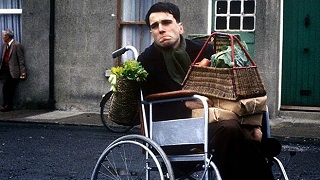
 1773741-14d12013455ab2b759f1c34f701a8cfd.jpg
Christy Brown (5 juni 1932 – 6 september 1981)
Daniel Day-Lewis als Christy in de film “My Left Foot” uit 1989 


De Britse schrijver, dramaturg en regisseur David Hare werd geboren op 5 juni 1947 in Sussex. Zie ook alle tags voor David Hare op dit blog.

Uit: Wall: A Monologue

« Except, of course, they don’t call it a wall. They call it a fence.
It’s one of those things, there seem to be so many, don’t there?—I’m thinking of abortion, or armed revolt—where the words you use—pro-life/pro-choice, terrorist/freedom fighter—tell the world which way you think. Words become flags, they announce which side you’re on. In this case, literally. The Israelis call it the gader ha’harfrada, which in Hebrew means “separation fence.” The Palestinians don’t call it that. Not at all. They call it jidar al-fasl al-‘unsuri, which in Arabic means “racial segregation wall.”
OK, let’s go coolly into this, shall we? If I use one word or the other, forgive me, it does not imply I am partisan. I have acquaintances on both sides of the fence and on both sides of the wall. “I hate the wall,” say my Israeli friends. “I regret it.” “I’m ashamed of the wall.” “I drive for miles so that I don’t have to see it. But it works. 80 percent of terrorist attacks against Israel have stopped. Have been stopped. Am I not meant to be pleased about that?”
Very well. I shall seek to describe the history of the wall.”


 1773741-a52f5f33a789d350e4278c5705650d54.jpg
David Hare (Sussex, 5 juni 1947)


De Egyptische schrijfster Alifa Rifaat werd op 5 juni 1930 in Caïro geboren. Zie voor onderstaande schrijfster ook alle tags voor Ailfa Rifaat op dit blog.

Uit: Another Evening at the Club

“In a state of tension. she awaited the return of her husband. At a loss to predict what would happen between them, she moved herself back and forth in the rocking chair on the wide wooden verandah that ran along the bank and occupied part of the river itself. its supports being fixed in the river bed. while around it grew grasses and reeds. As though to banish her apprehension, she passed her fingers across her hair. The spectres of the eucalyptus trees ranged along the garden fence rocked before her gaze. with white egrets slumbering on their high branches like huge white flowers among the thin leaves.
The crescent moon rose from behind the eastern mountains and the peaks of the gently stirring waves glistened in its feeble rays, intermingled with threads of light leaking from the houses of Manfalout scattered along the opposite bank. The coloured bulbs fixed to the trees in the garden of the club at the far end of the town stood out against the surrounding darkness. Somewhere over there her husband now sat, most likely engrossed in agame of chess.
It was only a few years ago that she had first laid eyes on him at her father‘s house, meeting his gaze that weighed up her beauty and priced it before offering the dowry. She had noted his eyes ranging over her as she presented him with the coffee in the Japanese cups that were kept safely locked away in the cupboard for important guests.”


 1773741-cc093466e63c11526e5edd22774f91f9.jpg
Alifa Rifaat (5 juni 1930 - 4 januari 1996)
Cover (geen portret beschikbaar)


De Zwitserse schrijver en uitgever Otto Friedrich Walter werd geboren op 5 juni 1928 in Rickenbach. Zie ook alle tags voor Otto. F. Walter op dit blog.

Uit: Herr Tourel

“Den Kopf kann ich auf meine Tasche legen; hinter mir, mit der Hand von hier aus eben noch zu erreichen, die Eingangstür. Da oben die Dachpappe über den angefaulten Balken, darüber, soviel ich gestern noch feststellen konnte, noch immer die aufgeschlitzten, flachgetrampelten und festgenagelten Teerfässer, verbeulte Blechstücke, schwarzrot. So waren sie schon damals, als wir da drüben am linken Aareufer noch badeten, vor, nun, fünfundzwanzig Jahre mögens her sein. Da hört mich niemand. Aber also mit einem Wort: ich bin zurückgekommen, zufällig, ich bin gestern zufällig wieder in die Gegend gekommen. Vielleicht muß ich kurz vorausschicken: ich habe hier in Jammers meine frühe Kindheit verbracht, wie man so sagt. Oben in der Stadt, in einem der alten Ringmauerhäuser. Mit elf Jahren kam ich fort, zunächst in die Klosterschule der Zisterzienser nach Sankt Leonhard, später habe ich bei Zoller & Co. in Fahris drüben während vier Jahren Photographie gelernt. Für ein Jahr war ich danach als Volontär und mit der Absicht, Französisch zu lernen, bei Auquier, Photogeschäft, in Aubonne, nordwestlich von Lausanne. Anschließend verbrachte ich ein halbes Jahr in dem, was wir hierzulande als Rekrutenschule bezeichnen.
Schon nach drei Monaten führte ich eine Gruppe. Tourel, pflegte unser Leutnant zu mir zu sagen, Sie sollten unbedingt Offizier werden. Aber ich lehnte ab. Ich kehrte als Angestellter zu meinem ehemaligen Chef nach Fahris zurück. Dort bin ich zwölf Jahre lang geblieben, und ich darf sagen, zunächst als zweiter, dann als erster Angestellter habe ich mir eine weithin geachtete Position erarbeitet. Herr Zoller senior ist jederzeit bereit, das zu bestätigen. Er hat mir ein entsprechend hervorragendes Zeugnis mitgegeben, und ich kann nur erneut erklären, daß es sich bei den meinen Wegzug von Fahris betreffenden Gerüchten um eigentliche Verleumdungen handelt.“


 1773741-b373790f0a0643896add305a6e883c64.jpg
Otto F. Walter (5 juni 1928 – 24 september 1994)


De Engelse schrijfster Ivy Compton-Burnett werd geboren op 5 juni 1884. Zie ook alle tags voor Ivy Compton-Burnett op dit blog.


Uit: A House and Its Head

“Duncan stood in the hall, with hat and book, in an attitude of being on the point of leaving the house. The young people stood about, still and silent, until Grant and Nance met each other’s eyes and broke into laughter.
Duncan breathed more audibly and maintained his position, but as the laughter increased, he dropped his book, and signed sharply to Grant to retrieve it. Grant took a moment to follow, and Sibyl was before him; and Duncan idly dropped it again, and motioned his nephew to obedience.
Ellen came hurrying down the stairs, her avoidable haste acting in its normal way upon her husband. He remained as he was, until she came up, and then without turning his eyes upon her, walked from the house
.”


 1773741-a99a672839e3dde51b08935da28ab6b8.jpg
Ivy Compton-Burnett (5 juni 1884 - 27 augustus 1969)

Geschreven door Romenu om 14:20 Reageer op dit bericht

Robert Franquinet

De Nederlandse dichter, schrijver en schilder Robert Marie Philmain Joseph Franquinet werd geboren in Amby (bij Maastricht) op 5 juni 1915. Franquinet debuteerde in 1933 als jong katholiek dichter met de bundel Het vroege uur. De barokke taal in die eersteling heeft hem zijn leven lang niet meer verlaten. Na een fervent belijden van het katholicisme werd hij steeds kritischer en nam hij afstand van zijn katholieke tijdgenoten. Hij publiceerde regelmatig in het tijdschrift Forum en ontwikkelde zich als essayist en romanschrijver. WO II, waarvan hij een jaar in de gevangenis doorbracht, is de breuk in zijn leven: alle romans en poëzie van na deze tijd cirkelen rond het thema van geweld en zijn tegenstrevers liefde en erotiek. Na de oorlog vestigde hij zich in Parijs en verdween hij langzaam van het literaire toneel, ondanks het feit dat hij door Marsman, Greshoff en Vestdijk tot de belangrijke auteurs werd gerekend. Met zijn roman “Drijfzand” (1977) begon echter een herwaardering van Franquinet.

Uit: Drijfzand

““Wanneer is onder mijn schedel het ruisen begonnen? Herinneringen zijn ontastbare obstakels geworden. Valt er ooit nog stilte over het woud van verminkingen? Wie ben ik geworden? Een schrale boom in de mist. Een bed in een uitdragerszaak. Een drijvend ding in het schuim van afvoerwater. Lang voordat de schimmels van de weemoed woekerden. Afscheid? Dit en dat moesten we nog doen. Een val in de kale ruimteloosheid spannen van wat nog zelfverdediging genoemd kan worden. Hebben we geen feilloze kennis van elkaar? We beminden als ongekooide honden. Een langspeelplaat die altijd draait is als de vorm van iemands handen die in troebel water zijn omtrek verliest. In de wulpsheid van je vlees hoor ik de stem van de gevangene jammerend schreeuwen. Wie van jullie heeft de straf bedacht? Het plat van zijn voeten wordt opengesneden, het vel gesperd, gevuld met kleine spijkers en daarna weer dichtgenaaid. Hij wordt naar de woestijn gebracht, ver van het dorp. Hij wordt aan zijn lot overgelaten, gillend van de pijn wanneer hij staan of gaan wil. Woestijngieren laten een kadaver de tijd niet om uit te drogen in de brandende sirocco.
De man heeft een parkiet gestolen.
‘En jij opent je ogen en blijft glimlachend liggen.’
‘Je moet bij zulke dingen niet teveel nadenken,’ zeg je.
‘Je kijkt naar de muur aan de overkant alsof daar de verloren tijd staat aangetekend. Het irriteert me dat ik je over de dingen-achter-de-dingen moet spreken.’
‘Nee, geen uitleg. Waarom? Dat vogeltje is een turkooiskleurige schaduw, maar men kan het liefhebben.’
‘Doe niet belachelijk.’
En ik bedroefd: ‘de eerste keer in Normandië.’
Er komt een nuance in de plooi van je mondhoek. Ik huiver om de koelte van je ogen en raak met een vinger de rand van je mond aan. En je trilt als het wateroppervlak tegen mijn lichaam voor dat onze monden hun vocht mengen. Nou, ja, wat doe ik met mijn onuitgesproken minachting? Zo gaat het altijd. De werkelijkheid is sneller dan de onwerkelijkheid. Afstand? Veel later. Maar de tijd krimpt als een overwinterde appel.”


 1916427-0d55d733ec6a29b05910754ea36020ad.jpg
Robert Franquinet (5 juni 1915 - 30 mei 1979)

Geschreven door Romenu om 00:00 Reageer op dit bericht

Meer van Romenu

↑ Terug naar de berichten