

Naar de inhoud

Romenu

Over literatuur, gedichten, kunst en cultuur
akke.beakke.be

Berichten van 7 december 2015 tot 8 december 2015

Jamal Ouariachi, Louis de Bernières, Bill Bryson, Mary Gordon, Delmore Schwartz, Jim Morrison, Georges Feydeau
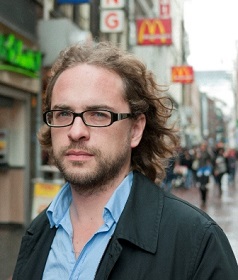
De Nederlandse schrijver Jamal Ouariachi werd geboren in Amsterdam op 8 december 1978. Zie ook alle tags voor Jamal Ouariachi op dit blog.

Uit: De Vernietiging van Prosper Morèl

“Geen antwoord.
‘De gaten in de kaas, mevrouw! Greppels waar onsmakelijk groen water doorheen stroomt! Is dat het gezicht van Amsterdam? Een klysma dat de aars van de stad reinigt? Ik mag toch hopen van niet!’
Gespeelde verontwaardiging in zijn wijd opengesperde ogen. Wij lachten gul, ’t was een artiest, die gids, een echte showman, en zo deskundig ook op z’n vakgebied.
‘Bovendien zijn grachten niet uniek voor Amsterdam; Utrecht heeft ze ook. En wat dacht u van Venetië? Juist... I rest my case.’
De dame lachte beschaamd haar vernedering weg, de gids maakte een verzoenend geeftniksgebaar en hervatte zijn verhaal op een serieuzere toon.
‘Laat ik zelf eens wat kandidaatsymbolen noemen. De grachtenpánden misschien, met hun pittoreske gevels? Zeker een belangrijk kenmerk van de oude binnenstad, maar het probleem is: er zijn er te veel van! Er bestaat niet zoiets als één archetypische gevel, die ene gevel waar iedereen meteen aan denkt als je “Amsterdam” zegt... Conclusie: ook de grachtenpanden voldoen niet.’
Wij voelden vaaglijk aan waar de gids heen wilde met zijn verhaal:de kolossale, bijna angstaanjagende toren, daar achter hem, viel niet te negeren. Maar zover was hij nog niet, de gids, hij was een man die zijn eigen woordegraag hoorde en er daarom de tijd voor nam, hij had geen haast, dat gebouw bleef wel staan.
‘Wat hebben we nog meer? Het Rijksmuseum? De Westerkerktoren? Het Paleis op de Dam? U gaat die prachtwerken de komende dagen allemaal zien, dames en heren, maar er zit geen icoon tussen die alle andere overbodig maakt. Kunt u nagaan, ik leid deze stadswandelingen al jaren, en al die tijd ben ik op zoek geweest naar een samenvatting, naar één woord om de stad te kenschetsen. Tevergeefs, zo leek het.”


 1848895-2e98c1bb718f84244addd4b9bd30fd81.jpg
Jamal Ouariachi (Amsterdam, 8 december 1978)


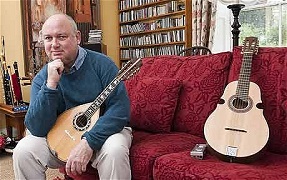
De Britse schrijver Louis de Bernières werd geboren in Londen op 8 december 1954. Zie ook alle tags voor Louis de Bernières op dit blog.


When the time comes

When the time comes, it is better that death be welcome,
As an old friend who embraces and forgives.
Sieze advantage of what little time is left,
And if imagination serves, if strength endures, if memory lives,
Ponder on those vanished loves, those jesting faces.
Take once more their hands and press them to your cheek,
Think of you and them as young again, as running in the fields,
As drinking wine and laughing.
And if you wish, let there be Spanish music, Greek seas
And French sun, the hills of Ireland if you loved them,
Some other place if that should please, some other music
More suited to your taste.
Consider, if you can, that
Soon you’ll shed this weariness, this pain,
The heaped-upon indignities, and afterwards - who knows?
Perhaps you’ll walk with angels, should angels be,
By fresher meadows, unfamiliar streams.
You may find that those who did not love you do so now,
That those who loved you did so more than you believed.
You may go on to better lives and other worlds.
You may meet God, directly or disguised.
You may, on the other hand - who knows? - just wander off
To sleep that seamless, darkest, dreamless, unimaginable sleep.
Do not be bitter, no world lasts forever.
You who travelled like Odysseus,
This is Ithaca, this your destination,
This your last adventure. Here is my hand,
The living to the dying;
Yours will grow cold in mine, when the time comes.
 

 1848895-54edbf46cdbea743ea3ef3eaf6448899.jpg
Louis de Bernières (Londen, 8 december 1954)


De Amerikaanse schrijfster Mary Catherine Gordon werd geboren op 8 december 1949 in Far Rockaway, New York. Zie ook alle tags voor Mary Gordon op dit blog.

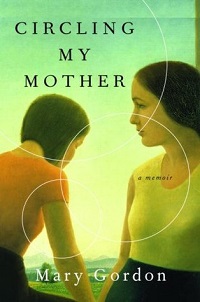
Uit:Circling My Mother

“My mother was once a beautiful woman, but all her teeth are gone now. Toothless, no woman can be considered beautiful. Whenever I arrive, she is sitting at the table in the common dining room, her head in her hands, rocking. Medication has eased her anxiety, but nothing moves her from her stupor except occasional moments of fear, too deep for medication. This is a room that has no windows, that lets in no light, in which an overlarge TV is constantly blaring, sending images that no one looks at, where the floors are beige tiles, the walls cream-colored at the bottom, papered halfway up with a pattern of nearly invisible grayish leaves. Many of the residents sit staring, slack-jawed, open-mouthed. I find it impossible to imagine what they might be looking at.
It is difficult to meet the eyes of these people; it is difficult to look at their faces. I wonder if Bonnard could do anything with this lightless room. If he could enter it, see in these suffering people, including my mother, especially my mother, only a series of shapes and forms, concentrate on the colors of their clothing (a red sweater here, a blue shirt there), transform the blaring images on the TV screen to a series of vivid rectangles, and, failing to differentiate, insisting on the falseness of distinctions, of an overly rigid individuality, saying that we must get over the idea that the features of the face are the important part-would he be able to create a scene of beauty from this scene, which is, to me, nearly unbearable? He once told friends that he had spent much of his life trying to understand the secret of white. How I envy him such a pure preoccupation, so removed from the inevitable degradations of human character and fate. So he could paint wilting flowers, overripe fruit, and make of them a richer kind of beauty, like the nearly deliquescing purple grapes, the visibly softening bananas of Bowl of Fruit, 1933. "He let the flowers wilt and then he started painting; he said that way they would have more presence," his housekeeper once said."
 

 1848895-64ff20c50d00e22b830e951af8759674.jpg
Mary Gordon (Far Rockaway, 8 december 1949)
Cover


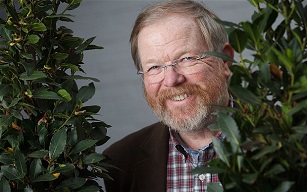
De Amerikaanse schrijver Bill Bryson werd geboren in Des Moines (Iowa) op 8 december 1951. Zie ook alle tags voor Bill Bryson op dit blog.

Uit:The Road to Little Dribbling

“I had never really stopped to consider what an extraordinary thing the Royal National Lifeboat Institution is. Think about it. A troubled ship calls for help, and eight people – teachers, plumbers, the guy who runs the pub – drop everything and put to sea, whatever the weather, asking no questions, imperilling their own lives, to try to help strangers. Is there anything more brave and noble than that?”
(..)

“Formerly there were two ways. One was to take the ferry. This is the way I came on my first visit, and I have to say it was strange. All the passengers – and there weren’t many – went below and lay down on whatever horizontal surface they could find. Many covered their faces with their coats, as if hiding. Just after we left port, the snack bar closed. All this seemed a little odd, and then we hit the open sea and we began to roll and pitch in a weirdly restrained way. I am not the most experienced of sailors, but I have been on a few boats in my time – including once through the Beagle Channel in South America, which isn’t so much a water passage as a trampoline for boats – and I can say that I had never encountered anything quite like this. It wasn’t rough, but just slowly, cumulatively, peculiarly unsettling. The problem, as it was explained to me later, is that the ferry must have a flat bottom to get in among the shallows around St Mary’s, the main port of the Scillies, but this means that it sits on the water like a cork, which guarantees a lot of motion even on the smoothest days. In rough weather, I was told, you will often have the novel experience of being sick on the ceiling.”
 

 1848895-d04430bef53ebb7bb1fa9fa335b7e745.jpg
Bill Bryson (Des Moines, 8 december 1951)


De Amerikaanse dichter en schrijver Delmore Schwartz werd geboren op 8 december 1913 in New York. Zie ook alle tags voor Delmore Schwarz op dit blog.


Calmly We Walk Through This April's Day

Calmly we walk through this April's day,
Metropolitan poetry here and there,
In the park sit pauper and rentier,
The screaming children, the motor-car
Fugitive about us, running away,
Between the worker and the millionaire
Number provides all distances,
It is Nineteen Thirty-Seven now,
Many great dears are taken away,
What will become of you and me
(This is the school in which we learn...)
Besides the photo and the memory?
(...that time is the fire in which we burn.)

(This is the school in which we learn...)
What is the self amid this blaze?
What am I now that I was then
Which I shall suffer and act again,
The theodicy I wrote in my high school days
Restored all life from infancy,
The children shouting are bright as they run
(This is the school in which they learn . . .)
Ravished entirely in their passing play!
(...that time is the fire in which they burn.)

Avid its rush, that reeling blaze!
Where is my father and Eleanor?
Not where are they now, dead seven years,
But what they were then?
No more? No more?
From Nineteen-Fourteen to the present day,
Bert Spira and Rhoda consume, consume
Not where they are now (where are they now?)
But what they were then, both beautiful;

Each minute bursts in the burning room,
The great globe reels in the solar fire,
Spinning the trivial and unique away.
(How all things flash! How all things flare!)
What am I now that I was then?
May memory restore again and again
The smallest color of the smallest day:
Time is the school in which we learn,
Time is the fire in which we burn.
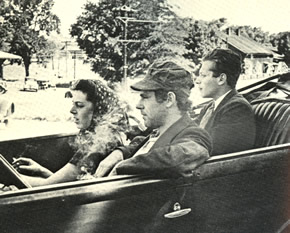
 

 1848895-15cb02c78567ff0c82f85f99c1e4a5e9.jpg
Delmore Schwartz (8 december 1913 – 11 juli 1966)
Hier in de auto achter Alma en James Agee in 1939


De Amerikaanse zanger, dichter en tekstschrijver James Douglas (Jim) Morrison werd geboren in Melbourne (Florida) op 8 december 1943.Zie ook alle tags voor Jim Morrison op dit blog.


What are you doing here?
 
What are you doing here?
What do you want?
Is it music?
We can play music.
But you want more.
You want something & someone new.
Am I right?
Of course I am.
You want ecstasy
Desire & dreams.
Things not exactly what they seem.
I lead you this way, he pulls that way.
I'm not singing to an imaginary girl.
I'm talking to you, my self.
Let's recreate the world.
The palace of conception is burning.

Look. See it burn.
Bask in the warm hot coals.

You're too young to be old
You don't need to be told
You want to see things as they are.
You know exactly what I do
Everything
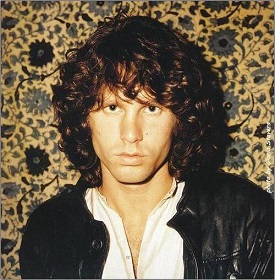
 

 1848895-8541dd68d9dea98a5e83f8d01ed933c6.jpg
Jim Morrison (8 december 1943 – 3 juli 1971)


De Franse theaterauteur Georges Feydeau werd geboren op 8 december 1862 in Parijs. Zie ook alle tags voor George Feydeau op dit blog.

Uit: Le dindon

« « PONTAGNAC. – Eh bien ! en voilà une surprise !...
VATELIN. – Comment « en voilà une surprise ! » puisque vous êtes chez moi, vous deviez bien vous attendre à m’y trouver.
PONTAGNAC. – Hein ?... non... je veux dire : en voilà une surprise que je vous fais, hein ?
VATELIN. – Ah ça ! oui, par exemple !
LUCIENNE. – Ah bien ! elle est forte ! (À Vatelin.) Comment, tu connais monsieur ?
VATELIN. – Si je le connais !
PONTAGNAC , affolé. – Oui... oui, il me... (Perdant la tête, prenant un louis de sa poche et le mettant dans la main de Lucienne.) Tenez, prenez ça ! pas un mot ! pas un mot !
LUCIENNE, ahurie. – Hein ! il me donne un louis !
VATELIN, qui n’a pas vu le jeu de scène. – Eh bien ! qu’est-ce que vous avez ?
PONTAGNAC. – Moi, je n’ai rien ! Qu’est-ce que vous voulez que j’aie ?
Vatelin remonte un peu.
LUCIENNE, bas.– Mais, monsieur, reprenez ça ! Qu’est-ce que vous voulez que je fasse de ce louis ?
PONTAGNAC.– Oh ! pardon, madame ! (À part.) Je ne sais plus ce que je fais ! Je perds la tête !
VATELIN. – Ah ! ce brave ami ! Vrai, vous ne sauriez croire combien je suis sensible ! Moi qui avais renoncé à l’espoir de vous recevoir jamais chez moi, vous qui m’aviez promis si souvent... »
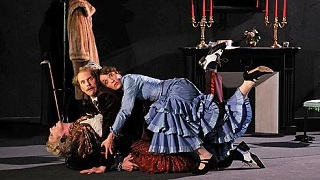
 

 1848895-14511cb1e20b353bb8ff3abdf46c3827.jpg
Georges Feydeau (8 december 1862 - 5 juni 1921)
Scene uit een opvoering in Parijs, 2010


Zie voor nog meer schrijvers van de 8e december ook mijn blog van 8 december 2014 en ook mijn blog van 8 december 2013 deel 1 en ook deel 2.
Geschreven door Romenu om 18:24 Reageer op dit bericht

Tatamkhulu Afrika, Johann Nestroy, Joyce Cary, Gabriel Marcel, Willa Cather, Noam Chomsky

De Zuid-Afrikaanse dichter en schrijver Tatamkhulu Afrika werd geboren op 7 december 1920 in Egypte. Zie ook alle tags voor Tatamkhulu Afrika op dit blog.

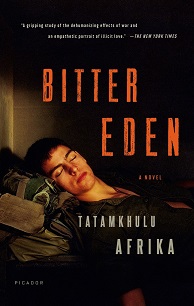
Uit:Bitter Eden

“Do I love her? ‘Love’ is a word that frightens me in the way that these two letters frighten me and if I were to say ‘yes’, I would qualify that by adding that – in our case and from my side – love is an emotion too often threatened by ennui to attain to the grand passion for which I have long since ceased to hope.
Certainly, though, I loved her enough to be able to say, ‘No, everything is fine,’ and turn around and smile into the once so startling blue eyes that now – under certain lights and when looked at in a certain way – have faded into the almost as startling white stare of the blind.
Whether she believed me or not, I cannot say, and equally do I not know why I have bothered to even mention a wife, and a second one at that – the first having absconded to fleshlier fields a lifetime ago – who does not in any way figure in the now so distant and tangled happenings with which the letters deal. Or do I, indeed, know why and have I subconsciously allowed Carina to surface in a manner and image that have more to do with me than her and that will save me the pain of having to explain in so many words why, in those years of warping and war, an oddness in my psyche became set in stone?
Whatever the case, I am now back with the package and the letters, leaving Carina sleeping – or pretending to, she being disconcertingly perceptive at times – and no commonplace papers or gulls beyond the window to divert me: only a darkness that is as inward as it is outward as – yielding to the persuasion of the tide I thought had ebbed beyond recall – I turn to the package and start to unwrap it, then stop, not wanting this from him and as afraid of it as though it held his severed hand.
Or is this all fancifulness? Am I permitting a phantom a power that belongs to me alone? What relevance do they still have – a war that time has tamed into the damp squib of every other war, a love whose strangeness is best left buried where it lies?
Haplessly, unable to resist, I listen for the nightingale that will never sing again, hear only the screaming of an ambulance or a patrol car, a woman crying to deaf ears of a murder or a raping in a lane, and lower my face into the emptiness of my hands.”


 1848477-43c45be3b150132a30c00f7d78ffc0f3.jpg
Tatamkhulu Afrika (7 december 1920 – 23 december 2002)


De Oostenrijkse schrijver Johann Nepomuk Eduard Ambrosius Nestroy werd geboren in Wenen op 7 december 1801. Zie ook alle tags voor Johann Nestroy op dit blog.

Uit: Der Unbedeutende

„„Erster Akt
Die Bühne stellt eine Waldpartie am Ufer eines Flusses vor, nur zwei Kulissen tief, links am Ufer ist eine Rasenbank, weiter vorne links ein Gebüsch; es ist Abend mit Vollmondbeleuchtung.
Erste Szene
Fräulein Ottilie, dann Puffmann.
Ottilie (rechts auftretend). Nun wird es Zeit sein – alle Vorkehrungen sind getroffen. – (Sich nochmals vorsichtig umsehend.) Ich gebe ihm das Zeichen. (Klatscht dreimal in die Hände.)
Puffmann (kommt aus dem Gebüsche links). Da bin ich, darf mein Schützling –
Ottilie (mit Beklommenheit). Sogleich –
Puffmann (hervoreilend). Ist Ihnen etwas, meine Gnädige?
Ottilie. Ich fühle eine Bangigkeit –
Puffmann. Warum? Ihnen betrifft es ja nicht.
Ottilie. Und doch klopft mir das Herz, als ob ich selbst entführt würde.
Puffmann. Das sind übertriebene Phantasiebilder, die man mit Brausepulver und Krebsaugen –
Ottilie. Bringen Sie ihn! (Geht Seite rechts ab.)
Zweite Szene
Puffmann, dann von Gröning.
Puffmann (der abgegangenen Ottilie nachrufend). Wird augenblicklich da sein. (Ein Schnupftuch hervorziehend.) Ein Schnupftüchelwinker, und alle Ersten-Mai-Läufer sind beschämt! (Er winkt mit dem Tuche links in die Kulisse.) Die Flagge der Liebe mag wehen.
Von Gröning (kommt eiligst aus links). Hermine, Geliebte! –
Puffmann. Aushalten! Nur einige Sekunden noch!
Von Gröning (ihm ein Papier gebend). Hier, Freund, nehmen Sie eine Anweisung auf die doppelte Summe.
Puffmann (entzückt). Also tausend Dukaten?? – Glänzender Belohner, jetzt freut's mich erst, daß ich das Dokumentwagstück unternommen hab'. (Gibt ihm eine Schrift.) Nehmen Sie!”


 1848477-3ee48c0aa6ea21363a5cef0a183f6ebc.jpg
Johann Nestroy (7 december 1801 - 25 mei 1862) 
Cover


De Brits - Ierse schrijver Arthur Joyce Lunel Cary werd geboren op 7 december 1888 in Derry, Ierland. Zie ook alle tags voor Joyce Cary op dit blog.

Uit: The Horse's Mouth

“I will admit that I wanted to shout for standing on the top of a scaffold in front of a good new wall always goes to my head. It is a sensation something between that of an angel let out of his cage into a new sky and a drunkard turned loose in a royal cellar.
And after all, what nobler elevation could you find in this world than the scaffold of a wall painter? No admiral on the bridge of a new battleship designed by the old navy, could feel more pleased with himself than Gulley, on two planks, forty feet above dirt level, with his palette table beside him, his brush in his hand, and the draught blowing up his trousers; cleared for action.”
(…)

“The Professor looked like a Protestant saint when the cannibal offered him the choice of taking six wives or being boiled alive. He wanted to mortify some flesh, but he didn't know which.”


 1848477-48e749341fa0cdc8d7c188ba66e10549.jpg
Joyce Cary (7 december 1888 - 29 maart 1957)


De Franse filosoof en toneelauteur Gabriel Marcel werd geboren op 7 december 1889 in Parijs. Zie ook alle tags voor Gabriel Marcel op dit blog.

Uit:The mystery of being

“My life cannot then be reproduced by a narrative ; in as much as it has been actually lived, it lies without the scope of my present concrete thought and can only be recaptured as particles irradiated by flashes of memory.
Nor is my life in the notes jotted down day by day and making up my diary; when I re-read them they have for the most part lost their meaning, and I do not recognize myself in them.
Nor is my work to be identified with my life; what judge could sift from my work that which truly expresses me?
Finally my acts, in as much as they are recorded in objective reality, do not tell of that within me which lies beyond them.
My life, in so far as already lived, is not then an inalterable deposit or a finished whole.
In so far as I am still living it, my life appears to me as something I can consecrate or sacrifice, and the more I feel that I am striving towards an end, or serving a cause, the more alive (living) I feel. It is therefore essential to life that it be articulated on a reality which gives it a meaning and a trend, and, as it were, justifies it; this does not signify that life is an available asset.
To give one’s life is neither to part with one’s self nor to do away with one’s self, it is to respond to a certain call. Death can then be life, in the supreme sense.”


 1848477-f5d9eb1dd99a3d03404b6f857ec3287f.jpg
Gabriel Marcel (7 december 1889 - 8 oktober 1973)


De Amerikaanse schrijfster Willa Cather werd geboren op 7 december 1873 in de buurt van Winchester, Virginia. Zie ook alle tags voor Willa Cather op dit blog en ook mijn blog van 7 december 2010.

Uit: Sapphira and the Slave Girl

“His countenance bespoke a man of upright character, straightforward and determined. It was only his eyes that were puzzling; dark and grave, set far back under a square, heavy brow. Those eyes, reflective, almost dreamy, seemed out of keeping with the simple vigour of his face. The long lashes would have been a charm in a woman.
Colbert drove his mill hard, gave it his life, indeed. He was noted for fair dealing, and was trusted in a community to which he had come a stranger. Trusted, but scarcely liked. The people of Back Creek and Timber Ridge and Hayfield never forgot that he was not one of themselves.
He was silent and uncommunicative (a trait they didn't like), and his lack of a Southern accent amounted almost to a foreign accent. His grandfather had come over from Flanders. Henry was born in Loudoun County and had grown up in a neighbourhood of English settlers. He spoke the language as they did, spoke it clearly and decidedly. This was not, on Back Creek, a friendly way of talking.
His wife also spoke differently from the Back Creek people; but they admitted that a woman and an heiress had a right to. Her mother had come out from England — a fact she never forgot. How these two came to be living at the Mill Farm is a long story — too long for a breakfast-table story.
The miller drank his first cup of coffee in silence. The old black man stood behind the Mistress's chair.
"You may go, Washington," she said presently. While she drew another cup of coffee from the urn with her very plump white hands, she addressed her husband: "Major Grimwood stopped by yesterday, on his way to Romney. You should have come up to see him."


 1848477-9eb297e396f139680933a83dd8e83a6a.jpg
Willa Cather (7 december 1873 – 24 april 1947)
Portret door Nikolai Fechin, 1923-24


De Amerikaanse taalkundige, mediacriticus en anarchistisch denker Noam Chomsky werd geboren in Philadelphia op 7 december 1928. Zie ook alle tags voor Noam Chomsky op dit blog en ook mijn blog van 7 december 2010.

Uit: De vernietiging van de 'commons’

“Het zou niet nodig moeten zijn om uit te wijden over de extreme gevaren die het gevolg zijn van één van de kernonderdelen van de roofzuchtige obsessies die rampen veroorzaakt over de hele wereld: de afhankelijkheid van fossiele brandstoffen, een dans op de vulkaan met gevolgen voor de hele wereld, misschien niet eens in een hele verre toekomst. Over de details kan men discussiëren, maar er is weinig oprechte twijfel dat de problemen serieus zijn, zo niet overweldigend, en dat hoe langer we wachten er iets aan te doen, des te verschrikkelijker de erfenis voor de volgende generaties is. Er wordt iets gedaan om de werkelijkheid onder ogen te komen, maar dat is nog veel te weinig. De recente Rio+20 Conferentie opende met zeer magere aspiraties en bespottelijke resultaten.
Ondertussen sturen de machtsconcentraties de andere kant op, geleid door het rijkste en machtigste land in de wereldgeschiedenis. Republikeinen uit het Congres ontmantelen de beperkte milieubeschermingen die ooit waren opgestart door Richard Nixon, die in de huidige politieke scene een soort gevaarlijk radicaal zou zijn. De belangrijkste lobby’s van het bedrijfsleven kondigen openlijk hun propagandacampagnes aan om het publiek ervan te overtuigen dat er geen reden is voor overdreven zorg – met effect, zoals blijkt uit opinieonderzoek.
De media doen mee door zelfs geen verslag te doen van de verschrikkelijke voorspellingen van internationale instituties of van het Amerikaanse Ministerie van Energie. De standaardwijze van presenteren is die van een debat tussen alarmisten en sceptici: aan de ene kant allemaal gekwalificeerde wetenschappers, aan de andere kant een handjevol weigeraars. Geen onderdeel van dit debat vormt een flinke groep van experts, waaronder het klimaatveranderingsprogramma van MIT om er maar een te noemen, die de wetenschappelijke consensus bekritiseren omdat zij te conservatief en voorzichtig is. Zij argumenteren dat de waarheid als het gaat om klimaatverandering nog veel verschrikkelijker is. Het is niet verrassend dat de bevolking in de war is.”


 1848477-9b6fbfed76e289c14421651ce7820a31.jpg
Noam Chomsky (Philadelphia, 7 december 1928)


Zie voor nog meer schrijvers van de 7e december ook mijn blog van 7 december 2014 deel 2.

Geschreven door Romenu om 18:02 Reageer op dit bericht

Dirk Sterman

De Duits-Oostenrijkse schrijver, presentator en cabaretier Dirk Sterman werd geboren op 7 december 1965 in Duisburg. Sterman deed na zijn middelbare school vervangende diensplicht. Daarna wilde hij theaterwetenschappen studeren in Duitsland, waar echter enkele jaren op een plek zou hebben moeten wachten. Daarom besloot hij uiteindelijk om in Wenen naar drama en geschiedenis te studeren, maar ook deze studie maakte hij tenslotte niet af. Sinds 1988 werkt hij voor de ORF; Hij is sinds 1990 aan de zijde van de Oostenrijker Christoph Grissemann, de Duitse helft van het duo Stermann & Grissemann waarmee hij de radio satire show Salon Helga presenteert. Tussen 1998 en 2011 werkte hij ook voor Radio Eins en maakte daar samen met zijn partner het radioprogramma Royale. Van 2004 tot 2013 presenteerde hij het protest songfestival in het Weense Rabenhoftheater. Sinds 2007 organiseert hij samen met Christoph Grissemann de talkshow Willkommen Österreich Vanaf 1989 publiceert Sterman ook gedichten, verhalen en romans. In zijn roman “Sechs Österreicher unter den ersten fünf” komt een tandarts genaamd Dr Braun voor die in opdracht gaat stelen. Toevallig bestaat in Graz een echte tandarts met dezelfde naam. Deze klaagde Stermann aan en eiste een schadevergoeding, maar verloor het proces in de laatste instantie. Vanaf januari 2015 presenteert Sterman het NDR televisieprogramma Soul Kitchen.

Uit: Eier

“Wussten Sie, dass man sich mit Bierflaschen nur sehr schwer abtrocknen kann? und mit Karamellbonbons? Jetzt wissen Sie es. ich habe mich einmal in einem bayrischen Theater
geduscht, ohne mich vorher zu vergewissern, dass es ein Handtuch gibt. ich ging davon aus, weil: Theater ist ja irgendwie kKultur, und körperpflege ist Körperkultur, da wird man ja wohl davon ausgehen können, dachte ich, aber nass stand ich dann vor der Dusche, ich tropfte aus allen Poren, ich war nasser als der neusiedler See, aber kein Handtuch, nur eine halbvolle Bierflasche und ein am Boden liegendes Karamellbonbon ohne Verpackung. und eine Kaffeemaschine, in der noch ein benutzter Filter steckte mit Kaffeesud. ich nahm zuerst das Karamellbonbon, wischte mich damit trocken, so gut es ging, war dann aber so pickig, dass ich seufzend wieder unter die Dusche stieg. Verstehen Sie, warum manche Eltern ihre Kinder davor warnen, Bühnenberufe zu ergreifen?
in der Berliner Volksbühne wird man angehalten, alle Wertsachen mit auf die Bühne zu nehmen, weil dort alle wie die raben stehlen. Darum haben viele Schauspieler ihre Geldbörsen in der Hand, während sie den Monolog sprechen. im Wiener Rabenhof gibt es als Catering uralte Semmeln aus dem 19. Jahrhundert, in die schon Soldaten bei der Schlacht von Königgrätz gebissen haben. im Linzer Landestheater fand ich ein Stück Wurst, wo sich auf dem Schimmel bereits Schimmel gebildet hatte, im Burgtheater steht ein halbvolles Glas milch von Oskar Werner, aus dem nippen Fans und durstige kollegen. auf der Bühne, da erstrahlen die Damen und Herren Schauspielerinnen und Schauspieler im hellsten Licht, aber das ist natürlich alles ein resultat der maske. Viele Schauspieler leben weit unter dem, was man weit unter dem Existenzminimum nennt. Denken Sie nur an Albert Fortell. ein paar wenige Auserwählte verdienen gut, Brandauer, Voss und ich, aber auch wir sehen uns mit der unfassbaren Armut der Kulturschaffenden ständig konfrontiert. Kultur schafft einen.
Mit der Bierflasche, da hatte ich gedacht, gut, vielleicht saugt das etikett meine Feuchtigkeit auf. erdinger Weißbier, das Franz Beckenbauer Bier, der sieht stets akkurat aus, der Kaiser. ich hab übrigens in einer Zeitschrift ein Foto von unserem Kaiser gesehen, in Uniform, und dachte mir, Wahnsinn, der arme Palfrader, ist der gealtert, aber dann war es doch Jopi Heesters.“

 1970533-1a360a00d5c15117084c3bf0802ed114.jpg
Dirk Sterman (Duisburg, 7 december 1965)

Geschreven door Romenu om 00:00 Reageer op dit bericht

Meer van Romenu

↑ Terug naar de berichten