Naar de inhoud

Romenu

Over literatuur, gedichten, kunst en cultuur
akke.beakke.be

Berichten van 27 augustus 2016 tot 28 augustus 2016

Dolce far niente, Geerten Gossaert Johann Wolfgang von Goethe, A. Moonen, Maria Barnas, C. J. Kelk, Frederick Kesner


Dolce far niente


 banyo-caballo-bisel.jpg
El bano del caballo door Joaquin Sorolla Y Bastida, 1909


De Centaur en de oceaan

Soms in den hoogen noen der heete zomerdagen
Ontspant de visschersknaap, die loom zijn leden baadt,
Half scherts, half medelij, 't paard van den schelpenwagen,
Dat hinnikt van genot en wild de hoeven slaat.

Doch hij, met kalmen lach, grijpt onversaagd, sterkhandig,
Zijn ruige manen vast, bedwingt zijn drift, en, vlug,
Met eenen breeden zwaai bespringt hij, naakt, 't stilstandig
Nu lijdzaam wachtend dier den breede' en naakten rug!

Dan stuurt hij zeewaarts in. En waar, in lage reven,
De laffe branding breekt, blijft hij, uitdagend, staan
En machtig, brons op bruin, tot ééne leest verheven,
Bespot hij, een centaur, den machtlooze' oceaan.

Wel ziet hij, diep in zee, uit de even waterwellen,
Een kleine spitse golf, al naar zij nader rent,
Gestaêg verkleurend tot een machtgen breker zwellen,
Al grommlende in zijn borst een duister dreigement ...

Maar hij, met strak gelaat, wacht, schrap zich stellend, zonder
Ontroering, tot de golf, schijnwoedend, schuimverbleekt,
In éénen langgerekt-traagsidderenden donder
Zijn tuimlende overmacht aan 't roerloos tarten wreekt ...

En dan, uitbundig, barst het hoog gegier van 't water,
En 't brieschen van den hengst, die worstelt om een steê,
Met zijn' metalen lach saam uit in één geschater
Dat opklimt uit het schuim en uitschalt over zee!


3592732294_be03a8ee67_b.jpg
Geerten Gossaert (9 februari 1884 - 27 oktober 1958)
Kralingen. Geerten Gossaert werd geboren in Kralingen


De Duitse dichter en schrijver Johann Wolfgang von Goethe werd geboren op 28 augustus 1749 in Frankfurt am Main. Zie ook mijn blog van 28 augustus 2010 en eveneens alle tags voor Johann Wolfgang von Goethe op dit blog.

Uit: Wilhelm Meisters Lehrjahre

»Mäßigt Euch«, sagte die Alte gelassen, »mäßigt Euch! Ich muß Eure Freude durch ein Wort unterbrechen: Norberg kommt! in vierzehn Tagen kommt er! Hier ist sein Brief, der die Geschenke begleitet hat.«
»Und wenn mir die Morgensonne meinen Freund rauben sollte, will ich mir's verbergen. Vierzehn Tage! Welche Ewigkeit! In vierzehn Tagen, was kann da nicht vorfallen, was kann sich da nicht verändern!«
Wilhelm trat herein. Mit welcher Lebhaftigkeit flog sie ihm entgegen! mit welchem Entzücken umschlang er die rote Uniform! drückte er das weiße Atlaswestchen an seine Brust! Wer wagte hier zu beschreiben, wem geziemt es, die Seligkeit zweier Liebenden auszusprechen! Die Alte ging murrend beiseite, wir entfernen uns mit ihr und lassen die Glücklichen allein.
Als Wilhelm seine Mutter des andern Morgens begrüßte, eröffnete sie ihm, daß der Vater sehr verdrießlich sei und ihm den täglichen Besuch des Schauspiels nächstens untersagen werde. »Wenn ich gleich selbst«, fuhr sie fort, »manchmal gern ins Theater gehe, so möchte ich es doch oft verwünschen, da meine häusliche Ruhe durch deine unmäßige Leidenschaft zu diesem Vergnügen gestört wird. Der Vater wiederholt immer wozu es nur nütze sei? Wie man seine Zeit nur so verderben könne?«
»Ich habe es auch schon von ihm hören müssen«, versetzte Wilhelm, »und habe ihm vielleicht zu hastig geantwortet; aber um 's Himmels willen, Mutter! ist denn alles unnütz, was uns nicht unmittelbar Geld in den Beutel bringt, was uns nicht den allernächsten Besitz verschafft? Hatten wir in dem alten Hause nicht Raum genug? und war es nötig, ein neues zu bauen? Verwendet der Vater nicht jährlich einen ansehnlichen Teil seines Handelsgewinnes zur Verschönerung der Zimmer? Diese seidenen Tapeten, diese englischen Mobilien, sind sie nicht auch unnütz? Könnten wir uns nicht mit geringeren begnügen? Wenigstens bekenne ich, daß mir diese gestreiften Wände, diese hundertmal wiederholten Blumen, Schnörkel, Körbchen und Figuren einen durchaus unangenehmen Eindruck machen. Sie kommen mir höchstens vor wie unser Theatervorhang. Aber wie anders ist's, vor diesem zu sitzen! Wenn man noch so lange warten muß, so weiß man doch, er wird in die Höhe gehen, und wir werden die mannigfaltigsten Gegenstände sehen, die uns unterhalten, aufklären und erheben."


 1950679-81845e2a11d7967dd02a3ad8859ec3b4.jpg
Johann Wolfgang von Goethe (28 augustus 1749 – 22 maart 1832)
Cover


De Nederlandse schrijfster, dichter en beeldend kunstenaar Maria Barnas werd geboren in Hoorn op 28 augustus 1973. Zie ook mijn blog van 28 augustus 2010 en eveneens alle tags voor Maria Barnas op dit blog.


Ik is een vlag

Zodra ik ik laat vallen trekt de lucht boven mij
samen vergrijst en legt zich neer boven de stad.
De stad vernauwt zijn straten kromt de bruggen
als tenen in mijn schoenen. Mijn tenen? Mijn schoenen?

Ik is een vlag op een maanlandschap waar iemand
metaalgaren in stak om het oneindige wapperen
te bereiken dat in windstilte iets monumentaals wil
betekenen. Maar vlaggen zijn weerloos en mijn lichaam

bewijst hier niets. Al schrijft het ik en stelt het zich
voor. Zolang we lopen doen we met elke stap
een stap in het ongewisse en kunnen we ons

in de geel kermende bermen in de lome namiddag
en in voorbeeldige wrakken langs de afkoelende
rivier als verlaten huizen in elkaar vergissen.


Reconstructie

Radiobericht: de politie heeft vannacht het lichaam van een vrouw
gevonden in de straten van Amsterdam. Naam en leeftijd
onbekend. Doodsoorzaak: onbekend.

je zoekt het woord voor de rand van de haven
die als een muur uit het water rijst.
je denkt ik vind het als ik zo ga liggen op het asfalt

je hoofd een aarzelend schip voor de stoeprand
je jas tot aan je hals voorzichtig nu
een aai je been vlugvluchtig de hoek om.

of

Ga liggen op het asfalt je hoofd net niet
tegen de stoeprand aan. Ram een schip tegen de kade
Maak twee gelijke barsten in een schedel

tot de tegels helder kraken. Rakelings het plein
waar ruimte om je oren waait als vlinderslag
in vlagen van paniek. Neem een k voor in je mond.

Een stokkende kade om aan te staan.


 1950679-10a2dac789cf557bf3f349b372c38714.jpg
Maria Barnas (Hoorn, 28 augustus 1973)


De Nederlandse schrijver A. Moonen, (spreek uit: 'a-punt-moonen') werd geboren in Rotterdam op 28 augustus 1937. Zie ook mijn blog van 28 augustus 2010 en eveneens alle tags voor A. Moonen op dit blog.

Uit: Armlastig

“Spoegmisselijk ook word ik van de zelfgenoegzame/triomfantelijke koppels; ongeveer van: zien jullie wel dat wij elkaar voor eeuwig gevonden hebben? Alzo de huwelijksfuik tegemoetzwierend richting gereedstaande kist, dichterbij dan ze zelf vermoeden.
Slechts eenmaal ben ik de afgelopen zomer naar het Scheveningse strand geweest. Ik moet die bewuste woensdagmiddag in juli alles meegehad hebben, leek een uitgelaten hondje, wuifde en riep naar de zee. Luchtig gekleed en op voetbedsandalen liep ik door rullig zand richting ver nudistengedeelte, kon mij niet herinneren wanneer precies voor 't laatst de zee gezien te hebben, metaalkleurig en witschuimige golfslag. In de verte een groot schip. Helaas de ontsierende zuurstok/pretpier van Zwolsman. Langs de botenverhuurafdeling en dan eindelijk het naturistenstrand, naakter dan naakt omdat er verder niemand aanwezig was. Nabij de verboden duinen ontkleedde ik mij rap en poogde zo zandvrij mogelijk te blijven. Op pantalon en shirt ging ik onbevangen om en om liggen. Wind en zon masseerden mij met zuivere zeelucht, zonder nabehandeling. Dit liet mijn piemel zeker niet onberoerd. Aldus ontstond de volgende dag weer eens een mop van eigen makelij: ik sta daar helemaal alleen op het nudistenstrand en word door wind en zon gemasseerd. Komt er in de verte een jongetje aangelopen, gekleed nog. Eindelijk naderbij gekomen blijkt het een dwergmevrouwtje te zijn. Zij is me genaderd en begint zich pal voor m'n Rotterdamse staander en zeeverkenner uit te kleden, hangt de boel eraan.”


 1950679-e8dcf4fb36943b7f365044d95357b338.jpg
A. Moonen (28 augustus 1937 – 24 januari 2007)
Cover biografie


De Nederlandse dichter, schrijver, letterkundige en literatuurcriticus Cornelis Jan (Cees) Kelk werd geboren in Amsterdam op 28 augustus 1901. Zie ook alle tags voor C. J. Kelk op dit blog.


Het rechte rugje

Het rechte rugje van zijn kinderjaren
raakt menigeen zijn leven niet meer kwijt.
't Weerbarstig kuifje slecht gekleurde haren
is nauwelijks vatbaar voor de tand des tijds.

Het schoolse schrift, de welverzorgde handen
beklijven en met rekenen blijft het gaan ...
O, konden wij eens ruilen met elkander
en zorgeloos in eens anders schoenen staan.

Ik zou zo graag dan Casanova wezen
of Don Quichotte of De Dikke Man
of iemand die een afschuw heeft van lezen,
maar daarentegen goed chaufferen kan.


Vanavond hebben alle mannen

Vanavond hebben alle mannen
sterren op hun hoofd gespannen,
kruizen op hun rug gedaan
en zijn naar 't bal-masqué gegaan.

Vanavond hebben alle vrouwen
jurken met versierde mouwen.
Zij dragen bloemen overal
en trippelen naar het carnaval.

Vanavond hebben alle kinders
vleugels als verheugde vlinders
en ze fladderen komiek
op de maat van de muziek......

 1950679-549f3ec18582cbde517b8185d13d758b.jpg
C. J. Kelk (28 augustus 1901 – 25 december 1981)
Cover 


De Australische dichter Frederick Kesner III werd geboren op 28 augustus 1967 in Manilla op de Filippijnen Zie ook mijn blog van 28 augustus 2010 en eveneens alle tags voor Frederick Kesner op dit blog.


Why do we trust in you?

On the waves of fresh lies
the wind fell into rumination,

As bright sunlit skies feigned--
spewed darkened ruination.

Each canopy of leafy words
waved in rhythmic undulation.

Then, by cover of cloud
whispered to unwilling ears –

Which brought heaves and sighs;
their hoisting chests wet in tears:

We pay attention to our thoughts
that sing to absinthian beats;

A bemusedly tapered divination,
dappled upon once-pristine sheets.


Your Holy Book or Mine?

So what if I've gone to Scripture
maybe just to have a look?
So what if it spoke to me so loud
with brilliant flashes of cutting blades?
So what if all my thoughts are laid bare
stripped of any guile or disguise?

We all are pilgrims in this journey,
We all seek for what we know
We do not have yet could not name;
We all of us are on a quest toward
What we know eternity must hold....

So what if in my searching I find
whims and wandering thoughts reigned
within the cosmic finiteness of this mind?
Then there must have been some use
undusting and poring through that Tome.


 1950679-4ef262cf267174ab376572bf448cac04.jpg
Frederick Kesner (Manilla, 28 augustus 1967)


Zie voor nog meer schrijvers van de 28e augustus ook mijn vorige blog van vandaag.
Geschreven door Romenu om 00:00 Reageer op dit bericht

Rita Dove, John Betjeman, Elmar Schenkel, Janet Frame, William Robertson Davies, Joeri Trifonov

De Amerikaanse schrijfster en dichteres Rita Frances Dove werd geboren op 28 augustus 1952 in Akron, Ohio. Zie ook alle tags voor Rita Dove op dit blog en ook mijn blog van 28 augustus 2009 en ook mijn blog van 28 augustus 2010.


Lines Composed On The Body Politic

Less than the charting of each dawn's resolutions,
less than each evening's trickle of doubt,
less than a crown's weight in silver, a diamond's
scratch against glass, less than the touted

ill luck of my rich beginnings—and yet
more than Eve's silence, my mute ingratitude.
More than music's safe passage, its rapturous net,
more than this stockpile of words, their liquid solicitude;

more desired than praise (the least-prized of my dreams),
less real than dreaming (castle keep for my sins),
more than no more, which seems
much less than hoped-for, again—
one mutiny, quelled; one wish lost, a forgotten treasure:
to live without scrutiny, beyond constant measure.


"Teach Us To Number Our Days"

In the old neighborhood, each funeral parlor
is more elaborate than the last.
The alleys smell of cops, pistols bumping their thighs,
each chamber steeled with a slim blue bullet.

Low-rent balconies stacked to the sky.
A boy plays tic-tac-toe on a moon
crossed by TV antennae, dreams

he has swallowed a blue bean.
It takes root in his gut, sprouts
and twines upward, the vines curling
around the sockets and locking them shut.

And this sky, knotting like a dark tie?
The patroller, disinterested, holds all the beans.


 1949756-14020ed25a31de5d34017214ce965b95.jpg
Rita Dove (Akron, 28 augustus 1952)


De Engelse dichter en literatuurcriticus Sir John Betjeman werd geboren in Londen op 28 augustus 1906. Zie ook alle tags voor John Betjeman op dit blog en ook mijn blog van 28 augustus 2009 en ook mijn blog van 28 augustus 2010


A Bay In Anglesey

The sleepy sound of a tea-time tide
Slaps at the rocks the sun has dried,

Too lazy, almost, to sink and lift
Round low peninsulas pink with thrift.

The water, enlarging shells and sand,
Grows greener emerald out from land

And brown over shadowy shelves below
The waving forests of seaweed show.

Here at my feet in the short cliff grass
Are shells, dried bladderwrack, broken glass,

Pale blue squills and yellow rock roses.
The next low ridge that we climb discloses

One more field for the sheep to graze
While, scarcely seen on this hottest of days,

Far to the eastward, over there,
Snowdon rises in pearl-grey air.

Multiple lark-song, whispering bents,
The thymy, turfy and salty scents

And filling in, brimming in, sparkling and free
The sweet susurration of incoming sea.


Dawlish

Bird-watching colonels on the old sea wall,
Down here at Dawlish where the slow trains crawl:
Low tide lifting, on a shingle shore,
Long-sunk islands from the sea once more:
Red cliffs rising where the wet sands run,
Gulls reflecting in the sharp spring sun;
Pink-washed plaster by a sheltered patch,
Ilex shadows upon velvet thatch:
What interiors those names suggest!
Queen of lodgings in the warm south-west...


 1949756-0a9569e80bc686ca46600b85aefec175.jpg
John Betjeman (28 augustus 1906 - 19 mei 1984)


De Duitse schrijver en vertaler Elmar Schenkel werd geboren in Hovestadt (Westfalen) op 28 augustus 1953. Zie ook mijn blog van 28 augustus 2009 en ook mijn blog van 28 augustus 2010

Uit: Keplers Dämon

„Die Wissenschaften existieren nur durch und mit den Menschen, die sie betreiben, die ihnen nachfolgen und sie anbeten oder niederreißen. Das erste Problem aller Wissenschaft ist genau dieses Wesen, das sich für das einzige Erkenntnis suchende Subjekt auf dieser Erde hält. Diese gattungsspezifischen Illusionen wurden von Swift gegeißelt, und bereits die Antike konnte darüber lachen. Schopenhauer und Nietzsche nahmen sich mit Vorliebe dieses in Illusionen verstrickten Tieres an. Erkenntnis suchend? Vielleicht ist auch dies nur eine weitere Form der Selbsttäuschung. So kann man auch Mary Shelleys revolutionären Roman über einen Mann, der dem Menschen ein Ebenbild schaffen will (so wie es laut Bibel und Koran Gott einst getan hat), lesen: als eine weitere Form der Täuschung, der Selbstanbetung der Spezies. Aber warum sollten Illusionen schlecht sein? Sie mögen eine Zeitlang als Schutz dienen, sind aber langfristig destruktiv. Der Frankenstein-Mythos, der bis in unsere Gegenwart reicht, zeigt dies sehr deutlich. Die Wissenschaften spiegeln beide Seiten des Menschen wider, unerbittlich. Mal retten, mal töten, mal verführen, mal helfen sie, mal lassen sie verzweifeln. Solche Wechselbäder werden an den beiden Protagonisten in Flauberts letztem Roman, Bouvard et Pécuchet, geradezu slapstickhaft bebildert. Für sie erweisen sich die Wissenschaften insgesamt als eine Enttäuschung – völlig überbewertet! Also kehren sie zu ihrem alten Beruf der Kopisten zurück.
In diesem ersten Teil, der mit »Mensch« überschrieben ist, geht es darum, wie biographische Situationen Begegnungen zwischen Wissenschaften und Literatur ermöglichen. Oft sind es krisenhafte Momente, in denen sie sich gegenseitig erkennen oder wiederentdecken nach einem langen gleichgültigen Nebeneinander – angefangen mit den nächtlichen Krisen, die wir Träume nennen, bis hin zu Lebenskrisen, wie bei Agatha Christie oder Paul Valéry.“


 1949756-20da444dc224b4f5ecd710bfde6172a2.jpg
Elmar Schenkel (Hovestadt, 28 augustus 1953)


De Nieuw-Zeelandse dichteres en schrijfster Janet Frame werd geboren in Dunedin en groeide op in Oamaru. Zie ook alle tags voor Janet Frame op dit blog en ook mijn blog van 28 augustus 2009 en ook mijn blog van 28 augustus 2010.


Poets

If poets die young
they bequeath two thirds of their life to the critics
to graze and grow fat in
visionary grass.

If poets die in old age
they live their own lives
they write their own poems
they are their own might-have-been.

Young dead poets are prized comets.
The critics queue with their empty wagons ready for hitching.

Old living poets
stay faithfully camouflaged in their own sky.
It may even be forgotten they have been shining for so long.
The reminder comes upon their falling
extinguished into the earth.
The sky is empty, the sun and moon have gone away,
there are not enough street bulbs, glow-worms, fireflies to give light

and for a time it seems there will be no more stars.


 1949756-f9edccdfec0cd26a61b61a8f628c69db.jpg
Janet Frame (28 augustus 1924 – 29 januari 2004)


De Canadese schrijver William Robertson Davies werd geboren op 28 augustus 1913 in Thamesville, Ontario. Zie ook alle tags voor William Robertson Davis en voor Robertson Davis op dit blog en ook mijn blog van 28 augustus 2009 en ook mijn blog van 28 augustus 2010

Uit: Fifth Business

“My lifelong involvement with Mrs. Dempster began at 8 o’clock p.m. on the 27th of December, 1908, at which time I was ten years and seven months old.
I am able to date the occasion with complete certainty because that afternoon I had been sledding with my lifelong friend and enemy Percy Boyd Staunton, and we had quarrelled, because his fine new Christmas sled would not go as fast as my old one. Snow was never heavy in our part of the world, but this Christmas it had been plentiful enough almost to cover the tallest spears of dried grass in the fields; in such snow his sled with its tall runners and foolish steering apparatus was clumsy and apt to stick, whereas my low-slung old affair would almost have slid on grass without snow.
The afternoon had been humiliating for him, and when Percy as humiliated he was vindictive. His parents were rich, his clothes were fine, and his mittens were of skin and came from a store in the city, whereas mine were knitted by my mother; it was manifestly wrong, therefore, that his splendid sled should not go faster than mine, and when such injustice showed itself Percy became cranky. He slighted my sled, scoffed at my mittens, and at last came right out and said that his father was better than my father. Instead of hitting him, which might have started a fight that could have ended in a draw or even a defeat for me, I said, all right, then, I would go home and he could have the field to himself. This was crafty of me, for I knew it was getting on for suppertime, and one of our home rules was that nobody, under any circumstances, was to be late for a meal. So I was keeping the home rule, while at the same time leaving Percy to himself.
As I walked back to the village he followed me, shouting fresh insults. When I walked, he taunted, I staggered like an old cow; my woollen cap was absurd beyond all belief; my backside was immense and wobbled when I walked; and more of the same sort, for his invention was not lively. I said nothing, because I knew that this spited him more than any retort, and that every time he shouted at me he lost face.”


 1949756-15e576872c12fbecd5eddd82e45260b6.jpg
William Robertson Davies (28 augustus 1913 – 2 december 1995)


De Russische schrijver Joeri Valentinovitsj Trifonov werd geboren in Moskou op 28 augustus 1925.Zie ook alle tags voor Joeri Trifonov op dit blog en ook mijn blog van 28 augustus 2010

Uit: The House on the Embankment (Vertaald door Michael Glenny)

“He said that the thought that had tormented Dostoyevsky – if man’s last refuge is nothing but a dark room full of spiders, then all is permitted – had hitherto been interpreted in a wholly simplistic, trivial sense. All such profound problems had, in fact, been distorted into pathetically inadequate form, but the problems themselves were still there and would not go away. Today’s Raskolnikov’s did not murder old women moneylenders with an ax, but they were still faced with the same agonizing choice: to cross or not to cross the line. In any case, what was the difference between using an ax and any other method?
(…)

GLEBOV: All my life I have tried to forget about that, and I nearly succeeded. Almost everything has been forgotten.
STRANGER: ...People would be happy if they knew how to forget...
GLEBOV: Everything will be forgotten! I can’t remember anything! I forgot everything! But no, I remember some things... I hate those times, because they were my childhood!
(…)

GLEBOV: But if I don’t remember-that means nothing happened! You understand, time only exists within us! And if one doesn’t remember, it means, those times didn’t exist! Nothing existed!
GANCHUK: ...You are making the same mistake as Kant: he suggests that time is the pure form of sensation...that it exists only in one’s conscience...and is expressed by the changing conditions of our conscience! ...But we materialists know very well that time is the form of the movement of matter. And there is only one direction of this movement in time-mark this welll-from the past to the future!“


 1949756-fe19234f2ad48277ab2f65700be9a8fc.jpg
Joeri Trifonov (28 augustus 1925 – 28 maart 1981)
Cover

Geschreven door Romenu om 00:00 Reageer op dit bericht

Dolce far niente, Frank O'Hara, Tom Lanoye, Jeanette Winterson, Kristien Hemmerechts


Dolce far niente


 1949493-699b102598c263415e745d3e05a3e04d.png
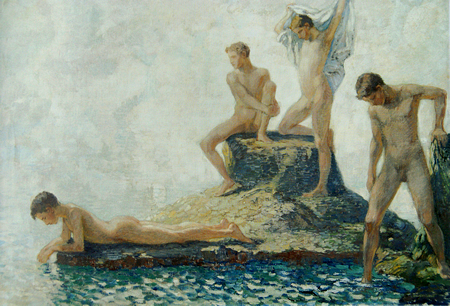
Badende Jünglinge door Ludwig von Hofman, 1905


The Bathers

After the immersion and the stance
how the blood bubbles like a firefly!
and the many flies come clipping through
the cumulus. Paradise melts its wings,

the shingle shows a red flag, lit,
incandescent, and chattering forth.
Crushing as always the pale leaves
of children’s feet, the shells crush,

the petals thrash, a lifeguard weeps
for his dead mother who has just sailed on.
Rumpling and rolling over, the rain
dumps its burden of restraint stonily,

without pressure from above. Be it killing
or caressing, the unhappy bathers moan
and remonstrate, hurtling through indifferences
and colors. On the sandbar lovers

hound each other to the salt, afraid of
neither running paralyzed nor trembling
hung, longing only to drift totally
in the garrulous frequency of their immanence.

Striding like statues the tremendous
arches, partially concealed by sunlight,
bounce. From barges grey with carrion
seem to rise the frenzied-whimpers of those

who are not thrusting their cheeks
against the wicker chests of heroes and
Desdemonas. Shall they drown that passion
they remember best? glinting and passing,

that discord scratching them a future
white-embossed and streaked? The delicacy
of birds eating fleas, so the sand may have
an eye at last, that crater and that sun.


 1949493-8a69a8e7d7f1e5ed59d35e720bafc20f.jpg
Frank O'Hara (27 juni 1926 - 25 juli 1966)
Baltimore Beach. Frank O’Hara werd geboren in Baltimore.


De Belgische dichter en schrijver Tom Lanoye werd geboren te Sint-Niklaas op 27 augustus 1958. Zie ook mijn blog van 27 augustus 2010 en eveneens alle tags voor Tom Lanoye op dit blog.


Waf waf waf

Leg de ketting klaar en hark mij tegen draad van
kokkelgeur, het ganzenei moet stuk voor stuk
gezwellen. Toe maar, bakkelei wat bokbederft, jij
stropop volle maan. Je lazerij nu pruimsteen en
dan vellen speelt geen rol, maar hou van mij.

Knip mijn oren, snij die staart. Dat kindschap
zweet in appeltaart vol hoedendoos en razernij?
En dat octaven biceps buitenspel erfdienstbaar
gaan, mits bloed gescheten foute formulieren
bij? Dat scheelt geen hol. Maar hou van mij.

Zing één voor één de nagels uit mijn poten,
hák. Geen jarretellen luxe geitebrij vol sap
ontstoken lippen meer, geen molleblinden eetgerei
of ellepijpen dood getij. Geen rollen
meer. Dan hou van hou van hou van mij.


Wara Avatara (vlammenzwijn)

Ik ga het hier niet
hebben over seks. dit is
tenslotte poëzie. rnaar ook:
als ik loop of zwem of
mijn gespannen lichaam in
een spiegel zie. krijg ik het
zo warm. Het lijkt wel transpiratie

maar dan vooral vanbinnen‚
in het diepste van mijn zinnen.
Het vervelende is wel, dat je je

daar moeilijk wassen kunt. Het
wordt er dan ook dierlijker en
natuurlijker met de dag. Maar dat kan
me eigenlijk niet schelen. llt vind het

heerlijk zo. ik weet dat alles mag.


Het afval spreekt

'Heel eerlijk? Ik zou liever zwerven.
In elke bocht van elke straat mijzelf
verzamelen en weer verwaaien, stof
en schimmels inviterend, en insecten.
In alle openheid de Schepping erend
door op uw Grote Markt tot supermest
te composteren. Zo ben ik op m'n best.

Maar iemand moet het vuile werk doen.
In dit geval: ik moet mijzelf maar leren
om mij, tot nut van d'algemene hygiëne,
te limiteren in mijn vrijheidsdrang. Door
dichtgesnoerd, voorgoed en zonder klachten
Van zak tot zak en wijk tot wijk te wachten
- en als het éffen kan: ook zonder lekken -
om van wie mij verwekte te vertrekken.

Adieu! Het ga u goed. Blijf monter en gezond.
Ik laat u schoner achter dan hoe ik u vond.


 1949493-13488682d7835ef90811cce8e5314a9c.jpg
Tom Lanoye (Sint-Niklaas, 27 augustus 1958)


De Britse schrijfster Jeanette Winterson werd geboren in Manchester op 27 augustus 1959. Zie ook mijn blog van 27 augustus 2010 en eveneens alle tags voor Jeanette Winterson op dit blog.

Uit: The Gap of Time

“They had met at boarding school at thirteen. Both boys had been sent away by fathers who had gained custody over unfit mothers. Leo’s mother had left his father for another woman. Xeno’s mother was alcoholic and mentally unstable. The boarding school was neither fashionable nor academic but it allowed their fathers to believe that they were bringing  up their sons when in fact their sons were barely at home.
Weekends at the school were quiet because most of the boys went home. Leo and Xeno invented worlds where they could live.
“I’m in a forest,” said Xeno. “My own cabin. Rabbits come and I shoot them. Bang bang bang.”
“I’m on the moon,” said Leo. “And it’s made of mozzarella.”
“How are you gonna walk on a ball of mozzarella? ” asked Xeno.
“Don’t have to walk,” said Leo. “No gravity.”
They listened to David  Bowie’s “Space Oddity” and Xeno got into country and western. Sometimes he thought he was Emmylou Harris.
They didn’t want to be like the other boys and that was just as well because they weren’t like the other boys.
By fifteen they were inseparable. They joined the school shooting club and competed at the target range. Xeno was more accurate because he was calmer. Leo was faster and sometimes won because he fired more shots. They invented a game: GUN BULLET TARGET. Win two rounds and you were the gun. Lose one and you were the bullet. Lose two, and you were the target. Then Xeno added MOVING TARGET and said it made him feel free. Leo didn’t understand that. He just wanted to be the gun.
One night after target  practice they had sex. It was a cliché. Shower. Hard-on. Three-minute handjob. No kissing. But the next day Leo kissed Xeno in the bike shed. He kissed him and he touched his face. He tried to say something but he didn’t know what it was. Xeno didn’t say anything. That was like him. Xeno was a bit of a girl anyway, Leo thought. He had grey eyes like a cat and soft, dark hair that fell over his eyes.
Leo was bulkier, tougher, taller, stronger. Built like a rugby player, he moved with confidence but without grace. He liked the watery quality Xeno had.
They went swimming, the sky low, the water warm, gulls patrolling the shoals. Leo was showy and noisy and fast and got tired before Xeno and his long, methodical distance swimming.”


 1949493-fedee9353399fc4b1e98e3d2a0f8c56f.jpg
Jeanette Winterson (Manchester, 27 augustus 1959)


De Belgische schrijfster Kristien Hemmerechts werd geboren in Brussel op 27 augustus 1955. Zie ook mijn blog van 27 augustus 2010 en eveneens alle tags voor Kristien Hemmerechts op dit blog.

Uit: Slaap

‘Hoe laat is het?’

De vraag waarmee hij iedere ochtend wakker schrok. Vandaag echter, voor de drieëntwintigste achtereenvolgende keer kwam er geen antwoord. Hij lag alleen in het brede bed, had slechts de helft beslapen, niet gewoon als hij was aan de zee van ruimte. Als kind deelde hij ooit het bed van zijn oom, een vrijgezel die zijn enige logeerbed aan zijn broer en diens vrouw - Rudolfs vader en moeder - had aangeboden en voor die ene nacht zijn neefje bij zich in bed nam. In de nacht strekte het lichaam van zijn oom zich uit over de hele oppervlakte van het bed zodat de kleine Rudolf ineenkromp op de uiterste rand ervan om het behaarde lijf naast zich te ontwijken. Die nacht zag hij de wijzers van de klok alle posities innemen, groene fluorescerende staafjes die nauwelijks merkbaar voortbewogen. Hij was op den duur toch in slaap gevallen want hij herinnerde zich het gekrijs van de wekker dat hem ruw uit zijn slaap haalde, en de schok die hij kreeg toen zijn oom de dekens wegsloeg en hij - Rudolf - een erectie bleek te hebben, een lachwekkend klein ding dat door de gulp van zijn pyjamabroek naar boven was geschoten.
Wakker worden met een erectie. Doe je er iets mee of niet? De hamvraag waarmee zoveel dagen begonnen. Mirjam hield niet van ochtendlijk vrijen. Een ochtendlijk lichaam, zei ze, of juister een lichaam dat in slaaptoestand verkeerd heeft, is per definitie een vies lichaam. Tijdens de nacht, wanneer een mens slaapt, worden afvalprodukten uit het lichaam verwijderd en aan het oppervlak ervan afgezet. Zweet vult de poriën, de geur die via de slokdarm uit de maag opstijgt verzamelt zich in de mondholte, vocht smeert de geslachtsdelen, de oksels en de spleet tussen de billen. Vroeger, zei ze, dacht men er wellicht anders over, maar daar hebben wij nu geen boodschap aan. ‘De twintigste eeuw heeft een menstype voortgebracht dat zich regelmatig wast. De natuurlijke afscheidingen worden verwijderd en vervangen door cosmetische produkten. Verliest de huid haar elasticiteit als gevolg van schrob- en wasbeurten dan wordt die hersteld door het aanbrengen van hydraterende crèmes. Het heeft geen zin die evolutie te betreuren. Wij zijn geen holbewoners. Wij hebben geen laag vuil nodig om ons warm te houden.’


 1949493-775759329a884f0d8a20b1d26615b69f.jpg
Kristien Hemmerechts (Brussel, 27 augustus 1955)


Zie voor nog meer schrijvers van de 27e augustus ook mijn vorige blog van vandaag.
Geschreven door Romenu om 11:56 Reageer op dit bericht

Lolita Pille, David Rowbotham, Norah Lofts, Cecil Scott Forester, Lernert Engelberts

De Franse schrijfster Lolita Pille werd geboren op 27 augustus 1982 in Sèvres. Zie ook mijn blog van 27 augustus 2010 en eveneens alle tags voor Lolita Pille op dit blog.

Uit:Bubble gum

“Celui-ci, je l avais nommé Bubble gum parce que tout y semblait creux, rose et gluant : decors, propos, sentiments, les personnages eux mêmes, moi compris, étaient creux, roses et gluants, au bord de l éclatement, et ce derrière quoi ils courraient, la sacro-sainte reconnaissance, la sacro-sainte célébrité, était devenue, a l époque où le non-film était supposé se dérouler, aussi creuse, rose, banale et brève qu une pauvre petite bulle de chewing-gum qui finissait inéluctablement par vous exploser a la gueule. »
(…)

Nous sommes rentrés pour démarrer cette promo et Mano s'y croyait à mort. Elle sy croyait à mort quand elle traversait Paris et qu'elle voyait sa gueule en 6 par 6 absolument partout, elle s'y croyait à mort pendant les interviews, elle virait ses attachés de presse, elle envoyait promener les types qui lui demandaient des autographes dans la rue, elle se sentait tellement unique, tellement privilégiée, elle avait l'impression d'être dans le secret de l'origine du monde, elle jubilait tout en faisant mine de se plaindre d'être trop exposée, son ego n'avait plus de limite."


 1949491-3373b819b58f91623e3fef8982089ab1.jpg
Lolita Pille (Sèvres, 27 augustus 1982)
Cover


De Australische dichter, schrijver en journalist David Rowbotham werd geboren in Toowoomba.in de Darling Downs van Queensland op 27 augustus 1924. Zie ook mijn blog van 27 augustus 2010 en eveneens alle tags voor David Rowbotham op dit blog.

Uit: The Man In The Jungle 

"Morning, laddie.”
Morden heard the words clearly. But he could not answer; he was too deliciously slothful, like someone after a long sleep from which the body shifts refreshed but unhurried, the mind cool and calm but backward. Yet the character of the words reminded him of someone he had known in the past.
After a while he realised who it was; and this, along with the idea that he felt fresh and easy only because he had been through some crucial experience or illness, brought all memory back with a bolt of shock. The relaxed center in the back of his head snapped to attention with a click and he jerked into a sitting position. He stretched his arms rigidly behind him and his finger-nails dug into dirt. The pain returned acutely to his nose, his eyes opened widely, and his speech came explosively.
“How did he get that rifle!”
Now he saw the faces. He saw them so plainly that they might have been magnified by some strange lens-like effect of the grey mist and the green forest. He touched his nose; it was covered with cotton-wool and sticking-plaster.
“How did he get it!”
“Now take it easy.”
Packs’ voice was firm, yet anxious.
“Tell me, damn you!”
The shock that had driven him upright disappeared; the fierceness in him seemed to fracture itself. He collapsed back on a hard support of rock standing out of the ground like a low-leaning, solid board. Swivelling his head, he traced out the shape of a caved-in hut among nearby trees, and, just beyond, the outline of what seemed to be a bending cross between two close tree-trunks. An ironical amusement rippled somewhere in him; he was at the Convict’s Find again. Last night he had come blindly back to it. A little more blind accuracy and he could have done his praying at the cross!
“Hullo. Got here as quick as we could.”
That was Jim. The kind aboriginal face with its apprehensive eyes was lowered towards him, and there was Packs’ broad brow under the ambulance cap. And there, to one side of them, was Milligan, looking edgy, disgruntled; and Cam Richmond with his moustache hiding his phlegmatic mouth.“


 1949491-9481c72edbadc27612b9f7577047c16a.jpg
David Rowbotham (27 augustus 1924 – 6 oktober 2010)
Cover 


De Britse schrijfster Norah Lofts werd geboren op 27 augustus 1904 in Shipham, Norfolk als Norah Robinson. Zie ook alle tags voor Norah Lofts op dit blogen ook mijn blog van 27 augustus 2009 en ook mijn blog van 27 augustus 2010.

Uit: The Lute Player

“NOTHER PACK OF WOLVES,” BROTHER Lawrence said as we rounded a curve in the track and sighted the little group of beggars. And I thought how much I would have preferred to meet actual four-legged wolves. One’s attitude toward a wolf pack is so simple; one hates, one fears; one attacks and scatters it or one flees in terror before it. No pity is involved. And I, for three days now, had been so wrenched by pity, so appalled by my own lack of power to help those I pitied, that now, seeing the beggars on the path, I thought that I could far more easily have stood still and let a wolf pack tear me to pieces than face a repetition of the scenes at Vibray and Amiche.
“Wake up, boy,” said Brother Lawrence, and moved his left leg so that his stirrup struck me on the upper arm. “Listen and kindly bear in mind what I say. No more hysteria, if you please. It serves no purpose and has a very ill effect. I shall give them what is left in the alms bag and pass straight on. I want no more of your nonsense. Remember, hungry men are dangerous.”
I turned my head and looked at him, and as I did so he twisted his head and looked straight ahead; but I had seen the expression-almost of gloating-with which he had been regarding me.And I wondered how far my behavior during these three days had been responsible for his. Once in the old days I had watched a bearbaiting and I had seen, on the faces of several spectators, that very look. A gloating compounded of amusement, ruthlessness, and a kind of speculation:What will this provoke? I made up my mind that this time I would betray no feeling, give him no satisfaction. He pulled the alms bag into an easily accessible position at the front of his girdle and set his face into lines of grave, remote contemplation. So we moved towards the knot of beggars; I limping on account of the blister on my heel and bending forwards a little to ease the ache in my empty belly, while my mind ran backwards and forwards, remembering the events of the last three days and dreading the moment that was approaching."


1949491-a04b24ab3b9bf5dffeb3390d4b14f369.jpg
Norah Lofts (27 August 1904 – 10 September 1983)
Cover


De Engelse schrijver Cecil Scott Forester (pseudoniem van Cecil Lewis Troughton Smith) werd geboren in Cairo, Egypte, op 27 augustus 1899. Zie ook alle tags voor C. S. Forester op dit blog en ook mijn blog van 27 augustus 2009 en ook mijn blog van 27 augustus 2010.

Uit: Ship of the Line

“Captain Hornblower struggled against hopelessness as he read the proof. Appeals of this sort were to be read in dozens in every market town. It hardly seemed likely that he could attract recruits to a humdrum ship of the line when dashing frigate captains of twice his reputation were scouring the country and able to produce figures of prize money actually won in previous voyages. To send four lieutenants, each with half a dozen men, round the southern countries to gather recruits in accordance with this poster was going to cost him practically all the pay he had accumulated last commission, and he feared lest it should be money thrown away.
Yet something had to be done. The Lydia had supplied him with two hundred able-bodied seamen (his placard said nothing of the fact that they had been compulsorily transferred without a chance of setting foot on English soil after a commission of two years' duration) but to complete his crew he needed another fifty seamen and two hundred landsmen and boys. The guardship had found him none at all. Failure to complete his crew might mean the loss of his command, and from that would result unemployment and half pay — eight shillings a day — for the rest of his life. He could form no estimate at all of with how much favour he was regarded at the Admiralty, and in absence of data it was natural to him to believe that his employment hung precariously in the balance.
Anxiety and strain brought oaths to his lips as he tapped on the proof with his pencil — silly blasphemies of whose senselessness he was quite well aware even as he mouthed them. But he was careful to speak softly; Maria was resting in the bedroom through the double doors behind him, and he did not want to rouse her. Maria (although it was too early to be certain) believed herself to be pregnant, and Hornblower sated with her cloying tenderness.”


 1949491-8049e380eaf5f5418f9320998ddf207b.jpg
Cecil Scott Forester (27 augustus 1899 – 2 april 1966)
Scene uit de film “Captain Horatio Hornblower” uit 1951 met o.a. Gregory Peck


De Nederlandse dichter en schrijver Lernert Engelberts werd geboren op 27 augustus 1977 in Leerdam. Zie ook mijn blog van 27 augustus 2010 en eveneens alle tags voor Lernert Engelbert op dit blog.

Uit: Echte slechte mensen

'In ieder geval, ik kijk dus van bovenaf naar dat schilderij. Een heel fraai geometrisch werkje overigens hoor. Een soort afgeleide van die honingraat van Escher, maar dan wat naïever, wat speelser, en ik denk: dat gaat niet passen. En zij probeert alleen maar wilder om het toch in die auto te krijgen. Uiteindelijk geeft ze het op en legt het schilderij en de vogelkooi, met de vogel er nog in, op het dak van de auto, zet het raampje van haar portier open en probeert de boel vast te houden terwijl die Belgische Bryan Ferry wegrijdt.'


 1949491-d7f4254d722de817f0ee3c3ab0b19397.jpg
Lernert Engelberts (Leerdam, 27 augustus 1977)

Geschreven door Romenu om 11:55 Reageer op dit bericht

Paul Verhuyck

De Vlaamse schrijver Paul Verhuyck werd op 27 augustus 1940 in Antwerpen geboren. Na Romaanse Filologie te hebben gestudeerd aan de Rijksuniversiteit te Gent werkte hij ondermeer aan de Hogeschool voor Vertalers & Tolken in Antwerpen. Daarna vertrok hij naar Nederland, waar hij gedurende 27 jaar als universitair hoofddocent aan de Rijksuniversiteit te Leiden verbonden was en oudere Franse en Occitaanse literatuur doceerde (1972-1999). Naast een reeks wetenschappelijke publicaties op vakgebied, publiceerde hij romans en verhalen. Zijn debuut “De doodbieren” werd in 1992 bekroond met de Anton Wachterprijs en de Vlaamse debuutprijs. Er volgden "Moord door geboorte", (1993),"De binnendienst"(1995), "Hout en koper) (1999), "De elektrische man" (2003) en "Inmiddels op aarde (2014), genomineerd voor de Zeeuwse Boekenprijs 2014. In samenwerking met Corine Kisling publiceerde hij volgende romans onder de auteursnaam "Kisling & Verhuyck": Verder is hij werkzaam als vertaler en publiceerde hij journalistieke bijdragen over literatuur in de Gazet van Antwerpen, K.C.L.B.-Boekengids, Nieuw Wereldtijdschrift (1994-1998), De Standaard, Standaard der Letteren en De Tijd.

Uit: Hout en koper

“Gustaaf Lamfreit ligt in zijn kist op het kerkhof. Hij wordt begraven, het is winter, bijna nieuwjaar. Maar de dode, de gekiste, hij kijkt. Hij kijkt intens en voor de laatste keer en door de borende kracht van zijn blik wordt het lente, wordt de wereld nieuw voor de eerste keer. Lamfreit is de heer der seizoenen. Iets wat hij bij leven en welzijn nooit geweest is. Misschien wordt het nu toch nog wel wat, het doodzijn. Want sinds zijn overlijden heeft hij alles maar vreemd gevonden, vooral die kist. Grenen, geen eik. Niet eens es of olm. Grenen. Tot nu toe is de dood zelf hem eerlijk gezegd een beetje tegengevallen, eerder een non-evenement zoals zijn trouwdag destijds, maar iets in hem blijft fluisteren dat deze lethargie van flauwe zweverigheid met amper kleuren of vormen niet zal blijven duren, dat het maar een overgangsfase is en dat er nog veel staat aan te komen.
Eerst had hij de indruk dat hij zich in een tunnel bevond, een donkere gang waarin vaag het geluid van een hobo weerklonk, een betoverde hobo die hem scheen te lokken naar zijn jongste lente, een betoverde melodie die hem de kracht gaf verder te gaan, nog verder de duisternis in.
Tot hij een lichtere zone meende te zien, misschien de uitgang van de tunnel. De ronde opening werd afgesloten door spinnenwebben. Duizenden webben evenwijdig achter elkaar op een rij, het ene op zo’n tien centimeter van het andere. Beestenkoppen. Er speelden regenbogen door de draden. Hij zou er wel doorkomen, dacht hij, die netten waren flinterdun. Hij dus moedig voorwaarts.
De eerste twintig, dertig gingen nog, met brede geestelijke armslagen baande hij zich een weg door de kleverige witte draden, maar daarna werd het ingewikkeld, werd hij duizenden keren ingewikkeld door de geduldige strategie van de spinnen, totdat ademnood en verstikkingsdood — alweer! — erop volgden, met — alweer! — uiteenknallende bloedbanen, adertjes, longblaasjes, buisjes, leidingen.”


 1963394-aa18599bcac6b49d6b1d3af9dd9358aa.jpg
Paul Verhuyck (Antwerpen, 27 augustus 1940)

Geschreven door Romenu om 00:00 Reageer op dit bericht

Meer van Romenu

↑ Terug naar de berichten