Naar de inhoud

Romenu

Over literatuur, gedichten, kunst en cultuur
akke.beakke.be

Berichten van 30 oktober 2018 tot 31 oktober 2018

Halloween (Madison Cawein)


Bij Halloween


 2189455-ee56c21d7f5d8220390ae05abc10dcfa.jpg
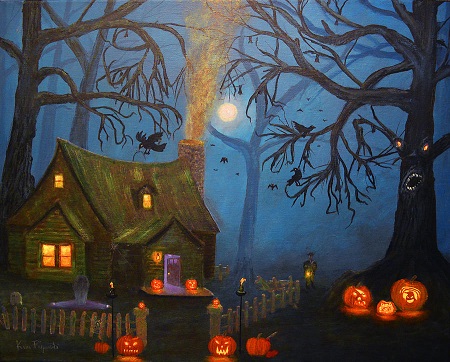
Halloween Night door Ken Figurski, 2014


Halloween


It was down in the woodland on last Hallowe’en,
Where silence and darkness had built them a lair,
That I felt the dim presence of her, the unseen,
And heard her still step on the hush-haunted air.

It was last Hallowe’en in the glimmer and swoon
Of mist and of moonlight, where once we had sinned,
That I saw the gray gleam of her eyes in the moon,
And hair, like a raven, blown wild on the wind.

It was last Hallowe’en where starlight and dew
Made mystical marriage on flower and leaf,
That she led me with looks of a love, that I knew
Was dead, and the voice of a passion too brief.

It was last Hallowe’en in the forest of dreams,
Where trees are eidolons and flowers have eyes,
That I saw her pale face like the foam of far streams,
And heard, like the night-wind, her tears and her sighs.

It was last Hallowe’en, the haunted, the dread,
In the wind-tattered wood, by the storm-twisted pine,
That I, who am living, kept tryst with the dead,
And clasped her a moment who once had been mine.


 2189455-47101daaa22ffad4aa1498d5fe8bef82.jpg
Madison Cawein (23 maart 1865 – 8 december 1914)
Oktober in Iroquois Park, Louisville, Kentucky, de geboorteplaats van Madison Cawein


Zie voor de schrijvers van de 31e oktober ook mijn vorige twee blogs van vandaag.


Geschreven door Romenu om 18:42 Reageer op dit bericht

Bruce Bawer, Joseph Boyden, John Keats, Don Winslow, Carlos Drummond de Andrade, Jean Améry, Nick Stone, Irina Denezhkina, Marijke Schermer

De Amerikaanse dichter, schrijver en literatuurcriticus Bruce Bawer werd geboren op 31 oktober 1956 in New York. Zie ook alle tags voor Bruce Bawer op dit blog.

Uit: Gays in the Era of Trump (Artikel in Frontpage Magazine, februari 2017)

“Certainly, given what Islamic immigration has meant for gay people in Europe, you'd think that every half-aware gay American would have cheered Trump's executive order temporarily blocking entry into the U.S. by citizens of seven majority-Muslim countries. In three of those nations, Syria, Somalia, and Libya, being gay is punishable by imprisonment; in three others, Yemen, Sudan, and Iran, it's a capital offense. (In the seventh, Iraq, homosexuality is technically legal, thanks to the U.S. influence over its post-Saddam constitution, although it's still not exactly the ideal spot for a gay honeymoon.) And yet on February 4, thousands of gays rallied outside the Stonewall Inn in New York's Greenwich Village – where the modern gay-rights movement is generally viewed as having begun – to protest the visa ban. These protesters (like the gay idiots of the BDS movement who march in “solidarity” with Palestine) haven't just been fed lies about Islam; they've failed to grasp – yet – that they're being used by the left to whitewash a “victim group” many of whose members, if given the power, would toss them to their deaths from the tops of buildings.
But this will change. Across Europe, gays have been deserting the left in growing numbers for the so-called “far-right” parties that are standing up to Islam – and they're making that move because they've seen enough of Islam to know that it represents a threat to their very lives. With Islam continuing its dread incursion into the U.S., with President Trump pronouncing the question of same-sex marriage “settled,” and (not least) with the staggeringly popular, flagrantly gay, and passionately pro-Trump Milo Yiannopoulos out there providing young audiences with desperately needed reality checks about Islam and the left, it only makes sense that gay Americans, like their European counterparts, will over time be increasingly suspicious of Islam's apologists – and increasingly receptive to Trump's blunt truth-telling about the Religion of Peace.”


2189447-5ea61057245c41a8dc93185c07ca526c.jpg
Bruce Bawer (New York, 31 oktober 1956)
De USA Gay Pride vlag


De Canadese schrijver Joseph Boyden werd geboren op 31 oktober 1966 in Willowdale, Ontario. Zie ook alle tags voor Joseph Boyden op dit blog

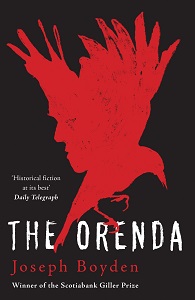
Uit: The Orenda

"And when the dogs are within a few minutes of reaching me, I will suddenly begin to feel a warmth creeping. My body will continue its hard seizures, but my toes and fingers and testicles will stop burning. I will begin to feel a sense of, if not comfort, then relief, and my breathing will be very difficult and this will cause panic but that will slowly harden to resolve. And when the dogs are on the lake and racing toward me, jaws foaming and teeth bared, I will know that even this won’t hurt anymore, my eyes frozen shut as I slip into a sleep that no one can awaken from. As the dogs circle me I will try to smile at them, baring my own teeth, too, and when they begin to eat me I won’t feel myself being consumed but will, like You, Christ, give my body so that others might live.
This thought of giving, I now see, lifts me just enough to pick up the girl and begin walking away from the lake’s edge. After all, if she’s alive, won’t her people—my pursuers—consider sparing me? I will
keep her alive, not only because this is what You demand but also to save myself. The thought of betraying Your wishes feels more an intellectual quandary than what I imagine should physically cause my heart to ache, but I’ll worry about that later. For now I follow the others’ footsteps as best I can, my thick black robe catching on the branches and nettles, the bush so thick I wonder how it is that the men I follow, and those who follow me, are not part animal, contain some black magic that gives them abilities beyond what is natural. You seem very far away here in this cold hell, and the Superior’s attempts to prepare me before I left France, before my journey to this new world, seem ridiculous in their naïveté. You will face great danger. You will most certainly face death. You will question Jesus’ mercy, even His existence. This is Lucifer whispering in your ear. Lucifer’s fires are ice.
There is no warming your body and your soul by them. But Superior doesn’t have any idea what true cold is, I realize, as I allow myself and the girl to be swallowed by the darkness of trees that the bitter sun fails to penetrate."


 2189447-5bea0abd4ef6b1cb710675a0ad241d07.jpg
Joseph Boyden (Willowdale, 31 oktober 1966)
Cover


De Engelse dichter John Keats werd geboren op 31 oktober 1795 in Finsbury Pavement in Londen. Zie ook alle tags voor John Keats op dit blog.


Ode on Melancholy

No, no, go not to Lethe, neither twist
Wolf’s-bane, tight-rooted, for its poisonous wine;
Nor suffer thy pale forehead to be kiss’d
By nightshade, ruby grape of Proserpine;
Make not your rosary of yew-berries,
Nor let the beetle, nor the death-moth be
Your mournful Psyche, nor the downy owl
A partner in your sorrow’s mysteries;
For shade to shade will come too drowsily,
And drown the wakeful anguish of the soul.

But when the melancholy fit shall fall
Sudden from heaven like a weeping cloud,
That fosters the droop-headed flowers all,
And hides the green hill in an April shroud;
Then glut thy sorrow on a morning rose,
Or on the rainbow of the salt sand-wave,
Or on the wealth of globed peonies;
Or if thy mistress some rich anger shows,
Emprison her soft hand, and let her rave,
And feed deep, deep upon her peerless eyes.

She dwells with Beauty — Beauty that must die;
And Joy, whose hand is ever at his lips
Bidding adieu; and aching Pleasure nigh,
Turning to poison while the bee-mouth sips:
Ay, in the very temple of Delight
Veil’d Melancholy has her sovran shrine,
Though seen of none save him whose strenuous tongue
Can burst Joy’s grape against his palate fine;
His soul shall taste the sadness of her might,
And be among her cloudy trophies hung.


Ode aan de neerslachtigheid

Ontwring de wrangwortel geen giftige wijn,
ontwijk de Lethe, laat geen scarabee
of doodshoofdvlinder je eigen Psyche zijn,
laat je niet kussen door Persefone,
nachtschades rode druif, op ’t bleke hoofd,
rijg niet je rozenkrans uit taxuszaad
en maak de donzige uil geen deelgenoot
van jouw geheim verdriet: je ziel verdooft
als elke schaduw in de schaduw staat –
daartussen vindt de waakzame angst de dood.

Maar komt zij plotseling uit de hemel vallen,
Neerslachtigheid, als huilbui die de bloemen
knikt maar ook voedt, en legt ze een wade op alle
hellingen met hun prille lentegroenen –
voed je verdriet dan met een morgenroos,
met welige pioenen, met de wieren
die aanspoelen omringd door regenbogen –
of, is je meesteres fantastisch boos,
vang dan haar zachte handen, laat haar tieren
en zwelg diep, diep in haar weergaloze ogen.

Ze woont bij Schoonheid, die ooit dood zal zijn,
en Blijheid, met haar hand steeds aan de lippen
ten afscheid, naast Plezier, ofwel Venijn
zo gauw de bijenmond ervan gaat nippen –
ja, de gesluierde Neerslachtigheid
heeft in het vreugdevolle heiligdom
haar soevereine schrijn, alleen betreden
door wie de druif van Blijheid met zijn tong
te barsten drukt – zijn ziel hangt na die tijd
tussen haar droeve, duistere trofeeën.
 

Vertaald door Jan Kuijper


 2189447-1d7f37514660c8102cde87c15300bc1c.jpg
John Keats (31 oktober 1795 – 23 februari 1821) 
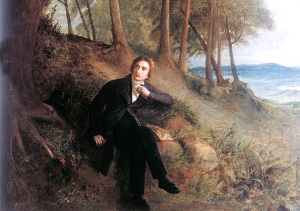
John Keats listening to the Nightingale on Hampstead Heath door Joseph Severn, ca. 1845


De Amerikaanse schrijver Don Winslow werd geboren in New York op 31 oktober 1953. Zie ook alle tags voor Don Winslow op dit blog.

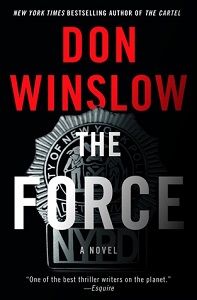
Uit: The Force

“The last guy on earth anyone ever expected to end up in the Metropolitan Correctional Center on Park Row was Denny Malone.
You said the mayor, the president of the United States, the pope—people in New York would have laid odds they'd see them behind bars before they saw Detective First Grade Dennis John Malone.
A hero cop.
The son of a hero cop.
A veteran sergeant in the NYPD's most elite unit.
The Manhattan North Special Task Force.
And, most of all, a guy who knows where all the skeletons are hidden, because he put half of them there himself.
Malone and Russo and Billy O and Big Monty and the rest made these streets their own, and they ruled them like kings. They made them safe and kept them safe for the decent people trying to make lives there, and that was their job and their passion and their love, and if that meant they worked the corners of the plate and put a little something extra on the ball now and then, that's what they did.
The people, they don't know what it takes sometimes to keep them safe and it's better that they don't.
They may think they want to know, they may say they want to know, but they don't.
Malone and the Task Force, they weren't just any cops on the Job. You got thirty-eight thousand wearing blue, Denny Malone and his guys were the 1 percent of the 1 percent of the 1 percent the smartest, the toughest, the quickest, the bravest, the best, the baddest.
The Manhattan North Special Task Force.
"Da Force" blew through the city like a cold, harsh, fast and violent wind, scouring the streets and alleys, the playgrounds, parks and projects, scraping away the trash and the filth, a predatory storm blowing away the predators.
A strong wind finds its way through every crack, into the project stairwells, the tenement heroin mills, the social club back rooms, the new-money condos, the old-money penthouses. From Columbus Circle to the Henry Hudson Bridge, Riverside Park to the Harlem River, up Broadway and Amsterdam, down Lenox and St. Nicholas, on the numbered streets that spanned the Upper West Side, Harlem, Washington Heights and Inwood, if there was a secret Da Force didn't know about, it was because it hadn't been whispered about or even thought of yet.”


 2189447-5ce36a7e5fb3d0d3e3ef3a839394ce82.jpg
Don Winslow (New York, 31 oktober 1953)
Cover


Zie voor nog meer schrijvers van de 31e oktober ook mijn vorige blog van vandaag.

Geschreven door Romenu om 18:42 Reageer op dit bericht

Carlos Drummond de Andrade, Jean Améry, Nick Stone, Irina Denezhkina, Marijke Schermer

De Braziliaanse dichter Carlos Drummond de Andrade werd geboren op 31 oktober 1902 in Itabira, een klein dorpje in de staat Minas Gerais. Zie ook alle tags voorCarlos Drummond de Andrade op dit blog.


Dawn

The poet rode the trolley drunk.
The sun came up behind the yards.
The small hotels slept very sadly.
The houses too were drunk.

Everything was a total wreck.
Nobody knew that the world was going to end
(only a child did but kept it quiet),
that the world was going to end at 7:45.
Last thoughts! Last telegrams!

Joe who listed pronouns,
Helen who loved men,
Sebastian who ruined himself,
Arthur who never said anything,
set off for eternity.

The poet is drunk, but
he hears a voice in the dawn:
Why don't we all go dancing
between the trolley and the tree?

Between the trolley and the tree
dance, brothers!
Even without music
dance, brothers!
Children are being born
with so much spontaneity.
Love is fantastic
(love and what it produces).

Dance, brothers!
Death will come later
like a sacrament.


Poetry

I spent one hour thinking of a verse
my pen does not want to write.
Yet, it is here inside
restless, alive.
It is here inside
and does not wish to get out.
But the poetry of this very moment
overflows my whole life.


Aporia

An insect digs
digs without alarm
perforating the earth
without finding escape.
What to do, exhausted,
in a blocked country,
union of the night
root and mineral?
And the labyrinth
(oh reason and mystery)
suddenly untie itself:
in green, lonely,
antieuclidean,
an orchid is born.


 2189449-8839c53a2602754ebc222f477361c718.jpg
Carlos Drummond de Andrade (31 oktober 1902 – 17 augustus 1987)


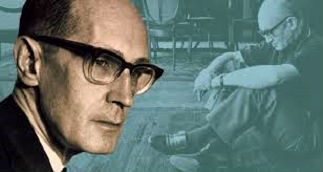
De Oostenrijkse schrijver Jean Améry werd geboren op 31 oktober 1912 in Wenen. Zie ook alle tags voor Jean Améry op dit blog.

Uit: Die Schiffbrüchigen

“Eugen Althager aber schwebte im Leeren. In eine unpersönliche Ferne waren ihm die Tage gerückt, in denen er gearbeitet hatte. Sachlich nur mehr und akademisch wußte er um eine Zeit, da er im Buchladen gestanden war und verkauft hatte. Unbeschwert von Erinnerungen daran war seine Seele. Das war vor drei Jahren gewesen: da sein Leben gegliedert und zielhaft gewesen war. Urlaube hatte es gegeben, die erstrebt und erhofft worden waren, Werktage der Arbeit, freie Abende, Sonntage der Einkehr und Andacht. Das waren Feiern gewesen, deren Leuchtkraft in den Jahren verblaßt war. Die ungeheure Menge freier Zeit, die nun sein Leben erfüllte, hatte jeden Begriff von Freiheit in ihm erdrückt. Er kämpfte einen erbitterten Kampf gegen diese Freiheit. Stunden um Stunden rang er ihr ab. Stunden, die trotz ihrer Sinnlosigkeit nicht würdelos versackten. Hell und hart waren seine Tage.
Nur in äußersten Fällen der inneren Trostlosigkeit, wenn drohend die Gefahr stumpfen Dämmerns vor ihm erwuchs, suchte er Umgang mit Freunden. Dann stieg er die sauberen, hellen Stiegen zu Heinrich Hessls Wohnung empor. Und Heinrichs Mutter, die ihn wohltuend und menschlich mit »Du« ansprach, öffnete ihm. Immer noch war es gut sein mit Heinrich Hessl. Achtzehn Jahre der Freundschaft lagen zwischen ihnen. Am ersten Schultag waren die Knaben damals nebeneinander gesetzt worden und nun stand Heinrich wenige Tage vor dem Rigorosum. Was alles zwischen jenem ersten Schultag und heute geschehen war! Die Tage einer ländlichen Kindheit mit den ungeheuer weiten und großartigen Spielen in den Wäldern. Was wissen davon die Knaben der Städte, die ihre mühseligen, armen Spiele hinter den grau verstaubten Büschen der Parks spielen, zwischen den Müllkübeln und Teppichstangen der Hinterhöfe. Höhlen hatten sie gemeinsam gegraben in den Wäldern, waren Reiter und Pfadfinder gewesen. Später waren die Knaben dann vorübergehend auseinandergekommen. Eugen, der die unteren Klassen eines Provinzgymnasiums besucht hatte, mußte frühzeitig einen Beruf erlernen und Heinrich wurde dem fragwürdigen städtischen Mittelschulbetrieb übergeben. Immer wieder, wenn die Freunde einander zu verlieren drohten, wenn starke Verschiedenheiten der Sphären und Lebensformen zwischen sie traten, dann war es das Erinnern der ländlichen Reiter- und Jägerzeit, das siegte.”


 2189449-662f8c2175450a8af8a619eb2aa23e11.jpg
Jean Améry (31 oktober 1912– 17 oktober 1978)
Portret door Manfred Dübelt, 2004


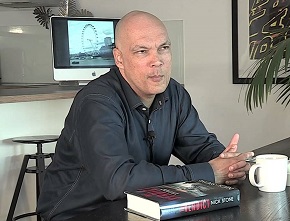
De Engelse schrijver Nick Stone werd geboren op 31 oktober 1966 in Cambridge. Zie ook alle tags voor Nick Stone op dit blog.

Uit: Mr Clarinet

“New York City, 6 November 1996

Ten million dollars if he performed a miracle and brought the boy back alive, five million dollars if he came back with just the body, and another five million if he dragged the killers in with it — their dead-or-alive status was immaterial, as long as they had the kid's blood on their hands. Those were the terms, and, if he chose to accept them, that was the deal.
Max Mingus was an ex-cop turned private investigator. Missing persons were his specialty, finding them his talent. Most people said he was the best in the business — or at least they had until 17th April 1989, the day he'd started a seven-year sentence for manslaughter on Attica Island and had his licence permanently revoked. The client's name was Allain Carver. His son's name was Charlie. Charlie was missing, presumed kidnapped. Optimistically, with things going to plan and ending happily for all concerned, Max was looking at riding out into the sunset a millionaire ten to fifteen times over. There were a lot of things he wouldn't have to worry about again, and he'd been doing a lot of worrying lately, nothing but worrying. So far, so good, but now for the rest: The case was based in Haiti. Waytee?' Max said as if he'd heard wrong. `Yes,' Carver replied. Shit. He knew this about Haiti: voodoo, AIDS, Papa Doc, Baby Doc, boat people and, recently, an American military invasion called Operation Restore Democracy he'd seen on TV. He knew — or had known — quite a few Haitians, ex-pats he'd had regular dealings with back when he'd been a cop and worked a case in Little Haiti, Miami. They hadn't had a decent thing to say about their homeland, 'bad place' being the most common and kindest. Nevertheless, he had fond memories of most of the Haitians he'd met. In fact, he'd admired them. They were honest, honourable, hard-working people who'd found themselves in the most unenviable place in America —bottom of the food chain, south of the poverty line, a lot of ground to make up. That went for most of the Haitians he'd met. When it came to people there were always plenty of exceptions to every generalization, and he'd come face to face with those. They hadn't left him with bad memories so much as the kind of wounds that never really heal, that open up at the slightest nudge or touch. The whole thing was already sounding like a bad idea. He'd just come out of one tough spot. Why go to another? Money. That was why.”

 2189449-814e914aaea2b514eeac20e31f04cba7.jpg
Nick Stone (Cambridge, 31 oktober 1966)


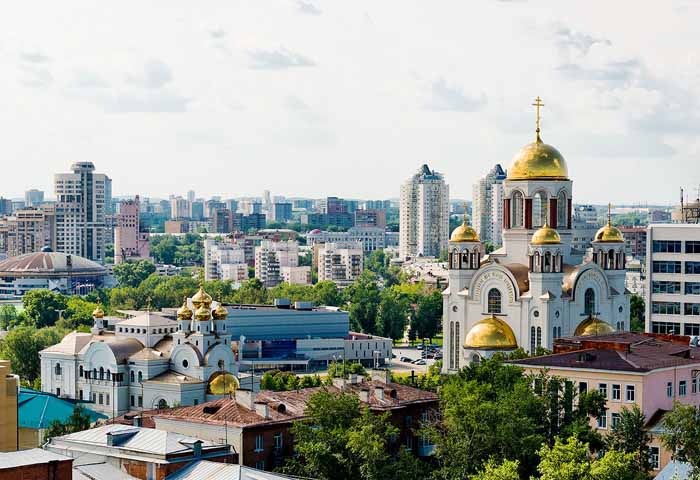
De Russische schrijfster Irina Denezhkina werd geboren op 31 oktober 1981 in Yekaterinburg. Zie ook alle tags voor Irina Denezhkina op dit blog.

Uit: Give Me: Songs for Lovers

“Now here I am stuck in real life, trying to wake him up. Trying to make him realize I want that rapid-rush start to our relationship to continue. Sugar, it’s like the Stork and the Heron … He smokes. And looks the other way. Drinks beer. And looks the other way. Plays the drums like a maniac. And all the time it’s like I don’t exist for him. Then why does he ask me to call? Why did he take me to Peterhof with Volkova and Kres? We had a great time there, climbed in all the fountains, and a militiaman even tried to chase us. And in the last fountain it was slippery, and Lyapa took hold of my hand. Or I took hold of his. I don’t remember. And we stood there under the clear streams of water, squeezing each other’s hands, and all around us everything was bright and happy. Lyapa’s spikes ran and his whole head was covered in gel. We stood there holding hands, and Volkova couldn’t get it together to take a picture of us. Finally she clicked the shutter and we headed back, still holding hands. And that was all. Separate again. And we’re still separate now. We walk separately, and it’s all just nothing but.
… Always writing hits so the brothers will get the feel. No garbage and no drivel and no strife.
The telephone rang. I started and looked at the clock—whoa! One o’clock in the morning!
Hippolet? Volkova’s voice mocked me tenderly in the receiver.
Whalelet?
Guess where I’m calling from!!!
I listened. Besides Volkova’s sniffling into the receiver I could hear the distant rumble of music.
From a club?
Right! And guess what phone I’m using!
A mobile.
Somehow I guessed all the answers very quickly. Volkova lost interest in her game and started telling me things in her everyday voice:
I’ve met this guy. Thirty-eight. Rich as Croesus … He gave me a lift home from work, then we went to a bar, and then came here. Tarasova’s here too. Her guy’s worse! Ha ha!
Well, naturally, I said with a nod, although Volkova couldn’t see me.
And where did you get to, mush? Volkova asked, suddenly taking an interest in me."

yeka
Irina Denezhkina (Yekaterinburg, 31 oktober 1981)


Onafhankelijk van geboortedata

De Nederlandse schrijfster Marijke Schermer werd geboren in Amsterdam in 1975. Zie ook alle tags voor Marijke Schermer op dit blog.

Uit: Noodweer

“Na het applaus, bij het verlaten van de zaal, raken ze elkaar kwijt. Emilia zoekt een tijdje. Bruch staat niet bij een deur of boven aan de trap op haar te wachten. Ze dwaalt door de gangen. Ze kijkt op haar telefoon. Geen berichten. Ze veronderstelt dat Bruch Vincent heeft gevonden, regisseur van de voorstelling en vriend van hem van vroeger. Ze bestelt een glas bier in de foyer. De actrice die Blanche speelde had de hele tuttige enscenering goed gemaakt. Ze liet alle zinnen van Tennessee Williams woord voor woord horen. Je leek me zo zacht, zo lief, als een holte in de rots die de wereld is waarin ik me kon verbergen. Ze liet de wanhoop als een niet te breken golf in zich uitbarsten. Emilia had ergens in een kier van de avond de leegte gevoeld die zij met diepe betekenis associeert. Daar is ze melancholisch van geworden.
Ze gaat het Ajaxbalkon op. Het is er leeg en verlaten waardoor ze zich afvraagt of het eigenlijk wel is toegestaan dat zij daar is. Er staan opgestapelde kratten en twee scheef gewaaide parasols. Het heeft geregend. In haar tas zoekt ze naar sigaretten die ze niet kan vinden. Ze gaapt. En dan grijpt iemand haar plotseling van achteren vast. Een stevige greep vat haar schouder. Een grote warme vaag naar komijn ruikende hand vouwt zich over haar gezicht, drukt haar ogen dicht, vingers schuin over haar lippen, vingertoppen waarop haar huid het eelt kan onderscheiden. Haar rug raakt een massief lijf. Achter haar ogen vindt een ontploffing plaats. Een vlam panische angst. Onmiddellijk daarna verdwijnt alle kracht en alle vorm uit haar lichaam en glijdt ze, zonder een spoor van een vluchtof vechtreflex, volkomen slap, uit zijn greep op de grote harde natgeregende cementtegels.
‘Hé, Emilia! wat doe je?’ Vertraagd breekt de stem door de suizende stilte. Het is Frank, vaak genoeg aan hun eettafel gezeten. Lolbroek, zonder meer, met terugwerkende kracht ook inderdaad bezitter van die komijnachtige lichaamsgeur, ze had hem daaraan kunnen herkennen.
‘Maak je nou een grap?’ roept hij van boven. Er verstrijken zeker twintig seconden waarin het vocht uit de tegels in de stof van haar kleren trekt, waarin ze zich afvraagt of ze haar reactie met een opmerking ongedaan zou kunnen maken. Dan pas hervindt Emilia haar spieren en botten en komt ze overeind.”

 2189449-565fe15fece5e041462408dd6cb4f46b.jpg
Marijke Schermer (Amsterdam, 1975)


Zie voor nog meer schrijvers van de 31e oktober ook mijn blog van 31 oktober 2017 deel 2.

Geschreven door Romenu om 18:42 Reageer op dit bericht

Jan Van Loy, Andrew Solomon, Ezra Pound, Paul Valéry, Miguel Hernández, Fjodor Dostojevski, Georg Heym, Kostas Karyotakis, Michal Ajvaz

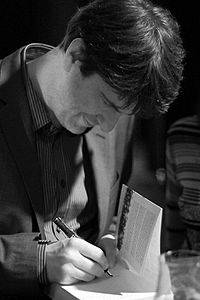
De Vlaamse schrijver Jan Van Loy werd op 30 oktober 1964 geboren te Herentals, in de Antwerpse Kempen. Zie ook alle tags voor Jan Van Loy op dit blog.

Uit: Hondenbrood

“Onze koffiekopjes zijn leeg, en Celis en ik leunen doelloos op de tapkast. De kroegbaas vouwt een vaatdoek in vieren. Celis futselt wat aan zijn lepeltje. Wij zijn de enige klanten.
‘Ik haat de ochtend,’ zeg ik.
‘IJdelheid der ijdelheden,’ zegt Celis.
‘Alles ligt zo plat als een paardenvijg.’
‘Jongens, hou het toch eens beetje luchtig,’ zegt de man achter de tap. ‘Kijk eens naar buiten. De zon schijnt, het wordt een prachtige dag.’
‘Wat is dat toch met die middenstand?’ zegt Celis tegen mij. ‘Wil altijd maar kletsen.’
‘Denken dat ze meer kunnen verzetten als ze er wat gelul bijdoen.’
‘Rustig, rustig,’ zegt de kastelein.
‘Onlangs heb ik het mijn kapper nog ingewreven,’ zeg ik. ‘Ik zei zwijgen en knippen, barbier, zei ik, ik wil niet weten waar jij met vakantie bent geweest.’
‘Ik praat met winkeliers zoals met mijn seniele oma,’ zegt Celis. ‘Als ze zegt, lekker weer, dan zeg ik: o jáá.’
‘Maar morgen wordt het weer slecht, zeggen ze.’
‘Altijd hetzelfde in dit kloteland.’
‘Als ik met pensioen ben, overwinter ik in Spanje.’
‘Maar gelijk heb je. Profiteer er maar van.’
Celis wendt zich tot de kroegbaas. ‘Is het nu luchtig genoeg?’ vraagt hij.
‘Drinken jullie nog iets, of hoe zit het?’
Ik laat mijn kont van mijn kruk glijden. ‘Kom,’ zeg ik. ‘Hij houdt niet van ons.’
Aan een plein dat wemelt van de vretende en schijtende duiven, vinden we nog één vrije bank.
‘Ik wil niet gaan dweilen,’ zegt Celis.
Maandag moeten we gaan dweilen. 't Is allemaal de schuld van Kristien.
Als hij niet uitkijkt, krijgt elke niksnut in dit land een maatschappelijk werkster over zich heen, en wij hebben Kristien gekregen. Dat ‘werkster’ doet ons altijd denken aan een bij, een vervelende bij die dreigend om je oren komt zoemen en zichzelf in een huidplooi probeert te wringen om je daar een steek te geven met het excuus dat ze niet anders kon. Wat een nuttig dier, die bij: zij schenkt ons honing en verse bloemen, het is de altruïst onder de insecten - maar net als alle altruïsten zijn het hypocrieten, die bijen. Leve de onvervalst valse wesp.
Kristien is een bij. Het liefst belt ze je om half negen 's ochtends uit bed, voor de een of andere formaliteit die noodzakelijk heet te zijn vanwege ‘het nieuwe computersysteem’ dat nu al jaren onderweg is.”
 

 2189091-42c48da36bf2a37e2e53930ebb236cb9.jpg
Jan Van Loy (Herentals, 30 oktober 1964)


De Amerikaanse schrijver, psychiater en journalist Andrew Solomon werd geboren op 30 oktober 1963 in New York. Zie ook alle tags voor Andrew Solomon op dit blog.

Uit: A Stone Boat

“This is what happened when my mother got sick: we were in Europe, on one of those family trips we had been taking since my childhood, one of those exquisitely conceived and impeccable holidays into which my mother poured—so it seems in retrospect—more energy than she could afford. "Just think, Harry:' my mother had said a week before, her voice lilting. "Four days of Paris, August sun, the city almost empty, and then we'll go down to the château—you'll love the chateau—and we'll eat breakfast looking across the valley, and we'll go for walks, and we'll swim a little if it gets really warm, and we'll go see all the Matisses. There's a piano at the château, so you can practice, but no one is going to make you perform for a whole two weeks. Just come along and relax and have a good time' I was living in London then, and my parents flew across the Atlantic three or four times a year; my father's bank had an office in the UK, and since my move to Britain he had taken an active interest in supervising the local staff, and came over for regular quick visits. My mother and I would spend the after-noons together while he worked, and then we would all meet for supper. Sometimes my parents came straight to London, but often enough I met them on the Continent so that we could all travel together. A few days before breakfast looking across the valley, my mother got sick in Paris. I will not forget my parents' arrival in Paris that time. My old friend Helen, my brother, Freddy, and I had been sitting for at least an hour in the bar at the hotel, waiting. When Helen and I left the bar (we left to see whether my parents had arrived yet, while Freddy went off to the bathroom), there they were. My father was at the front desk, discussing the rooms in his familiar way, and my mother was sitting nearby. The reality of my par-ents' checking in that day is so strong that it overwhelms me:”

 

 2189091-4515286b9a88ce5d7ef1dce835973e74.jpg
Andrew Solomon (New York, 30 oktober 1963)


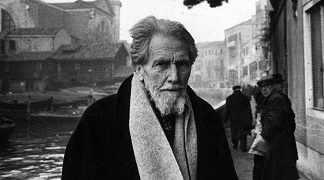
De Amerikaanse dichter Ezra Pound werd geboren in Hailey, Idaho op 30 oktober 1885. Zie alle tags voor Ezra Pound op dit blog.

Uit: Canto III (Fragment)

I sat on the Dogana's steps
For the gondolas cost too much, that year,
And there were not " those girls ", there was one face,
And the Buccentoro twenty yards off, howling " Stretti ",
And the lit cross-beams, that year, in the Morosini,
And peacocks in Kore's house, or there may have been.
Gods float in the azure air,
Bright gods and Tuscan, back before dew was shed.
Light: and the first light, before ever dew was fallen.
Panisks, and from the oak, dryas,
And from the apple, maelid,
Through all the wood, and the leaves are full of voices,
A-whisper, and the clouds bowe over the lake,
And there are gods upon them,
And in the water, the almond-white swimmers,
The silvery water glazes the upturned nipple,
As Poggio has remarked.
Green veins in the turquoise,
Or, the gray steps lead up under the cedars.

My Cid rode up to Burgos,
Up to the studded gate between two towers,
Beat with his lance butt, and the child came out,
Una nina de nueve anos,
To the little gallery over the gate, between the towers,
Reading the writ, voce tinnula:
That no man speak to, feed, help Ruy Diaz,
On pain to have his heart out, set on a pike spike
And both his eyes torn out, and all his goods sequestered, "
And here, Myo Cid, are the seals,
The big seal and the writing."
And he came down from Bivar, Myo Cid,

With no hawks left there on their perches,
And no clothes there in the presses,
And left his trunk with Raquel and Vidas,
That big box of sand, with the pawn-brokers,
To get pay for his menie;
Breaking his way to Valencia.
Ignez da Castro murdered, and a wall
Here stripped, here made to stand.
Drear waste, the pigment flakes from the stone,
Or plaster flakes, Mantegna painted the wall.
Silk tatters, "Nec Spe Nec Metu."
 

 2189091-d334f674d90c2d5e445872ca6c63259a.jpg
Ezra Pound (30 oktober 1885 – 1 november 1972)
In 1963


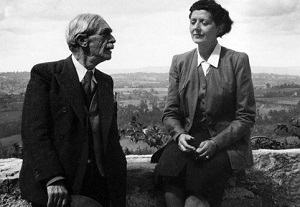
De Franse dichter en schrijver Paul Valéry werd geboren op 30 oktober 1871 in Sète. Zie ook alle tags voor Paul Valéry op dit blog.


Été

Été, roche d’air pur, et toi, ardente ruche,
Ô mer! Éparpillée en mille mouches sur
Les touffes d’une chair fraîche comme une cruche,
Et jusque dans la bouche où bourdonne l’azur;

Et toi, maison brûlante, Espace, cher Espace
Tranquille, où l’arbre fume et perd quelques oiseaux,
Où crève infiniment la rumeur de la masse
De la mer, de la marche et des troupes des eaux,

Tonnes d’odeurs, grands ronds par les races heureuses
Sur le golfe qui mange et qui monte au soleil,
Nids purs, écluses d’herbe, ombres des vagues creuses,
Bercez l’enfant ravie en un poreux sommeil!

Dont les jambes (mais l’une est fraîche et se dénoue
De la plus rose), les épaules, le sein dur,
Le bras qui se mélange à l’écumeuse joue
Brillent abandonnés autour du vase obscur

Où filtrent les grands bruits pleins de bêtes puisées
Dans les cages de feuille et les mailles de mer
Par les moulins marins et les huttes rosées
Du jour… Toute la peau dore les treilles d’air.


Féerie

La lune mince verse une lueur sacrée,
Toute une jupe d’un tissu d’argent léger,
Sur les bases de marbre où vient l’Ombre songer
Que suit d’un char de perle une gaze nacrée.

Pour les cygnes soyeux qui frôlent les roseaux
De carènes de plume à demi lumineuse,
Elle effeuille infinie une rose neigeuse
Dont les pétales font des cercles sur les eaux…

Est-ce vivre?… Ô désert de volupé pamée
Où meurt le battement faible de l’eau lamée,
Usant le seuil secret des échos de cristal…

La chair confuse des molles roses commence
À frémir, si d’un cri le diamant fatal
Fêle d’un fil de jour toute la fable immense.
 

 2189091-8bc68525d67b7c1818123e58cd7b95fc.jpg
Paul Valéry (30 oktober 1871 – 20 juli 1945)
Hier met zijn “laatste muze” Jean Voilier (rechts), eind jaren 1930


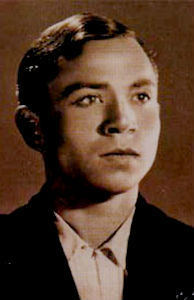
De Spaanse dichter en schrijver Miguel Hernández werd geboren in Orihuela, Alicante, op 30 oktober 1910. Zie ook alle tags voor Miguel Hernández op dit blog.


Elegy For Ramon Sue
(In Orihuela, where he and I were born, death like a lightning flash deprived me of Ram6n Sij6, so dear to me.)

I want to be the grieving gardener
of the earth you fill and fertilize,
my dearest friend, so soon.

Mingling my helpless sorrow with the rain,
the snails, and all the organs of your body,
I shall feed your heart

to the drooping poppies. Pain bunches up
between my ribs till every breath I draw
becomes an aching stitch.

A brutal slam, a heavy frozen fist,
a sudden silent killing axe-blow sent
you toppling to the ground.

Nothing gapes wider than my wounded cry,
this grief that plummets down to roots of death
sunk deeper than my life.

Across the stubble of the dead I walk
uncomforted, leaving my heart behind,
and go about my business.


Vertaald door Edwin Honig


First Song

The field has retreated,
seeing man's
convulsive charge.

What an abyss is laid bare
between the olive tree and man!

The animal who sings,
the animal who knows
how to weep and grow roots,
has remembered his claws.

Claws that he dressed up
in gentleness and flowers
but which, in the end, he bares
in all his cruelty.

They crackle on my hands:
Keep away from them, boy.
Or I will plunge them
into your little body.

I've regressed into a tiger.
Keep away or I'll tear you apart.

These days, love is death,
and ma lies in ambush for man.


Vertaald door Don Share
 

 2189091-c966f13792b9f5766da483a52ce2f419.jpg
Miguel Hernández (30 oktober 1910 – 28 maart 1942)


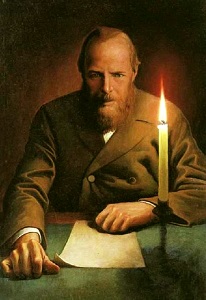
De Russische schrijver Fjodor Michajlovitsj Dostojevski werd geboren ergens tussen 30 oktober en 11 november 1821 in Sint Petersburg. Zie ook alle tags voor Fjodor Dostojevski op dit blog.

Uit: Buried Alive: Or, Ten Years Penal Servitude in Siberia (Vertaald door Marie von Thilo)

"Oun prison was situated on the outskirts of the fortress, and almost immediately above the rampart. I used often to look through the chinks in the fence and try and catch a glimpse of the wide world beyond. But all I could see was a little piece of the sky and the high grassy rampart where the sentinels walked to and fro day and night. And then I used to wonder how often during the long years that lay before me I should creep to the fence and peep through the holes and see the same sentinels and the same rampart and the same little bit of blue sky, which, strange to say, did not seem to belong to that sky which we could see from our prison, but rather to some other sky that was far away from us, and under which free people lived. The courtyard was very large—two hundred feet long and one hundred and fifty wide. It formed an irregular hexangle, and was surrounded by a high fence made of posts pointed at the top. They had. been rammed deep into the ground, and stood so close that they nearly touched each other. Across the posts broad planks had been nailed to make the fence still more solid. This was the outer bulwark of the convict prison. An opening had been left for the,gates in one of the sides of the hexangle. They were very strong, and always kept locked and watched night and day by the sentinels. The only time when they were unlocked was when the convict prisoners left the prison to go to their work. Beyond those gates was the fair free world where the people might do as they listed. But to us who used on this side of the fence that world seemed as unreal as a weird fairy tale. For we lived in our on world, which was unlike anything we had ever heard or seen; we were ruled by our own laws, wore a peculiar garb, and had peculiar customs and habits. Our dwelling-place was not unlike a huge grave where living people had been buried; and I am going to describe to you this abode.”
 

 2189091-44211943ae2a05ca69a50f0f939cb448.jpg
Fjodor Dostojevski(30 oktober 1821 – 9 februari 1881)
Portret door Konstantin Vasilyev, z.j.


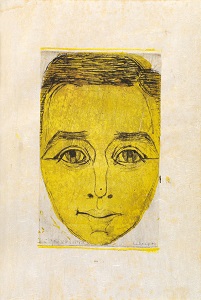
De Duitse dichter Georg Heym werd geboren op 30 oktober 1887 in Hirschberg. Zie ook alle tags voor Georg Heym op dit blog.


An den schönen Gott

Wenige nur lieben dich noch
Seit dich verstieß das verächtliche Volk.
Ihre Seelen tragen darum
Kummer und Haß und Hohn.

Doch in ihr Herz senketest du,
Als du schiedest, die Schönheit, und
Sie erkennen einander an
Sehnsucht und Leid im Aug.


Die Somnambulen

Schon braust die Mitternacht. Mit langem Haar
In weiße Tücher feierlich gehüllt
Zieht schwankend auf der Somnambulen Schar,
Wie Rauch so weiß, der weit den Himmel füllt.

Aus allen Dächern steigen sie herauf,
Irrlichtern gleich auf einem schwarzen Sumpf.
Sie tanzen auf der Wetterfahnen Knauf,
Mit irren Lächelns fröhlichem Triumph.

Sie schlagen Zimbeln in der leichten Hand
Und irren singend in der grünen Luft.
Vor ihren Brüsten zittert ihr Gewand,
Die wild den Mond berauschen, süß, voll Duft.

Sie kitzeln ihn mit ihren zarten Händen
Und zwicken leicht ihn in das gelbe Ohr.
Sie wiegen sich in ihren magern Lenden
Im Tanzschritt hin, ein weißer Trauerchor.

Sie fliegen durch die Nacht wie Wolken leise
Hoch über spitzer Berge blauem Grat
Hinauf zu ihm auf ihrer leichten Reise
Zu einem Wiegenlied an Abgrunds Pfad.

Der Mond umfängt sie sanft mit Spinnenarm.
Ihr Haupt wird von dem Kusse weiß gemalt.
Sie ruhn an ihres Bräutigams Herzen warm,
Der tief durch ihre dünne Rippe strahlt.


Halber Schlaf

Die Finsternis raschelt wie ein Gewand,
Die Bäume torkeln am Himmelsrand.

Rette dich in das Herz der Nacht,
Grabe dich schnell in das Dunkele ein,
Wie in Waben. Mache dich klein,
Steige aus deinem Bette.

Etwas will über die Brücken,
Er scharret mit Hufen krumm,
Die Sterne erschraken so weiß.

Und der Mond wie ein Greis
Watschelt oben herum
Mit dem höckrigen Rücken.
 

 2189091-717e3b2cd980df46ac78c5755fb92a78.jpg
Georg Heym (30 oktober 1887 – 16 januari 1912)
Ets door Ernst Ludwig Kirchner, 1924


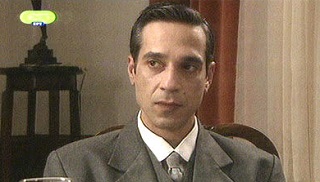
De Griekse dichter en schrijver Kostas Karyotakis werd geboren op 30 oktober 1896 in Tripolis. Zie ook alle tags voor Kostas Karyotakis op dit blog.


Strophes

1.
For twenty years I gambled
with books instead of cards;
for twenty years I gambled
and I squandered my life.
Poor now I lie down here
to listen to an easy wisdom
which an old plane tree
whispers to me.


2.
Free from everything I want
to sail to the end of the world.
If I have any friend left,
he should flee, escape.
And when death demands
the wealth I've amassed,
you, my vast bitterness,
will be my only estate.


Vertaald door Haris Stavrakis
 

 2189091-2d4596a879e9d6b511ec581cebd71081.jpg
Kostas Karyotakis (30 oktober 1896 – 21 juli 1928)
Dimosthenis Papadopoulos als Kostas Karyotakis in de Griekse dramaserie “Karyotakis” uit 2009


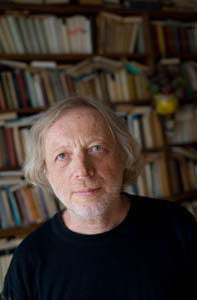
De Tsjechische dichter, schrijver, essayist en vertaler Michal Ajvaz werd geboren op 30 oktober 1949 in Praag. Zie ook alle tags voor Michal Ajvaz op dit blog.

The Other City (Vertaald door Gerald Turner)

“A cough was heard from the cinema foyer. It was even worse than that gloomy November day when you were walking through the de-serted center of a village near Prague and you heard from a loud-speaker attached to a lamp-post a voice ironically reading your study about the Grail of rural post-offices, which lay at the bottom of your desk drawer and which you have never given to anyone to read, be-cause it was your only piece of writing in which you openly named (even with the vilest consonants produced by slovenly and depraved movements of the tongue in the moist darkness of the mouth) the thing that squelches its way out of the deep chasm in the middle of your apartment. Some kind of St Vitus's Cathedral, even bigger than the one at Prague Castle, is moving around the Sobeslav district at a speed of 170 mph. The Isthmus rises above the surface of two seas. The piano turned into crabs and crept around the bedroom, the mo-ment was not yet ripe for the music to sound, not yet; the goddesses in silver cases had not yet fallen through the ceiling of the mon-sters' parliament. The pictogram with the spiral at its center, drawn in pencil on the backs of the lively piano crabs, is pronounced with a sound that resembles a sneeze in a concrete bunker and means forgetting the supple movements of the hand with the green rings in the darkened room in the house above the lake. (There are many and various Chinas on whose outskirts we live; there are rice fields in all the rooms of the adjacent apartment.) You wanted to flee the dial dance because speech is inadequate to describe what was here before the emergence of ornament. We wouldn't even be able to see the primordial dance because vision is so embedded in the mesh of familiar sense, that whatever is not nourished by that sense would remain invisible to us." "But what about the starfish on the carpet, the Gothic-chapel rail-road car and the books with the mysterious script?" I objected. "After all, people from our world encountered them:' "Those are just things that happen to get washed up on our shore, which we have enveloped in some compensatory meaning on the basis of false similarities with our own experience. The anxious and cunning deity of grammar holds its protective hand over us, and conceals the monsters' faces; we say 'that thing's a mystery' and 'that incident is uncanny: but in doing so we discreetly wrap their dread-ful presence, their sinister essence, unrelated to anything and de-fying our gaze, in metaphor, as if in an old threadbare suit and so assign them a place in our world. It can't be helped. It doesn't matter who drew the pattern on our mosaic floor, it still remains our prison and our home.”
 

 2189091-f24d4156182e59b22f4bd8075ed1508d.jpg
Michal Ajvaz (Praag, 30 oktober 1949)


Zie voor nog meer schrijvers van de 30e oktober ook mijn blog van 30 oktober 2017 en ook mijn blog van 30 oktober 2011 deel 2.


Geschreven door Romenu om 18:23 Reageer op dit bericht

Meer van Romenu

↑ Terug naar de berichten