

 Kazuo Ishiguro, Joshua Ferris, Detlef Opitz, Alice Notley, Herbert Hindringer, Elfriede Brüning, Margaret Mitchell, Bram Stoker, Peter Weiss

De Japanse schrijver Kazuo Ishiguro werd op 8 november 1954 geboren in Nagasaki. Zie ook alle tags voor Kazuo Ishiguro op dit blog.
Uit: The Remains of the Day
“I believe I can best highlight the difference between the generations by expressing myself figuratively. Butlers of my father’s generation, I would say, tended to see the world in terms of a ladder – the houses of royalty, dukes and the lords from the oldest families placed at the top, those of ‘new money’ lower down and so on, until one reached a point below which the hierarchy was determined simply by wealth – or the lack of it. Any butler with ambition simply did his best to climb as high up this ladder as possible, and by and large, the higher he went, the greater was his professional prestige. Such are, of course, precisely the values embodied in the Hayes Society’s idea of a ‘distinguished household’, and the fact that it was confidently making such pronouncements as late as 1929 shows clearly why the demise of that society was inevitable, if not long overdue. For by that time, such thinking was quite out of step with that of the finest men emerging to the forefront of our profession. For our generation, I believe, it is accurate to say, viewed the world not as a ladder, but more as a wheel. Perhaps I might explain this further.
It is my impression that our generation was the first to recognize something which had passed the notice of all earlier generations: namely that the great decisions of the world are not, in fact, arrived at simply in the public chambers, or else during a handful of days given over to an international conference under the full gaze of the public and the press. Rather, debates are conducted, and crucial decisions arrived at, in the privacy and calm of the great houses of this country. What occurs under the public gaze with so much pomp and ceremony is often the conclusion, or mere ratification, of what has taken place over weeks or months within the walls of such houses. To us, then, the world was a wheel, revolving with these great houses at the hub, their mighty decisions emanating out to all else, rich and poor, who revolved around them. It was the aspiration of all those of us with professional ambition to work our way as close to this hub as we were each of us capable. For we were, as I say, an idealistic generation for whom the question was not simply one of how well one practised one’s skills, but to what end one did so; each of us harboured the desire to make our own small contribution to the creation of a better world, and saw that, as professionals, the surest means of doing so would be to serve the great gentlemen of our times in whose hands civilization had been entrusted.”
Kazuo Ishiguro (Nagasaki, 8 november 1954)
De Amerikaanse schrijver Joshua Ferris werd op 8 november 1974 in Danville, Illinois geboren. Zie ook alle tags voor Joshua Ferris op dit blog.
Uit:The Dinner Party
“They come in,” he said, “we take their coats. Everyone talks in a big hurry as if we didn’t have four long hours ahead of us. We self-medicate with alcohol. A lot of things are discussed, different issues. Everyone laughs a lot, but later no one can say what exactly was so witty. Compliments on the food. A couple of monologues. Then they start to yawn, we start to yawn. They say, ‘We should think about leaving, huh?,’ and we politely look away, like they’ve just decided to take a crap on the dinner table. Everyone stands, one of us gets their coats, peppy goodbyes. We all say what a lovely evening, do it again soon, blah-blah-blah. And then they leave and we talk about them and they hit the streets and talk about us.”
“What would make you happy?” she asked.
“A blow job.”
“Let’s wait until they get here for that,” she said.
She slid her finger along the blade to free the clinging onion. He handed her her glass. “Drink your wine,” he said. She took a sip. He left the kitchen.
He sat on the sofa and resumed reading an article. Then he got up and returned to the kitchen and poured himself a new drink.
“That’s another thing,” he said. “Their big surprise. Even their goddam surprises are predictable.”
“You need to act surprised for their sake,” she said.
“Wait for a little opening,” he said, “a little silence, and then he’ll say, he’ll be very coy, he’ll say, ‘Why don’t you tell them?’ And she’ll say, ‘No, you,’ and he’ll say, ‘No, you,’ and then she’ll say, ‘O.K., O.K., I’ll tell them.’ And we’ll take in the news like we’re genuinely surprised—like, holy shit, can you believe she’s knocked up, someone run down for a Lotto ticket, someone tell Veuve Clicquot, that bastard will want to know! And that’s just the worst, how predictable our response to their so-called news will be.”
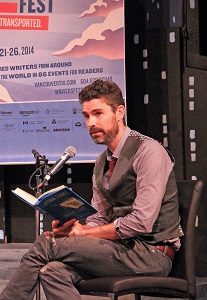
Joshua Ferris (Danville, 8 november 1974)
De Duitse schrijver Detlef Opitz werd geboren op 8 november 1956 in Steinheidel-Erlabrunn. Zie ook alle tags voor Detlef Opitz op dit blog.
Uit: Der Büchermörder
“Denn das Bankhaus Frege & Co. liegt von der Grimmaischen Gasse aus besehen quer übern Markt, dann nur sieben Häuser die Katharinenstraße hinein, linkerhand; Nummer 372. Wie später die Ermittlungen ergaben, war zur etwa selben Stunde, in der der Anschlag auf Schmidt geschah, im Fregeschen Comptoir eine Person erschienen, die sich als Hr. Siegel aus Elsterberg bei Stolpe ausgab, um elf ihrer Stadtobligationen zu verkaufen. Dem Hrn. Obercassirer Witzendorf kam der Mann vom Ansehen her zwar vor, wie ein bestimmter, hier in Leipzig wohnender Hr. Doctor Dorn, doch er dachte hierüber nicht weiter nach. Desfalls, es sollte etwas nicht gut sein, machte ihm sein Gegenüber ein gar zu besonnenes Gesicht, schien auch keineswegs in Eile, oder der hohen Summe wegen in erkennbarer Aufregung befangen. Nach kurzer Rücksprache mit seinem Principalen zahlte er die Summe baar aus, und zwar nominal Gold in preussischen Friedrichsd’or, französischen Louisd’or und braunschweigischen und sächsischen Thalern, einen kleinen Rest aber silbern in Preussisch-Courant. Der Verkäufer zählte genau noch einmal alles durch, schob 10 halbe Louisd’or zurück und erbat sich ganze dafür, verbrachte dann umständlich die vielen Stücke in seine ledernen Beutel und war, anbei, auch einem Schwätzchen nicht abgeneigt über diese und iene Course, und welche derzeit die günstigsten warn. In aller Weltenruhe, als hätte er nur eine schlechte Lotterie eingeholt oder eine harmlose Tratte vertauscht, verließ er schließlich das Bureau unter freundlichem Grüßen.
Genau zur gleichen Minute, als bedachter Hr. Siegel aus Elsterberg, als der Verkäufer elfer Obligationen, nur kurze Zeit nach seinem Weggang noch einmal zurück ins Comptoir spazirt kam und Bitte vortrug um eine Note über das Geschäft, welche er vorhin vergessen, genau im selben Moment sank, nur einige hundert Schritte entfernt, zwischen Schalter und Actenrepositorium des Schoßamts, der Kaufmann Schmidt zum zweiten Male binnen halber Stunde in sich selbst hinein.”
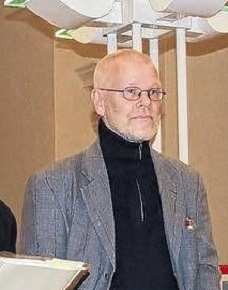
Detlef Opitz (Steinheidel-Erlabrunn, 8 november 1956)
De Amerikaanse dichteres Alice Notley werd geboren op 8 november 1945 in Bisbee, Arizona. Zie ook alle tags voor Allice Notley op dit blog.
The Elements
You must do battle with Eros I am
more worried about space, pressed for details
collapsed in chaos with my sword holding up the sky the
girl said. They cared not for love lying ever that they loved
But I your leader wounded in gender and bleeding
for Eros fought it away from my true beginning as now.
Always climbing that hill in several ways.
One goes past the Baptist Church and through the ugly
trees, houses I only visualize in dreams
you have no right to pursue me to my origins man
as bipolar as the one candidate, forgettable
as the other. We once lived in a postwar barracks blue
heated by a black stove of assumptions
Eros a youth admits no equal; Aphrodite the slut;
Chaos is whom I admire that keeps forgetting
love in favor of this terrible mixity I am
for example ... these poems. Out of the pre-beginning
a different beauty. They want you to confess
something like in church, that a man will
save you. But I am your leader savior and poet
I am your general out of the desert thee
most ardent void precursor of love
Eros approaches again not the man but quality
sculpted genitals arush with the words
of unreason: I will never die. Which I is I
if I can remain chaotic I'll tell you who you are
that you've never anticipated, but know
the only one. Without a thing. To be is not
to have; nor to belong; nor to have been born.
You are not the child of earth. Beauty still thy name.
Poem 2
You hear that heroic big land music?
Land a one could call one.
He starred, had lives, looks down:
windmill still now they buy only
snow cows. Part of a dream, she
had a long waist he once but yet
never encircled, and now I'm
in charge of this, this donkey with
a charmed voice. Elly, I'm
being sad thinking of Daddy.
He marshaled his private lady,
did she wear a hat or the
other side? get off my own land? We
were all born on it to die on
with no writin' on it. But who are
you to look back, well he's
humming 'From this valley,' who's gone.
Support and preserve me, father. Oh
Daddy, who can stand it?
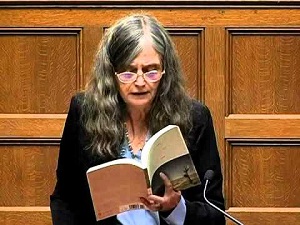
Alice Notley (Bisbee, 8 november 1945)
De Duitse dichter en schrijver Herbert Hindringer werd geboren op 8 november 1974 in Passau. Zie ook alle tags voor Herbert Hindringer op dit blog.
Profi-Teufelskerle
laufen 100 Meter Amok unter 3 Minuten, einmal um die ganze Welt
ein Staffellauf durch alle Gesichtsbücher, oh Gott, wir sind fassungslos
ihr auch? Nur Amy Winehouse als Stolperstein
Fuck Amy, es sind 77 unschuldige Menschen gestorben, oh
meine Güte, deine Güte, was für ein Arschloch, Hans-Peter Uhl
(CSU) sagt: In Wahrheit wurde diese Tat im Internet geboren
Da nehmen wir doch gleich Erziehungsurlaub, bilden uns fort und weiter
im Text: Wir sind die deutsche Synchronstimme des norwegischen Volkes
immerhin sind wir nicht verfassungslos und wachsen sorglos auf
dem Boden der Tatsachen fest
gehen in die Kneipe, denn draußen findet das wahre Leben statt
Tod statt, das gilt auch für hier drinnen, ein Bier, wir nicken und schütteln Köpfe
und Hände, wissen mehr als andere: In was für Zeiten wir nur leben
aber nicht lieben, Herzschmerz ist eine App, die man als Wecker benutzt
in den finsteren Nächten, in denen Haustiere sterben
wacht man als Achtjähriger auf und Satan liegt unter dem Bett
schnurrt wie eine Erinnerung, so wird der Kopf zum Fall von ganz oben
wartet auf Knien und auf Gedeih und Verderb und auf den nächsten Knall

Herbert Hindringer (Passau, 8 november 1974)
De Duitse schrijfster Elfriede Brüning werd geboren op 8 november 1910 in Berlijn. Zie ook alle tags voor Elfriede Brüning op dit blog.
Uit: Und außerdem ist Sommer
“Trude Klein saß vor der Schreibmaschine und wartete den Büroschluß ab. Gegenüber las der Doktor Korrekturen. Es sah aus, als sei er eingeschlafen. Der Kopf lag halb auf dem Tisch, und die Augen waren von gebogenen Lidern weit überzogen. Aber jetzt fing er an, mit den Rändern der Fahnen zu knistern, wie es seine Gewohnheit war. Er steckte den Bleistift zwischen die Lippen und sah auf. „Schreibt man ‚Waage‘ mit Doppel-a oder nicht?“ fragte er langsam. „In meiner Jugendzeit …“ Hier unterbrach er sich. Aber obgleich Fräulein Klein hätte antworten können, saß sie stillundwartetegeduldigab.DerDoktorstütztedenEllenbogen auf den Tisch, das heißt, er ließ ihn über die Tischplatte gleiten, von rechts nach links und an der Kante entlang, bis er den richtigen Punkt gefunden hatte. Nun beugte er sich weit über den Tisch und legte das Kinn in die flache Hand. „Ja, in meiner Jugendzeit schrieb man ‚Waage‘ noch mit Doppel-a, dann nahm man im Laufe der Zeit ein a weg, soweit ich unterrichtet bin. Aber ich bin mir nicht im klaren, was die neueste Rechtschreibung vorsieht. Ich könnte mir denken …“ „Jedenfalls schreibt man es mit Doppel-a“, kürzte die Stenotypistin ab. Sie stand auf und ging an den Regalen vorbei zum Ofen. Die Uhr zeigte auf zwei. Der Doktor wandte sich auf seinem Stuhl um und sah dem Fräulein nach, wie es den Handspiegel auf dem Sims plazierte und behutsam eine Mütze auf die Haare schob. „Wollen Sie schon gehen, Kleine?“ „Natürlich. Um zwei ist Schluß. Übrigens sollen Sie mich nicht Kleine nennen.“ Der Doktor entzündete ein Streichholz und warf es auf den Boden. „Wollen Sie nicht drinnen Ihren Chef fragen, ob er noch was für Sie hat, und nicht einfach lostürmen? Und daß ‚Kleine‘ kein Kosewort ist, sondern nur die weibliche Form Ihres Namens, wissen Sie ja.“ „Sie haben ein Streichholz auf die Erde geworfen.“ Gerade knurrte der Hausapparat dreimal hintereinander. Trude riß die Mütze vom Kopf und ging mit gespreizten Schritten zum Chef in den Nebenraum. Als sie wiederkam, waren zehn Minuten vergangen. Der Doktor stand in der Tür, er war in Hut und Mantel. „Haben Sie noch zu tun?“ Die Stenotypistin sah ihn an. Sie hatte gerade den Bogen einspannen wollen, nun stand sie auf und klappte die Maschine zu. Der Doktor schien zwar auf dem Sprung, immerhin war er da, ein Gebildeter, der am meisten geschätzte Mitarbeiter, ein Mann, dem man vertrauen durfte. Sie sagte: „Sehen Sie, so ist es immer. Gerade sonnabends, wenn man zeitig weg will. Punkt zwei fällt ihm ein, was er noch zu erledigen hat.“ Der Doktor ließ die Klinke los und kam zurück in das Zimmer. „Wenn Sie’s ihm mal höflich sagen würden?“
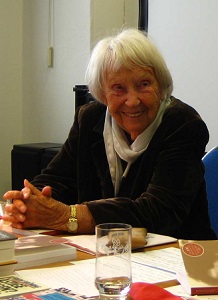
Elfriede Brüning (8 november 1910 – 5 augustus 2014)
De Ameikaanse schrijfster Margaret Mitchell werd geboren op 8 november 1900 in Atlanta, Georgia. Zie ook alle tags voor Margaret Mitchell op dit blog.
Uit: Gone with the wind
“Hunger gnawed at her empty stomach again and she said aloud: “As God is my witness, as God is my witness, the Yankees aren’t going to lick me. I’m going to live through this, and when it’s over, I’m never going to be hungry again. No, nor any of my folks. If I have to steal or kill — as God is my witness, I’m never going to be hungry again.”
In the days that followed, Tara might have been Crusoe’s desert island, so still it was, so isolated from the rest of the world. The world lay only a few miles away, but a thousand miles of tumbling waves might have stretched between Tara and Jonesboro and Fayetteville and Lovejoy, even between Tara and the neighbors’ plantations. With the old horse dead, their one mode of conveyance was gone, and there was neither time nor strength for walking the weary red miles.
Sometimes, in the days of backbreaking work, in the desperate struggle for food and the never-ceasing care of the three sick girls, Scarlett found herself straining her ears for familiar sounds — the shrill laughter of the pickaninnies in the quarters, the creaking of wagons home from the fields, the thunder of Gerald’s stallion tearing across the pasture, the crunching of carriage wheels on the drive and the gay voices of neighbors dropping in for an afternoon of gossip. But she listened in vain. The road lay still and deserted and never a cloud of red dust proclaimed the approach of visitors. Tara was an island in a sea of rolling green hills and red fields.
Somewhere was the world and families who ate and slept safely under their own roofs. Somewhere girls in thrice-turned dresses were flirting gaily and singing “When This Cruel War Is Over,” as she had done only a few weeks before. Somewhere there was a war and cannon booming and burning towns and men who rotted in hospitals amid sickening-sweet stinks. Somewhere a barefoot army in dirty homespun was marching, fighting, sleeping, hungry and weary with the weariness that comes when hope is gone. And somewhere the hills of Georgia were blue with Yankees, well-fed Yankees on sleek corn-stuffed horses.
Beyond Tara was the war and the world. But on the plantation the war and the world did not exist except as memories which must be fought back when they rushed to mind in moments of exhaustion. The world outside receded before the demands of empty and half-empty stomachs and life resolved itself into two related thoughts, food and how to get it.
Food! Food! Why did the stomach have a longer memory than the mind? Scarlett could banish heartbreak but not hunger and each morning as she lay half asleep, before memory brought back to her mind war and hunger, she curled drowsily expecting the sweet smells of bacon frying and rolls baking. And each morning she sniffed so hard to really smell the food she woke herself up.”
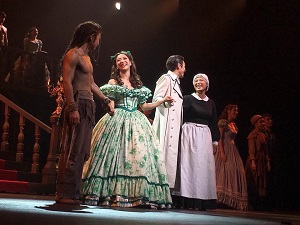
Margaret Mitchell (8 november 1900 – 16 augustus 1949)
Scene uit een uitvoering van de musical ‘Gone with the wind’ in Seoul, 2015
De Ierse schrijver Bram Stoker werd geboren op 8 november 1847 in Clontarf, een wijk van Dublin in Ierland. Zie ook alle tags voor Bram Stoker op dit blog.
Uit: Dracula
“I was told that this road is in summertime excellent, but that it had not yet been put in order after the winter snows. In this respect it is different from the general run of roads in the Carpathians, for it is an old tradition that they are not to be kept in too good order. Of old the Hospadars would not repair them, lest the Turk should think that they were preparing to bring in foreign troops, and so hasten the war which was always really at loading point.
Beyond the green swelling hills of the Mittel Land rose mighty slopes of forest up to the lofty steeps of the Carpathians themselves. Right and left of us they towered, with the afternoon sun falling full upon them and bringing out all the glorious colours of this beautiful range, deep blue and purple in the shadows of the peaks, green and brown where grass and rock mingled, and an endless perspective of jagged rock and pointed crags, till these were themselves lost in the distance, where the snowy peaks rose grandly. Here and there seemed mighty rifts in the mountains, through which, as the sun began to sink, we saw now and again the white gleam of falling water. One of my companions touched my arm as we swept round the base of a hill and opened up the lofty, snow-covered peak of a mountain, which seemed, as we wound on our serpentine way, to be right before us:--
"Look! Isten szek!"--"God's seat!"--and he crossed himself reverently.
As we wound on our endless way, and the sun sank lower and lower behind us, the shadows of the evening began to creep round us. This was emphasised by the fact that the snowy mountain-top still held the sunset, and seemed to glow out with a delicate cool pink. Here and there we passed Cszeks and Slovaks, all in picturesque attire, but I noticed that goitre was painfully prevalent. By the roadside were many crosses, and as we swept by, my companions all crossed themselves. Here and there was a peasant man or woman kneeling before a shrine, who did not even turn round as we approached, but seemed in the self-surrender of devotion to have neither eyes nor ears for the outer world.”
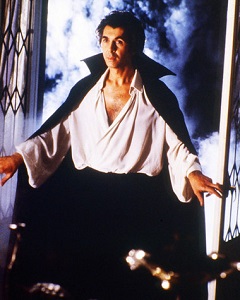
Bram Stoker (8 november 1847 – 20 april 1912)
Frank Langella als Dracula in de gelijknamige film uit 1979
De Duitse schrijver Peter Weiss werd geboren op 8 november 1916 in Nowawes (het tegenwoordige Neubabelsberg) bij Berlijn. Zie ook alle tags voor Peter Weiss op dit blog.
Uit: Abschied von den Eltern
"Ich habe oft versucht, mich mit der Gestalt meiner Mutter und der Gestalt meines Vaters auseinanderzusetzen, peilend zwischen Aufruhr und Unterwerfung. Nie habe ich das Wesen dieser beiden Portalfiguren meines Lebens fassen und deuten können. Bei ihrem fast gleichzeitigen Tod sah ich, wie tief entfremdet ich ihnen war. Die Trauer, die mich überkam, galt nicht ihnen, denn sie kannte ich kaum, die Trauer galt dem Versäumten, das meine Kindheit und Jugend mit gähnender Leere umgeben hatte. Die Trauer galt der Erkenntnis eines gänzlich mißglückten Versuchs von Zusammenleben, in dem die Mitglieder einer Familie ein paar Jahrzehnte lang beieinander ausgeharrt hatten.
(...)
Ich verschloß meine Tür und hängte ein Tuch über das Schlüsselloch. Erst nachts war ich befreit von dem Schnüffeln draußen vor meiner Tür. Da war ich allein in der sausenden Stille eines Hohlraums, allein mit meinem Bildern und meinen beschriebenen Blättern, allein mit meinen Büchern und meiner Musik. Mit Decken dämpfte ich das Grammofon. Aus unermeßlicher Ferne kam die Musik zu mir, wie ein Traum von Befreiung. Ich stand in meiner Grotte, und meine Hände tanzten zum Takt der Musik. In meinem Blut und in den Vibrationen meiner Nerven, in meinen Pulsschlägen und Atemzügen klang die Musik. Von Tränen überströmt trankt ich die Musik, und dann ging ich zu den Geisterstimmen der Bücher, trat in die anonyme Gemeinschaft mit Sprechern, die sich ringsum in der Welt umhertasteten, diese Bücher waren geheime Botschaften, Flaschenposten, ausgeworfen, um einen Gleichgesinnten zu finden. Überall in fremden Städten, an öden Küsten, in der Verborgenheit von Wäldern, lebten diese Einzelnen, und viele sprachen aus einem Totenreich zu mir. Die Vorstellung dieser Zusammengehörigkeit tröstete mich. Es war mir, als müsse, der, dessen Buch ich jetzt las, von meiner Gegenwart wissen, und wenn ich mich dann selbst zum Schreiben niedersetzte, so wußte ich, daß andere auf mich lauschten, durch ein großes Rauschen hindurch, das uns alle umgab."
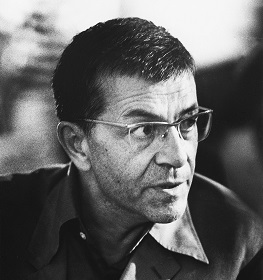
Peter Weiss (8 november 1916 – 10 mei 1982)
Zie voor nog meer schrijvers van de 8e november ook mijn blog van 8 november 2015 deel 2.


