Frans Coenen, Eric Bogosian, Robert Penn Warren, George Oppen, Sue Grafton, Carl Spitteler, Anthony Trollope, Michael Schaefer, Marcus Clarke
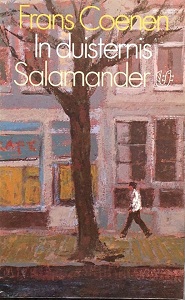
De Nederlandse schrijver, essayist en criticus Frans Coenen werd in Amsterdam geboren op 24 april 1866. Zie ook alle tags voor Frans Coenen op dit blog.
Uit: In duisternis
“In zijn kamertje, grijsdruilend van wintermorgenschemering, lag hij al lange tijd wakker op het ijzerknarsend ledikant, zich telkens omwendend in de bedwarmte, liggend een poos met gesloten ogen, dan weer starend op het groezele vlak van 't neergelaten gordijn. Zijn hoofd voelde zwaar-moe, zwak van zorggedachten, die hij niet meester worden kon. Het verleden was daar telkens in hem met brokken visie, met gehoorde woorden van vroeger, vermoeiend druk en duidelijk. Dan ineens, als een brede benauwing, kwam het besef van de dag en het noodzakelijk doen dat aanstaande was, zijn bewustheid bezetten, zodat zijn hart hoorbaar bonzen ging en weeë angstgolven borrelden door zijn lijf. Het moest nu wel... het móést... De even-aansluipende verlokking tot nog-uitstellen werd zelve tot walging onder het onverzettelijk besef der noodzakelijkheid. Wat gaf het vandaag niet te doen, als 't morgen toch moest of overmorgen?...
En hij zag het in, wreed zichzelve pijnend, met bewust willen. Hij zou opstaan, eten in die kille kamer naast-aan en dan, in de grauwe, natte novemberochtend, begon zijn tocht, de zware solliciteergang. Vaag en vluchtig openden zich even de gezichten van zijn sjokkend lopen op straat: een kaal-fatsoenlijk heer met bleek gezicht tussen de onverschillige mensenstoeten. Zijn zenuwig wachten na het aanbellen aan een breed herenhuis, of het lange, pijnlijke wachten in een stommelig hokje tegenover een paar matglazen loketten, sufgrauw-ogend. Een hokje, waar kantoorlopers zwaar binnenstampen en de stroefverende deur moeilijk-piepend openzwaait. En dan herhaalde hij in zich koortsig de woorden, die hij zeggen moest, hoe te doen om zijn optreden zelfbewuster, zekerder te maken...
Maar nu bijna halfluid sprekend, klonk zijn eigen stem leeg-onnozel in de stilte van het kamertje... Hij werd weer zich zelf bewust en zonk vermoeid in het kussen terug, een ogenblik matsoezend zonder gedachten, daar zijn hoofd te vol was om ze afzonderlijk gewaar te worden. Maar allengs klaarde de doezel op, en begon hij weer één gedachte tegelijk uit te spinnen.
Het was een weevragende onrust waar Carolien nu wel zou zijn, hoe ze 't hebben zou daarginds, en of ze nog met die vent zou wezen. Hij was wel helemaal los van haar... Zij had hem schandalig behandeld... maar een mens kan toch maar niet net zo makkelijk vergeten, als hij ander goed aandoet... Je had toch je momenten van zwakheid... Hij hield nog van d'r... hij voelde het in 't flauw-zoete verlangen dat nu zijn gedachten tot haar dreef... Hij werd ineens benauwd-ongerust om haar, zoals hij pas nog ongerust om zich zelf was...”
Frans Coenen (24 april 1866 – 23 juni 1936)
Cover
De Amerikaanse schrijver en acteur Eric Bogosian werd geboren op 24 april 1953 in Woburn, Massachusetts. Zie ook alle tags voor Eric Bogosian op dit blog.
Uit: Perforated Heart
“I brought up my own mother's premature death and we discussed that for a while until I sensed that tears were imminent and I changed the subject. After endless all-night sessions with various ex-girlfriends and lovers, I am no longer available as therapist to fucked-up beauties. I want my perquisites with no strings attached. The awards dinner was a fading memory as we flirted. It was fait ac-compli, wasn't it? We were striking a deal. She would permit me to caress those mysterious thighs, nuzzle those breasts and enter her. In return I would grant her access to the inner sanctum of a great man's life. She would be allowed to entertain the illusion that she had melded with a great mind. (A mind not unlike hers, of course.) This entitlement would nourish her grandiosity, which she mistook for authentic talent. My venerable cum was still cooling (or warming?) in her somewhere when I began to get restless. (No, no condom. I'm fixed. Furthermore I always make a pretense of being a person who rarely gets laid, ergo, the logic is, I carry no STDs. Girls like my new friend are usually clean and so am I. I hope.) At two A.M, I let her know I had an early morning appointment and invited her to depart. She seemed surprised by this. As she redressed, I killed time scanning the latest issue of The New York Review of Books, then escorted her down to my driver, who had been waiting patiently under the awning of the building. Something simultaneously chivalrous and vulgar about that. I handed her an autographed copy of A Gentle Death, slammed the door of the car, blew a kiss, turned on my heels and marched smartly back into the mild glow of the lobby, where my stoic doorman kept vigil. His face betrayed nothing. In the elevator I discovered myself in a mirror. I am in my mid-fifties, almost handsome, gray-haired, bespectacled. I have the bearing of what? A successful man of the city. Or just one more putz?”
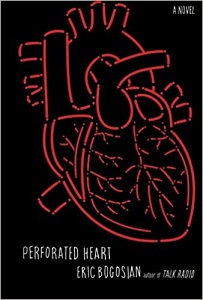
Eric Bogosian (Woburn, 24 april 1953)
Cover
De Amerikaanse dichter en schrijver Robert Penn Warren werd geboren op 24 april 1905 in Guthrie, Kentucky. Zie ook alle tags voor Robert Penn Warren op dit blog.
Uit: Selected Letters of Robert Penn Warren: Triumph and Transition, 1943-1952
“TO LAMBERT DAVIS
January 28, 1943
Dear Lambert: I mentioned in my last note that Samuel Goldwyn wants a reading on At Heaven's Gate. Recently, I have had two other requests: Richard Mealand, of Paramount, and Irving Deakin, of Warner Brothers. I realize, of course, that these requests area matter of routine, but I have referred them to you, since I don't have a decent copy of the novel. In fact, your copy is the only complete one of the final version. By the way, Paramount got fairly warm on Night Rider.' But I suppose that At Heaven's Gate would offer too many difficulties—unless they simply took some of the material and drastically reworked it. There's another little matter. Recently, in worrying over the novel coming up (which will probably be called All the King's Men) and the text book, I got the idea of appealing to the Rosenwald people' for a grant to enable me to get South for the summer and work the newspaper files and do a little prying around, gossip and interview, etc. to heat myself up for the final business on the political novel. It's just a damned shame I didn't get farther into this novel before I had to leave the neighborhood of Louisiana and Mississippi. The Rosenwald people reply that there are sev-eral objections to my application — too much publishing behind me, not living in the South now, only four months involved in project instead of six, etc. But they admit that there's a chance and send me blanks. I've given you as a reference. So you'll know what it's all about when you hear from them. If you hear. The trouble is that that damned house of mine in Louisiana is still around my neck, and so the Harcourt $750 simply has to go for the annual extra payment on that. Which means that its teaching for me next summer unless I can scare up the money from Rosenwald. I don't dare hope for anything from At Heaven's Gate. And certainly I can't do any planning on it. By the way, tell the text book people that I haven't forgotten them. I've been fiddling with the project'—inspecting books, doing a few trial outlines, etc. And I taught a section of freshmen last term. I shall teach another in the spring term and try out what few ideas I have come to by that time. I have also written Cleanth about the matter. If it should work out that I could get South next summer, I could kill two birds with one stone — or at least knock off a few tail feathers. As for the date of All the King's Men. I hope to get down to the final grind of writing next fall. I have begun tinkering with it, and have settled on an approach. It seems to me that my way in is through a single narra-tor who will carry the ball all the way—first-person treatment. I think I've got my man picked. The problem was to get a narrator who would have enough opportunity to know the story and would have enough intelli-gence to interpret and would have a style of his own. I believe that I have the boy, all right. He's a first cousin of Duckfoot (Blake, in At Heaven's Gate], I should say., Coming back to the date. I should hope to have the thing ready for you in the early fall of next year. I don't see it as a very long book— rather a shortish and strongly unified one., Well, goodbye, and best luck. We are still wrestling with colds and flu. My head feels like a feather bed the baby wet in. As ever, Red”
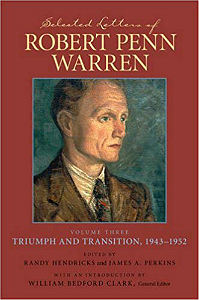
Robert Penn Warren (24 april 1905 – 15 september 1989)
Cover
De Amerikaanse dichter George Oppen (eig. George Oppenheimer) werd geboren op 24 april 1908 in New Rochelle, New York. Zie ook alle tags voor George Oppen op dit blog.
Five Poems about Poetry
1
THE GESTURE
The question is: how does one hold an apple
Who likes apples
And how does one handle
Filth? The question is
How does one hold something
In the mind which he intends
To grasp and how does the salesman
Hold a bauble he intends
To sell? The question is
When will there not be a hundred
Poets who mistake that gesture
For a style.
2
THE LITTLE HOLE
The little hole in the eye
Williams called it, the little hole
Has exposed us naked
To the world
And will not close.
Blankly the world
Looks in
And we compose
Colors
And the sense
Of home
And there are those
In it so violent
And so alone
They cannot rest.
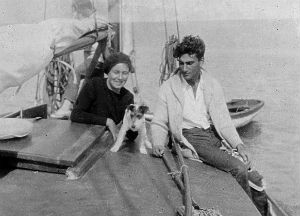
George Oppen (24 april 1908 – 7 juli 1984)
Mary en George Oppen op hun boot in California, ca. 1930
De Amerikaanse schrijfster Sue Grafton werd geboren in Louisville (Kentucky) op 24 april 1940 als dochter van schrijver C.W. Grafton en Vivian Harnsberger. Zie ook alle tags voor Sue Grafton op dit blog.
Uit: X
“Santa Teresa, California, Monday, March 6, 1989. The state at large and the town of Santa Teresa in particular were nearing the midpoint of a drought that had slithered into view in 1986 and wouldn’t slither off again until March of 1991, when the “miracle rains” arrived. Not that we dared anticipate relief at the time. From our perspective, the pitiless conditions were upon us with no end in sight. Local reservoirs had shrunk, leaving a wide swath of dried mud as cracked as an alligator’s hide.
My professional life was in the same state—always worrisome when you are your sole financial support. Self-employment is a mixed bag. The upside is freedom. Go to work when you like, come home when you like, and wear anything you please. While you still have bills to pay, you can accept a new job or decline. It’s all up to you. The downside is uncertainty, the feast-or-famine mentality not everyone can tolerate.
My name is Kinsey Millhone. I’m a private detective by trade, doing business as Millhone Investigations. I’m female, thirty-eight years old, twice divorced, and childless, a status I maintain with rigorous attention to my birth control pills. Despite the shortage of new clients, I had a shitload of money in the bank, so I could afford to sit tight. My savings account had been plumped by an unexpected sum that dropped into my lap some six months before. I’d invested the major chunk of it in mutual funds. The remaining cash I kept in a money market account that I designated “untouchable.” Friends, on hearing about my windfall, viewed me as certifiable. “Forget about work. Why not travel and enjoy life?”
I didn’t give the question credence. At my age, retirement is out of the question, and even temporary idleness would have driven me insane. True, I could have covered my expenses for months to come with enough in reserve for a lavish trip abroad, except for the following impediments:
1. I’m miserly and cheap.
2. I don’t have a passport because I’ve never needed one. I had traveled to Mexico some years before, but all that was required in crossing the border then was proof of U.S. citizenship.”
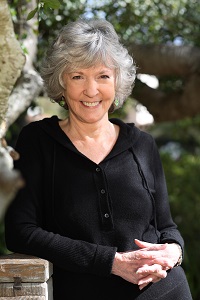
Sue Grafton (24 april 1940 – 28 december 2017)
De Zwitser dichter, schrijver, essayist en criticus Carl Friedrich Georg Spitteler (eig. Carl Felix Tandem) werd geboren op 24 april 1845 in Liestal bij Basel. Zie ook alle tags voor Carl Spitteler op dit blog.
Uit:Lachende Wahrheiten
„Kein empörenderes Schauspiel, als sehen zu müssen, wie unsere leidige Allerweltsschulmeisterei es fertig gebracht hat, die süßesten Früchte mittels pädagogischer Bakterien ungenießbar zu machen und Geschenke, die dazu ersehen waren, uns zu beglücken, in Buß und Strafe umzusetzen. Die Kunst ist großherzig und menschenfreundlich wie die Schönheit, welcher sie entspringt. Sie ist ein Trost der Menschen auf Erden und erhebt keinen andern Anspruch, als innig zu erfreuen und zu beseligen. Sie verlangt weder Studien noch Vorbildung, da sie sich unmittelbar durch die Sinne an das Gemüt und die Phantasie wendet, so daß zu allen Zeiten die einfache jugendliche Empfänglichkeit sich im Gebiete der Kunsturteilsfähiger erwiesen hat, als die eingehendste Gelehrsamkeit. So wenig man Blumen und Sonnenschein verstehen lernen muß, so wenig es Vorstudien braucht, um den Rigi herrlich, ein Fräulein schön zu finden, so wenig ist es nötig, die Kunst zu studieren. Gewiß, die Empfänglichkeit ist beschränkt, die Begabungen sind ungleich zugeteilt, die Sinne, welche die Kunsteindrücke vermitteln, beobachten schärfer oder stumpfer. Indessen habe ich noch keinen Menschen von Gemüt und Phantasie (denn Gemüt und Phantasie sind die Vorbedingungen, aber auch die einzigen Vorbedingungen des Kunstgenusses) gekannt, welcher nicht an irgendeinem Teil der Kunst unmittelbare Freude empfunden hätte. Und darauf kommt es allein an. Jeder suche sich an dem himmlischen Fest diejenige Speise aus, die seine Seele entzückt, und weide sich daran nach Herzenslust, so oft und so viel er mag, im stillen oder, wenn ihm das Herz überläuft, mit gleichgesinnten Freunden. Das ist Kunstgenuß. Das ist aber auch Kunstverständnis. Wer sich aufrichtig und bescheiden an einem Kunstwerke erfreut, der versteht es ebensowohl und wahrscheinlich noch besser, als wer gelehrte Vorträge darüber hält; wie denn auch ewig die Künstler selbst sich unmittelbar an das einfache Publikum wenden und alle Vormundschaft und gelehrte Zwischenträgerei zwischen Kunstwerk und Publikum verabscheuen.“
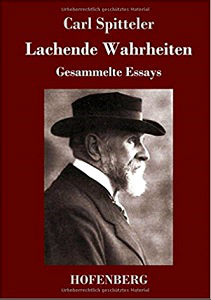
Carl Spitteler (24 april 1845 – 29 december 1924)
Cover
De Engelse schrijver Anthony Trollope werd geboren in Londen op 24 april 1815. Zie ook alle tags voor Anthony Trollope op dit blog.
Uit: The Prime Minister
“Ferdinand Lopez, who in other respects had much in his circumstances on which to congratulate himself, suffered trouble in his mind respecting his ancestors such as I have endeavoured to describe. He did not know very much himself, but what little he did know he kept altogether to himself. He had no father or mother, no uncle, aunt, brother or sister, no cousin even whom he could mention in a cursory way to his dearest friend. He suffered no doubt; — but with Spartan consistency he so hid his trouble from the world that no one knew that he suffered. Those with whom he lived, and who speculated often and wondered much as to who he was never dreamed that the silent man’s reticence was a burden to himself. At no special conjuncture of his life, at no period which could be marked with the finger of the observer, did he glaringly abstain from any statement which at the moment might be natural. He never hesitated, blushed, or palpably laboured at concealment; but the fact remained that though a great many men and not a few women knew Ferdinand Lopez very well, none of them knew whence he had come, or what was his family.
He was a man, however, naturally reticent, who never alluded to his own affairs unless in pursuit of some object the way to which was clear before his eyes. Silence therefore on a matter which is common in the mouths of most men was less difficult to him than to another, and the result less embarrassing. Dear old Jones, who tells his friends at the club of every pound that he loses or wins at the races, who boasts of Mary’s favours and mourns over Lucy’s coldness almost in public, who issues bulletins on the state of his purse, his stomach, his stable, and his debts, could not with any amount of care keep from us the fact that his father was an attorney’s clerk, and made his first money by discounting small bills. Everybody knows it, and Jones, who like popularity, grieves at the unfortunate publicity. But Jones is relieved from a burden which would have broken his poor shoulders, and which even Ferdinand Lopez, who is a strong man, often finds it hard to bear without wincing.
It was admitted on all sides that Ferdinand Lopez was a ‘gentleman’. Johnson says that any other derivation of this difficult word than that which causes it to signify ‘a man of ancestry’ is whimsical. There are many who, in defining the term for their own use, still adhere to Johnson’s dictum; — but they adhere to it with certain unexpressed allowances for possible exceptions. “
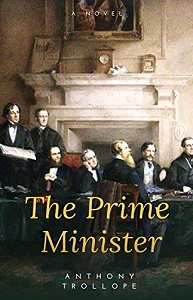
Anthony Trollope (24 april 1815 – 6 december 1882)
Cover
De Duitse schrijver Michael Schaefer werd geboren op 24 april 1976 in Bielefeld. Zie ook alle tags voor Michael Schaefer op dit blog.
Uit: Liebe auf Raten
„Als sie dann den Buckingham-Palace aus der Entfernung sahen, wurden die Gespräche über das schöne Schloss und die Queen laut. Immer neue Wunder durften Tom und Steve bewundern. Als sie dann in eine kleinere Seitengasse im Stadtzentrum einbogen und vor dem Jugendhotel zum Stehen kamen, war keiner mehr zu halten. Sie quetschten sich heraus, so als würden sie innerhalb von Minuten alles verpassen. Die Begeisterung fand ihren ersten Höhepunkt als sie in das weitläufige Foyer des Hotels schritten mit seinen hohen Räumen und den Bemalungen an Wand und Decke. Der Boden war sorgsam gebohnert, die kleinen Sitzecken geschickt mit bepflanzten Raumteilem getrennt. In der Mitte der Halle neben der bauchigen Rezeption der Wegweiser zu den Speisesälen, der Waschstube, den Tagungsräumen, dem Freizeitkeller mit Tischtennis, Kicker und Billard. Dem Partykeller mit Discoanlage und Lichtorgeln. Auch eine Bar war ausgeschildert. Tom war hellauf begeistert, wie Licht und Schatten geschickt ausgenutzt wurden, um eine warme, heimische Atmosphäre zu schaffen. Die große Halle wurde optimal genutzt und gab den Betrachtern nicht das Gefühl, eingeengt zu sein. Als die Zimmer verteilt wurden, hatten Tom und Steve das große Los gezogen, als einzige ein Zweibettzimmer zu bekommen, während die anderen in 6-Bett-Zimmern untergebracht wurden. Steve war das relativ egal, schlafen würde er dann ohnehin nur, wenn es unbedingt sein muss. Zuviel gibt es in London zu entdecken. Die Tagesplanung der Lehrer war genau richtig, um die nähere Umgebung zu erkunden. Man durfte ohne Lehrer durch die Stadt ziehen, musste nur am Abend um 19 Uhr wieder im Haus sein, weil es da Abendessen gab. Auch die Zimmer waren eher zweckmäßig als schick eingerichtet, dafür waren sie aber sauber und gepflegt. Tom und Steve warfen einfach ihr Zeug ins Zimmer, bezogen schnell die Betten und waren als eine der ersten bereits schon wieder unten und aus dem Hotel raus. Steve, bewaffnet mit Stadtführer und Stadtplan, und Tom mit einer Fotokamera anno Domini 1980. Tom wünschte sich zwar schon immer eine Digitalkamera als so ein klobiges Ding, allerdings hatten seine Eltern das bisher mangels finanzieller Möglichkeiten abgelehnt.
Als sie die ersten Schritte in der Traummetropole wagten, begannen auch die Probleme. Zuerst verirrten sie sich in der alten Metro mit ihren Tausenden kleinen Durchgängen und Gleisen. Dann stiegen sie auch noch in die falsche Bahn und fuhren bis fast zum Stadtrand, wo es wenig Tolles zu sehen gab. Außerdem war die allgemeine Hektik in der Stadt unter der Stadt völlig unbekannt für die beiden. Die lauten Stimmen und die schiebenden, quetschenden und durchaus mal Ellenbogen nutzenden Massen, waren den beiden Landeiem sehr bald schon zuwider. Auch diese teilweise völlig obskuren Gestalten mit hoch stehenden gefärbten Haaren, zerrissenen Hosen und Ketten an den Schuhen und Jacken.“
Michael Schaefer (Bielefeld, 24 april 1976)
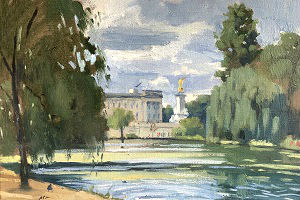
Buckingham Palace from St James’s Park door Daisy Sims-Hilditch, z.j.
De Australische schrijver Marcus Clarke werd geboren op 24 april 1846 in Londen. Zie ook alle tags voor Marcus Clarke op dit blog.
Uit: Australian Tales of the Bush
“A deeper melancholy seemed to fall on the always melancholy township. Coppinger's cronies took their "tots" in silence, steaming the while, and Coppinger himself would come gloomily to the door, speculating upon evil unless the leaden curtain lifted.
But it did not lift, and rumour of evil came. Up the country, by Parsham and Merrydale, and Black Adder’s Gully, there were whole tracts of grass-land under water. The neighbouring station of Hall’s, in the mountains, was a swamp. The roads were bogged for miles. Tim Doolan was compelled to leave his dray and bullocks Tom and Jerry’s, and ride for his life before the advancing waters. The dams were brimming, at Quartzborough, St. Rey reservoir was running over. It was reported by little McCleod, the sheep-dealer, that the old bridge at the Little Glimmera had been carried away. It was reported that Old Man Horn, whose residence overlooked the river, had fastened a bigger hook to a larger pole (there was a legend to the effect that Old Man Horn had once hooked a body from the greedy river, and after emptying its pockets, had softly started it down stream again), and was waiting behind his rickety door, rubbing his withered hands gleefully. Young Bartram rode over to Quartzborough to get McCompass, the shire engineer, to look at his new dam. Then the coach stopped running, and then Flash Harry, galloping through the township at night, like the ghost-rider the ghost-rider in Bürger's ghastly ballad, brought the terrible news: THE FLOODS WERE UP, AND THE GLIMMERA BANK AND BANK AT THE OLD CROSSING-PLACE.
“It will be here in less than an hour,” he shouted, under Coppinger’s red lamps; “make for the high ground if you love your lives;” and so wet, wild-eyed, and white, splashed off into the darkness, if haply he might warn the poor folk down the river of the rushing death that was coming upon them.
Those who were there have told of the horrors of that night. How the muddy street, scarce reclaimed from the river-bed, was suddenly, full of startled half-dressed folk. How Coppinger’ss was crowded to the garret. How the schoolmaster dashed off, stumbling through the rain, to warn them at Seven Creeks. How bullies grew pale with fear, and men hitherto mild of speech and modest of mien, waxed fiery-hot with wrath at incapacity, and fiercely self-assertive in relegating fools to their place in the bewildered social economy of that general overturn. How the roaring flood came down, bearing huge trees, fragments of houses, grotesquely terrible waifs and strays of house-hold furniture upon its yellow and turbid bosom, timid women grew brave, and brave men hid their faces for a while.”
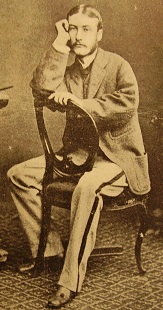
Marcus Clarke (24 april 1846 – 2 augustus 1881)
Cover
Zie voor nog meer schrijvers van de 24e april ook mijn blog van 24 april 2016 deel 2.