Naar de inhoud

Romenu

Over literatuur, gedichten, kunst en cultuur
akke.beakke.be

Berichten van 30 juli 2019 tot 31 juli 2019

Derik Walcott, Cees Nooteboom, Wouter Godijn, Dolce far niente


Dolce far niente


2257143-140f89fee21b93b1cbb0686838e68e29.jpg 
Bleecker Street Shadows & Reflections door Sonya Sklaroff, ca. 2010


Bleeker Street, Summer

Summer for prose and lemons, for nakedness and languor,
for the eternal idleness of the imagined return,
for rare flutes and bare feet, and the August bedroom
of tangled sheets and the Sunday salt, ah violin!

When I press summer dusks together, it is
a month of street accordions and sprinklers
laying the dust, small shadows running from me.

It is music opening and closing, Italia mia, on Bleecker,
ciao, Antonio, and the water-cries of children
tearing the rose-coloured sky in streams of paper;
it is dusk in the nostrils and the smell of water
down littered streets that lead you to no water,
and gathering islands and lemons in the mind.

There is the Hudson, like the sea aflame.
I would undress you in the summer heat,
and laugh and dry your damp flesh if you came.


 2257143-c70ba0b8001818d25a2b564c4db6bf55.JPG
Derik Walcott (Castries, 23 januari 1930)
Castries


De Nederlandse dichter en schrijver Cees Nooteboom werd geboren in Den Haag op 31 juli 1933. Zie ook alle tags voor Cees Nooteboom op dit blog.

Uit: Roads to Santiago (Vertaald door Ina Rilke)

“To make time melt strikes me as a peculiarly Spanish occupation, and nowhere has time been melted so handsomely as on the decaying, snaillike blob of Dali's watch. As I wait for my car, I unfold the Mundo Diario and read the letter the ailing painter has written to his people to explain how ill he is not. The signature under the typed statement (letterhead: TEATRO MUSEO DALI) is shaky, but still familiarly distinctive -- the letters of the magical name subsumed into a drawing of a Quixotic horseman, the lance thrusting bravely forward into the blank space of the paper. Poring over that signature, I think how Spanish Dali's appearance is, how easily his self-made image will be absorbed into the national panopticum alongside pancake-frying Teresa of Avila, the nuns' corpses strung on the gallows of the Civil War, the garrotte, and Philip II languishing in the dungeon that is his own palace. Shutting my eyes, I can see the painter, the two pencil-sharp points of his moustache aimed like antennae upwards into the ionosphere to receive rarefied, coded messages incomprehensible to all other moustaches. STATEMENT FROM DON SALVADOR AND DONA GALA DALI reads the heading with majestic simplicity -- no addressee specified.
"We are pleased to bring to the attention of all ... the sincere hope of the undersigned artist ..." -- and more such dignified phrases give the letter the aura of a bulletin, issued at the palace gates when the king is known to be dying. Bitter earnest or is it black humour, you never know, but in any case "the undersigned artist" makes it known to his people that he has already set to work on a new painting. When it is finished it will go to his wife, and anon she will pass it on to the museum. On the inside page the signature is repeated, considerably enlarged. The newspaper editors have submitted it to a Professor Lester. It is not explained who this is, but in these parts if someone does not have a Spanish-sounding surname and has no first name at all it means that whoever he is need not be taken too seriously. The professor advises Dali to take great care between 4 and 19 November, for at this time the planet Pluto and the star Lilith -- the black moon -- are in conjunction in the sign of Cancer, and this spells trouble above Cadaques, where the artist lives. He can escape disaster by travelling to Greece, where it is safer for Taureans at this particular time.
My route takes me through Zaragoza, by motorway from Barcelona to Soria, to old Castile, Castilla la Vieja. I see the town lying in the distance like a vision, shimmering in the heat. This is where the true Spain begins, the meseta, the high plain of Castile, empty, scorched, as huge as an ocean. Not much can have changed since the thirteenth century, when the principal sheep farmers joined forces to secure free passage of their flocks from the drought-ridden prairies of Extremadura to the green pastures of the northern cordillera. Soria pura, cabeza de Extremadura is the motto in the city's coat of arms. This is where the kingdoms of Castile and Aragon met the Muslim south. All over this region, transected by the River Duero like a line of defence, rise the ruins of once mighty fortresses whose sturdy contours still dominate the landscape.”


 2257143-f5da67a42c6293980b44a4b3f97bcac0.jpg
Cees Nooteboom (Den Haag, 31 juli 1933)
Zomers Amsterdam


De Nederlandse dichter en schrijver Wouter Godijn werd geboren in Amsterdam op 31 juli 1955. Zie ook alle tags voor Wouter Godijn op dit blog.


Over hemelse schoonheid

Een beroemde dichter terroriseerde zijn gezin;
het contrast tussen zijn gezin en zijn gedichten kon hij niet verdragen;
de ‘prins der duisternis’: hij bracht de hemel naar de aarde
en leidde kinderen en vrouwen naar de hel die hij rondom de hemel maakte
als hij geen trompet speelde.
Kun je schrijven: voor deze kunstenaars was de schoonheid van hun kunst een te zware last?
(Zijn deze formuleringen helder en eenvoudig
of moet ik er nog aan werken?)
Ik bedenk – terwijl ik Miles Davis opzet –
dat ze die schoonheid beter niet hadden kunnen maken
als ze dan minder slecht waren geweest.
Van dat streng zijn ga ik me groter voelen,
Plato- en kikkerachtig zwel ik op,
ik voel me een trompet waarop wordt gespeeld.
Ik spreek in gedachten tegen mijn vrouw en dochter:
jullie verwoesten mijn leven! Alles maken jullie kapot!
en ik word nòg groter, als deeg rijst hemelse schoonheid rond me op.
‘Ga weg!’ roep ik. ‘Ik wil geen hemelse schoonheid!’

Ik wil slecht schrijven en onbenullig zijn.
Ik ga naar mijn vrouw en dochter en aai ze over hun hoofd;
ik voel mezelf veranderen in een aardige man.
Het zonlicht aait de slootjes rondom het huis;
overal beginnen kikkers te kwaken.
De enige waardevolle muziek en de enige waardevolle poëzie, besef ik, klinkt zo:
kwaak-kwaak-kwaak.
Nu is iedereen gelukkig.


 2257143-238681b5964cc21026aff636e0a823fa.jpg
Wouter Godijn (Amsterdam, 31 juli 1955)
Zomers Amsterdam


Zie voor nog meer schrijvers van de 31e juli ook mijn blog van 31 juli 2018 en ook mijn blog van 31 juli 2017 en ook mijn blog van 31 juli 2016 deel 1 en eveneens deel 2.

Geschreven door Romenu om 00:00 Reageer op dit bericht

Frank Lima, Emily Brontë, Patrick Modiano, Maja Lunde, Aly Freije, Martijn Simons, Dolce far niente


Dolce far niente


 2256728-7336047602d5e5a5386812edbe3e28f1.jpg
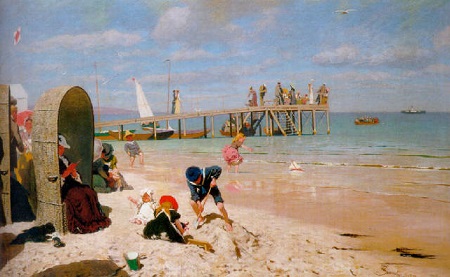
Summer Day At The Beach door Wilhelm Simmler, 1900


Summer (a love poem)

I wanted to be sure this was our island
so we could walk between the long stars by the sea
though your hips are slight and caught in the air
like a moth at the end of a river around my arms
I am unable to understand the sun your dizzy spells
when you form a hand around me on the sand

I offer you my terrible sanity
the eternal voice that keeps me from reaching you
though we are close to each other every autumn
I feel the desperation of a giant freezing in cement
when I touch the door you're pressed against
the color of your letter that reminds me of flamingos

isn't that what you mean?
the pleasure of hands and
lips wetter than the ocean
or the brilliant pain of
breathless teeth in a
turbulent dream on a roof
while I thought of nothing
else except you against
the sky as I unfolded you
like my very life a liquid
signal of enormous love we
invented like a comet that
splits the air between us!

the earth looks shiny wrapped in steam and ermine
tired of us perspiring at every chance on the floor
below I bring you an ash tray out of love for the
ice palace because it is the end of summer the end
of the sun because you are in season like a blue
rug you are my favorite violin when you sit and
peel my eyes with your great surfaces seem intimate
when we merely touch the thread of life and kiss


 2256728-3fb2649931ad7c9b261bb49eed551608.jpg
Frank Lima (1939 - 21 oktober 2013)


De Engelse dichteres en schrijfster Emily Brontë werd geboren in Thornton in Yorkshire op 30 juli 1818. Zie ook alle tags voor Emily Brontë op dit blog.


Come, Walk With Me

Come, walk with me,
There's only thee
To bless my spirit now -
We used to love on winter nights
To wander through the snow;
Can we not woo back old delights?
The clouds rush dark and wild
They fleck with shade our mountain heights
The same as long ago
And on the horizon rest at last
In looming masses piled;
While moonbeams flash and fly so fast
We scarce can say they smiled -

Come walk with me, come walk with me;
We were not once so few
But Death has stolen our company
As sunshine steals the dew -
He took them one by one and we
Are left the only two;
So closer would my feelings twine
Because they have no stay but thine -

'Nay call me not - it may not be
Is human love so true?
Can Friendship's flower droop on for years
And then revive anew?
No, though the soil be wet with tears,
How fair soe'er it grew
The vital sap once perished
Will never flow again
And surer than that dwelling dread,
The narrow dungeon of the dead
Time parts the hearts of men -'


 2256728-93ef388c43da68407c90c39bb9ac3dd2.jpg
Emily Brontë (30 juli 1818 – 19 december 1848)
Borstbeeld in Bradford


De Franse schrijver Patrick Modiano werd geboren in Boulogne-Billancourt op 30 juli 1945. Zie ook alle tags voor Patrick Mondiano op dit blog.

Uit: The Search Warrant (Vertaald door Joanna Kilmartin)

“Like many writers before me, I believe in coincidence and, sometimes, in the novelist's gift for clairvoyance — the word "gift" not being the right one, for it implies a kind of superiority. Clairvoyance is simply part of the profession: the essential leaps of imagination, the need to fix one's mind on detail — to the point of obsession, in fact — so as not to lose the thread and give in to one's natural laziness. All this tension, this cerebral exercise, may well lead in the long run to "flashes of intuition concerning events past and future", as defined by Larousse dictionary under "clairvoyance".
In December 1988, after reading the announcement of the search for Dora in the Paris Soir of December 1941, I had thought about it incessantly for months. The precision of certain details haunted me: "41 Boulevard Ornano, 1.55m, oval-shaped face, grey-brown eyes, grey sports jacket, maroon pullover, navy-blue skirt and hat, brown gym shoes." And all enveloped in night, ignorance, forgetfulnes, oblivion. It seemed impossible to me that I should ever find the faintest trace of Dora Bruder. At the time, the emptiness I felt prompted me to write a novel, Honeymoon, it being as good a way as any of continuing to fix my attention on Dora Bruder, and perhaps, I told myself, of elucidating or divining something about her, a place where she had been, a detail of her life. I knew nothing about her parents, about the circumstances of her flight. All I had to go on was this: I had seen her name, BRUDER, DORA — nothing else, no date or place of birth — above that of her father — BRUDER, ERNEST, 21.5.99, Vienna. Stateless. — on the list of those who left on the convoy of 18 September 1942 for Auschwitz.
In writing Honeymoon, I had had in mind certain women I knew in the 1960s: Anne B, Bella D — the same age as Dora, in one case almost to the month — who could have shared her fate, having been in a similar situation during the Occupation, and whom she may have resembled. Today, it occurs to me that I had had to write 200 pages before I captured, unconsciously, a vague gleam of the truth.
It was a matter of a few lines: "The train had stopped at Nation. The line didn't go any farther. Rigaud and Ingris had gone past Bastille, where they ought to have changed for the Porte Dorée. They came out of the métro into a big snowfield. [ ... ] The sledge cut through several little streets to get back to the Boulevard Soult."
These back streets lay behind the Rue de Picus and the Holy Heart of Mary, the convent from which Dora Bruder made her escape, one December evening when it had probably been snowing in Paris.
This was the only moment in the book when, without knowing it, I came close to her in time and space.”


 2256728-9e9e9b3dc2e29a8c56f7f0ecfe05c683.jpg
Patrick Modiano (Boulogne-Billancourt, 30 juli 1945)


De Noorse schrijfster en scenariste Maja Lunde werd geboren in Oslo op 30 juli 1975. Zie ook alle tags voor Maja Lunde op dit blog. Zie ook alle tags voor Maja Lunde op dit blog.

Uit: The History of Bees (Vertaald door Diane Oatley)

“The tin box was empty before I was full. I stood up and put it back in the return basket from the Trade Commission. Then I jogged in place. My legs were tired, but nonetheless stiff from standing still in locked positions up there in the trees. My blood tingled; I couldn't stand still. But it didn't help. I took a quick look around me. Nobody from management was paying attention. I quickly lay down on the ground, just to stretch out my back. It was aching after having been bent over in the same position for a long time. I closed my eyes for a moment, tried to shut out the conversation of the other women of the crew, instead listening to how the chatter rose and fell in volume. This need to talk, all of them at the same time, where did it come from? The other women had started when they were little girls. Hour after hour of group conversations where the subject was always of the lowest common denominator and one could never really go into depth about anything. Perhaps with the exception of when the one being talked about wasn't there. Personally I preferred one-on-one conversations. Or my own company, for that matter. At work, often the latter. At home I had Kuan, my husband. Not that we had the longest conversations, either, conversation wasn't what held us together. Kuan's references were here and now, he was concrete, didn't crave knowledge, something more. But in his arms I found peace. And then we had Wei-Wen, our three-year-old. Him we could talk about.
Just as the cacophony had almost sung me to sleep, it suddenly fell silent. Everyone was quiet. I sat up. The others on the crew were facing the road. The entourage was walking down the tire ruts and towards us. They were no more than eight or nine years old. I recognized several of them from Wei-Wen's school. All of them had been given identical work clothes, the same synthetic beige uniforms that we were wearing, and they walked towards us as quickly as their short legs could carry them. Two adult leaders kept them in line. One in front, one behind. Both of them were equipped with powerful voices that corrected the children without cease, but they did not reprimand them, giving instructions with warmth and compassion, because even though the children had not yet fully taken in where they were headed, the adults knew. The children walked hand in hand, in mismatched pairs, the tallest with the shortest, the older children taking care of the younger. An uneven gait, disorganized, but the hands held on tight as if they were glued together. Perhaps they had been given strict instructions not to let go.”


2256728-ef943bb5d4cc918f0006395a855cc748.jpg
Maja Lunde (Oslo, 30 juli 1975)


De Nederlandse dichteres Aly Freije werd geboren in Veelerveen op 30 juli 1944. Zie ook alle tags voor Aly Freije op dit blog.


Kreuzberg Berlijn

Hun graffiti trekt huizenblokken op
schopt tegen monumentale deuren
-Zwangsräumung blockieren-

ze gooien spuitbussen weg, tappen ander bier
hangen een nacht een beest uit
fabeldieren spreken
draak, griffioen, misschien een sabeltijger

ze schaffen fijne kwasten aan, bestuderen
spierbundels, haarinplant van vachten
gevorkte veren, ingekeepte snavels
de kwetsbaarheid van ogen wit

in één nacht is op een blinde muur
tot boven aan de nok
een voorstelling neergezet

bungelend aan één poot
een edelhert, een ooievaar, een haas
uitvergroot
hun spreken.


Het mist

I
Ze kreeg een bouwdoos, zette vier palen
in een gatenplaat, schoof langs de gleuven
voor- en achtergevel op hun plaats
dit was haar huis

schuren geurden met ingedikte
tractorolie en oogstverhalen
schoffels hingen schuin
tegen de zomerwind

deurklinken gingen in verzet
planken opgebroken, opengezette hokken
ze wiste de witte plekken op behang
zwakte het gissen af
naar een waarom en hoe


 2256728-b4d51e13af7e23165b8461e25b05cc71.jpg
Aly Freije (Veelerveen, 30 juli 1944)


Onafhankelijk van geboortedata


De Nederlandse schrijver Martijn Simons werd geboren in 1985 en groeide op in Woerden. Zie ook alle tags voor Marijn Simons op dit blog.

Uit: Ik heet Julius

“Nog altijd dat zenuwachtige gekietel. Een warme, vochtige adem. Ik kneep mijn ogen stijf dicht om de beelden van vannacht te verdrijven, van de meisjes, en deed mijn best zo stil mogelijk te blijven liggen. Ze kietelde me echt, Nore, ze deed wat ze ’s ochtends zo vaak deed, gaf kleine likjes, speldenprikjes in mijn oorschelp, en als ik me niet zo… niet zó voelde, had ik er alles aan gedaan om het moment te rekken. Want, jongen, ik hield ervan, die sluimerende seconden tussen slapen en waken, het eiland en de rest van de wereld op veilige afstand. Ik wist waar ze mee bezig was en hoe het zou eindigen, haar warme adem en het geluid van haar lippen, zo dichtbij. Ze gaf me een por tussen mijn ribben als ze vond dat het lang genoeg geduurd had, als ik in actie moest komen. Dan draaide ik me langzaam op mijn zij, als een oud beest, mijn ogen nog altijd dicht, kuste haar en kwam overeind. Klom boven op haar. Hoe ze daar lag, haar ogen nog klein van de nacht, maar al warm en schitterend. Ik drukte mijn neus in haar haar en snoof, kuste haar nog eens, hield mijn ogen open terwijl zij die van haar traag sloot.
Speelse Nore, vrolijke pup. Hoe erg vond ik het als ze het juist níet deed en gewoon opstond, de kamer verliet en ging zitten op de veranda die over de heuvel uitkeek, met een kop thee en een stuk fruit, en de dag langzaam over zich heen liet komen, de geluiden uit de struiken absorbeerde en bedacht wat er gedaan moest worden, om vervolgens tot de heerlijke conclusie te komen dat er die dag niets was wat haar onmiddellijke aandacht vroeg. Want iemand als Nore had nog geen verplichtingen. Niets behalve school, niets behalve ouders die al hun energie staken in het uitbaten van het luxueuze vakantieresort dat zijn naam dankte aan die voddenbalen van vogels die af en toe neerstreken in de branding of op het strand, en waarvan het logo een goedlachse en met klare lijn getekende stripversie van deze vis verslindende vogelsoort was. Pelican was een ordinaire toeristenfuik, waar die hele Jan Thielbaai mee was volgegooid en die week in, week uit, elke maand van het jaar, vol zat met Hollanders en de laatste jaren steeds vaker met Russen.”


 2256728-070ca3777db4fe6c7782e3827d3854e4.jpg
Martijn Simons (Woerden, 1985)


Zie voor meer schrijvers van de 30e juli ook mijn blog van 30 juli 2017 en ook mijn blog van 30 juli 2016 deel 1 en eveneens deel 2.
Geschreven door Romenu om 18:18 Reageer op dit bericht

Frank Lima


Onafhankelijk van geboortedata

De Amerikaanse dichter Frank Lima werd geboren in 1939 in het Spaanse Harlem, New York City. Lima was het enige Latino lid van de New York School tijdens zijn historische hoogtijdagen. Na een moeilijke en gewelddadige jeugd te hebben doorstaan, ontdekte hij poëzie als gedetineerde van een jeugdcentrum voor drugsbehandeling onder toezicht van de schilder, Sherman Drexler, die hem aan zijn dichtersvrienden introduceerde. Na zijn poëziedebuut in de Evergreen Review in 1962, verscheen Lima in de belangrijkste bloemlezingen van de New York School en publiceerde hij twee volledige eigen bundels. Aan het einde van de jaren zeventig verliet Lima de poëziewereld om een succesvolle carrière als chef-kok na te streven, hoewel hij met tussenpozen terugkeerde tot de poëzie en tot aan zijn dood een gedicht per dag bleef schrijven. Hij gaf les aan de New York Restaurant School en was assistent-chef in het Witte Huis tijdens de John Fitzgerald Kennedy-administratie. Lima behaalde zijn MFA aan de Columbia University, waar hij studeerde onder andere Kenneth Koch en Stanley Kunitz. Tot zijn gepubliceerde bundels behoren; “Inventory” (1964), “Underground with the Oriole” (1971), “Angel, New Poems” (1976), “Inventory: New & Selected Poems” (1997) en “The Beatitudes” (2000). Lima werd afgebeeld in het bekende tweeluik van Wynn Chamberlain "Poets Dressed and Undressed", dat het kwartet van Joe Brainard, Frank O'Hara, Joe LeSueur en Lima portretteert in opeenvolgende panelen, gekleed en vervolgens naakt.


This Is a Poem About My Life

the grapes
remind me of the whales
gathering salt for the ocean

this is a poem about my life

you've interrupted
my life and death schedule
which gives me that poetic look each day

this is a poem about my life

where was I before I met you?
I was eroding on my way to work
and slept a lot
deep in the subways

this is a poem about my life

then I met your lips
on that windy day
I stopped poisoning my life
on Monday mornings

this is a poem about my life

when I met you
you were undressed
like a stone in the rain
I swam after utterly naked

this is a poem about my life

before you leave me to heal
I will find you someone to love
who will be shaped like a box

this is a poem about my life

before you leave me to heal
I will become an apple
and hide in a clock

this is a poem about my life

I will plant these wild lines
they will grow into honey
and weep in the spring
for you


Juarez

These empty words are so remote. They are stories someone wants
To believe at the end of the century. Everyone gathers their sea of telluric
Pain to greet the beginning of the new world.

Cars stop and watch the deck chairs limp across the street to await
The coming of the new year. It is the end of summer and autumn and
Winters and springs, and panzer infatuation.

After four hundred eighty-one years, I cannot pull out the Spanish arrow
In my eye. Suddenly everything I knew was inhuman:
The oceans, the tadpoles in their new cars. The clams became
Cheerleaders. The palm trees, strippers, and everyone forgot,
Deer are the shapes of God.

His official language became Latin, when he ceased to be a Jew,
Biting his nails and collecting cans like a cheap minister with sunny gold teeth.
The tender years that once wore oysters would never speak to Him again.

The female spider became a lesbian, devouring our new long legs,
That would never again climb the toy steps our fathers left us. Although
Our legs are hairy and the lilies of a theater, the gentle lips of
Our pyramids rest on our souls like a lover’s fingers.

How many aspirins will we take to reach the surface of truth?
My existence is for sale. The dawn is learning English.
The waves of the sea are unionizing.

The stones that were once our troubled hearts are eating chocolate.
I come to sell you fish, the bread in my blood and my existence.


 2256727-58d3903c6471dc69b93b5f0d0b3bd133.jpg
Frank Lima (1939 - 21 oktober 2013)
Cover

Geschreven door Romenu om 18:17 Reageer op dit bericht

Meer van Romenu

↑ Terug naar de berichten