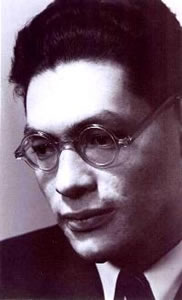
Yasushi Inoue, Harry Martinson, Carl Ludwig Börne

De Japanse schrijver Yasushi Inoue werd geboren op 6 mei 1907 in Asahikawa. Zie ook mijn blog van 6 mei 2007 en ook mijn blog van 6 mei 2009.
Uit: Lou-Lan and Other Stories (Vertaald door Edward Seidensticker)
„The next morning the soldiers of Charkhlik heard a strange howling. The wind had risen again, but it was not the wind they heard. It was a sound that came through the wind.
The young leader ordered a soldier to a tower. Just then the first arrow hit the side of a building and fell into the street. It was a long arrow, and after it a shower of arrows fell upon the stone paving. They came from a considerable distance, but it was not possible to determine the direction. Blown by the fierce wind, they struck the ground almost horizontally. The soldier came down from the tower. The air was black with sand, and he had been able to see nothing. The leader himself went up the tower, but it was as the man had said.
The wind howled through a sky dark as night, and with it came that other sound--the angry howling of Lop Nor. The leader would probably have seen it the day before if he had gone a little farther.
He came down from the tower. The rain of arrows was heavier and the strange noise seemed nearer. He marched his men toward the gate, since they would be at a disadvantage fighting a large enemy within the walls. They were not quite fast enough, however. At the guardhouse they came upon a strangely clad troop making its way in. The soldiers of Charkhlik faced the enemy there inside the gate. Each with a long sword in hand, the men of the strangely clad troop feinted and lunged at them.
The soldiers of Charkhlik answered with their long spears. Sand began to descend on the battlefield like a waterfall. Both sides had to stop fighting. They could not keep their eyes open, and the sand penetrated the smallest holes in their armor.
The wind grew yet fiercer and the sand yet thicker. The sun was hidden, and the fighters could hardly make one another out.
The young leader had finally pushed his way through the gate with a number of followers. They could go no farther. The sandstorm was even worse than within the city. The soldiers of Charkhlik one by one joined their leader, and the band lay huddled against the wall. With them were a number of enemy soldiers who had been unable to go inside. The neighing of hundreds of ponies and the crying of camels came through the howling wind and waves.“
De Zweedse dichter en schrijver Harry Martinson werd geboren op 6 mei 1904 in Jämshög in het zuidoosten van Zweden. Zie ook mijn blog van 6 mei 2007 en ook mijn blog van 6 mei 2008 en ook mijn blog van 6 mei 2009.
Li Ti's Advice
If you own two coppers, said Li-Ti on a journey,
buy one loaf of bread and one blossom.
The bread is there to fill you
The blossom you buy is to tell you
that life is worth the living.
Vertaald door Stephen Klass
Dusk in the Country
The riddle silently sees its image. It spins evening
among the motionless reeds.
There is a frailty no one notices
there, in the web of grass.
Silent cattle stare with green eyes.
They mosey in evening calm down to the water.
And the lake holds its immense spoon
up to all the mouths.
Power
The engineer sits by the big wheel,
all through the June night, reading.
The power station mumbles introverted in the turbines,
its leafy, embedded heart beats calm and strong.
The timid birch stands tall by the concrete mouth of the dam;
not a leaf quivers.
The hedgehog slobbers along the river bank.
The guard's cat listens hungrily to birdsong.
And the power whistles away along a hundred miles of wire
before it suddenly rumbles down into the braggart cities.
Vertaald doorRobert Bly

De Duitse schrijver, journalist en criticus Carl Ludwig Börne werd in Frankfurt geboren als Juda Löb Baruch op 6 mei 1786. Zie ook mijn blog van 6 mei 2009.
Uit: Über das Schmollen der Weiber
„Meine ehemalige Braut nannte ich, wie es bei allen kultivierten Völkern Sitte ist, einen Engel; meine jetzige Frau nenne ich, wenn ich böse auf sie bin, einen gefallenen Engel, ist das Ehewetter aber heiter, einen gestutzten. »Warum gestutzter?« fragte mich Wilhelmine, als ich mich zum ersten Male dieses Ausdrucks bediente. Ich ward verlegen; denn ich hatte mich noch nicht zu verstellen gelernt, ich wußte noch nicht, wie gut in der Ehe oft das Lügen sei und wie ohne diesen Lichtschirm der Wahrheit rote Augen noch häufiger wären. »Teure Wilhelmine!« sagte ich, indem ich ihr ein Stückchen Zucker, den sie sehr liebt, in den Purpurmund steckte, »liebes Vögelchen, müßte ich nicht zittern für mein Glück, wenn deine Engelsflügel nicht etwas gestutzt wären? Müßte ich nicht fürchten, du entflattertest!« ... und flögest den Himmel hinauf, wo deine Heimat ist – wollte ich höchst poetischer Weise hinzusetzen. Aber meine gute Frau ließ mich nicht ausreden. »Du fürchtest also, ich könnte dir untreu werden?« fragte sie, wartete aber auf keine Antwort, sondern nahm ihr Gesicht zusammen, verschloß den Mund und schmollte. Vergebens war mein Flehen, mein Drohen, mein Reden, mein Schweigen sogar; sie schmollte fort. Ich ging mit starken Schritten das Zim mer auf und ab; in Engels »Mimik« ist keine Bewegung geschildert, die ich nicht mit der größten Naturtreue darstellte: Liebe, Haß, Zorn, Wut, Verzweiflung; aber meine gute Wilhelmine sprach kein Wort. Bei dieser Gelegenheit lernte ich das berühmte Schmollen der Weiber kennen, und seitdem verlernte ich es nicht mehr. Es war der dreißigste Tag nach meiner Hochzeit, da mein Glück in den Wendepunkt des Krebses trat. Anfänglich hatte meine teure Wilhelmine nur einen Schmollstuhl, dann nahm sie einen Schmollwinkel ein, später verschloß sie sich in ein Schmollkämmerchen, bis sie endlich es durch Übung dahingebracht, im ganzen Hause zu schmollen.“

Buste op Pere Lachaise