Naar de inhoud

Romenu

Over literatuur, gedichten, kunst en cultuur
akke.beakke.be

Berichten van 22 november 2010 tot 23 november 2010

Paul Celan, Marcel Beyer, Jennifer Michael Hecht
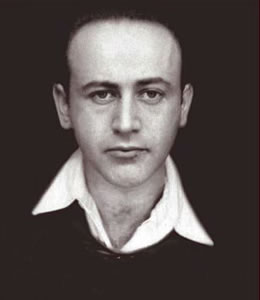

De Duits-Roemeense dichter Paul Celan werd onder de naam Paul Antschel op 23 november 1920 geboren in Czernowitz, toentertijd de hoofdstad van de Roemeense Boekovina, nu behorend bij de Oekraïne. Zie ook mijn blog van 23 november 2006 en ook mijn blog van 29 maart 2006  en ook mijn blog van 23 november 2007 en ook mijn blog van 23 november 2008 en ook mijn blog van 23 november 2009.


Sprich auch du

Sprich auch du,
sprich als letzter,
sag deinen Spruch.

Sprich -
Doch scheide das Nein nicht vom Ja.
Gib deinem Spruch auch den Sinn:
gib ihm den Schatten.

Gib ihm Schatten genug,
gib ihm so viel,
als du um dich verteilt weißt zwischen
Mittnacht und Mittag und Mittnacht.

Blicke umher:
sieh, wie's lebendig wird rings -
Beim Tode! Lebendig!
Wahr spricht, wer Schatten spricht.


Nun aber schrumpft der Ort, wo du stehst:
Wohin jetzt, Schattenentblößter, wohin?
Steige. Taste empor.
Dünner wirst du, unkenntlicher, feiner!
Feiner: ein Faden,
an dem er herabwill, der Stern:
um unten zu schwimmen, unten,
wo er sich schimmern sieht: in der Dünung
wandernder Worte


Harnischstriemen

Harnischstriemen, Faltenachsen,
Durchstich-
punkte:
dein Gelände.

An beiden Polen
der Kluftrose, lesbar:
dein geächtetes Wort.
Nordwahr. Südhell.


Met wisselende sleutel

Met wisselende sleutel
ontsluit je het huis, waarin
de sneeuw van 't verzwegene woedt.
Naar gelang het bloed opwelt
uit je oog of je mond of je oor
wisselt je sleutel.

Wisselt je sleutel, wisselt het woord
dat woeden mag met de vlokken.
Naar gelang de wind die jou wegstoot,
balt om het woord zich de sneeuw.


Vertaald door Frans Roumen


 790203-42d263f8e9a1c9afb52e7526f7d2802d.jpg

Paul Celan (23 november 1920 – 20 april 1970)


De Duitse dichter, schrijver en essayist Marcel Beyer werd op 23 november 1965 in Tailfingen / Württemberg geboren. Zie ook mijn blog van 23 november 2006 en ook mijn blog van 23 november 2008 en ook mijn blog van 23 november 2009.


Hotel Kaliningrad


Na komm. Im Nachbarbett verhaken sich die Finger,

die Wand ist Packpapier, im Dunkeln rieche

ich nach Fisch. Die Tür war offen, angelehnt, als


ich den langen Flur herunterkam. Nun komm, komm

schneller. Sie lachten nicht, ich dachte immer,

daß sie lachen, wenn sie im Nachbarzimmer sich


betrachten. Das Bett, die Wäsche ist so grob gemustert,

ich kann darin den nackten Fuß nur schwer

erkennen. Na komm, nicht schlafen, nicht ermüden,


steh. Lang kann es nicht mehr dauern, die Hand ist warm,

das Muster grob, das Fenster Zellophan. Es dauert

nicht mehr lang, dann schiebt der Tabakhändler seinen


Ring der dunklen Nachtgenossin auf den kleinen Zeh.


Wespe, komm


Wespe, komm in meinen Mund,

mach mir Sprache, innen,

und außen mach mir was am

Hals, zeig’s dem Gaumen, zeig es


uns. So ging das. So gingen die

achtziger Jahre. Als wir jung

und im Westen waren. Sprache,

mach die Zunge heiß, mach


den ganzen Rachen wund, gib mir

Farbe, kriech da rein. Zeig mir

Wort- und Wespenfleiß, mach’s

dem Deutsch am Zungengrund,


innen muß die Sprache sein. Immer

auf Nesquik, immer auf Kante.

Das waren die Neunziger. Waren

die Nuller. Jahre. Und: so geht das


auf dem Land. Halt die Außensprache

kalt, innen sei Insektendunst, mach

es mir, mach mich gesund,

Wespe, komm in meinen Mund.


 790203-18ea15d66955afaff479c6f9335c1a33.jpg

Marcel Beyer (Tailfingen, 23 november 1965)


De Amerikaanse dichteres en schrijfster Jennifer Michael Hecht werd geboren op 23 november 1965 in New York. Zie ook mijn blog van 23 november 2006 en ook mijn blog van 23 november 2008 en ook mijn blog van 23 november 2009.


Funny Strange


We are tender and our lives are sweet


and they are already over and we are

visiting them in some kind of endless

reprieve from oblivion, we are walking

around in them and after we shatter

with love for everything we settle in.


Thou tiger on television chowing,

thou very fact of dreams, thou majestical

roof fretted with golden fire. Thou wisdom

of the inner parts. Thou tintinnabulation.


Is it not sweet to hand over the ocean's

harvest in a single wave of fish? To bounce

a vineyard of grapes from one's apron

and into the mouth of the crowd? To scoop up

bread and offer up one's armful to the throng?

Let us live as if we were still among


the living, let our days be patterned after

theirs. Is it not marvelous to be forgetful?


September

Tonight there must be people who are getting what they want.
I let my oars fall into the water.
Good for them. Good for them, getting what they want.

The night is so still that I forget to breathe.
The dark air is getting colder. Birds are leaving.

Tonight there are people getting just what they need.

The air is so still that it seems to stop my heart.
I remember you in a black and white photograph
taken this time of some year. You were leaning against
a half-shed tree, standing in the leaves the tree had lost.

When I finally exhale it takes forever to be over.

Tonight, there are people who are so happy,
that they have forgotten to worry about tomorrow.

Somewhere, people have entirely forgotten about tomorrow.
My hand trails in the water.
I should not have dropped those oars. Such a soft wind.


 790203-1cfe1a6a1a3765f72ba2e1c00a72410f.jpg

Jennifer Michael Hecht (New York, 23 november 1965)


Zie voor nog meer schrijvers van de 23e november ook mijn vorige blog van vandaag.
Geschreven door Romenu om 23:03 Reageer op dit bericht

Sait Faik Abasıyanık, Guy Davenport, Nigel Tranter, Marieluise Fleißer, Nirad C. Chaudhuri


De Turkse schrijver
Sait Faik Abasıyanık werd geboren op 23 november 1906 in Adapazarı. Zie ook mijn blog van 23 november 2008. 


Uit: Hisht, Hisht!... (Vertaald door Ufuk Özdağ)


„Maybe it’s a bird. Maybe it’s a tortoise. Maybe a hedgehog. Or maybe a fish, a monster, calling out from the sea nearby. Maybe a cormorant. Maybe a mihaliki1 bird.

Or better still, why don’t I, myself, start a “hisht hisht.” Right at that instant, I began murmuring a sound, not at all resembling the hisht hisht sound that was going on . . . a sound, though I wrestled, that would not resemble the sound I had been hearing.

All of a sudden, a man and a woman appeared ahead of me. They asked for the road to Kalpazankaya.2 “You’re right on it,” I replied. It seemed as though the road moved . . .  as though they didn’t walk. They became distant to me in a matter of steps. I noticed the priest’s son lying facedown among the sheep. From his face rose a creature, silly and like a freckled rooster. He wiped saliva from his mouth. He grabbed the lamb by its legs. He fell with the lamb. He kissed the lamb on its nose. He stared about with an ugly, silly, jerk-off’s face. Now I was in a flower field. It was, no doubt, some kind of bird that kept saying “hisht hisht” to me. Y’see, there certainly are birds like that. They do not go “chirp chirp”; they go “hisht hisht.” A bird it was, a bird.

A man was spading the ground. He was stepping on the metal of the spade, and was tilling the soil, reddish in color, upside down.

“Hello there, my fellow friend!” he said.“


 790184-cb197561de2b0c57c114fad7043a7b0c.jpg

Sait Faik Abasıyanık (23 november 1906 – 11 mei 1954)


De Amerikaanse schrijver, vertaler, schilder, illustrator Guy Mattison Davenport werd geboren op 23 november 1927 in Anderson, South Carolina. Zie ook mijn blog van 23 november 2008.


Uit: The Dawn


„At the gymnasium he had finished his presses and curls, walked springfooted to the

showers, tossed his shorts and jockstrap into his locker, and lifted his face to the cold torrent that

sprayed him until he was gooseflesh and shivers, his scrotum tight.

Wittgenstein’s mornings were spent in gardens, forests, Cambridge fields. His hands in

the pockets of his leather jacket, he walked around trees, his eyes puzzled by their beauty.

(...)


The attendant Hans, a tall, steep-chested boy with a wad of hair at his jugular notch, had brought

him a fresh towel. A redstone kouros from Sounion, this strapping young Amsterdammer,

translated into the slenderer grace of the modern gramivore. He wore only a thin-bretelled blue

undershirt that rucked under his pectoral mass but stretched creaseless across his myronic flanks.

Adriaan regarded his stout cock with philosophic admiration, male envy tempered by apolegamy.“


790184-1f9b4e55689d8dff91de70a5c6a74c9b.jpg
Guy Davenport (23 november 1927 – 4 januari 2005)


De Schotse schrijver en historicus Nigel Tranter werd geboren op 23 november 1909 in Glasgow. Zie ook mijn blog van 23 november 2008.


Uit: The Queen’s Scotland


“Monikie, Craigton and Newbigging.

This rural parish lies eight miles north-east of Dundee and four north of Monifieth, and is readily identified, both on the ground and on the map, by the double Monikie Reservoirs of the Dundee Waterworks, of 73 and 46 acres, which, with a third one two miles to the north at Crombie, supply some 650 million gallons. The parish is medium-sized, of about 9000 acres, and contains the villages of Craigton and Newbigging. Monikie itself consists of two hamlets, the Kirkton and that at the former railway-station a mile to the west; plus another, reduced to a scatter of houses, at Guildy farther to the east. Two small ranges of hills divide the parish into three districts of differing character, traversed by the streams and dens of Monikie, Pitairlie and Buddon Burns.The larger, Monikie, hamlet at the west end of the reservoirs, is quite an attractive place, with a surprisingly large granary, formerly a seed-crushing mill, to find in such a rural site, the works of the Panmure Trading Company, which dries and stores grain from a wide area, especially barley for the distilleries. The branch-line and former railway-station are closed. Half a mile to the north-west is the highly interesting Auchinleck or Affleck Castle. This is an excellent example of the sturdy and massive free-standing tower of the late 15th century, little altered, five storeys and 60 feet high, with corbelled parapet and two distinctly unusual square caphouses, the flat roofs of which form lofty watch-platforms.“


790184-db7e1005c0a9996f27e093e8d1194ff2.jpg
Nigel Tranter (23 november 1909 – 9 januari 2000)

Glasgow 


De Duitse schrijfster Marieluise Fleißer werd geboren op 23 november 1901 in Ingolstadt. Zie ook mijn blog van 23 november 2008.


Uit: Hiltrud Häntzschel: Marieluise Fleißer. Eine Biographie


„Zu Marieluise Fleißers 70. Geburtstag im November 1971 forderte der Dramatiker Franz Xaver Kroetz in der Süddeutschen Zeitung: "Der Suhrkamp Verlag sollte endlich auch eine Gesamtausgabe der Fleißerschen Werke herausbringen." Es gab damals nicht nur keine Gesamtausgabe, das literarische Früh- und Hauptwerk der Schriftstellerin Marieluise Fleißer war so gut wie verschollen, ungelesen, unüberprüfbar. Ein Jahr zuvor erst hatte "das Wunder" begonnen, das Wunder ihrer Wiederentdeckung, Wiedererkennung, begleitet vom großen späten Ruhm.
Zweimal in ihrem Leben hatte sie wirklich Erfolg. Der erste, 1929 mit der Berliner Aufführung der Pioniere in Ingolstadt, war so glanzvoll wie umstritten und brach - in Verbindung mit persönlichen Umständen - ihre Karriere ab. Der zweite am Ende ihres Lebens kam zu spät, aus Ruhm wurde Nachruhm, aus Nachruhm Legende. Dazwischen liegen Jahrzehnte eines unglücklichen, engen, einzig an Mangel, Entbehrungen, Enttäuschungen reichen Lebens: materieller Mangel, nackter Hunger und völlige Mittellosigkeit, Mangel an Liebe, an erfüllter Sexualität, Mangel an intellektuellen Kontakten, an Austausch mit Ebenbürtigen, Mangel an öffentlicher Anerkennung ihres Schreibens, an Erfolg. Wären da nicht ihre "Fluchtwege im Kopf", ihre einzigartige dichterische Könnerschaft, es lohnte kaum, von ihr zu erzählen.
Heute ist Marieluise Fleißer auf sonderbare Weise unbekannt und prominent zugleich: Es gibt Marieluise-Fleißer-Straßen und eine Briefmarke, ein ICE führt unter ihrem Namen. Ihre Lebensgeschichte - oder was davon in die Legenden einging, das Brecht-Erlebnis vor allem - hat sich verselbständigt, wieder in Literatur verwandelt.


790184-cab2fd2f35216e267118ed880c9828d0.jpg
Marieluise Fleißer (23 november 1901 – 2 februari 1974)

Omslag biografie 


Zie voor onderstaande schrijver ook mijn blog van 23 november 2008.


De Bengaals-Indische schrijver Nirad C. Chaudhuri werd geboren op 23 november 1897 in Kishoreganj.


Geschreven door Romenu om 20:40 Reageer op dit bericht

In Memoriam Guillaume van der Graft


In Memoriam Guillaume van der Graft


In zijn woonplaats Utrecht is afgelopen zondag, 21 november, op 90-jarige leeftijd de Nederlandse dichter, schrijver en theoloog Guillaume van der Graft overleden. Guillaume van der Graft werd op 15 augustus 1920 geboren in Rotterdam. Zie ook mijn blog van 15 augustus 2007 en ook mijn blog van 15 augustus 2008 en eveneens mijn blog van 15 augustus 2009 en mijn blog van 15 augustus 2010.


Met de mensen mee


Met de vogels mee om vermoeidheidsredenen
reed ik de berg af, zij volgden mij,
enkelen rolden een groot rond ei
tussen zich in, sommigen deden


driftige ave's met hun vleugels;
gaandeweg werd de weg steenachtiger,
een reiger hijgde als een tachtiger,
allerlei onbewoonde geheugens


lagen verspreid in de groene kommen,
huppelend liepen de kleinsten naast mij,
veerkrachtig de arenden, zonder haast
de pienteren en kwaadsprekend de dommen.


Waarom? vroeg ik mij eensklaps af;
vogels zijn vlammen, ze slaan naar boven,
ze kunnen staan in een vurige oven,
maar mensen zijn as in een koud graf.


 789694-300ac0a4b03656520c495c507600b176.jpg

Guillaume van der Graft (15 augustus 1920 – 21 november 2010)

Geschreven door Romenu om 08:16 Reageer op dit bericht

Henri Borel

De Nederlandse schrijver en journalist Henri Jean Francois Borel werd geboren in Dordrecht op 23 november 1869. Hij was de zoon van kapitein der artillerie (later luitenant-kolonel en generaal-majoor) George Frederik Willem Borel. Een van zijn voorouders was waarschijnlijk de Franse zwartromantische schrijver Petrus Borel. Borel studeerde in Leiden en was vervolgens (van 1894-1899) tolk in China en ambtenaar voor Chinese aangelegenheden in Nederlands-Indië. Na zijn terugkeer in Nederland, in 1913, werd hij journalist en literair criticus voor De Telegraaf en Het Vaderland. Daarnaast schreef hij diverse boeken. Als romancier werd hij bekend met „Het jongetje“ (1898) en „Het zusje“ (1900). Door de kritiek werden deze doorgaans afgewezen, getuige de vele drukken werden ze door het grote publiek gewaardeerd. Ook Louis Couperus bewonderde Borel zeer, zoals te lezen is in Couperus roman Metamorphose (1897). Verder schreef hij Chinees-wijsgerige boeken als Wijsheid en schoonheid van China (1895), Kwan Yin: een boek van de goden en de hel (1896), De Chineesche filosofie toegelicht voor niet-sinologen (drie delen, 1896-1931) en De geest van China (1916). Hij was bevriend met Frederik van Eeden, Johan Thorn Prikker en Louis Couperus.


Uit: Het jongetje


“Hij was nog een heel erg Jongetje. Hij vond zichzelf al een beetje een meneer, sedert hij op de Hoogere Burgerschool was, en een lange broek aan had. Ook wist hij zoo nog al het een en ander, wat schooljongens in den Haag al zoo heel gauw weten, en hij vloekte ook wel, als de andere er bij waren, en lachte om allerlei leelijke dingen, zonder de gemeenheid te voelen.

Maar in zijn hart was hij nog een heel erg Jongetje gebleven. En ik zeg dit, omdat ik het weten kan. Hij liep meestal in een zwart pakje, dat stond hem het beste, zei moê; zijn lange broek had hij nog maar kort aan; en daarom liepen zijn beenen er nog wat moeilijk en verlegen in, alsof hij nog niet goed groot durfde zijn. Hij droeg een rond zwart hoedje, met zijde geboord en met een zijden lint. Onder een wit liggend boordje droeg hij een breedgestrikte das, en aan zijn mouwen vastgespeld witte manchetten. Een wit zakdoekje kwam uit zijn vestjeszak kijken. Voor al die dingen zorgde moê. Maar het boordje en de manchetten waren heel gauw vuil, en hij beet gaatjes in zijn zakdoeken, en smeerde er inkt aan. Hij had een wandelstok met een gouden knop, dien hij zooveel mogelijk op straat liet zien. Nog al een deftig jongetje was hij, en wou dat ook erg graag zijn. Hij was in den groei, en erg tenger, met een bleek gezicht, en hij wist dat dit een beetje voornaam was. Hij wist ook, dat de meisjes hem wel mochten, en liep een heele boel meisjes tegelijk na. Op de groote kinderbals in den Haag kwam hij vroeger in zwart fluweel, met korte broek, zwart zijden kousen en verlakte schoentjes met strikken, en dan maakte hij zichzelf wijs dat hij een prins of een graaf was. Vol decoraties, gouden sterren en bloemen van de cotillon, kwam hij daarvan thuis, en dan stond hij zich heel lang in den spiegel te bekijken, met al die glorie op zijn borst, vóór hij in bed ging. Een roosje en een lintje van het állerliefste meisje, - van een klein, wonderteer wezentje, feeëriek in tulle en kant -, ging meê, onder zijn kussen. - Maar hij had telkens weer een ánder allerliefst meisje, en was heel ontrouw, ofschoon hij een ridder wilde zijn.”


911308-7a588aa5ff148e9c02a0b481330ab773.jpg
Henri Borel (23 november 1869 - 31 augustus 1933)
Geschreven door Romenu om 00:00 Reageer op dit bericht

Sipko Melissen

De Nederlandse dichter en schrijver Sipko Melissen werd geboren in Scheveningen op 23 november 1944. Melissen debuteerde in 1985 met de dichtbundel Gezicht op Sloten. In 1997 ontving hij voor zijn roman Jonge mannen aan zee de Anton Wachterprijs (voor het beste debuut). In 2000 verscheen De huid van Michelangelo en in 2003 De vendelzwaaier. Ook heeft Melissen een dichtbundel gepubliceerd in 1985, Gezicht op Sloten. In zijn romans spelen zelfonderzoek, de zoektocht naar inzicht en vriendschap tussen al dan niet homoseksuele mannen een belangrijke rol.


Buitenhuis


De appelboom staat al weer klaar
de bloesems komen dit voorjaar
laat maar zij komen niettemin

want in de takken huist geduld
een winter lang zijn zij vervuld
van niets dan breekt voor ons de knop

de bloei gebeurt in lichte tint
dan komen vlinders en de wind
de blaadjes worden losgerukt

en in de zomer als wij komen
hangen de appels aan de bomen
eten wij appels uit de hand

de takken raken leeggeplukt
ik overdenk het kort geluk
tussen bloesem en appelmoes

de appelboom is een parabel
die vrucht afwerpt in menig fabel
en aan mijn houten keukentafel


 899230-a1753a409dda68b3cc53a65f2205681e.jpg

Sipko Melissen (Scheveningen, 23 november 1944)
Geschreven door Romenu om 00:00 Reageer op dit bericht

André Gide, George Eliot, Viktor Pelevin, Suresh en Jyoti Guptara

De Franse schrijver André Gide werd geboren op 22 november 1869 in Parijs. Zie ook mijn blog van 22 november 2006 en ook mijn blog van 22 november 2007 en ook mijn blog van 22 november 2008 en ook mijn blog van 22 november 2009.


Uit: La symphonie pastorale


“Mais je crois inutile de noter ici tous les échelons premiers de cette instruction qui, sans doute, se retrouvent dans l’instruction de tous les aveugles. C’est ainsi que, pour chacun d’eux, je pense, la question des couleurs a plongé chaque maître dans un même embarras. (Et à ce sujet je fus appelé à remarquer qu’il n’est nulle part question de couleurs dans l’Évangile.) Je ne sais comment s’y sont pris les autres ; pour ma part je commençai par lui nommer les couleurs du prisme dans l’ordre où l’arc-en-ciel nous les présente ; mais aussitôt s’établit une confusion dans son esprit entre couleur et clarté ; et je me rendais compte que son imagination ne parvenait à faire aucune distinction entre la qualité de la nuance et ce que les peintres appellent, je crois, « la valeur ». Elle avait le plus grand mal à comprendre que chaque couleur à son tour pût être plus ou moins foncée, et qu’elles pussent à l’infini se mélanger entre elles. Rien ne l’intriguait davantage et elle revenait sans cesse là-dessus.
Cependant il me fut donné de l’emmener à Neuchâtel où je pus lui faire entendre un concert. Le rôle de chaque instrument dans la symphonie me permit de revenir sur cette question des couleurs. Je fis remarquer à Gertrude les sonorités différentes des cuivres, des instruments à cordes et des bois, et que chacun d’eux à sa manière est susceptible d’offrir, avec plus ou moins d’intensité, toute l’échelle des sons, des plus graves aux plus aigus. Je l’invitai à se représenter de même, dans la nature, les colorations rouges et orangées analogues aux sonorités des cors et des trombones, les jaunes et les verts à celles des violons, des violoncelles et des basses ; les violets et les bleus rappelés ici par les flûtes, les clarinettes et les hautbois. Une sorte de ravissement intérieur vint dès lors remplacer ses doutes :
– Que cela doit être beau ! répétait-elle.
Puis, tout à coup :
– Mais alors : le blanc ? Je ne comprends plus à quoi ressemble le blanc...
Et il m’apparut aussitôt combien ma comparaison était précaire. – Le blanc, essayai-je pourtant de lui dire, est la limite aiguë où tous les tons se confondent, comme le noir en est la limite sombre. – Mais ceci ne me satisfit pas plus qu’elle, qui me fit aussitôt remarquer que les bois, les cuivres et les violons restent distincts les uns des autres dans le plus grave aussi bien que dans le plus aigu. Que de fois, comme alors, je dus demeurer d’abord silencieux, perplexe et cherchant à quelle comparaison je pourrais faire appel.”


 789299-d70a494c456e62e5adeb997903726027.jpg

André Gide (22 november 1869 – 19 februari 1951)

Portret door Jacques Emile Blanche, 1912


De Engelse schrijfster George Eliot werd geboren op 22 november 1819 in Nuneaton in Warwickshire. Zie ook mijn blog van 22 november 2006 en ook mijn blog van 22 november 2008 en ook mijn blog van 22 november 2009.


Count That Day Lost 


If you sit down at set of sun

And count the acts that you have done,

And, counting, find

One self-denying deed, one word

That eased the heart of him who heard,

One glance most kind

That fell like sunshine where it went --

Then you may count that day well spent.


But if, through all the livelong day,

You've cheered no heart, by yea or nay --

If, through it all

You've nothing done that you can trace

That brought the sunshine to one face--

No act most small

That helped some soul and nothing cost --

Then count that day as worse than lost.


In a London Drawingroom 


The sky is cloudy, yellowed by the smoke.

For view there are the houses opposite

Cutting the sky with one long line of wall

Like solid fog: far as the eye can stretch

Monotony of surface & of form

Without a break to hang a guess upon.

No bird can make a shadow as it flies,

For all is shadow, as in ways o'erhung

By thickest canvass, where the golden rays

Are clothed in hemp. No figure lingering

Pauses to feed the hunger of the eye

Or rest a little on the lap of life.

All hurry on & look upon the ground,

Or glance unmarking at the passers by

The wheels are hurrying too, cabs, carriages

All closed, in multiplied identity.

The world seems one huge prison-house & court

Where men are punished at the slightest cost,

With lowest rate of colour, warmth & joy.


 789299-d4be94415420acab207e16ef6610fb84.jpg

George Eliot (22 november 1819 – 22 december 1880)

Op 30-jarige leeftijd, portret door François D'Albert Durade


De Russische schrijver Viktor Pelevin werd geboren op 22 november 1962 in Moskou. Zie ook mijn blog van 22 november 2006 en ook mijn blog van 22 november 2008 en ook mijn blog van 22 november 2009.


Uit: The Life Of Insects (Vertaald door Andrew Browmfield)


„The main building of the old resort hotel, half hidden from view behind a screen of old poplars and cypresses, was an oppressive, gray structure which seemed to have turned its back to the sea at the bidding of some crazed fairy-tale conjuror. The facade, with its columns, cracked stars, and sheaves of wheat bent eternally before a plaster wind, faced into a shallow courtyard where the smells of the kitchen, the laundry, and the hairdresser's mingled; the massive wall which faced onto the shoreline had only two or three windows. A few yards from the colonnade there was a high concrete wall, beyond which the rays of the sunset glinted on the smokestacks of the local power plant. The tall formal doors concealed in the shade on the cyclopean balcony had been locked for so long that even the crack between them had disappeared under several layers of caked paint, and the yard was usually empty, except when an occasional truck cautiously squeezed its way in, bringing milk and bread from Feodosia.

This evening there wasn't even a truck in the yard, so there was no one to notice the individual leaning on the molded balustrade of the balcony, except perhaps for a pair of seagulls out on patrol, two white specks drifting across the sky. The stranger was looking down and to the right, toward the shelter on the dock and the cone of a loudspeaker lodged under the edge of its roof. The sea was noisy, but when the wind blew toward the hotel, it carried audible snatches of a radio broadcast directed at the deserted beach.

"... not at all the same as each other, not cut to the same pattern ... created us all different; is not this part of the grand scheme of things, counted, unlike the transient plans of man, in many ... What does the Lord expect of us, as He turns His hopeful gaze in our direction? Will we be able to make use of His gift? ... For He Himself does not know what to expect from the souls that He has sent to ..."


 789299-b1c98015fe0130415650f79149325f6d.jpg

Viktor Pelevin (Moskou, 22 november 1962)


De Brits-Indische schrijverstweeling Suresh en Jyoti Guptara werd geboren op 22 november 1988 in Frimley, Hants in het zuidoosten van Engeland. Zie ook mijn blog van 22 november 2008 en ook mijn blog van 22 november 2009.


Uit: Conspiracy of Calaspia


„After throwing a wary look around him, Galar stooped to look at the man.  He was in a nasty state, battered and bloody – however, miraculously all in one piece.  Alive, but barely so.  Although the fight had not taken place all that long ago, the man’s wounds had already dried.  That wasn’t much of a surprise in this accursed heat.

A sigh escaped the man’s lips.  He tried to sit up, but collapsed under the strain and gasped in pain.

‘Monsters,’ he finally stammered.

‘O’course,’ Galar rumbled.  ‘What did yeh expect, butterflies?’ 

The Dwarf felt sorry for the man, but what had he expected?  Anyone nosing around this part of Calaspia was asking for trouble.  It was home to the worst of creatures, although thankfully it no longer supported certain predators.  A ludicrous thought popped into Galar’s mind, and he chuckled at the notion of the Ministry for Ecology or whatever the Numenii now called it, labelling the monsters here ‘endangered species’.  No, nobody was sad that these beasts were dying out.  And no one regretted obliterating the monstrous Ostentum.

‘Come on, let’s get yeh outta here,’ the Dwarf said gently to the whimpering man, ‘before they return.’  He would get to ask him who he was and what stroke of insanity had led him here later.  But the man resisted Galar’s powerful arms, shaking his head and muttering, as if to ward off a nightmare.

‘Sun must’ve got to yeh head, but we’ll have yeh sorted in no time.  Here, this’ll help.’  Galar fumbled around in his beard until he found what he was looking for.  Retrieving a crystal vial, Galar bent over his wounded charge and prepared to administer the liquid.  Again a feeble protest ensued, and so instead the Dwarf cradled the man’s head in one enormous hand and helped him to sit up.  The man took several gulps of the scorched air.  His eyelids fluttered as he fought to keep them open.  He opened his mouth to speak and his cracked lips struggled to form the words.”


789299-6701b7e85fd27b84713646da871a27e3.jpg
Suresh en Jyoti Guptara (Frimley, 22 november 1988)


Zie voor nog meer schrijvers van de 22 november ook
mijn vorige blog van vandaag.

Geschreven door Romenu om 21:45 Reageer op dit bericht

Endre Ady, William Kotzwinkle, George Robert Gissing, Elisabeth Maria Post


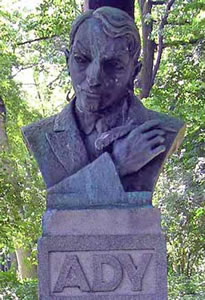
De Hongaarse dichter Endre Ady werd geboren op 22 november 1877 in het huidige Adyfalva. Zie ook mijn blog van 22 november 2008 en ook mijn blog van 22 november 2009.


Benediction from a Train


The express is hurtling at full speed,
the sun explodes into the sea,
my memories flash a millisecond,
and I bless you.


"May God bless
all your goodness,
your unresponsiveness,
and all your wickedness.
May your words of torment
return to you in benediction.
May your coldness
leap into flames.
All is at an end.
I have a thousand cares,
and for my folly
the bier is spread.
Well, I bless you,
and meanwhile
kiss me softly,
in silence and peace.
I wish to leave you
with a memory and a kiss
to freeze for warmth,
to be alone,
to feel alone,
to die alone.
May God bless you."


The express is hurtling at full speed,
the sun explodes into the sea,
my memories flash a millisecond,
and I bless you.


Vertaald door Gábor Lendvai


789292-c824349b4952871124f9d6ff6c016c15.jpg
Endre Ady (22 november 1877 – 27 januari 1919)

Buste in de Hungarian Cultural Gardens, Cleveland, Ohio


De Amerikaanse schrijver
William Kotzwinkle werd geboren op 22 november 1943 in Scranton, Pennsylvania. Zie ook mijn blog van 22 november 2008
en ook mijn blog van 22 november 2009.


Uit: The Amphora Project


"Sky mines," hissed Lizardo, his throat inflating nervously as he gazed out the flight deck window at the ornaments of doom flickering in the darkness. His armored scales made a scraping sound as he wrapped his tail around the pedestal of his seat. "No one mentioned minefields."
"You worry too much," said Commander Jockey Oldcastle, his formidable paunch pressed against the controls of their descending ship.
"That's why we haven't been killed until now," hissed Lizardo. He was a navigator from Planet Serpentia. The pupils of his eyes were shaped like keyholes in an ancient lock, glowing with menace. In the rooms of his brain were recipes for poisons in all dilutions, from mild to murderous. Two fangs lay backward against the roof of his mouth. When they swung forward, they filled with venom and the recipient of it was going to go to sleep, for hours, days, or forever, depending on the mixture.
Jockey looked beyond the sky mines to the little moon below.
"Made for pleasure."
"Only fools seek pleasure on such places. We don't need this job."
"We need any job we can get." Jockey touched the controls lightly, taking the ship closer to the minefield.
Lizardo's scaly claws clicked on the control face of his naviga�tional equipment. He was preparing a flight plan for escape, back out through the minefield. Serpentians receive vibratory patterns from the metabolic processes of other brains, and metabolic tremors were now reaching him from the moon below. Amid the usual garbage of human and alien emotion he discerned the emanation of a hunting party--highly focused individuals on the prowl. As there was no game on the little moon, what were they hunting?“


789292-413497bcbca0919020bf144b3bf5b10c.jpg
William Kotzwinkle (Scranton 22 november 1943)


De Engelse schrijver George Robert Gissing werd geboren op 22 november 1857 in Wakefield, Yorkshire. Zie ook mijn blog van 22 november 2008 en ook mijn blog van 22 november 2009.


Uit: Our Friend the Charlatan


„As he waited for his breakfast, never served to time, Mr. Lashmar drummed upon the window-pane, and seemed to watch a blackbird lunching with much gusto about the moist lawn of Alverholme Vicarage. But his gaze was absent and worried. The countenance of the reverend gentleman rarely wore any other expression, for he took to heart all human miseries and follies, and lived in a ceaseless mild indignation against the tenor of the age. Inwardly, Mr. Lashmar was at this moment rather pleased, having come upon an article in his weekly paper which reviewed in a very depressing strain the present aspect of English life. He felt that he might have, and ought to have, written the article himself a loss of opportunity which gave new matter for discontent.

The Rev. Philip was in his sixty-seventh year; a thin, dry, round-shouldered man, with bald occiput, straggling yellowish beard, and a face which recalled that of Darwin. The resemblance pleased him. Privately he accepted the theory of organic evolution, reconciling it with a very broad Anglicanism; in his public utterances he touched upon the Darwinian doctrine with a weary disdain. This contradiction involved no insincerity; Mr. Lashmar merely held in contempt the common understanding, and declined to expose an esoteric truth to vulgar misinterpretation. Yet he often worried about it -- as he worried over everything.

Nearer causes of disquiet were not lacking to him. For several years the income of his living had steadily decreased; his glebe, upon which he chiefly depended, fell more and more under the influence of agricultural depression, and at present he found himself, if not seriously embarrassed, likely to be so in a very short time. He was not a good economist; he despised everything in the nature of parsimony; his ideal of the clerical life demanded a liberal expenditure of money no less than unsparing personal toil. He had generously exhausted the greater part of a small private fortune; from that source there remained to him only about a hundred pounds a year. His charities must needs be restricted; his parish outlay must be pinched; domestic life must proceed on a narrower basis. And all this was to Mr. Lashmar supremely distasteful.“


 789292-ae93196feba91b6e73077f344031502d.jpg

George Robert Gissing (22 november 1857 – 28 december 1903)


De Nederlands dichteres en schrijfster Elisabeth Maria Post werd geboren in Utrecht op 22 november 1755. Zie ook mijn blog van 22 november 2006.en ook mijn blog van 22 november 2008 en ook mijn blog van 22 november 2009.


De bosch-duif


 Lief duifjen! in uw' ted'ren toon,

 Hoor ik een liefdeklagt;

 Gij zucht uw koe koe roe roe roe,

 Zoo innig smachtend uit;

 Het galmt door 't hol en statig bosch;

 Een Echo baauwt het na;

 Ik luister; en ook in mijn hart

 Roept nog een Echo na.

 Werd u uw gaaiken ongetrouw?

 Of nam een roofdier 't weg?

 Zit ge op 't verlaaten nest alleen?

 Is uw geluk nu weg?

 Zij geeft geen antwoord, hoe gij roept;

 Uw klagt verscheurt mijn hart;

 Veelmeer misschien dan iemant ooit,

 Deel 'k in uw treurigheid. 


 Ook ik, gescheiden van mijn' vriend,

 Den eengen in 't heelal,

 Die mijn geheele hart bezit,

 Ben hier zoo gantsch alleen:

 Onzeker of het lot ons ooit

 Elkander geeven zal,

 Ga ik mistroostig door dit bosch;

 Zijn groen lacht mij niet aan.

 Der vooglen wildzang zij zoo blij

 Als ooit, ik word niet blij;

 Alleen uw koe koe roe roe roe,

 O! das gevalt mijn hart!


789292-736d5a120642f38f3fc7e0bf251c770c.jpg
Elisabeth Maria Post (22 november 1755 - 3 juli 1812)

Het landhuis Emminkhuizen waar de fam. Post waarschijnlijk enige jaren heeft gewoond

Geschreven door Romenu om 16:56 Reageer op dit bericht

Meer van Romenu

↑ Terug naar de berichten