

Naar de inhoud

Romenu

Over literatuur, gedichten, kunst en cultuur
akke.beakke.be

Berichten van 26 maart 2011 tot 27 maart 2011

Heinrich Mann, Golo Mann, Patrick McCabe, Bob den Uyl, Dubravka Ugrešić, Shusaku Endo

De Duitse schrijver Heinrich Mann werd geboren op 27 maart 1871 in Lübeck. Zie ook mijn blog van 27 maart 2007 en ook mijn blog van 27 maart 2008 en ook mijn blog van 27 maart 2009 en ook mijn blog van 27 maart 2010.


Uit: Professor Unrat


„Zu seiner Jubelfeier im Vorjahr hatte das Gymnasium ihm einen Fackelzug gebracht. Er war auf seinen Balkon getreten und hatte geredet. Während alle Köpfe, in den Nacken gelegt, zu ihm hinaufsahen, war plötzlich eine unschöne Quetschstimme losgegangen: »Da ist Unrat in der Luft!« Andere hatten wiederholt: »Unrat in der Luft! Unrat in der Luft!«
Der Professor dort oben fing an zu stottern, obwohl er den Zwischenfall vorausgesehn hatte, und sah dabei je­dem der Schreier in den geöffneten Mund. Die andern Herren standen in der Nähe; er fühlte, daß er wieder ein­mal »nichts beweisen« könne; aber er merkte sich alle Namen. Schon tags darauf gab der mit der gequetschten Stimme dadurch, daß er das Heimatdorf der Jungfrau von Orleans nicht kannte, dem Professor Gelegenheit zu der Versicherung, er werde ihm im Leben noch oftmals hinderlich sein. Richtig war dieser Kieselack zu Ostern nicht versetzt worden. Mit ihm blieben die meisten in der Klasse zurück von denen, die am Jubiläumsabend ge­schrien hatten, so auch von Ertzum. Lohmann hatte nicht geschrien und blieb dennoch sitzen. Dieser erleich­terte die Absicht Unrats durch seine Trägheit und jener durch seine Unbegabtheit. Nächsten Spätherbst nun, an einem Vormittag um elf, in der Pause vor dem Klassen­aufsatz über die »Jungfrau von Orleans«, geschah es, daß von Ertzum, der der Jungfrau immer noch nicht näherge­treten war und eine Katastrophe voraussah, in einem An­fall schwerfälliger Verzweiflung das Fenster aufriß und aufs Geratewohl mit wüster Stimme in den Nebel hinaus­brüllte: »Unrat!«
Es war ihm unbekannt, ob der Professor in der Nähe sei, und es war ihm gleichgültig. Der arme, breite Land­junker war nur von dem Bedürfnis fortgerissen worden, noch einen kurzen Augenblick seinen Organen freies Spiel zu gewähren, bevor er sich für zwei Stunden hinhocken mußte vor ein weißes Blatt, das leer war, und es mit Wor­ten bedecken aus seinem Kopf heraus, der auch leer war. Tatsächlich aber ging Unrat grade über den Hof. Als der Ruf aus dem Fenster ihn traf, machte er einen eckigen Sprung. Im Nebel droben unterschied er von Ertzums knorrigen Umriß. Kein Schüler hielt sich drunten auf, kei­nem konnte von Ertzum das Wort zugerufen haben. >Die­ses Mal<, dachte Unrat frohlockend, >hat er mich gemeint. Diesmal kann ich es ihm beweisen!< „


 880806-4159e202ff4bae7fa71c60a05e95079b.jpg

Heinrich Mann (27 maart 1871 – 12 maart 1950)

In 1906


De Duitse schrijver en historicus Golo Mann werd geboren in München op 27 maart 1909. Zie ook mijn blog van 27 maart 2009  en ook mijn blog van 27 maart 2010.


Uit: Golo Mann (Biografie door Urs Bitterli)


„Über die Familie, in die Angelus Gottfried Thomas Mann am 27. März des Jahres 1909 hineingeboren wurde, ist viel geschrieben worden, von den Angehörigen wie von den Literaturhistorikern.

Man kennt die Herkunft des Vaters, des Abkömmlings aus vornehmer Lübecker Kaufmannsfamilie und großen Schriftstellers, bis in ihre entlegenen Verästelungen. Und man kennt nicht minder genau die Familiengeschichte seiner Ehefrau Katia, der schönen Tochter aus dem jüdischen Professorenhause Pringsheim, in dem sich um die Jahrhundertwende alles traf, was in München kulturell Rang und Namen hatte.1 Im Jahre 1905 fand die Trauung zwischen dem Schriftsteller und der «Prinzessin» statt. Man lebte erst in einer Stadtwohnung, baute sich 1908 ein Sommerhaus in Bad Tölz und bezog sechs Jahre später eine stattliche Villa in München-Bogenhausen, Poschingerstraße 1. In rascher Folge wurden die Kinder geboren: Erika, in den Jahren des Exils und danach die hilfreiche Vertraute ihres Vaters; Klaus, der hochbegabte Schriftsteller, der sich 1949 das Leben nahm; Angelus Gottfried

Thomas, der spätere Historiker, den man als Kind in launiger Zusammenziehung der Vornamen Golo nannte – ein Name, der dem Erwachsenen blieb. Man mag sich an den letzten Stammhalter der Buddenbrooks erinnern, der die Vornamen Justus Johann Kaspar trug und den jedermann Hanno nannte. Es sollten noch Monika, Elisabeth und Michael nachfolgen.

Das, was man gemeinhin eine glückliche, unbeschwerte Kindheit nennt, hat Golo Mann nicht verlebt. Sosehr sein Vater Wert auf Nachwuchs legte, so wenig war er bereit, sein literarisches Schaffen, das im Jahre 1901 mit dem Erscheinen der Buddenbrooks erstaunte Bewunderung erregt hatte, den Bedürfnissen der Familie unterzuordnen.“


 880806-d5fd2065ed49d0336ca931d165ce7503.jpg

Golo Mann (27 maart 1909 - 7 april 1994) 

Cover van het luisterboek


De Ierse schrijver Patrick Joseph McCabe werd geboren op 27 maart 1955 in Clones, Monaghan. Zie ook mijn blog van 27 maart 2007 en ook mijn blog van 27 maart 2008 en ook mijn blog van 27 maart 2009 en ook mijn blog van 27 maart 2010.
 

Uit: The Butcher Boy


“I was thinking about Mrs Nugent standing there crying her eyes out. I said sure what's the use in crying now Nugent it was you caused all the trouble if you hadn't poked your nose in everything would have been all right. And it was true. Why would I want to harm her son Philip--I liked him. The first day he came to the school Joe says to me did you see the new fellow? Philip Nugent is his name. O, I says, I'll have to see this. He had been to a private school and he wore this blazer with gold braid and a crest on the breast pocket. He had a navy blue cap with a badge and grey socks. What do you make of that says Joe. Woh boy, I said, Philip Nugent. This is Philip Nugent, said the master, he's come to join us Philip used to live in London but his parents are from the town and they have come back here to live. Now I want you to make him feel at home won't you? He was like Winker Watson out of the Dandy in this get-up of his only Winker was always up to devilment and Philip was the opposite. Every time you saw him he was investigating insects under rocks or explaining to some snottery-nosed young gawk about the boiling point of water. Me and Joe used to ask him all about this school. We said: What about these secret meetings and passwords? Tell us about the tuck shop--come on Philip but I don't think he knew what we were talking about. The best thing about him was his collection of comics. I just can't get over it, said Joe, I never seen anything like it. He had them all neatly filed away in shirt boxes not a crease or a dog-ear in sight. They looked as if they had come straight out of the shop. There were comics there we had never seen before in our lives and we thought we knew plenty about comics. Mrs Nugent says: Make sure not to damage any of those now they cost money. We said: We won't!--but afterwards Joe said to me: Francie we've got to have them. So you could say it was him started it and not me. We talked about it for a long time and we made our decision.

We had to have them and that was that.”


 880806-f518047a5b6459f716a79133ce8f0138.jpg

Patrick McCabe (Clones, 27 maart 1955)


De Nederlandse schrijver Bob den Uyl werd geboren in Rotterdam op 27 maart 1930. Zie ook mijn blog van 27 maart 2009 en ook mijn blog van 27 maart 2010.


Uit: Donker Spanje


“De uitspraak ‘Gods wegen zijn duister en zelden aangenaam’ lijkt ontworpen voor de Spaanse busdiensten en spoorwegen. Vaak ga ik naar Spanje, de masochist in mij wordt er volkomen bevredigd. Alles is daar afhankelijk van het toeval, duistere beweegredenen, gevolgen zonder verklaarbare oorzaken, en het goede of slechte humeur van betrokkenen. Een inspannend duivelsspel.

Val niemand lastig met mededelingen dat een bepaalde omstandigheid of dienstregeling verbeterd is. Dat zijn ze niet. Alle veranderingen daar betekenen alleen veranderingen, geen verbeteringen. Ongekunstelde tragiek, en zo blijft het.

Vroeger waren de loketten in de Spaanse stations kleine poortjes op heuphoogte; je moest je diep buigen om je wensen kenbaar te maken. Van de beambte zag je alleen een hand die het geld weggriste. Tegenwoordig zijn deze gaten vrij algemeen vervangen door een rechthoek van verticale, schuin geplaatste, doorzichtige latten van kunststof, en dient het poortje slechts om geld en kaartjes door te schuiven. Boven het latwerk staat ‘Hierdoor spreken om redenen van hygiëne’. Je kan nu rechtop blijven staan, maar toch zie je nog veel Spanjaarden zich naar het poortje toebuigen om in deze nederige houding een kaartje af te smeken. Deze mensen voelen goed aan dat een hygiënisch latwerk aan het wezen der dingen niets verandert, want gebleven is de snauwerige toon van de beambte. Dit moet niet persoonlijk worden opgevat. De beambte is hoog, de reiziger laag: het gesnauw is alleen een formele bevestiging van deze verhouding.

In Toledo wil ik naar Ciudad Real. Toledo heeft alleen treinverbinding met Madrid; hier dient de bus genomen te worden. Het eeuwige vraagstuk, op welke plaats de bussen uit een bepaalde stad vertrekken, heb ik hier al opgelost: vanaf een glooiend, zanderig ‘terrain vague’ achter het Alcazar.“


 880806-1bbe47be4803e9600319fd528f8c0ef8.jpg

Bob den Uyl (27 maart 1930 - 14 februari 1992)


De Kroatische schrijfster Dubravka Ugrešić werd geboren op 27 maart 1949 in Kutina in Joegoslavië. Zie ook mijn blog van 27 maart 2007 en ook mijn blog van 27 maart 2009  en ook mijn blog van 27 maart 2010.


Uit: Thank You For Not Reading. Alchemy (Vertaald door Celia Hawkesworth)


„In the noncommercial East European cultures, there were no divisions into good and bad literature. There was literature and there was trash. Culture was divided into official culture and underground culture. Underground literature, as a resistance movement, occupied far more space (justifiably or not) on the unofficial scale of literary values. East European writers moved in a world of clear aesthetic coordinates; at least that’s what they believed. In their underground literary workshops, they diligently tempered the steel of their literary convictions. In return, they received abundant moral and emotional support from their readership. Both writers and their readers had endless amounts of time at their disposal, both everyday and "historical" time. And for someone to have any idea at all of what is really good, he needs time.

When East European writers finally began crawling out of their underground, they stepped into the global literary marketplace like self-confident literary arbiters, as unfailing connoisseurs of difference. They brought with them an awareness of their chosen position in this world (the Muses decided, not them), and a conviction that they had an unalienable right to literary art.

Their encounter with the literary market was the biggest shock of their writing lives, a loss of the ground under their feet, a terrible blow to their writers’ ego.

"Oh, you’re a writer?"

"Yes," our Easterner replies, trying to sound like a modest and well-brought-up person who does not want to humiliate those who have not been chosen.

"What a coincidence! Our ten-year-old daughter is just finishing a novel. We even have a publisher!"

And this is the first insult that our Easterner has to swallow. He himself does not even have a publisher. And he will soon discover that the world of the literary marketplace is densely populated with the "chosen," with his fellow writers.“


 880806-a123b606f1e0cf665ca7ee363121f4f5.jpg

Dubravka Ugrešić (Kutina, 27 maart 1949)


De Japanse schrijver Shusaku Endo werd geboren in Tokio op 27 maart 1923. Zie ook mijn blog van 27 maart 2007 en ook mijn blog van 27 maart 2009  en ook mijn blog van 27 maart 2010. 

Uit: Five by Endo : Stories (Vertaald door Van C. Gessel)


„Finally the engine started up, and the bus made its way through thevillage. They passed through a district of two- and three-storey Japaneseinns, where men leaned with both hands on the railings of the balconiesand peered down into the bus. Even those windows which were desertedwere draped with pink and white washcloths and towels. When the busfinally passed beyond the hotel district, both sides of the mountain roadwere lined with old stone walls and squat farmhouses with thatchedroofs.

    Suguro had no way of knowing whether these walls and farmhouseshad existed in the Christian century. Nor could he be sure that this roadwas the one travelled by the Christians, the officers, and the man he waspursuing. The only certain thing was that, during their fitful stops alongthe path, they had looked up at this same Mount Unzen wrapped in greymist.

    He had brought a number of books with him from Tokyo, but he nowregretted not including a collection of letters from Jesuits of the day whohad reported on the Unzen martyrdoms to their superiors in Rome. Hehad thoughtlessly tossed into his bag one book that would be of no use tohim on this journey — Collado's Christian Confessions.

    The air cooled as the bus climbed into the hills, and the passengers,peeling skins from the mikans they had bought at Obama, listenedhalf-heartedly to the sing-song travelogue provided by the conductor.

    `Please look over this way,' she said with a waxy smile. `There are twolarge pine trees on top of the hill we are about to circle. It's said that atabout this spot, the Christians of olden days would turn around and looklongingly back at the village of Obama. These trees later became knownas the Looking-Back Pines.'

    Collado's Christian Confessions was published in Rome in 1632, justfive years before the outbreak of the Shimabara Rebellion. By that timethe shogunate's persecution of the Christians had grown fierce, but afew Portuguese and Italian missionaries had still managed to steal intoJapan from Macao or Manila. The Christian Confessions were printed asa practical guide to Japanese grammar for the benefit of these missionaries.But what Suguro found hard to understand was why Collado hadmade public the confessions of these Japanese Christians, when aCatholic priest was under no circumstances permitted to reveal theinnermost secrets of the soul shared with him by members of his flock.“


 880806-ea7bf632a7f99dc36707082d150440f6.jpg

Shusaku Endo (27 maart 1923 – 29 september 1996)


Zie voor nog meer schrijvers van de 27e maart ook
mijn vorige blog van vandaag en eveneens mijn eerste blog van vandaag.

Geschreven door Romenu om 19:26 Reageer op dit bericht

Hansjörg Schneider, Žarko Petan, Alfred de Vigny, Kenneth Slessor, Francis Ponge

De Zwitserse schrijver Hansjörg Schneider werd geboren op 27 maart 1938 in Aarau. Zie ook mijn blog van 27 maart 2007 en ook mijn blog van 27 maart 2008 en ook mijn blog van 27 maart 2009. en ook mijn blog van 27 maart 2009 en ook mijn blog van 27 maart 2010.


Uit: Hunkeler und die Augen des Odipus


„Am Morgen des 24. April, es war ein Freitag, wurde Willy Dreier, Inhaber der Wirtscha∫ Stauwehr bei Märkt im deutschen Markgräflerland, von einem dumpfen, knirschenden Geräusch, welches das stete Rauschen des Wassers übertönte, geweckt. Er sah auf dem Wecker, dass es kurz vor sieben

war. Punkt sieben hatte er aufstehen wollen, um den Keller zu reinigen und vorzubereiten für eine Lieferung Wein vom Tüllinger Hügel. Am Freitag, dem 1. Mai, wollte er sein Lokal für die kommende Sommersaison eröffnen.

Er fragte sich, ob er geträumt hatte, und blieb eine Weile liegen. Da das Geräusch nicht nachließ, sondern sich im Gegenteil steigerte, als ob Eisen gegen Eisen stieße, erhob er sich, schlüpfte in Hose und Hemd und trat vor die Tür. Die Auenlandscha∫ lag in leichtem Nebel. Die Sonne war

noch nicht zu sehen. Ein Chor von Vögeln besang das aufkommende Morgenlicht.

Das fremde Geräusch, das ihn geweckt hatte, war verstummt. Er überlegte, ob er zurückgehen sollte ins Haus, um zu frühstücken und mit der Arbeit zu beginnen. Da hörte er einen langgezogenen, schrillen, schleifenden Ton. Er erstarb. Es war nur noch das Wasser zu hören, das übers Wehr fiel.

Er ging die wenigen Meter durch das morgenfeuchte Gras zum Damm, kletterte hinauf und schaute über den Fluss, der breit wie ein See vor ihm lag. Dicht am Ufer schwammen ein paar hundert Reiherenten, die aus dem Norden hergeflogen waren, um hier zu überwintern. Drüben war das französische Ufer.“


 880798-e62c2a559979fb26312dbed6480d31a3.jpg

Hansjörg Schneider (Aarau, 27 maart 1938)


De Sloveense schrijver, regisseur en journalist Žarko Petan werd geboren op 27 maart 1929 in Ljubljana. Zie ook mijn blog van 27 maart 2007 en ook mijn blog van 27 maart 2009  en ook mijn blog van 27 maart 2010.


Uit: Aphorismen

Wir sind vormittags Sozialisten und nachmittags Kapitalisten.


In der Kunst werden Greise für ihre Jugendsünden ausgezeichnet.


Ich kenne einen Judas, der aus Vorsicht nur Frauen küsst.


petan.jpg
Žarko Petan (Ljubljana, 27 maart 1929)


De Franse dichter en schrijver Alfred de Vigny werd geboren op 27 maart 1797 te Loches (departement Indre-et-Loire). Zie ook mijn blog van 27 maart 2007 en ook mijn blog van 27 maart 2009.en ook mijn blog van 27 maart 2010.


Moïse


... Et, debout devant Dieu, Moïse ayant pris place,
Dans le nuage obscur lui parlait face à face.

Il disait au Seigneur : " Ne finirai-je pas ?
Où voulez-vous encor que je porte mes pas ?
Je vivrai donc toujours puissant et solitaire ?
Laissez-moi m'endormir du sommeil de la terre !
Que vous ai-je donc fait pour être votre élu ?
J'ai conduit votre peuple où vous avez voulu.
Voilà que son pied touche à la terre promise.
De vous à lui qu'un autre accepte l'entremise,
Au coursier d'Israël qu'il attache le frein ;
Je lui lègue mon livre et la verge d'airain.

" Pourquoi vous fallut-il tarir mes espérances,
Ne pas me laisser homme avec mes ignorances,
Puisque du mont Horeb jusques au mont Nébo
Je n'ai pas pu trouver le lieu de mon tombeau ?
Hélas ! vous m'avez fait sage parmi les sages !
Mon doigt du peuple errant a guidé les passages
J'ai fait pleuvoir le feu sur la tête des rois ;
L'avenir à genoux adorera mes lois ;
Des tombes des humains j'ouvre la plus antique,
La mort trouve à ma voix une voix prophétique,
Je suis très grand, mes pieds sont sur les nations,
Ma main fait et défait les générations.

Hélas ! je suis, Seigneur, puissant et solitaire,
Laissez-moi m'endormir du sommeil de la terre !...

... " Sitôt que votre souffle a rempli le berger,
Les hommes se sont dit : " Il nous est étranger " ;
Et leurs yeux se baissaient devant mes yeux de flamme,
Car ils venaient, hélas ! d'y voir plus que mon âme.
J'ai vu l'amour s'éteindre et l'amitié tarir ;
Les vierges se voilaient et craignaient de mourir.
M'enveloppant alors de la colonne noire,
J'ai marché devant tous, triste et seul dans ma gloire,
Et j'ai dit dans mon coeur : Que vouloir à présent ?
Pour dormir sur un sein mon front est trop pesant,
Ma main laisse l'effroi sur la main qu'elle touche,
L'orage est dans ma voix, l'éclair est sur ma bouche ;
Aussi, loin de m'aimer, voilà qu'ils tremblent tous,
Et, quand j'ouvre les bras, on tombe à mes genoux.
Ô Seigneur ! j'ai vécu puissant et solitaire,
Laissez-moi m'endormir du sommeil de la terre ! "


 880798-4fd4580ceeac2ff93a73b6675679d7c9.jpg

Alfred de Vigny (27 maart 1797 – 17 september 1863)

Foto van Felix Nadar


De Australische dichter Kenneth Slessor werd geboren op 27 maart 1901 in Orange, New South Wales. Zie ook mijn blog van 27 maart 2009 en ook mijn blog van 27 maart 2010.


Sleep


Do you give yourself to me utterly,
Body and no-body, flesh and no-flesh
Not as a fugitive, blindly or bitterly,
But as a child might, with no other wish?
Yes, utterly.

Then I shall bear you down my estuary,
Carry you and ferry you to burial mysteriously,
Take you and receive you,
Consume you, engulf you,
In the huge cave, my belly, lave you


With huger waves continually.
And you shall cling and clamber there
And slumber there, in that dumb chamber,
Beat with my blood's beat, hear my heart move
Blindly in bones that ride above you,
Delve in my flesh, dissolved and bedded,
Through viewless valves embodied so –

Till daylight, the expulsion and awakening,
The riving and the driving forth,
Life with remorseless forceps beckoning –
Pangs and betrayal of harsh birth.


 880798-320119154f72a4098962765929d12fc9.jpg

Kenneth Slessor (27 maart 1901 – 30 juli 1971)


De Franse dichter en schrijver Francis Ponge werd geboren op 27 maart 1899 in Montpellier. Zie ook mijn blog van 27 maart 2009 en ook mijn blog van 27 maart 2010.


Uit: Le Parti pris des choses


„La surface du pain est merveilleuse d'abord à cause de cette impression quasi panoramique qu'elle donne : comme si l'on avait à sa disposition sous la main les Alpes, le Taurus' ou la Cordillère des Andes. Ainsi donc une masse amorphe en train d'éructer' fut glissée pour nous dans le four stellaire, où durcissant elle s'est façonnée en vallées, crêtes, ondulations, crevasses... Et tous ces plans dès lors si nettement articulés, ces dalles minces où la lumière avec application couche ses feux - sans un regard pour la mollesse ignoble sous-jacente. Ce lâche et froid sous-sol que l'on nomme la mie a son tissu pareil à celui des éponges : feuilles ou fleurs y sont comme des soeurs siamoises soudées par tous les coudes à la fois. Lorsque le pain rassit ces fleurs fanent et se rétrécissent. Elles se détachent alors les unes des autres, et la masse en devient friable... Mais brisons-la : car le pain doit être dans notre bouche moins objet de respect que de consommation.“


 880798-87163e174e0c324b004cf0d420487e21.jpg

Francis Ponge (27 maart 1899 – 6 augustus 1988)

Geschreven door Romenu om 19:26 Reageer op dit bericht

Marie Under, Lajos Zilahy, Andon Zako Çajupi, Sophie Mereau, Harry Rowohlt, Carlo Dossi, Louis Simpson

De Estlandse dichteres Marie Under werd geboren op 27 maart 1883 in Tallin. Zie ook mijn blog van 27 maart 2009 en ook mijn blog van 27 maart 2010.


TEMPÊTE D’AUTOMNE


Vous entendez la tempête, comme elle fait rage et déferle,
mugit dans les forêts et siffle dans les cimes,
et cruelle elle effraie les oiseaux apeurés dans leur nid,
hérisse la tête crépue du genévrier et les buissons jaunis,
griffe des pâtures la face raboteuse et tourmentée,
arrache encore et déchire les dernières fleurs transies,
s’ébat et se déchaîne et danse et hurle comme un loup par les champs.

Des bosquets et des bois montent comme des pleurs secrets,
les sapins, les bouleaux et les pins bruissent et gémissent:
plus d’un craque et succombe, dans sa lutte contre elle.
Mais elle, hautaine, elle chevauche par-dessus ses victimes,
sourit, méchante, et fait tinter ses orgueilleux éperons,
propage sa rumeur parmi les souches et fait siffler les cimes:
la reine aux mains de fer... la tempête d’automne.


Vertaald door Michel Dequeker


880788-c76fa9ae6eb6328629bd546ff544144d.jpg
Marie Under (27 maart 1883 – 25 september 1980)


De Hongaarse schrijver en filmmaker Lajos Zilahy werd geboren op 27 maart 1891 in Nagyszalonta, nu Salonta nabij Oradea. Zie ook mijn blog van 27 maart 2009 en ook mijn blog van 27 maart 2010.


Uit: Was mein Herz begehrt (Vertaald door Eta Neumann-Veith u. Andrea Seidler)


„Gegenüber der Brücke, wo einst das alte Badehaus gestanden hatte, verbargen hohe Planken den Neubau des Hotels Gellért vor neugierigen Blicken. Péter sah durch einen Spalt hindurch. Auf den frisch aufgeworfenen Erdhaufen, in den wie von Riesenhand aufgewühlten Gräben lagen Balken und schmutzige Bretter herum, Werkzeuge und Schubkarren bildeten ein wirres Durcheinander. Alles

erinnerte an lautes Treiben, an das ächzende Knirschen schwer beladener Wagen, an Gehämmere, Staubwolken, aufgewirbelt durch herabstürzende Holzbalken.

Nun lag alles starr in der sonntäglichen Stille. Péter versuchte, sich die Umrisse des neu entstehenden

Hotels vorzustellen. Er dachte daran, dass es dort oben, wo im Augenblick nur Wind und Sonne herrschten und gerade ein paar zwitschernde Spatzen vorbeiflogen, bald schon Zimmer geben würde, Betten, Teppiche, rauschende Wasserleitungen, läutende Telefone. Gäste in Abendrobe würden die Treppe herunterkommen, nackte Frauen in weißen Wannen baden und Kellner im Frack mit beladenen Tabletts durch die Gänge eilen.

»Merkwürdig«, dachte er, »hier, wo jetzt nur der Wind weht, werden bald schon Worte, Seufzer, Lachen zu hören sein.«

Eine gewisse Gleichgültigkeit überkam ihn, der er jetzt nicht Herr zu werden vermochte.

Zwei kleine Jungen gingen an ihm vorbei. Der größere der beiden trug eine lange Angelrute über der Schulter, der kleine, der kaum Schritt halten konnte, trippelte aufgeregt hinterher. Sie verschwanden in einer Seitengasse, gingen in Richtung des toten Donauarmes. Plötzlich verspürte Péter den Wunsch, den Knaben zu folgen.“


 880788-afce15306272bf3f1580d7da9e425a71.jpg

Lajos Zilahy (27 maart 1891 - 1 december 1974)


De Albanese dichter, schrijver en vertaler Andon Zako Çajupi werd geboren op 27 maart 1866 in Sheper. Zie ook mijn blog van 27 maart 2009 en ook mijn blog van 27 maart 2010.


Servitude


Dear motherland of mine,
I love you as you are,
But if I saw you free,
I'd love you even more.


Weep, oh forests, plains and stones,
Weep, oh mountains under snows,
Poor Albania is abandoned,
Never will she see the light,
Veiled forever is the country
In a thick and sombre blight.


Darkness and misfortune on us,
Thunder, lightning all around us,
Do we live with hearts a-frozen,
Dwell in fear, deprived of joy,
None in song do raise their voices,
And the nightingales are grieving.


What disaster, desolation!
In their nests the birds take shelter,
Yet the people flee their own soil,
For a savage law does rule it,
Yes, Albania we yearn for you,
Refugees in states so foreign.


How can you endure such serfdom,
Oh, Albania, wretched country?
You've saved other nations while you
Bear this heavy yoke and burden.
Oh, Albanians, swear an oath that
You will now fight for your homeland.


Dear motherland of mine,
I love you as you are,
But if I saw you free,
I'd love you even more.


Vertaald door Robert Elsie


 u1_Cajupi.jpg

Andon Zako Çajupi (27 maart 1866 – 11 juli 1930)


De Duitse dichteres en schrijfster Sophie Mereau (geb. Schubart) werd geboren op 27 maart 1770 in Altenburg. Zie ook mijn blog van 27 maart 2009 en ook mijn blog van 27 maart 2010.


Der Knabe
 
Wenn ich nur ein Vöglein wäre,
Ach wie wollt' ich lustig fliegen,
Alle Vögel weit besiegen.
 
Wenn ich so ein Vogel bin,
Darf ich alles alles haschen
Und die höchsten Kirschen naschen,
Fliege dann zur Mutter hin,
Ist sie bös' in ihrem Sinn,
Kann ich lieb mich an sie schmiegen,
Ihren Ernst ja bald besiegen.
 
Bunte Federn, leichte Flügel,
Dürft' ich in der Sonne schwingen,
Daß die Lüfte laut erklingen,
Weiß nichts mehr von Band und Zügel.
Wär ich über jene Hügel,
Ach dann wollt' ich lustig fliegen,
Alle Vögel weit besiegen.


 880788-df584a3a73254caa4ece1ca80dbe4c13.jpg

Sophie Mereau (27 maart 1770 – 31 oktober 1806)

Silhouet, rond 1795


De Duitse schrijver en vertaler Harry Rowohlt werd geboren op 27 maart 1945 in Hamburg. Zie ook mijn blog van 27 maart 2009.


Uit: Der Kampf geht weiter


„Ins Archiv steigen: das hört sich nach Gewölbe an, nach Staub und Stille. Bei Harry Rowohlt ist das aktuelle Archiv auf der untersten Ebene eines Bücherregals angesiedelt, auf dem Fußboden seines Arbeitszimmers nämlich; antikere Dokumente befinden sich wiederum in der obersten Etage einer Holzkonstruktion in der Wäschekammer (ergo weder Staub, siehe Wäschekammer, noch Stille, siehe Arbeitszimmer – wegen Telefon).

Jedenfalls besteht jenes Archiv aus ca 80 Leitz-Ordnern, so prall gefüllt, daß das Herausnehmen bzw. Wiedereinfügen einzelner Blätter ein scheinbar unlösbares Unterfangen darstellte, von der titanischen Aufgabe der inhaltlichen Auswahl ganz zu schweigen.

Und jedenfalls müssen Harry und ich, die wir seit Dezennien befreundet sind (andernfalls hätte er der Plünderung seiner Korrespondenz vielleicht nicht zugestimmt; anderseits war ihm nach kurzem Zögern und langem Brummen offenbar alles egal, als sein Verleger Peter Haag und ich mit dem Plan des nun vorliegenden Briefbandes herausrückten, sofern »ich mit diesem ganzen Scheiß nichts zu tun habe«); wir müssen also und jedenfalls einen sonderbaren, um nicht zu sagen befremdlichen Eindruck

hinterlassen haben bei den Passanten der Eppendorfer Landstraße, Hamburg, an jenem Frühlingstag des Jahres 2004. Als da schoben Harry »Der Penner aus der Lindenstraße« Rowohlt und ich in schönster Berbermanier ausgeliehene Einkaufswagen der Firma »Schlemmermarkt« zu meinem in der Nähe von Harrys Wohnung sich befindlichen Büro, beladen allerdings nicht mit Kolonialwaren, sondern mit oben genannten Leitz-Ordnern. Denn auf meine zaghafte Anfrage, ein Lasttaxi zu engagieren, sagte Harry: »Du spinnst ja wohl, das kostet doch!«


880788-74bc637fecf8923d068a3f74c7fc770c.jpg
Harry Rowohlt (Hamburg, 27 maart 1945)


De Italiaanse schrijver Carlo Dossi werd geboren op 27 maart 1849 in Zenevredo in de provincie Pavia. Zie ook mijn blog van 27 maart 2009.


Uit: Notes d'azur


„Nul ne connaît la mort s'il ne l'a une fois vue sur un visage adoré.“


„A beaucoup de gens, il ne manque que de l'argent pour être honnêtes.“


 „Les fous ouvrent des voies qu'empruntent ensuite les sages.“


880788-de684a7de248f97aa1bc4b7294533cc1.jpg 

Carlo Dossi (27 maart 1849 – 1910)


De Jamaicaanse dichter Louis Simpson werd geboren op 27 maart 1923 in Jamaica. Zie ook mijn blog van 27 maart 2009.


Working Late    


A light is on in my father's study.

"Still up?" he says, and we are silent,

looking at the harbor lights,

listening to the surf

and the creak of coconut boughs.


He is working late on cases.

No impassioned speech! He argues from evidence,

actually pacing out and measuring,

while the fans revolving on the ceiling

winnow the true from the false.


Once he passed a brass curtain rod

through a head made out of plaster

and showed the jury the angle of fire--

where the murderer must have stood.

For years, all through my childhood,

if I opened a closet . . . bang!

There would be the dead man's head

with a black hole in the forehead.


All the arguing in the world

will not stay the moon.

She has come all the way from Russia

to gaze for a while in a mango tree

and light the wall of a veranda,

before resuming her interrupted journey

beyond the harbor and the lighthouse

at Port Royal, turning away

from land to the open sea.


Yet, nothing in nature changes, from that day to this,

she is still the mother of us all.

I can see the drifting offshore lights,

black posts where the pelicans brood.


And the light that used to shine

at night in my father's study

now shines as late in mine.


 880788-f47e98d5732a7d4fce33783e453659d8.jpg

Louis Simpson (Jamaica, 27 maart 1923)

Geschreven door Romenu om 19:25 Reageer op dit bericht

Carolina Trujillo

De Uruguayaans-Nederlandse schrijfster Carolina Trujillo werd geboren in Montevideo, Uruguay, op 27 maart 1970. Zij kwam op vijfjarige leeftijd naar Nederland. Na het einde van de dictatuur in Uruguay keerde ze terug. In 1991 won ze een eerste prijs voor haar eerste Spaanstalige novelle en besloot ze weer naar Amsterdam te gaan. Daar voltooide ze haar studie scenarioschrijven aan de Filmacademie.


Uit: De terugkeer van Lupe Garcia


“Ik had Lupes borsten gezien toen het nog van die kleine puntige heuveltjes waren. Onze eerste zomer samen was nog maar net begonnen en ik heb die heuveltjes nooit meer uit mijn hoofd gekregen. In Nederland was topless normaal, zei ze. Toco, mijn beste vriend, begon te gillen toen hij het hoorde, helemaal toen hij erachter kwam dat Lupe zich omkleedde waar ik bij was en soms in haar slipje in de tuin zat. Meisjes deden dat niet, niet als er jongens bij waren. De enige slipjes die wij zagen hingen aan kramen op de markt. Het langst duurde het voor ik het stukje tussen haar benen zag en toen dat gebeurde begreep ik dat zij de liefde van mijn leven was.
We waren op het strand voor mijn huis. Ik kan de rots waar ik op zat nog aanwijzen. Zij zat een stukje lager in het zand en droeg een korte broek aan en had haar benen opgetrokken. Ik kon zomaar alles zien, het hele vlezige roosje, en zij maar kletsen. Ik denk dat ik nog nooit zo’n stijve heb gehad, ik voelde me er bleek bij wegtrekken.
‘Zullen we een duik nemen?’ vroeg ze, maar als ik overeind kwam zou mijn lul me het zand in heien. Zo voelde dat op die leeftijd. Ik keek haar na terwijl ze het water in rende.
In Nederland leerden ze op de lagere school al zwemmen. Dat kwam doordat er zoveel grachten waren. Er was een kans van acht op tien dat je er ooit in zou fietsen. Daar waren onderzoeken naar gedaan. Ik geloofde haar en zei dat we hier ook vaak in het water vielen maar dat we gewoon verzopen. Ze geloofde mij niet.”


939249-06a354dd439d2c7a247462fc26d74f74.jpg
Carolina Trujillo (Montevideo, 1970)

Geschreven door Romenu om 00:00 Reageer op dit bericht

100 Jaar Tennessee Williams, Hwang Sun-won, Martin McDonagh, Gregory Corso, Bettina Galvagni, Hai Zi

100 Jaar Tennessee Williams


De Amerikaanse schrijver Tennessee Williams (eigenlijk Thomas Lanier Williams) werd geboren in Columbus (Mississippi op 26 maart 1911. Dat is vandaag precies 100 jaar geleden. Zie ook mijn blog van 26 maart 2007 en ook mijn blog van 26 maart 2008 en ook mijn blog van 26 maart 2009 en ook mijn blog van 26 maart 2010.


Uit: Cat on a Hot Tin Roof


„BRICK: Why d'ya call Gooper's kiddies no-neck monsters?

MARGARET: Because they've got no necks! Isn't that a good enough reason?

BRICK: Don't they have any necks?

MARGARET: None visible. Their fat little heads are set on their fat little bodies without a bit of connection.

BRICK: That's too bad.

MARGARET: Yes, it's too bad because you can't wring their necks if they've got no necks to wring! Isn't that right, honey?

[She steps out of her dress, stands in a slip of ivory satin and lace.]

Yep, they're no-neck monsters, all no-neck people are monsters ...

[Children shriek downstairs.]

Hear them? Hear them screaming? I don't know where their voice boxes are located since they don't have necks. I tell you I got so nervous at that table tonight I thought I would throw back my head and utter a scream you could hear across the Arkansas border an' parts of Louisiana an' Tennessee. I said to your charming sister-in-law, Mae, honey, couldn't you feed those precious little things at a separate table with an oilcloth cover? They make such a mess an' the lace cloth looks so pretty! She made enormous eyes at me and said, "Ohhh, noooooo! On Big Daddy's birthday? Why, he would never forgive me!" Well, I want you to know, Big Daddy hadn't been at the table two minutes with those five no-neck monsters slobbering and drooling over their food before he threw down his fork an' shouted, "Fo' God's sake, Gooper, why don't you put them pigs at a trough in th' kitchen?"-Well, I swear, I simply could have di-ieed!


 880153-515b0ffc9784dc975c8722512b5ed63e.jpg

Paul Newman en Elizabeth Taylor in Cat on a Hot Tin Roof (1958).


Think of it, Brick, they've got five of them and number six is coming. They've brought the whole bunch down here like animals to display at a county fair. Why, they have those children doin' tricks all the time! "Junior, show Big Daddy how you do this, show Big Daddy how you do that, say your little piece fo' Big Daddy, Sister. Show your dimples, Sugar. Brother, show Big Daddy how you stand on your head!"-It goes on all the time, along with constant little remarks and innuendos about the fact that you and I have not produced any children, are totally childless and therefore totally useless! -Of course it's comical but it's also disgusting since it's so obvious what they're up to!

BRICK [without interest]: What are they up to, Maggie?“


880153-1ae464a3dcfe0cbd3f1a470ac80404b6.jpg 

Tennessee Williams (26 maart 1911 – 25 februari 1983)


De Zuid-Koreaanse dichter en schrijver Hwang Sun-won werd geboren op 26 maart 1915 in Taedong, Zuid-Pyongan, in het hedendaagse Noord-Korea. Hoewel hij vele bundels poëzie en acht romans schreef werd Hwang vooral bekend als auteur van korte verhalen, die in Korea gedurende het grrootste deel van de twintigste eeuw als het belangrijkste literaire genre beschouwd werden. Hwang is de auteur van een aantal van de bekendste verhalen in de moderne Koreaanse literaire canon, zoals "Stars" (1940), "Old Man Hwang" (1942), "The Old Potter" (1944), "Cloudburst" (1952 ), "Kranen" (1953) en "Rain Shower " (1959). Hwang begon het schrijven van romans in de jaren 1950. Zijn meest succesvolle werd „Trees on a Slope“ (1960), waarin de levens van drie soldaten tijdens de Koreaanse Oorlog beschreven worden. Sunlight, Moonlight (1962-1965) beschrijft het leven van de leden van de voormalige onaantastbare klasse in stedelijk Seoul. De Moving Castle (1968-1972) toont de complexe en problematische synthese van Westerse en inheemse culturen tijdens de snelle modernisering van Korea. Na de opsplitsing van Korea woonde Hwang Sun-won in het Zuiden, waar hij ook werkte als hoogleraar aan de Universiteit Kyunghee.


Uit: The Mule (Vertaald door Kim Chong-un and Bruce Fulton)
 

„Once again young Yu saw a fresh pile of trampled-down dung where the mule had been tied up next to his house the previous night. And once again he reminded himself it was high time he gave the owner a piece of his mind and stopped him from bringing the mule there. That way, if his family ended up buying it, the owner could probably be persuaded to part with it dirt cheap. On the spot, young Yu sought out the old gentleman who lived next door, on the other side of where the mule had been tied up. As was his habit, the man was taking in the sun, pipe in hand.  
"Grandpa, we need to do something. Either that damn little mule goes or my people go, one or the other.  
"Irregardless, how come we got to put up with it? This very morning the neighbors come by and tell us to clean up the damn mess. We ain't said nothing to the owner, and the whole village is getting filthy... You being an elder, the folks here won't speak up to you. Instead they come to us.  
"How come we got to put up with it?"  
The head with its horsehair hat liner nodded. The old gentleman seemed to have been put on the spot.  
"Well, it's been an eyesore for so long, I wish we'd stopped it from being tied up there once and for all. The man who owns it keeps asking people to give them a break and bear with them a little longer, until they can move it...  
"But from now on he's going to gave to clean up after the animal."  
"That's what I like to hear. But he's going to need some convincing. You know, this cooler weather we been having is a luxury. But the dog days are coming, and that's when we get a real problem. Then that manure attracts every fly in the village."  
"Yes sir, it does."  
"I wish Yu wouldn't talk so polite to me, sir."  
"Well, for the time being..."  
"There's all sorts of diseases from Manchuria going around, and people say it 's because of that damn manure.“  


 880153-6662a16d82453b13bdd3c2d5415be887.jpg

Hwang Sun-won (26 maart 1915-14 september 2000)


De Engels-Ierse schrijver en regisseur Martin McDonagh werd geborenop 26 maart 1970 in Camberwell, Londen. Zie ook mijn blog van 26 maart 2009 en ook mijn blog van 26 maart 2010.


Uit: The Beauty Queen of Leenane


“MAG. Young girls should not be out gallivanting with fellas …!

MAUREEN. Young girls! I’m forty years old, for feck’s sake! Finish it!

Mag drinks again

MAUREEN. ‘Young girls’! That’s the beste yet. And how did Annette or Margo ever get married if it wasn’t first out gallivanting that they were?

MAG. I don’t know.

MAUREEN. Drink!

MAG. I don’t like it, Maureen.

MAUREEN. Would you like it better over your head?

Mag drinks again

MAUREEN. I’ll tell you, eh? ‘Young girls out gallivanting.’ I’ve heard it all now. What have I ever done but kissed two men the past forty years?

MAG. Two men is plenty!

MAUREEN. Finish!

MAG. I’ve finished! (Mag holds out the mug. Maureen washes it.) Two men is two men too much!

MAUREEN. To you, maybe. To you. Not to me.

MAG. Two men too much!

MAUREEN. Do you think I like being stuck up here with you? Eh? Like a dried up oul …

MAG. Whore!

Maureen laughs

MAUREEN. Whore? (Pause) Do I not wish, now? Do I not wish? (Pause) Sometimes I dream …

MAG. Of being a …?

MAUREEN. Of anything! (Pause. Quietly) Of anything. Other than this.”


 880153-aacc1f7335ed0627d792564a5bf09137.jpg

Martin McDonagh (Camberwell, 26 maart 1970)


De Italiaanse, Duitstalige, dichteres en schrijfster Bettina Galvagni werd geboren op 26 maart 1976 in Neumarkt. Zie ook mijn blog van 26 maart 2009 en ook mijn blog van 26 maart 2010.


Uit: Persona


"Das Feuer ...", begann Lori, "ich träumte von einer Katze, die ich in einem Zeichentrickfilm gesehen hatte. Sie ist in einem Zimmer eingesperrt, es bricht Feuer aus, ein kaputtes Bügeleisen hat es verursacht, und die Katze versucht vergeblich, sich bemerkbar zu machen. Im letzten Augenblick gelingt es ihr, aus dem Fenster zu hüpfen, und draußen treibt sich ein schwarzer Kater herum, mit dem sie fortgeht ... Trotzdem war der Film traurig, ich habe sehr geweint ..."
"Und was war danach, nach dem Feuer?" bohrte Eliza weiter wie ein Zahnarzt.
"Ich bekomme Valiumspritzen. Ich vertraue nur ihm, dem Valium, und dem Arzt. Ich schreie, damit er kommt. Er muß kommen ... Es ist wie eine Liebe."
"Valium ... Spritze ... Arzt ... Der Arzt, der Sie niederspritzt, mit Valium ..."
Lori fühlte einen leichten Schauer, als Eliza diese Worte mit einer tiefen Stimme aussprach.
"Als ich den Geruch des Valiums spürte, einen schweren Geruch, wie der von Veilchen, die in Alkohol eingelegt werden, bildete ich mir ein, jemand träte an mein Bett und sagte: 'Es regnet, die Blätter der Bäume sind grün. Sieh sie dir an.' Ich würde aufstehen und sie mir ansehen, und dann würde ich in mein Bett zurückkehren. Aber einmal geschah es, daß ich mich statt dessen nach der Spritze übergab. Von dem Tag an vertraute ich dem Arzt nicht mehr, ich vertraute niemandem mehr."
Eliza verließ kurz den Raum, und Lori stand auf. Es war ihr, als hörte sie, wie im angrenzenden Raum eine Schranktür geöffnet und etwas entnommen wurde. Sie hörte, wie eine Tablette aus einer Aluminiumverpackung gedrückt und ein Wasserhahn geöffnet wurde. In dem Augenblick versuchte sie sich vorzustellen, wie es wäre, an Elizas Schreibtisch zu sitzen, dort einzuschlafen und am Morgen wieder aufzuwachen. Dann strich sie wie eine Katze um Elizas Bücherregal herum. Auf dem Rücken eines blauen Buches stand in fliederfarbenen Buchstaben "Anti-Ödipus", und auf einem gelben Buch stand "Weltrevolution der Seele".
"Ein Flughafen ... ich fühle mich so krank, daß ich jedem, der mir entgegenrennt, in die Arme sinken will ... Da sehe ich das Buch in meiner Hand, ich halte es sehr fest, wie einen kleinen piepsenden Vogel in einem Käfig. Ich notiere das Datum und die Fluglinie, ich schreibe sie mit einem Bleistift in dieses Buch; ein dickes Buch, das ich auf Reisen immer mit mir herumschleppe ..."


 880153-200f8ceb32cbdfcb910d31cc79277c97.jpg

Bettina Galvagni (Neumarkt, 26 maart 1976)


De Amerikaanse dichter Gregory Corso werd geboren in New York op 26 maart 1930. Zie ook mijn blog van 26 maart 2007 en ook mijn blog van 26 maart 2008. en ook mijn blog van 26 maart 2009 en ook mijn blog van 26 maart 2010.


Last night I drove a car


Last night I drove a car

not knowing how to drive

not owning a car


I drove and knocked down

people I loved

...went 120 through one town.


I stopped at Hedgeville

and slept in the back seat

...excited about my new life.


The Mad Yak


I am watching them churn the last milk they'll ever get

from me.

They are waiting for me to die;

They want to make buttons out of my bones.

Where are my sisters and brothers?

That tall monk there, loading my uncle, he has a new cap.

And that idiot student of his--

I never saw that muffler before.

Poor uncle, he lets them load him.

How sad he is, how tired!

I wonder what they'll do with his bones?

And that beautiful tail!

How many shoelaces will they make of that!


 880153-f6f0a82083c8d6978f5c84d945d615c4.jpg

Gregory Corso (26 maart 1930 – 17 januari 2001)


De Chinese dichter
Hai Zi (pseudoniem van de Chinese dichter Cha Haisheng) werd geboren op 26 maart 1964 in Huaining, een klein dorpje in de provincie Anhui. Zie ook mijn blog van 26 maart 2010.


July is Not Far

                       —for Qinghai Lake, please put out my love

July is not far
The birth of sex is not far
Love is not far—under a horse’s nose
salt in the lake

Thus Qinghai is not far
Beehives along the lake
make me lugubrious:
Flowers bloom in green grass.

On Qinghai Lake
my loneliness is like heaven’s horse
(Thus, heaven’s horse is not far)

I am the loveseed: the wild flower
sung in poems, the only fatal flower
in the belly of heaven’s horse
(Qinghai Lake, put out my love!)

The green stem of a wild flower is not far
The ancient names in the medicine chest are not far
(Other bums, their sicknesses cured
returned home, I want to go visit you now)

Thus over the mountain and across the water
death is not far
Bones hang in my body like branches on blue water

O Qinghai Lake, the dusk-covered water:
Everything is in front of me!

But the birds of May have flown away
The first bird that drinks my head of jewels has flown away
Only Qinghai Lake stays, this corpse of jewels
                                       this dusk-covered water


Vertaald door Ye Chun


 880153-fba1e765aae7bc5c81d2d6c1f69104e8.jpg

Hai Zi (26 maart 1964 – 26 maart 1989)


Zie voor nog meer schrijvers van de 26e maart ook
mijn vorige blog van vandaag.
Geschreven door Romenu om 19:10 Reageer op dit bericht

Robert Frost, Erica Jong, Patrick Süskind, A. E. Housman, Artur Landsberger

De Amerikaanse dichter Robert Lee Frost werd geboren op 26 maart 1874 in San Francisco. Zie ook mijn blog van 26 maart 2007 en ook mijn blog van 26 maart 2008.en ook mijn blog van 26 maart 2009 en ook mijn blog van 26 maart 2010.


A Prayer in Spring


Oh, give us pleasure in the flowers today;

And give us not to think so far away
As the uncertain harvest; keep us here

All simply in the springing of the year.


Oh, give us pleasure in the orchard white,

Like nothing else by day, like ghosts by night;

And make us happy in the happy bees,

The swarm dilating round the perfect trees.


And make us happy in the darting bird

That suddenly above the bees is heard,

The meteor that thrusts in with needle bill,

And off a blossom in mid air stands still.


For this is love and nothing else is love,

To which it is reserved for God above

To sanctify to what far ends he will,

But which it only needs that we fulfill.


Putting in the seed


You come to fetch me from my work to-night
When supper's on the table, and we'll see
If I can leave off burying the white
Soft petals fallen from the apple tree
(Soft petals, yes, but not so barren quite,
Mingled with these, smooth bean and wrinkled pea);
And go along with you ere you lose sight
Of what you came for and become like me,
Slave to a Springtime passion for the earth.
How Love burns through the Putting in the Seed
On through the watching for that early birth
When, just as the soil tarnishes with weed,
The sturdy seedling with arched body comes
Shouldering its way and shedding the earth crumbs.


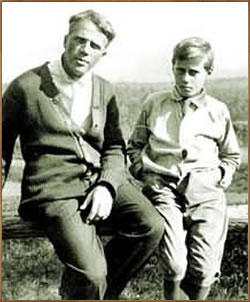
 880150-58a15ef99cb9998a3530ddd38daaaf1a.jpg

Robert Frost  (26 maart 1874 – 29 januari 1963)

Hier met zijn zoon Carol in 1916 of 1917


De Amerikaanse dichteres en schrijfster Erica Jong werd geboren in New York op 26 maart 1942. Zie ook mijn blog van 26 maart 2007 en ook mijn blog van 26 maart 2008.en ook mijn blog van 26 maart 2009 en ook mijn blog van 26 maart 2010.


By Train from Berlin


A delicate border. A nonexistent country.
The train obligingly dissolves in smoke.
The G.I. next to me is talking war.
I don't "know the Asian mind," he says.


Moving through old arguments.


At Potsdam (a globe-shaped dome,
a pink canal reflecting sepia trees)
we pull next to a broken-down old train
with REICHSBAHN lettered on its flank.


Thirty years sheer away leaving bare cliff.


This is a country I don't recognize.
Bone-pale girls who have nothing to do with home.
Everyone's taller than me, everyone naked.
"Life's cheap there," he says.


But why are we screaming over a track
which runs between a barbed wire corridor?
And why has it grown so dark outside,
so bright in here


that even the pared moon is invisible?


In the window we can only see ourselves,
America we carry with us,
two scared people talking death
on a train which can't stop.


Flying at Forty


You call me
courageous,
I who grew up
gnawing on books,
as some kids
gnaw
on bubble gum,


who married disastrously
not once
but three times,
yet have a lovely daughter
I would not undo
for all the dope
in California.


Fear was my element,
fear my contagion.
I swam in it
till I became
immune.
The plane takes off
& I laugh aloud.
Call me courageous.


I am still alive.


 880150-d66314fc3f3ad7a1d6b4cdf619475215.jpg

Erica Jong (New York, 26 maart 1942)


De Duitse schrijver Patrick Süskind werd geboren in Ambach op 26 maart 1949. Zie ook mijn blog van 26 maart 2007 en ook mijn blog van 26 maart 2008 en ook mijn blog van 26 maart 2009 en ook mijn blog van 26 maart 2010.


Uit: Die Taube


“In der Nacht entlädt sich dann ein gewaltiges Gewitter, zuerst mit einem lauten Donnerschlag, der Jonathan aufschrecken lässt. Er denkt als erstes an das Ende, an das absolute Ende und an den Weltuntergang, dann an den Krieg in seiner Kindheit und erst als der Regen einsetzt, erinnert er sich, wo er ist. Früh am Morgen nimmt er seinen Koffer, verlässt das Hotel und hüpft wie ein Kind durch sämtliche Pfützen nach Hause. Er ist richtig befreit und fühlt sich wohl. Erst im Treppenhaus erinnert er sich an die Taube und hält kurz inne um zu verschnaufen. Er hat auch kurz Angst vor ihr, doch sie verschwindet, als er die vertrauten Geräusche des erwachenden Hauses hört. Er steigt vollends hoch und sieht, dass der Gang sauber und das Fenster geschlossen ist. Die Taube ist weg.


880150-7bcf6267e9f8f2b549cf2df33baf8944.jpg
Patrick Süskind (Ambach, 26 maart 1949)


De Engelse dichter Alfred Edward Housman werd geboren op 26 maart 1859 in  Fockbury, Worcestershire. Zie ook mijn blog van 26 maart 2007 en ook mijn blog van 26 maart 2008.en ook mijn blog van 26 maart 2009 en ook mijn blog van 26 maart 2010. 


Oh, when I was in love with you


Oh, when I was in love with you

Then I was clean and brave,

And miles around the wonder grew

How well did I behave.


And now the fancy passes by

And nothing will remain,

And miles around they'll say that I

Am quite myself again.


The chestnut casts his flambeaux, and the flowers


The chestnut casts his flambeaux, and the flowers

Stream from the hawthorn on the wind away,

The doors clap to, the pane is blind with showers.

Pass me the can, lad; there's an end of May.


There's one spoilt spring to scant our mortal lot,

One season ruined of our little store.

May will be fine next year as like as not:

Oh ay, but then we shall be twenty-four.


We for a certainty are not the first

Have sat in taverns while the tempest hurled

Their hopeful plans to emptiness, and cursed

Whatever brute and blackguard made the world.


It is in truth iniquity on high

To cheat our sentenced souls of aught they crave,

And mar the merriment as you and I

Fare on our long fool's-errand to the grave.


Iniquity it is; but pass the can.

My lad, no pair of kings our mothers bore;

Our only portion is the estate of man:

We want the moon, but we shall get no more.


If here to-day the cloud of thunder lours

To-morrow it will hie on far behests;

The flesh will grieve on other bones than ours

Soon, and the soul will mourn in other breasts.


The troubles of our proud and angry dust

Are from eternity, and shall not fail.

Bear them we can, and if we can we must.

Shoulder the sky, my lad, and drink your ale.


880150-181351d3cf3d64b0f92e9ca7d8d35b4c.jpg
A. E. Housman (26 maart 1859 – 30 april 1936)

Boekcover


De Duitse schrijver en criticus Artur Hermann Landsberger werd geboren op 26 maart 1876 in Berlijn. Zie ook mijn blog van 26 maart 2009 en ook mijn blog van 26 maart 2010.


Uit: Berlin ohne Juden


„Äußerst rechter und äußerst linker Flügel werden sich auf dem Wege Antikapitalismus begegnen und sich auf die Parole einigen "Nieder mit den Juden!"

Die Mentalität des deutschen Volkes (jedes Volk hat seine eigene, und nur durch die Verschiedenheit ihrer Mentalität unterscheiden sich die Völker voneinander) ist ausdrückbar in zwei Worten, die lauten: vult decipi. Es will getäuscht sein, es will die Wahrheit, sofern sie unangenehm ist, nicht wissen und lieber mit der Lüge untergehen als mit dem Bekenntnis, daß es sich geirrt hat, weiterleben. Diese sehr simple Wahrheit kleidet es euphemistisch in die Worte: es will nicht seine Ideale opfern.

Der Kapitalismus ist das Schlagwort der Kommunisten, die "Juden" das sinnfälligere und daher zugkräftigere Schlagwort der Rechten. ... Kapitalismus ist ein Schlagwort, mit dem man Leidenschaften anfachen, die Juden die Opfer, an denen entfachte Leidenschaft sich austoben kann. Sie sind nun einmal die Prügeljungen der Weltgeschichte und werden es bleiben, sofern sie nicht, dieser Rolle überdrüssig, sich eines Tages auf sich selbst besinnen und sich zu einer Volksgemeinschaft zusammenschließen.

Ein Volk wie das deutsche wird immer ein Spielball in der Hand eines gewandten Hazardeurs sein, der seine Mentalität geschickt zu nutzen weiß ...“


880150-90d5463e770354c26350d0fc327e2b1c.jpg
Artur Landsberger ( 26 maart 1876 – 4 oktober 1933)

Berlijn, Neue Synagoge (Centrum Judaicum)

Geschreven door Romenu om 19:03 Reageer op dit bericht

Meer van Romenu

↑ Terug naar de berichten