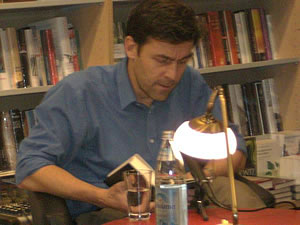
Edgar Allen Poe, Julian Barnes, Edwidge Danticat, Gustav Meyrink, Eugénio de Andrade, Patricia Highsmith, Marie Koenen
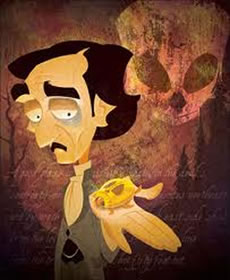
De Amerikaanse schrijver Edgar Allen Poe werd geboren op 19 januari 1809 in Boston. Zie ook alle tags voor Edgar Allen Poe op dit blog
Uit: The Gold Bug
„Many years ago I contracted an intimacy with a Mr. William Legrand. He was of an ancient Huguenot family, and had once been wealthy; but a series of misfortunes had reduced him to want. To avoid the mortification consequent upon his disasters, he left New Orleans, the city of his forefathers, and took up his residence at Sullivan's Island, near Charleston, South Carolina.
This Island is a very singular one. It consists of little else than the sea sand, and is about three miles long. Its breadth at no point exceeds a quarter of a mile. It is separated from the main land by a scarcely perceptible creek, oozing its way through a wilderness of reeds and slime, a favorite resort of the marsh-hen. The vegetation, as might be supposed, is scant, or at least dwarfish. No trees of any
magnitude are to be seen. Near the western extremity, where Fort Moultrie stands, and where are some miserable frame buildings, tenanted, during summer, by the fugitives from Charleston dust and fever, may be found, indeed, the bristly palmetto; but the whole island, with the exception of this western point and a line of hard white beach on the sea-coast, is covered with a dense undergrowth of the sweet myrtle so much prized by the horticulturists of England. The shrub here often attains the height of fifteen or twenty feet, and forms an almost impenetrable coppice, burthening the air with its fragrance.
In the inmost recesses of this coppice, not far from the eastern or more remote end of the island, Legrand had built himself a small hut, which he occupied when I first, by mere accident, made his acquaintance. This soon ripened into friendship — for there was much in the recluse to excite interest and esteem. I found him well educated, with unusual powers of mind, but infected with misanthropy, and subject to perverse moods of alternate enthusiasm and melancholy. He had with him many books, but rarely employed them.”
Edgar Allen Poe (19 januari 1809 – 7 oktober 1849)
De Engelse schrijver Julian Barnes werd geboren op 19 januari 1946 in Leicester. Zie ook alle tags voor Julian Barnes op dit blog.
Uit: Arthur and George
„George does not have a first memory, and by the time anyone suggests that it might be normal to have one, it is too late. He has no recollection obviously preceding all others—not of being picked up, cuddled, laughed at or chastised. He has an awareness of once having been an only child, and a knowledge that there is now Horace as well, but no primal sense of being disturbingly presented with a brother, no expulsion from paradise. Neither a first sight, nor a first smell: whether of a scented mother or a carbolicy maid-of-all-work.
He is a shy, earnest boy, acute at sensing the expectations of others. At times he feels he is letting his parents down: a dutiful child should remember being cared for from the first. Yet his parents never rebuke him for this inadequacy. And while other children might make good the lack—might forcibly install a mother's doting face or a father's supporting arm in their memories—George does not do so. For a start, he lacks imagination. Whether he has never had one, or whether its growth has been stunted by some parental act, is a question for a branch of psychological science which has not yet been devised. George is fully capable of following the inventions of others—the stories of Noah's Ark, David and Goliath, the Journey of the Magi—but has little such capacity himself.
He does not feel guilty about this, since his parents do not regard it as a fault in him. When they say that a child in the village has "too much imagination," it is clearly a term of dispraise. Further up the scale are "tellers of tall stories" and "fibbers"; by far the worst is the child who is "a liar through and through"—such are to be avoided at all costs. George himself is never urged to speak the truth: this would imply that he needs encouragement. It is simpler than this: he is expected to tell the truth because at the Vicarage no alternative exists.“
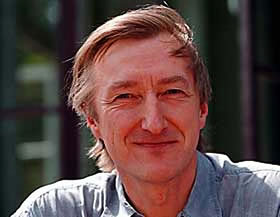
Julian Barnes (Leicester, 19 januari 1946)
De Amerikaanse schrijfster Edwidge Danticat werd geboren in Port-au-Prince op Haïti op 19 januari 1969. Zie ook mijn blog van 19 januari 2009 en ook mijn blog van 19 januari 2010 en ook mijn blog van 19 januari 2011.
Uit: Create Dangerously
„On November 12, 1964, in Port-au-Prince, Haiti, a huge crowd gathered to witness an execution. The president of Haiti at that time was the dictator Francois "Papa Doc" Duvalier, who was seven years into what would be a fifteen-year term. On the day of the execution, he decreed that government offices be closed so that hundreds of state employees could be in the crowd. Schools were shut down and principals ordered to bring their students. Hundreds of people from outside the capital were bused in to watch.
The two men to be executed were Marcel Numa and Louis Drouin. Marcel Numa was a tall, dark-skinned twenty-one-year-old. He was from a family of coffee planters in a beautiful southern Haitian town called Jeremie, which is often dubbed the "city of poets." Numa had studied engineering at the Bronx Merchant Academy in New York and had worked for an American shipping company.
Louis Drouin, nicknamed Milou, was a thirty-one-year-old light-skinned man who was also from Jeremie. He had served in the U.S. army — at Fort Knox, and then at Fort Dix in New Jersey — and had studied finance before working for French, Swiss, and American banks in New York. Marcel Numa and Louis Drouin had been childhood friends in Jeremie.
The men had remained friends when they'd both moved to New York in the 1950s, after Francois Duvalier came to power. There they had joined a group called Jeune Haiti, or Young Haiti, and were two of thirteen Haitians who left the United States for Haiti in 1964 to engage in a guerrilla war that they hoped would eventually topple the Duvalier dictatorship.
The men of Jeune Haiti spent three months fighting in the hills and mountains of southern Haiti and eventually most of them died in battle. Marcel Numa was captured by members of Duvalier's army while he was shopping for food in an open market, dressed as a peasant. Louis Drouin was wounded in battle and asked his friends to leave him behind in the woods.”
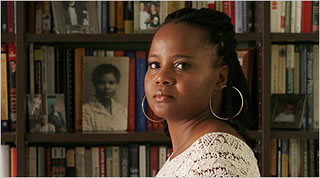
Edwidge Danticat (Port-au-Prince, 19 januari 1969)
De Oostenrijkse schrijver Gustav Meyrink werd op 19 januari 1868 te Wenen geboren. Zie ook mijn blog van 19 januari 2009 en ook mijn blog van 19 januari 2010 en ook mijn blog van 19 januari 2011.
Uit: Der Golem
„Das Mondlicht fällt auf das Fußende meines Bettes und liegt dort wie ein großer, heller, flacher Stein.
Wenn der Vollmond in seiner Gestalt zu schrumpfen beginnt und seine rechte Seite fängt an zu verfallen, – wie ein Gesicht, das dem Alter entgegengeht, zuerst an einer Wange Falten zeigt
und abmagert, – dann bemächtigt sich meiner um solche Zeit des Nachts eine trübe, qualvolle Unruhe.
Ich schlafe nicht und wache nicht, und im Halbtraum vermischt sich in meiner Seele Erlebtes mit Gelesenem und Gehörtem, wie Ströme von verschiedener Farbe und Klarheit zusammenfließen.
Ich hatte über das Leben des Buddha Gotama gelesen, ehe ich mich niedergelegt, und in tausend Spielarten zog der Satz immer wieder von vorne beginnend durch meinen Sinn:
»Eine Krähe flog zu einem Stein hin, der wie ein Stück Fett aussah, und dachte: vielleicht ist hier etwas Wohlschmeckendes. Da nun die Krähe dort nichts Wohlschmeckendes fand, flog sie fort.
Wie die Krähe, die sich dem Stein genähert, so verlassen wir – wir, die Versucher, – den Asketen Gotama, da wir den Gefallen an ihm verloren haben.«
Und das Bild von dem Stein, der aussah wie ein Stück Fett, wächst ins Ungeheuerliche in meinem Hirn: Ich schreite durch ein ausgetrocknetes Flußbett und hebe glatte
Kiesel auf.
Graublaue mit eingesprengtem glitzerndem Staub, über die ich nachgrüble und nachgrüble und doch mit ihnen nichts anzufangen weiß, – dann schwarze mit schwefelgelben Flecken wie die steingewordenen Versuche eines Kindes, plumpe, gesprenkelte Molche nachzubilden.
Und ich will sie weit von mir werfen, diese Kiesel, doch immer fallen sie mir aus der Hand, und ich kann sie aus dem Bereich meiner Augen nicht bannen.“
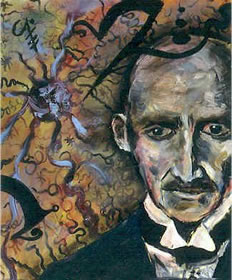
Gustav Meyrink (19 januari 1868 – 4 december 1932)
De Portugese dichter Eugénio de Andrade (eig. José Fontinhas) werd geboren op 19 januari 1923 in Póvoa de Atalaia.Zie ook mijn blog van 19 januari 2009 en ook mijn blog van 19 januari 2010 en ook mijn blog van 19 januari 2011
Against Obscurity (6)
The gaze lets go from ripeness.
I don’t know what to do with a gaze
overflowing from a tree,
what to do with that ardour
overflowing from the mouth,
and waiting on the ground to flow back to the source.
I don’t know the destiny of light,
but whatever it may be
it is the same as that of a gaze: the same
fraternal dust,
a delayed pain gathering, the shadow,
quivering still,
of a startled skylark.
The Syllable
All morning I was searching for a syllable.
It’s very little, that’s for sure: a vowel,
a consonant, practically nothing.
But I feel its absence. Only I know
how much I miss it.
That’s why I searched for it so stubbornly.
Only it could shield me from
January cold, the drought
of summer. A syllable.
A single syllable.
Salvation.
Vertaald door Alexis Levitin
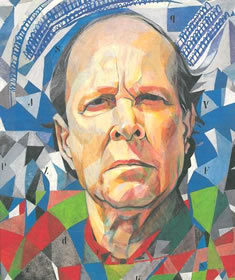
Eugénio de Andrade (19 januari 1923 – 13 juni 2005)
Portret door emerenciano
De Amerikaanse schrijfster Patricia Highsmith werd geboren als Mary Patricia Plangman in Fort Worth (Texas) op 19 januari 1921. Zie ook alle tags voor Patricia Highsmith op dit blog.
Uit: The Price of Salt
„Carol kissed her on the lips, and pleasure leaped in Therese again. [...] Her arms were tight around Carol, and she was conscious of Carol and nothing else. And then her body too seemed to vanish in widening circles that leaped further and further, beyond where thought could follow.“
(...)
‘I wonder if you’ll really enjoy this trip,’ Carol said. ‘You so prefer things reflected in a glass, don’t you? You have your private conception of everything. Like that windmill. It’s practically as good as being in Holland to you. I wonder if you’ll even like seeing real mountains and real people.’
Therese felt crushed as if Carol had accused her of lying. She felt Carol meant, too, that she had a private conception of her, and that Carol resented it. Real people? She thought suddenly of Mrs Robichek. And she had fled her because she was hideous.
‘How do you ever expect to create anything if you get all your experiences second-hand?’ Carol asked her, her voice soft and even, and yet merciless.
Carol made her feel like she had done nothing, was nothing at all, like a wisp of smoke.“
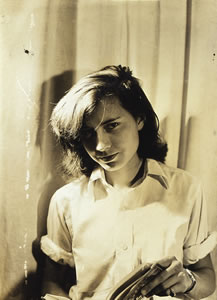
Patricia Highsmith (19 januari 1921 - 4 februari 1995)
De Nederlandse dichteres en schrijfster Marie Koenen werd geboren in ’s-Hertogenbosch op 19 januari 1879. Zie ook alle tags voor Marie Koenen op dit blog.
Uit: De godsvlam
„Aan den ingang van het besloten dal, bij den samenloop der twee holle wegen uit de boschheuvels met den breeden grintweg uit de lage velden, lag Sterrensteen, de rijke burchthoeve met de beide plompe peertorens boven den geweldigen samenbouw der leien daken uit; de ontzaglijke poort tot ijzer benageld; de tuinmuren en ruggevels door reuzige schoorbeeren versterkt tot wallen, bespoeld door de breede gracht, waarin twee watergulle bergbeken alle seizoenen door haar helder water stortten, dat als een tamme sloot door het sluisje er weer uitvloeide, de boomgaarden in.
Over deze weidsche boomgaarden zagen de bovenvensters van het hooge woonhuis, dat heel de breedte van het binnenplein achter de poort besloeg, op de groep leemen huisjes uit, bij den dal-uitgang genesteld aan den voet der duisterige struikenhelling, om het mergelkerkje heen, dat buiten een bouwval was en binnen een spelonk, armer dan de stal van Bethlehem. Dit was het dorpje Case, waar de Godsvlam waakte.
Sinds de oude pastoor Xaverius, die den tegenwoordigen heer van Sterrensteen zijn wangedrag
had durven verwijten, van hartzeer om zijn verarmoede parochie gestorven was, had Case geen priester meer. De goddelooze Sterrensteener, die als schout en als eigenaar van allen grond oppermachtig was in Case, wilde verder met zedenpreekers en dwarskijkers niets te doen hebben.
Het meerendeel der Casenaars kon zelden of nooit den mijlen verren kerkgang doen naar de naaste parochie. Maar elken dag in het uur der vroegmis van voorheen, zaten ze allen neergeknield op de uitgesleten plavuizen hunner eigen van God beroofde kerk.“
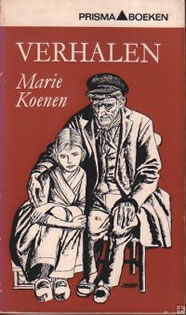
Marie Koenen (19 januari 1879 - 11 juli 1959)
Boekomslag
Zie voor nog meer schrijvers van de 17e januari ook mijn blog van 17 januari 2011 deel 1 en eveneens deel 2.