

Naar de inhoud

Romenu

Over literatuur, gedichten, kunst en cultuur
akke.beakke.be

Berichten van 26 januari 2012 tot 27 januari 2012

Leopold von Sacher-Masoch, Benjamin von Stuckrad-Barre, James Grippando, Lewis Carroll,
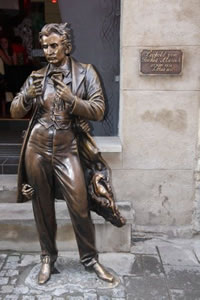
De Duitse schrijver Leopold Ritter von Sacher-Masoch werd geboren op 27 januari 1836 in Lemberg. Zie ook alle tags voor Leopold von Sacher-Masoch op dit blog.


Uit: The Letawitza (Vertaald door Sarah Dean)


“It was an unlucky day for the chase: two hazel-hens and a big vulture comprised the whole booty. “It is the fault of that confounded sorceress!” exclaimed the gamekeeper, taking off his hat, and wiping the large drops of perspiration on his forehead on the puffed sleeves of his shirt; then he handed me some brandy in a gourd, yellow and chubby as a Barbary ape.

At dawn we had, it is true, in starting out on our expedition, met a little old woman, all withered up, who was searching for mushrooms in the brushwood; and now evening was falling, and there was nothing left for us but to return to the house. The sun was setting, red and angry, behind the huge blocks of granite that like great crumbling towers overhang the grey, jagged sides of the Carpathian Mountains. Nothing else was to be seen, unless it were an old stunted trunk, which, stretching out from the rubbish over the slippery declivity, seemed to reach towards us its long, gnarled arms. It stood projected against the sky, with its bent back, its hanging chevelure and mossy beard, absolutely like our Jew; but it clings, firm and immovable, to the rock, as he also knows how to hold on energetically to whatever his thin bony hands have once seized[1].

We descended rapidly by a path draped with bilberries and rhododendrons, our dog panting painfully behind us, and passed under the green canopy of pines. The subdued noise of a distant waterfall accompanied us. The tall, green, feathery tree-tops, which shot up toward heaven with solemn majesty, began to mingle with the golden, rosy horizon, while from their slender trunks escaped their amber-coloured resinous juice. Red and purple berries, with the large forest flowers, made designs like a many-coloured embroidery upon the velvety moss which spread among the interlacing roots; and deep shadows fell from above upon the branches, like black drops between the motionless needles..”


 1081127-58eb7fa1694cb9c0463d57e5490f1466.jpg

Leopold von Sacher-Masoch (27 januari 1836 – 9 maart 1895)

Standbeeld in Lviv, Oekraïne


De Duitse schrijver Benjamin von Stuckrad-Barre werd op 27 januari 1975 in Bremen geboren. Zie ook alle tags voor Benjamin von Stuckrad-Barre op dit blog.


Uit: Eine Liebeserklärung an die Zeitung (Welt-On-Line, 2009)


„Den schmissigen Einstiegssatz zu diesem Text finden Sie im Internet. Dort, wo Sie alles finden, lieber Leser. Besuchen Sie doch mal unsere Seite, diskutieren Sie mit, klicken Sie einfach mal - nein, ich möchte Sie keineswegs loswerden. Klingt aber so, nicht wahr?

Dauernd wird man ins Internet geschickt, auf beinahe jeder Zeitungsseite, in so ziemlich jeder Fernsehsendung, in jedem CD-Booklet. Den Zeitungen geht es schlecht, dem herkömmlichen Fernsehen geht es schlecht; die Musikindustrie: im akuten Opel-Stadium.

Schuld, das ist bekannt, ist das Internet. Da gehen alle immerzu "rein" - und was unternehmen die klassischen, sich selbst darob als überkommen fühlenden Medien dagegen?

Nichts, sie tun, im Gegenteil, alles dafür: Auf unserer Internetseite finden Sie dies und das, tolle Extra-Inhalte, chatten Sie mit unserem Experten, laden Sie sich Schnickschnack herunter, schicken Sie uns Ihre Meinung, Ihre Fotos, schicken Sie uns irgendwas, ach, bitte, bitte, besuchen Sie uns doch einfach mal!

Es gibt natürlich auch wertvolle Preise zu gewinnen, stündlich. Und verweilen Sie lang auf unserer Seite, wir haben da alle möglichen Vertiefungen, und auch für Ihre Unterhaltung ist gesorgt. Sie erfahren dort mehr – oder sogar: "alles".


 1081127-d0d4000641a4222952fc3c7a191ec0cd.jpg

Benjamin von Stuckrad-Barre (Bremen, 27 januari 1975)


De Amerikaanse schrijver James Grippando werd geboren op 27 januari 1958 in Waukegan, Illinois. Zie ook alle tags voor James Grippando op dit blog.


Uit: Last To Die


„The rainstorm was blinding, and Sally was way behind schedule. She hadn't intended to be late, fashionably or otherwise. She just wasn't good with directions, and this wasn't exactly her neck of the woods.

Sheets of water pelted the windshield, sounding like marbles bouncing off glass. She adjusted the wipers, but they were already working at full speed. She couldn't remember rain like this in years, not since she and her first husband lost their restaurant to that no-name tropical storm.

Orange taillights flashed ahead. A stream of cars was inching down the highway at the speed of cooling lava. She slowed to somewhere below the school-zone limit, then checked her watch. Eleven twenty-five.

Damn. He'd just have to wait. She'd get there, eventually.

Their meeting had been arranged by telephone. They'd spoken only once, and his instructions were simple enough. Thursday, 11 P.M. Don't be late. She didn't dare reschedule, not even in this weather. This was her man. She was sure of it.

Just ahead, a neon sign blinked erratically, as if shaken by the storm. It was like trying to read an eye chart at the bottom of a lake, and she could only make out part of it: S-P-something-something-K-Y-apostrophe-S.

"Sparky's," she read aloud. This was the place. She steered off the highway and pulled into the flooded parking lot. Under all this water, she could only guess as to the exact location of the parking spot. She killed the engine and checked her face in the rearview mirror. Lightning flashed -- a close one. It lit up the inside of her car and unleashed a crack of thunder that sent shivers down her spine. It frightened her, then triggered a bemused smile. How ironic would that have been? After all this planning, to get hit by lightning.“


 1081127-9674f7a6a3f37532823af2257fbfbab2.jpg

James Grippando (Waukegan, 27 januari 1958)   


De Engelse dichter en schrijver Lewis Carroll werd op 27 januari 1832 in Daresbury. Zie ook alle tags voor Lewis Caroll op dit blog.


Uit: Alice in Wonderland


“Alice was not a bit hurt, and she jumped up on to her feet in a moment: she looked up, but it was all dark overhead: before her was another long passage, and the White Rabbit was still in sight, hurrying down it. There was not a moment to be lost: away went Alice like the wind, and was just in time to hear it say, as it turned a comer, "Oh my ears and whiskers, how late it's getting!" She was close behind it when she turned the comer, but the Rabbit was no longer to be seen: she found herself in a long, low hall, which was lit up by a row of lamps hanging from the roof.

There were doors all round the hall, but they were all locked; and when Alice had been all the way down one side and up the other, trying every door, she walked sadly down the middle, wondering how she was ever to get out again.

Suddenly she came upon a little three-legged table, all made of solid glass: there was nothing on it but a tiny golden key, and Alice's first idea was that this might belong to one of the doors of the hall; but, alas! either the locks were too large, or the key was too small, but at any rate it would not open any of them. However, on the second time round, she came upon a low curtain she had not noticed before, and behind it was a little door about fifteen inches high: she tried the little golden key in the lock, and to her great delight it fitted!

Alice opened the door and found that it led into a small passage, not much larger than a rat-hole: she knelt down and looked along the passage into the loveliest garden you ever saw. How she longed to get out of that dark hall, and wander about among those beds of bright flowers and those cool fountains, but she could not even get her head through the doorway; "and even if my head would go through," thought poor Alice, "it would be of very little use without my shoulders. Oh, how I wish I could shut up like a telescope! I think I could, if I only knew how to begin." For, you see, so many out-of-the- way things had happened lately, that Alice had begun to think that very few things indeed were really impossible.”


 1081127-d3ac44891eb875771ac4359db77dadeb.jpg

Lewis Carroll (27 januari 1832 – 14 januari 1898)


 Zie voor nog meer schrijvers van de 27e januari ook mijn vorige blog van vandaag.
Geschreven door Romenu om 15:21 Reageer op dit bericht

Alexander Stuart, Eliette Abécassis, Mordecai Richler, Ethan Mordden

De Brits-Amerikaanse schrijver Alexander Stuart werd geboren op 27 januari 1955 in Brighton. Zie ook mijn blog van 27 januari 2010 en ook mijn blog van 27 januari 2011.


Uit: The War Zone


"There is a moment which is so beautiful it makes everything else worthwhile. You stand on the cliff above the village, early in the morning or late in the evening, and you gaze out at the sea – a huge, changing wash of light and movement, bigger than any of us, a joker with a patience longer than any one life and an inconceivable strength that can snap your back against the rocks as easily as you

might flick a fly off your nose.

I can feel how cold it is, even when it’s warm. Even when the water’s not skimmed with a purple film of oil, and the pebbles and seaweed are stewed in the sun, I can sense the ocean’s cold heart further out, out by the skyline. Jessie’s tried to paint it, but she can’t get close. Either the beauty is there or the darkness, but not both...

It’s not just the color, it’s the color of light, it’s the mood of the sky and your own cross-wired soul. Down on the beach, it’s the druggy thunder-hiss of the surf dragging at thousands of pebbles, as if the sea’s in training for the greatest glue-sniffing contest on earth. Up here, with a view of the sheep and the cottages and the coastline, there’s just the image, no sound, and a faint tang of brine in the air, like a taunt or a memory."

It’s more than a moment. It’s repeatable, though it’s never the same twice. It’s where I go to stay sane down here, it’s where I go when I miss London, when I want to work out what the fuck I’m doing with
my life."


 1081120-ea2c190658239cfaa273d53dc15813ef.jpg

Alexander Stuart (Brighton, 27 januari 1955)


De Franse schrijfster Eliette Abécassis werd geboren op 27 januari 1969 in Straatsburg. Zie ook mijn blog van 27 januari 2009 en ook mijn blog van 27 januari 2010 en ook mijn blog van 27 januari 2011.


Uit: Une affaire conjugale


„Le bureau était dans un désordre indescriptible. Il y  régnai t une odeur de cendre f roi de, d' al cool , de  haschisch, et un air de fin du monde. Un bric-à-brac  encombrait la pièce : ordinateurs de plusieurs générations, scanner, imprimante, chaussettes, caleçons, livres,  photos, séries de câbles et de fils, vieux emballages. Partout, des cadavres de bouteilles de bière, des mégots de  ci garet t es. Je consul t ai à nouveau ma mont re : di x  minutes avaient passé. Avec mon Iphone, je pris une
photographie de l'ensemble de la pièce, puis d'une série  de détails. J'avais préparé un sac en plastique pour collecter les pièces à conviction. À l'aide d'une spatule, j'y  fis tomber les miettes de haschisch qui parsemaient son  bureau. Puis je m'installai sur son siège, devant l'ordinateur. L'écran affichait la page d'accueil de son profil sur  Facebook. Je me mis au travail. Tandis que je cliquais
sur la fenêtre des messages reçus, je branchai un disque  dur externe pour faire une copie de ses fichiers. L'ordinateur i ndi qua que l ' opérati on prendrai t une heure  quarante-sept minutes. Je sentis mes pupilles se dilater  et de nouveau la sueur sur mes paumes : j'avais à peine  le temps. Je me hâtai. J'ouvris ses tiroirs les uns après les  autres, photographiai les papiers administratifs, les rele-
vés bancaires, les feuilles de salaire et les factures. Puis je  revins devant l'écran de l'ordinateur pour consulter ses  messages.
C'est à cet instant, je crois, que ma vie bascula.“


 1081120-5bec0dfae048c74defe1f3aee2ad03e6.jpg

Eliette Abécassis (Straatsburg, 27 januari 1969)


De Canadese Schrijver Mordecai Richler werd geboren op 27 januari 1931 in Montreal. Zie ook alle tags voor Mordecai Richler op dit blog.


Uit: Barney’s Version


“I understand why our most perspicacious men of letters object to the current trend in biography, its mean practitioners revelling in the carve-up of genius. But the truth is, nothing delights me more than a biography of one of the truly great that proves he or she was an absolute shit. I’m a sucker for studies of those who, in the words of that friend of Auden’s (not MacNeice, not Isherwood, the other guy) “…travelled a short while toward the sun/And left vivid air signed with honour.” But took no prisoners en route, now the facts are known. Say, the story of T.S. Eliot having his first wife locked up in the bin, possibly because she had written some of his best lines. Or a book that delivers the dirt on Thomas Jefferson, who kept slaves and provided the prettiest one with an unacknowledged child. (“How is it,” asked Dr. Johnson, “that we hear the loudest yelps for liberty amongst the drivers of the negroes?”) Or reveals that Martin Luther King was a plagiarist and a compulsive fucker of white women. Or that Admiral Byrd, one of my boyhood heroes, was actually a smooth-talking liar, a terrible navigator, an air traveller so frightened of flying that he was frequently drunk while others did the piloting, and a man who never hesitated to take unearned credit. Or tells how F.D.R. cheated on Eleanor. Or that J.F.K. didn’t really write Profiles in Courage. Or how Bobby Clarke slashed Kharlamov across the ankles, taking out the better player in that first thriller of a hockey series against the incredible Russians. Or that Dylan Thomas was a shnorrer born. Or that Sigmund Freud faked some of his case notes. I could go on, but I think you get the idea.”


 1081120-4ac91e578ddc485843e4c82b0edb1bb1.jpg

Mordecai Richler (27 januari 1931 – 3 juli 2001)


De Amerikaanse schrijver Ethan Mordden werd geboren op 27 januari 1947 in Pennsylvania. Zie ook alle tags voor Ethan Mordden op dit blog.


Uit: The Guest List


„The whole thing got started by accident, in late 1919 or early 1920,* at a celebratory lunch more or less devoted to Alexander Woollcott. There were speeches, toasts, and insults both teasing and cutting, and everyone had a wonderful time. Someone said, “Why don't we do this every day?,” and they began to, meeting in the Algonquin's main dining hall at a long table, with side tables attending as needed. Then, sensing an angle for publicity, manager Case moved the gang to the smaller Rose Room, seating them at a round table right in the center of every other diner's view. Some of the Round Table came often and some now and again, with wives, friends, or new talent ready to be Introduced and take the town. The also theres included actress beauties Margalo Gillmore, Peggy Wood, and Ina Claire; playwrights Robert E. Sherwood, Laurence Stallings, and Marc Connelly; novelist Edna Ferber; and comic Harpo Marx. But the Round Table proper counted a sextet:
ALEXANDER WOOLLCOTT, overbearing merrymaker. Best assault on Wooll cott, by Gertrude Stein, who keeps interrupting: Woollcott: “People don't dispute Woollcott.” Stein: “I'm not people. I'm Gertrude Stein.”
ROBERT BENCHLEY, spokesman for the Little Fellow Eternally Puzzled By Life. Characteristic observation: “I seem to be behind on my parades …”
DOROTHY PARKER, wit, lover, and occasional failed suicide. Essential first line of a Parker short story: “Please, God, let him telephone me now.”
*The date of the first lunch is unknown; writers treating the Round Table blithely skate around it.
GEORGE S. KAUFMAN, the fastest draw in the east in sarcasm. Typical un- Algonquinlike gallantry, in a curtain speech at the first night of Once in a Lifetime, a collaboration: “I would like the audience to know that eighty percent of this play is Moss Hart.”
FRANKLIN P. ADAMS, the mentor, already famous in his late thirties when the others were more or less starting out. Another assault on Woollcott, who toys with one of his own books and sighs, “Ah, what is so rare as a Woollcott first edition?” Adams: “A Woollcott second edition.”
and HEYWOOD BROUN, the one no one remembers anything about.Typical Broun line: “      .


 1081120-0eb62c179db44a7089b86d8d407cc462.jpg

Ethan Mordden (Pennsylvania, 27 januari 1947)

Boekcover


Zie voor nog meer schrijvers van de 27e januari ook mijn blog van 27 januari 2011 deel 2 en eveneens deel 3.
Geschreven door Romenu om 15:17 Reageer op dit bericht

Menno ter Braak, Achim von Arnim, Jonathan Carroll, Gerrit Jan Zwier

De Nederlandse schrijver Menno ter Braak werd geboren op 26 januari 1902 in Eibergen. Zie ook alle tags voor Menno ter Braak op dit blog.


Uit: De duivelskunstenaar


“Waaraan herkent men het optreden van den duivelskunstenaar? Eenerzijds aan de bewondering dergenen, die met open mond staan te kijken naar zijn verbijsterende prestaties; anderzijds aan den haat en het wanbegrip dergenen, die in zulke prestaties onmiddellijk het ongewone, het buitensporige ruiken en krachtens hun logica dus wel moeten concludeeren, dat dààr de duivel in het spel is. Niet alleen in de middeleeuwen werd, wie aan den eenen kant succes had als wonderdoener, door de andere partij (soms door dezelfde) tot den brandstapel veroordeeld wegens hekserij!

Zulk een duivelskunstenaar is S. Vestdijk, en hij heeft dus, nu hij eenmaal niet meer te ontkennen valt als ‘producent’, zijn gapende bewonderaars, maar in grooter getale nog zijn haters en belagers; in

beide verhoudingen is dit grootste talent na Louis Couperus (dat bovendien stellig grooter is, als talent, dan Couperus) voor Nederland de duivelskunstenaar. Men is verbijsterd; sommigen verheerlijken hem, anderen verfoeien hem als den man der zwarte magie, den ‘viezerd’, die niets onaangetast laat van de heilige dingen. Het is, onder dezen gezichtshoek gezien, bepaald een symbolische gebeurtenis, dat dit wonderbaarlijke talent, met op zijn minst kenmerken van het genie, moest stuiten op de incarnatie van den hollandschen filistergeest, het model van kleinburgerlijke geborneerdheid D. Hans; naar ik persoonlijk heb mogen ervaren een zeer fatsoenlijk en ridderlijk man, maar dat verandert niets aan de geborneerdheid. Hans contra Vestdijk: dat is de kleinburgerlijkheid in haar meest verstarde, rhetorische en ondoordringbare gedaante tegen de kleinburgerlijkheid, die, zonder haar afkomst te kunnen of willen verloochenen, haar benauwde grenzen aan alle kanten overschrijdt, universeel wordt, uiterst subtiel en intelligent wordt, haar valsche schaamte en valsche zekerheden verliest en zich openstelt voor alle invloeden der moderne cultuur.”


 1080632-5f74bdbdd9d1fd33e06561c0816df4f4.jpg

Menno ter Braak (26 januari 1902 -  14 mei 1940)

Portret door de Duitse street arist El Bocho, Literaturhaus Berlijn


De Duitse dichter en schrijver Achim von Arnim werd geboren in Berlijn op 26 januari 1781. Zie ook alle tags voor Achim von Arnim op dit blog.


Kriegslieder - I.


Frisch auf, ihr preußischen Soldaten!

Ihr, die ihr noch mit deutschem Blut,

Ihr, die ihr noch mit frischem Mut

Belebet suchet große Taten,

Ihr Landsleut', ihr Brüder, frisch auf!

Deutschland, die Freiheit sich verlieret,

Wo ihr nicht mutig schlaget drauf

Und überwindend triumphieret.


Der ist ein Deutscher wohlgeborn,

Der von Betrug und Falschheit frei

Hat, voll der Redlichkeit und Treu,

Nicht Glauben, nicht Freiheit verloren;

So straf du, preußisch Herz und Hand,

Nun die Tyrannen und die Bösen;

Die Freiheit und das Vaterland

Ist nur durch ihren Tod zu lösen.


Ha, fallet in sie, ihre Fahnen

Zittern aus Furcht, sie trennen sich,

Ihr' böse Sach' heilt nicht den Stich,

Drum zu der Flucht sie sich schon mahnen.

Groß ist ihr Heer, klein ist ihr Glaub',

Gut ist ihr Zeug, bös' ihr Gewissen,

Frisch auf! Sie zittern wie das Laub

Und wären gern schon ausgerissen.


Der traurige Garten

Frische Liedlein


Ach Gott, wie weh thut Scheiden,

Hat mir mein Herz verwundt,

So trab ich über Helden,

Und traure zu aller Stund,

Der Stunden der sind alsoviel,

Mein Herz trägt heimlich Leiden,

Wiewohl ich oft fröhlich bin.


Hät mir ein Gärtlein bauet,

Von Veil und grünem Klee,

Ist mir zu früh erfroren,

Thut meinem Herzen weh;

Ist mir erfrorn bei Sonnenschein

Ein Kraut je länger je lieber,

Ein Blümlein Vergiß nicht mein.


Das Blümlein, das ich meine,

Das ist von edler Art,

Ist aller Tugend reine,

Ihr Mündlein das ist zart,

Ihr Aeuglein die sind hübsch und fein,

Wann ich an sie gedenke,

So wollt ich gern bei ihr seyn.


Mich dünkt in all mein Sinnen,

Und wann ich bei ihr bin,

Sie sey ein Kaiserinne,

Kein lieber ich nimmer gewinn,

Hat mir mein junges Herz erfreut,

Wann ich an sie gedenke,

Verschwunden ist mir mein Leid.


 1080632-e1ef792af4ad428e25838e57041e1774.jpg

Achim von Arnim (26 januari 1781 -  21 januari 1831)


De Amerikaanse schrijver Jonathan Carroll werd geboren op 26 januari 1949 in New York. Zie ook mijn blog van 26 januari 2010 en ook mijn blog van 26 januari 2011.


Uit: The Ghost In Love


“The ghost was in love with a woman named German Landis. Just hearing that arresting, peculiar name would have made the ghost’s heart flutter if it had had one. She was coming over in less than an hour, so it was hurrying now to make everything ready. The ghost was a very good cook, sometimes a great one. If it’d spent more time at it or had more interest in the subject, it would have been exceptional. From its large bed in a corner of the kitchen a mixed-breed, black-and-oatmeal-colored dog watched with great interest as the ghost prepared the meal. This mutt was the only reason that German Landis was coming here today. His name was Pilot, after a poem the woman loved about a Seeing Eye dog. Suddenly sensing something, the ghost stopped what it was doing and eyeballed the dog. Peevishly, it demanded "What?" Pilot shook his head. "Nothing. I was only watching you work." "Liar. That is not the only thing. I know what you were thinking: that I’m an idiot to be doing this." Embarrassed, the dog turned away and began furiously biting one of its rear paws. "Don’t do that. Look at me. You think I’m nuts, don’t you?" Pilot said nothing and kept biting his foot. "Don’t you?""Yes, I think you’re nuts, but I also think it’s very sweet. I only wish she could see what you’re doing for her." Resigned, the ghost shrugged and sighed. "It helps when I cook. When my mind is focused, I don’t get so frustrated." "I understand." "No, you do not. How could you? You’re only a dog." The dog rolled his eyes. "Idiot." "Quadruped." They had a cordial relationship. Like Icelandic or Finnish, "Dog "is spoken by very few. Only dogs and dead people understand the language. When Pilot wanted to talk, he either had to get in a quick chat with whatever canine he happened to meet on the street when he was taken out for a walk three times a day, or he spoke with this ghost—who, by attrition, knew more about Pilot now than any dog had ever known. There aren’t that many human ghosts in the land of the living, so this one was equally happy for the dog’s company. Pilot asked, "I keep meaning to ask: Where did you get your name?"


 1080632-4331289e1c6a982d437d428269cd9450.jpg

Jonathan Carroll (New York, 26 januari 1949)


De Nederlandse schrijver Gerrit Jan Zwier werd geboren in Leeuwarden op 26 januari 1947. Zie ook alle tags voor Gerrit Jan Zwier op dit blog.


Uit: Slauerhoff bij kampvuur en traanlamp


‘Al het reizen doet je alleen zien dat de aarde overal gelijk is,’ zegt de oude Camoës. Het gaat, kortom, niet om de ruimte maar om de diepte, niet om de mast maar om de wortel. Dezelfde oppositie tussen het middelpuntvliedende zwerven en het middelpuntzoekende blijven, komt onder andere ook naar voren in De terugkeer, een tweetal verzen uit de bundel Saturnus (1930). Van beide gedichten citeer ik hier de eerste twee strofen:


Ik zocht in zeeën, bosschen, bergen, droomen,

Nimmermeer rustig tot de plek gekomen,

Waar zij verborgen als een bloesem was

Onder 't in lange herfst gewoekerd gras.


Hoe kon, in 't ruim teloor, ik ook vermoeden

Dat zij vol zorg de hoeve voort zou hoeden

En stil in stagen vree de weelde won

Die ik wild zwervend nooit bereiken kon?


Zij leeft in 't afgelegen, mistig land

Dat ik verliet de wereld óm te varen;
Zij woont er nog, ik weet het zeker, want

Een sterke vrede was de hare.


Het maakte haar niet neerslachtig dat de weiden

Groen waren, lente, zomer, herfst en winter.

Zij werkte, en wist altijd iets te vinden

Dat 't grijs bestaan tot een rein wonder wijdde.


Rust en onrust, Fernweh en Heimweh, nooit hier, altijd daar, das Glück ist dort wo du nicht bist - Marsman zei het al, de thema's van Slauerhoff zijn zo oud als de wereld en romantisch als de hel. ‘Hij is een ontwortelde provinciaal,’ zei een tegenstander eens (Herman van den Bergh), ‘die zich bedient van ‘globetrotterbluf’.’


1080632-01c5af06bf72201fc30b50c6cc7caad1.jpg
Gerrit Jan Zwier (Leeuwarden, 26 januari 1947)


Zie voor nog meer schrijvers van de 26e januari ook mijn vorige blog van vandaag
Geschreven door Romenu om 19:14 Reageer op dit bericht

Bhai, Rudolf Alexander Schröder, François Coppée, Eugène Sue

De Surinaamse dichter Bhai (eig.James Ramlall) werd geboren op 26 januari 1935 in het toenmalige district Suriname. Zie ook alle tags voor Bhai op dit blog.


drirh

(vastberaden)


Ik zal geen meter wijken

noch enig woord verspelen,

geen troost aanvaarden

noch smeken om een gunst.

Ik vrees geen God

noch Dood

maar leef

In het AL, dat één is,

trots zijn vormen veel.


pichhar gaya

(achtergelaten)


Ik ben te laat,

De wind die mij dragen moet,

nadert reeds de kim.

Nog trilt het water van de oceaan,

Zilte hangt aan mijn lippen.

Mijn tong is droog en stijf.

Ik hijg en snak naar adem.

Mijn bruin gelaat verbleekt

van angst, gemengd met verdriet.

De wind versterft ginds in de verte,

wordt één met kim en water.

Ik sta en staar.... ween....

Ik ben te laat.


 1080629-fd24016ca7ea8aec7675bc0529f93207.jpg

Bhai (District Suriname, 26 januari 1935)

Portret van de jonge Bhai door Nora Stroink 


De Duitse dichter en schrijver Rudolf Alexander Schröder werd geboren op 26 januari 1878 in Bremen. Zie alle tags voor Rudolf Alexander Schröder op dit blog.


Wer das versteht


Wer das versteht: die Sonne zu genießen,

die kurzer Fahrt den kühlen Himmel grüßt;

wer das versteht: mit Tagen hinzufließen,

indem er auch die trüberen genießt;


wer das versteht: sich allem aufzuschließen,

was sich auch scheu in ihm verschließt;

wer das versteht: mit Dingen, die ihn ließen,

zu sein, als hat er sie nicht eingebüßt;


wer das verstünd -- Nun aber wendet sich

das Lied und sagt, bevor es schweigt,

mit Lächeln : Reichtum ist in jedem Ding.


Auch ein verdorrtes Blatt dünkt königlich,
Wenn über ihm sich Liebe neigt.
Nur ohne Liebe wär die Welt gering


1080629-da27cce5fc18e86d58f2cd1340d98913.jpg 

Rudolf Alexander Schröder (26 januari 1878 – 22 augustus 1962)


De Franse dichter en schrijver François Coppée werd geboren op 26 januari 1842 in Parijs. Zie ook mijn blog van 26 januari 2009 en ook mijn blog van 26 januari 2010 en ook mijn blog van 26 januari 2011.


Petits bourgeois


Je n'ai jamais compris l'ambition. Je pense
Que l'homme simple trouve en lui sa récompense,
Et le modeste sort dont je suis envieux,
Si je travaille bien et si je deviens vieux,
Sans que mon coeur de luxe ou de gloire s'affame,
C'est celui d'un vieil homme avec sa vieille femme,
Aujourd'hui bons rentiers, hier petits marchands,
Retirés tout au bout du faubourg, près des champs.
Oui, cette vie intime est digne du poète.


Novembre


Captif de l'hiver dans ma chambre
Et las de tant d'espoirs menteurs,
Je vois dans un ciel de novembre,
Partir les derniers migrateurs.

Ils souffrent bien sous cette pluie ;
Mais, au pays ensoleillé,
Je songe qu'un rayon essuie
Et réchauffe l'oiseau mouillé.

Mon âme est comme une fauvette
Triste sous un ciel pluvieux ;
Le soleil dont sa joie est faite
Est le regard de deux beaux yeux ;

Mais loin d'eux elle est exilée ;
Et, plus que ces oiseaux, martyr,
Je ne puis prendre ma volée
Et n'ai pas le droit de partir.


 1080629-e1caf30592f9c6856e1e45cee9f5ff1b.jpg

François Coppée (26 januari 1842 – 23 mei 1908)


De Franse schrijver Eugène Sue zou geboren zijn op 26 januari 1804. Zie alle tags voor Eugène Sue op dit blog


Uit: The Mysteries of Paris (Vertaald door Henry C. Deming)


„The motive for Rodolph's visit was, therefore, to inquire the result of Cecily's introduction. To his great astonishment, he found, on entering the lodge, that although eleven o'clock in the morning had struck by all the neighbouring dials, Pipelet had not yet risen, while Anastasie was standing beside his bed, offering him some sort of drink.

As Alfred, whose forehead and eyes were entirely concealed beneath his huge cotton nightcap, did not reply to his wife's inquiries, she concluded he slept, and therefore closed the curtains of his bed. Turning around, she perceived Rodolph, and, as usual, gave him a military salute, by lifting the back of her left hand up to her wig.

"Ah, my king of lodgers! Service to you! How are you? As for me, I'm upset—bewildered—stupefied. Pretty doings have there been in the house since you was here. And my poor Alfred,—obliged to keep his bed ever since yesterday!"

"Why, what has happened?"

"Positively, don't you guess? Still going on in the old way with that monster of a painter, who is more bitter than ever against Alfred. He has quite muddled his brains, till I declare I don't know what to do with him."

"Cabrion again?"

"Oh, he'll never leave off."

"He must be the very devil!"

"Really, M. Rodolph, I shall very soon think so; for he always knows the very instant I quit the house.“


1080629-0d7f24a50830111aff6c4e1e6f2af298.jpg
Eugène Sue
(26 januari 1804 – 3 augustus 1857)

Portret door Charles-Émile-Callande de Champmartin, 19e eeuw


Zie voor nog meer schrijvers van de 26e januari ook
mijn blog van 26 januari 2011 deel 1 en evenneens deel 2 en ook deel 3.


Geschreven door Romenu om 19:09 Reageer op dit bericht

VSB Poëzieprijs 2012 voor Jan Lauwereyns


VSB Poëzieprijs 2012 voor
Jan Lauwereyns


De Vlaamse dichter en neurowetenschapper Jan Lauwereyns is de winnaar van de VSB Poëzieprijs 2012. Hij krijgt de jaarlijkse prijs voor Nederlandse poëzie voor zijn dichtbundel Hemelsblauw. Dat maakte de organisatie vandaag bekend tijdens de prijsuitreiking in de Nicolaïkerk in Utrecht. Lauwereyns ontving een geldbedrag van 25.000 euro en een glaskunstwerk van kunstenares Maria Roosen. Zie ook mijn blog van 13 mei 2011.


Vuurwerk


Volgens de astronooom die met de mond
vol tanden staat - knappe kerel -
was er in het begin al iets.

Iets: met veel aantrekkingskracht,
een zwart gat, een vlam in mijn hart.

Zo niet, geen gebeurtenis t voor t + 1,
en dan ook niets daartussen

waar tijd plaats

kon vinden. En zonder tijd
geen pijl die ergens vertrekt om God
weet wanneer ergens anders aan te komen.

God, Cupido, Thor.

Zo denkt men zwijgend dat
er in het begin iets geweest moet zijn
waarmee het allemaal begonnen is.


De paradox van slaap


Die muurschildering, de vogel op hoge stelt,
de twee speren, de bizon, de man met armen
wijd, liggend tegen lucht, zijn pik stijf.

Waar gaat dit naartoe?

Nergens: nacht, land van wat
niet bestaat.

Wat richt die vogel/ziel
op hoge stelt/hakken uit?

Op het tipje van je tong begint de wacht.

Kon je maar als een dolfijn
slapen met een hersenhelft,
rondjes varen met de andere.


 1080160-ca3aa68ffcfa238d588e6feeb45c7336.jpg

Jan Lauwereyns (Antwerpen, 13 mei 1969)
Geschreven door Romenu om 09:36 Reageer op dit bericht

David Troch winnaar Turing Nationale Gedichtenwedstrijd

De Vlaamse dichter David Troch winnaar Turing Nationale Gedichtenwedstrijd.


De Vlaming David Troch is de winnaar van de Turing Nationale Gedichtenwedstrijd. Hij ontvangt 10.000 euro voor zijn winnende gedicht wij waren geen jongens. Volgens de jury trekt de winnaar met al „zijn beelden, zijn taal en de opgeroepen sfeer diep de zompige Hollandse klei in”. Het gedicht „lijkt doordesemd van een streng-calvinistisch determinisme en van boerse aardsheid. Knielen op een bed violen. Des te verrassender is het voor de jury, nu blijkt dat met dit gedicht een Vlaming wordt bekroond.” Zie ook alle tags voor David Troch op dit blog.


wij waren geen jongens


wij hadden vaders, wij waren zonen. het volstond niet
dat wij driemaal daags spek en spinazie vraten.
de hemdsmouwen moesten omhoog,

wij moesten tonen hoe hard wij de spieren in onze bovenarmen
op konden spannen. wij zweetten als zwijnen, groeven bloederige kloven
in onze handen, wroetten in het stof waarin onze voorvaderen
al jaren liggen te liggen

en kregen het vuil amper onder onze vingernagels vandaan.
wij moesten voelen met wat wij tussen de benen geboren waren, jongens,

maar hadden niet eens een eigen kamer
waar wij voorovergebogen, met opgetrokken knieën
en met de neus in andere werelden zaten.

wij ondervonden aan den lijve dat doordringende boerenstank
je harder in het gezicht kan slaan dan wat vuistdikke boeken.


 1080157-64e60fc0c0df4845be1bb69e2362a53d.jpg

David Troch (Bonheiden, 28 juli 1977)

Geschreven door Romenu om 09:33 Reageer op dit bericht

Meer van Romenu

↑ Terug naar de berichten