

 Donald Hall, Javier Marías, Cyriel Buysse, Upton Sinclair
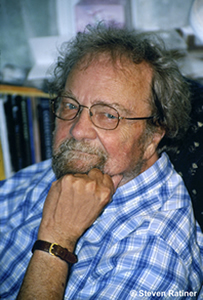
De Amerikaanse dichter en schrijver Donald Hall werd geboren in Hamden, New Haven County, Connecticut op 20 september 1928. Zie ook mijn blog van 20 september 2010 en eveneens alle tags voor Donald Hall op dit blog.
Gold
Pale gold of the walls, gold
of the centers of daisies, yellow roses
pressing from a clear bowl. All day
we lay on the bed, my hand
stroking the deep
gold of your thighs and your back.
We slept and woke
entering the golden room together,
lay down in it breathing
quickly, then
slowly again,
caressing and dozing, your hand sleepily
touching my hair now.
We made in those days
tiny identical rooms inside our bodies
which the men who uncover our graves
will find in a thousand years,
shining and whole.
Je Suis une table
It has happened suddenly,
by surprise, in an arbor,
or while drinking good coffee,
after speaking, or before,
that I dumbly inhabit
a density; in language,
there is nothing to stop it,
for nothing retains an edge.
Simple ignorance presents,
later, words for a function,
but it is common pretense
of speech, by a convention,
and there is nothing at all
but inner silence, nothing
to relieve on principle
now this intense thickening.
Donald Hall (Hamden, 20 september 1928)
De Spaanse schrijver Javier Marías Franco werd op 20 september 1951 in Madrid geboren. Zie ook mijn blog van 20 september 2010 en eveneens alle tags voor Javier Marías op dit blog.
Uit: Your Face Tomorrow. Poison, Shadow and Farewell (Vertaald door Margaret Jull Costa)
“It’s true that there are still a few people who harbor this deep - seated belief and to whom it does matter, and they are, in fact, acting so that the person they are saving can bear witness, so that he or she will think well of them and remember them with eternal admiration and gratitude; what they don’t realize at that decisive moment, or at least not fully, is that they will never enjoy that admiration or gratitude because they will be the ones who, a moment later, will be dead.’
And what came into my head while he was talking was an expression that was both diffi cult to grasp and possibly untranslatable, which is why, at fi rst, I didn’t mention it to Tupra, it would have taken me too long to explain. My initial thought was: ‘It’s what we call “vergüenza torera,” literally “a bullfi ghter’s sense of shame,” ’ and then: ‘Because bullfi ghters, of course, have loads of witnesses, a whole arenaful, plus sometimes a TV audience of millions, so it’s perfectly understandable that they should think: “I’d rather leave here with a ruptured femoral artery or dead than be thought a coward in the presence of all these people who will go on to talk about it endlessly and forever.” Bullfi ghters fear narrative horror like the plague, that fi nal defi ning wrong move, they really care about how their lives end, it’s the same with Dick Dearlove and almost any other public fi gure, I suppose, whose story is played out in full view of everyone at every stage or chapter, right up to the dénouement that can mark a whole life and give it an entirely false and unfair meaning.’ And then I couldn’t help saying it out loud, even though it meant briefl y interrupting Tupra. But it did, after all, add to what he was saying and was also a way of pretending that this was a dialogue:
‘That’s what we call “vergüenza torera.” ’ And I said the two words in Spanish, then immediately translated them. ‘I’ll explain to you exactly what it means another day, since you don’t have bullfighters here.’ Although at that moment, I wasn’t even sure there would be another day, another day at his side, not one.
‘OK, but don’t forget. And no, you’re right, we don’t have bullfi ghters here.’ Tupra was always curious to hear the turns of phrase in my own language about which I occasionally enlightened him, whenever they seemed relevant or were particularly striking. Now, however, he was enlightening me (I knew where he was heading, and both he and the path he was taking aroused my curiosity over and above the foreseeable revulsion I would feel at the end of the journey), and so he continued: ‘From there to letting someone die in order to save yourself is only a step, and trying to ensure that someone else dies in your place or even bringing that about (you know the kind of thing, it’s him or me) is just one more short step, and both steps are easily taken, especially the fi rst, in fact, in an extreme situation, almost everyone takes that step.”
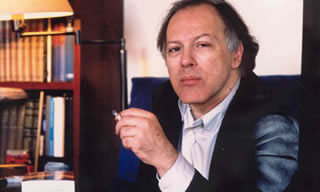
Javier Marías (Madrid, 20 september 1951)
De Vlaamse schrijver Cyriel Buysse werd geboren op 20 september 1859 in Nevele. Zie ook mijn blog van 20 september 2007. Zie ook mijn blog van 20 september 2010 en eveneens alle tags voor Cyriel Buysse op dit blog.
Uit: De zwarte kost
“Het sloeg juist elf, die zondagmorgen, en in de enkele straat van het dorpje was alles stil en vreedzaam, toen, in een plotselinge opschudding, van huis tot huis de deuren openvlogen, en de bewoners met uitroepingen van verbazing op hun dorpels kwamen.
Er moest voorwaar geen gewichtige gebeurtenis in het rustig Akspoele plaatsgrijpen, om er terstond de lieden op de straat te lokken: de enkele voorbijtocht van een ongewoon rijtuig of de verschijning van een onbekende waren daartoe ruim voldoende. Doch ditmaal gold het iets zó buitengewoon ontzettends, dat het er terstond als een klein oproer werd.
Dáár, aan het uiteinde van de straat, komend in het dorp langs de weg van het station Bavel, naderde met rasse tred, vergezeld van een joelende bende knapen en meisjes, een groep van drie personen.
Hij, die in het midden liep, werd dadelijk herkend. Het was Massijn, Fortuné Massijn, de klerk van notaris Potvlieghe. Maar of de twee anderen mensen of dieren waren, dat konden de stomverbaasde dorpelingen nog niet bevestigen.
Zij hadden de gestalte en de lichaamsvormen van twee magere, te vroeg opgeschoten vijftienjarige knapen. Beiden droegen een zwartfluwelen pak, met korte broek en koperen knopen op het wambuis; beiden hadden lange rode kousen aan, en op het hoofd een zonderlinge rode pet, met zwarte, schuins afhangende kwast. Doch wat volstrekt op niets menselijks meer leek was hun gezicht: een glimmend-zwarte, monsterlelijke tronie met vervaarlijke ogen en vingerdikke lippen; en hun handen: afschuwelijke handen, zwart, lang en mager gelijk beestenklauwen. Een soort van zwarte, dicht-kroezende wol bedekte hun slapen; en door hun oorlellen staken overgrote koperen ringen, woest schitterend in de ochtend-zonneglans.
Massijn was in het dorp bekend als een allerzonderlingste kerel. Het greintje hoogmoedswaanzin, waaraan hij laboreerde, openbaarde zich bij hem in een zeer curieus verschijnsel: hij was bezeten door de manie der kennismaking met vreemdelingen. Men wist maar niet waar hij die steeds vandaan haalde, doch weinig zondagen gingen er voorbij dat hij niet de een of andere onbekende bij zich had, waarmee hij, opgeblazen van trots, de herbergen van Akspoele bezocht, met zijn verwarde uitspraak van hakkelaar de vreemdeling aan zijn kennissen voorstellend als ‘zij...ijn bêêêsten vri...iend’ van deze of gene, door de dorpelingen nooit gehoorde stad of streek; hem gul onthalend op al wat hij maar drinken wilde; hem eindelijk aan tafel uitnodigend en hem zelfs vaak met een rijtuig naar het naastgelegen station terugbrengend, dit alles tot grote ergernis van zijn moeder en zuster, die in dergelijke kennismakingen niet het minste genoegen vonden, en er integendeel zeer tegen opzagen een deel van het beperkt huiselijk inkomen zo nutteloos te zien verspillen.

Cyriel Buysse (20 september 1859 - 25 juli 1932)
Gedenkplaat van Cyriel Buysse aan zijn voormalige woning in Nevele.
De Amerikaanse schrijver Upton Beall Sinclair werd geboren op 20 september 1878. Zie ook mijn blog van 20 september 2010 en eveneens alle tags voor Upton Sinclair op dit blog.
Uit: The Jungle
"Z. Graiczunas, Pasilinksminimams darzas. Vynas. Sznapsas. Wines and Liquors. Union Headquarters"—that was the way the signs ran. The reader, who perhaps has never held much converse in the language of far-off Lithuania, will be glad of the explanation that the place was the rear room of a saloon in that part of Chicago known as "back of the yards." This information is definite and suited to the matter of fact; but how pitifully inadequate it would have seemed to one who understood that it was also the supreme hour of ecstasy in the life of one of God's gentlest creatures, the scene of the wedding feast and the joy-transfiguration of little Ona Lukoszaite!
She stood in the doorway, shepherded by Cousin Marija, breathless from pushing through the crowd, and in her happiness painful to look upon. There was a light of wonder in her eyes and her lids trembled, and her otherwise wan little face was flushed. She wore a muslin dress, conspicuously white, and a stiff little veil coming to her shoulders. There were five pink paper roses twisted in the veil, and eleven bright green rose leaves. There were new white cotton gloves upon her hands, and as she stood staring about her she twisted them together feverishly. It was almost too much for her—you could see the pain of too great emotion in her face, and all the tremor of her form. She was so young—not quite sixteen—and small for her age, a mere child; and she had just been married—and married to Jurgis,* (*Pronounced Yoorghis) of all men, to Jurgis Rudkus, he with the white flower in the buttonhole of his new black suit, he with the mighty shoulders and the giant hands.
Ona was blue-eyed and fair, while Jurgis had great black eyes with beetling brows, and thick black hair that curled in waves about his ears—in short, they were one of those incongruous and impossible married couples with which Mother Nature so often wills to confound all prophets, before and after. Jurgis could take up a two-hundred-and-fifty-pound quarter of beef and carry it into a car without a stagger, or even a thought; and now he stood in a far corner, frightened as a hunted animal, and obliged to moisten his lips with his tongue each time before he could answer the congratulations of his friends.
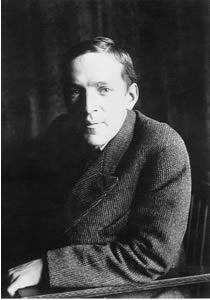
Upton Sinclair (20 september 1878 – 25 november 1968)
Zie voor nog meer schrijvers van de 20e september ook mijn blog van 20 september 2011 deel 1 en eveneens deel 2.


