

Naar de inhoud

Romenu

Over literatuur, gedichten, kunst en cultuur
akke.beakke.be

Berichten van 11 oktober 2012 tot 12 oktober 2012

Stefaan van den Bremt, Eugenio Montale, Robert Fitzgerald
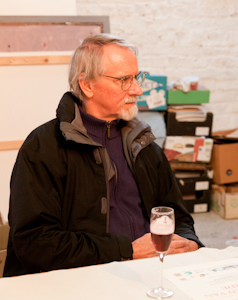
De Vlaamse dichter en essayist Stefaan van den Bremt werd geboren in Aalst op 12 oktober 1941. Zie ook mijn blog van 12 oktober 2010 en eveneens alle tags voor Stefaan van den Bremt op dit blog.


Naastenliefde


Wie heeft de pad het pad zien oversteken?
De boer op zijn tractor niet: hij heeft
al honderd padden overreden. Het pad
is smal, en de pad traag. Hij is een
pelgrim, onderweg (misschien mist hij
een kenteken?). Hij sleept zich naar
de plas, de poel waarin herboren wordt
zijn groene paradijs. Hij wil dwars
door het stenen huis, hij volhardt in
zijn heimwee, zwijgend, laat zich
met geen klem van drempels overreden.
En als wij in het donker de deur dicht-
slaan brengt hij geen klacht uit, geeft
geen kik. Pas maanden later vindt men
tussen deur en drempel, geplet, gedroogd,
zijn bijna gewichtloos, haast onstoffelijk
omhulsel. Gelukkige pad, nog steeds
op pad, pelgrim zonder reisgoed.


Lijflied


Het is van mijn leven nog niet geschreven,
nog nooit van m'n leven.
Het staat om de dood nog niet te boek,
om de dooie dood niet.

Het voelt nog zo iel aan,
of het mijn tong nog niet kan roeren;
ik voel me beroerd. Hoor hoe
het zou willen schreien.

Ik wil het ooit nog eens op
kunnen schrijven, al is het te weinig
om van te leven, het is om dood te gaan
te veel.

Een wijs is het, een onbepaalde
ruimte, die nog niet weet van tijd.
Een mond waarin bestorven ligt
wat nog geboren moet worden.


 1254585-c6698fbab29a3fc09e5274435e3c1076.jpg

Stefaan van den Bremt (Aalst, 12 oktober 1941)


De Italiaanse dichter Eugenio Montale werd geboren in Genua op 12 oktober 1896. Zie ook mijn blog van 12 oktober 2010 en eveneens alle tags voor Eugenio Montale op dit blog.


Glory of Expanded Noon

Glory of expanded noon
when the trees give up no shade,
and more and more the look of things
is turning bronze, from excess light.

Above, the sun—and a dry shore;
so my day is not yet done:
the finest hour is over the low wall,
closed off by a pale setting sun.

Drought all around: kingfisher hovers
over something life has left.
The good rain is beyond the barrenness,
but there's greater joy in waiting.


Vertaald door Jonathan Galassi


Bring Me the Sunflower

Bring me the sunflower so I can transplant it
here in my own field burned by salt-spray,
so it can show all day to the blue reflection of the sky
the anxiety of its golden face.

Darker things yearn for a clarity,
bodies fade and exhaust themselves in a flood
of colors, as colors do in music. To vanish,
therefore, is the best of all good luck.

Bring me the plant that leads us
where blond transparencies rise up
and life evaporates like an essence;
bring me the sunflower sent mad with light.


Vertaald door Charles Wright


 1254585-e310c3ba3334106f0c07e12a656e5453.jpg

Eugenio Montale (12 oktober 1896 - 12 september 1981)

Portret door  Guido Peyron, 1932


De Amerikaanse dichter, criticus en vertaler Robert Stuart Fitzgerald werd geboren op 12 oktober 1910 in Springfield, Illinois. Zie ook mijn blog van 12 oktober 2010 en eveneens alle tags voor Robert Fitzgerald op dit blog.


Cobb Would Have Caught It

In sunburnt parks where Sundays lie,
Or the wide wastes beyond the cities,
Teams in grey deploy through sunlight.


Talk it up, boys, a little practice.


Coming in stubby and fast, the baseman
Gathers a grounder in fat green grass,
Picks it stinging and clipped as wit
Into th eleather: a swinging step
Wings it deadeye down to first.
Smack. Oh, attaboy, attyoldboy.


Catcher reverses his cap, pulls down
Sweaty casque, and squats in the dust:
Pitcher rubs new ball on his pants,
Chewing, puts a jet behind him;
Nods past batter, taking his time.
Batter settles, tugs at his cap:
A spinning ball: step and swing to it,
Caught like a cheek before it ducks
By shivery hickory: socko, baby:
Cleats dig into dust. Outfielder,
On his way, looking over shoulder,
Makes it a triple. A long peg home.


Innings and afternoons. Fly lost in sunset.
Throwing arm gone bad. There's your old ball game.
Cool reek of the field. Reek of companions.


Night Images


Late in the cold night wakened, and heard wind,   

And lay with eyes closed and silent, knowing   

These words how bodiless they are, this darkness   

Empty under my roof and the panes rattling   

Roughed by wind. And so lay and imagined   

Somewhere far off black seas heavy-shouldered   

Plunging on sand and the ebb off-streaming and   

Thunder forever. So lying bethought me, friend,   

What traffic ghouls have, or this be legend,   

In low inland hollows of the earth, under

Shade of moon, the night moaning, and bitter frost;   

And feared the riches of my bones, long given   

Into this earth, should tumble to their hands.   

No girl or ghost beside me, and I lonely,   

Remembering gardens, lilac scent, or twilight   

Descending late in summer on that town,   

I lay and found my years departed from me,   

And feared the cold bed and the wind, absurdly   

Alone with silence and the trick of tears.


 1254585-cb84e353458a6733c4a1646165edd30d.jpg

Robert Fitzgerald (12 oktober 1910 – 16 januari 1985)


Zie voor nog meer schrijvers van de 12e oktober ook mijn blog van 12 oktober 2011 deel 1 en eveneens deel 2.

Geschreven door Romenu om 19:44 Reageer op dit bericht

Nobelprijs voor de Literatuur voor Mo Yan


Nobelprijs voor de Literatuur voor Mo Yan


De Nobelprijs voor de Literatuur is toegekend aan Chinese schrijver Mo Yan. Dat heeft het Nobelcomité in Stockholm bekendgemaakt. Mo Yan werd geboren op 17 februari 1955 in Gaomi in de provincie Shandong. Aan de Nobelprijs is een bedrag van ongeveer € 930.000 verbonden. Het Nobelcomité roemt Mo Yan voor het "hallucinerend realisme" waarmee hij volksverhalen, geschiedenis en het hedendaagse combineert. Mo Yan, een pseudoniem voor 'spreek niet', krijgt de prijs op 10 december uitgereikt. Zie ook alle tags voor Mo Yan op dit blog.
 

Uit: The Garlic Ballads (Vertaald door Howard Goldblatt)


“Gao Yang touched the drop of nectar with his tongue, and his taste buds were treated to a cool, sweet taste that relaxed him. He surveyed his three acres of garlic field. It was a good crop, the white tips large and plump, some at a jaunty angle, others straight as a board. The garlic was moist and juicy, with downy sprouts beginning to appear. His pregnant wife was on her hands and knees beside him, yanking garlic out of the ground. Her face was darker than usual, and there were fine lines around her eyes, like veins of spreading rust on a sheet of iron. As she knelt, knees coated with mud, her childhood deformity — a stunted left arm that inconvenienced her in everything she did — made the job harder than it ought to have been. He watched her reach down and pinch the stalks with a pair of new bamboo chopsticks; the effort made her bite her lip each time, and he felt sorry for her. But he needed her help, for he’d heard that the co-op was setting up shop in the county town to buy the garlic crop at slightly over fifty fen a pound, higher than last year’s peak price of forty-five. He knew the county had expanded the amount of acreage given over to garlic this year; and with a bumper crop, the earlier you harvested yours, the sooner you could sell it. That was why everyone in the Village, women and children included, was out in the fields. But as he looked at his pitiable pregnant wife, he said, “Why not rest awhile?”

“What for?” She raised her sweaty face. “I’m not tired. I just worry the baby might come.”

“Already?” he asked anxiously.

“I figure some time in the next couple of days. I hope it waits till the harvest is in, at least.”

“Do they always come when they’re due?”

“Not always. Xinghua was ten days late.”

They turned to look behind them, where their daughter sat obediently at the edge of the field, her sightless eyes opened wide. She was holding a stalk of garlic in one hand and stroking it with the other.

“Careful with that garlic, Xinghua,” he said. “Each stalk is worth several fen.”


 1254189-09e75bca326ebcb689c42846e235e6b9.jpg

Mo Yan (Gaomi, 17 februari 1955)

Geschreven door Romenu om 09:15 Reageer op dit bericht

Gertrud von Le Fort, François Mauriac, Conrad Ferdinand Meyer

De Duitse dichteres en schrijfster Gertrud von Le Fort werd geboren in Minden op 11 oktober 1876. Zie ook mijn blog van 11 oktober 2010 en eveneens alle tags voor Gertrud von Le Fort op dit blog.


Stille


Mich ruft zuweilen eine Stille,
die alles Tönen überschweigt
bis ein geheimnisvoller Wille
sich über meine Seele neigt.

Der sprengt im Zittern von Sekunden
dies enge Haus - die Welt ist Traum,
in ferne Täler sanken Stunden
und flüsternah ward jeder Baum.


Die Heimatlosen


Wir sind von einem edlen Stamm genommen,
Der Schuld vermählt,
Wir sind auf dunklen Wegen hergekommen
Wund und gequält.

Wir hielten einst ein Vaterland umfangen -
Gott riß uns los -
Wir sind durch Feuer und durch Blut gegangen
Verfolgt und bloß.

Des Abgrunds Engel hat uns überflogen -
Wer bannt sein Heer?
Wir sind am Rand der Hölle hingezogen -
Uns graust nicht mehr.

Durch jede Schmach sind wir hindurchgebrochen
Bis ins Gericht:
Wir hörten Worte, die ihr nicht gesprochen -
O, redet nicht!

Uns winkt hier niemals Heimat mehr wie andern,
Uns hält kein Band,
Gott riss uns los, wir müssen wandern, wandern -
Wüst liegt das Land,

Wüst liegt die Stadt, wüst liegen Hof und Hallen,
Die Hand ward leer,
Wir sahen eine Welt in Trümmer fallen -
Uns trifft nichts mehr.

Ziel eines Hasses oder Spottes,
Was liegt daran?
Wir sind die Heimatlosen uns'res Gottes -
Er nimmt uns an.

Die Schuld ist ausgeweint, wir sind entronnen
Ins letzte Weh:
Die ew'ge Gnade öffnet ihre Bronnen -
Blut wird zu Schnee.


 1253938-1d4f9858f3fac91b28938c30bdf77ccf.jpg

Gertrud von Le Fort (11 oktober 1876 - 1 november 1971)


De Franse schrijver François Mauriac werd op 11 oktober 1885 geboren in Bordeaux. Zie ook mijn blog van 11 oktober 2010. en eveneens alle tags voor François Mauriac op dit blog.


Uit : Thérèse Desqueyrou


“L'avocat ouvrit une porte. Thérèse Desqueyroux, dans ce couloir dérobé du palais de justice, sentit sur sa face la brume et, profondément, l'aspira. Elle avait peur d'être attendue, hésitait à sortir. Un homme, dont le col était relevé, se détacha d'un platane, elle reconnut son père.
L'avocat cria __ << Non-lieu >> et, se retournant vers Thérèse : __ << Vous pouvez sortir, il n'y a personne. >>
Elle descendit des marches mouillées. Oui, la petite place semblait déserte. Son père ne l'embrassa pas, ne lui donna pas même un regard ; il interrogeait l'avocat Duros qui répondait à mi-voix, comme s'ils eussent été épiés. Elle entendait confusément leurs propos : -- Je recevrai demain l'avis officiel du non-lieu.
__ Il ne peut plus y avoir de surprise ?
__ Non : les carottes sont cuites, comme on dit.
__ Après la déposition de mon gendre, c'était couru.
__ Couru... couru... On ne sait jamais.
__ Du moment que, de son propre aveu il ne comptait jamais les gouttes...
__ Vous savez, Larroque, dans ces sortes d'affaires, le témoignage de la victime... >>
La voix de Thérèse s'éleva : __ Il n'y a pas eu de victime.
__ J'ai voulu dire : victime de son imprudence, madame. >>
Les deux hommes, un instant, observèrent la jeune femme immobile, serrée dans son manteau, et ce blême visage, qui n'exprimait rien. Elle demanda où était la voiture ; son père l'avait fait attendre sur la route de Budos, en dehors de la ville, pour ne pas attirer l'attention. Ils traversèrent la place : des feuilles de platane étaient collées aux bancs trempés de pluie. Heureusement, les jours avaient bien diminué. D'ailleurs, pour rejoindre la route de Budos, on peut suivre les rues les plus désertes de la sous-préfecture. Thérèse marchait entre les deux hommes qu'elle dominait du front et qui de nouveau discutaient comme si elle n'eût pas été présente ; mais, gênés par ce corps de femme qui les séparait, ils le poussaient du coude. Alors elle demeura un peu en arrière, déganta sa main gauche pour arracher de la mousse aux vieilles pierres qu'elle longeait. Parfois un ouvrier à bicyclette la dépassait, ou une carriole ; la boue jaillie l'obligeait à se tapir contre le mur. Mais le crépuscule recouvrait Thérèse, empêchait que les hommes la reconnussent. L'odeur de fournil et de brouillard n'était plus seulement pour elle l'odeur du soir dans une petite ville : elle y retrouvait le parfum de la vie qui lui était rendue enfin ; elle fermait les yeux au souffle de la terre endormie, herbeuse et mouillée ; s'efforçait de ne pas entendre les propos du petit homme aux courtes jambes arquées qui, pas une fois, ne se retourna vers sa fille ; elle aurait pu choir au bord de ce chemin : ni lui, ni Duros ne s'en fussent aperçus. Ils n'avaient plus peur d'élever la voix.”


1253938-c0e0dc7362a951c9106390d8f5224984.jpg

François Mauriac (11 oktober 1885 - 1 september 1970)

Hier links, met zijn zoon Claude in 1930 


De Zwitserse dichter en schrijver Conrad Ferdinand Meyer werd geboren in Zürich op 11 oktober 1825. Zie ook mijn blog van 11 oktober 2010 en eveneens alle tags voor Conrad Ferdinand Meyer op dit blog.


Das Strandkloster


Bollwerk und Mauer trutzen
Dem Wellenwurf schon ein Jahrtausend ja,
Wir singen, elf Kapuzen
Ein kräftig schallend Deo Gloria!

Die Kutten, stark gewoben
Umhingen uns in braunen Lappen lang
Sie sind gemach verstoben
Die Stäubchen irren durch den Klostergang.

Die Orgel im Empore
Spielt unser zwölftes totes Brüderlein
Hier rieselt uns im Chore
Der morsche Kalk sanft ins Geripp herein.

Es glitt vor tausend Jahren
Dem Strand ein Sarazenensegel nah
Sobalds vorbeigefahren
Anstimmten wir ein kräftig Gloria.

Ergötzt von unserm Singen
Nahm der Pirat zu uns zurück den Lauf,
Zwölf Köpfe liess er springen
Das Blut schoss wie aus Brunnenröhren auf.

Wir singen ohne Kehlen
Wir sitzen fröhlich ohne Schädel da,
Wir singen mit den Seelen
Ein kräftig schallend Deo Gloria!

Der Morgenstrahl, der schiefe
Durchs rechte Fenster äugelt er herein
Vergoldend in der Tiefe
Ein lustiglich psallierend Totenbein.

Der Abendstrahl, der schräge
Durchs linke Fenster blinzelt er herein
Und zählt, ob allewege
Wir richtig unser elf Gespenster sein.

Bollwerk und Mauer trutzen
Dem Wellenwurf noch tausend Jahre ja,
Wir singen, elf Kapuzen
Ein kräftig schallend Deo Gloria!


Der Reisebecher


Gestern fand ich, räumend eines langvergessnen Schrankes Fächer,
Den vom Vater mir vererbten, meinen ersten Reisebecher.
Währenddes ich, leise singend, reinigt ihn vom Staub der Jahre
Wars, als höbe mir ein Bergwind aus der Stirn die grauen Haare
Wars, als dufteten die Matten, drein ich schlummernd lag versunken,
Wars, als rauschten alle Quelle, draus ich wandernd einst getrunken.


Der Gesang des Meeres


Wolken, meine Kinder, wandern gehen
Wollt ihr? Fahret wohl! Auf Wiedersehen!
Eure wandellustigen Gestalten
Kann ich nicht in Mutterbanden halten.

Ihr langweilet euch auf meinen Wogen,
Dort die Erde hat euch angezogen:
Küsten, Klippen und des Leuchtturms Feuer!
Ziehet, Kinder! Geht auf Abenteuer!

Rauscht im Regen! Murmelt in den Quellen!
Füllt die Brunnen! Rieselt in den Wellen!
Braust in Strömen durch die Lande nieder -
Kommet, meine Kinder, kommet wieder!


1253938-81117f5332ee9128ea57264db252318e.jpg
Conrad Ferdinand Meyer
(11 oktober 1825 - 28 november 1898)
Medaille


Zie voor nog meer schrijvers van de 11e oktober ook mijn blog van 11 oktober 2011.


Geschreven door Romenu om 20:18 Reageer op dit bericht

Meer van Romenu

↑ Terug naar de berichten