

 Lars Gustafsson, Peter Høeg, Gary Paulsen, Henri Barbusse, Virginie Loveling, Mischa Andriessen
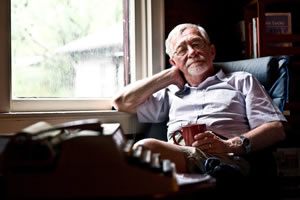
De Zweedse dichter en schrijver Lars Gustafsson werd geboren in Västeras, op 17 mei 1936. Zie ook alle tags voor Lars Gustafsson op dit blog.
Placenta
This formless, lobated organ
that is expelled after birth.
Neither mother nor child, neutral,
in the same way the innermost void
within true insomnia
is a completely neutral place.
There always exists something
that is between usual states,
neither the one nor the other.
Towards this Between
I feel a wry friendship,
a kinship even.
It has the real world’s
large vacant, candid face.
The art room
The room itself smelled of chalk
and heavy, dried wood.
Generations had carved in the tables
so that the systems of letters
intersected each other
as in some ancient Sumerian
or why not Babylonian
archaeology.
Forgotten gods with dog’s ears
and stern wooden faces
came of their own accord out of the graining.
On the paper, though, only the strict
figures and angles of the linear drawing that were
so sharp that you could cut yourself on them.
And this was meant to be the place where art dwelt.
Vertaald door John Irons
Fichte an der Petroleumlampe
Als das weiche Dunkel des Augusts
sich plötzlich verdichtete
war es, als habe der See da unten
einen kürzeren Wellenschlag, eine andere Atmung
unbekannte Tiere schauten vielleicht aus
ihren Höhlen am Uferrand.
Und die Petroleumlampe wurde angezündet.
Sie sah aus wie ein kleiner Leuchtturm
mit verschiedenen Absätzen aus Glas und Porzellan
und der starke Strom von erhitzter Luft
durfte nicht in die Gardine geraten.
Da hieß es aufpassen,
die Lampe nicht unter die Gardine stellen.
Sie erzeugte, genau genommen, große Hitze
(der Unterschied war im Raum deutlich zu spüren)
und wenig Licht. Und um diese Lampe flog
ein wütendes kleines metallblaues Insekt.
Der Philosoph Fichte war irgendwie
dem dicken braunen Buch
auf dem Tisch entschlüpft,
in dem er allem Anschein nach wohnte.
Kreiste, bis ihn die Flamme verschlang.
Aber da war der Abend zu Ende.
Vertaald door Verena Reichelaus
Lars Gustafsson (Västeras, 17 mei 1936)
De Deense schrijver Peter Høeg werd geboren in Kopenhagen op 17 mei 1957. Zie ook alle tags voor Peter Høeg op dit blog.
Uit: Smilla's Sense of Snow (Vertaald door Tina Nunnally)
“But out in the
darkness, like the bow of a ship, the walls of Vestre Prison loom; we are in
Copenhagen.
The Greenlanders' cemetery is part of Vestre Cemetery. A procession follows
Isaiah in his coffin--Juliane's friends, who are now holding her upright, the
pastor and the verger, the mechanic, and a small group of Danes, among whom I
recognize only the social worker and the investigator.
The pastor is now saying something that makes me think he must have actually
met Isaiah, even though, as far as I know, Juliane has never gone to church.
Then his voice disappears, because now the other women are weeping along with
Juliane.
Many have come, perhaps twenty, and now they let their sorrow wash over them
like a black flood, into which they dive and let themselves be carried along in
a way that no outsider could understand, no one who has not grown up in
Greenland. And even that might not be enough. Because I can't follow them,
either.
For the first time I look closely at the coffin. It's hexagonal. At a certain
point ice crystals take the same form.
Now they are lowering him into the ground. The coffin is made of dark wood, it
looks so small, and there is already a layer of snow on it. The flakes are the
size of tiny feathers, and that's the way snow is, it's not necessarily cold.
What is happening at this moment is that the heavens are weeping for Isaiah,
and the tears are turning into frosty down that is covering him up. In this way
the universe is pulling a comforter over him, so that he will never be cold
again.
The moment the pastor throws earth on the coffin and we are supposed to turn
around and leave, a silence falls that seems to last for a long time. The women
are quiet, no one moves, it's the sort of silence that is waiting for something
to burst. From where I'm standing, two things happen.
First, Juliane falls to her knees and puts her face to the ground, and the
other women leave her alone.
The second event is internal, inside of me, and what bursts through is an insight.
All along I must have had a comprehensive pact with Isaiah not to leave him in
the lurch, never, not even now.
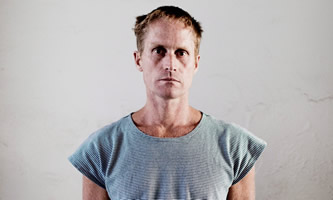
Peter Høeg (Kopenhagen, 17 mei 1957)
De Amerikaanse schrijver Gary Paulsen werd geboren op 17 mei 1939 in Minneapolis, Minnesota. Zie ook alle tags voor Gary Paulsen op dit blog.
Uit: Guts
“I have spent an
inordinate amount of time in wilderness woods, much of it in northern
Minnesota, some in Canada and some in the Alaskan wilds. I have hunted and
trapped and fished and have been exposed to almost all kinds of wilderness
animals; I’ve had bear come at me, been stalked by a mountain lion, been bitten
by snakes and punctured by porcupines and torn by foxes and once pecked by an
attacking raven, but I have never seen anything rivaling the madness that seems
to infect a large portion of the moose family.
I first witnessed this insanity when I was twelve, in northern Minnesota. I had
just started hunting with a rifle. Back then there were none of today’s modern
hunting weapons and I was, to put it mildly, financially disadvantaged. I worked
hard at setting pins in a bowling alley, selling newspapers in bars at night
and laboring on farms in the summer (hoeing sugar beets for eleven dollars an
acre and picking potatoes for five cents a bushel) to make enough money to buy
clothing and supplies for school. There was little left for fancy weapons, and
after saving for a long time I finally managed to come up with enough money for
a Remington single-shot .22 rifle. It was bolt action, with a twist safety on
the rear of the bolt, and had to be loaded for each shot by opening the bolt,
which extracted the empty shell if you had just fired. Then you put a new
cartridge into the chamber by hand, closed the bolt and fired. It was a long
process and the end result was that it forced the shooter to pay attention to
his first shot and make certain it was accurately placed. It also made the
hunter careful not to waste his shot. Withing a short time I was very accurate
with this little rifle and was steadily bringing home rabbits and ruffed
grouse, which I cleaned and cooked.
Just as they do today, game wardens had a great deal of say in how game laws were enforced, and if a family was poor or there were other special conditions, the wardens would sometimes overlook minor infractions. The legal hunting seasons were in fall and winter, but sometimes I hunted in spring as well, and it gave me food at times when my parents were on long drunks and didn’t keep the refrigerator filled. I would like to thank those game wardens who looked the other way now and then when they saw a scruffy kid come out of the woods with a not-quite-legal grouse or rabbit hanging on his belt.”
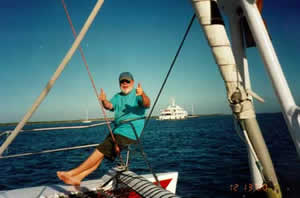
Gary Paulsen (Minneapolis, 17 mei 1939)
De Franse dichter en schrijver Henri Barbusse werd geboren op 17 mei 1873 in Asnières-sur-Seine. Zie ook alle tags voor Henri Barbusse op dit blog.
Uit: L'Enfer
“L'hôtesse, Mme Lemercier, me laissa seul dans ma chambre, après m'avoir rappelé en quelques mots tous les avantages matériels et moraux de la pension de famille Lemercier. Je m'arrêtai, debout, en face de la glace, au milieu de cette chambre où j'allais habiter quelque temps. Je regardai la chambre et me regardai moi-même. La pièce était grise et renfermait une odeur de poussière. Je vis deux chaises dont l'une supportait ma valise, deux fauteuils aux maigres épaules et à l'étoffe grasse, une table avec un dessus de laine verte, un tapis oriental dont l'arabesque, répétée sans cesse, cherchait à attirer les regards. Mais à ce moment du soir, ce tapis avait la couleur de la terre. Tout cela m'était inconnu; comme je connaissais tout cela, pourtant: ce lit de faux acajou, cette table de toilette, froide, cette disposition inévitable des meubles, et ce vide entre ces quatre murs...
La chambre est usée; il semble qu'on y soit déjà infiniment venu. Depuis la porte jusqu'à la fenêtre, le tapis laisse voir la corde: il a été piétiné, de jour en jour, par une foule. Les moulures sont, à hauteur des mains, déformées, creusées, tremblées, et le marbre de la cheminée s'est adouci aux angles. Au
contact des hommes, les choses s'effacent, avec une lenteur désespérante. Elles s'obscurcissent aussi. Peu à peu, le plafond s'est assombri comme un ciel d'orage. Sur les panneaux blanchâtres et le papier rose, les endroits les plus touchés sont devenus noirs: le battant de la porte, le tour de la serrure peinte du placard et, à droite de la fenêtre, le mur, à la place où l'on tire les cordons des rideaux.”
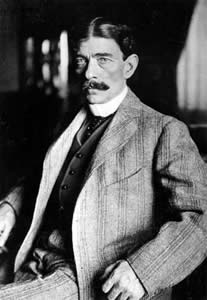
Henri Barbusse (17 mei 1873 –30 augustus 1936)
De Vlaamse dichteres en schrijfster Virginie Loveling werd geboren in Nevele op 17 mei 1836. Zie ook alle tags voor Virginie Loveling op dit blog.
Geboortegrond
In 't zuiden heerst een eeuwge lent,
En aarde en hemel lacht.
In 't hoge Noorden nijpt de kou,
Daar ligt de sneeuw, daar is de rouw,
De schemering en de nacht
Waarom bewoont de Noorderman
Die streek der duisternis?
Omdat hij dáar zich wel bevindt
Omdat de mens het plekje mint,
Waar hij geboren is.
Hij vraagt geen-rozen aan de Mei,
Geen vruchten aan de herfst.
Hij mint zijn groen fluwelen mos,
Hij jaagt de ijsbeer en de vos,
Die in de vlakten zwerft.
En keert hij weer door mist en sneeuw,
Van jacht of kleine reis,
Dan haakt zijn hart, vol ongeduld,
Ook naar zijn hut met rook vervuld,
Als naar een lustpaleis.
Hij ziet toch, als de bleke dag
Voor 't lange duister zwicht,
De sterren aan de hemel staan,
Hij heeft het licht der klare maan,
En 't rode noorderlicht.
Waar ook de mens zijn woning vest,
Gaan lief en leed gepaard :
De vreugdestralen van 't gemoed,
Zij zijn de ware zonnegloed,
In elke streek der aard.
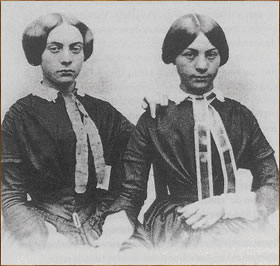
Virginie Loveling (17 mei 1836 – 1 december 1923)
Hier met haar zus Rosalie (links) in 1851
Onafhankelijk van geboortedata:
De Nederlandse dichter Mischa Andriessen werd geboren in Apeldoorn in 1970. Zie ook alle tags voor Mischa Andriessen op dit blog.
Thuis
Het donker van je
eigen
schaduw op de muur zien
en schrikken. Niets is gevaarlijker
dan wat je kunt begrijpen.
Het is jouw arm in de mouw
die over de muur kruipt,
jouw leegte die je achterlaat
als je de jas op de kapstok hangt.
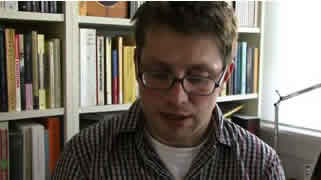
Mischa Andriessen
(Apeldoorn, 1970)
Zie voor nog meer schrijvers van de 17e mei ook mijn
blog van 17 mei 2012 en ook mijn blog van 17 mei 2011 deel 2.


