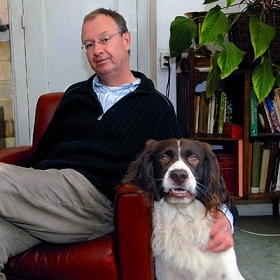
Michel van der Plas, Masiela Lusha, Augusten Burroughs, Robert Bridges, Adalbert Stifter

De Nederlandse dichter en schrijver Michel van der Plas werd geboren op 23 oktober 1927 in Den Haag. Zie ook mijn blog van 23 oktober 2010 en eveneens alle tags voor Michel van der Plas op dit blog.
Engelbewaarder
1
Je hebt, denk ik, een overvol bestaan:
alle dagen meezingen in het koor
voor de almachtige, en ertussendoor
hier op de aarde mijn gangen nagaan,
mijn onverbeterlijke eigenwaan
en levensangst gedurig op het spoor,
volgend als zijn getrouwe oog en oor
en tussenbeide komend met vermaan.
Ik overweeg aan 't eind van elke dag,
jouw zorgenkind, huiverend van ontzag,
dat dansen tussen tijd en eeuwigheid,
dat dubbelleven dat je vlakbij leidt
en dat ik toch niet met je delen mag,
engel van God die mijn bewaarder zijt.
2
Vannacht was ik je kwijt, want opgenomen
in reuzenwolken, op en neer spiralend
en met miljoenen 't zelfde lied herhalend,
rondom een licht te fel voor mensendromen,
gezang dat een oneindig aantal malen
uiteen viel en weer als een zee ging stromen,
en jij daarin, voorgoed, leek het, ontkomen:
wat zou je nu nog naar mijn leven talen.
Kom terug, kom terug, riep ik je na.
Kon ik jou uit mijn duister nog bezweren?
Maar uit de zwermen hoorde ik geen ja,
alleen het ruisen van de atmosferen
rondom het zwijgen van de Heer der heren
ver in den hoge, in jouw gloria.
De rijke jongeling 2
Ik zou zo graag geloven dat hij later
naar hem teruggekeerd is: in die nacht
dat Jezus in de tuin werd opgebracht.
Een jonge man wilde hem volgen, staat er.
Dat hij toen echt alles had weggegeven.
Want hij ging enkel in een linnen doek
om zijn lichaam naar de meester op zoek.
Het was zijn schuld niet dat ze hem verdreven.
Het laatste wat hij had viel hun in handen.
Naakt sloeg hij op de vlucht. Verder dan daar
kon hij niet volgen. Als een bedelaar.
Ik zie de tranen in zijn ogen branden
terwijl hij rent, tussen de struiken door:
En sinds die nacht ontbreekt van hem elk spoor.
Michel van der Plas (23 oktober 1927 - 21 juli 2013)
De Albanees-Amerikaanse schrijfster en actrice Masiela Lusha werd geboren op 23 oktober 1985 in Tirana. Zie ook mijn blog van 23 oktober 2010 en eveneens alle tags voor Masiela Lusha op dit blog.
Early Spring
When the waving
heavens are soft
Cool inside the birth of green—
And the snowdrops filter
Through the blades and leaves
Budding and leafing
A rosy reflection—a mist of chill,
A pillow of muse in all its glory
And glistening, never blinding
A fading, a release,
A relinquishing on all
That is cold and vacant.
When the birds are plump
And wild with nature—
Seeking a link of rebirth.
Early spring, when the
World reopens to your embrace
And there is no need for cover,
For protection—
All you need is one smile—
And muse to live.
Early spring: when birth
Is a little gold, a little white.
Maple Lives
This yellow sweet
anthem of spring is nearing
Sung and played by the Green Mistress's steering
Of mated birds and collected hives
This busy song, her ode to maple lives.
Frothing from her mother-bark's leaf
Is this sole drop, wet and golden and candy sweet.
How delicious for her to swallow all in her path,
To collect and drown their secret wrath...
Then forth she wanders, glassy and bubbling,
With stolen specks of silent troubling...
Frozen conspiracies and shadowed fights,
Arousing this nature's cast of caramel light.
The poor mass of humbled beings broken by her design,
Will illustrate the price of what's physically benign.
This maturing candy rock of once silent sweet flirt,
Will allow you to flavor those souls she had hurt.

Masiela Lusha (Tirana, 23 oktober 1985)
De Amerikaanse schrijver Augusten Xon Burroughs werd geboren op 23 oktober 1965 in Pittsburgh, Pennsylvania. Zie ook mijn blog van 23 oktober 2010 en eveneens alle tags voor Augusten Burroughs op dit blog.
Uit: Dry
“My phone rings. I
let the machine pick up.
“Hey, it’s Jim … just wanted to know if you wanna go out for a quick
drink. Gimme a call, but try and get back—”
As I pick up the machine screeches like a strangled cat. “Yes,
definitely,” I tell him. “My blood alcohol level is dangerously low.”
“Cedar Tavern at nine,” he says.
Cedar Tavern is on University and Twelfth and I’m on Tenth and Third, just a
few blocks away. Jim’s over on Twelfth and Second. So it’s a fulcrum between
us. That’s one reason I like it. The other reason is because their martinis are
enormous; great bowls of vodka soup. “See you there,” I say and hang up.
Jim is great. He’s an undertaker. Actually, I suppose he’s technically not
an undertaker anymore. He’s graduated to coffin salesman, or as he puts it,
“pre-arrangements.” The funeral business is rife with euphemisms. In the
funeral business, nobody actually “dies.” They simply “move on,” as if
traveling to a different time zone.
He wears vintage Hawaiian shirts, even in winter. Looking at him, you’d think
he was just a normal, blue-collar Italian guy. Like maybe he’s a cop or owns a
pizza place. But he’s an undertaker, through and through. Last year for my
birthday, he gave me two bottles. One was filled with pretty pink lotion, the
other with an amber fluid. Permaglow and Restorative: embalming fluids. This is
the sort of conversation piece you simply can’t find at Pottery Barn. I’m not
so shallow as to pick my friends based on what they do for a living, but in
this case I have to say it was a major selling point.
A few hours later, I walk into Cedar Tavern and feel immediately at ease.
There’s a huge old bar to my right, carved by hand a century ago from several
ancient oak trees. It’s like this great big middle finger aimed at nature
conservationists.”

Augusten Burroughs (Pittsburgh, 23 oktober 1965)
De Engelse dichter, toneel- en prozaschrijver Robert Seymour Bridges werd geboren in Walmer, Kent, op 23 oktober 1844. Zie ook mijn blog van 23 oktober 2009 en ook mijn blog van 23 oktober 2010
Pater Filio
Sense with keenest
edge unused,
Yet unsteel'd by scathing fire;
Lovely feet as yet unbruised
On the ways of dark desire;
Sweetest hope that lookest smiling
O'er the wilderness defiling!
Why such beauty, to be blighted
By the swarm of foul destruction?
Why such innocence delighted,
When sin stalks to thy seduction?
All the litanies e'er chaunted
Shall not keep thy faith undaunted.
I have pray'd the sainted Morning
To unclasp her hands to hold thee;
From resignful Eve's adorning
Stol'n a robe of peace to enfold thee;
With all charms of man's contriving
Arm'd thee for thy lonely striving.
Me too once unthinking Nature,
--Whence Love's timeless mockery took me,--
Fashion'd so divine a creature,
Yea, and like a beast forsook me.
I forgave, but tell the measure
Of her crime in thee, my treasure.

Robert Bridges (23 oktober 1844 - 21 april 1930)
De Oostenrijkse schrijver Adalbert Stifter werd geboren in Oberplan op 23 oktober 1805. Zie ook mijn blog van 23 oktober 2010 en eveneens alle tags voor Adalbert Stifterdit blog.
Uit: Der Nachsommer
„Mein Vater war ein Kaufmann. Er bewohnte einen Teil des ersten Stockwerkes eines mäßig großen Hauses in der Stadt, in welchem er zur Miete war. In demselben Hause hatte er auch das Verkaufsgewölbe, die Schreibstube nebst den Warenbehältern und anderen Dingen, die er zu dem Betriebe seines Geschäftes bedurfte. In dem ersten Stockwerke wohnte außer uns nur noch eine Familie, die aus zwei alten Leuten bestand, einem Manne und seiner Frau, welche alle Jahre ein oder zwei Male bei uns speisten, und zu denen wir und die zu uns kamen, wenn ein Fest oder ein Tag einfiel, an dem man sich Besuche zu machen oder Glück zu wünschen pflegte. Mein Vater hatte zwei Kinder, mich, den erstgeborenen Sohn, und eine Tochter, welche zwei Jahre jünger war als ich. Wir hatten in der Wohnung jedes ein Zimmerchen, in welchem wir uns unseren Geschäften, die uns schon in der Kindheit regelmäßig aufgelegt wurden, widmen mußten, und in welchem wir schliefen. Die Mutter sah da nach und erlaubte uns zuweilen, daß wir in ihrem Wohnzimmer sein und uns mit Spielen ergötzen durften.
Der Vater war die meiste Zeit in dem Verkaufsgewölbe und in der Schreibstube. Um zwölf Uhr kam er herauf, und es wurde in dem Speisezimmer gespeiset. Die Diener des Vaters speisten an unserem Tische mit Vater und Mutter, die zwei Mägde und der Magazinsknecht hatten in dem Gesindezimmer einen Tisch für sich. Wir Kinder bekamen einfache Speisen, der Vater und die Mutter hatten zuweilen einen Braten und jedesmal ein Glas guten Weines. Die Handelsdiener bekamen auch von dem Braten und ein Glas desselben Weines. Anfangs hatte der Vater nur einen Buchführer und zwei Diener, später hatte er viere.
In der Wohnung war ein Zimmer, welches ziemlich groß war. In demselben standen breite, flache Kästen von feinem Glanze und eingelegter Arbeit. Sie hatten vorne Glastafeln, hinter den Glastafeln grünen Seidenstoff, und waren mit Büchern angefüllt. Der Vater hatte darum die grünen Seidenvorhänge, weil er es nicht leiden konnte, daß die Aufschriften der Bücher, die gewöhnlich mit goldenen Buchstaben auf dem Rücken derselben standen, hinter dem Glase von allen Leuten gelesen werden konnten, gleichsam als wolle er mit den Büchern prahlen, die er habe. Vor diesen Kästen stand er gerne und öfter, wenn er sich nach Tische oder zu einer andern Zeit einen Augenblick abkargen konnte, machte die Flügel eines Kastens auf, sah die Bücher an, nahm eines oder das andere heraus, blickte hinein, und stellte es wieder an seinen Platz.“

Adalbert Stifter (23 oktober 1805 - 28 januari 1868)
Postzegel ter gelegenheid van zijn 200e geboortedag
Zie voor nog meer schrijvers van de 23e oktober ook mijn blog van 24 oktober 2011 deel 1
en eveneens deel 2.