

Naar de inhoud

Romenu

Over literatuur, gedichten, kunst en cultuur
akke.beakke.be

Berichten van 26 februari 2014 tot 27 februari 2014

John Steinbeck, Lawrence Durrell, André Roy, Henry Longfellow, Elisabeth Borchers, James T. Farrell
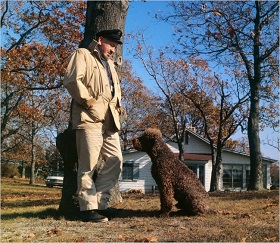
De Amerikaanse schrijver John Steinbeck werd geboren in Salinas, Californië, op 27 februari 1902. Zie ook alle tags voor John Steinbeck op dit blog.

Uit: Travels with Charley

“When I was very young and the urge to be someplace else was on me, I was assured by mature people that maturity would cure this itch. When years described me as mature, the remedy prescribed was middle age.In middle age I was assured greater age would calm my fever and now that I am fifty-eight perhaps senility will do the job. Nothing has worked. Four hoarse blasts of a ships's whistle still raise the hair on my neck and set my feet to tapping. The sound of a jet, an engine warming up, even the clopping of shod hooves on pavement brings on the ancient shudder, the dry mouth and vacant eye, the hot palms and the churn of stomach high up under the rib cage. In other words, once a bum always a bum. I fear this disease incurable. I set this matter down not to instruct others but to inform myself....A journey is a person in itself; no two are alike. And all plans, safeguards, policing, and coercion are fruitless. We find after years of struggle that we not take a trip; a trip takes us.”
(…)

“Once a journey is designed, equipped, and put in process, a new factor enters and takes over. A trip, a safari, an exploration, is an entity, different from all other journeys. It has personality, temperament, individuality, uniqueness. A journey is a person in itself; no two are alike. And all plans, safeguards, policing, and coercion are fruitless. We find after years of struggle that we do not take a trip; a trip takes us. Tour masters, schedules, reservations, brass-bound and inevitable, dash themselves to wreckage on the personality of the trip. Only when this is recognized can the blown-in-the glass bum relax and go along with it. Only then do the frustrations fall away. In this a journey is like marriage. The certain way to be wrong is to think you control it.”
(…)

“Once Charley fell in love with a dachshund, a romance racially unsuitable, physically ridiculous, and mechanically impossible. But all these problems Charley ignored. He loved deeply and tried dogfully.”


 1557131-ea670951f91d6217bae0f0320956dc1f.jpg
John Steinbeck (27 februari 1902 - 20 december 1968)


De Britse dichter en schrijver Lawrence George Durrell werd geboren op 27 februari 1912 in Jalandhar in India. Zie ook alle tags voor Lawrence Durrell op dit blog.

Uit: Spirit Of Place: Letters And Essays On Travel.

„Hotel Internazionale,
Brindisi, Italy
To Alan G. Thomas
Dear Alan,
You will see from this that we have arrived so far—at a certain cost. The whole town has been alive with rumours of the Greek revolt—and the services have been disorganized. The place swarms with people who are held up. But by some special dispensation we have discovered a boat which will drop us off at Corfu sometime in the middle of tonight. I hope you can read this scrawl. I can get you a copy of the infamous Lady Chatterly for 14 liras—about 5/-.
If the English are a nation of shop keepers, then the Italians are a nation of waiters. Positively they radiate a sort of charming servility. I have never been as waited on in any country—or, I might add, so badly. All the service is done from the wrong side.
I feel most disinclined to write. It’s very wearying kicking one’s heels in this military and naval port.
I’ve got quite a lot of amusement parading the slums and attending funerals. Most impressive. But the excitement of Greek civil war—and Italian importunity consumes me. However we leave tonight. God knows what time we reach the island. Dawn, I imagine. We have met a charming Greek boy who speaks Italian and has taken us round the town; the only night-haunt—apart from the more obvious houses of Venus for the soldiers— is a vacuous cafe with a very bad amateur band.
In order to give what Pat would call “body” to their music they accompany an exceedingly improbable and tinny gramophone. As the instruments are tuned from a piano which is several tones flat you can imagine the resulting noise.
Still I bear up very well under the stacks of local vino I am forced to consume. I’m developing a paunch like a channel buoy.
. . . For the rest—I’m too bored and the pen is too bad to write more. If I perish in the revolution you might save this letter as an example of what Italy can do to a gallant Englishman.
P’fui
Larry”


 1557131-a11925cdeca62571ddce704fc122e3bd.jpg
Lawrence Durrell (27 februari 1912 – 7 november 1990)


De Canadese dichter, schrijver en essayist André Roy werd geboren op 27 februari 1944 in Montréal. Zie ook alle tags van André Roy op dit blog.


Positions, Descriptions,
Phrases, Affairs

when it swells he's blond brown black red
when that and everything else and in every way
the different positions from the exercises
that you put into them, the specific texture of
this description I taxed my patience therein
the day is bright of course I'm really trying
to describe precisely, my eyes are useful but
with no talent for languages therefore did try
to untangle myself by using these few but
decisive phrases, allthings consodered caught
in the act of writing for sex's sake is my affair.


Confession and a Tale

the frequent love word in whose name
so readily we make our confession
as lacking in scruples as impromptu dreams;
so then, were those words a command? like silk,
like glass there is sperm, it's
the hieroglyph of a game over, dry dried
a swarm of assembled animals can be read therein,
immaculate burned to ashes
I'm looking it's a tale tied
to this naked young man asleep
with his stiffened tail, I was absolutely about
to pretend I was dying
on this lovely summer evening when he let me
 love him.


Vertaald door Daniel Sloate


 1557131-91da428c6ab17e5c20945858a648764b.jpg
André Roy (Montréal, 27 februari 1944)


De Amerikaanse dichter Henry Wadsworth Longfellow werd geboren in Portland, Maine, op 27 februari 1807. Zie ook alle tags voor Henry Longfellow op dit blog.


A Summer Day By The Sea

The sun is set; and in his latest beams
Yon little cloud of ashen gray and gold,
Slowly upon the amber air unrolled,
The falling mantle of the Prophet seems.
From the dim headlands many a light-house gleams,
The street-lamps of the ocean; and behold,
O'erhead the banners of the night unfold;
The day hath passed into the land of dreams.
O summer day beside the joyous sea!
O summer day so wonderful and white,
So full of gladness and so full of pain!
Forever and forever shalt thou be
To some the gravestone of a dead delight,
To some the landmark of a new domain.


Holidays

The holiest of all holidays are those
Kept by ourselves in silence and apart;
The secret anniversaries of the heart,
When the full river of feeling overflows;--
The happy days unclouded to their close;
The sudden joys that out of darkness start
As flames from ashes; swift desires that dart
Like swallows singing down each wind that blows!
White as the gleam of a receding sail,
White as a cloud that floats and fades in air,
White as the whitest lily on a stream,
These tender memories are;--a fairy tale
Of some enchanted land we know not where,
But lovely as a landscape in a dream.


Old Age

The course of my long life hath reached at last,
In fragile bark o'er a tempestuous sea,
The common harbor, where must rendered be
Account of all the actions of the past.
The impassioned phantasy, that, vague and vast,
Made art an idol and a king to me,
Was an illusion, and but vanity
Were the desires that lured me and harassed.
The dreams of love, that were so sweet of yore,
What are they now, when two deaths may be mine,--
One sure, and one forecasting its alarms?
Painting and sculpture satisfy no more
The soul now turning to the Love Divine,
That oped, to embrace us, on the cross its arms.


 1557131-f93ef417ef791f5843ac83ee3e380aff.jpg
Henry Longfellow (27 februari 1807 - 24 maart 1882)
Portret door zijn zoon Ernest W. Longfellow, 1886


De Duitse schrijfster en dichteres Elisabeth Borchers werd geboren in Homberg op 27 februari 1926. . Zie ook alle tags voor Elisabeth Borchers op dit blog.


Zeit. Zeit

Ich muß endlich begreifen
daß ich Zeit habe.
Zeit für den Vogel auf der Brüstung
der mit mir redet, im Auftrag.
Zeit für den Lampenfuß
in dem sich das Erdenlicht spiegelt.
Zeit für die Katze auf blauem Samt
in kleinstem Format an der Wand
von Almut gemalt, als beide noch lebten.
Auch für das Schaf mit den schwarzen Ohren
den schielenden Augen, dem schiefen Maul und dem
durstigen Mund. Indianisch, ganz einfach, instruktiv.
Vermissen werde ich's im kommenden Jahrhundert.
Ich habe noch nicht ein stillschweigendes Wort
mit der getrockneten Rose gewechselt, woher und wohin denn.
Und das Kalenderbuch in schwarzem Leder
mit der goldenen Jahreszahl
klafft elegant auseinander, um mich ein- und auszulassen.
Lernen, Zeit zu haben.
Lernen, daß es zu spät ist.


Ich will ihn haben

Ich will ihn heben
den versunkenen Schatz
das Gold, die Lieb, den Edelstein
Ich will die Weltenuhr verrücken
Ich weiß, es wird nicht einfach sein
Ich weiß, es wird mir nie
           und nimmer glücken
So laß die Sterne leuchten
und sei's nur einer: der ist dein.


 1557131-97a155f40625366bfae5577965e3add1.jpg
Elisabeth Borchers (27 februari 1926 – 25 september 2013)


De Amerikaanse schrijver James Thomas Farrell werd geboren op 27 februari 1904 in Chicago. Zie ook alle tags voor James T. Farrell op dit blog.

Uit: Young Lonigan

“It meant Bertha trying to pound lessons down your throat, when you weren’t interested in them; church history and all about the Jews and Moses, and Joseph, and Daniel in the lion’s den, and Solomon who was wiser than any man that ever lived, except Christ, and maybe the Popes, who had the Holy Ghost to back up what they said; arithmetic, and square and cube roots, and percentage that Studs had never been able to get straight in his bean; catechism lessons ... the ten commandments of God, the six commandments of the church, the seven capital sins, and the seven cardinal virtues and that lesson about the sixth commandment, which didn’t tell a guy anything at all about it and only had words that he’d found in the dictionary like adultery which made him all the more curious; grammar with all its dry rules, and its sentences that had to be diagrammed and were never diagrammed right; spelling, and words like apothecary that Studs still couldn’t spell; Palmer method writing, that was supposed to make you less tired and made you more tired, and the exercises of shaking your arm before each lesson, and the round and round (a pictures of small circles) and straight and straight, (a picture of small vertical lines) and the copy book, all smeared with ink, that he had gone through, doing exercise after exercise on neat sheets of Palmer paper, so that he could get a Palmer method certificate that his old man kicked about paying for because he thought it was graft; history lessons from the dull red history book, but they wouldn’t have been so bad if America had had more wars and if a guy could talk and think about the battles without having to memorize their dates, and the dates of when presidents were elected, and when Fulton invented the steamboat, and Eli Whitney invented the cotton gin or whatever in hell he did invent.”


 1557131-19c7454be6de71fc8264da8bc55189c4.jpg
James T. Farrell (27 februari 1904 – 22 augustus 1979)
Poster voor de film „Studs Lonigan“ uit 1960 met o.a. Christopher Knight en Jack Nicholson


Zie voor nog meer schrijvers van de 27e februari ook mijn blog van 27 februari 2012 deel 2 en eveneens deel 3.
Geschreven door Romenu om 20:05 Reageer op dit bericht

Michel Houellebecq, Victor Hugo, Adama van Scheltema, George Barker, Hermann Lenz, Antonin Sova

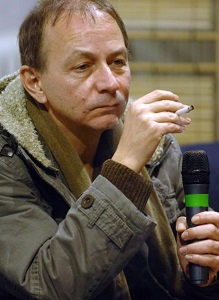
De Franse dichter en schrijver Michel Houellebecq werd geboren in Réunion op 26 februari 1958 (1956). Zie ook alle tags voor Michel Houellebecq op dit blog.


Uit: Le Sens du combat

Le jour monte et grandit, retombe sur la ville
Nous avons traversé la nuit sans délivrance
J’entends les autobus et la rumeur subtile
Des échanges sociaux. J’accède à la présence.

Aujourd’hui aura lieu. La surface invisible
Délimitant dans l’air nos êtres de souffrance
Se forme et se durcit à une vitesse terrible ;
Le corps, le corps pourtant, est une appartenance.

Nous avons traversé fatigues et désirs
Sans retrouver le goût des rêves de l’enfance
Il n’y a plus grand-chose au fond de nos sourires,
Nous sommes prisonniers de notre transparence.


Au long de ces journées où le corps nous domine
Où le monde est bien là, comme un bloc de ciment,
Ces journées sans plaisir, sans passion, sans tourment,
Dans l’inutilité pratiquement divines

Au milieu des herbages et des forêts de hêtres,
Au milieu des immeubles et des publicités
Nous vivons un moment d’absolue vérité :
Oui le monde est bien là, et tel qu’il paraît être.

Les êtres humains sont faits de parties séparables,
Leur corps coalescent n’est pas fait pour durer
Seuls dans leurs alvéoles soigneusement murés
Ils attendent l’envol, l’appel de l’impalpable.

Le gardien vient toujours au cœur du crépuscule ;
Son regard est pensif, il a toutes les clés,
Les cendres des captifs sont très vite envolées ;
Il faut quelques minutes pour laver la cellule


Dawn rises, grows, settles on the city
We’ve come through the night and not been set free
I hear the buses and the quiet hum
Of social exchange. I’m overcome with presence.

Today will happen. Invisible surfaces
Separate our suffering selves in the air
Then form and harden at a terrible pace;
But the body, still our pact with the body.

We’ve come through strain and desire
Childhood and dreams still pass us by
Not much there in a lifetime of smiling
We’re prisoners in our own clear selves.


Vertaald door Delphine Grass en Timothy Mathews


 1556512-26a088430a45a8d4488ac50e0b0ff29a.jpg
Michel Houellebecq (Réunion, 26 februari 1958)


De Franse dichter en schrijver Victor Hugo werd geboren in Besançon (Franche-Comté) op 26 februari 1802. Zie ook alle tags voor Victor Hugo op dit blog.


Infantile influence.

The child comes toddling in, and young and old
With smiling eyes its smiling eyes behold,
And artless, babyish joy;
A playful welcome greets it through the room,
The saddest brow unfolds its wrinkled gloom,
To greet the happy boy.

If June with flowers has spangled all the ground,
Or winter bleak the flickering hearth around
Draws close the circling seat;
The child still sheds a never-failing light;
We call; Mamma with mingled joy and fright
Watches its tottering feet.

Perhaps at eve as round the fire we draw,
We speak of heaven, or poetry, or law,
Or politics, or prayer;
The child comes in, 'tis now all smiles and play,
Farewell to grave discourse and poet's lay,
Philosophy and care.

When fancy wakes, but sense in heaviest sleep
Lies steeped, and like the sobs of them that weep
The dark stream sinks and swells,
The dawn, like Pharos gleaming o'er the sea,
Bursts forth, and sudden wakes the minstrelsy
Of birds and chiming bells;

Thou art my dawn; my soul is as the field,
Where sweetest flowers their balmy perfumes yield
When breathed upon by thee,
Of forest, where thy voice like zephyr plays,
And morn pours out its flood of golden rays,
When thy sweet smile I see.

Oh, sweetest eyes, like founts of liquid blue;
And little hands that evil never knew,
Pure as the new-formed snow;
Thy feet are still unstained by this world's mire,
Thy golden locks like aureole of fire
Circle thy cherub brow!

Dove of our ark, thine angel spirit flies
On azure wings forth from thy beaming eyes.
Though weak thine infant feet,
What strange amaze this new and strange world gives
To thy sweet virgin soul, that spotless lives
In virgin body sweet.

Oh, gentle face, radiant with happy smile,
And eager prattling tongue that knows no guile,
Quick changing tears and bliss;
Thy soul expands to catch this new world's light,
Thy mazed eyes to drink each wondrous sight,
Thy lips to taste the kiss.

Oh, God! bless me and mine, and these I love,
And e'en my foes that still triumphant prove
Victors by force or guile;
A flowerless summer may we never see,
Or nest of bird bereft, or hive of bee,
Or home of infant's smile.


Vertaald door Henry Highton, M.A.


 1556512-90565011594531164a7555d9e2ca59dc.jpg
Victor Hugo (26 februari 1802 – 22 mei 1885)
Portret door Paul Gavarni, 1829


De Nederlandse dichter Carel Steven Adama van Scheltema werd geboren in Amsterdam op 26 februari 1877. Zie ook alle tags voor Adama van Scheltema op dit blog.


De dijk

Tussen de Betuwe en tussen de Veluwe
Daar lag de dijk door het waterig land
Als iets waaraan niets was te veranderen:-
De koeien en de kikkers aan de' ene kant
En de zilveren vissen aan de' andere;
Zo bleven zij ieder in hun element,
Daar was dan ook ieder al lang aan gewend
Daar tussen de Betuwe en tussen de Veluwe.

En ónder aan de dijk daar glommen de blommen:-
Die zwierden en tierden maar overal,
Die stonden te bloze' en te bloeien,
Die knikten en knakte', en die lachten maar al
Om die klapperdekakkende koeien;
En de koeien, die tilden hun steerten op
En zagen nadenkende uit hunne kop,-
Ja, ònder aan de dijk daar glommen de blommen!

En óver de dijk daar floten de boten:-
Die toeterde' en ploeterden door de rivier,
Die waren geweldig aan 't slepen,
En hadden een onfatsoenlijk plezier
In de deftig zeilende schepen-
Die hielden zich quasi wat achteraf,
Maar eigenlijk legden ze 't lelijk af,-
Ja, óver de dijk daar floten de boten!

En benéde' aan de dijk daar had je het stadje:-
Dat lag daar zo kluchtig, zo klein en zo rein,
Als was 't maar een hapje, een stapje –
Dat kon eigenlijk wel eens niet anders zijn
Dan een echt-Hollands schildersgrapje!
Maar van de toren is dat niet gezegd,
Want de ouwe toren was zeker echt!-
Ja, benéde' aan de dijk daar had je het stadje!

En bóve' op de dijk daar voeren de boeren:-
Die holderdebolderden over de dijk
In hun hossebossende sjezen-
Die reden hun glanzende peerden te kijk,
En hun wijf in heur Zondagse wezen,
En die klapte' hunne zweep en die dachten maar: ‘krak,
Hoort gij die rijksdaalders wel in miene zak!'-
Ja bóve' op de dijk daar voeren de boeren!


 1556512-c0288dcb7ed99711164135dedb85d5f3.JPG
Adama van Scheltema (26 februari 1877 - 6 mei 1924)
Het monument voor Adama van Scheltema uit 1933, Amsterdam


De Engelse dichter George Granville Barker werd geboren op 26 februari 1913 in Loughton, Essex. Zie ook alle tags voor George Barker op dit blog.


O Child Beside The Waterfall

O Child beside the Waterfall
what songs without a word
rise from those waters like the call
only a heart has heard-
the Joy, the Joy in all things
rise whistling like a bird.

O Child beside the Waterfall
I hear them too, the brief
heavenly notes, the harp of dawn,
the nightingale on the leaf,
all, all dispel the darkness and
the silence of our grief.

O Child beside the Waterfall
I see you standing there
with waterdrops and fireflies
and hummingbirds in the air,
all singing praise of paradise,
paradise everywhere.


 1556512-78a4b30e06a39ae21c2c5562baffdf27.jpg
George Barker (26 februari 1913 – 27 oktober 1991)
Portret door  Patrick Swift, rond 1960


De Duitse schrijver Hermann Lenz werd op 26 februari 1913 in Stuttgart geboren. Zie ook alle tags voor Hermann Lenz op dit blog.

Uit: Neue Zeit

„Die Stadt wiedersehen, wo das Siegestor im Nebel näherrückte, das Siegestor, dessen Erzmedaillons die Marmorflanken schwärzten, weil über sie der Regen hundert Jahre lang herabgeflossen war. Dahinter regten sich die gelben Pappeln,schon fast ausgekämmt.
Wie früher umstanden Staketenzäune die Vorgärten der Schackstraße rechter und linker Hand, und immer noch war die Schackstraße kaum belebt, weshalb er dachte: bilde dir ein, man schriebe das Jahr neunzehnhundertsieben . . . obwohl vor dreißig Jahren jener Sessel bei Baronesse Vellberg nicht so abgewetzt wie heut gewesen wäre, sein Sammet aber schon zu jener Zeit die Farbe von trockenen Gräsern gehabt hätte; denn er entsann sich nun, als er wieder nach München kam, des Sessels, hoffte, daß er wieder in das Zimmer jener Baronesse einziehen könne, das im Hause Nummer sechs gelegen war, wo, ebenfalls wie vor drei Jahren, eine Tafel mit der Aufschrift ›Zimmer zu vermieten‹ hinterm Gitter der Haustüre und oben im dritten Stock am Fenster steckte; die Aufschrift hatte gotische Buchstaben.
Er ging hinauf und hörte, nachdem er geläutet hatte, die schnell hackenden Schritte der Baronesse und wie die Messingklappe hinterm gläsernen Türauge klickte, bevor sie öffnete, und er bemerkte, daß auch ihre runzelige Oberlippe noch dieselbe war. Es dehnte sich der dunkle Flur mit hohen Schränken, und sie sagte: »Sie haben doch schon mal bei mir gewohnt.« »Dann kennen Sie mich also noch?« – »Natürlich«, antwortete sie, als wundere sie sich, und führte ihn zur Glaswand mit der nachgiebigen Klinke an der gedämpft klirrenden Türe, hinter der, wie früher, ein kindlicher Engel aus Raffaels Sixtinischer Madonna auf einem Pastellbild schwärmerisch nach oben blickte und der Schreibsekretär wie ehemals am Fenster stand.“


 1556512-45cfbde9ab3226ed64a21a3d1b3874e9.jpg
Hermann Lenz (26 februari 1913 – 12 mei 1998)
Cover


De Tsjechische schrijver en dichter Antonín Sova werd geboren op 26 februari 1864 in Pacov (Dt. Patzau). Zie ook alle tags voor Antonín Sova op dit blog.


Alder-trees

Ye alder-trees, to me how dear,
At eve, with fragrant coolness near,
When o'er the water bent alone,
Your shadow here and there was thrown.

Somewhere the fishers' voices trailing,
Within the depths of night are quailing ;
The mill-sails, as they rustle low,
Have stirred within me old-time woe.


The yellow flowers

The meadow of Death grows sere in the gloom,
The land is athrob with the lute of Doom ;
Someone a blossom asmider strips.
And presses it close to the feverish lips.

The aged folk are on the brink.
And in sips their wine they drink ;
Upon their locks the moon-light rests,
On withered skin and drooping breasts.

Still may they tarry for a space.
And still to something turn their face.

Still to the Field they will not go.
The yellow blossoms rustle low,—
They will not die. They answer " No."


Vertaald door Henry J. Drane


 1556512-d2c96f16990f7e9feb3b5da4048f7de6.jpg
Antonín Sova (26 februari 1864 – 16 augustus 1928)


Zie voor nog meer schrijvers van de 26e februari ook mijn blog van 26 februari 2012 deel 1 en eveneens deel 2.

Geschreven door Romenu om 18:43 Reageer op dit bericht

Meer van Romenu

↑ Terug naar de berichten