

 Fernando Pessoa , Willem Brakman, William Butler Yeats, Thomas Heerma van Voss, Tristane Banon, Dorothy L. Sayers, Marcel Theroux
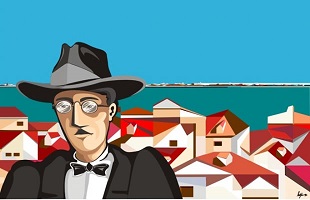
De Portugese dichter en schrijver Fernando António Nogueira Pessoa werd geboren in Lissabon op 13 juni 1888. Zie ook alle tags voor Fernando Pessoa op dit blog.
To see the fields and the river
To see the fields and the river
It isn't enough to open the window.
To see the trees and the flowers
It isn't enough not to be blind.
It is also necessary to have no philosophy.
With philosophy there are no trees, just ideas.
There is only each one of us, like a cave.
There is only a shut window, and the whole world outside,
And a dream of what could be seen if the window were opened,
Which is never what is seen when the window is opened.
Oxfordshire
I want the good, I want the bad, and in the end I want nothing.
I toss in bed, uncomfortable on my right side, on my left side,
And on my consciousness of existing.
I’m universally uncomfortable, metaphysically uncomfortable,
But what’s even worse is my headache.
That’s more serious than the meaning of the universe.
Once, while walking in the country around Oxford,
I saw up ahead, beyond a bend in the road,
A church steeple towering above the houses of a hamlet or village.
The photographic image of that non-event has remained with me
Like a horizontal wrinkle marring a trouser’s crease.
Today it seems relevant...
From the road I associated that steeple with spirituality,
The faith of all ages, and practical charity.
When I arrived at the village, the steeple was a steeple
And, what’s more, there it was.
You can be happy in Australia, as long as you don’t go there.
The gods grant nothing more than life
The gods grant nothing more than life,
So let us reject whatever lifts us
To unbreathable heights,
Eternal but flowerless.
All that we need to accept is science,
And as long as the blood in our veins still pulses
And love does not shrivel,
Let us go on
Like panes of glass: transparent to light,
Pattered by the sad rain trickling down,
Warmed by the sun,
And reflecting a little.
Vertaald door Richard Zenith
Fernando Pessoa (13 juni 1888 – 30 november 1935)
De Nederlandse schrijver Willem Brakman werd geboren op 13 juni 1922 in Den Haag. Zie ook alle tags voor Willem Brakman op dit blog.
Uit: De grote schok was Rilke
“Maar dan is er Rilke's voorvader, Detlev von Ulsgaard. Toen hem de reis werd aangezegd kleedde hij zich in zijn blauwe uniform met sjerp, steek en epauletten. Gevolgd door zijn hele hofhouding jachthonden incluis, besteeg hij daverend de trappen, daalde ze dreunend weer af en bonkte door alle zalen en vertrekken. Deuren moesten worden uitgebroken, leuningen verwijderd en uit zijn borst steeg een geluid omhoog als een boomstam, zodat wijd en zijd in de omtrek de boeren uit hun klompen schoten van angst.
Dagen lang heerste de grote dood geweldig en verpletterend in huis en omgeving, tot Detlev von Ulsgaard neerstortte op het parket van het slaapvertrek, donkerblauw gekleed, opeens veel kleiner dan men had gedacht, wat rimpelig en met de kleur van oude bijenwas.
Een machtig beeld van een grote vertellende, evocatieve kracht, een beeld waarin het grillige droomkarakter duidelijk is te herkennen. In mijn bewondering moet ik nog zo'n beeld kwijt, namelijk Rilke's beschrijving van de dood van Karel de Stoute bij Nancy. Na de slag heeft men de koning gemist, men heeft gezocht, het is nacht geworden, het vriest en er valt wat sneeuw. De volgende ochtend vroeg trekt een wat wonderlijk troepje er weer op uit: twee edellieden, de lijfarts en de nar. Eindelijk vinden ze de hertog, half op het land, half op het ijs van een vijver. Wie in die tijd sneuvelde, werd geplunderd tot de laatste vezel, zodat de hertog daar naakt, stijf, koud en bedekt met wat rijp en sneeuw ligt. Vol deernis knielen de mannen bij hem neer, vol piëteit tillen ze hem op, en zie... de wang van de hertog blijft ach ter op het ijs als een vreemde witte schil.
Een subliem détail, dat het toch al indrukwekkende beeld volmaakt afrondt. De betekenissen klinken hier samen zoals de tonen in een accoord: in het sneeuwlandschap ligt verstening en de kilte van de dood; door het carnavaleske van de stoet schemert het protest ertegen; uit het zoeken en dwalen spreekt deernis en ontferming; uit de naakte koning hulpeloosheid en onmacht, en in het achterblijven van de wang ligt een jammerlijke onttakeling, even doorflitst van een grimmige spot.”
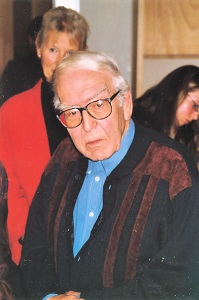
Willem Brakman (13 juni 1922 – 8 mei 2008)
In 2002
De Ierse dichter, toneelschrijver en mysticus William Butler Yeats werd geboren in Sandymount bij Dublin op 13 juni 1865. Zie ook alle tags voor William Butler Yeats op dit blog.
He Wishes For The Cloths Of Heaven
Had I the heavens' embroidered cloths,
Enwrought with golden and silver light,
The blue and the dim and the dark cloths
Of night and light and the half-light,
I would spread the cloths under your feet:
But I, being poor, have only my dreams;
I have spread my dreams under your feet;
Tread softly because you tread on my dreams.
Sailing To Byzantium
I
That is no country for old men. The young
In one another's arms, birds in the trees
---Those dying generations---at their song,
The salmon-falls, the mackerel-crowded seas,
Fish, flesh, or fowl commend all summer long
Whatever is begotten, born, and dies.
Caught in that sensual music all neglect
Monuments of unaging intellect.
II
An aged man is but a paltry thing,
A tattered coat upon a stick, unless
Soul clap its hands and sing, and louder sing
For every tatter in its mortal dress,
Nor is there singing school but studying
Monuments of its own magnificence;
And therefore I have sailed the seas and come
To the holy city of Byzantium.
III
O sages standing in God's holy fire
As in the gold mosaic of a wall,
Come from the holy fire, perne in a gyre,
And be the singing-masters of my soul.
Consume my heart away; sick with desire
And fastened to a dying animal
It knows not what it is; and gather me
Into the artifice of eternity.
IV
Once out of nature I shall never take
My bodily form from any natural thing,
But such a form as Grecian goldsmiths make
Of hammered gold and gold enamelling
To keep a drowsy Emperor awake;
Or set upon a golden bough to sing
To lords and ladies of Byzantium
Of what is past, or passing, or to come.
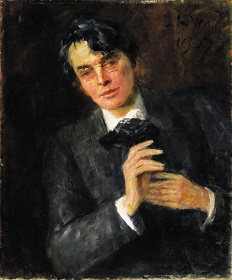
William Butler Yeats (13 juni 1865 – 28 januari 1939)
Portret door zijn vader John Butler Yeats, 1907
De Nederlandse schrijver Thomas Heerma van Voss werd geboren in Amsterdam op 13 juni 1990. Zie ook alle tags voor Thomas Heerma van Voss op dit blog.
Uit: Stern
“Zullen we beginnen?’
Zeker een minuut houdt Hugo Stern de bowlingbal nu vast. Hij kijkt om zich heen, naar Bram, naar de kinderen op de banen naast hem, naar de blonde vrouw achter de balie. Dan, zonder verder iets te zeggen, werpt hij de bal naar voren. Weinig kalmeert hem zoals deze beweging. Vooral op het moment dat zijn hand de bal net heeft losgelaten, voelt Stern zich onoverwinnelijk, even is alles precies in balans, overzichtelijk, zoals het hoort.
Pats. Drie kegels vallen om.
‘Papa…’
‘Wacht even.’ Stern wrijft in zijn handen, loopt naar het rek en pakt een nieuwe bal. Hij gooit zo hard als hij kan. Weer die ongrijpbare controle, maar nu niet gevolgd door een verlossende knal.
De bal belandt in de goot.
‘Papa…’
Stern voelt een hand op zijn rug. Bram is achter hem komen staan, hangende schouders, vermoeid gezicht. Stern bukt een beetje, om op gelijke hoogte te komen. ‘Wat is er?’
Terwijl hij het vraagt, kijkt hij Bram doordringend aan, recht in de donkerbruine ogen waarvan hij tevergeefs hoopt dat ze op die van hem lijken.
‘Ik wil niet.’
‘Wat?’
‘Ik wil niet bowlen. Zullen we gaan?’
‘Hè? We zijn net binnen. Jij hebt nog helemaal niet gegooid.’
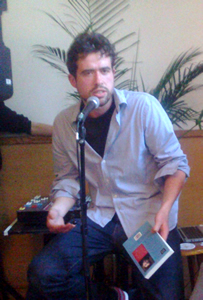
Thomas Heerma van Voss (Amsterdam, 13 juni 1990)
De Franse journaliste en schrijfster Tristane Banon werd geboren op 13 juni 1979 in Neuilly-sur-Seine. Zie ook alle tags voor Tristane Banon op dit blog.
Uit: “Erreurs avouées…”.
« Mais l'histoire ne commence pas là.
Je suis anxieuse. Arrivée à l'accueil de l'Assemblée nationale à 10 h 45; trois quarts d'heure plus tard, j'attends toujours.
Je refuse de me décourager. Tandis que je l'attends, je me pose encore de nombreuses questions: un élu du peuple a-t-il droit aux erreurs? Comment les analyse t-il? Lui qui fut mis en cause dans le cadre de l'instruction sur la MNEF et qui a égaré la cassette Méry.
On finit tout de même par m'inviter à monter: ascenseur de gauche, troisième étage, bureau 6847-6848.
Assis à son bureau, il m'attend. Plutôt chaleureux.
- Bonjour!
Il me fait entrer, marmonne quelques civilités et me fixe. Visiblement, si la langue n'est pas encore de bois, le regard est déjà de braise.
J'attaque: - Alors, monsieur DSK, pour vous, l'erreur, qu'est-ce que c'est?
Il réfléchit un instant puis, comme un automate, se met en route:
- L'erreur est générale et fréquente. Lorsqu'on dit qu'elle est humaine, cela peut avoir deux sens. Un sens banal: tout homme, toute femme, fait des erreurs... Un sens plus complexe: c'est l'erreur elle-même qui rend humain! Etre faillible prouve que nous ne sommes pas des machines. »
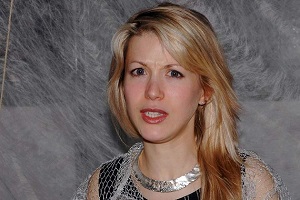
Tristane Banon (Neuilly-sur-Seine,13juni 1979)
De Engelse schrijfster, dichteres en vertaalster Dorothy Leigh Sayers werd geboren op 13 juni 1893 in Oxford. Zie ook alle tags voor Dorothy L. Sayers op dit blog.
Uit:Creed or Chaos?
“It it is worse than useless for Christians to talk about the importance of Christian morality, unless they are prepared to take their stand upon the fundamentals of Christian theology. It is a lie to say that dogma does not matter; it matters enormously. It is fatal to let people suppose that Christianity is only a mode of feeling; it is vitally necessary to insist that it is first and foremost a rational explanation of the universe. It is hopeless to offer Christianity as a vaguely idealistic aspiration of a simple and consoling kind; it is, on the contrary, a hard, tough, exacting, and complex doctrine, steeped in a drastic and incompromising realism. And it is fatal to imagine that everybody knows quite well what Christianity is and needs only a little encouragement to practice it. The brutal fact is that in this Christian country not one person in a hundred has the faintest notion what the Church teaches about God or man or society or the person of Jesus Christ.... ...Theologically this country is at present is in a state of utter chaos established in the name of religious toleration and rapidly degenerating into flight from reason and the death of hope.”
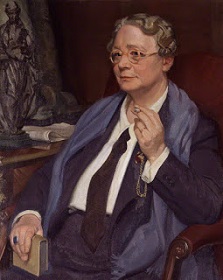
Dorothy L. Sayers (13 juni 1893 – 17 december 1957)
Portret door Sir William Oliphant Hutchison
De Britse schrijver en presentator Marcel Theroux werd geboren op 13 juni 1968 in Kampala, Oeganda. Zie ook alle tags voor Marcel Theroux op dit blog.
Uit: Strange Bodies
“Whatever this is, it started when Nicky Slopen came back from the dead.
The man who walked into my shop that day was solidly built, bearded, and had his head shaved almost to the scalp, but he knew my old nickname. He shuffled up to the counter and greeted me by it. “No one’s called me that for years,” I said.
“It has been years,” he said. “It’s me. Nicky.”
There was a rush of awkwardness as I flanneled to cover the fact I didn’t know him, and then a much more unpleasant sensation when he said his last name.
“I heard you were . . .” I couldn’t bring myself to say it. “Is this some kind of joke? Because I don’t appreciate it.”
“Calm down, Sukie, it’s really me,” he said.
For a moment I just didn’t believe him, but then he told me things that only he knew, things we’d said to each other, and gradually I saw that it was him. His eyes had a familiar intensity, and when he said my name, it had the same shape in his mouth that it had always had.
So of course I apologized: I was flummoxed, must have mixed him up with someone else. We had a laugh about it: reports of my death have been greatly exaggerated, that sort of thing. For over an hour all we did was chat about old times. Weekday mornings are so quiet in the shop that I generally use them for stocktaking and dealing with invoices”.
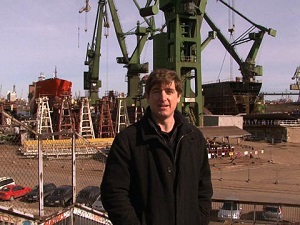
Marcel Theroux (Kampala, 13 juni 1968)
Zie voor nog meer schrijvers van de 13e juni ook mijn blog van 13 juni 2012 deel 1 en ook mijn blog van 13 juni 2012 deel 2 en bovendien mijn blog van 13 juni 2011 deel 2 en eveneens deel 3.


