Naar de inhoud

Romenu

Over literatuur, gedichten, kunst en cultuur
akke.beakke.be

Berichten van 13 januari 2016 tot 14 januari 2016

J. Bernlef, Chris de Stoop, Edward St Aubyn, Yukio Mishima, Anchee Min, Martin Auer, Isaäc da Costa
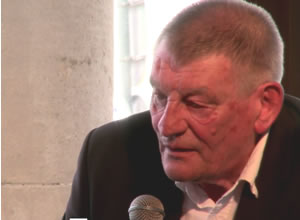
De Nederlandse schrijver en dichter J. Bernlef werd geboren op 14 januari 1937 in Sint Pancras. Zie ook alle tags voor J. Bernlef en alle tags voor Bernlef op dit blog.

Uit:Publiek geheim

“Clara schoof de papieren en boeken naar een hoek van de tafel, zodat er ruimte vrijkwam voor twee ontbijtborden en twee koppen koffie. ‘Hier.’ Ze gaf het stapeltje correspondentiekaarten aan Judith. ‘Daar staat alles op.’
‘Verhaal kuil. Dode Duitse soldaat. Vrouw met kar. Stilte in gevangenis. Koffiehuizen.’ Judith haalde haar schouders op. ‘Ik moet het materiaal eerst zien,’ zef ze.
Op het bed maakten ze twee stapeltjes. Links de perfotapes, rechts de losse filmstukken. Aan de hand van de nummering op de kaartjes zochten ze de corresponderende rolletjes bij elkaar. Judith legde de stroken op de montagetafel synchroon.
Twee uur lang keken ze naar de bevende beelden op het scherm. Clara had uit de keuken een tafeltje gehaald en het naast de montagetafel gezet. Daar lagen nu in drie keurige rijtjes de zwarte plastic rolletjes met de stukken film en perfotape. Drie rechte rijtjes. Plakkertjes met nummers erop. Zo zag het er heel ordelijk uit.
‘Wat vind je ervan?’
‘Hoe moet dat in godsnaam ooit een film worden,’ zei Judith.
‘Ik had gedacht...’ Clara's stem stokte. Ze had wel wat gedacht, maar nu ze haar gedachten moest formuleren kon ze er opeens geen woorden voor vinden. ‘Misschier moet het ook helemaal geen film worden.’
Judith las verstrooid in het stapeltje correspondentiekaartjes. ‘Een volgorde,’ mompelde ze. ‘Er moet toch een volgorde voor te bedenken zijn, een vorm.’
‘Ik bedoel dat we uit laten komen dat het maar fragmenten zijn, een soort gefilmde notities,’ zei Clara.
‘Maar dan nog,’ zei Judith. ‘Er ontbreekt gewoon te veel.’
‘Dit is wat we hebben. Tomas heeft wel gezegd dat hij nog wel dingen wil toelichten. Misschien dat we, als we een bandrecorder hebben, dat we hem dan nog dingen kunnen laten vertellen en die er dan gewoon met zwartbeeld tussen zetten.’


 1864205-9a0fa479c96ae85691febd6637b8b1aa.jpg
J. Bernlef (14 januari 1937 - 29 oktober 2012)


De Vlaamse schrijver en journalist Chris De Stoop werd geboren op 14 januari 1958 in Sint-Gillis-Waas. Zie ook alle tags voor Chris de Stoop op dit blog.

Uit: Dit is mijn hof

“Alle vee is nu van de wei en alleen de bulldozer blijft buiten achter in de regen, die gaandeweg overgaat in natte sneeuw. Binnen is het behaaglijk tussen de dampende koeienlijven. Maar we praten niet zoals vroeger met voldoening na over de hele operatie, we rakelen niet eindeloos op hoe hachelijk het wel was en hoe wild ze waren en hoeveel geluk we hadden dat we de beesten weer in de stal kregen, nee.
‘Het boeren is bijna afgelopen,’ zegt mijn broer voor de zoveelste keer, met op zijn gezicht een mengsel van schrik en wrok. ‘Ze willen ons weg.’
‘Nog lang niet,’ zeg ik.
We zwijgen en kijken de stal rond, waarin het verval stilaan merkbaar wordt in de kromme buizen en roestige drinkbakken. De koeien zijn al gaan liggen, dicht bij elkaar, met hun zware koppen op elkaars buik. Ze kijken met glanzende ogen naar ons terug. Hun adem is zichtbaar als wolken stoom. De jonge vaarzen zitten nog vol onrust. Soms kunnen ze het niet houden van de schurft en schuren ze zich tegen de muren. Soms krommen ze hun rug en steken ze hun staart omhoog om pletsend te pissen en te schijten. Het spat tot op ons gezicht.
‘Brave beesten,’ zeg ik verkrampt, om hem te paaien. ‘Een mooi, gesloten en gezond zoogkoeienbedrijf, wat wil een boer nog meer?’
‘Ze hebben de schijterij,’ zegt hij. ‘En de boerderij draait niet meer."


 1864205-20ef07a81213dc2e703bd01f07a5ace5.jpg
Chris De Stoop (Sint-Gillis-Waas, 14 januari 1958)


De Britse schrijver en journalist Edward St Aubyn werd geboren op 14 januari 1960 in Cornwall. Zie ook alle tags voor Edward St Aubyn op dit blog.

Uit: Never Mind

“The chateau, as Yvette called what the Melroses called an old farmhouse, was built on a slope so that the drive was level with the upper floor of the house. A wide flight of steps led down one side of the house to a terrace in front of the drawing room.
Another flight skirted the other side of the house down to a small chapel which was used to hide the dustbins. In winter, water gurgled down the slope through a series of pools, but the gutter which ran beside the fig tree was silent by this time of year, and clogged with squashed and broken figs that stained the ground where they had fallen.
Yvette walked into the high dark room and put down the laundry. She switched on the light and began to divide the towels from the sheets and the sheets from the tablecloths. There were ten tall cupboards piled high with neatly folded linen, none of it now used. Yvette sometimes opened these cupboards to admire this protected collection. Some of the tablecloths had laurel branches and bunches of grapes woven into them in a way that only showed when they were held at certain angles. She would run her finger over the monograms embroidered on the smooth white sheets, and over the coronets encircling the letter ‘V' in the corner of the napkins. Her favourite was the unicorn that stood over a ribbon of foreign words on some of the oldest sheets but these too were never used, and Mrs Melrose insisted that Yvette recycle the same poor pile of plain linen from the smaller cupboard by the door.

* * *
Eleanor Melrose stormed her way up the shallow steps from the kitchen to the drive. Had she walked more slowly, she might have tottered, stopped, and sat down in despair on the low wall that ran along the side of the steps. She felt defiantly sick in a way she dared not challenge with food and had already aggravated with a cigarette. She had brushed her teeth after vomiting but the bilious taste was still in her mouth. She had brushed her teeth before vomiting as well, never able to utterly crush the optimistic streak in her nature. The mornings had grown cooler since the beginning of September and the air already smelt of autumn, but this hardly mattered to Eleanor who was sweating through the thick layers of powder on her forehead. With each step she pushed her hands against her knees to help her forward, staring down through huge dark glasses at the white canvas shoes on her pale feet, her dark pink raw-silk trousers like hot peppers clinging to her legs.”


 1864205-bf5e5ee4f3705469661fa05bb99dcb85.jpg
Edward St Aubyn (Cornwall, 14 januari 1960)


De Japanse schrijver Yukio Mishima werd geboren op 14 januari 1925 in Tokyo. Zie ook ook alle tags voor Yukio Mishima op dit blog.

Uit: Thirst for Love

“When a captive lion steps out of his cage, he comes into a wider world than the lion who has known only the wilds. While he was in captivity, there were only two worlds for him - the world of the cage, and the world outside the cage. Now he is free. He roars. He attacks people. He eats them. Yet he is not satisfied, for there is no third world that is neither the world of the cage nor the world outside the cage.”
(…)

“No one’s words can compete with this mercilessly powerful rain. The only thing that can compete with the sound of this rain, that can smash this deathlike wall of sound, is the shout of a man who refuses to stoop to this chatter, the shout of a simple spirit that knows no words.”
(…)

“She drank like a drowning man helplessly swallowing sea water, in accordance with some law of nature. To ask for nothing means that one has lost one’s freedom to choose or reject. Once having decided that, one has no choice but to drink anything — even sea water….
Afterwards, however, Etsuko felt none of the nausea of a drowning person. Until the moment of her death, it seemed, no one would know she was drowning. She did not call out — she was a woman bound and gagged by her own hand.”


 1864205-f33b724aed28e152cfceb6aff84e9253.jpg
Yukio Mishima (14 januari 1925 - 25 november 1970)


De Chinese schrijfster Anchee Min werd geboren in Shanghai op 14 januari 1957. Zie ook alle tags voor Anchee Min op dit blog.

Uit: Becoming Madame Mao

« You are a historian, Nah. You should document my role in the revolution. I want you to demonstrate my sacrifices and contributions. Yes, you can do it. Forget about what your father will think about you. He is dead. I wonder what's happened to his ghost. I wonder if it rests in its grave. Watch out for his shadow.
The hands to strangle me are creeping up fast. I can feel them at my throat. That's why I am telling you this. I am not afraid of death if I know my spirit will live through the tip of your fountain pen to the lips of the people, generations to come. Tell the world the story of a heroine. If you can't print your manuscript in China, take it outside. Don't let me down. Please.
You are not a heroine, Mother! I hear my daughter fire back. You are a miserable, mad and sick woman. You can't stop spreading your disease. Like Father said, you have dug so many graves that you don't have enough bodies to lay in them!
Their dinner has turned cold. Nah stands up and kicks away her chair. Her elbow accidentally hits the table. A dish falls. Breaks. Pieces of ceramics scatter on the floor. Grease splatters on the mother's shoe. You have killed me, Nah. Madame Mao suddenly feels short of breath. Her hand grips the edge of the table to prevent herself from falling.
Pretend that you never had me, Mother.
You can't disown your mother!"


 1864205-9a1ebcb32e33dd573d988b4aa6108d74.jpg
Anchee Min (Shanghai, 14 januari 1957)


De Oostenrijkse dichter en schrijver, musicus en cabaretier Martin Auer werd geboren op 14 januari 1951 in Wenen. Zie ook alle tags voor Martin Auer op dit blog.

Uit:Manchmal hört es nie zu regnen auf

“Herr Balaban und seine kleine Tochter Selda kamen auf dem Bahnhof einer fremden Stadt an.
„Entschuldigen Sie bitte“, sprach Herr Balaban einen Mann an, „was halten Sie von der Ausländerfrage?“
„Oh“, sagte der Mann, „ich bin unseren ausländischen Mitbürgern sehr dankbar, dass sie uns die schweren Arbeiten abnehmen, die niemand sonst machen will.“
„Vielen Dank!“ sagte Herr Balaban, und wandte sich an einen anderen: „Verzeihen Sie, was halten denn Sie von der Ausländerfrage?“
Der Mann sagte: „Wissen Sie, ich finde, dass unsere ausländischen Mitbürger frische Farben in das Bild unserer Stadt bringen und unsere Kultur mit neuen Impulsen bereichern!“
„Danke schön“, sagte Herr Balaban und wandte sich an einen dritten Mann: „Was bitte, halten Sie von der Ausländerfrage?“
„Also wenn Sie mich fragen, mir wär’s lieber, wenn die alle zu Hause bleiben und uns in Ruhe lassen würden!“
„Oh“, strahlte Herr Balaban, „endlich ein ehrlicher Mensch. Würden Sie bitte einen Moment auf unsere Koffer aufpassen? Ich muss die Kleine da aufs Klo bringen!“


 1864205-424f74f1c35dfc06d85531085993e0ab.jpg
Martin Auer (Wenen, 14 januari 1951)


De Nederlandse dichter en schrijver Isaäc da Costa werd geboren in Amsterdam op 14 januari 1798. Zie ook alle tags voor Isaäc da Costa op dit blog.


Heimwee
Kennst du das Land?

Kent gij het land, waar hoog de ceder wies?
een adem Gods door ’t moerbeiboomdal blies?
van ’t eêlste bloed de bruine druifrots zwol?
de olijftak glom, van malse koornen vol?
Kent gij dat land? daarheen, daarheen,
o leidsman mijner vaadren! voer mijn schreên!

Kent gij de stad? Haar hoog en heerlijk huis
maalde, eeuwen door, bij palm- en lofgeruis,
met offerbloed, in ’t heiligdom gebracht,
de Redder af, door eigen volk geslacht.
Verstrooide schaar, daarheen, daarheen!
de Rijkstad ligt niet voor altoos vertreên.

Kent gij het volk? Zijn doden leven weer,
Zijn stammen gaan weer opwaart, God ter eer.
Zijn oog aanschouwt wiens hart zijn misdrijf brak.
Vergeving stroomt uit d’ ader, die ’t doorstak.
Daarheen, o aard, de blik! daarheen
Uw heil vangt aan bij ’t einde zijner weên!


 1864205-4db515396628f5a03ca37f822b628290.jpg
Isaäc da Costa (14 januari 1798 – 28 april 1860)


Zie voor nog meer schrijvers van de 14e januari ook mijn blog van 14 januari 2011 deel 2 en eveneens deel 3


Geschreven door Romenu om 18:39 Reageer op dit bericht

Andreas Steinhöfel

De Duitse schrijver en vertaler Andreas Steinhöfel werd geboren op 14 januari 1962 in Battenberg. Steinhöfel groeide met twee broers op in de Hessische stad Biedenkopf en volgde daar een gymnasiumopleiding. Hij begon vervolgens aan de studie biologie en Engels om leraar te worden, maar stapte na een lange stage over op Engels, Amerikaans en media studies aan de universiteit van Marburg. Hij maakte vijf jaar deel uit van de Engelse drama groep van de faculteit Engels. Na zijn afstuderen verscheen in 1991 zijn eerste (jeugd-)boek “Dirk und ich”. Als winnaar van de Alice Salomon Poëzieprijs in 2013 had hij een daaraan verbonden leeropdracht van de Berlijnse Alice Salomon Fachhochschule. Als “Poet in Residence“ hield hij in het wintersemester 2014/2015 aan de Universiteit van Bielefeld een serie lezingen. Tot zijn bekendste boeken behoort “Paul Vier und die Schröders” (1992), dat is uitgegroeid tot standaardlectuur aan Duitse scholen. De verfilming van het boek won in 1995 de Duitse kinderfilmprijs. Bij adolescenten is vooral zijn roman “Die Mitte der Welt” populair, die onder meer voor de Duitse Jeugdliteratuur Prijs genomineerd werd, evenals het quasi-vervolg “Defender – Geschichten aus der Mitte der Welt”. Onder zijn vertalingen bevinden zich naast boeken van Jerry Spinelli, Roddy Doyle, Lois Lowry, Paul Shipton en Kate Walker ook vertalingen van de twee bekendste werken van Susan E. Hinton, “The Outsiders” en “Rumble Fish”. Als scenarist schreef Andreas Steinhöfel o.a. 40 afleveringen van de Käpt’n Blaubär Club (1993-1994 voor WDR / ARD) en 5 afleveringen van de kinderen serie Urmel aus dem Eis (1994 WDR / ARD), In 2009 kreeg hij voor zijn boek “Rico, Oskar und die Tieferschatten” de Duitse Jeugd Literatuur Prijs in de categorie kinderboeken. De gelijknamige film kwam in juli 2014 in de Duitse bioscopen. Andreas Steinhöfel was tot aan diens dood in 2009 de levensgezel van de bekende Berlijnse DJ Gianni Vitiello.

Uit: Die Mitte der Welt

„Ich liege matt auf meinem Bett, als das Telefon klingelt. Die Julihitze hat mich erschlagen, sie kriecht selbst bei Nacht durch die Zimmer und Flure wie ein müdes Tier, das nach einem Schlafplatz sucht. Ich weiß, wer der Anrufer ist, weiß es seit drei Wochen. Kat - eigentlich Katja, aber bis auf ihre Eltern und einige Lehrer gibt es niemanden, der sie bei ihrem vollen Namen nennt - ist aus dem Urlaub zurück. "Ich bin wieder da, Phil!", schreit sie am anderen Ende der Leitung. "Unüberhörbar. Wie war's?" "Ein Albtraum, und hör auf zu grinsen, ich weiß, dass du das gerade tust! Ich bin total elterngeschädigt, und die Insel war ein verdammtes Dreckloch, du kannst es dir nicht vorstellen! Ich will dich sehen." Ich blicke auf die Uhr. "In einer halben Stunde auf dem Schlossberg?" "Ich wäre gestorben, wenn du keine Zeit hättest." "Willkommen im Club. Ich hab mich in den letzten drei Wochen fast zu Tode gelangweilt." "Hör zu, ich brauche länger, ungefähr eine Stunde? Ich muss noch auspacken." "Kein Problem." "Ich freu mich auf dich ... Phil?" "Hm?" "Ich hab dich vermisst." "Ich dich nicht." "Dachte ich mir. Arschloch!" Ich lege den Hörer auf, bleibe auf dem Rücken liegen und blinzele eine Viertelstunde lang das blendende Weiß der Zimmerdecke an. Zypressenduft wird vom Sommerwind in Wellen durch die geöffneten Fenster getrieben. Dann wälze ich mich aus dem verschwitzten Bett, greife nach Boxershorts und T-Shirt und tapse auf knarrenden Dielen durch den Flur in Richtung Dusche. Ich hasse das Badezimmer auf dieser Etage. Der Rahmen der Tür ist verzogen, man muss sein ganzes Gewicht dagegen stemmen, um sie zu öffnen. Dahinter wird man von zersprungenen schwarzen und weißen Kacheln, von Rissen in der Decke und rieselndem Putz begrüßt. Das veraltete Leitungssystem benötigt drei Minuten, bis es endlich Wasser liefert; im Winter ist der daran angeschlossene rostige Boiler nur durch heftige Fußtritte dazu zu bringen, sich entnervend langsam aufzuheizen. Ich drehe den Wasserhahn auf, lausche dem vertrauten asthmatischen Pfeifen der Leitung und bedauere nicht zum ersten Mal, dass Glass sich nie mit einem Klempner eingelassen hat. "Wegen der Rohrleitungen?", hat sie erstaunt gefragt, als ich sie irgendwann auf die praktischen Möglichkeiten einer solchen Liaison angesprochen habe. "Wofür hältst du mich, Darling - für eine Nutte?“


 1976082-0c331526cf7e952160211c1018be3874.JPG
Andreas Steinhöfel (Battenberg, 14 januari 1962)

Geschreven door Romenu om 00:00 Reageer op dit bericht

Edmund White, Daniel Kehlmann, Jay McInerney, Lorrie Moore, Jan de Bas, Edgardo Cozarinsky, Mohammad- Ali Jamālzādeh, Clark Ashton Smith

De Amerikaanse schrijver en essayist Edmund White werd geboren op 13 januari 1940 in Cincinnati. Zie ook alle tags voor Edmund White op dit blog.

Uit: The Farewell Symphony

“I'd been afraid I wouldn't feel anything when Brice finally died-but my body did all the feeling for me. It took over. My knees buckled, I lost my balance, tears spurted from my eyes. I staggered in the sunlight and nearly fell and had to be held up by Laurent and his lover.
Everything I'd lived through in the last five years had changed me-whitened my hair, made me a fat, sleepy old man, matured me, finally, but also emptied me out. I met Brice five years before he died-but I wonder whether I'll have the courage to tell his story in this book. The French call a love affair a "story," une histoire, and I see getting to it, putting it down, exploring it, narrating it as a challenge I may well fail. If I do fail, don't blame me. Understand that even writers, those professional exhibitionists, have their moments of reticence.
Strange that I should be living here, in Paris. Ever since I'd been a child, an imaginary Paris had been the bright planet pulsing at the heart of my mental star map, but the one time I'd gone to Paris I had been dressed in a horrible shiny blazer and everyone in the cafés had laughed at me. I said to a French acquaintance as we left the Flore, "I know I'm being paranoid," but he said matter-of-factly, "No, they are laughing at you."
A sign in the tailor shop window off the Boulevard St.-Germain warned that customers would not be allowed more than three fittings after the purchase of a suit and my mind winced at this proof of shameless male vanity, so exotic to an American since Americans equated male vanity with effeminacy or Mafia creepiness. The year was 1968 and stylish young American men back home were wearing fringe and puffy-sleeved pirate shirts, headbands, mirrored vests and winklepicker boots, but the materials were synthetic, the colors garish, the fit very approximate and the mood one of dressing up. Orange and black were popular colors. The long Mardi Gras of that decade in the States was a mockery of traditional good taste, a send-up of adult propriety, the recklessness of a generation that would never settle down long enough to study the fine gradations with which quality, and especially beauty, begin. And if the mood was festive, the festivity seemed more a gesture defying parental drabness than an assertion of a new-born hedonism. A true search for pleasure is an exacting science and is born from a profound interest in raglan versus fitted sleeves and in the precise arc a weighted hem on the bias will describe."


 1863750-2b5f3aec2217508566bc1f74e0408e1a.jpg
Edmund White (Cincinnati, 13 januari 1940)
Hier met partner Michael Carroll (links)


De Duitse schrijver Daniel Kehlmann werd op 13 januari 1975 in München geboren. Zie ook alle tags voor Daniel Kehlmann op dit blog.

Uit:Ruhm

„Aber diese Nummer gehört jemand anderem!“
Unmöglich, antwortete sie. Da gebe es – „Sicherungen, ich weiß! Aber ich bekomme ständig Anrufe für ... Wissen Sie, ich bin Techniker. Ich weiß, daß sich bei Ihnen dauernd Leute melden, die von nichts eine Ahnung haben. Aber ich bin vom Fach. Ich weiß, wie man -“
Sie könne gar nichts tun, sagte sie. Sie werde sein Anliegen weiterleiten.
„Und dann? Was passiert dann?“
Dann, sagte sie, werde man weitersehen. Aber dafür sei sie nicht zuständig.
An diesem Vormittag konnte er sich nicht auf die Arbeit konzentrieren. Seine Hände waren zittrig, und in der Mittagspause hatte er keinen Hunger, obwohl es Wiener Schnitzel gab. Die Kantine hatte nicht oft Wiener Schnitzel, und normalerweise freute er sich schon am Tag vorher darauf. Diesmal jedoch stellte er sein Tablett mit dem halbvollen Teller in die Stellage zurück, ging in eine stille Ecke des Eßsaals und schaltete sein Telefon ein.
Drei Nachrichten. Seine Tochter, die vom Ballettuntericht abgeholt werden wollte. Das überraschte ihn, er hatte gar nicht gewußt, daß sie tanzte. Ein Mann, der um Rückruf bat. Nichts an seiner Nachricht verriet, wem sie galt: ihm oder dem anderen. Und dann eine Frau, die ihn fragte, warum er sich so rar machte. Ihre Stimme, tief und schnurrend, hatte er noch nie gehört. Gerade als er ausschalten wollte, läutete es wieder.
Die Nummer auf dem Bildschirm begann mit einem Pluszeichen und einer zweiundzwanzig. Ebling wußte nicht, welches Land das war. Er kannte fast niemanden im Ausland, nur seinen Cousin in Schweden und eine dicke alte Frau in Minneapolis, die jedes Jahr zu Weihnachten ein Foto schickte, auf dem sie grinsend ihr Glas hob. Auf die lieben Eblings stand auf der Rückseite, und weder er noch Elke wußte, wer von ihnen eigentlich mit ihr verwandt war. Er hob ab.“


1863750-17c2d79faf7acb52f62324cd01bd334b.jpg
Daniel Kehlmann (München, 13 januari 1975)


De Amerikaanse schrijver Jay McInerney werd geboren op 13 januari 1955 in Hartford, Connecticut. Zie ook alle tags voor Jay McInerney op dit blog.

Uit: The Good Life

“Corrine had become a connoisseur of guilt; not for her the stabbing thrust of regret for an ill-conceived act—but, rather, the dull and steady throb of chronic guilt, even as she'd done her best to rearrange her life around her kids, quitting her job to take care of them and, over the past two years, working highly flexible hours on a screenplay and on a project that was the obverse of a busman's holiday—a start-up venture called Momtomtom.com, which had been on the verge of a big launch this past spring, when the Internet bubble started to deflate and the venture capital dried up. This afternoon, she'd spent four hours making a presentation to a possible backer, hustling for seed money for the Web site. As these prospects dimmed, she'd been trying to set up meetings on the screenplay, an adaptation of Graham Greene's The Heart of the Matter. And here were the theoretical bookends of her existence, the maternal and the romantic—the latter submerged and almost extinct. In fact, that had been her secret intention in writing this script: to try to rekindle the romance and fan it back to life.
Corrine hadn't wanted to be one of those mothers who paid someone else to raise her kids; for the first five years, to the astonishment of her friends and former colleagues, she'd stayed at home.
Manhattan was an existential town, in which identity was a function of professional accomplishment; only the very young and the very rich were permitted to be idle. The latter, like her friend Casey Reynes, had their charities and their personal assistants and inevitably managed to convey the impression that all this constituted an exhausting grind. Russell had initially supported her maternal ideal, though, as the years went by and their peers bought vacation homes in the Hamptons, he couldn't consistently disguise his resentment over their straitened finances, or his sense that his stay-at-home wife had become translucent, if not invisible, within the walls of their loft—a nanny without salary.“


 1863750-cade24207a0dd352bfdd4f587cf891ea.jpg
Jay McInerney (Hartford, 13 januari 1955)


De Amerikaanse schrijfster Lorrie Moore werd geboren op 13 januari 1957 in Glens Falls, New York. Zie ook alle tags voor Lorrie Moore op dit blog.

Uit: Who Will Run the Frog Hospital

“We sit beside people who show us wallet pictures of their children. "Sont-ils si mignons!" I say. My husband constructs remarks in his own patois. We, us, have no little ones. He doesn't know French. But he studied Spanish once, and now, with a sad robustness, speaks of our childlessness to the couple next to us. "But," he adds, thinking fondly of our cat, "we do have a large gato at home."
"Gâteau means 'cake,' I whisper. "You've just told them we have a large cake at home." I don't know why he always strikes up conversations with the people next to us. But he strikes them up, thinking it friendly and polite rather than oafish and irritating, which is what I think.
Afterward we always go to the same chocolatier for whiskey truffles. One feels the captured storm in these, a warm storm under the tongue.
"What aggrandizement are we in again?" my husband asks.
"What 'aggrandizement'?" I say. "I don't know, but I think we're in one of the biggies." My husband pronounces tirez as if it were Spanish, père as if it were pier. The affectionate farce I make of him ignores the ways I feel his lack of love for me. But we are managing. We touch each other's sleeves. We say, "Look at that!," wanting our eyes to merge, our minds to be one. We are in Paris, with its impeccable marzipan and light, its whiffs of sewage and police state. With my sore hip and his fallen arches ("fallen archness," Daniel calls it), we walk the quais, stand on all the bridges in the misty rain, and look out on this pretty place, secretly imagining being married to other people—right here in River City!—and sometimes not, sometimes simply wondering, silently or aloud, what will become of the world.”


 1863750-8a52eaf3734ad04f3a27a9586f4f8139.JPG
Lorrie Moore (Glens Falls, 13 januari 1957)


De Nederlandse historicus en dichter Jan de Bas werd geboren op 13 januari 1964 in Waddinxveen. Zie ook alle tags voor Jan de Bas op dit blog.


God

Hoeveel pogingen ondernamen ze:
wetenschappers, filosofen, dichters,
theologen, politici, zoekers naar een
Hooiberg in een speld?

Het licht, de zon, de natuur, het gelaat
van de ander, het allerdiepste ik in
de gedachten. Er werd gevonden:
een Speld in een hooiberg.

Vragen, onzekerheden, angsten,
twijfels, irritaties, verdachtmakingen
en bewonderingen bleven bestaan:
wat is de hooiberg en wat is de speld?


Langs de rand van het gedicht

Kleine egel, bol van angst,
schuifelt heel voorzichtig langs.
Zijn bestaan is marginaal.

Maar zijn stekels die ik zie,
prikkelden tot poëzie.
Metaforen, maar voor wie?


 1863751-a3fbfa203ecd2b110a2864753a155d3b.jpg
Jan de Bas (Waddinxveen, 13 januari 1964)


De Argentijnse schrijver en regisseur Edgardo Cozarinsky werd geboren 13 januari 1939 in Buenos Aires. Zie ook alle tags voor Edgardo Cozarinsky op dit blog.

Uit:Letters From Buenos Aires

« Tuesday 10th

The current crop of young directors approach the cinema with a strength and desire unknown to most of their elders. I can sense this in their work—films neither the industry nor the public demanded, and which exist only because of the determination of their makers. Once they are made, however, their necessity becomes fully apparent. This is most likely not the result of some new development, since the history of the cinema, no less than History itself, consists of what Vico referred to as ‘corsi e ricorsi’. And yet how to describe, if not with the word ‘new’, certain images and forms of behaviour that evoke a whole country and its people as if they were being filmed for the first time?
When I saw Lucrecia Martel’s La ciénaga (The Swamp, 2001) in Paris, I was struck, not by the dysfunction of the provincial bourgeois family, but by the skill with which this first-time director choreographed the movements of the various characters within her frame; and by the film’s setting—a country house or holiday home, where the beds are never made, where children come and go from the swimming pool without wiping their feet. Then there is the delicate evocation of the pains of adolescent love, experienced above all in what is left unsaid, a transgression to which we cannot yet put a name. Filming 1,200 miles north of Buenos Aires in Salta province, Martel did not choose the picturesque scenery to the west—mountains, crystalline rocks eroded to fantastical forms—but opted instead for the low jungle and muggy atmosphere of the east. (Hence the frequent talk in the dialogue, so exotic to porteño ears, of going shopping in Bolivia, ‘where it’s better value for money’).”


 1863750-853d1cdc5d0914398f3f5696121ab82f.jpg
Edgardo Cozarinsky (Buenos Aires, 13 januari 1939)


De Iraanse schrijver Mohammad- Ali Jamālzādeh Esfahani werd geboren op 13 januari 1892 in Isfahan. Zie ook alle tags voor Mohammad- Ali Jamālzādeh op dit blog.

Uit: Persian Is Sugar (Vertaald door Heshmat Moayyad en Paul Sprachman)

“The attendants locked the door from the outside and left me to my fate.
Earlier, as I was leaving the ship, going ashore on the tender, I had learned from bits and pieces of people’s conversations with the boatmen, that the shah and the Assembly were at loggerheads once more and that a new wave of arrests and imprisonment had begun.* The capital had decreed that travelers were to receive special scrutiny.
Clearly, this was what was behind the arrests-especially when you consider that a supernumerary had arrived that morning from Rasht expressly for this purpose. In order to display his utility, his talent, and his expertise, he was making good and bad suffer alike and turning on the defenseless like a mad dog. In the meantime, he had even displaced the hapless provincial governor and was paving the way for his own administration of Enzeli: reports of his services had been keeping the telegraph lines between Enzeli and Tehran busy every minute since morning.
I was so dismayed at first that I could barely see, but, as I gradually got used to the darkness, I sensed that I wasn’t the only guest in the cell. I first noticed one of those notorious “Western-oriented gentlemen” who will serve as monuments to coddling, idiocy, and illiteracy in Iran until the Resurrection, and who will surely keep audiences rolling in the aisles oflocal theaters (I hope the devil’s not listening) for another century. My \lVogT companion was perched in an arched alcove wearing a collar as tall as a samovar chimney and, from the black smoke of some Caucasus diesel train, as sooty. Pinched by the collar, which propped up his neck like a pillory, he was immersed in a French novel, reading in the light and shadow of the cell.”


 1863750-7de03c9571b11bf261dd2e0bd20bbc17.jpg
Mohammad- Ali Jamālzādeh (13 januari 1892 - 8 november 1997)


De Amerikaanse dichter, schrijver en beeldhouwer Clark Ashton Smith werd geboren in Long Valley (Californië) op 13 januari 1893. Zie ook alle tags voor Clark Ashton Smith op dit blog.


Future Pastoral

Dearest, today I found
A lonely spot, such as we two have loved,
Where two might lie upon Favonian ground
Peering to faint horizons far-removed:

A green and gentle fell
That steepens to a rugged canyon's rim,
Where voices of vague waters fall and swell
And pines far down in sky-blue dimness swim.

Toward the sunset lands,
A leafless tree, from tender slopes of spring,
Holds out its empty boughs like empty hands
That vainly seek some distance-hidden thing.

Strange, that my wandering feet,
In all the years, had never known this place,
Where beauty, with a glamor wild and sweet,
Awaits the final witchcraft of your face.

Upon this secret hill
I gave my dark bereavement to the sun,
My sorrow to the flowing air . . . until
Your tresses and the grass were somehow one,

And in my prescient dream I seemed to find
An unborn joy, a future memory
Of you, and love, and sunlight and the wind
On the same grass, beneath the selfsame tree.


 1863750-c3afa5a23b83a919a8edda3cbf6ec5e8.jpg
Clark Ashton Smith (13 januari 1893 – 14 augustus 1961)


Zie voor nog meer schrijvers van de 13e januari ook mijn blog van 13 januari 2014 en ook mijn blog van 13 januari 2013 deel 2.


Geschreven door Romenu om 18:41 Reageer op dit bericht

Michael Carroll

Onafhankelijk van geboortedata

De Amerikaanse schrijver Michael Carroll werd geboren in 1965 en groeide op in een wijk van Fort Caroline (nu Jacksonville), Florida. Hij verliet Jacksonville in de vroege jaren '90 om twee jaar te dienen bij het Peace Corps, eerst in Jemen, toen in de Tsjechische Republiek. Daarna verbleef hij weer een jaar in Jacksonville voordat hij naar Parijs trok om met de schrijver Edmund White, die hij zes maanden eerder op een reis had ontmoet te gaan samen wonen. Een paar jaar later verhuisden ze naar Princeton, New Jersey, daarna naar New York. Nadat ze vanaf 1995 partners waren geweest trouwde het stel in 20013. Carroll debuteerde met de verhalenbundel “Little Reef and Other Stories” in 2014. De bundel werd genomineerd voor de shortlist voor de Lambda Literary Award for Gay Fiction. Zijn korte verhalen zijn ook verschenen in Ontario Review, Boulevard en The New Penguin Book of Gay Short Stories.

Uit: After Memphis (Little Reef and Other Stories)

““My brother Jeff called. I’m not even sure why I answered, seeing on the landline’s display who it was, or at least recognizing the area code and the prefix of the number, though of course I was expecting him to call any day, any week, since I had heard from our mother that he’d broken up with his new girlfriend, after getting cold feet about divorcing his wife Deanne. I had not met the new girlfriend, Terri, now the new ex-girlfriend. Jeff still had a touch of the guilt, I could hear in his voice, but I could also discern a gratifying exasperation with Deanne. She had taken thirty hard years out of Jeff, bankrupted him, and was now daring him to follow through by hiring a second, more aggressive lawyer-whose services he was paying for. To top it off, the case was complicated by the fact that before he could finally be cut loose, my brother first had to settle up with the banks. I didn’t know much else except that he wasn’t expected to pay every cent of debt she’d rung up on the credit cards, just a big chunk of it. No doubt, Deanne’s pride had been hurt, because after all she was the one being left. Oh yes, Jeff said, Deanne was now officially pissed.
“But after the hundred and ten thousand,” he said, “how the fuck could she question it?”
That was new, the f-word. I hadn’t heard that or any other cussing out of Jeff ’5 mouth in thirty years. Of course I sympathized, but I couldn’t let on too strongly, not yet. I’d been highly supportive of their union then the shotgun wedding when we were in high school. But Deanne, really, over time she’d taken the cake. She’d raised and homeschooled three kids, but when you don’t work and your husband’s a firefighter, you really had to rein in the indulgences, and she had been quite indulgent, denying those kids nothing in the way of clothes and gadgets and meals out at Wagon Wheel and TGI Friday’s. I was finishing the cold coffee left in my Grumpy mug from Disneyland Paris and feeling seized upon and getting low on blood sugar as he dived right into all this and told me something none of us had ever known: that he’d always put Deanne in charge of the monthly bill paying. He was still getting to the bottom of how many cards were involved.
“But this,” he said, “I take partial, no, the lion’s share of responsibility for. I was an idiot, so I guess that’s what I get for my willful ignorance. Having to work three jobs to get untangled from responsibilities I take very seriously. I’ll be under the fucking water for a long-ass time.”


 1864212-ffe5ce68400f3ee56557210c628c0c24.jpg
Michael Carroll (Fort Caroline, 1965)

Geschreven door Romenu om 00:00 Reageer op dit bericht

Meer van Romenu

↑ Terug naar de berichten