Naar de inhoud

Romenu

Over literatuur, gedichten, kunst en cultuur
akke.beakke.be

Berichten van 12 oktober 2016 tot 13 oktober 2016

Colin Channer, Herman Franke, Sebastian Fitzek, Richard Howard, Migjeni, Arna Wendell Bontemps, Conrad Richter, Edwina Currie, Frank Witzel
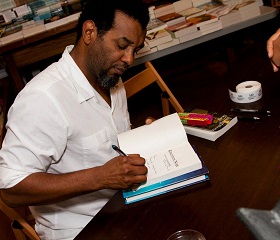
De Jamaicaanse schrijver Colin Channer werd geboren op 13 oktober 1963 in Kingston. Zie ook mijn blog van 13 oktober 2010 en eveneens alle tags voor Colin Channer op dit blog.

Uit: The Girl with the Golden Shoes

“So while the others ran, she hid behind the almond tree and watched in fearful fascination as the creature loomed.
It wasn’t until the mask had been removed that Estrella, who’d never been to school or traveled much on her tiny island, understood that what she thought had been a monster was a human being—a scuba diver in a rubber suit.
She stepped out from behind the tree and walked toward him in her old blue frock with eyelet lace around the hem, hips moving widely underneath the faded fabric, giving insight to the marvel of her shape. She was tall and big-boned with mannish shoulders and a long face with sharp cheeks. Her eyes were bright and slanted, and although her skin was darker than a Coke, she had a length of wavy hair.
“What are you wearing?” she asked in English, which she rarely had the need to use, since everyone around her spoke Sancoche.
“It lets me breathe beneath the water.”
They talked for several minutes, during which he explained some of his duties; then he disappeared below the surf.
In Sancoche, her native dialect, Estrella kept repeating as the ripples disappeared, “I never even thought to dream of seeing a thing like that.”


 1965630-27fc32b37f965c121fea8f1ac0c75260.jpg
Colin Channer (Kingston, 13 oktober 1963)


De Nederlandse schrijver Herman Franke werd geboren op 13 oktober 1948 in Groningen. Zie ook mijn blog van 13 oktober 2010 en eveneens alle tags voor Herman Franke op dit blog.

Uit: De ziel van Nederland

“Dat was anders toen ik die openingszin van mijn eerste roman schreef. Ik deed onderzoek en gaf les aan de universiteit. Ik had wetenschappelijke artikelen en boeken geschreven, onder meer over de doodstraf, die later in dit verhaal nog ter sprake zal komen. In de lente van dat jaar was ik – met hooggeleerde oppositie en ‘hora est’ en al – als sociologisch geschoold criminoloog gepromoveerd op Twee eeuwen gevangen, een bijna duizend bladzijden dik proefschrift over de geschiedenis van de gevangenisstraf vanaf het einde van de achttiende eeuw. Ik wist bij het tikken van die openingszin dus goed wat wetenschappelijk betogen is. En ik besefte tot in mijn vingertoppen dat Nisbet ongelijk had met zijn gelijkschakeling van kunst en wetenschap. Mijn gezicht paste zich aan bij dit besef. Ik kreeg een januskop.
Dat proefschrift van mij wemelt van de noten, 2129 welgeteld, en de bibliografie telt honderden titels. Ik wist dus ook wat het is om echt research te doen. Ik had me voor dat proefschrift zelfs, als een echte schrijver, zal ik maar zeggen, een nacht laten opsluiten in een negentiende-eeuwse cel van drie bij vier meter. Maar qua wetenschappelijk onderzoek stelde dat niets voor, zoals ook mijn research in Berlijn ten tijde van de Wiedervereinigung in 1989 wetenschappelijk geen waarde had, maar mijn eerste roman had ik zonder dat verblijf niet kunnen schrijven. Alles wat ik zag, las en hoorde, filterde ik door de zeef van een verhaal dat ik hoopte te kunnen vertellen. Dat mag als je schrijver bent, maar wetenschappers die met zo’n vooringenomen houding hun onderzoek verrichten deugen niet, wat beslist niet wil zeggen dat ze niet bestaan.
Tussen wetenschappelijk onderzoek en schrijversresearch zit een wereld van verschil. Wetenschappelijke onderzoekers willen weten welke antwoorden de waarneembare werkelijkheid geeft op vragen die zij gesteld hebben. Zij willen verzinsels scheiden van de objectieve werkelijkheid, wat zelden lukt, maar het gaat om de intentie. Als zij schrijven, willen ze hun lezers op basis van hun onderzoek met hun redeneringen overtuigen van de juistheid van hun kennis. Zij zijn uit op bewijzen. Kortom: zij betogen, ook als hun betoog in feite vol fictie zit.”


 1965630-3754d556d77584ba192d275672d42ee3.jpg
Herman Franke (13 oktober 1946 – 14 augustus 2010)


De Duitse schrijver en journalist Sebastian David Fitzek werd geboren op 13 oktober 1971 in Berlijn. Zie ook alle tags voor Sebastian Fitzek op dit blog.

Uit: Das Paket

„Als Emma die Tür zum Schlafzimmer ihrer Eltern öffnete, ahnte sie nicht, dass sie dies zum letzten Mal tun würde. Nie wieder würde sie sich, mit einem Stoffelefanten bewaffnet, nachts um halb eins an ihre Mutter kuscheln, vorsichtig bemüht, Papa beim Ins-Bett-Krabbeln nicht aufzuwecken, der im Traum mit den Füßen strampelte, zusammenhanglose Worte murmelte oder mit den Zähnen knirschte.
Heute strampelte, murmelte oder knirschte er nicht. Heute wimmerte er nur.
»Papa?«
Emma tapste von der Dunkelheit des Flurs ins Schlafzimmer. Das Licht des Vollmonds, der über Berlin in diesen Frühlingsnächten wie eine Mitternachtssonne thronte, fiel mit einem quecksilbrigen Schimmer durch die zugezogenen Gardinen.
Mit zusammengekniffenen Augen, über denen Emmas Pony wie ein kastanienbrauner Vorhang hing, konnte sie die Umgebung erahnen: die Rattantruhe am Fußende, die gläsernen Nachttische, die das ausladende Bett flankierten, den Schrank mit den Schiebetüren, in dem sie sich früher manchmal versteckt hatte.
Bis Arthur in ihr Leben trat und ihr das Versteckspielen verleidete.
»Papa?«, flüsterte Emma und tastete nach dem nackten Fuß ihres Vaters, der unter der Bettdecke hervorstach.
Sie selbst trug nur eine einzelne Socke, und auch die hing ihr kaum noch an den Zehen. Die andere hatte sie im Schlaf verloren, irgendwo auf dem Weg vom Einhorn-Glitzerschloss zum Tal der silbergrauen Flugspinne, die ihr im Traum manchmal Angst einjagte.
Aber nicht so viel Angst, wie ich sie vor Arthur habe.
Obwohl der ihr immer wieder versicherte, er wäre nicht böse. Aber konnte sie ihm vertrauen?"


 1965630-8e1fa02d048d5fbe65f9ef2f9852bcaf.jpg
Sebastian Fitzek (Berlijn, 13 oktober 1971)


De Amerikaanse dichter, literair criticus, essayist en vertaler Richard Joseph Howard werd geboren op 13 oktober 1929 in Cleveland, Ohio. Zie ook alle tags voor Richard Howard op dit blog.


Another Translator

The first one just happened to be there, a little like
Everest or the General’s nose
(remarkable eminences, both)
and also happened to be me, a daunted witness
of that weird Parisian ritual of the Sixties,
a de Gaulle press conference, summoned
since I was in Paris at the time
and had been his (or one of his) paraphrasts of prose
concerned with what the General preferred to call (un-
translatably) la chose allemande.

The occasion was particularly rare because
Mme de Gaulle was at his side and
(even rarer) willing to answer
questions, provided of course such inquiries observed
the mandates of Presidential privacy. Of course.
But after several anodine
approximations ofpolitesse
on the part of the Fourth Estate, a Herald- Tribune
reporter brought proceedings to a heart-stopping halt:
“What do you regard, Mme de Gaulle,

as the chief significance of life?” And with a sad smile,
after a moment, Yvonne de Gaulle
(whose life had after all included
the death of a soldier son in that same German Thing)
flabbergastcd us all by speaking three syllables:
“A penis.” And with an interval
of no more than five seconds, a hand
(with perhaps military promptitude) descended
on her shoulder: “I believe the English word you mean,
ma chén'e, is pronounced “Hap-pi-ness.”


 1965630-0a7a57ba902363299fe8132149c7bc05.jpg
Richard Howard (Cleveland, 13 oktober 1929)


De Albanese dichter Migjeni (eigen. Millosh Gjergj Nikolla) werd geboren op 13 oktober 1911 in Shkodra. Zie ook mijn blog van 13 oktober 2010 en eveneens alle tags voor Migjeni op dit blog.


Poem Of Poverty (Fragment)

Poverty, brothers, is a mouthful that's hard to swallow,
A bite that sticks in your throat and leaves you in sorrow,
When you watch the pale faces and rheumy eyes
Observing you like ghosts and holding out thin hands;
Behind you they lie, stretched out
Their whole lives through, until the moment of death.
Above them in the air, as if in disdain,
Crosses and stony minarets pierce the sky,
Prophets and saints in many colours radiate splendour.
And poverty feels betrayed.

Poverty carries its own vile imprint,
It is hideous, repulsive, disgusting.
The brow that bears it, the eyes that express it,
The lips that try in vain to hide it
Are the offspring of ignorance, the victims of disdain,
The filthy scraps flung from the table
At which for centuries
Some pitiless, insatiable dog has fed.
Poverty has no good fortune, only rags,
The tattered banners of a hope
Shattered by broken promises.

Poverty wallows in debauchery.
In dark corners, together with dogs, rats, cats,
On mouldy, stinking, filthy mattresses,
Naked breasts exposed, sallow dirty bodies,
With feelings overwhelmed by bestial desire,
They bite, devour, suck, kiss the sullied lips,
And in unbridled lust the thirst is quenched,
The craving stilled, and self-consciousness lost.
Here is the source of the imbeciles, the servants and the beggars
Who will tomorrow be born to fill the streets.

 1965630-52163bcb9a837324809dd47552c03b03.jpg
Migjeni (13 oktober 1911 – 26 augustus 1938)
Cover


De Amerikaanse dichter en schrijver Arna Wendell Bontemps werd geboren op 13 oktober 1902 in Alexandria in Louisiana. Zie ook mijn blog van 13 oktober 2010 en eveneens alle tags voor Arna Wendell Bontemps op dit blog.

Uit: Popo and Fifina (Samen met Langston Hughes)

“From the rear of their tiny caravan, Popo could see the members of his family stretched along the road, one after another, like a line of ducks. First was Papa Jean himself, a big powerful black man with the back torn out of his shirt.
He wore a broad turned-up straw hat and a pair of soiled white trousers; but, like all peasants of Haiti, he was barefooted. He walked proudly, and there was a happy bounce in his step as he led his little family toward the town of his dreams.
Next came Mamma Anna with the baby, Pensia, swinging from her side as Haitian babies do.
Mamma Anna was also barefootcd, and she wore a simple peasant dress and a bright peasant headcloth of red and green. She was a strong woman with high glossy cheek bones. She followed her husband stcp for step in the dusty road. The two loaded burros came next. They were shaggy animals, and their heads were lowered as they trudged along. Great bright- winged flies rode on their flanks and buzzed around their heads.
Fifina, Popo’s ten-year-old sister, walked so close behind the second burro that she could reach out her hand and smack him on the flanks if he stopped to nibble grass on the roadside. She wore a little blue dress that reached her knees.
But Popo, who walked behind her, was only eight, and all he wore was a shirt that didn’t even reach his waist. At home he wouldn’t have been wearing this; but when a person is making a long journey to an important town like Cape Haiti, he has to dress up a little. So Popo had worn his Sunday clothes. And Sunday c1othes for black peasant boys in Haiti usually consist of nothing more than the single shirt Popo was wearing to town.
Like all dressed-up people, Popo was proud of himself this afternoon. He was proud also to be going to town to live by the ocean and to see new wonders.”


1965630-0a63320cf3c08bebd412a236671d75cd.jpg
Arna Wendell Bontemps (13 oktober 1902 – 4 juni 1973)
Cover


De Amerikaanse schrijver Conrad Richter werd geboren op 13 oktober 1890 in Pine Grove, Pennsylvania. Zie ook mijn blog van 13 oktober 2010 en eveneens alle tags voor Conrad Richter op dit blog.

Uit: The Light in the Forest

„The day his father told him, the boy made up his mind. Never would he give up his Indian life. Never! When no one saw him, he crept away from the village. From an old campfire, he blackened his face. Up above Pockhapockink, which means the stream between two hills, he had once found a hollow tree. Now he hid himself in it. He thought only he knew the existence of that tree and was dismayed when his father tracked him to it. It was humiliating to be taken back with his blackened face and tied up in his father's cabin like some prisoner to be burned at the stake. When his father led him out next morning, he knew everybody watched: his mother and sisters, the townspeople, his uncle and aunt, his cousins and his favorite cousin, Half Arrow, with whom he had ever fished, hunted and played. Seldom had they been separated even for a single day.
All morning on the path with his father, crazy thoughts ran like squirrels in the boy's head. Never before had he know his father to be in the wrong. Could it be that he was in the right now? Had he unknowingly left a little white blood in the boy's veins and was it for this that he must be returned? Then they came in sight of the ugly log redoubts and pale tents of the white army, and the boy felt sure there was in his body not a drop of blood that knew these things. At the sight and smells of the white man, strong aversion and loathing came over him.
He tried with all his young strength to get away. His father had to hold him hard. In the end he dragged him twisting and yelling over the ground to the council house of the whites and threw him on the leaves that had been spread around.”


 1965630-0e00eaeb225890c809f31d6392e82a47.jpg
Conrad Richter (13 oktober 1890 – 30 oktober 1968)
Scene uit de film "The Light in the Forest" uit 1958


De Britse romanschrijfster en gewezen politica Edwina Currie werd geboren in Liverpool op 13 oktober 1946.Zie ook alle tags voor Edwina Currie op dit blog en ook mijn blog van 13 oktober 2010.

Uit: Diaries

“Tower House, Friday, April 25, 5.50pm
The Lichfield session was brilliant: Patrick told wonderful stories about Princess Margaret (his cousin) and other notables. My favourite was about how he tried to buy a piece of land on Mustique, adjacent to hers.
The negotiations were long and ultimately unsuccessful. Following the last two-hour session with solicitors, Patrick gave up.
As he left, he heard Margaret say to Sir Michael Farrar, her solicitor, ‘You see, Sir Michael, Patrick comes from the side of the family without the Jewish blood."


1965630-8b0764a7895f11c9b4c0fd7161068a29.jpg

Edwina Currie (Liverpool, 13 oktober 1946)


Onafhankelijk van geboortedata

De Duitse schrijver en muzikant. Frank Witzel werd geboren in 1955 in Wiesbaden. Zie ook alle tags voor Frank Witzel op dit blog.

Uit: Die Erfindung der Roten Armee Fraktion durch einen manisch depressiven Teenager im Sommer 1969

„Vorsichtig schauen wir auf die Straße. Die Bullen sind nirgendwo zu sehen. Los, schnell! Wir laufen die Weihergasse nach links runter und biegen rechts in die Feldstraße ein, dann zum Bahndamm und wieder rechts Richtung Schrott Wiedemann. Wir müssen uns trennen, sagt Claudia. Ja, sage ich, wenn ich um sieben nicht daheim bin, krieg ich sowieso Ärger. Ich muss erst um acht da sein, sagt Bernd. Am besten wir sehen uns ein paar Tage nicht. Wir nicken. Und wenn die Bullen bei einem vorbeikommen, dann sofort die anderen anrufen. Aber, was sollen wir sagen? Einfach sagen, es geht um die Mathe Hausaufgabe vom Montag. Mathe Hausaufgabe Montag, okay. Dann weiß jeder Bescheid. Ansonsten Samstag um vier an der Lohmühle. Ich muss Samstag zur Beichte, kommt nicht außerdem Beat-Club? Dann um halb sechs, okay?
Am Abend um zwanzig nach acht im Schlafanzug in der Tür zum Fernsehzimmer beim Gute-Nacht-Sagen versuche ich, einen Blick auf den Fernseher zu erhaschen, sehe verwackelte Aufnahmen von rennenden Männern auf nassen Straßen und bekomme wieder Angst. Nein, das waren wir nicht. Aber sie schienen die Suche noch nicht aufgegeben zu haben. Es kommt ein Phantombild mit Bleistift gezeichnet, aber zum Glück sind die Haare viel länger, weil ich erst letzte Woche wieder zum Frisör musste und sie mir zur Zeit noch nicht mal mehr über die Ohren gehen. Aber der vorgeschobene Unterkiefer, das könnte ich schon sein. Und dann das nächste Bild. Eine Frau diesmal. Nein, auch nicht Claudia. Claudia sieht ganz anders aus, da stimmt aber auch gar nichts, sie hat ganz andere Augen, und die Lippen sind auch nicht so schmal.
Dann wird etwas von einem Bekennerbrief erzählt, aber wir haben uns zu nichts bekannt. Noch nie, also auch vorher nicht. Einmal haben wir was zusammen geschrieben, aber nicht abgeschickt und außerdem gleich verbrannt, also, ich habs mitge-nommen und auf dem Heimweg durch den Henkellpark, als gerade niemand kam, angezündet und auf den Kiesweg geworfen und dann noch, als es ganz verbrannt war, die Rußflocken auseinandergetreten.“


1965630-0716e31d7f952fdd83177d91920bc81f.jpg
Frank Witzel (Wiesbaden, 1955)
Geschreven door Romenu om 17:18 Reageer op dit bericht

Nobelprijs voor Literatuur 2016 voor Bob Dylan

Nobelprijs voor Literatuur 2016 voor Bob Dylan


De Nobelprijs voor de Literatuur is dit jaar toegekend aan de Amerikaanse zanger, songwriter en dichter Bob Dylan. Bob Dylan werd geboren als Robert Allen Zimmerman op 24 mei 1941 in Duluth, Minnesota. Zie ook alle tags voor Bob Dylan op dit blog


Mr. Tambourine Man

Hey ! Mr Tambourine Man, play a song for me
I'm not sleepy and there is no place I'm going to
Hey !
Mr Tambourine Man, play a song for me
In the jingle jangle morning I'll come followin' you.
Though I know that evenin's empire has returned into sand
Vanished from my hand
Left me blindly here to stand but still not sleeping
My weariness amazes me, I'm branded on my feet
I have no one to meet
And the ancient empty street's too dead for dreaming.

Hey ! Mr Tambourine Man, play a song for me
I'm not sleepy and there is no place I'm going to
Hey ! Mr Tambourine Man, play a song for me
In the jingle jangle morning I'll come followin' you.

Take me on a trip upon your magic swirlin' ship
My senses have been stripped, my hands can't feel to grip
My toes too numb to step, wait only for my boot heels
To be wanderin'
I'm ready to go anywhere, I'm ready for to fade
Into my own parade, cast your dancing spell my way
I promise to go under it.

Hey ! Mr Tambourine Man, play a song for me
I'm not sleepy and there is no place I'm going to
Hey ! Mr Tambourine Man, play a song for me
In the jingle jangle morning I'll come followin' you.

Though you might hear laughin', spinnin' swingin' madly across the sun
It's not aimed at anyone, it's just escapin' on the run
And but for the sky there are no fences facin'
And if you hear vague traces of skippin' reels of rhyme
To your tambourine in time, it's just a ragged clown behind
I wouldn't pay it any mind, it's just a shadow you're
Seein' that he's chasing.

Hey ! Mr Tambourine Man, play a song for me
I'm not sleepy and there is no place I'm going to
Hey ! Mr Tambourine Man, play a song for me
In the jingle jangle morning I'll come followin' you.

Then take me disappearin' through the smoke rings of my mind
Down the foggy ruins of time, far past the frozen leaves
The haunted, frightened trees, out to the windy beach
Far from the twisted reach of crazy sorrow
Yes, to dance beneath the diamond sky with one hand waving free
Silhouetted by the sea, circled by the circus sands
With all memory and fate driven deep beneath the waves
Let me forget about today until tomorrow.

Hey ! Mr Tambourine Man, play a song for me
I'm not sleepy and there is no place I'm going to
Hey ! Mr Tambourine Man, play a song for me
In the jingle jangle morning I'll come followin' you.


 1965626-37db00596db1a46d9f661a4936d4cefb.jpg
Bob Dylan (Duluth, 24 mei 1941)


Geschreven door Romenu om 16:53 Reageer op dit bericht

In Memoriam Dario Fo


In Memoriam Dario Fo

De Italiaanse schrijver, regisseur en acteur Dario Fo die in 1997 de Nobelprijs voor de Literatuur kreeg, is op 90-jarige leeftijd overleden. Dat meldt de Italiaanse regering. Dario Fo werd geboren in Leggiuno-Sangiamo op 24 maart 1926. Zie ook alle tags voor Dario Fo op dit blog.

Uit: Mistero Buffo (Mary at the Cross, vertaald door Ed Emery)

“SOLDIER: I told you before, lady! there is only one way to make him happy: kill him at once. If you want to hurry it up and take that lance leaning over there, we soldiers will pretend not to see, and you must run up under the cross and stick the point into him with all your strength, stick the lance right into his belly, right in, and then, in a moment, you will see Christ die. [The Madonna faints] What's the matter? Why did she faint? I never even touched her!
MAN: Lay her out... do it gently... and give her room to breathe...
WOMAN: Let's have something to cover her with... she's shivering with the cold...
OTHER MAN: I left my cloak at home...
MAN: Move aside there... Help me to lay her out...
OTHER MAN: And now be quiet and let her recover.
MARY: [As if in a dream] Who are you, up there, young man, I sem to know you. What is it that you want from me?
WOMAN: She's talking in her sleep, she's confused... she's having visions...
GABRIEL: I am Gabriel, the Anel of the Lord. I am he, oh Virgin, the herald of your solitary and delicate love.
MARY: Go spread your wings, Gabriel. return to the radiant joys of Heaven, for there is nothing for you on this vile earth, in this tormented world. Go, so that you do not soil your wings, with their feathers coloured in gentle colours... Don't you see the mud... and the blood... dung and filth...? It's like a sewer... Go, so that your delicate ears are not burst asunder with this desperate crying, the pleading and weeping that arises on all sides. Go, so that you do not sear your bright eyes looking at sores and scabs and boils and flies and worms creeping forth from torn bodies of the dead.
You are not used to this, because in Paradise you have no wailing and lamentation, or wars, or prisons, or men hanged, or women raped. In Paradise there is no hunger, no starvation, nobody sweating with work, wearing themselves to the bone, no children without smiles, no women out of their mids with grief, nobody who suffers to pay the price of original sin. Go, Gabriel, go, Gabriel.
GABRIEL: Grief-stricken woman, whom suffering has struck even in her belly, now I understand clearly... Now that this torment has seized you, seeing the young Lord God nailed up... at this moment, I too understand, just like you...
MARY: You understand, just like me, just lik me? Gabriel, did you bear my son in your swelling belly? Did you bite you lip so as not to scream with pain while giving birth to him? Did you feed him? Did you give him the milk from your breast, Gabriel? Did ou suffer when he was sick with fever, when he was down with measles, and did you stay up all night comforting him when he was crying with his first teeth? No, Gabriel? Well, if you didn't go through all that, then you cannot speak of sharing my grief at this moment...
GABRIEL: You're right, Mary... Forgive my presumption. I said it because my heart is breaking within me. I who thought that I was above all suffering. But I come to remind you that it is just this, your song, this lament without a voice, this plaint without sobs, this, your sacrifice, and the sacrifice of your son, which will tear apart the heavens, and which will enable men for the first time to enter Paradise!”


 1965576-f3b560c75315a687597d6918d404767c.jpg
Dario Fo (24 maart 1926 – 13 oktober 2016)

Geschreven door Romenu om 12:33 Reageer op dit bericht

Jeet Thayil

De Indiase dichter, schrijver, librettist en muzikant Jeet Thayil werd geboren op 13 oktober 1959 in Kerala als zoon van de auteur en redacteur TJS George, die op verschillende plaatsen in India, in Hong Kong en New York heeft gewerkt. Thayil werd vooral in het buitenland opgeleid. Hij behaalde een Master in Fine Arts aan het Sarah Lawrence College (New York), en hij heeft beurzen prijzen gekregen van o.a. de New York Foundation for the Arts, de Zwitserse Raad voor de Kunsten, de British Council en de Rockefeller Foundation. Zijn eerste roman, Narcopolis (2011) speelt grotendeels in Bombay in de jaren '70 en '80, en vertelt de geheime geschiedenis van de stad, toen opium plaats maakte voor de nieuwe goedkope heroïne. Thayil is redacteur van het “Bloodaxe Book of Contemporary Indian Poets” (2008), “60 Indian Poets”, (2008) en een verzameling van essays “Divided Time: India and the End of Diaspora” (2006) en van een bloemlezing van Indische poëzie (2015). Ook schreef hij het libretto voor de opera “Babur in Londen”, in opdracht van de Britse Opera Group met muziek van de in Zurich gevestigde Britse componist Edward Rushton. De wereldpremière van de opera vond plaats in Zwitserland in 2012, gevolgd door reizen naar het Verenigd Koninkrijk (Londen en Oxford) en India. De kern van het werk is een verkenning van de complexiteit van geloof en multiculturalisme in het hedendaagse Groot-Brittannië. Thayil is ook bekend als een performance dichter en alsmuzikant. Als songwriter en gitarist is hij de ene helft van het hedendaagse muziek project Sridhar / Thayil. In 2012 kreeg hij voor de dichtbundel “These Errors are Correct” de Sahitya Akademi Award voor Engels. Zijn roman stond op de short list voor de Man Booker Prize 2012 en de Hindu Literary Prize (2013).


The Penitent

I'm back where my life and I parted ways.
I'm talking to the coffeemaker, to the face
towels folded by the sink, to the air
conditioner that conspires with my enemies. Even now,
in the midst of my extremity my eyes are dry,
and if I jump repeatedly against the window
I can tell myself I'm being lifted by a great joy -
until the glass smites my face and I cry out
your old name. The room is empty, lonely
as a still life, but the water stains speak
with your voice, Honor me, honor everything.


To Baudelaire

I am over you at last, in Mexico City,
in a white space high above the street,
my hands steady, the walls unmoving.
It's warm here, and safe, and even in winter
the rain is benign. Some mornings I let
the sounds of the plaza - a fruit seller,
a boy acrobat, a woman selling
impossible fictions - pile up in a corner
of the room. I'm not saying I'm happy
but I am healthy and my money's my own.
Sometimes when I walk in the market
past the chickens and the pig smoke,
I think of you - your big talk and wolf's heart,
your Bonaparte hair and eyes of Poe.
I don't miss you. I don't miss you when
I open a window and light fills the room
like water pouring into a paper cup,
or when I see a woman's white dress shine
like new coins and I know I could follow
my feet to the river and let my life go
away from me. At times like this,
if I catch myself talking to you,
I'm always surprised at the words I hear
of regret and dumb boyish devotion.


 2004124-5dd21d1c4127098336176f6f326a37cb.jpg
Jeet Thayil (Kerala, 13 oktober 1959)

Geschreven door Romenu om 00:00 Reageer op dit bericht

Eugenio Montale, Stefaan van den Bremt, Robert Fitzgerald, Paul Engle, Ann Petry, Louis Hemon, Paula von Preradović

De Vlaamse dichter en essayist Stefaan van den Bremt werd geboren in Aalst op 12 oktober 1941. Zie ook mijn blog van 12 oktober 2010 en eveneens alle tags voor Stefaan van den Bremt op dit blog.


In Newtons boomgaard

Ik wacht tot de appel niet ver
van de boom valt of de zwaarte
ontstijgt. De appel is rood
en hardstelig; hij hecht aan
zijn tak, zwelt welbehaaglijk.

Ik heb tijd zat. De appel
weet niet dat de zwaarte
kracht, wet is, dat de tak
zijn dracht moe wordt.
Het is herfst: appeltijd.

De appel doet of ik ver
van de boom of lucht ben
voor hem. De appel bloost
van opwinding. Zou hij
vallen? Wordt het dit keer

zweven?


Schaduw en licht

1
Wat avondjapons onthulden
deed kroonluchters lachen of huilen.
Wat ochtendjurken verrieden
was wat vroeg daglicht verdroeg.
Maar al wat op bloesjesdag
rakelings aan je voorbijging!
Nee, niet aan je voorbij, het bleef
een lente lang als een schaduw
van bloeiende meisjes bij.


2
Een lente lang als een schaduw
van breekbare benen die lengen
en rakelings blijven opdagen.
Wat ochtend koeltjes onthulde
als straatlantarens uithuilen.
Wat avond luchtig verried –
al wat geen daglicht kan velen
en in de schaduw wil schuilen
en één schaduw wil strelen


 1965356-a73cf38172647ab76b163fdd02d51361.gif
Stefaan van den Bremt (Aalst, 12 oktober 1941)


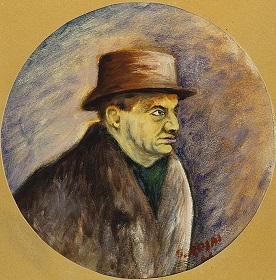
De Italiaanse dichter Eugenio Montale werd geboren in Genua op 12 oktober 1896. Zie ook mijn blog van 12 oktober 2010 en eveneens alle tags voor Eugenio Montale op dit blog.


Mittagsstunde

Verlorener Zikade
schwaches Sistrum im Wind,
kaum ertönt schon verklungen
im trägen Dunst.

Aus der Tiefe verzweigt
in uns sich die geheime
Vene; mühsam
hält sich unsre Welt.

Ein Zeichen deiner Hand:
da flimmern in der fahlen Luft
zersetzt die Spuren,
die die Leere nicht verschluckt.

Zu nichts wird dann auch Gebärde,
jede Stimme schweigt,
zu seiner Mündung steigt
hinab das kahle Leben.


Auf einen ungeschriebenen Brief

Um wimmelnder Tagesfrühen, um weniger
Fäden willen, darin der Knäuel des Lebens
sich verfängt und wieder löst
in Stunden und in Jahre, springen heut die
Delphinenpaare mit den Jungen? Oh, laß mich nichts
hören von dir, laß fliehen mich vor dem Schimmer
deiner Wimpern. Sehr andres ist auf der Erde.

Vergehen und wiederkommen: beides ist schwer.
Es zögert die rote Esse der Nacht,
lang säumt der Abend, das Gebet
ist Qual, und noch ist zwischen den ragenden
Felsen zu dir nicht gelangt die Flasche vom Meer.
Leer bricht sich die Woge

an der Spitze, in Finisterre.


Lob unserer Zeit

Nicht genug des Guten kann man sagen
von der Wichtigkeit der Welt
(der unsren, mein’ ich),
wohl der einzigen,
in der mit Kunst man töten
und Werke doch der Kunst erschaffen kann,
bestimmt für eines Morgens Dauer –
auch wenn der Morgen aus Jahrtausenden
und mehr besteht. Nein, man kann sie nie
genugsam preisen. Eile freilich
scheint geboten, denn es könnte
die Stunde nicht mehr ferne sein,
da sie im Übermaße sich wird aufgeblasen haben,
wie ein gewisser Frosch in der bekannten Fabel.


Vertaald door Herbert Frenzel


 1965356-7c5fca7ba59cce56d35184c13c12e48a.jpg
Eugenio Montale (12 oktober 1896 - 12 september 1981)
Portret door Ottone Rosai, 1941


De Amerikaanse dichter, criticus en vertaler Robert Stuart Fitzgerald werd geboren op 12 oktober 1910 in Springfield, Illinois. Zie ook mijn blog van 12 oktober 2010 en eveneens alle tags voor Robert Fitzgerald op dit blog.


Counselors (Fragment)

For his retreat
The priest lifts up the monstrance, muttering
Abstracted Latin to the tinkle behind him.
Presently they will bawl the Stabat Mater.
And all those years at seminary, reading
St. Basil and Jerome, girding his cassock
For handball in the gritty cement courtyard
Under the swooping smoke of the powerhouse;
And ordination when the folks from Chicago
Wept before the bishop. Mortify
The flesh. Think on thy last end. Pray
The Holy Mother of God in her infinite mercy,
And Him who rests in the dark chapel always,
Where the wick burns in wax, a cuddling flame:
Deduced by Thomas from the tip of heaven.

Or should I tumble to the recumbent
Confessional, and the scientist of distress?
For any child the terror in the night,
The hating eyes by day may be
Death’s cunning orchestration: they prepare
The servant’s cry at last, absolute and lonely.
See this easy gentleman in tweeds,
Deepchested, a swimmer to the farthest light,
Diagnostician of the subaqueous
Faces of dreams: with patience like a lover
He must all day sustain his authority,
Must not be bored, merciful or amused.

Or the anatomist and healer of bones?
Trepanner, skilled in suturing, the masked
And sterile hero in the cone of light;
There the sweet ether cone must be inhaled
With one, two pulses of the fiery spiral
Singing into timeless speed or quiet:
A mound under a sheet, a square of pale
Mortal flesh incised in a seeping line,
Spreading its lips for pretty butchery.


 1965356-a7d4ca81b0ecbad59bf433c3dc1efcac.jpg
Robert Fitzgerald (12 oktober 1910 – 16 januari 1985)


De Amerikaanse dichter en schrijver Paul Engle werd geboren op 12 oktober 1908 in Cedar Rapids. Zie ook alle tags voor Paul Engle op dit blog en ook mijn blog van 12 oktober 2010.


Twenty Below

Twenty below, I said, and closed the door,
A drop of five degrees and going down.
It makes a tautened drum-hide of the floor,
Brittle as leaves each building in the town.
I wonder what would happen to us here
If that hard wind of winter never stopped,
No man again could watch the night grow clear,
The blue thermometer forever dropped.

I hope, you answered, for so cruel a storm
To freeze remoteness from our lives too cold.
Then we could learn, huddled all close, how warm
The hearts of men who live alone too much,
And once, before our death, admit the old
Need of a human nearness, need of touch.


American Child III

1.
EACH morning she looks up and breathes the sky
And marvels again that night and day are varied.
Breathing, she does not wonder at what cry
of woman, crow or bell that wind has carried.
Each day is an astonishment of breath
She warms by the nourished blood, yet unaware
That all the dark astonishment of death
Is merely the lung emptied of mere air.

She breathes that insubstantial element
That turns to substance: body, nerve and pain.
Yet there are days of absolute content
When all her laughter is a hollow house
Raised against sorrow and the raving rain
While she lives in it like a patient mouse.


 1965356-6401b6e374cb6ca55f94a8c18730d9b0.jpg
Paul Engle (12 oktober 1908 – 25 maart 1991)
In 1941


De Amerkaanse schrijfster Ann Petry werd geboren op 12 oktober 1908 in Old Saybrook, Connecticut. Zie ook alle tags voor Ann Petry op dit blog en ook mijn blog van 12 oktober 2010.

Uit: The Street

“It was like the Chandlers and their friends in Connecticut, who looked at her and didn't see her, but saw instead a wench with no morals who WOuld be easy to come by. The reporter saw a dead Negro who had attempted to hold up a store, and so he couldn't really see what the man lying on the sidewalk looked like. He couldn't see the ragged shoes, the thin, starved body. He saw, instead, the picture he already had in his mind: a huge, brawny, blustering, ignorant, criminally disposed black man who had run amok with a knife on a spring afternoon in Harlem and who had. in turn been knifed.
She had gone past ‘the bakery shop again the next afternoon. The windows had been smashed, the front door had apparently been broken in, because it was boarded up. There were messages chalked on the sidewalk in front of the store. They all said the same thing: “White man, don’t come back.’ She was surprised to see that there were men still standing around, on the nearest corners, across the street.
Their faces were turned toward the store. They weren’t talking. They were just standing with their hands in their pockets - waiting.
Two police cars with their engines running were drawn up in front of the store. There were two cops right in front of the door, swinging nightSticks. She walked past, thinking that it was like a war that hadn’t got off to a Start yet, though bOth sides were piling up ammunition and reserves and were now wait- in g for anything, any little excuse, a geSture, a word, a sudden loud noise - and poufl it would start.
Lutie moved uneasily on the bed. She pulled the robe more tightly around her. All of these streets were filled with violence, she thought. You turned a corner, walked through a block, and you came on it suddenly, unexpectedly.
Or it was later in the spring that she took Bub to Roundtree Hospital. There was a cold, driving rain and she had hesitated about going out in it. But Bub had fallen on the sidewalk and cut his knee. She had come home from work to find him sitting disconsolately in Pop's kitchen. It was a deep, nasty cut, so she took him to the emergency room at Roundtree in order to find out just how bad it was.”


 1965356-37300be74be865d33b27ec0f1d06b948.jpg
Ann Petry (12 oktober 1908 – 28 april 1997)
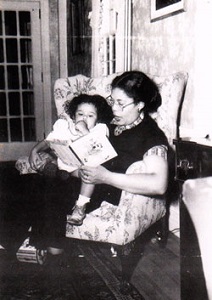
Hier met haar dochtertje Liz, rond 1940 


De Franse schrijver Louis Hemon werd geboren op 12 oktober 1880 in Brest in Bretagne. Zie ook alle tags voor Louis Hemon op dit blog en eveneens mijn blog van 12 oktober 2010.

Uit: Maria Chapdelaine

“Un grand éclat de rire lui répondit.
- On les connaît, les cochons de la grand-race à Hormidas. Gros comme des rats, et vifs comme des écureux pour sauter les clôtures.
- Vingt-cinq cents! cria un jeune homme par dérision.
- Cinquante cents!
- Une piastre!
- Ne fais pas le fou, Jean. Ta femme ne te laissera pas payer une piastre pour ce cochon-là.
Jean s'obstina.
- Une piastre. Je ne m'en dédis pas.
Hormidas Bérubé fit une grimace de mépris et attendit d'autres enchères; mais il ne vint que des quolibets et des rires.
Pendant ce temps les femmes avaient commencé à sortir de l'église à leur tour. Jeunes ou vieilles, jolies ou laides, elles étaient presque toutes bien vêtues en des pelisses de fourrure ou des manteaux de drap épais; car pour cette fête unique de leur vie qu'était la messe du dimanche elles avaient abandonné leurs blouses de grosse toile et les jupons en laine du pays, et un étranger se fût étonné de les trouver presque élégantes au coeur de ce pays sauvage, si typiquement françaises parmi les grands bois désolés et la neige, et aussi bien mises à coup sûr, ces paysannes, que la plupart des jeunes bourgeoises des provinces de France.
Cléophas Pesant attendit Louisa Tremblay, qui était seule, et ils s'en allèrent ensemble vers les maisons, le long du trottoir de planches. D'autres se contentèrent d'échanger avec les jeunes filles, au passage, des propos plaisants, les tutoyant du tutoiement facile du pays de Québec, et aussi parce qu'ils avaient presque tous grandi ensemble."


 1965356-4667da05e0dd4f0782da78b0034b2d18.JPG
Louis Hemon (12 oktober 1880 - 8 juli 1913)
Affiche


De Oostenrijkse dichteres en schrijfster Paula von Preradović werd geboren op 12 oktober 1887 in Wenen. Zie ook alle tags voor Paula von Preradović op dit blog.

Uit: Die Königslegende

„Immer  wenn du königlich und heldisch verfuhrst. Da du auf euren Schiffen die Narenta hinunter segeltest, da man dich krönte, da dein Knabe geboren wurde. Da war ich dir nahe, aber du sahst mich nicht …. Mich sieht nur, wer geprüft und schmerzerfahren ist"
„Warst du auch in der Schlacht an meiner Seite?"
„In der Schlacht floh ich dich, denn du warst der Unterlegene".
„Warum hast du mir nicht geholfen. Warum hast du das Unglück nicht abgewendet?"
„Wir Vilen stärken und vermehren das Glück der Glücklichen. Unglück abzuwenden sind wir nicht gesandt".
(…)

„Warum sagst du – böser Menschen? Weil sie anders wollten als du? Du hast erstrebt und getan, was gegen die wahren Zeichen der Zeit war. Sieh, Slavatz, ich bin unseres heiligen Vaters Benedikt von Nursia demütiger Sohn. Aber sollte man mich eines Tages doch noch auf den Thron rufen, so würde ich folgen, denn ich bin der legitime Erbe. Nicht aus Lust und Ehrsucht würde ich folgen, sondern aus Pflicht. Und dann würde ich mit Gottes Hilfe versuchen, den heiligen Willen und Brauch des Volkes, seine tiefe und wilde Liebe zu den eigenen uralten Wurzeln mit der neuen großen Ordnung zu versöhnen, die im Abendland herrscht und die auch das kroatische Volk einbeziehen will.
Wir sind keine Morgenländer. Unsere Berge und unsere Küsten blicken nach Abend. Wir gehören zur abendländischen Christenheit, dem Basileus sind wir viel zu fern."
Und schließlich endet Stjepan mit der Conclusio, dass "unser Volk fest in der eigenen Erde wurzeln, aber nach Westen schauen muss".


 1965356-2b97e706094f979b74b6f98573230e8e.jpg
Paula von Preradović (12 oktober 1887 – 25 mei 1951)
Wenen

Geschreven door Romenu om 18:16 Reageer op dit bericht

Meer van Romenu

↑ Terug naar de berichten