Naar de inhoud

Romenu

Over literatuur, gedichten, kunst en cultuur
akke.beakke.be

Berichten van 27 februari 2017 tot 28 februari 2017

Chanson pour mourir d'amour au temps de carnaval (Louis Aragon)


Bij Carnaval


2012888-778f69cf4ec83082a3b597d3b8a69e08.jpg
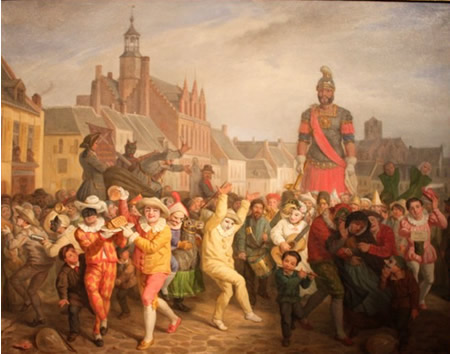
Le Carnaval de Cassel door Alexis Bafcop, 1876


Chanson pour mourir d'amour au temps de carnaval

Dimanche et
Lundi nettoyez
Paris
Dimanche pleurons que mardi je rie
Lundi domino sans poudre de riz
L'amour se perdra dans ta féerie
Mardi
Mardi gras tous les toits sont frits
Mardi
Mardi gras
Mardi
Mardi gris
Par où t'en viens-tu
Mercredi des
Cendres

Mardi
Mercredi
Mon cœur s'y perdit

Mercredi me fait un signe de croix
Mercredi menteur veux-tu que je croie
Qu'Amour est en terre et déjà tout froid
Il est mon
Seigneur et je suis sa proie
La nuit sera longue et le lit étroit
Le ciel est ouvert tout rouge à l'endroit
Par où tu t'en vas
Mercredi descendre

Mardi
Mercredi
Mon cœur s'y perdit


 2012888-6c64d2c78e8a8e364646a7ed1a6502d8.jpg
Louis Aragon (3 oktober 1897 – 24 december 1982)
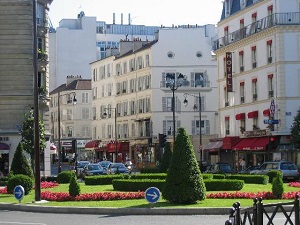
Neuilly-sur-Seine, de geboorteplaats van Louis Aragon


Zie voor de schrijvers van de 28e februari ook mijn vorige blog van vandaag.

Geschreven door Romenu om 13:36 Reageer op dit bericht

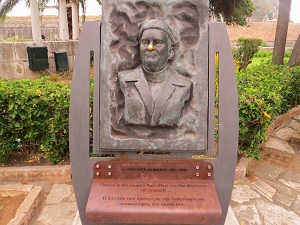
Stephen Spender, Bart Koubaa, Luc Dellisse, John Montague, Marcel Pagnol, Bodo Morshäuser, Martin Suter, Yórgos Seféris, Howard Nemerov

De Engelse dichter, essayist en schrijver Stephen Spender werd geboren op 28 februari 1909 in Londen. Zie ook alle tags voor Stephen Spender op dit blog.


The Labourer In The Vineyard

Here are the ragged towers of vines
Stepped down the slope in terraces.

Through torn spaces between spearing leaves
The lake glows with waters combed sideways,
And climbing up to reach the vine-spire vanes
The mountain crests beyond the far shore
Paint their sky of glass with rocks and snow.

Lake below, mountains above, between
Turrets of leaves, grape-triangles, the labourer stands.

His tanned trousers form a pedestal,
Coarse tree-trunk rising from the earth with bark
Peeled away at the navel to show
Shining torso of sun-burnished god
Breast of lyre, mouth coining song.

My ghostly, passing-by thoughts gather
Around his hilly shoulders, like those clouds
Around those mountain peaks their transient scrolls.

He is the classic writing all this day,
Through his mere physical being focussing
All into nakedness. His hand
With outspread fingers is a star whose rays
Concentrate timeless inspiration
Onto the god descended in a vineyard
With hand unclenched against the lake's taut sail
Flesh filled with statue, as the grape with wine.


He Will Watch The Hawk

He will watch the hawk with an indifferent eye
Or pitifully;
Nor on those eagles that so feared him, now
Will strain his brow;
Weapons men use, stone, sling and strong-thewed bow
He will not know.

This aristocrat, superb of all instinct,
With death close linked,
Had paced the enormous cloud, almost had won
War on the sun;
Till now, like Icarus mid-ocean-frowned,
Hands, wings are found.


 2012882-1eac8c7d9a76c3d0ea48afeded4d92d3.jpg
Stephen Spender (28 februari 1909 – 16 juli 1995)


De Vlaamse schrijver Bart Koubaa (pseudoniem van Bart van den Bossche) werd geboren op 28 februari 1968 in Eeklo. Zie ook alle tags voor Bart Koubaa op dit blog.

Uit: Een goede vriend

“Ik zag een wit T-shirt met in het midden een Picasso-achtige sardien waaronder in stevige zwarte letters dream stond, daarna een zwart behaarde hand die uit het halfdonker tevoorschijn kwam. ‘Ivan,’ zei een man met een hartelijke glimlach op zijn bebaarde ronde gezicht en nadat hij me stevig de hand had geschud, stapte hij in het zuiderse zonlicht en omklemde het uittrekbare handvat van mijn koffer. Zo staken we de kalme straat over, hij voorop, mijn koffer achter zich meetrekkend, ik met mijn schoudertas om. Ik volgde hem over een lommerrijke strook op een breed voetpad vol drukke terrassen en statige winkels; links, op het zonovergoten plein dat als een oceaan van zwart-witte tegeltjes voor het theater golfde, herkende ik de Griekse zuil met de donkere koning erop. Nadat we dezelfde kalme straat rond het plein nog een keer hadden overgestoken, kwamen we in een brede winkelstraat met aan het einde de triomfboog waardoor ik een glimp van de Taag kon opvangen. Ivan wierp me af en toe een glimlach toe en stak ter hoogte van een krantenkiosk een hand naar links uit, als een fietser. Kort daarna stopte hij voor een souvenirwinkeltje. Hij deed de deur van het winkeltje dicht en toonde me hoe je die met een trucje kon openen. ‘Easy,’ zei hij en hij trok mijn koffer naar binnen, groette de winkeljuffrouw die een kruiswoordraadsel aan het invullen was en liep langs met prullaria volgestouwde rekken, vitrinekasten, bakken en draaibare kaartenrekken naar wat hij breed glimlachend de echte ingang van het appartement noemde. Voor hij die deur openmaakte, legde hij me nog uit dat ’s avonds in het winkeltje twee ijzeren rolluiken werden neergelaten, waardoor een gang van de straatdeur naar de tweede deur binnen ontstond. Het appartement dat ik voor een maand had gehuurd was helemaal boven op de vijfde verdieping, er was geen lift, en Ivan stond erop mijn koffer te dragen. ‘Sardienen,’ pufte hij toen hij op de tweede verdieping even stopte en zich met een draaiende handbeweging voor zijn snuivende neus de walm van geroosterde vis en knoflook toewaaide in de kille, rijk betegelde gang. Voor we het appartement in konden was er een poortje van traliewerk, dat je ook met een trucje kon openmaken. Na een paar trappen duwde hij een laatste deur voor me open en nodigde me met een breed handgebaar uit naar binnen te gaan. Daarna liep hij naar mijn koffer, die hij naast het poortje had laten staan en trok hem hortend en stotend over de trappen tot in de hal van het appartement.”


 2012882-e0574774904de9b6c4957e81adedc7b7.jpg
Bart Koubaa (Eeklo, 28 februari 1968)


De Ierse dichter John Montague werd geboren in New York op 28 februari 1929. Zie ook alle tags voor John Montague op dit blog.


Like dolmens round my childhood, the old people

Like dolmens round my childhood, the old people.
Jamie MacCrystal sang to himself,
A broken song without tune, without words;
He tipped me a penny every pension day,
Fed kindly crusts to winter birds.
When he died his cottage was robbed,
Mattress and money box torn and searched.
Only the corpse they didn't disturb.

Maggie Owens was surrounded by animals,
A mongrel bitch and shivering pups,
Even in her bedroom a she-goat cried.
She was a well of gossip defiled,
Fanged chronicler of a whole countryside:
Reputed a witch, all I could find
Was her lonely need to deride.

The Nialls lived along a mountain lane
Where heather bells bloomed, clumps of foxglove.
All were blind, with Blind Pension and Wireless,
Dead eyes serpent-flicked as one entered
To shelter from a downpour of mountain rain.
Crickets chirped under the rocking hearthstone
Until the muddy sun shone out again.

Mary Moore lived in a crumbling gatehouse,
Famous as Pisa for its leaning gable.
Bag-apron and boots, she tramped the fields
Driving lean cattle from a miry stable.
A by-word for fierceness, she fell asleep
Over love stories, Red Star and Red Circle,
Dreamed of gypsy love rites, by firelight sealed.

Wild Billy Eagleson married a Catholic servant girl
When all his Loyal family passed on:
We danced round him shouting "To Hell with King Billy,"
And dodged from the arc of his flailing blackthorn.
Forsaken by both creeds, he showed little concern
Until the Orange drums banged past in the summer
And bowler and sash aggressively shone.

Curate and doctor trudged to attend them,
Through knee-deep snow, through summer heat,
From main road to lane to broken path,
Gulping the mountain air with painful breath.
Sometimes they were found by neighbours,
Silent keepers of a smokeless hearth,
Suddenly cast in the mould of death.

Ancient Ireland, indeed! I was reared by her bedside,
The rune and the chant, evil eye and averted head,
Fomorian fierceness of family and local feud.
Gaunt figures of fear and of friendliness,
For years they trespassed on my dreams,
Until once, in a standing circle of stones,
I felt their shadows pass

Into that dark permanence of ancient forms.


 2012882-e16ae51dfbb0c0598c7f15dcf2289367.jpg
John Montague (28 februari 1929 – 10 december 2016)


De Belgische-Franse dichter, schrijver, essayist, dramaturg en scenarioschrijver Luc Dellisse werd geboren op 28 februari 1953 in Brussel. Zie ook alle tags voor Luc Delisse op dit blog.

Uit: L'Invention du scénario

"Dans le cas d’un scénario de long métrage, vous vous lancez dans une entreprise qui peut durer un an ou davantage. Vous y engagez votre temps, votre conscience, et la
maîtrise de votre projet.
Vous aurez à défendre, argumenter, modifier, sacrifier vos plus belles trouvailles.
Le but de ce livre n’esr pas de faire passer un te5t, ni de décourager les vocations : mais l’écriture eEecdve et efficace d’un scénario doit reposer sur une nécessité forte et
non sur un malentendu.
QU’EST-Œ QU’UN RÉCIT
Un récit n’est pas une simple histoire. Un récit esr une histoire organisée et menée à bien.
Dans un récit, il y a autre chose que les matériaux bruts et péle-méle d’une histoire : il y a en outre tous les élé- ments de consrrucfion, de direcdon, d’enchänemenr des faits et de résolution.
Il n’y a place ni pour le flou (tout doit être perceptible), ni pour les coïncidences (tout doit être cohérent ou préparé).
Le terme intrigue s’impose lorsque tous les éléments ont trouvé leur jusre place, sans séquences inutiles, sans aucme perte d’énergie ou de sens ; lorsque le récit esr parfaitement struœuré."


 2012882-aa0d1d250cb9244259b76c34e471e623.jpg
Luc Dellisse (Brussel, 28 februari 1953)
Cover 


De Franse dichter, schrijver, dramaturg en regisseur Marcel Pagnol werd geboren op 28 februari 1895 in Aubagne, Bouches-du-Rhône. Zie ook alle tags voor Marcel Pagnol op dit blog.

Uit: Eléments d’une thermodynamique nouvelle

"Les cours de Physique et Chimie étaient faits par M.Oneto.
Il avait une petite barbiche noire, il ressemblait à Méphistophélès, mais en beaucoup plus jeune ; il avait beaucoup d’autorité, et une grande bonté.
Comme M.Cros, il roulait les r ; comme M.Cros, il avait pour nous une sorte d’affectueux mépris.
Un programme parfaitement imbécile exigeait qu’il enseignât, en cent cinquante leçons, toute la Physique et toute la Chimie, à des gaillards qui ne savaient pas résoudre une équation du premier degré, et qui lui arrivaient en droite ligne du cours de Philosophie : c’est-à-dire complètement écrémés par Beckerley, Fichte-grain-de-sable, l’impératif catégorique, le Pragmatisme, Auguste Comte et Baralipton.
Alors, avec beaucoup de patience, et pour amuser les grands idiots que nous étions, il faisait des expériences. Lorsque je pense à ces classes de sciences je vois un morceau de fil de fer qui brûle dans un bocal d’oxygène ; une lampe à mercure qui verdit la barde, pourtant si noire, de M.Oneto ; une éprouvette qu’il secoue en disant : «
Vous allez voir : ça va tourner au bleu » (et ça tourne au rouge le plus vif) ; enfin, je vois –apothéose de mes classes de physique – un morceau de sodium affolé qui tire des bordées foudroyantes à la surface d’une sorte de pot de chambre, et qui jette des éclairs subits, avec des crachotements irrités, au sein d’un incendie sous-marin."


 2012882-2898360e2d2c680c05f1dc5b82ca44be.jpg
Marcel Pagnol (28 februari 1895 – 18 april 1974)
Op een afiche n.a.v. zijn 120e geboortedag in 2015 


De Duitse dichter en schrijver Bodo Morshäuser werd geboren op 28 februari 1953 in Berlijn. Zie ook alle tags voor Bodo Morshäuser op dit blog.

Uit: Und die Sonne scheint

„Zwei Verkäuferinnen, deren Geschäfte es nicht mehr gab, waren so langsam zu Fuß unterwegs, als sollten die zweihundert Meter, die sie noch hatten, bloß nicht enden, während ein Radfahrer nach dem anderen sie umkurvte, einer gar absteigen musste. Er hatte ein so langsames Gehen nicht erwartet und den Bremspunkt an einer Verengung falsch berechnet. Gegenüber stand ein alter Mann auf dieselbe Weise wie immer an seinem Fenster und schaute zu denselben Stellen wie immer schon. Neuerdings belegte ein Schuttcontainer eine der Parkbuchten, erst noch in tiefem Schatten, im nächsten Moment im Sonnenlicht, und gleich darauf wieder im Schatten. Eine Straßenseite war trocken, die andere nass.
Ich saß an der Scheibe eines Cafés und sah mich selbst vorübergehen. Als ich mich über eine bestimmte Gestalt, die ich seit Jahren oder Jahrzehnten vom Sehen kannte, innerlich lustig machen wollte, fiel mir ein, dass ich selbst einmal solch eine Erscheinung gewesen war. Sah ich nicht einsam aus, wie ich vor mir selbst vorüberging? Ja, ich sah einsam und verloren aus, aber nicht zurückgezogen vor anderen, sondern vor mir selbst. Sah aus wie einer, der sich für alles Mögliche interessierte, nur nicht für sich. In welch friedlicher Gegend ich doch gewohnt hatte.
Bis dorthin drangen die Kämpfe nicht vor. Was einen in meiner alten Straße umwehte, konnte man für den perfekten Frieden halten. Zwar wurde viel geklagt, doch waren Anlässe nicht zu erkennen. Man saß in Cafés, im Sommer davor, und hörte man von Sorgen, so schienen deren Schauplätze so fern zu sein wie die Nordatlantikströmung, wie brasilianische Regenwälder oder wie ein Waffentest im Südpazifik. Gleichzeitig wurden Sorgen um Globales als allerpersön.”


 2012882-8e2d35b3ebcf74e07aafd6a34ab4fe9a.jpg
Bodo Morshäuser (Berlijn, 28 februari 1953)
Cover


De Zwitserse schrijver Martin Suter werd geboren op 29 februari 1948 in Zürich. Zie ook alle tags voor Martin Suter op dit blog.

Uit: Ein perfekter Freund

„Weshalb?"
"Man hatte im Computertomogramm eine Hirnprellung festgestellt, und der Arzt entschied, Sie in Narkose zu behalten und den Hirndruck zu überwachen. Wenn er gestiegen wäre, hätte das geheissen, dass das Hirn anschwillt oder eine Blutung auftritt."
"Was passiert dann?"
"Es ist nicht angeschwollen."
"Ich war in einem künstlichen Koma?"
"In einer Langzeitnarkose. Zwei Tage."
Fabio fielen die Augen zu. "Wo ist meine Freundin?"
"Ich nehme an, zu Hause. Es ist kurz nach Mitternacht."
"Ist sie schon lange gegangen?"
"Ich weiss nicht. Ich bin die Nachtschwester", antwortete die Stimme. Jetzt wieder von jenseits des Flusses.
Norina wusch seinen Bauch mit einem weichen Lappen. Er spürte ihre leichte Hand und die Wärme des Lappens. Er lag mit leicht gespreizten Beinen da und stellte sich schlafend. Er hörte es plätschern, wenn sie den Lappen auswrang, und konnte es kaum erwarten, bis sie ihn wieder berührte.
Sie seifte Schamhaare und Leisten ein. Endlich spürte er ihre Finger an seinem Penis. Sie hob ihn an - und ein stechender Schmerz durchzuckte ihn. Fabio schrie auf.
"Pardon." Eine Männerstimme.
Er schlug die Augen auf. Ein Mann stand neben dem Bett. Er war etwa in seinem Alter und trug das weissblond gefärbte Haar millimeterkurz. Er hatte eine blaue Baumwollhose an und darüber eine blaue, lose, kurzärmelige Bluse mit einem Namensschild. Er hob die Hände bedauernd in die Höhe. "Der Blasenkatheter, sorry. Wissen Sie, wo Sie sind?" Fabio schaute sich um. Neben dem Bett ein Infusionsständer, an der Wand ein Tisch mit einem Blumenstrauss, darüber ein Kruzifix. "Sieht nach Krankenhaus aus."


 2012882-755d8a5410ed1fa20c26a647511f62ef.jpg
Martin Suter (Zürich, 29 februari 1948)


De Griekse dichter Yórgos Seféris werd geboren in Smyrna (nu Izmir, in Turkije) op 29 februari 1900. Zie ook alle tags voor Yórgos Seféris op dit blog.


Letter Of Mathios Paskalis

The skyscrapers of New York will never know the coolness that comes down on Kifisia
but when I see the two cypress trees above your familiar church
with the paintings of the damned being tortured in fire and brimstone
then I recall the two chimneys behind the cedars I used to like so much when I was abroad.

All through March rheumatism wracked your lovely loins and in summer you went to Aidipsos.
God! what a struggle it is for life to keep going, as though it were a swollen river passing through the eye of a needle.
Heavy heat till nightfall, the stars discharging midges, I myself drinking bitter lemonades and still remaining thirsty;
Moon and movies, phantoms and the suffocating pestiferous harbour.

Verina, life has ruined us, along with the Attic skies and the intellectuals clambering up their own heads
and the landscapes reduced by drought and hunger to posing
like young men selling their souls in order to wear a monocle
like young girls — sunflowers swallowing their heads so as to become lilies.

The days go by slowly; my own days circulate among the clocks dragging the second hand in tow.
Remember how we used to twist breathless through the alleys so as not to be gutted by the headlights of cars.
The idea of the world abroad enveloped us and closed us in like a net
and we left with a sharp knife hidden within us and you said ‘Harmodios and Aristogeiton'.

Verina, lower your head so that I can see you, though even if I were to see you I'd want to look beyond.
What's a man's value? What does he want and how will he justify his existence at the Second Coming?
Ah, to find myself on a derelict ship lost in the Pacific Ocean alone with the sea and the wind
alone and without a wireless or strength to fight the elements.


 2012882-fbd54042d84d910b5e3c79d811a0e778.jpg
Yórgos Seféris (29 februari 1900 - 20 september 1971)


De Amerikaanse dichter en literatuurdocent Howard Nemerov werd geboren op 29 februari 1920 in New York. Zie ook alle tags voor Howard Nemerov op dit blog.


Political Reflection
loquitur the sparrow in the Zoo

No bars are set too close, no mesh too fine
To keep me from the eagle and the lion,
Whom keepers feed that I may freely dine.
This goes to show that if you have the wit
To be small, common, cute, and live on shit,
Though the cage fret kings, you may make free with it


The Beautiful Lawn Sprinkler

What gives it power makes it change its mind
At each extreme, and lean its rising rain
Down low, first one and then the other way;
In which exchange humility and pride
Reverse, forgive, arise, and die again,
Wherefore it holds at both ends of the day
The rainbow in its scattering grains of spray.


 2012882-cf1bb10fe9297298e5599dcd4647fa82.jpg
Howard Nemerov (29 februari 1920 – 5 juli 1991) 


Zie voor nog meer schrijvers van de 28e februari ook mijn blog van 28 februari 2016 deel 1 en ook deel 2.en ook mijn blog van 29 februari 2016.


Geschreven door Romenu om 13:33 Reageer op dit bericht

Josef Svatopluk Machar

De Tsjechische dichter, schrijver, journalist en politicus Josef Svatopluk Machar wed geboren op 29 februari 1864 in Kolín als zoon van een molenaar. Machar bezocht het gymnasium in Praag, voltooide daarna de eenjarige militaire school en vond in 1891 een baan als bediende in een bank in Wenen, waarbij hij op hetzelfde moment voor diverse tijdschriften ging schrijven. Hier ontmoette hij T. G. Masaryk en werd hij een belangrijke vertegenwoordiger van de Realistische Partij. Al voor de Eerste Wereldoorlog trad hij op als tegenstander van het holle patriottisme. Na 1918 keerde hij op verzoek van Masaryk naar Tsjecho-Slowakije terug en werd hij benoemd tot inspecteur-generaal van het Tsjechoslowaakse leger. Deze functie legde hij in 1924 wegens openlijk meningsverschillen met Masaryk neer en hij sloot zich aan bij het kamp van radicaal rechts. In zijn werken schreef hij over de burgerlijke maatschappij. Hij bekritiseerde haar onverschilligheid, hypocrisie en valse patriottisme. Zijn kritiek raakte ook de kerk en de jonge Tsjechen. Hij schreef subjectieve en politieke poëzie en lyrische epen, vermengd met satire, ironie en sarcasme. Aldus trad hij in het voetspoor van Karel Havlicek Borovsky en Jan Neruda. Hij werd echter ook beschouwd als problematisch schrijver met fascistische opvattingen. Hij keerde zich in zijn “Satiricon” boek en in zijn essay “Amnestie” echter tegen het antisemitisme. In de strijd tussen de oudere en jongere literaire generatie richtte hij samen met andere jonge schrijvers de vereniging “Česká Moderna”op en schreef daartoe een bijbehorend manifest.

Uit: Dreißig Jahre

“Wir quartierten uns im Hotel Hammerand ein. [...] Und nun begannen wir in dieser fremden Stadt irgendwie die Scheu abzulegen.
Wie ein Mensch, der schwimmen lernt, von Tag zu Tag versucht, weiter in den Strom vorzudringen, gingen wir Morgen für Morgen aus dem Hotel, immer weiter und weiter weg, tauchten in die Gassen ein, in den Lärm und in das Menschengewimmel, schauten nach Häusern und Geschäften aus, suchten Punkte, an denen wir uns beim nächsten Mal orientieren würden, kurzum, wir waren bedacht, den Körper und die Seele der unbekannten Stadt kennenzulernen, die nun unsere Heimat sein sollte.
Auf die Ringstraße, den Graben, in die langen Straßen in den Bezirken, in die Kirchen, Museen, die Parks, zu den Monumenten gingen wir.
Eine große ausgedehnte Stadt – aber es ist nicht Prag. Das hier, das ist ein großes Camp von Häusern, die in manchmal geraden, manchmal krummen Reihen von Gassen Habtacht stehen, ein Haus wie das andere, ihre Uniform ist keineswegs etwas Besonderes, einmal sauberer, einmal schmutziger, hie und da steht neben und zwischen ihnen wie ein Korporal eine Kirche, hie und da, wie  ein Offizier, ein Palais, ein Bauwerk – die Universität, das Parlament, die kaiserlichen Museen, der Neubau der Hofburg, des Burgtheaters – aus allen Zeiten und Kulturen zusammengetragene Stile ohne Patina der Vergangenheit, ohne Charakter und Tradition, ein Leben ohne Geschichte und ohne inneren Sinn – das ist nicht Prag, das ist nicht unser Prag.
Dem Abend zu, wenn sich der Himmel rötete, kam die Traurigkeit. Die Seele dieser Stadt war mir fremd, sie sprach nicht zu mir, und wenn sie zu mir sprach, war sie mir zuwider. Es war die Seele eines Weibes, das sich aushalten ließ, das sich in seinem Luxus bemüht, den Eindruck einer vornehmen Dame zu erwecken. Und wieder erinnerte ich mich und verglich: Prag ... eine ausgeraubte und verarmte Adelige, sie lebt und kämpft armselig um jeden Tag ihres Lebens, aber sie ist eine Adelige, hat eine ehrenvolle Vergangenheit, und ehrenhaft ist auch die Armut ihres Heute. Mit jedem  Wölkchen, das gegen Norden schwamm, wäre ich gerne zurückgekehrt, ich beneidete die Vögel um ihre Flügel und um ihre Freiheit.“


 2017603-9daaa75bf64ea0362ff871be60e586da.jpg
Josef Svatopluk Machar (29 februari 1864 - 17 maart 1942)

Geschreven door Romenu om 00:00 Reageer op dit bericht

Carnival Evening (Linda Pastan)


Bij Carnaval


 2012529-ca687811f420c32343343c55eec5390c.jpg
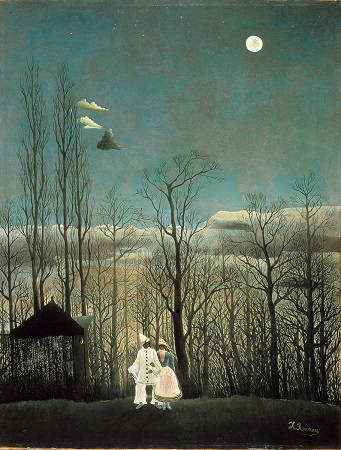
Carnival Evening door Henri Rousseau, 1886


Carnival Evening

Despite the enormous evening sky
spreading over most of the canvas,
its moon no more
than a tarnished coin, dull and flat,

in a devalued currency;
despite the trees so dark themselves,
stretching upward like supplicants,
utterly leafless; despite what could be
a face, rinsed of feeling, aimed
in their direction,

the two small figures
at the bottom of this picture glow
bravely in their carnival clothes,
as if the whole darkening world
were dimming its lights for a party.


 2012529-7c8d0e4e9fe5b14e36ff6e3977d993d9.jpg
Linda Pastan (New York, 27 mei 1932)
Een Mardi Gras penthouse party op Fifth Avenue, New York


Zie voor de schrijvers van de 27e februari ook mijn vorige blog van vandaag.

Geschreven door Romenu om 10:29 Reageer op dit bericht

Cynan Jones, John Steinbeck, Lawrence Durrell, André Roy, Henry Longfellow, Elisabeth Borchers, James T. Farrell, Irwin Shaw

De Welshe schrijver Cynan Jones werd geboren op 27 februari 1975 in Aberystwyth, Wales. Zie ook alle tags voor Cynan Jones op dit blog.

Uit: The Dig

“The policeman opened the door, looked at the deep mud of the yard, and got deliberately out.
Set back from the window, the man watched him through the gap in the curtains. He watched him scan the place. The policeman was young and he was not a policeman the big man had seen before.
The policeman bent through the car door and pushed the horn twice.
What do I do here? thought the man. He wished he’d left one of the big dogs off but knew even through the coal it would scent the badger and bother it. If I stay in the house, he’ll start looking round, thought the man. Ag.
The policeman had started to walk toward the house from the car and the big man came out.
Afternoon, sir. It’s clearing up, the policeman said. The policeman looked at the man and looked out as if at the weather over the valley.
The big man just nodded.
Few questions, really, sir. The policeman was light and inoffensive the way they are and the man moved to bring him away from the house.
Can you tell me what you were doing last night, or early this morning?
The big man didn’t reply.
The policeman looked around at the yard and privately noticed the two sets of tire tracks that were cut into the mud and that were not filled with overnight rain. He saw the old red van and guessed one set belonged to that. The policeman took in the many dumped engines and tires and the wastage of vehicles and machines about.
We’ve had a report of fly-tipping. He waited. I just wanted to ask whether you would know anything about that.
What did they tip? asked the man.
The policeman didn’t respond. He was looking at the junk and the big man saw and said, Does it look like I throw things away?”


 2012527-bbd0e070f4d6ea1d13272364c09bccf4.jpg
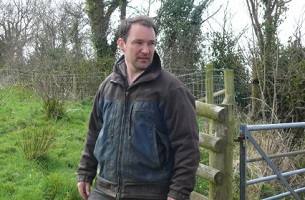
Cynan Jones (Aberystwyth, 27 februari 1975)


De Amerikaanse schrijver John Steinbeck werd geboren in Salinas, Californië, op 27 februari 1902. Zie ook alle tags voor John Steinbeck op dit blog.

Uit: Travels with Charley

“Then I found a telescope sight I had to have, and waited while it was mounted on the rifle, and in the process got to know everyone in the shop and any customers who entered. With the gun in a vise and the bolt out, we zeroed the new sight on a chimney three blocks away, and later when I got to shooting the little gun I found no reason to change it. I spent a good part of a morning at this, mostly because I wanted to stay. But I see that, as usual, love is inarticulate. Montana has a spell on me. It is grandeur and warmth. If Montana had a seacoast, or if I could live away from the sea, I would instantly move there and petition for admission. Of all the states it is my favorite and my love.
At Custer we made a side trip south to pay our respects to General Custer and Sitting Bull on the battlefield of Little Big Horn. I don’t suppose there is an American who doesn’t carry Remington’s painting of the last defense of the center column of the 7th Cavalry in his head. I removed my hat in memory of brave men, and Charley saluted in his own manner but I thought with great respect.
The whole of eastern Montana and the western Dakotas is memory-marked as Injun country, and the memories are not very old either. Some years ago my neighbor was Charles Erskine Scott Wood, who wrote Heavenly Discourse. He was a very old man when I knew him, but as a young lieutenant just out of military academy he had been assigned to General Miles and he served in the Chief Joseph campaign. His memory of it was very clear and very sad. He said it was one of the most gallant retreats in all history. Chief Joseph and the Nez Percés with squaws and children, dogs, and all their possessions, retreated under heavy fire for over a thousand miles, trying to escape to Canada. Wood said they fought every step of the way against odds until finally they were surrounded by the cavalry under General Miles and the large part of them wiped out. It was the saddest duty he had ever performed, Wood said, and he had never lost his respect for the fighting qualities of the Nez Percés. “If they hadn’t had their families with them we could never have caught them,” he said. “And if we had been evenly matched in men and weapons, we couldn’t have beaten them. They were men,” he said, “Real men.”


 2012527-70d6680c10bd3f29ec48d31abd19687e.jpg
John Steinbeck (27 februari 1902 - 20 december 1968)
Cover


De Britse dichter en schrijver Lawrence George Durrell werd geboren op 27 februari 1912 in Jalandhar in India. Zie ook alle tags voor Lawrence Durrell op dit blog.

Uit: The Alexandria Quartet

“It was cold in the street and I crossed to the lighted blaze of shops in Rue Fuad. In a grocer’s window I saw a small tin of olives with the name Orvieto on it, and overcome by a sudden longing to be on the right side of the Mediterranean, entered the shop: bought it: had it opened there and then: and sitting down at a marble table in that gruesome light I began to eat Italy, its dark scorched flesh, hand-modelled spring soil, dedicated vines. I felt that Melissa would never understand this. I should have to pretend I had lost the money. I did not see at first the great car which she had abandoned in the street with its engine running. She came into the shop with swift and resolute suddenness and said, with the air of authority that Lesbians, or women with money, assume with the obviously indigent: ‘What did you mean by your remark about the antinomian nature of irony?’ — or some such sally which I have forgotten.”
(…)

“Idle’ she writes ‘to imagine falling in love as a correspondence of minds, of thoughts; it is a simultaneous firing of two spirits engaged in the autonomous act of growing up. And the sensation is of something having noiselessly exploded inside each of them. Around this event, dazed and preoccupied, the lover moves examining his or her own experience; her gratitude alone, stretching away towards a mistaken donor, creates the illusion that she communicates with her fellow, but this is false. The loved object is simply one that has shared an experience at the same moment of time, narcissistically; and the desire to be near the beloved object is at first not due to the idea of possessing it, but simply to let the two experiences compare themselves, like reflections in different mirrors. All this may precede the first look, kiss, or touch; precede ambition, pride or envy; precede the first declarations which mark the turning point — for from here love degenerates into habit, possession, and back to loneliness.”


 2012527-835ba4468bd8985859e34eef281ecd57.JPG
Lawrence Durrell (27 februari 1912 – 7 november 1990)
Standbeeld in Corfu-stad


De Canadese dichter, schrijver en essayist André Roy werd geboren op 27 februari 1944 in Montréal. Zie ook alle tags van André Roy op dit blog.


C’est la nuit où nous sommes

C’est la nuit où nous sommes
toi, moi, nous, les autres pareils à nous.
Encore l’action,
la structure de la pensée dans l’action.
Monde moderne des forêts et des eaux.
Tu appartiens aux forains,
à nos ancêtres les vampires.
Les villes, les maisons, les lits
où nous avons pensé être
mystérieux, impossibles, immortels,
quelle folie !
Le désir coule;
nous pourrions nous tuer
pour la connaissance du désir.


Actions, roues, horloges

Actions, roues, horloges.
Les images où nous nous imaginons
grands, désirés, symboliques
varient avec le temps.
Une histoire succède à notre histoire,
nos corps produisent des contre-corps.
La lumière fond sur la toile,
blancheur qui coule,
ça devient action.
Le corps se refait au cinéma,
il y vit, il y meurt, il y ressuscite;
il est l’autre que moi je suis,
de ce que je connaîtrai dans la peur.


 2012527-ddad44af2c967b543cd0bbc32a7220a5.png
André Roy (Montréal, 27 februari 1944)


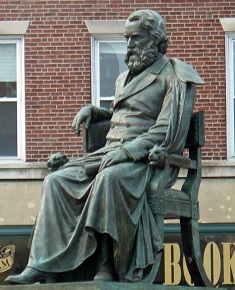
De Amerikaanse dichter Henry Wadsworth Longfellow werd geboren in Portland, Maine, op 27 februari 1807. Zie ook alle tags voor Henry Longfellow op dit blog.


The Village Blacksmith

Under a spreading chestnut-tree
The village smithy stands;
The smith, a mighty man is he,
With large and sinewy hands;
And the muscles of his brawny arms
Are strong as iron bands.

His hair is crisp, and black, and long,
His face is like the tan;
His brow is wet with honest sweat,
He earns whate'er he can,
And looks the whole world in the face,
For he owes not any man.

Week in, week out, from morn till night,
You can hear his bellows blow;
You can hear him swing his heavy sledge,
With measured beat and slow,
Like a sexton ringing the village bell,
When the evening sun is low.

And children coming home from school
Look in at the open door;
They love to see the flaming forge,
And hear the bellows roar,
And catch the burning sparks that fly
Like chaff from a threshing-floor.

He goes on Sunday to the church,
And sits among his boys;
He hears the parson pray and preach,
He hears his daughter's voice,
Singing in the village choir,
And it makes his heart rejoice.

It sounds to him like her mother's voice,
Singing in Paradise!
He needs must think of her once more,
How in the grave she lies;
And with his hard, rough hand he wipes
A tear out of his eyes.

Toiling,--rejoicing,--sorrowing,
Onward through life he goes;
Each morning sees some task begin,
Each evening sees it close
Something attempted, something done,
Has earned a night's repose.

Thanks, thanks to thee, my worthy friend,
For the lesson thou hast taught!
Thus at the flaming forge of life
Our fortunes must be wrought;
Thus on its sounding anvil shaped
Each burning deed and thought.


 2012527-0caf99bd4f1ddfacb4f721f4647ce8e1.jpg
Henry Longfellow (27 februari 1807 - 24 maart 1882) 
Standbeeld in Portland 


De Duitse schrijfster en dichteres Elisabeth Borchers werd geboren in Homberg op 27 februari 1926. . Zie ook alle tags voor Elisabeth Borchers op dit blog.


Hast du gesehen

hast du den vogel gesehen
der dies und das tat ich sah ihn
hast du den fisch gesehen
mit dem vielen und wenigen ich sah ihn
hast du das pferd gesehen
mit dem neben und fernen ich sah es

der vage] glühte im meer
der fisch bewanderte das Land
das pferd zog den himmel ab

sage nicht der morgen ist. rot
sage nicht laut wir bereisen

die nacht


Regen

einmal geschah es
da trank ich die ewigkeit aus
und den regen

ein andermsl geschah es
da ertrank der regen
in meiner ewigkeit

doch dann geschah es
daß es regnete
die stimme des regens
meines regens kleine stimme
wie kann das sein?
wird morgen das gras grün sein?
morgen wird das gras grün sein
und sonst wird nichts sein?
sonst nichts


 2012527-97a155f40625366bfae5577965e3add1.jpg
Elisabeth Borchers (27 februari 1926 – 25 september 2013)
Cover 


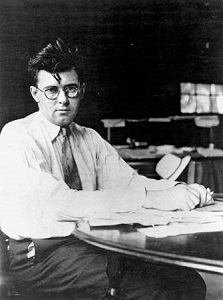
De Amerikaanse schrijver James Thomas Farrell werd geboren op 27 februari 1904 in Chicago. Zie ook alle tags voor James T. Farrell op dit blog.

Uit: Young Lonigan

“He had walked home with her. All along Indiana Avenue, he had been liking her, wanting to kiss her. Now, he remembered that day as clearly as if it had just happened. He remembered it better than the day when he was just a punk and he had bashed the living moses out of that smoke who pulled a razor on him over in Carter Playground, and a gang of guys had carried him around on their shoulders, telling him what a great guy he was, and how, when he grew up, he would become the white hope of the world, and lick Jack Johnson for the heavyweight championship. He remembered the day with Lucy, and his memory of it was like having an awful thirst for a drink of clear cold water or a chocolate soda on a hot day. It had been a windy day in March, without any sun. The air had seemed black, and the sky blacker, and all the sun that day had been in his thoughts of her. He had had all kinds of goofy, dizzy feelings that he liked. They had walked home from school, along Indiana Avenue, he and Lucy. They hadn’t spoken much, and they had stopped every little while to look at things. They had stopped at the corner of Sixtieth, and he had shown her the basement windows they had broken, just to get even with old Boushwah, the Hunkie janitor, because he always ran them off the grass when they goofed on their way home from school. And she had pretended that it was awful for guys to break windows, when he could see by the look in her eyes that she didn’t at all think it so terrible.”

 2012527-5dae58483608d308351d6976dbeaaa74.jpg
James T. Farrell (27 februari 1904 – 22 augustus 1979)


De Amerikaanse schrijver Irwin Shaw werd geboren op 27 februari 1913 als Irwin Gilbert Shamforoff in New York. Zie alle tags voor Irwin Shaw op dit blog.

Uit: The Girls In Their Summer Dresses

"I'm wonderfully happily married," Michael said patiently. "I am the envy of all men between the ages of fifteen and sixty in the state of New York."
"Stop kidding," Frances said.
"I have a fine home," Michael said. "I got nice books and a phonograph and nice friends. I live in a town I like the way I like and I do the work I like and I live with the woman I like. Whenever something good happens, don't I run to you? When something bad happens, don't I cry on your shoulder?"
"Yes," Frances said. "You look at every woman that passes."
"That's an exaggeration."
"Every woman." Frances took her hand off Michael's arm. "If she's not pretty you turn away fairly quickly. If she's halfway pretty you watch her for about seven steps. . . ."
"My Lord, Frances!"
"If she's pretty you practically break your neck . . ."
"Hey, let's have a drink," Michael said, stopping.
"We just had breakfast."
"Now, listen, darling," Mike said, choosing his words with care, "it's a nice day and we both feel good and there's no reason why we have to break it up. Let's have a nice Sunday."
"I could have a fine Sunday if you didn't look as though you were dying to run after every skirt on Fifth Avenue."
"Let's have a drink," Michael said.
"I don't want a drink."
"What do you want, a fight?"
"No," Frances said, so unhappily that Michael felt terribly sorry for her. "I don't want a fight. I don't know why I started this. All right, let's drop it. Let's have a good time."


 2012527-78767d7ce9c115e7909acce9adb126c5.jpg
Irwin Shaw (27 februari 1913 – 16 mei 1984)


Zie voor nog meer schrijvers van de 27e februari ook mijn blog van 27 februari 2016 deel 2.

Geschreven door Romenu om 10:29 Reageer op dit bericht

Ruy Belo

De Portugese dichter, vertaler en essayist Ruy de Moura Belo werd geboren op 27 februari 1933 in São João da Ribeira, nabij Rio Maior. Hij begon aan de Universiteit van Coimbra rechten te studeren in 1952 en voltooide deze studie in 1956 aan de Universiteit van Lissabon. Daarna studeerde hij canoniek recht aan de Gregoriaanse Universiteit van Thomas van Aquino in Rome. Kort daarna promoveerde hij op het onderwerp literaire fictie en kerkelijke censuur. Tijdens zijn verblijf in Rome was Ruy Belo ook lid van de katholieke organisatie Opus Dei. Na zijn terugkeer in Portugal werkte Belo als adjunct-afdelingshoofd bij het toenmalige Ministerie van Onderwijs. Door zijn deelname aan de academische algemene staking in 1962, en zijn plaatsvervangende kandidatuur voor de Comissão Eleitural de Unidade Democrática (verkiezingscommissie van democratische eenheid) moest hij het ministerie, op dat moment nog steeds onder het fascistische Salazar regime, verlaten. In 1961 ontving Belo een beurs voor literair onderzoek. In de loop van zijn onderzoek verliet hij de organisatie Opus Dei. In 1967 studeerde hij Latijnse filologie aan de Universiteit van Lissabon. In de jaren 1971 tot 1977 werkte hij als docent Portugees in Madrid. Na zijn terugkeer in 1978 nam Belo een baan als leraar aan aan de technische school in Cacém. In juni 2003 werd een standbeeld van Belo, evenals twintig andere belangrijke Portugese schrijvers, in de Parque dos Poetas in Oeiras geplaatst. Ruy Belo schreef in de jaren zestig en zeventig en wordt beschouwd als een van de grote existentialistische schrijvers in de Portugees sprekende wereld, Terwijl Belos eerste werk “Aquele Grande Rio Eufrates” en in het bijzonder “O Problema da Habitação - Alguns aspectos” zich met het vraagstuk van de innerlijke mens en de confrontatie met de buitenwereld bezighouden, behandelen zijn latere werken, in het bijzonder “Boca Bilingue” en “Homem de Palavra (s)” meer religieuze en metafysische vraagstukken. Ruy Belo publiceerde in totaal acht poëziebundels en twee essaybundels. Verder vertaalde hij werken uit het Frans en het Spaans in de Portugese taal.


On The Hill Of This Moment

A hint of absinthe fills the air when the beetles
emerging from the rotten bark of the old oaks
begin their flight in the month of june
Picking hazelnuts we walk through the garden
where the lindens’ aroma wafts in the breeze
The coolness of the fruit defeats the declining sun
We are who we used to be walking so softly
with so much childlike dignity
that here not even death would remember us
nor would the monstrous flower of other destinies
or any other of the republics of hatred
stir up the calm sea of this late afternoon
It is to the sacred celebration of chance
to the feast of the world’s mineral essence
that the sun is proceeding in this temple’s inner sanctum
The afternoon is everything and everything is pathways
We are the chosen assistants to this hour
Here summer’s insanity doesn’t arrive
and I quit loathing my ancestors
and I rise as the last light flickers
For a moment I am I and here no one died
O my life that process I left behind


And Everything Was Possible

When I was still young before I left home
ready to travel around in the world
I already knew about the waves’ breaking
from the pages of all the books I’d read

When may rolled around everything was flowers
the morning turtledove flew here flew there
and to hear the dreamer just speak of life
was like it having actually happened

Everything took place in another life
and there was always a way out when needed
When was all this? Not even I can say

I know only that I had a child’s power
all things were close to me and everything
was possible I only had to want it


Vertaald door Richard Zenith


 2113700-a0908dbeee3122325f191cf305a37216.png
Ruy Belo (27 februari 1933 - 8 augustus 1978)

Geschreven door Romenu om 00:00 Reageer op dit bericht

Meer van Romenu

↑ Terug naar de berichten