Naar de inhoud

Romenu

Over literatuur, gedichten, kunst en cultuur
akke.beakke.be

Berichten van 17 juli 2017 tot 18 juli 2017

Simon Vinkenoog, Steffen Popp, Per Petterson, Elizabeth Gilbert, Alicia Steimberg, Jevgeni Jevtoesjenko, Aad Nuis, William M. Thackeray, Nathalie Sarraute
De Nederlandse dichter en schrijver Simon Vinkenoog werd op 18 juli 1928 in Amsterdam geboren. Zie ook alle tags voor Simon Vinkenoog op dit blog en ook mijn blog van 18 juli 2010.


Zuster

Er woont een zachte zuster in mijn huid
een vrijbuiter die in mijn lichaam bijt
ensoms haar handen op mijn zijde legt,
‘s nachts stelten loopt, of danst of rust.

Dan dringt zij ook haar dromen aan mij op
en ik leg mij huiverend naast haar:
een dode, een schamel geraamte,
knikkend en stamelend.


Tenzij de dingen uit zichzelf gaan spreken

een kraan het hoog geluid van liefde fluit
een waterstraal die onverslapte aandacht tikt
een dronken boodschap in de brievenbus
een onverwacht bezoek aan de deur gevonden

de zee die door de straten weifelt
de zon een onbeholpen minnaar op mijn huid
en de doofstomme takken van de bomen
in mijn ogen et cetera

Tenzij ik jaren op je wachten wil
en op je mond het stempel ongeopend druk

als met een zegelring die woorden bloed
en vlijt in de nagels drijft

de handen die niets meer weten
van het feest dat morgen
in de cijfers van het heden
wijdbeens staat geplant


 2056387-5054204bd38eb3bd74de601cd45e0ae4.jpg
Simon Vinkenoog (18 juli 1928 – 12 juli 2009)


De Duitse dichter en schrijver Steffen Popp werd geboren op 18 juli 1978 in Greifswald. Zie ook alle tags voor Steffen Popp op dit blog en ook mijn blog van 18 juli 2010.


Russische Einheiten

Eine Art Liebe, zwischen den Blocks
mit Schneeohren: unwirklich, außer der Zeit
liegen die Steine unter dem Eis
die gefrorene Bremsspur, die Pirouette
des Betrunkenen –
in meinem Herz
dröhnt ein Finale, ich weiß nicht
von welchem Stück
durch das Balkonfenster
blickt die Geranie, reglos, ein schläfriges Kind
sagt: Wir haben Lenin gesehen …

und jedes Licht ist eine Münze Glück/Unglück
die Dinge zerfallen, in ihre stoische Schönheit

eine träumende Schaffnerin
mit eisernem Münzkasten
man sieht den Schnee und möchte sich losreißen

wenn wir in kleinen Gefährten
durch Städte reisen, bleiben Ringlinien
die letzten Einheiten
atmet der ausgebeutete Raum
ein Massiv aus toten Bienen.


 2056387-89639e97030dbc6abaed878745507e2b.jpg
Steffen Popp (Greifswald, 18 juli 1978)


De Noorse schrijver Per Petterson werd geboren in Oslo op 18 juli 1952. Zie ook alle tags voor Per Petterson op dit blog.

Uit: Nicht mit mir (Vertaald door Ina Kronenberger)

„Dunkel. Es war viereinhalb Stunden nach Mitternacht. Ich kam aus Hauketo und fuhr auf den Herregårdsveien zu. Kurz vor dem Bahnhof Ljan bog ich oberhalb der Eisenbahnbrücke nach links, die Ampel war rot, aber es war niemand zu sehen, darum bog ich einfach ab. Als ich auf der anderen Seite schon ein gutes Stück in der Straße war und den Laden passiert hatte, der sich dort befand und Karusellen hieß, tauchte plötzlich ein Mann aus der Dunkelheit auf, als würde er ins Scheinwerferlicht vor meinen Wagen katapultiert. Er war im Begriff zu fallen, als ich ihn sah. Ich stieg auf die Bremse, die Räder blockierten, und der Wagen rutschte mit einem unangenehm kreischenden Geräusch ein paar Meter seitlich weiter und kam kurz vor dem Mann zum Stehen. Der Motor ging sofort aus. Ich war davon überzeugt, den Mann mit der Stoßstange erwischt zu haben.
Doch dann fiel er gar nicht. Er lehnte sich an die Motorhaube, ging drei Schritte rückwärts, blieb stehen und schwankte, ich sah, wie das Licht in seine Augen strömte. Er starrte auf die Windschutzscheibe, aber er konnte mich nicht sehen, er konnte gar nichts sehen. Seine Haare waren lang, sein Bart war lang, und er hatte einen grauen Rucksack unter den Arm geklemmt. Einen Augenblick lang glaubte ich, es sei mein Vater. Aber es war nicht mein Vater. Ich hatte meinen Vater noch nie gesehen.
Dann verschwand er in der Dunkelheit auf der anderen Seite der Straße, von wo ein steiler Pfad hinunter nach Ljansdalen führte. Ich blieb mit steifen Armen sitzen, die Hände fest gegen das Lenkrad gepresst, das Auto schräg auf dem Herregårdsveien, halb auf der Gegenfahrbahn. Es war nach wie vor dunkel, ja, noch dunkler jetzt. Zwei Scheinwerferlichter kamen die Straße herauf. Ich drehte den Zündschlüssel um, doch der Motor wollte nicht starten, ich versuchte es noch einmal, und diesmal sprang er an. Ich spürte, wie rasch mein Atem ging, ganz oben im Hals, so wie Hunde atmen. Ich setzte zurück in meine eigene Spur, bevor das andere Auto bei mir angelangt war, und fuhr in einer leichten Kurve langsam hinunter zum Mosseveien und bog unten nach rechts, Richtung Oslo.“


 2056387-9e64fddc982798985a4eed6d3173d7da.jpg
Per Petterson (Oslo, 18 juli 1952)


De Amerikaanse schrijfster en essayiste Elizabeth M. Gilbert werd geboren op 18 juli 1969 in Waterbury, Connecticut. Zie ook alle tags voor Elizabeth Gilbert op dit blog.

Uit: Eat, Pray, Love

“Using my keen intuitive powers, I e-mailed both men at the same time, asking in Italian, "Are you perhaps brothers?"
It was Giovanni who wrote back this very provocativo message: "Even better. Twins!"
Yes—much better. Tall, dark and handsome identical twenty-five-year-old twins, as it turned out, with those giant brown liquid-center Italian eyes that just unstitch me. After meeting the boys in person, I began to wonder if perhaps I should adjust my rule somewhat about remaining celibate this year. For instance, perhaps I could remain totally celibate except for keeping a pair of handsome twenty-five-year-old Italian twin brothers as lovers. Which was slightly reminiscent of a friend of mine who is vegetarian except for bacon, but nonetheless ... I was already composing my letter to Penthouse:
In the flickering, candlelit shadows of the Roman café, it was impossible to tell whose hands were caress—
But, no.
No and no.
I chopped tvhe fantasy off in mid-word. This was not my moment to be seeking romance and (as day follows night) to further complicate my already knotty life. This was my moment to look for the kind of healing and peace that can only come from solitude.
Anyway, by now, by the middle of November, the shy, studious Giovanni and I have become dear buddies. As for Dario—the more razzle-dazzle swinger brother of the two—I have introduced him to my adorable little Swedish friend Sofie, and how they've been sharing their evenings in Rome is another kind of Tandem Exchange altogether. But Giovanni and I, we only talk. Well, we eat and we talk. We have been eating and talking for many pleasant weeks now, sharing pizzas and gentle grammatical corrections, and tonight has been no exception. A lovely evening of new idioms and fresh mozzarella.”


 2056387-700990222d2dc124a71bcf6f6b1df04c.jpg
Elizabeth Gilbert (Waterbury, 18 juli 1969)
Cover 


De Argentijnse schrijfster en vertaalster Alicia Steimberg werd geboren op 18 juli 1933 in Buenos Aires. Zie ook alle tags voor Alicia Steinberg op dit blog en ook mijn blog van 18 juli 2010.

Uit: Call Me Magdalena

“That night, our first night on the estancia, we had gone to our room and slept like logs until morning, when we were awakened by the birds singing, the children shouting, and a few hens cackling as they escaped from the henhouse. We also heard the shouts of the cook as she chased after them, followed by Emi's cries as she leaned out her bedroom window and shouted insults at the cook. A half hour later we met in the dining room for breakfast with the other guests. This room, like the rest of the house, was furnished simply: a tall, heavy table, covered with a red-and-white checkered tablecloth, a few equally heavy chairs with woven seats (the kind that leave marks on the back of your thighs), a sideboard, and two solid chests that reached waist-high on a person of average height. The children had to stand on tiptoe to see the tops of these pieces of furniture, which held trays or bottles that didn't fit on the table. At that time of day the sideboard held trays of toast and croissants and smaller trays with butter or dulce de leche, the estancia's own famous dulce de leche, cooked in a copper kettle with vanilla beans. Someone always found a hard little piece of vanilla bean in the sauce and sucked it clean before tossing it out the window. Every so often I'm visited by the spirit of the countryside I knew when I was a girl: the birds singing, the dulce de leche.
"How strange! I thought you found the country boring."
"It never bores me to talk about the country, because I can talk about twilight, the breeze gently ruffling the stalks of wheat, the contentment of the farmer and the fragrance of the wisteria ... Nothing about droughts or the va-a-a-st distances. In any case, we finally had our breakfast, together with some very badly behaved children."

 2056387-d9b00ded58804060040e2b952e9a27a5.jpg
Alicia Steimberg (18 juli 1933 – 16 juni 2012)


De Russische dichter Jevgeny Jevtoesjenko werd geboren in Zima in Irkutsk op 18 juli 1933. Zie ook alle tags voor Jevgeni Jevtoesjenko op dit blog en ook mijn blog van 18 juli 2010.


Babi Yar (Fragment)

O, Russia of my heart, I know that you
Are international, by inner nature.
But often those whose hands are steeped in filth
Abused your purest name, in name of hatred.

I know the kindness of my native land.
How vile, that without the slightest quiver
The antisemites have proclaimed themselves
The “Union of the Russian People!”

It seems to me that I am Anna Frank,
Transparent, as the thinnest branch in April,
And I’m in love, and have no need of phrases,
But only that we gaze into each other’s eyes.
How little one can see, or even sense!
Leaves are forbidden, so is sky,
But much is still allowed – very gently
In darkened rooms each other to embrace.

-“They come!”

-“No, fear not – those are sounds
Of spring itself.
She’s coming soon.
Quickly, your lips!”

-“They break the door!”

-“No, river ice is breaking…”

Wild grasses rustle over Babi Yar,
The trees look sternly, as if passing judgement.
Here, silently, all screams, and, hat in hand,
I feel my hair changing shade to gray.


 2056387-4f37ae0377be95d0ad6be76757a9051f.jpg
Jevgeni Jevtoesjenko (Zima, 18 juli 1933)


De Nederlandse schrijver, criticus en politicus Aad Nuis werd geboren op 18 juli 1933 in Sliedrecht. Zie ook alle tags voor Aad Nuis op dit blog en ook mijn blog van 18 juli 2010.


Ik leer het nooit

Tussen zeven katten woon ik
om nog te zwijgen van paarden en honden.
Het gras rond mijn huis is te lang.
En wat zou dat.

In alle vroegte beklim ik de trein,
draaf door het land, praat met deze en gene,
haal veel te veel verhoop.
En wat zou dat.

Hee de week ben ik driftig op stap
en als ik thuis ben meestentijds afwezig.
Je zult er maar mee getrouwd zijn.

Ha! Nog even en ik maai het gras,
breng maat en orde in mijn bezigheden,
vol rustig aandacht voor kind en voor kraai.
Dàt zal wat moois zijn!


 2056387-337045e3a6ebc08fc21afc643c46b5bf.jpg
Aad Nuis (18 juli 1933 - 8 november 2007)


De Engelse schrijver William Makepeace Thackeray werd geboren in Calcutta op 18 juli 1811. Zie ook alle tags voor William Makepeace Thackeray op dit blog en mijn blog van 18 juli 2010.

Uit: Vanity Fair

“Miss Pinkerton’s attachment was, as may be supposed from the high position and eminent virtues of that lady, calm and dignified; but Miss Jemima had already whimpered several times at the idea of Amelia’s departure; and, but for fear of her sister, would have gone off in downright hysterics, like the heiress (who paid double) of St. Kitt’s. Such luxury of grief, however, is only allowed to parlour-boarders. Honest Jemima had all the bills, and the washing, and the mending, and the puddings, and the plate and crockery, and the servants to superintend. But why speak about her? It is probable that we shall not hear of her again from this moment to the end of time, and that when the great filigree iron gates are once closed on her, she and her awful sister will never issue therefrom into this little world of history.
But as we are to see a great deal of Amelia, there is no harm in saying, at the outset of our acquaintance, that she was a dear little creature; and a great mercy it is, both in life and in novels, which (and the latter especially) abound in villains of the most sombre sort, that we are to have for a constant companion so guileless and good-natured a person. As she is not a heroine, there is no need to describe her person; indeed I am afraid that her nose was rather short than otherwise, and her cheeks a great deal too round and red for a heroine; but her face blushed with rosy health, and her lips with the freshest of smiles, and she had a pair of eyes which sparkled with the brightest and honestest good-humour, except indeed when they filled with tears, and that was a great deal too often; for the silly thing would cry over a dead canary-bird; or over a mouse, that the cat haply had seized upon; or over the end of a novel, were it ever so stupid; and as for saying an unkind word to her, were any persons hard-hearted enough to do so--why, so much the worse for them. Even Miss Pinkerton, that austere and godlike woman, ceased scolding her after the first time, and though she no more comprehended sensibility than she did Algebra, gave all masters and teachers particular orders to treat Miss Sedley with the utmost gentleness, as harsh treatment was injurious to her.”


 2056387-c134685ba5331ff00cc4b9e0c0626294.jpg
William Makepeace Thackeray (18 juli 1811 – 24 december 1863)
Portret door William Lockhart Bogle, 1893


De Franse schrijfster Nathalie Sarraute werd geboren op 18 juli 1900 in Ivanova, Rusland. Zie ook alle tags voor Nathalie Sarraute op dit blog en mijn blog van 18 juli 2010.

Uit: Tropismes

« Elle les sentait ainsi, étalés, immobiles, derrière les murs, et prêts à tressaillir, à remuer.
Elle ne bougeait pas. Et autour d’elle toute la maison, la rue semblaient l’encourager, semblaient considérer cette immobilité comme naturelle.
Il paraissait certain, quand on ouvrait la porte et qu’on voyait l’escalier, plein d’un calme implacable, impersonnel et sans couleur, un escalier qui ne semblait pas avoir gardé la moindre trace des gens qui l’avaient parcouru, pas le moindre souvenir de leur passage, quand on se mettait derrière la fenêtre de la salle à manger et qu’on regardait les façades des maisons, les boutiques, les vieilles femmes et les petits enfants qui marchaient dans la rue, il paraissait certain qu’il fallait le plus longtemps possible – attendre, demeurer ainsi immobile, ne rien faire, ne pas bouger, que la suprême compréhension, que la véritable intelligence, c’était cela, ne rien entreprendre, remuer le moins possible, ne rien faire.
Tout au plus pouvait-on, en prenant soin de n’éveiller personne, descendre sans le regarder l’escalier sombre et mort, et avancer modestement le long des trottoirs, le long des murs, juste pour respirer un peu, pour se donner un peu de mouvement, sans savoir où l’on va, sans désirer aller nulle part, et puis revenir chez soi, s’asseoir au bord du lit et de nouveau attendre, replié, immobile. »
(…)

C’est aux environs de Londres, dans un cottage aux rideaux de percale, avec la petite pelouse par-derrière, ensoleillée et toute mouillée de pluie.
Le grande porte-fenêtre du studio, entourée de glycines, s’ouvre sur cette pelouse.
Un chat est assis tout droit, les yeux fermés sur la pierre chaude.
Une demoiselle aux cheveux blancs, aux joues roses un peu violacées, lit devant la porte un magazine anglais."


 2056387-1efb0d7fd141b014c2118ae874505f25.jpg
Nathalie Sarraute (18 juli 1900 – 19 oktober 1999)


Zie voor nog meer schrijvers van de 18e juli ook mijn blog van 18 juli 2015 deel 2.
Geschreven door Romenu om 18:22 Reageer op dit bericht

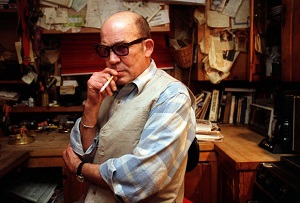
Hunter S. Thompson

De Amerikaanse schrijver en journalist Hunter Stockton Thompson werd geboren in Louisville (Kentucky). op 18 juli 1937. Hij groeide op in de Cherokee Triangle buurt in de Highlands en ging naar Louisville Male High School. Zijn ouders trouwden in 1935. Door de dood van de vader werden hun drie zoons: Hunter, Davison en James opgevoed door hun moeder, een alcoholiste. Na vroege aanrakingen met de politie meldde hij zich als onderdeel van zijn straf bij de Amerikaanse Luchtmacht. Op Eglin Air Force Base in Florida begon hij in 1956 als sportjournalist te schrijven voor het nieuwsblad van de basis. In 1958 werd hij weggestuurd bij de luchtmacht. Hierna werkte Thompson kort als redacteur voor Time Magazine in New York. Thompson reisde door Peru, Colombia en Brazilië. Hier schreef hij als freelance journalist artikelen voor meerdere Amerikaanse kranten. In Puerto Rico werd hij bevriend met journalist William Kennedy en werd Zuid-Amerika-correspondent voor onder andere het tijdschrift The National Observer. In 1966 trok hij een tijd op met een groep Californische Hells Angels. Hij schreef over hen een serie artikelen die in 1967 werd gebundeld onder de titel "Hell's Angels: A Strange and Terrible Saga Of The Outlaw Motorcycle Gangs". Aan het eind van de jaren zestig ging hij als een van de eersten voor het nieuwe tijdschrift Rolling Stone werken. Zijn excentrieke levensstijl en schrijfstijl was een van de factoren achter het succes van "Rolling Stone". Thompson creëerde een geheel eigen journalistieke stijl met als voornaamste kenmerk dat hij niet zijn onderwerp maar zichzelf centraal stelde; hij noemde dit gonzojournalistiek, een in drugs gedrenkte variant van new journalism. Zijn bekendste werk uit deze periode is “Fear and Loathing in Las Vegas, and Other American Stories” (1971), dat in 1998 door Terry Gilliam zou worden verfilmd met Johnny Depp en Benicio Del Toro. In 1972 schreef hij voor Rolling Stone een serie reportages over de Amerikaanse presidentsverkiezingen van 1972, waarbij hij nauw betrokken raakte bij het kamp van presidentskandidaat George McGovern. Thompson schreef daarna uitvoerig over het Watergateschandaal en steunde bij de daarop volgende presidentsverkiezingen van 1976 al vroeg de toen nog onbekende Jimmy Carter. Als buitenlandcorrespondent berichtte Thompson in 1983 over de invasie van de Amerikaanse mariniers in Grenada. Op 67-jarige leeftijd werd hij door het hoofd geschoten aangetroffen door zijn zoon Juan Thompson op zijn Owl Farm in Woody Creek bij Aspen (Colorado). Op grond van de schotwond oordeelde de politie dat er sprake was van zelfmoord.

Uit: Fear and Loathing in Las Vegas

“We were somewhere around Barstow on the edge of the desert when the drugs began to take hold. I remember saying something like "I feel a bit lightheaded; maybe you should drive. ..." And suddenly there was a terrible roar all around us and the sky was full of what looked like huge bats, all swooping and screeching and diving around the car, which was going about 100 miles an hour with the top down to Las Vegas. And a voice was screaming: "Holy Jesus! What are these goddamn animals?"
Then it was quiet again. My attorney had taken his shirt off and was pouring beer on his chest, to facilitate the tanning process. "What the hell are you yelling about?" he muttered, staring up at the sun with his eyes closed and covered with wraparound Spanish sunglasses. "Never mind," I said. "It's your turn to drive." I hit the brakes and aimed the Great Red Shark toward the shoulder of the highway. No point mentioning those bats, I thought. The poor bastard will see them soon enough.
It was almost noon, and we still had more than 100 miles to go. They would be tough miles. Very soon, I knew, we would both be completely twisted. But there was no going back, and no time to rest. We would have to ride it out. Press registration for the fabulous Mint 400 was already underway, and we had to get there by four to claim our soundproof suite. A fashionable sporting magazine in New York had taken care of the reservations, along with this huge red Chevy convertible we'd just rented off a lot on the Sunset Strip ... and I was, after all, a professional journalist; so I had an obligation to cover the story, for good or ill.
The sporting editors had also given me $300 in cash, most of which was already spent on extremely dangerous drugs. The trunk of the car looked like a mobile police narcotics lab. We had two bags of grass, 75 pellets of mescaline, five sheets of high-powered blotter acid, a salt shaker half full of cocaine, and a whole galaxy of multi-colored uppers, downers, screamers, laughers ... and also a quart of tequila, a quart of rum, a case of Budweiser, a pint of raw ether and two dozen amyls.
All this had been rounded up the night before, in a frenzy of high-speed driving all over Los Angeles County – from Topanga to Watts, we picked up everything we could get our hands on. Not that we needed all that for the trip, but once you get locked into a serious drug collection, the tendency is to push it as far as you can."


 2122409-67ae6cab442f7ee1928512ff92308a40.jpg
Hunter S. Thompson (18 juli 1937 – 20 februari 2005)

Geschreven door Romenu om 00:00 Reageer op dit bericht

Martin R. Dean, Rainer Kirsch, Eelke de Jong, Alie Smeding, Paul Lomami Tshibamba, James Purdy, Roger Garaudy, Clara Viebig, Lilian Loke

De Zwitserse schrijver Martin R. Dean werd geboren op 17 juli 1955 in Menziken Aargau. Zie ook alle tags voor Martin R. Dean op dit blog en ook mijn blog van 17 juli 2010.

Uit:The Guyana Knot (Vertaald door Nadia Lawrence)

“First of all, I’ll lie down. You have to dream a city first, before you can take possession of it. Then I’ll take my clothes out of the suitcase and spread them around the room; I shove the heavy metal trunk with the work tools under the bed, to begin with. I won’t need it for my first appearance. Till then I’m a normal traveler.
The hotel room is a strange thing. The white walls radiate the blind concentration of a delivery room; towards evening they become crowded with colorful plays of light and shade, which gently heave and sway this way and that and simulate a deep ocean bed. One of the walls, the east wall, curves into the middle of the room with a wide, full angel’s swing. I felt as if I was in a submarine when I came in. There were the round windows too, molded in greyish cast iron, three bull’s eyes which lure you towards three different views.
In a certain evening light, the south window goes blind and reflects the Vittorio Emanuele monument. Behind that gleam the enormous incisors of the Colosseum. I think about the story of the hotel rooms I’ve stayed in while I’ve been on tour. In northern Germany, melancholy square double bedrooms with a rustic feel and a luxury that amazed me. Further north, purple or mustard patterned carpets, rooms which chilled or nauseated me, all of them overheated. Instead of enjoying a view of chimney pots or shrubby pedestrian precincts, I watched TV for hours at a time. Like someone chained to the bed, I shuddered at the sight of politicians, priests and sportsmen, waffling entertainers in gloomy brewery cellars.
Still further north, in Sweden, I was brought to a room completely lined in blood-red velvet. Outside it was pitch dark and cold, Stockholm in never-ending rain. I sat tight in that room; the blood-red walls flowed over my hands and feet, trickled over my body. I showered half a dozen times and switched on every available lamp. Rainwater clung to bull’s eye window panes as thick as my finger; the only window looked out onto a murky inner courtyard into which, I imagined, a small girl with red glowing eyes and a slit throat was throwing herself, over and over again. Stockholm, an ode full of blood; through my mind ran images of murder, incest, torture and refined methods of mutilation. After ten days I traveled on to Helsinki. There I was met by pure coffin wood, the euphoria of a hotel room lined with pale pinewood. Pinewood, wherever I looked: there wasn’t half an inch in this shack that wasn’t made of that wood. The bed and the walls, the rails and the shower, the breakfast dishes and the chairs and tables—everything was made of pinewood. Looking out of the window, I still saw nothing but pine trees, though in between was sand and a few heavy birches, and in the distance, where the wet black sky stuck, a dreary sea. Not the foamy, steel blue sea of the south, but a northern sea welded tightly into the horizon, heaving up and down, thick and filthy. Up here, life came to an end; obscene fact, everything lay limply on the ground and wallowed in its own oily daze.“


 2056153-c7b557a9ae403ffc79c9228c4b7ac8fd.jpg
Martin R. Dean (Menziken, 17 juli 1955)


De Duitse dichter en schrijver Rainer Kirsch werd geboren op 17 juli 1934 in Döbeln. Zie ook alle tags voor Rainer Kirsch op dit blog en ook mijn blog van 17 juli 2010.


Claudine oder die Zeitläufte

Hübsche Claudine, mußt du bei mir weinen?
Dein Loch ist wundersüß, ich gönn es keinem
So glatt wie mir, doch kann ichs nicht verwalten
Als Eigentum: Schwäch wen du schwächst!, und halten
Dich andre aus, sei seufzend guter Dinge.
(Es gibt der Güter schlimmere und geringe,
Das schlimmste ist: Claudine unverspundet.)
Dann nämlich will sie, daß die Welt gesundet,
Und wenn die Welt das nicht so eilig möchte,
Schwindelt Claudine sie höchst laut zurechte.
Und weil das wehtut, kommen ihr die Tränen.
Es ist ja wahr: ein Balg mit Sägespänen
Strengt nicht so an; was mach ichs dir? Mir scheint:
Weil Eine weniger dann lügt und weint.


Im Maß Petrarcas

Wolltest du ich sein wie ich du bin: Wäre
Zeit Unzeit dann, der festentflochtenen Haare
Aschblondheit Regen, mit dem Tag und Jahre
Rückfielen wie in mondbewegter Meere
Hinspiel und Gegenspiel, da schlagend Wellen
Getier am Ort belassen, Größeres treibend
Und wir, im salzigtrüben Tiefen, bleibend?
Wirkten des Welttods Gegengrund im schnellen
Gemeinen Wechsel, der wie lang er währte
Um was sonst Zeit ist fischgleich Strudel, nährte
Die unser Atmen aufschickt und erhält?
Dein Haar ists, das mir in die Augen fällt
Daß ich neu sähe; was? was Blinde sehen.
Sprich was du weißt, die Augenblicke gehen.


 2056153-8b6d022c162b6f9436ae0c3c45443a15.jpg
Rainer Kirsch (17 juli 1934 – 14 september 2015)
Cover


De Nederlandse schrijver Eelke de Jong werd geboren in Apeldoorn op 17 juli 1935. Zie ook alle tags voor Eelke de Jong op dit blog.

Uit:Paris mon amour

“Vandaag laat, d.w.z. 'n uur of 10 ontwaakt met uitgedroogde ofwel verschrompelde mondholte en zware druk op de ogen, poosje op de rand van het bed gezeten, 'k word elke morgen beroerder wakker. Niets schijnt zo uit te putten als de nachtrust. Heeft niets te maken met drankmisbruik, want daar probaat middeltje op gevonden, nl. 2 Entosorbinetabletjes voor het slapen gaan, die een kalme spijsvertering, 'n gezonde ontlasting garanderen, maar zou graag willen weten wat wél de oorzaak is. Lange tijd gedacht, dat m'n bed in een aardstraal stond en derhalve verlangend uitgezien naar eerstvolgende wenk voor een logeerpartij. Uitnodigingen lieten echter op zich wachten en toen maar kamer in hotel besproken om proef op som te nemen. Even besodemieterd wakker geworden, dus theorie ging niet op.
Voor de spiegel zag ik bleek, 'n ongezonde midwinterkleur met de zomervakantie nog maar net achter de rug, 'n rode gloed over de ogen, hologig tb-lijdertje, vreemde.
Laat d.w.z. uur of half 12 honden uitgelaten. Sprongen vrolijk tegen me op, geen verwijt dat ze circa een etmaal in een klein kamertje opgesloten waren geweest, maar dieren hebben misschien geen besef van tijd, alleen honger.
Naar de dijk. Tijdje op een door raadselachtige hand hier achtergelaten boomstam gezeten tot 't begon te regenen.
Opgestaan en verder gewandeld. Tekkel had 'n pootje van 'n haas gevonden. Afgepakt, hondje weggebonjourd, keek me nog leep na, pootje zag er onbeschadigd uit. Rest van haas echter niet gevonden.
Toen 't droog werd een tijdje op een steen op een knik in de dijkrug gezeten. De lucht zag grauw, maar in de verte vertoonden zich boven de stad opklaringen.
Jongensstemmen van een onzichtbaar sportveld, daarachter rij peppels, torens van flats, hotels, kantoren, fabrieken.”

 2056153-e9974fe51395072cbbf12faa3c3e71e1.jpg
Eelke de Jong (17 juli 1935 – 1 augustus 1987)


De Nederlandse schrijfster Alie Smeding werd geboren in Enkhuizen op 17 juli 1890. Zie ook alle tags voor Alie Smeding op dit blog.

Uit:Duivelsnaaigaren

“Fem morrelde moeizaam de roestige grendels van de achterdeur af, de scharnieren krasten als raven, gelijk met de glanzende ochtend boog een verwaaide Ribesstruik de keuken in.
Onder haar hand uit, keek ze op in de witte dag.
Het voorjaar stond als een bonte prent van groen, rood en zilver voor haar knipperende oogen en in haar neus drong als een krieuwel, een overzoete geur.
Zij ademde ingehouden als in tegenzin, en haar kuisch-dunne mond kneep in kleine dwarse plooien bijeen, of ze wat bitters proefde. ‘Ik geloof,’ zei ze vaag in zich zelf, ‘dat ik er bang van ben.’ Haar mat-grijze oogen werden donker, en in haar breedwit gezicht trokken de rimpels veel te diep.
Werktuigelijk streek ze een haarpiek terug in haar dikke zwarte vlechten, toen zag ze ook weer de zware gouden ring met de bloedroode camee aan haar middenvinger, en dacht aan haar verjaardag...
Fronsend een beetje, draaide ze de scheef-gezakte steen terecht, onder het wat knobbelige vingerkootje, en ademde op het flonkerende kopje van koraal. ‘Lief,’ waardeerde ze, ‘van Grômoeder, zoo'n mooie ouë ring, er zat ook vast wel wat intiems aan vast, 'n geschiedenis uit Grômoeder's jonge jaren. Daarom had zij hem zeker ook aangehouën van nacht: 'n ring die met 'n belofte gegeven was misschien, en met 'n zoen. Grômoeder had zoo genoeglijk zitten te kijken over haar bril heen...’
Fem plukte met haar handen aan haar bovenlip. Haar glimlach aarzelde en vergleed... donkere gedachten sloegen een stempel...
Ze boog de Ribes-tak terug en liep over de rinkelende blauwe tegels van de plaats, het tuintje in.
Schel-bont en schaterend glansden er de roode en witte tulpen in het midden-bed, en de forsch-opgeschoten hyacinthen stonden als zuiltjes van geur in de halvemaan-perken.
Fem trok haar lip op - als misprijzend. ‘Verleden jaar was 't ook zoo en eer-verleden jaar en al die jaren terug...’
Het brak in haar luisteren.
Achter de hooge dijkrug - oostwaarts van het land - spoelde de stem van de zee aan - gelijkmatig en klein - of zij telkens een enkel eender-klinkend woord neerlei op het slik.”


 2056153-b07dc387b02a4beb6161660bf6360c7f.jpg
Alie Smeding (17 juli 1890 - 5 juli 1938)
Enkhuizen


De Congolese schrijver en journalist Paul Lomami Tshibamba werd geboren op 17 juli 1914 in Brazzaville. Zie ook alle tags voorPaul Lomami Tshibamba op dit blog.

Uit: Ah ! Mbongo

« Il n’est peut-être pas sans intérêt, pensons-nous, de débuter par la présentation du principal personnage qui est à l’origine des péripéties dont nous suivrons plus loin la trame. Nous estimons donc opportun qu’avant de lui emboîter le pas tout au long de la succession des épisodes où l’entraînera l’engrenage des événements, de faire prendre connaissance aux lecteurs de l’état civil circonstancié se rapportant aux particularités plutôt singulières de sa venue au monde.
Son nom est Gikwa. Il descend d’un grand chef des Hoto Mbanza1, une des grandes branches parmi les tribus d’Oubangui. Son aventure se situe dans les années 20. À une époque où, douze ans après avoir été cédé à la Belgique, le fantomatique « État Indépendant du Congo » du roublard Mfumu Mandefu Léopold II était assujetti à un nouveau statut et baptisé Colonie du Congo belge, dont les indigènes étaient taillables et corvéables à merci, tout comme ils le furent durant le règne du souverain-monarque belge. Redevenant ainsi le sosie de l’ancien « Empire du Silence », il était particulièrement marqué par des situations « héroïques », sous des fourches caudines, grâce à la servilité admirablement conjuguée au mutisme : deux solides éléments du gond sur lequel s’articulait la « civilisatrice sujétion » pour le plus grand bien des indigènes soigneusement « chosifiés ». Ainsi le plus bel humanisme proclamé par les nouveaux maîtres ne réussissait qu’à étamer l’oxyde de l’humanisme léopoldien avide d’ivoire et de caoutchouc… Le prince Gikwa était un des indigènes de cette époque « nouvelle »
Au lendemain d’une nuit orgiaque, les Hoto Mbanza ivres de fatigue se reposaient. Les hommes surtout : étendus çà et là sous l’auvent de leur case ou sous l’ombre d’un arbre à proximité, tous ronflaient, chacun sur sa chaise longue, un siège soporifique par excellence. Il y en avait cependant qui, malgré la pression de la torpeur rendue opiniâtre par la tumultueuse frairie de la veille, résistaient à l’assoupissement tout en demeurant immobiles, comme momifiés, ne réagissant même pas aux picoteries agaçantes des mouches. Bien entendu, dans cette prostration générale, aucun promeneur ne manifestait la moindre présence. »


 2056153-a9658a817d2f09bd935227d00e514b7c.jpg
Paul Lomami Tshibamba (17 juli 1914 – 12 augustus 1985)


De Amerikaanse schrijver James Purdy werd geboren in Fremont in de staat Ohio op 17 juli 1914. Zie ook alle tags voor James Purdy op dit blog.

Uit:Eustace Chisholm And the Works

“Eustace Chisholm's street, with the Home for the Incurables to the south and the streetcar line to the west, extended east up to blue immense choppy Lake Michigan. South of its terminus the great gray museum took up acres and acres with its caryatids, and further south rose the steel mills of Gary and South Chicago with their perpetual vomit of fire. Further down his street in a westerly direction, before Washington Park slipped into the colored ghetto, there was a rose garden in which the German poet, Lessing, sat among the blooms. Here amid the industrial whirlwind of America's economic burnout, the unemployed, in nondescript small separate armies, with a generous sprinkling of white youths from small towns and farms and up-from-the-South Negroes, stood in line to go on relief. Eustace Chisholm had been caught up in two tragedies, the national one of his country's economic collapse, and his failed attempt to combine marriage with the calling of narrative poet. He wondered whether it was because of his inability to produce a book or merely the general tenor of the times that his wife, Carla, who had supported him hand and mouth for two years, ran out on him with a baker's apprentice some six months before this story begins. Eustace answered for his failure as a writer on the grounds that he was too far distant from the great monopoly city of New York, claiming that no Chicago writer could become famous until he had departed the gem of prairies. Yet he dared not ever run the risk of abandoning his coign of vantage on Fifty-fifth Street, with the concomitant danger of losing his native accent and vision, so Eustace stayed in Chicago, where he was known by intimates and strangers as Ace. The original name, like a scar, he reopened each morning while shaving. "I am Eustace," he would mumble into the mirror. On the day this story begins Ace had been to the Catholic Salvage to see about getting an extra mattress, for Carla had taken the only good one when she had run off.


 2056153-066d2a8a3f6bfdbc3717bb20ff2014dc.jpg
James Purdy (17 juli 1914 - 13 maart 2009)
Cover


De Franse schrijver, filosoof en politicus Roger Garaudy werd geboren in Marseille op 17 juli 1913. Zie ook alle tags voor Roger Garaudy op dit blog.

Uit:Comment construire l'unité humaine

« Le point de départ de l'éducation, c'est cet acte créateur de l'homme.
C'est aussi son point d'arrivée: faire de chaque homme un homme, c'est-à-dire un créateur, un poète.
Comment alors peut se situer la création artistique dans le développement de l'acte humain du travail, de la création continuée de l'homme par l'homme?
Comment le mythe peut-il être une composante de l'action pour transformer le monde?
S'il est le langage de la transcendance, cette transcendance ne peut être pensée en termes d'extériorité ni de puissance: ni transcendance d'en haut d'un Dieu, ni transcendance d'en bas d'une nature donnée toute faite.
Le mythe n'est pas participation mais création.
Le mythe chez Marx, n'est pas, comme chez Freud, une traduction, même sublimée, du désir, mais un moment du travail.
Différence fondamentale, car le désir prolonge la nature alors que le travail la transcende.
Faire du travail la matrice du mythe, comme d'ailleurs de toute culture par opposition à la nature, nous permet déjà de tracer une ligne de démarcation entre le symbole onirique et le symbole mythique. Le premier est expression ou traduction du désir, le second est un moment de la création continuée de l'homme par l'homme, sous forme poétique, prophétique, militante, mais toujours prospective.
Ainsi est écartée la confusion entre le mythe proprement dit et ce que l'on appelle faussement de ce nom: si le mythe est ce moment du travail par lequel l'émergence de l'homme s'affirme avec cette dimension nouvelle de l'être: l'efficace du futur, l'on ne saurait appeler mythe ce qui est simple survivance du passé, la raison paresseuse et dépassée de l'allégorie ou des fables étiologiques. Pas davantage ce qui est simple reproduction ou conservation du présent par une image qui devient norme de conduite. Ce stéréotype social, démultiplié par la propagande ou la publicité, est illusion et aliénation. Il tend non à promouvoir l'histoire mais au contraire à l'arrêter en donnant seulement un visage au désir; et en laissant l'homme tourner en rond, dans le cercle fermé de l'instinct. Les variantes en sont nombreuses, depuis la propagande hitlérienne de la race, ou l'érotisme comme moyen de publicité. Jusqu'à cet ersatz dégradé du héros mythique que constitue l'idole, offrant à la jeunesse l'illusion compensatrice d'une vie aliénée, d'une vie par procuration grâce à l'inflation du mythe: Diana pour Bérénice, Madonna pour Aphrodite…"


 2056153-56c358e787840f76d72ff59fca5f5831.jpg
Roger Garaudy (17 juli 1913 – 13 juni 2012)


De Duitse schrijfster Clara Viebig werd geboren op 17 juli 1860 in Trier. Zie ook alle tags voor Clara Viebig op dit blog.

Uit: Vor Tau und Tag

„Vom Waldrand her kommt Vogelgezwitscher, und in den Hecken am Weg regt sich's auch; es hüpft, es schlüpft, es piept, es jagt und erhascht und schnäbelt sich — Frühling! Die Schlehen blüh'n, der Himmel ist lichtblau; um die Zweige, die, zitternd vor Glück, die ersten grünen Blättchen tragen, fächelt der laue Wind. Aus dem Wald treten zwei Gestalten, ein Mädchen und ein Mann; nun wandern sie langsam den schmalen Grasrain entlang. Rechts und links die Hecken sind hoch, die beiden gehen dahinter wie von einem Schirm gedeckt, die Welt sieht sie nicht; aber sie küssen sich doch nicht. Nun gehn sie auch nicht mehr nebeneinander; das Mädchen schlendert voran, hebt das Gesicht zum Himmel auf und versucht gleichgültig auszusehen. Sie ist sehr schlank, jung, sehr hübsch, und sind ihre Wangen auch nur schwach rötlich angehaucht, wie die Blätter der Dijon-Rose, es pulst doch gesundes warmes Blut in ihnen. Sie ist ganz frisch, ganz unberührt. „Maria", sagte der Mann leise. Er hielt die Blicke unverwandt auf die schlank vor ihm Herwandelnde geheftet, und das Blut stieg ihm heiß in die Stirn. Der Hut drückte ihn wie im heißen Sommer, er nahm ihn ab und fuhr sich mit gespreizten Fingern durchs Haar. „Maria —!" Sie drehte sich nicht um, sie hielt immer das Gesicht geradauf zum Himmel gerichtet. „Maria," sagte er wieder, „Maria, sei doch nicht so stumm! Was hab' ich dir getan? Eben warst du noch so fröhlich, und nun ist alles wie fortgeweht. Was hast du?" Ihre zartgefärbten Lippen drückten sich mit leisem Zucken aufeinander, ihre Augen zwinkerten.
„Maria,” fragte er, „bin ich dir denn zuwider? Das habe ich nicht gedacht!" Er machte einen raschen Schritt, um neben sie zu treten; sie machte noch einen rascheren und war ihm wieder voraus. Noch immer keine Antwort. Zwei, drei Minuten vergingen. Der Wind strich lau durch die Hecken und zupfte der Schlehe ein paar weiße Blüten aus der schimmernden Brautkrone; ein Vogelpärchen verkroch sich, lockend, tiefer ins lauschige Versteck. Antwortete sie jetzt? Der Mann lauschte — nein! „So war es eine Täuschung", sagte er bitter. „Ich werde morgen früh abreisen." „Nein, o nein!" Hastig fuhr Marias Kopf herum, die Augen blitzten angstvoll. „Schon — abreisen —?!"


2056153-e52c035eef7e38597df99083245677b4.jpg
Clara Viebig (17 juli 1860 – 31 juli 1952)
Cover biografie


Onafhankelijk van geboortedata

De Duitse schrijfster Lilian Loke werd geboren in 1985 in München. Zie ook alle tags voor Lilian Loke op dit blog.

 Uit: Gold in den Straßen

„Zurück in seiner Wohnung, stopft er vor Wut die Sportkleidung und Laufschuhe in den Müll, fuck Adidas Supernova Glide Boost, fuck Continental-Außensohle, optimale Griffigkeit bei Nässe, Meyer hätte mit seinem Arsch zu Hause bleiben sollen, sein Hals, sein Kopf, jeder Muskel schmerzt, er fühlt sich fiebrig, überhaupt nicht in der Lage, gleich diesen Termin wahrzunehmen, aber er muss sich zusammenreißen, duscht, zieht sich um, in nicht mal einer Stunde muss er in Kronberg sein, um das Haus für die Besichtigung vorzubereiten, und, wie Falber ihn gestern bereits gewarnt hat, Brink kam bisher immer zu früh.
Meyer wirft seine Aktenmappe auf den Rücksitz, schlägt die Wagentür zu, überprüft noch mal sein Outfit für Brink in der Spiegelung der Autoscheibe, der neue tiefblaue Einreiher, weißes Hemd, silbergraue Krawatte, passendes Einstecktuch. Auf der Kappe seines Schuhs entdeckt er einen kleinen Fleck, wischt ihn mit etwas Spucke weg. Bevor er in den Wagen steigt, breitet er zur Sicherheit ein frisches Handtuch auf dem Sitz aus. Er bildet sich ein, das Leder sei immer noch sandig und klamm, die ganze Kabine rieche nach dem Moder des Weihers.
Als Meyer die Kronberger Villa betritt, strömt ihm der schwache Duft von Möbelpolitur entgegen, die Putzleute waren gestern da, Meyer öffnet die Fenster, legt die Sicherungen um, kontrolliert alle Räume, verbringt fast zwanzig Minuten damit, in den düsteren Ecken Licht zu machen, aber dann liegt alles in warmem Glanz. Zum Schluss platziert er das bestellte Blumenarrangement auf dem Tisch in der Eingangshalle, bevor er sich kurz auf den Absatz der Treppe setzt, spürt, wie ihm die Handflächen feucht werden. Ihn packt immer noch das Lampenfieber bei jeder großen Besichtigung, ein Gefühl, als sirre jede Faser seines Körpers, Angst, aber noch mehr die Lust auf Performance, sich ganz hineinzulegen in den Verkauf. Meyer steht auf, atmet durch. Heute verkuppelt er den alten Brink. Anfang sechzig, Unternehmer, Chemieindustrie, zu viel Aftershave und keine Spur von Grau im Haar, nur ein verdächtiger Violettstich im Braun.“


 2056153-d3fea0eb4611c77d4fc0a6d07cfa7ce8.jpg
Lilian Loke (München, 1985)


Zie voor nog meer schrijvers van de 17e juli ook
mijn blog van 17 juli 2016 deel 2.

Geschreven door Romenu om 18:34 Reageer op dit bericht

Donald Davie

De Engelse dichter en criticus Donald Alfred Davie werd geboren op 17 juli 1922 in Barnsley, Yorkshire. Hij begon zijn opleiding aan de Barnsley Holgate Grammar School en doorliep later het St Catharine's College in Cambridge. Zijn studies daar werden onderbroken tijdens de oorlog door zijn dienst bij de Koninklijke Marine in het Russiche deel van de Noordpool, waar hij zichzelf de taal leerde. In het laatste oorlogsjaar, in Devon, trouwde hij met Doreen John. Na zijn terugkeer in Cambridge, vervolgde hij zijn studie en behaalde hij zijn B.A., M.A. en Ph.D. Hij keerde terug naar Cambridge in 1958 en werd in 1964 de eerste hoogleraar Engels aan de nieuwe universiteit van Essex. Hij doceerde Engels aan de universiteit van Essex van 1964 tot 1968, toen hij verhuisde naar Stanford University, waar hij Yvor Winters opvolgde. In 1978 verhuisde hij naar de Vanderbilt University, waar hij les gaf tot zijn pensionering in 1988. Hij schreef vaak over de techniek van poëzie, zowel in boeken als “Purity of Diction in English Verse”, en in kleinere artikelen zoals 'Some Notes on Rhythm in Verse'. Davie's kritiek en poëzie worden beide gekenmerkt door zijn interesse in modernistische en pre-modernistische technieken. Veel van Davie's poëzie is vergeleken met die van de traditionalistische Philip Larkin, maar andere werken zijn meer beïnvloed door Ezra Pound.


Across the Bay

A queer thing about those waters: there are no
Birds there, or hardly any.
I did not miss them, I do not remember
Missing them, or thinking it uncanny.

The beach so-called was a blinding splinter of limestone,
A quarry outraged by hulls.
We took pleasure in that: the emptiness, the hardness
Of the light, the silence, and the water’s stillness.

But this was the setting for one of our murderous scenes.
This hurt, and goes on hurting:
The venomous soft jelly, the undersides.
We could stand the world if it were hard all over.


In California

Chemicals ripen the citrus;
There are rattlesnakes in the mountains,
And on the shoreline
Hygiene, inhuman caution.

Beef in cellophane
Tall as giraffes,
The orange-rancher’s daughters
Crop their own groves, mistrustful.

Perpetual summer seems
Precarious on the littoral. We drive
Inland to prove
The risk we sense. At once

Winter claps-to like a shutter
High over the Ojai valley, and discloses
A double crisis,
Winter and Drought.

Ranges on mountain-ranges,
Empty, unwatered, crumbling,
Hot colours come at the eye.
It is too cold

For picnics at the trestle-tables. Claypit
Yellow burns on the distance.
The phantom walks
Everywhere, of intolerable heat.

At Ventucopa, elevation
Two-eight-nine-six, the water hydrant frozen,
Deserted or broken settlements,
Gasoline stations closed and boarded.

By nightfall, to the snows;
And over the mile on tilted
Mile of the mountain park
The bright cars hazarded.


 2135113-27dcf63f6cdc948ebe104c0696b92ba3.jpg
Donald Davie (17 juli 1922 - 18 september 1995)


Geschreven door Romenu om 00:00 Reageer op dit bericht

Meer van Romenu

↑ Terug naar de berichten