Naar de inhoud

Romenu

Over literatuur, gedichten, kunst en cultuur
akke.beakke.be

Berichten van 15 september 2017 tot 16 september 2017

Breyten Breytenbach, Alfred Schaffer, Frans Kusters, Michael Nava, Justin Haythe

De Zuid-Afrikaanse schrijver en dichter Breyten Breytenbach werd geboren op 16 september 1936 in Bonnievale. Zie ook mijn blog van 16 september 2010 en eveneens alle tags voor Breyten Breytenbach op dit blog.


(de buikspreker)

was het Rimbaud die de dichtkunst
aan de vooravond van zijn vertrek
naar Afrika
op de knie heeft genomen zodat ze
wenen kon?

want in Afrika
is het ’t voorrecht van een dichter
immers dat je niet hoeft in te staan
voor je opinies

je neemt het gedicht op je schoot
die schattige
buikpop:
en laat het dan een dans dansend
vrijheidsliederen zingen voor Afrika


aan de wereld te kunnen zeggen

aan de wereld te kunnen zeggen
de weg te onthouden
wanneer de gedachte aan
het grote vergeten voor
nog een aanlokkelijk avontuur is
te luisteren hoe de boom groeit
en de rondingen van de wind
met de hand te verkennen
te weten hoe de vernedering
van armoede vreet
en het verdriet van macht
met een vinger het bloed
te proeven en te schrijven
het gezicht van het wordwoord
te kunnen tekenen
het bestaan te zingen en te bezingen
dat de zin van het zijn het leven is


Vertaald door Laurens van Krevelen


spieden over de muur

eerst is er de zeer blauwe koepel
dan een gerafelde witte wolk zuiver wit
zoals het wit en enkel dromend
van een heel oude man met een ruw geheugen die toen hij nog jong was
zo veel van nachtvlinders hield

dan de halve cirkel van de maan
zo wit in die dag
een kaalkop met ouderdomsvlekken
de witgespikkelde kale kop van een heel oude stinkkaas-man
die door diepe waters loopt

en hoger dan de muren een vlinder wit dartelend
eerst een maar daarna twee in flappertonen
witte vlucht twee witte zakdoekjes één
in een onzichtbare trein

elke dag is huwelijk


Vertaald door Adriaan van Dis


 2073367-6973f090b2163f2818f0fb690b10a3e5.jpg
Breyten Breytenbach (Bonnievale, 16 september 1936)


De Nederlandse dichter Alfred Schaffer werd geboren in Leidschendam op 16 september 1973. Zie ook alle tags voor Alfred Schaffer op dit blog.


Kleine gezichten

Broers beschermen elkaar met messen
en stenen. Ze zijn jong en groot,
op zoek naar een vijand en vinden hem,
dagen hem uit.

Ze maken hun jongere broers vroeg wijs,
met hun kleine gezichten
waarop veel geschreven staat.
Hun moeder heeft de mooiste stem van alle moeders.

Op een bewolkte vakantiedag
voldoen de broers aan hun broederplicht,
dromen dat zij mannen werden
en zien niet vooruit.


De vertraging goedgemaakt

Op de donkerrode tennisbaan suist een bal heen en weer.
De tribunes zijn leeggehaald uit veiligheidsoverwegingen.

De formule bevredigt: de spelers imponeren als tijdens een topwedstrijd.
De lichamen in de juiste posities. Tot moord in staat.

Nu en dan slaat de vermoeidheid toe in de vorm van een reeks troebele
gedachten en het spel wordt gestaakt tot de spanningen verdwenen zijn.

Harder knalt de bal bij elk slag. In een melkwitte lucht.
De bal relativeert de regels van het spel tot in het oneindige.


 2073367-35aa279be10591939141bca8ba1b6091.png
Alfred Schaffer (Leidschendam, 16 september 1973)


De Nederlandse schrijver Frans Kusters werd geboren in Nijmegen op 16 september 1949. Zie ook alle tags voor Frans Kusters op dit blog en ook mijn blog van 16 september 2010.

Uit: Tussen de rododendrons (een fragment)

“Ik weet niet meer precies of de Nijmeegse rechtenfaculteit in twee- of drieëntachtig naar de Thomas van Aquinostraat is verhuisd. Wel herinner ik me dat ik, voor het zover was, met een collega aan het eind van een regenachtige ochtend naar de amper in de steigers staande bouwdelen 6 en 8 ben gefietst en dat wij, turend op een door weer een andere collega vervaardigd schetsje, probeerden te bepalen waar onze werkkamers zouden komen. Dat moest op de eerste verdieping van 8 zijn en volgens het document dat onder het hemelwater gestadig aan bruikbaarheid inboette zaten we schuin boven iets dat reska iii heette en driekwart van de begane grond in beslag moest gaan nemen.
‘De derde reska,’ sprak mijn collega nadenkend, ‘weet jij wat een reska is?’ De druppels dropen langs de veter waarmee hij zijn capuchon onder de kin had vastgestrikt en ik bracht met een stelligheid die mezelf verbaasde in het midden dat het hier om ‘een soort demonstratieruimte’ ging. Niet lang daarna wisten we beiden wel beter. Reska is een samenstelling van restaurant en kantine, een (om in de termen van het universitair management te spreken) immobiel verstrekkingspunt voor natte en droge voedingswaren waar het minuscule kuipje halvarine de naam ‘Bebo’ draagt en het tussen de middag altijd een drukte van jewelste is. Die collega was een zachtmoedige en inschikkelijke figuur; we wisten niet hoe we het hadden, toen hij tijdens een examenvergadering in een opwelling van niet voor mogelijk gehouden drift verklaarde dat hij liever met wachtgeld ging dan gedwongen te worden ook maar een minuut van zijn middagpauze in die ruimte door te brengen. Niemand van ons die iets zei; maar ik zag ze, stuk voor stuk, aan onverwerkte kostschoolbelevenissen denken en aan een proefschrift dat maar niet opschoot, zodat hij een benoeming tot hoofddocent wel kon vergeten, en aan het triestige van een leven dat met niemand wordt gedeeld. Maar dat had er allemaal volgens mij weinig mee te maken. Het was de angst voor de afgrond van iemand die aan hoogtevrees lijdt. Wij verzekerden hem dat het niet in ons hoofd zou opkomen hem tot wat dan ook te dwingen. En we vergaderden verder over het examen, alsof er niets was voorgevallen, een beetje goedlachser misschien dan voorheen.
Hij hield woord, de collega. Iedere middag, weer of geen weer, zagen we hem om kwart over twaalf stipt het instituut verlaten, zijn plastic boterhammentrommeltje onder de ene, een karton melk onder de andere arm. En wij, aan ons gezamenlijke middagmaal, smeerden de Bebo op ons brood en spraken over het bestaan van vrijgezel, dissertatieperikelen en traumatische jeugdervaringen waarmee iemand maar behept kan zijn.”


 2073367-359d7d4d3ca7eee62510dda0ef457d4c.jpg
Frans Kusters (16 september 1949 - 20 november 2012)


De Amerikaanse schrijver Michael Nava werd geboren op 16 september 1954 in Stockton, Calefornië. Zie ook mijn blog van 16 september 2010 en eveneens alle tags voor Michael Nava op dit blog.

Uit: Lay Your Sleeping Head

“I stood in the sally port until the steel door lurched back with a clang and then stepped into the jail. A sign ordered prisoners to proceed no further; an emphatic STOP was scrawled beneath the printed message. I looked up at the mirror above the sign where I saw a slender, olive-skinned, dark-haired man in a wrinkled seersucker suit. I adjusted the knot in my tie. A television camera recorded the gesture in the booking room where a bank of screens monitored every quarter of the jail.
It was six-thirty a.m., but in the windowless labyrinth of cells and offices in the basement of Linden’s City Hall, perpetually lit with buzzing fluorescent lights, it could have been midnight. Only mealtimes and the change of guards communicated the passage of time to the inmates. I had often thought the hardest part of doing time was that time stood still; serving a sentence must feel like scaling a mountain made of glass.
I stepped out of the way of a trustie who raced by carrying trays of food. Breakfast that morning, the first Monday of June, 1982, was oatmeal, canned fruit cocktail, toast, milk and Sanka—inmates were not allowed caffeine because it was a stimulant. Ironic considering the other stimulants that made their way into the jail; you could get almost any drug here. Jones stepped into the hall from the kitchen and acknowledged me with an abrupt nod. He had done his hair up in cornrows and his apron was splattered with oatmeal. On the outside, Jones was a short-order cook and a low level drug dealer. I’d represented him after his last bust. In exchange for snitching on some higher ups, I got him a plea, a reduced sentence and a guarantee he could serve it in county jail instead of state prison where his life expectancy would have been about that of a soap bubble. Unlike the prisons, the jail population was either transient or made up of inmates serving short sentences for relatively minor offenses. The deputy sheriffs who ran the place weren’t as tightly wound as prison guards and you didn’t see inmates sleeping in the halls or six to a cell because of overcrowding. Jail was easy time compared to the hard time at places like Folsom or San Quentin and a lot safer for a snitch like Jones. Still, county had the familiar institutional stink of all places of incarceration, a complex odor of ammonia, unwashed bodies, latrines, dirty linen and cigarette smoke compounded by bad ventilation and mingled with a sexual musk, a distinctive genital smell. The walls were painted in listless pastels, faded greens and washed-out blues like a depressed child’s coloring book, and were grimy and scuffed. The linoleum floor, however, was spotless. The trusties mopped it at all hours of the day and night. Busy work, I suppose."


 2073367-f8f7e11ec43984dc1b50cd03f3ad33b8.jpg
Michael Nava (Stockton, 16 september 1954)
Cover 


De Amerikaanse schrijver Justin Haythe werd geboren op 16 september 1973 in Londen. Zie ook alle tags voor Justin Haythe op dit blog en ook mijn blog van 16 september 2010

Uit:The Honeymoon

“For a moment, a breeze tapped the plants against the railing and then there was a version of silence, a flexing of the space that had swallowed her before Maureen returned. She was in the middle of saying something, but when she saw me she fell quiet. She looked around as if Claudia might have concealed herself in the shadows. She stepped out onto the patio, and without getting too close, peered over the edge. Maureen held me on her lap while we waited for the siren. Small breaths of steam escaped from the teapot. She served the tea to the police once she assured them we were in no way related to Claudia. She wandered around filling cups, the policemen thanking her politely. She forgot to put out ashtrays and after some hesitation, the men went ahead and ashed in their saucers. Marcel came home early from the jungle. Claudia's mother sat at the table in the living room where my mother had left the petit fours and the mail. Our bags were already in the hall. Maureen told her how sorry we were. The woman silently sipped her tea while Marcel stood at the window smoking cigarettes. They did not speak in our presence. Four bars had to be sawed away from the fence on the pavement when they cut Claudia's body free. Paris was finished. So was my mother's friendship with Marcel. And then there was the airport, the plane full of people, and the sky.

(...)

Maureen was too disorganized and in ways had too much faith to have made a duplicate. The dedication is to me—For Gordon, My Faithful Assistant (Of Course). To the front page she paperclipped two photographs of herself—potential dust jacket pictures, I imagine. The first was taken quite recently here in Cape Cod in cold black and white. In the picture she sits alert on her porch in a wooden deckchair. A corner of the wood-shingle house is visible behind her, a window stands open; it is warmer than it looks. Her face is thin; her hair has grown long again. She wears a coat over her shoulders. The smoke from her cigarette is washed away in the breeze, or perhaps it is unlit.”


 2073367-41aad3d1dfef675328963cbe1d67b332.jpg
Justin Haythe (Londen, 16 september 1973)


Zie voor nog meer schrijvers van de 16e september ook mijn vorige blog van vandaag.
Geschreven door Romenu om 10:10 Reageer op dit bericht

James Alan McPherson, Hans Arp, Andreas Neumeister, Anna Bosboom - Toussaint, Frans Eemil Sillanpää

De Amerikaanse schrijver James Alan McPherson werd geboren op 16 september 1943 in Savannah, Georgia. Zie ook mijn blog van 16 september 2010 en eveneens alle tags voor James Alan McPherson op dit blog.

Uit:A Region Not Home: Reflections from Exile

“I recall that in 1960, for example, something called the National Defense Student Loan Program went into effect, and I found out that by my agreeing to repay a loan plus some little interest, the federal government would back my enrollment in a small Negro college in Georgia. When I was a freshman at that college, disagreement over a seniority clause between the Hotel & Restaurant Employes and Bartenders Union and the Great Northern Railway Co., in St. Paul, Minn., caused management to begin recruiting temporary summer help. Before I was 19 I was encouraged to move from a segregated Negro college in the South and through that very beautiful part of the country that lies between Chicago and the Pacific Northwest. That year -- 1962 -- the World's Fair was in Seattle, and it was a magnificently diverse panorama for a young man to see. Almost every nation on earth was represented in some way, and at the center of the fair was the Space Needle. The theme of the United States exhibit, as I recall, was drawn from Whitman's "Leaves of Grass": "Conquering, holding, daring, venturing as we go the unknown ways."
When I returned to the South, in the midst of all the civil rights activity, I saw a poster advertising a creativewriting contest sponsored by Reader's Digest and the United Negro College Fund. The first story I wrote was lost; but the second, written in 1965, was awarded first prize by Edward Weeks and his staff at The Atlantic Monthly. That same year I was offered the opportunity to enter Harvard Law School. During my second year at law school, a third-year man named Dave Marston (who was in a contest with Attorney General Griffin Bell [last] year) offered me, through a very conservative white fellow student from Texas, the opportunity to take over his old job as a janitor in one of the apartment buildings in Cambridge. There I had the solitude, and the encouragement, to begin writing seriously. Offering my services in that building was probably the best contract I ever made.
I HAVE NOT recalled all the above to sing my own praises or to evoke the black American version of the Horatio Alger myth. I have recited these facts as a way of indicating the haphazard nature of events during that 10-year period. I am the product of a contractual process. To put it simply, the 1960s were a crazy time. Opportunities seemed to materialize out of thin air; and if you were lucky, if you were in the right place at the right time, certain contractual benefits just naturally accrued. You were assured of a certain status; you could become a doctor, a lawyer, a dentist, an accountant, an engineer. Achieving these things was easy, if you applied yourself.”


 2073361-6cf2dcbb483947d4c56de2ccf1e4a123.jpg
James Alan McPherson (Savannah, 16 september 1943)


De Frans-Zwitserse kunstenaar, dichter en schrijver Hans (Jean) Arp werd geboren op 16 september 1886 in Straatsburg. Zie ook mijn blog van 16 september 2010 en eveneens alle tags voor Hans Arp op dit blog.


Die Herzen sind Sterne (Fragment)

Wie schnell vergeht ein Leben
in Gottes lichtem Dunkel.
Kaum ist heute gesagt,
ist morgen schon vergangen.
Und so vergehen die Jahre
mit Spielen, Träumen, Säumen.
Und so vergeht die Zeit,
in der die Blumen schweben.

Wann blühen wir wieder
vereint an Gottes lichtem Strauch?
Wann ruhe ich für immer
in deinem reinen Hauch?


2073361-f859ef89bcb5b6548f09855344ebe6ab.jpg
Hans Arp, Human Concretion without Oval Bowl, 1933


Du lächelst,
um nicht zu weinen.
Du lächelst,
als würden lange noch
die guten Tage scheinen.
Deine Flügel glänzten
wie junge Blätter.
Dein Gesicht
war ein weißer Stern.

Seitdem du gestorben bist,
danke ich jedem vergehenden Tag.
Jeder vergangene Tag
bringt mich dir näher.


 2073361-3dd45dc0cadd26d65e6a962df548d1ba.jpg
Hans Arp (16 september 1886 - 7 juni 1966)
Hans Arp Museum Bahnhof Rolandseck in Remagen


De Duitse schrijver Andreas Neumeister werd geboren op 16 september 1959 in Starnberg. Zie ook alle tags voor Andreas Neumeister op dit blog en ook mijn blog van 16 september 2010

Uit: Könnte Köln sein

„Die neue Brücke der Hungerburgbahn über den Inn. Rechts ab. Bergisel Ski Jump. Das Beste an Innsbruck ist nicht das Goldene Dachl. Das Beste an Innsbruck war nicht die gewonnene Schlacht gegen Franzosen und Bayern. Das Beste an Innsbruck ist Frau Hadids neue Sprungschanze. Vier-Schanzen-Tournee: Wegen Zaha Hadids neuer Sprungschanze zum ersten Mal ein echtes Skispringen in Echtzeit am Fernseher verfolgt. Wer hat gewonnen? Zaha Hadid. Schlacht am Bergisel. Wer hat gewonnen? Am besten sieht die Schanze in der Dämmerung aus, wie sie da erleuchtet aus dem finsteren Schlachtwald emporsteigt und als schick behelmter Kopf nach Süden schaut. Den windschnittigen Kopf frisch gewaschen gegen den Wind stemmt. (Föhn, der aus dem Süden ins Tal pfeift)

The Europabruecke (Bridge Europe), located just outside of Innsbruck, a few kilometers north of the Brenner Pass, is a large concrete bridge carrying the six-lane autobahn over the valley of the Sill River. 180 meters tall and 820 meters long, it was celebrated as a masterpiece of engineering upon its completion in 1963

Ingenieursbaukunststück Europabrücke. Irgendein Rekord zu ihrer Zeit. Riesige Spannweite in Beton und Spannstahl gemeistert

Den sanften Schwung der Brennerautobahnbrücken sieht man nicht von der Autobahn. Den sanften Schwung der Brennerautobahnbrücken sieht man am besten von der weit ausholenden Bundesstraße. (Vater hat nie Stahlbrücken gebaut, Vater hat immer nur Spannbetonbrücken gebaut, Vater hat meistens gerade Brücken gebaut)“


 2073361-5c4e12b23d27819ba322bd0fc2051fb9.jpg
Andreas Neumeister (Starnberg, 16 september 1959)
Starnberg


De Nederlandse schrijfster Anna Bosboom - Toussaint werd geboren op 16 september 1912 te Alkmaar. Zie ook alle tags voor Anna Bosboom – Toussaint op dit blog en ook mijn blog van 16 september 2010

Uit:Engelschen te Rome

“Wie lust heeft den loop van dit verhaal te volgen, verplaatse zich in verbeelding binnen Rome, maar Rome in 1587. Ik heb dat woord slechts te uiten en de lezer denkt zich de stad, die tweemaal heerschappij heeft gevoerd over de wereld; eene heerschappij, die zij nog niet heeft opgegeven. De stad, die tweemaal een stoffelijk en een zedelijk overwicht gehad heeft over de volkeren, het Rome der Consuls en der Cesars, door het zwaard en de wet; het Rome der Pausen, door den banbliksem en het kruis; de stad, waarvan de Sibyllijnsche boeken voorspeld hebben, dat zij sterker zijn zoude dan de tijd! Zij ook die profetie valsch, moet Rome den tol betalen, dien zij zelve Karthago heeft afgeëischt, dien Babylonie heeft moeten brengen! Wie toch zoude Vandaal genoeg zijn, om er met koelheid aan te denken, hoe de Zeven-heuvelenstad langzaam in zich zelve verkwijnende, roemloos vergaande onder vermolming en onedel wormgeknaag, onbemerkt zal afnemen onder de stil vernielende beten van den tijd, zooals eene moerassige kust langzaam wegslibt onder de trouwelooze liefkoozingen van den oceaan,zoo onbemerkt zelfs, dat niemand het rechte uur van haren dood zal weten, omdat de wereld sinds lang niet meer aan haar dacht, of haar reeds dood waande, toen ze nog op haar uitterend sterfbed lag. Wie is zoó kond voor de poëzie der geschiedenis, om zich zonder weemoed voor te stellen, dat Rome zou kunnen wegsterven als eene andere stad, die uitgewischt wordt uit de rij der steden, en om niet liever te wenschen. dat haar val een ontzettend verheven, een schrikkelijk grootsch schouwspel mocht zijn, waarop de volkeren met siddering staarden, en waarbij de wereld eenen langen lijkzang aanhief, een val, die de aarde zonde schokken als eene hevige stuiptrekking, opdat hare aspunten het weten konden, dat de wereldstad gevallen was! En waarom zoude zij nog niet eenmaal kunnen opflikkeren tot eenen schijn der vorige schittering, om te eindigen zooals Rome eindigen moet? Terwijl ik met beschouwingen speel, is de lezer misschien reeds op het St. Pietersplein ; hij heeft misschien reeds eene standplaats gekozen, dicht bij de trappen van het Vatikaan, hij ziet de Engelenburg, de St. Pieterskerk, het laatste wonder der bouwkunst, de gedenkteekenen der oudheid, die weder vernieuwd zijn geworden, en wat niet al, dat ik niet beschrijven zal, omdat het reeds duizendmaal beter gedaan is, dan ik het zoude kunnen doen, omdat ieder het weet, en eindelijk ook, omdat ik slechts vertel en niet schilder.”


 2073361-4da916f9f1152fe455d1aec4e3fd67b5.jpg
Anna Bosboom – Toussaint (16 september 1812 – 13 april 1886)


De Finse schrijver en Nobelprijswinnaar Frans Eemil Sillanpää werd geboren in Hämeenkyrö op 16 september 1888. Zie ook alle tags voor Frans Eemil Sillanpää op dit blogen ook mijn blog van 16 september 2006 en mijn blog van 16 september 2010

Uit: Silja ou une brève destinée (Vertaald door Jean-Louis Perret)

« Silja, la belle jeune campagnarde, s'éteignit, une huitaine de jours après la Saint-Jean, alors que l'été rayonnait dans toute sa fraîcheur. Elle eut une fin très convenable, étant donné sa condition. Bien qu'elle ne fût qu'une servante orpheline de père et de mère, et sans autres parents à qui s'adresser, et bien qu'elle dût recourir un temps aux soins d'autrui, elle put se passer de l'assistance publique : ainsi lui fut épargnée cette petite laideur pourtant bien anodine.
(…)

"L'amour commence, malheureusement, toujours par la période la plus délicate, si bien qu'il ne peut que se souiller avec le temps. L'amour d'un homme et d'une femme est un organisme dont les veines et les fibres, une fois rompues, ne peuvent plus se ressouder. Il serait prudent, dès le début, de lui maintenir un aspect rude et brutal, et pour un homme, le plus sage serait de prendre femme au diable vauvert, comme on dit."

(…)

"Doucement, sans faire grincer la porte, Silja sortait dans la cour où s'attardait le crépuscule printanier. Les touffes fleuries des merisiers sur les rives lointaines et le long des chemins semblaient suspendues dans l'air. Le chant des oiseaux se taisait peu à peu dans le voisinage des maisons ; mais au coeur des forêts éloignées, quelques chanteurs puissants exprimaient par leur longue, longue mélopée le charme profond de la nuit d'été nordique qui les avait attirés d'au-delà les mers et les terres."

(…)

"L'Etat-Major siégeait dans un nuage de fumée ; les hommes avaient l'air placide de gens qui détiennent la puissance. Ces quelques tenanciers et locataires, dont les ancêtres - et eux-mêmes dans leur jeunesse - avaient trimé une année après l'autre sans espoir de jamais améliorer leur condition, que leur travail eût été accompli paresseusement ou avec énergie, se trouvaient au comble du bonheur de former maintenant un Etat-Major. Ils avaient de la nourriture, du repos, du tabac, de beaux discours. Ils éprouvaient une forte émotion en donnant des ordres à des paysans naguère hautains ; au début, ils en avaient presque le vertige, ils sentaient qu'ils s'étaient engagés sur une voie dont l'aboutissement était des plus incertains. Ce sentiment s'associait aussi aux arrestations de personnes connues qu'on amenait devant eux."


 2073361-8bc2cc47b26c44eaeaf2c1a81b3e0204.jpeg
Frans Eemil Sillanpää (16 september 1888 – 3 juni 1964)
Cover

Geschreven door Romenu om 10:08 Reageer op dit bericht

Lucebert, Jan Slauerhoff, Sergio Esteban Vélez, Chimamanda Ngozi Adichie, Agatha Christie, Orhan Kemal, Gunnar Ekelöf, James Fenimore Cooper, Claude McKay

De Nederlandse dichter Lucebert werd in Amsterdam geboren op 15 september 1924 onder de naam Lubertus Swaanswijk. Zie ook mijn blog van 15 september 2010 en eveneens alle tags voor Lucebert op dit blog.


de rivier

uit al haar armen brandt de rivier onder de rotsen
en onder de kleine zon boven de bossen
spuwt naar tellurische wortels naar de staart van de wolk
en met gesperde muil dwars door deinende scherven zij zwermt
met grillige warmte over de wereld

de duisternis dicht bij haar buik buigen gulzige bloemen
en daar is een hol en een poel en het kraken en zoemen
van een paar draken in de avond niet veraf op een graf
staande een uil staart naar een glazen galg daar grof
gebouwde rotsen omringen de melodische afgrond

ach altijd en altijd hangen natte tongen aan de trieste bergen
gespleten tongen getande tongen en opgeblazen
ronkende tongen en in de dalen in de stenen en lemen cocons
academisch zingende mannen manmoedig wanhopig
zingende mannen en vrouwen vaag draperend de ruimte

maar een adder de lichtgeaderde rivier spartelt en
knaagt aan het wenende vlees van de wind
wat geeft dat klagen? sneeuw sneeuwt over vervaarlijke
en ook over bedaagde ogen en alles raakt los in de nacht
voort stromende argeloos tomeloos maar niet verlost
van de klagende nacht


lente-suite voor lilith

introductie:

als babies zijn de dichters niet genezen
van een eenzaam zoekend achterhoofd
velen hebben liefde uitgedoofd
om in duisternis haar licht te lezen

in duisternis is ieder even slecht
de buidel tederheid is spoedig leeg
alleen wat dichters brengen het te weeg
uit poelen worden lelies opgedregd

kappers slagers beterpraters
alles wat begraven is
godvergeten dovenetels laat es
aan uw zwarte vlekken merken dat het niet te laat is

wie wil stralen die moet branden
blijven branden als hij liefde meent
om in licht haar duisternis op handen
te dragen voor de hele goegemeent


1
o-o-oh
zo god van slanke lavendel te zien
en de beek koert naar de keel
en de keel is van de anemonen
is van de zee de monen zingende bovengekomen

kleine dokter jij drinkende huid van bezien
zie een mond met de torens luiden de tong
een wier van geluid de libbelen tillende klei

en jij
wassen jij klein en vingers in de la in de ven
lavendel in de lente love lied
laat zij geuren
pagodegeuren
lavendelgoden
geuren


 2073244-e44fa147c925a8047c0fe94039fe9dd4.png
Lucebert (15 september 1924 - 10 mei 1994)
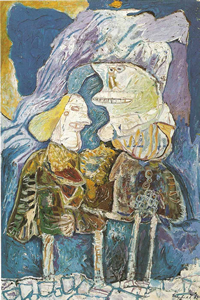
Lucebert: Prinsenpaar, 1962


De Nederlandse dichter en schrijver Jan Jacob Slauerhoff werd geboren in Leeuwarden op 15 september 1898. Zie ook mijn blog van 15 september 2010 en eveneens alle tags voor Jan Slauerhoff op dit blog.


Eer de tuin 't vertrouwen vindt

Eer de tuin 't vertrouwen vindt
Zich de volle bloei te geven,
Staan de meisjes er in, beven,
Willen wel, neen nog niet leven
En uit enge angsten streven
Tengre handen tegen wind.

En zij gaan met schuwe voeten,
Als door zwaar gewaad gedrukt,
Traag, bevreesd en toch verrukt,
Houdingen zoekend die zij moeten
Vinden om hun droom te ontmoeten.


Uyemo Park, Tokio

De kindren lopen uit hun kleurig spel
En laten 't park schuw en verwaarloosd achter.
De vogels zwijgen om een oude wachter,
Alleen de krekels sjirpen snel en schel.

Het groene en rode loof wordt even vaal.
Een flakkerlicht ontwaakt in bronzen lampen.
De avond komt gedempt, gehuld in dampen
Nader, als een sluipmoordnaar in een zaal.

Maar plechtig aangetrokken klokken tampen
En langgerekte heilige tonen gonzen
Boven het dor en streng gebed der bonzen,
Beveiligd voor de nacht in 't heiligdom.


Klaaglijk roepen de alcyonen

KLAAGLIJK roepen de alcyonen,
Schichtig fladdren de alcyonen,
Boven 't woedend brandingklotsen
Tegen Akashiro's rotsen,
Waar wraakgierige demonen,
Boven Akashiro's rotsen,
Tussen gierennesten tronen.

Over Akashiro's rotsen
Zweeft een lieflijk avondrood;
Onder, blind in 't brandingklotsen,
Vindt de schepeling zijn dood.
Klaaglijk schreeuwen de alcyonen,
Laag en schichtig de alcyonen
Scheren over 't brandingklotsen.
Rood zijn Akashiro's rotsen.


 2073244-08961d97326a91fda0f4996e06256027.jpg
Jan Slauerhoff (15 september 1898 – 5 oktober 1936) 


De Colombiaanse dichter, schrijver, hoogleraar en journalist Sergio Esteban Vélez Peláez werd geboren op 15 september 1983 in Medellín. Zie ook alle tags voor Sergio Esteban Vélez op dit blog.


The soul weighs twenty-one grams

The soul weighs twenty-one grams,
say the esoteric
philosophers.
The supreme energy
chained to a body
and only two trembling
shutters
show you a
deserted
corner of the universe.

Pseudolife
subjected to time;
dreams,
a few bones,
and love,
a few atoms of smoke.

All in an ashtray.

They are only twenty-one
eternal grams.


 2073244-45722b8ac866114adeb08def821dc41a.jpg
Sergio Esteban Vélez (Medellín, 15 september 1983)


De Nigeriaanse schrijfster Chimamanda Ngozi Adichie werd geboren op 15 september 1977 in Enugu. Zie ook mijn blog van 15 september 2010 en eveneens alle tags voor Chimamanda Ngozi Adichie op dit blog.

Uit: Americanah

“Everyone she had told she was moving back seemed surprised, expecting an explanation, and when she said she was doing it because she wanted to, puzzled lines would appear on foreheads.“You are closing your blog and selling your condo to go back to Lagos and work for a magazine that doesn’t pay that well,” Aunty Uju had said and then repeated herself, as though to make Ifemelu see the gravity of her own foolishness. Only her old friend in Lagos, Ranyinudo, had made her return seem normal. “Lagos is now full of American returnees, so you better come back and join them. Every day you see them carrying a bottle of water as if they will die of heat if they are not drinking water every minute,” Ranyinudo said. They had kept in touch, she and Ranyinudo, throughout the years. At first, they wrote infrequent letters, but as cybercafés opened, cell phones spread, and Facebook flourished, they communicated more often. It was Ranyinudo who had told her, some years ago, that Obinze was getting married. “Meanwhile o, he has serious money now. See what you missed!” Ranyinudo had said. Ifemelu feigned indifference to this news. She had cut off contact with Obinze, after all, and so much time had passed, and she was newly in a relationship with Blaine, and hap-pily easing herself into a shared life. But after she hung up, she thought endlessly of Obinze. Imagining him at his wedding left her with a feeling like sorrow, a faded sorrow. But she was pleased for him, she told herself, and to prove to herself that she was pleased for him, she decided to write him. She was not sure if he still used his old address and she sent the e-mail half expecting that he would not reply, but he did. She did not write again, because she by then had acknowledged her own small, still-burning light. It was best to leave things alone. Last December, when Ranyinudo told her she had run into him at the Palms mall, with his baby daughter (and Ifemelu still could not picture this new sprawling, modern mall in Lagos; all that came to mind when she tried to was the cramped Mega Plaza she remembered)—“He was looking so clean, and his daughter is so fine,” Ranyinudo said—Ifemelu felt a pang at all the changes that had happened in his life.“Nigeria film very good now,” Aisha said again.“Yes,” Ifemelu said enthusiastically. This was what she had become, a seeker of signs. Nigerian films were good, therefore her move back home would be good.“You from Yoruba in Nigeria,” Aisha said.“No. I am Igbo.”“You Igbo?” For the first time, a smile appeared on Aisha’s face,a smile that showed as much of her small teeth as her dark gums.”


 2073244-2d6efb45417bb8e5b4ffe1ccaeaef51d.jpg
Chimamanda Ngozi Adichi (Enugu, 15 september 1977)
Cover 


De Britse schrijfster Agatha Christie werd geboren in Torquay (Devon) op 15 september 1890. Zie ook mijn blog van 15 september 2010 en eveneens alle tags voor Agatha Christie op dit blog.

Uit: The Murder at the Vicarage

“It is difficult to know quite where to begin this story, but I have fixed my choice on a certain Wednesday at luncheon at the Vicarage. The conversation, though in the main irrelevant to the matter in hand, yet contained one or two suggestive incidents which influenced later developments.
I had just finished carving some boiled beef (remarkably tough by the way) and on resuming my seat I remarked, in a spirit most unbecoming to my cloth, that any one who murdered Colonel Protheroe would be doing the world at large a service.
My young nephew, Dennis, said instantly:
"That'll be remembered against you when the old boy is found bathed in blood. Mary will give evidence, won't you, Mary? And describe how you brandished the carving knife in a vindictive manner."
Mary, who is in service at the Vicarage as a stepping-stone to better things and higher wages, merely said in a loud, businesslike voice, "Greens," and thrust a cracked dish at him in a truculent manner.
My wife said in a sympathetic voice: "Has he been very trying?"
I did not reply at once, for Mary, setting the greens on the table with a bang, proceeded to thrust a dish of singularly moist and unpleasant dumplings under my nose. I said, "No, thank you," and she deposited the dish with a clatter on the table and left the room.
"It is a pity that I am such a shocking housekeeper," said my wife, with a tinge of genuine regret in her voice.
I was inclined to agree with her. My wife's name is Griselda — a highly suitable name for a parson's wife. But there the suitability ends. She is not in the least meek.
I have always been of the opinion that a clergyman should be unmarried. Why I should have urged Griselda to marry me at the end of twentyfours hours' acquaintance is a mystery to me.”

 2073244-9b0ab6b9859392cf9ff79a1f0608bc41.jpg
Agatha Christie (15 september 1890 – 12 januari 1976)
Cover DVD van de film uit 1986 met Joan Hickson als Miss Marple


De Turkse schrijver Orhan Kemal (eig. Mehmet Raşit Öğütçü) werd geboren op 15 september 1914 in Ceyhan. Zie ook mijn blog van 15 september 2010 en eveneens alle tags voor Orhan Kemal op dit blog.

Uit: The Idle Years (Vertaald door Cengiz Lugal)

‘Obviously. We’ll also have to invite him out as well.’
‘We could do that, you know. Take him along to a restaurant with Nejip.    We ought to, really.’
‘We could order two full bottles of raki…’
‘If I get about a hundred and fifty or so, then it really won’t matter.’
‘I wouldn’t worry. Your aunt’s bound to send you at least that. Because she does know you have a friend with you as well….’
That evening Nevzat handed me the letter I had long been waiting for. I excitedly ripped open the envelope. Gazi and I leaned over and swiftly read the brief note.
I was to leave any so-called friend and come over straight away. There would be no need for me to pay the bus fare – I had only to give my uncle’s name. And when was I going to learn not to let every bum and scrounger tag along wherever I went!
Gazi had changed colour. I tore up the letter and threw it out of the window and into the smell of fried fish. First, we sold my clothes and then my suitcase.
‘Istanbul is one of a kind!’
You can hop off its trams, hop on to its taxis and entertain whom you want at the restaurant of your choice…. You can set up a factory, or stay unemployed or open a bank… Whatever you want!
‘Istanbul is one of a kind!’
Then what?
Well, then, it was first one bit of work, then another. We worked as waiters in cafés around Galata, shovelled coal, did a bit of street selling and occasionally played for some of the useless local football teams, all for no more than a square meal.
‘Istanbul is one of a kind!’
Finally one morning, half starving, we bade farewell to the bridge, to the trams, to the dirty sea, to Galata and to Beyoglu and boarded a ship back home, leaving all those beautiful women to the men of Istanbul.
Farewell, then, Istanbul!”


 2073244-4e66ce4837d1398deba5e0ecbd502f22.jpg
Orhan Kemal (15 september 1914 – 2 juni 1970)


De Zweedse dichter en schrijver Bengt Gunnar Ekelöf werd geboren op 15 september 1907 in Stockholm. Zie ook mijn blog van 15 september 2010 en eveneens alle tags voor Gunnar Ekelöf op dit blog.


The flowers doze in the window

The flowers doze in the window and the lamp gazes / light
the window gazes with thoughtless eyes out into the / dark
paintings exhibit without soul the thought confided / to then
and houseflies stand still on the walls and think

the flowers lean into the night and the lamp weaves / light
the cat in the corner weaves woolen yarn to sleep with
on the stove the coffeepot snores now and then with / pleasure
the children play quietly on the floor with words

the table set with white cloth is waiting for someone
whose feet never will come up the stairs

a train-whistle tunneling through the silence in the / distance
does not find out what the secret of things is
but fate counts the strokes of the pendulum by / decimals


Vertaald door Robert Bly


 2073244-bcf1dae5bfe1dc14ae1261e652e422b6.jpg
Gunnar Ekelöf (15 september 1907 – 16 maart 1968)


De Amerikaanse schrijver James Fenimore Cooper werd geboren in Burlington, New Jersey op 15 september 1789. Zie ook alle tags voor James Fenimore Cooper op dit blog.

Uit: The Last of the Mohicans

“While, in the pursuit of their daring plans of annoyance, the restless enterprise of the French even attempted the distant and difficult gorges of the Alleghany, it may easily be imagined that their proverbial acuteness would not overlook the natural advantages of the district we have just described. It became, emphatically, the bloody arena, in which most of the battles for the mastery of the colonies were contested. Forts were erected at the different points that commanded the facilities of the route, and were taken and retaken, razed and rebuilt, as victory alighted on the hostile banners. While the husbandman shrank back from the dangerous passes, within the safer boundaries of the more ancient settlements, armies larger than those that had often disposed of the scepters of the mother countries, were seen to bury themselves in these forests, whence they rarely returned but in skeleton bands, that were haggard with care or dejected by defeat. Though the arts of peace were unknown to this fatal region, its forests were alive with men; its shades and glens rang with the sounds of martial music, and the echoes of its mountains threw back the laugh, or repeated the wanton cry, of many a gallant and reckless youth, as he hurried by them, in the noontide of his spirits, to slumber in a long night of forgetfulness.
It was in this scene of strife and bloodshed that the incidents we shall attempt to relate occurred, during the third year of the war which England and France last waged for the possession of a country that neither was destined to retain.
The imbecility of her military leaders abroad, and the fatal want of energy in her councils at home, had lowered the character of Great Britain from the proud elevation on which it had been placed by the talents and enterprise of her former warriors and statesmen. No longer dreaded by her enemies, her servants were fast losing the confidence of self-respect. In this mortifying abasement, the colonists, though innocent of her imbecility, and too humble to be the agents of her blunders, were but the natural participators. They had recently seen a chosen army from that country, which, reverencing as a mother, they had blindly believed invincible--an army led by a chief who had been selected from a crowd of trained warriors, for his rare military endowments, disgracefully routed by a handful of French and Indians, and only saved from annihilation by the coolness and spirit of a Virginian boy, whose riper fame has since diffused itself, with the steady influence of moral truth, to the uttermost confines of Christendom.”


 2073244-1b9902757d0b5f62f88003eeb2160161.jpg
James Fenimore Cooper (15 september 1789 - 14 september 1851)
Standbeeld in New York


De Jamaicaanse dichter en schrijver Festus Claudius "Claude "McKay werd geboren op 15 september 1890 in Sunny Ville, Clarendon, Jamaica. Xie ook alle tags voor Claude McKay op dit blog.


After the Winter

Some day, when trees have shed their leaves
And against the morning’s white
The shivering birds beneath the eaves
Have sheltered for the night,
We’ll turn our faces southward, love,
Toward the summer isle
Where bamboos spire the shafted grove
And wide-mouthed orchids smile.

And we will seek the quiet hill
Where towers the cotton tree,
And leaps the laughing crystal rill,
And works the droning bee.
And we will build a cottage there
Beside an open glade,
With black-ribbed blue-bells blowing near,
And ferns that never fade.


Subway Wind

Far down, down through the city’s great gaunt gut
The gray train rushing bears the weary wind;
In the packed cars the fans the crowd’s breath cut,
Leaving the sick and heavy air behind.
And pale-cheeked children seek the upper door
To give their summer jackets to the breeze;
Their laugh is swallowed in the deafening roar
Of captive wind that moans for fields and seas;
Seas cooling warm where native schooners drift
Through sleepy waters, while gulls wheel and sweep,
Waiting for windy waves the keels to lift
Lightly among the islands of the deep;
Islands of lofy palm trees blooming white
That led their perfume to the tropic sea,
Where fields lie idle in the dew-drenched night,
And the Trades float above them fresh and free.


 2073244-f48116725b35cad4a315793bb8a22b72.jpg
Claude McKay (15 september 1890 - 22 mei 1948)


Zie voor nog meer schrijvers van de 15e september ook mijn blog van 15 september 2015 en ook mijn blog van 15 september 2013 deel 2.

Geschreven door Romenu om 18:15 Reageer op dit bericht

Meer van Romenu

↑ Terug naar de berichten