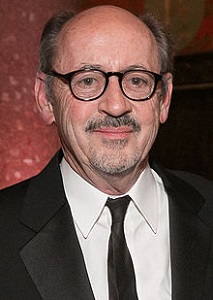
Cri Stellweg, Jonathan Ames, Yōko Tawada, Gary Whitehead, Mitch Cullin, Roger Martin du Gard, Madison Cawein, Nils-Aslak Valkeapää, Federica de Cesco
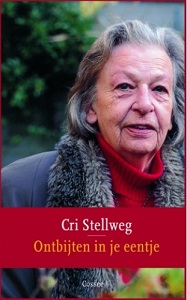
De Nederlandse schrijfster en columniste Margaretha Hendrika (Cri) Stellweg (alias Saartje Burgerhart) werd geboren in Nijmegen op 23 maart 1922. Zie ook alle tags voor Cri Stellweg op dit blog en ook mijn blog van 27 november 2006.
Uit: Ontbijten in je eentje
“Het was 1939, een oorlog dreigde. Beneden in de kelder stonden blikken met pakjes koffie, met thee. Dozen met zeep. Vele krakende zakjes gedroogde groenten, die later door vader in zijn pijp gestopt opgerookt zouden worden omdat proefondervindelijk bewezen was dat er echt niets anders, iets eetbaars van te bereiden viel. De moeder had goed gezorgd; zó, dacht zij, zou het uit vijf personen bestaande gezin een oorlog wel doorkomen. Dat pakte dus anders uit. Maar hoe had zij kunnen voorzien dat zij voor vier jaren vet, olie, suiker, zout, naaigaren, pantoffels, breiwol, worst en brandstof had moeten inslaan? Twee grote wasmanden vol turven in de kelder voor je-weet-maar-nooit, alla. Maar mudden antraciet, nootjes nr. 4, voor vier winters achtereen? En water? Had ze soms water moeten en kunnen hamsteren? Terwijl toch de tijd kwam dat vier personen hun tandenborstel uitspoelden in een en hetzelfde bekertje water, waarna de vijfde er het kunstgebit in te weken legde. Nee, de moeder kon dat niet helpen, het was de schuld van een Tommy die zijn bom liet vallen op de waterinstallatie van de stad, denkend dat hij al boven Duitsland was, terwijl dat net een krappe vijftig kilometer verderop lag. Een tankwagen kwam tweemaal daags op de hoek van de straat, de bewoners groepten eromheen met emmers, teilen, kannen en soms met een door twee man aangezeulde wasketel.
Toch werd eind april 1945 levend gehaald, mede dankzij de hamstervoorraad, hoewel de rijst muf begon te smaken en de bonen tenslotte boontje voor boontje moesten worden ontdaan van een wittige uitslag. Dankzij groezelige handeltjes met familiesieraden, moeders bontjas en beddengoed, dankzij ook de Centrale Keuken, maar vooral God was het die luid en langdurig dank diende te worden gezegd.”
Cri Stellweg (23 maart 1922 - 26 november 2006)
Cover
De Amerikaanse schrijver en acteur Jonathan Ames werd geboren op 23 maart 1964 in New York. Zie ook alle tags voor Jonathan Ames op dit blog.
Uit: Wake up, Sir!
"Wake up, sir. Wake up," said Jeeves.
"What? What is it, Jeeves?" I said, floating out of the mists of Lethe. I had been dreaming of a gray cat, who, like some heavy in a film noir, was throttling in its fists a white mouse. "I was dreaming of a gray cat, Jeeves. Quite the bully."
"Very good, sir."
I started slipping back into that cat-and-mouse confrontation. I wanted to see the little white fellow escape. It had very sweet, pleading eyes. But Jeeves cleared his throat respectfully, and I sensed an unusual urgency to his hovering presence which demanded that the young master rally himself from the luscious pull of dreams. Poor mouse would have to go unsaved. No happy ending.
"What's going on, Jeeves?" I asked, casting a sleepy eye at his kind but inscrutable face.
"There are indications, sir, that your uncle Irwin is no longer asleep."
It was only under these alarming circumstances that Jeeves would interrupt my eight hours of needed unconsciousness. He knew that the happiness of my morning was dependent on having as little contact with said uncle aspossible.
"Groans from the bedroom, Jeeves? He no longer dreams - probably of firearms - and is staring at the ceiling summoning the courage to blight another day?"
"His progression into the morning is further along than that, sir."
"You heard his feet hit the floor and he's sitting on the edge of the bed in a stupor?"
"He's on his stationary bicycle and he's davening, sir." Jeeves had picked up the Anglicization of the Yiddish from me, adding the ing to daven (to pray) as I did.
"Good God!" I said. "This is desperate, Jeeves. Calamitous!"
Coming fully awake and now nearly at the height of my sensory powers, I could make out the spinning of the bicycle's tires, as well as my uncle's off-key Hebraic singing - his bedroom was just fifteen feet away down the hall.
"Do you think there's time, Jeeves?"
"There is very little room for error, sir."
I am usually unflappable and rather hard-boiled, if I may say so, but this predicament first thing in the morning shook me to the core. For several months now, with rigorous discipline, I had just about managed never to see my uncle before noon.”
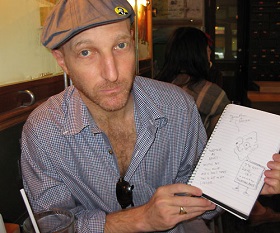
Jonathan Ames (New York, 23 maart 1964)
De Japanse dichteres en schrijfster Yōko Tawada werd geboren op 23 maart 1960 in Tokyo. Zie alle tags voor Yōko Tawada op dit blog.
Uit: Where Europe Begins (Vertaald door Susan Bernofsky)
“I always wrote a travel narrative before I set off on a trip, so that during the journey I'd have
something to quote from. I was often speechless when I traveled. This time it was particularly
useful that I'd written my report beforehand. Otherwise, I wouldn't have known what to say about
Siberia. Of course, I might have quoted from my diary, but I have to admit that I made up the
diary afterward, having neglected to keep one during the journey.
A few months before I set off on my journey, I was working evenings after school in a food processing factory. A poster advertising a trip to Europe on the Trans-Siberian Railroad transformed the immeasurably long distance to Europe into a finite sum of money.
In the factory, the air was refrigerated, kept at a very low temperature so the meat wouldn't go bad. I stood in this cold, which I referred to as “Siberian frost,” wrapping frozen poultry in plastic. Beside the table stood a bucket of hot water in which I could warm my hands at intervals.
Once three frozen chickens appeared in my dreams: I watched my mother place them in the frying pan. When the pan was hot, they suddenly came to life and flew out the kitchen window. “No wonder we never have enough to eat,” I said with such viciousness even I was shocked. “What am I supposed to do?” my mother asked, weeping. Besides earning money, there were two other things I wanted to do before my departure: learn Russian and write an account of the journey.
For my grandmother, to travel was to drink foreign water. Different places, different water. There was no need to be afraid of foreign landscapes, but foreign water could be dangerous.
When I was a little girl, I never believed there was such a thing as foreign water, for I had always thought of the globe as a sphere of water with all sorts of small and large islands swimming on it. Water had to be the same everywhere. Sometimes in sleep I heard the murmur of the water that flowed beneath the main island of Japan. The border surrounding the island was also made of water that ceaselessly beat against the shore in waves. How can one say where the place of foreign water begins when the border itself is water?
The ship followed the coastline northward. Soon it was dark, but many passengers still sat on the
upper deck. In the distance one could see the lights of smaller ships.”
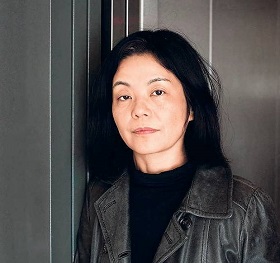
Yōko Tawada (Tokyo, 23 maart 1960)
De Amerikaanse dichter Gary Joseph Whitehead werd geboren op 23 maart 1965 in Pawtucket, Rhode Island. Zie alle tags voor Gary Whitehead op dit blog.
Ararat
Years later, in spite of his weak knees,
he might have labored up that volcanic peak
to gaze upon the giant ribs
of this thing he'd built by hand, the ship
it was sailing into view as through the eyes
of some half-starved songbird looking for a place
to land. And because he'd hewn it,
he might have run his hand along a cubit,
the keel piece bleached as a bone
and smooth, breamed by many days beneath the sun.
There, above the treeline and below the snow,
unsteady on his feet, fatigued, the ship he knew
reduced so, when, at its best
it had quartered all those pairs of beasts,
he would, no doubt, have reeled,
not unlike the Lord seeing his failed
creation. What builder wouldn't glance
between the ruined futtocks and apprehend in the distance
mud structures; smoke of cookfires; shapes
of donkeys, dogs, goats, grazing sheep?
Above the green plateau there is always grief,
which, inspired, becomes the breath of life.
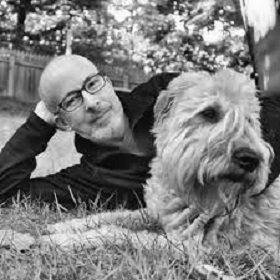
Gary Whitehead (Pawtucket, 23 maart 1965)
De Amerikaanse schrijver Mitch Cullin werd geboren op 23 maart 1968 in Santa Fe, New Mexico. Zie alle tags voor Mitch Cullin op dit blog.
Uit:Whompyjawed
“So I go into Coach Bud's office wearing only my game pants and socks, and he's sitting behind his desk in that high-backed, tattered swivel chair. He's as sweaty as the rest of us, maybe more. His dress shirt is stained at the armpits, unbuttoned at the neck, with a wrinkled blue tie loose and dangling to one side. His cheek bulges with a wad of chew. He's got this half-pint wastebasket set on the lap of his baggy slacks for spitting. Thing about Coach Bud is that from looking at him it's easy to tell he was once a player. Even with his thin hair and that heavy hanging paunch, he still runs with us during practice. He's pretty good at showing the line how to block and all. Like if I was to blur my eyes a little, or sort of pinch my eyelids almost shut, he might not look much older than me. "Yeah, Coach?" I say. His face is hard, very thoughtful, in a way to where it's impossible to tell if he's happy or mad. He just might break into a funny story or give me some hell about something I done wrong in the game, though he'd be pressed to say what. He tells me, "Shut the door." So I do. Then I turn around again to face him, and he's waving me toward a metal chair in front of his desk. So I go and sit. I watch as he works that chew a little, spits, then gives me a wink in kind of an admiring way. I've seen him do this before, but it always makes me feel strange. I can't help but shift some in the chair. I glance at the taping table along one wall. Glance at the folding chairs set close to his all-purpose wooden desk. He spits again. I notice the stand-free photo of his wife on the corner of the desk, the old circular-dial telephone, the nameplate made years ago by a shop student that Coach Bud now uses for a paperweight, with uneven carved letters—COACH BUD WARFIELD. "That was pure-dee football you played out there tonight, son," he finally says. "Pure-dee football." "Thanks, Coach." "Know who was up in them stands tonight?" I shake my head like I don't know, but I got a pretty good idea. He leans forward over the desk. "Two more recruiters," he almost whispers. "Where from?" "TCU," he tells me, "but that don't matter. That's chickenshit as far as I'm concerned. Point is—they're all starting to come in now. And everybody knows what everybody else is doing.”
Mitch Cullin (Santa Fe, 23 maart 1968)
Cover
De Franse schrijver Roger Martin du Gard werd geboren op 23 maart 1881 in Neuilly. Zie alle tags voor Roger Martin du Gard op dit blog.
Uit: Les Thibault, I, Le pénitencier
– « Tu n’es plus un enfant », proclama-t-il, comme s’il eût constaté l’âge d’Antoine au son de sa voix. « Tu dois comprendre l’inconvenance d’une pareille démarche, à mon insu. Est-ce que tu avais une raison particulière pour aller à Crouy sans me le dire ? Est-ce que ton frère t’avait écrit, t’avait appelé ? »
– « Non. J’ai été pris de doutes, tout à coup. »
– « De doutes ? Sur quoi ? »
– « Mais sur tout… Sur le régime… Sur les effets du régime auquel Jacques est soumis depuis neuf mois. »
– « Vraiment, mon cher, tu… tu me surprends ! » Il hésitait, choisissant des termes mesurés, que démentaient ses grosses mains fermées et ses coups de tête en avant. « Cette… méfiance, à l’égard de ton père… »
– « Tout le monde peut se tromper. La preuve ! »
– « La preuve ? »
– « Écoute, père, inutile de se fâcher. Je pense que nous voulons l’un et l’autre la même chose : le bien de Jacques. Quand tu sauras dans quel état de déchéance je l’ai trouvé, tu décideras, tout le premier, que Jacques doit quitter le pénitencier au plus tôt. »
– « Ça, non ! »
Antoine s’efforça de ne pas entendre le ricanement de M. Thibault.
– « Si, père. »
– « Je te dis : non ! »
– « Père, quand tu sauras… »
– « Est-ce que tu me prendrais pour un imbécile, par hasard ? Est-ce que tu supposes que j’ai attendu tes renseignements pour savoir ce qui se fait à Crouy, où, depuis plus de dix ans, je passe tous les mois une inspection générale, suivie d’un rapport ? Où rien ne se décide sans avoir d’abord été discuté en séance d’un Conseil dont je suis le président ? Voyons ?»
Roger Martin du Gard (23 maart 1881 – 22 augustus 1958)
Cover
De Amerikaanse dichter Madison Julius Cawein werd geboren in Louisville, Kentucky, op 23 maart 1865. Zie ook alle tags voor Madison Cawein op dit blog.
After Long Grief
There is a place hung o'er of summer boughs
And dreamy skies wherein the gray hawk sleeps;
Where water flows, within whose lazy deeps,
Like silvery prisms where the sunbeams drowse,
The minnows twinkle; where the bells of cows
Tinkle the stillness; and the bobwhite keeps
Calling from meadows where the reaper reaps,
And children's laughter haunts an oldtime house:
A place where life wears ever an honest smell
Of hay and honey, sun and elder-bloom,-
Like some sweet, simple girl,-within her hair;
Where, with our love for comrade, we may dwell
Far from the city's strife, whose cares consume.-
Oh, take my hand and let me lead you there.
In A Garden
The pink rose drops its petals on
The moonlit lawn, the moonlit lawn;
The moon, like some wide rose of white,
Drops down the summer night.
No rose there is
As sweet as this-
Thy mouth, that greets me with a kiss.
The lattice of thy casement twines
With jasmine vines, with jasmine vines;
The stars, like jasmine blossoms, lie
About the glimmering sky.
No jasmine tress
Can so caress
Like thy white arms' soft loveliness.
About thy door magnolia blooms
Make sweet the glooms, make sweet the glooms;
A moon-magnolia is the dusk
Closed in a dewy husk.
However much,
No bloom gives such
Soft fragrance as thy bosom's touch.
The flowers blooming now will pass,
And strew the grass, and strew the grass;
The night, like some frail flower, dawn
Will soon make gray and wan.
Still, still above,
The flower of
True love shall live forever, Love.
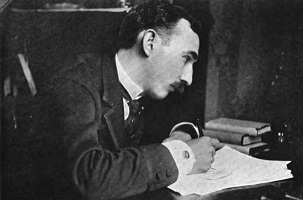
Madison Cawein (23 maart 1865 – 8 december 1914)
In 1900
De Samische dichter, schilder, musicus en fotograaf Nils-Aslak Valkeapää werd geboren op 23 maart 1943 in Palonjoensuu nabij Enontekiö. Zie alle tags voor Nils-Aslak Valkeapää op dit blog.
My home is in my heart (Fragment)
all this is my home
and I carry it
within me
in my heart
I can hear it
when I close my eyes
I can hear it
I hear somewhere
deep within me
I hear the ground thunder
from thousands of hooves
I hear the reindeer herd running
or is it the noaidi drum
and the sacrificial stone
I discover
somewhere within me
I hear sound whisper shout call
with the thunder still echoing
from rib to rib
And I can hear it
even when I open my eyes
I hear it
Somewhere deep within me
I can hear it
a voice calling
and the blood's yoik I hear
In the depths
from the dawn of life
to the dusk of life
All of this is my home
these fjords rivers lakes
the cold the sunlight the storms
The night and day of the fjelds
happiness and sorrow
sisters and brothers
All of this is my home
and I carry it in my heart
Vertaald door Ralph Salisbury, Lars Nordström en Harald Gaski
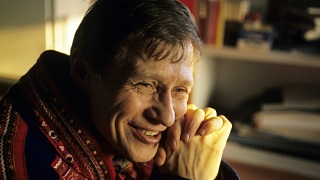
Nils-Aslak Valkeapää (23 maart 1943 – 26 november 2001)
De Zwitserse schrijfster Federica de Cesco werd geboren op 23 maart 1938 in Pordenone, Zie alle tags voor Federica de Cesco op dit blog.
Uit: Die neunte Sonne
„Seitdem ich krank bin, kommen alte Erinnerungen zu mir. Bilder bewegen sich an meinen Augen vorbei, und ich bewege mich mit ihnen, von einem Punkt zum anderen. Manche dieser Bilder sind ziemlich grell, lichtgetränkt. Ich weiß nicht, ob es Bilder sind, die es gibt oder jemals gegeben hat. Ich habe so verrückte Träume. Seit einigen Tagen liege ich da ohne Schmerzmittel, ohne Schlaftabletten, ohne die Furcht, an meinem eigenen Atem zu ersticken. Es riecht nach sauberen Reisstrohmatten und nach Kampfer. Gerüche, die ich mag. Zunächst habe ich die Traumbilder ohne Interesse betrachtet, nur um die Zeit totzuschlagen. Womöglich fantasierte ich ja. Aber die Bilder wandern an meinen Augen vorbei und ziehen mich mit sich, ein unwiderstehlicher Sog. Sie flimmern nicht und verschwinden auch nicht. Ich sehe sie hinter meinen Pupillen bei Licht und bei Dunkelheit. Ich denke an ganz gleich was, ihre Umrisse sind immer klar. Sie sind wie ein Fenster zu einer anderen Dimension. Es geht nicht, denke ich, dass hinter diesem Fenster etwas ist, das ich nicht sehen kann. Das macht mich reizbar. Ich fühle mich zunehmend unbehaglich, verstricke mich in Phasen krampfhafter Unruhe. Bis ich auf einmal ganz still liege. Etwas ist da. Ich würge Schleim herunter, spüre in mir eine Hebung und Senkung. Unvermittelt explodiert die Luft um mich herum. Alle Geräusche dieser Welt verschwinden. Aus dem Nirgendwo schwebt – wie eine Leuchtspur – ein Bild dicht vor meinen Augen empor und öffnet sich. Ich bin sofort innen drin.
Ich bin neun Jahre alt. Ich hänge mit den Knien kopfüber an einem Ast des höchsten Baumes im Garten und schaukele in zehn Metern Höhe. Meine Mutter steht unten und ruft, ich soll sofort herunterkommen. Inge, die junge Kinderfrau, steht neben ihr, knetet die Hände und jammert: »Ach lieber Jesus, heilige Maria! Wenn ihm nur nichts passiert …« Meine Schwester Amanda tobt und schreit wie am Spieß. Sie will auch auf den Baum, und Inge hält sie fest. Ich sehe das alles von oben, ich bin glücklich, völlig in meiner Welt, fühle mich leicht wie eine Seifenblase und zugleich voller Kraft, der Himmel schwankt mit mir hin und her. Ich gebe immer mehr Schwung, der Himmel schaukelt stärker, bis der Ast den Druck nicht mehr aushält und entzweikracht.“
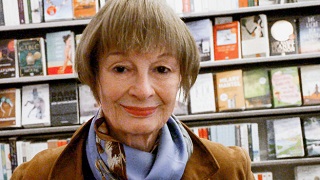
Federica de Cesco (Pordenone, 23 maart 1938)
Zie voor nog meer schrijvers van de 23e maart ook mijn blog van 23 maart 2015 deel 1 en eveneens mijn blog van 23 maart 2014 deel 1 en ook deel 2.
Zie voor bovenstaande schrijvers ook mijn blog van 23 maart 2007 en ook mijn blog van 23 maart 2008 en eveneens mijn blog van 23 maart 2009.