Naar de inhoud

Romenu

Over literatuur, gedichten, kunst en cultuur
akke.beakke.be

Berichten van 26 oktober 2018 tot 27 oktober 2018

Sylvia Plath, Dylan Thomas, Steffie van den Oord, Zadie Smith, Nawal el Saadawi, Albrecht Rodenbach
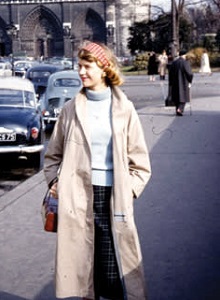
De Amerikaanse dichteres en schrijfster Sylvia Plath werd geboren op 27 oktober 1932 in Jamaica Plain, een buitenwijk van Boston. Zie ook alle tags voor Sylvia Plath op dit blog.


Circus in Three Rings

In the circus tent of a hurricane
designed by a drunken god
my extravagant heart blows up again
in a rampage of champagne-colored rain
and the fragments whir like a weather vane
while the angels all applaud.

Daring as death and debonair
I invade my lion's den;
a rose of jeopardy flames in my hair
yet I flourish my whip with a fatal flair
defending my perilous wounds with a chair
while the gnawings of love begin.

Mocking as Mephistopheles,
eclipsed by magician's disguise,
my demon of doom tilts on a trapeze,
winged rabbits revolving about his knees,
only to vanish with devilish ease
in a smoke that sears my eyes.


Channel Crossing

On storm-struck deck, wind sirens caterwaul;
With each tilt, shock and shudder, our blunt ship
Cleaves forward into fury; dark as anger,
Waves wallop, assaulting the stubborn hull.
Flayed by spray, we take the challenge up,
Grip the rail, squint ahead, and wonder how much longer

Such force can last; but beyond, the neutral view
Shows, rank on rank, the hungry seas advancing.
Below, rocked havoc-sick, voyagers lie
Retching in bright orange basins; a refugee
Sprawls, hunched in black, among baggage, wincing
Under the strict mask of his agony.

Far from the sweet stench of that perilous air
In which our comrades are betrayed, we freeze
And marvel at the smashing nonchalance
Of nature : what better way to test taut fiber
Than against this onslaught, these casual blasts of ice
That wrestle with us like angels; the mere chance

Of making harbor through this racketing flux
Taunts us to valor. Blue sailors sang that our journey
Would be full of sun, white gulls, and water drenched
With radiance, peacock-colored; instead, bleak rocks
Jutted early to mark our going, while sky
Curded over with clouds and chalk cliffs blanched

In sullen light of the inauspicious day.
Now, free, by hazard's quirk, from the common ill
Knocking our brothers down, we strike a stance
Most mock-heroic, to cloak our waking awe
At this rare rumpus which no man can control :
Meek and proud both fall; stark violence

Lays all walls waste; private estates are torn,
Ransacked in the public eye. We forsake
Our lone luck now, compelled by bond, by blood,
To keep some unsaid pact; perhaps concern
Is helpless here, quite extra, yet we must make
The gesture, bend and hold the prone man's head.

And so we sail toward cities, streets and homes
Of other men, where statues celebrate
Brave acts played out in peace, in war; all dangers
End : green shores appear; we assume our names,
Our luggage, as docks halt our brief epic; no debt
Survives arrival; we walk the plank with strangers.


 2188316-6f1a41da29839163cb397b3f7c8a6f97.jpg
Sylvia Plath (27 oktober 1932 – 11 februari 1963)


De Engelse dichter Dylan Thomas werd geboren op 27 oktober 1914 in Swansea in Wales. Zie ook alle tags voor Dylan Thomas op dit blog.


How Shall My Animal

How shall my animal
Whose wizard shape I trace in the cavernous skull,
Vessel of abscesses and exultation's shell,
Endure burial under the spelling wall,
The invoked, shrouding veil at the cap of the face,
Who should be furious,
Drunk as a vineyard snail, flailed like an octopus,
Roaring, crawling, quarrel
With the outside weathers,
The natural circle of the discovered skies
Draw down to its weird eyes?

How shall it magnetize,
Towards the studded male in a bent, midnight blaze
That melts the lionhead's heel and horseshoe of the heart
A brute land in the cool top of the country days
To trot with a loud mate the haybeds of a mile,
Love and labour and kill
In quick, sweet, cruel light till the locked ground sprout
The black, burst sea rejoice,
The bowels turn turtle,
Claw of the crabbed veins squeeze from each red particle
The parched and raging voice?

Fishermen of mermen
Creep and harp on the tide, sinking their charmed, bent pin
With bridebait of gold bread, I with a living skein,
Tongue and ear in the thread, angle the temple-bound
Curl-locked and animal cavepools of spells and bone,
Trace out a tentacle,
Nailed with an open eye, in the bowl of wounds and weed
To clasp my fury on ground
And clap its great blood down;
Never shall beast be born to atlas the few seas
Or poise the day on a horn.

Sigh long, clay cold, lie shorn,
Cast high, stunned on gilled stone; sly scissors ground in frost
Clack through the thicket of strength, love hewn in pillars drops
With carved bird, saint, and suns the wrackspiked maiden mouth
Lops, as a bush plumed with flames, the rant of the fierce eye,
Clips short the gesture of breath.
Die in red feathers when the flying heaven's cut,
And roll with the knocked earth:
Lie dry, rest robbed, my beast.
You have kicked from a dark den, leaped up the whinnying light,
And dug your grave in my breast.

 

 2188316-bc8cecb1036d9c156668058f560b0b8d.jpg
Dylan Thomas (27 oktober 1914 – 9 november 1953)
Tim Hollander als Dylan Thomas in de televisiefilm “A Poet in New York” uit 2014


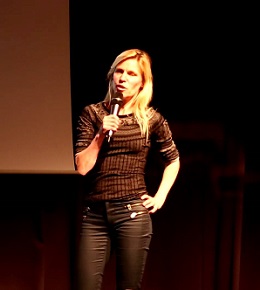
De Nederlandse schrijfster Steffie van den Oord werd geboren op 27 oktober 1970, in Ammerzoden, Gelderland. Zie ook alle tags voor Steffie van den Oord op dit blog.

Uit: Vonk, een noodlottige liefde

“Het was een prachtige dag voor een executie, en toch voelde Andries van Anhout niet de voldoening die zich meestal aandiende als hij op het punt stond het schepengericht te dienen. Als jongen was hij al gewend zijn vader op het schavot te assisteren, maar zojuist, toen hij haar kinderen had opgemerkt, kon hij, scherprechter op leeftijd, maar één ding doen, in een niet bij zijn ambt passende opwelling: grijpen naar zijn zwarte lap, voortijdig, zodat ze haar niet zouden herkennen en de illusie konden koesteren dat hier een andere vrouw stond, niet hun moeder. Ook had hij het gedaan voor haar. Vonk, zo was hij haar kortweg gaan noemen.
De stilte die altijd kwam maar die nu volkomen leek, was met het blinddoeken ingetreden. Een zuigeling krijste: een stem die scherper was dan zijn gewette zwaard. ‘Mama…!’: hij hoorde het opnieuw. Kon dan niemand haar kinderen weghalen, ontsnapten ze nu al aan hun voorlopige voogd? Als ze die hadden. Zo kon hij zijn werk niet doen. Hij vloekte onhoorbaar, alweer onprofessioneel, hij keek naar de heren schepenen die – nogal ongebruikelijk – met elkaar in discussie waren gegaan. Hij wachtte op een teken dat hij verder kon, of niet; al zou dat raar zijn, zelden vertoond.
De hele stad wachtte. Langer dan anders wachtte hij. De eerste zonnige dag was het, de laatste dinsdag van maart, 1713 alweer.
Andries van Anhout had zijn eerste lijfstraf, twee harige rechtervingers, al dertig jaar achter zich – in één slag – ; talloze keren had hij in deze stad en elders de doodstraf voltrokken, met het zwaard, met het koord; zelden tot nooit had hij zich ergens iets van aangetrokken, vakkundig roofde hij vet op misdadige lijken voor zijn heilzame smeersels; maar deze vrouw, Vonk, om wie een moord was gepleegd – en terecht! dacht hij in een opwelling –, deze vrouw beroerde hem. En dat mocht niet. Het kon niet: ze beroerde hem. Niet eens omdat ze rossig was en met duizend sproeten bedekt en zelfs halfnaakt toch waardig, nee, dat was het niet; het was omdat ze anders was dan wie ook met wie hij te maken kreeg.
In haar diepste nood had hij haar gezien en misschien wel beter gekend dan haar man ooit, misschien zelfs beter dan haar minnaar: ook haar geest werd opgelicht door iets mysterieus, een inwendig soort sproeten, iets dat hij nog niet eerder was tegengekomen en waarover hij in het boek dat sinds generaties in de familie was, bondig alle geheimen bevattend, een losse aantekening had gemaakt: Standvastig, doch niet van godsvr. of devote aard. Op een los blad. Niet bedoeld om te bewaren voor toekomstige generaties scherprechters, laat staan voor zijn zoon, die stevig optrad met de stok.”
 

 2188316-bdfa26172610919808016f6baab906f7.jpg
Steffie van den Oord (Ammerzoden, 27 oktober 1970)


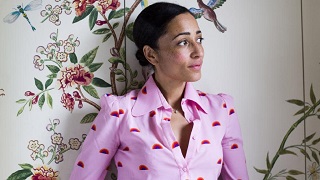
De Engelse schrijfster Zadie Smith werd geboren op 27 oktober 1975 in Londen. Zie ook alle tags voor Zadie Smith op dit blog.

Uit: Feel Free

“Last time I was in Willesden Green I took my daughter to visit my mother. The sun was out. We wandered down Brondesbury Park toward the high road. The "French Market" was on, which is a slightly improbable market of French things sold in the concrete space between the pretty turreted remnants of Willesden Library (1894) and the brutal red-brick beached cruise ship known as Willesden Green Library Centre (1989), a substantial local landmark that racks up nearly five hundred thousand visits a year. We walked in the sun down the urban street to the concrete space—to market. This wasn't like walking a shady country lane in a quaint market town ending up in a perfectly preserved eighteenth-century square. It was not even like going to one of these farmers' markets that have sprung up all over London at the crossroads where personal wealth meets a strong interest in artisanal cheeses. But it was still very nice. Willesden French Market sells cheap bags. It sells CDs of old-time jazz and rock and roll. It sells umbrellas and artificial flowers. It sells ornaments and knickknacks and doodahs, which are not always obviously French in theme or nature. It sells water pistols. It sells French breads and pastries for not much more than you'd pay for the baked goods in Greggs down Kilburn High Road. It sells cheese, but of the decently priced and easily recognizable kind—Brie, goat's, blue—as if the market has traveled unchanged across the Channel from some run-down urban suburb of Paris. Which it may have done for all I know. The key thing about Willesden's French Market is that it accentuates and celebrates this concrete space in front of Willesden Green Library Centre, which is at all times a meeting place, though never quite so much as it is on market day. Everybody's just standing around, talking, buying or not buying cheese, as the mood takes diem. It's really pleasant. You could almost forget Willesden High Road was ten yards away. This matters. When you're standing in the market you're not going to work, you're not going to school, you're not waiting for a bus. You're not heading for the Tube or shopping for necessities. You're not on the high road where all these activities take place. You're just a little bit off it, hanging out, in an open-air urban area, which is what these urban high streets have specifically evolved to stop people from doing. Everybody knows that if people hang around for any length of time in an urban area without purpose they are likely to become "antisocial." And indeed there were four homeless drunks sitting on one of the library's strange architectural protrusions, drinking Special Brew. Perhaps in a village they would be sitting under a tree, or have already been driven from the area by a farmer with a pitchfork. I do not claim to know what happens in villages. But here in Willesden they were sitting on their ledge and the rest of us were congregating for no useful purpose in the unlovely concrete space, simply standing around in the sunshine, like some kind of community.”
 

 2188316-c3afa5a23b83a919a8edda3cbf6ec5e8.jpg
Zadie Smith (Londen, 27 oktober 1975)


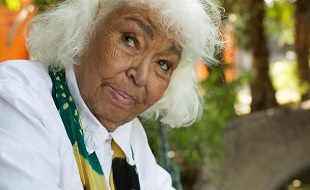
De Egyptische schrijfster, gynaecologe, moslimfeministe en politiek activiste Nawal el Saadawi werd geboren in Kafr Tahla op 27 oktober 1931. Zie ook alle tags voor Nawal el Saadawi op dit blog.

Uit: Women At Point Zero (Vertaald door Sherif Hetata)

“Without looking me in the face, he said, 'What do you mean, you can't carry on like this? `I cannot continue to live in your house,' I stammered. 'I'm a woman, and you're a man, and people are talking. Besides, you promised I'd stay only until you found me a job.' He retorted angrily, 'What can I do, get the heavens to intervene for you?' `You're busy all day in the coffee-house, and you haven't even tried to find me a job. I'm going out now to look for one.' I was speaking in low tones, and my eyes were fixed on the ground, but he jumped up and slapped me on the face, saying, 'How dare you raise your voice when you're speaking to me, you street walker, you low woman?'
His hand was big and strong, and it was the heaviest slap I had ever received on my face. My head swayed first to one side, then to the other. The walls and the floor seemed to shift violently. I held my head in my hands until they grew still again, then I looked upwards and our eyes met. It was as though I was seeing the eyes that now confronted me for the first time. Two jet black surfaces that stared into my eyes, travelled with an infinitely slow movement over my face, and my neck, and then dropped downwards gradually over my breast, and my belly, to settle somewhere just below it, between my thighs. A cold shiver, like the shiver of death, went through my body, and my hands dropped instinctively to cover the part on which his gaze was fixed, but his big strong hands moved quickly to jerk them away. The next moment he hit me with his fist in the belly so hard that I lost consciousness immediately. He took to locking me in the flat before going out. I now slept on the floor in the other room. He would come back in the middle of the night, pull the cover away from me, slap my face, and then bear down on me with all his weight. I kept my eyes closed and abandoned my body. It lay there under him without movement, emptied of all desire, or pleasure, or even pain, feeling nothing. A dead body with no life in it at all, like a piece of wood, or an empty sock, or a shoe. Then one night his body seemed heavier than before, and his breath smelt different, so I opened my eyes. The face above me was not Bayoumi's. `Who are you?' I said. `Bayoumi,' he answered. I insisted, 'You are not Bayoumi. Who are you?' `What difference does it make? Bayoumi and I are one.' Then he asked, 'Do you feel pleasure?' `What did you say?' I enquired. `Do you feel pleasure?' he repeated. I was afraid to say I felt nothing so I closed my eyes once more and said, `Yes.' He sank his teeth into the flesh of my shoulder and bit me several times in the breast, and then over my belly.”
 

 2188316-f43bcf5fb8105b1cbe4f98ea9793492e.jpg
Nawal el Saadawi (Kafr Tahla, 27 oktober 1931)


De Belgische dichter en schrijver Albrecht Rodenbach werd geboren te Roeselare op 27 oktober 1856. Zie ook alle tags voor Albrecht Rodenbach op dit blog.


Het klooster

'k Kwam gewandeld gansch aleene.
De avond viel, de zonne zonk,
smeltend ginder ver in 't westen,
langzaam weg in roeden gloed.
Váér mij' lag het rustig kerkhof,
achter mij strekte de stee;
en ik ging voorbij het klooster,
langs de groene hagen heen,
tot ik stil bleef staan vóór 't kerksken,
met zijn scherpe torennaald,
van de zone rood beschongen,
huis van vrede en heiligheid.
't Kloksken viel opeens aan 't luiden,
en ik trad het kerksken in.
't Altaar stond van 't licht te schitteren.
menschen knielden, hier en daar,
en de priester, de koralen,
traden op en 't lof begon.
Nevens 't altaar achter traliën,
schoof een groen gordijn nu weg,
en ik hoorde maagden zingen,
eerst gezamenlijk in koor,
dan opeens een enkle stemme,
wijl 't Hoogweerdig, plechtig in
's priesters handen, over 't buigend
volk, het kruisgebaar volbracht.
't Maagdenherte scheen te kloppen,
als zij zong « Adoro te.»
Lieve zusters, Jezus' maagden,
ook mijn herte was ontroerd,
en ge zoudet 't geerne schenken,
wist gij wat ik wenschte dan.
Een gebed voor mij, die jong ben,
een gebed voor dezen tijd,
die mij rollen zal en wentelen,
lijk de zee de bare rolt.
«Recht door zee» wil ik toch varen,
zusters, een gebed voor mij.
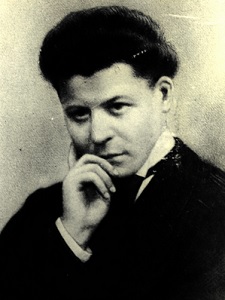
 

 2188316-314c6b7b2a73e4f82e20643e9af2eab0.jpg
Albrecht Rodenbach (27 oktober 1856 – 23 juni 1880)


Zie voor nog meer swchrijvers van de 27e oktober ook mijn vorige blog van vandaag.
Geschreven door Romenu om 12:09 Reageer op dit bericht

Jamie McKendrick, Fran Lebowitz, Josef Václav Sládek, Enid Bagnold, Kazimierz Brandys, Reza Allamehzadeh


De Engelse dichter en vertaler Jamie McKendrick werd op 27 oktober 1955 in Liverpool geboren. Zie ook alle tags voor Jamie McKendrick op dit blog.


A Mole of Sorts

The digging creature has been at work again
out there — first a modest trough with a crest
of dry earth, fit for a starling or a thrush
to rest in. No big deal except to some yellow ants
doing repairs, carrying stuff on their hods.
Next day the hole was deeper,
deeper and wider, encroaching on the lawn
which yielded inch by inch each clump of turf
as though to a pendulum or scythe.

Asleep, I sat talking to an animal:
three-, four-foot long with silky white fur
and slim interminable fingernails
lucid as biro shafts or goose quills.
They made the plasticky click
of knitting needles as he waved them
in front of his pink snout as if to dry
the shining varnish. He was indeed
he declared to me a mole of sorts.

In a question of days, two weeks at most,
the lavender, the rose bush, the bay plant,
the bindweed, the lilac tree, the brambles
and the potato vine had disappeared
leaving a long rectangular pit
like the foundations of a house
that would never be built, never be lived in.
Then I suppose that was the job done
and the digger moved on to another plot


 2188311-237e9f1486412330409ce38341452598.jpg
Jamie McKendrick (Liverpool, 27 oktober 1955)


De Amerikaanse schrijfster Frances Ann “Fran” Lebowitz werd geboren op 27 oktober 1950 in Morristown, New Jersey. Zie ook alle tags voor Frans Lebowitz op dit blog.

Uit: Fran Lebowitz Doesn’t Have a Cell Phone, But Knows Everything That Happens on Social Media Anyway (Interview door Stephanie Eckardt op W Magazine)

“Have you read any new novelists lately that you’re excited about?
By new novelists you probably mean people right out of writing school, which didn’t use to exist. I mean, it’s not that I’m against the idea of new novelists. I’m always asking people if they’ve read anything new that is really good. They very rarely say yes, and when they do, they’re often wrong. My idea of a new novelist is someone who’s still alive. I read Darryl Pinckney’s novel, Black Deutschland. I’m sure he’s not your idea of young, but he’s younger than me. That might be the most recent novel I read by someone who’s alive.

What about by someone who’s not?
My great preference. You know what, I just read Little Dorrit, because I asked a friend of mine what she recommended and she said “Did you ever read Little Dorritt?” And I said, “I think I did not," because when I was young, I was not the world’s biggest [Charles] Dickens fan. So I did read it, and I would highly recommend it, and he is definitely not alive. The great thing about writers who are not alive is that you don’t meet them at parties.

Do you watch any TV shows?
I watch TV all night long, I flip it on and off. But I have to tell you that watching TV is really an exact description, by which I mean if something interests me I’ll watch it 'til the commercial, then I’ll flip and I don’t even remember that I watched it anymore. I know this is against the law, but I am also the only person I know of who is not presently obsessed with television. I never imagined that I would live to see a day where people talked about television all the time. I’m astounded by the number of people who — do you realize how much TV you’re watching? Thousands of hours. Thousands of hours. And people now think it’s like a requirement. I have to go, I have 75 episodes of such and such I have to watch. I’m not saying these shows are not good, I’m just saying maybe if I was three years old and I imagined I had this amount of time ahead of me, I might start pursuing it.

Do you have cable?
I do. When they first invented cable television, I didn’t get it. I thought it was ridiculous to pay to watch television. It should be free, like water. [Laughs.] I didn’t get it until they built the World Trade Center (I mean the initial one) because that cut off the TV reception to downtown. So I do have cable television.”


 2188311-bba33fda407a393f6e9062abc8ca9336.jpg
Fran Lebowitz (Morristown, 27 oktober 1950)


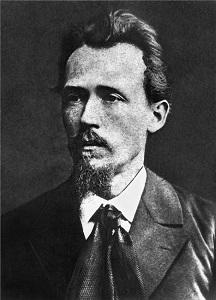
De Tsjechische schrijver, dichter, journalist en vertaler Josef Václav Sládek werd geboren op 27 oktober 1845 in Zbiroh. Zie ook alle tags voor Josef Václav Sládek op dit blog.


We’ll Last, As We’ve Lasted

We’ll last, as we’ve lasted
up till now, awoken,
though fate-battered, blasted,
never crushed or broken.

Many tidal surges
at our promontory
fought off down the ages,
we’ll fight on, yield nary!

Though our flags be rended,
rooftop torn, storm-blustered,
we’ll stay, our house tended
by our hands, own-mastered.

Let seas seethe, rapacious,
by our blood outlasted,
gutsy, contumacious,
we’ll last, as we’ve lasted!


Vertaald door Václav Z J Pinkava


 2188311-cb5db92a5ba8b78188cc2751c74d304e.jpg
Josef Václav Sládek (27 oktober 1845 – 28 juni 1912) 


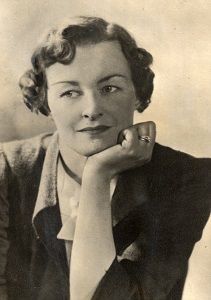
De Britse schrijfster Enid Algerine Bagnold werd geboren op 27 oktober 1889 in Rochester, Kent. Zie ook alle tags voor Enid Bagnold op dit blog.


Uit: A Diary Without Dates

“When one shoots at a wooden figure it makes a hole. When one shoots at a man it makes a hole, and the doctor must make seven others.
I heard a blackbird sing in the middle of the night last night - two bars, and then another. I thought at first it might be a burglar whistlingto his mate in the black and rustling garden.
But it was a blackbird in a nightmare.
Those distant guns again tonight... 5
Now a lull and now a bombardment; again a lull, and then batter,batter, and the windows. Is the lull when they go over the top?
I can only think of death tonight. I tried to think just now, 'What is it, after all! Death comes anyway; this only hastens it.' But that won'tdo; no philosophy helps the pain of death. It is pity, pity, pity, that I feel, and sometimes a sort of shame that I am here to write at all.
Summer... Can it be summer through whose hot air the guns shakeand tremble? The honeysuckle, whose little stalks twinkled and shone that January night, has broken at each woody end into its crumbled flower.
Where are the frost, the snow? ... Where are the dead?
The sound of a bombardment at the Front, which could be heard in England.
Where are my trouble and my longing, and the other troubles, and the happiness in other summers?
Alas, the long history of life! There is that in death that makes the throat contract and the heart catch: everything is written in water.
We talk of tablets to the dead, there can be none but in the heart, and the heart fades.”


 2188311-ad67ac209bf866777157262cc4027990.jpg
Enid Bagnold ( 27 oktober 1889 – 3 maart 1981)


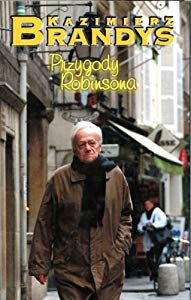
De Poolse schrijver Kazimierz Brandys werd geboren op 27 oktober 1916 in Lodz. Zie ook alle tags voor Kazimierz Brandys op dit blog.

Uit: Maanden (Vertaald door Liesbeth Schnack-Dijkhuis)

“November 1978
Honderd passen van mijn poortdeur. Al twintig jaar blijven daar groepen buitenlandse toeristen even staan, al twintig jaar hoor ik diezelfde hese bariton: ‘That is the old gothic door of fifteenth century!’ Daarop weerklinkt het toeristisch gekakel, de groep bekijkt mijn poort. Sinds twintig jaar vervloek ik dat wezen en haat ik zijn heesheid. Pas een maand geleden heb ik, op weg naar huis, die gids voor het eerst gezien. Het was een vrouw, al wat ouder, met donkere, lachende ogen, waarmee ze me niet zonder sympathie een steelse blik toewierp, alsof ze mijn langjarige kwellingen begreep. Haar schoenen zaten onder de modder. Ik voel sindsdien geen haat meer als ik haar bariton beneden hoor. Op honderd passen van mijn poort gebeuren wonderen. Niet overdrachtelijk, nee, echte wonderen, met een wonderdoener die uit Engeland is gekomen. Tussen het Bastion en de Swietojerskastraat staat al sinds vroeg in de ochtend een menigte. Mensen op karretjes, mannen met kinderen op de arm, grijsaards, verlamde vrouwen, zonen die hun moeders in rolstoelen voortduwen, een hoop mensen met een schijnbaar gezond uiterlijk, veel jonge gezichten. De zijstraten zijn aan het eind versperd met auto's, er komen ziekenauto's aangereden. De menigte staat uren te wachten, om de zoveel tijd klinkt er aan de voet van de Heilige-Jacekkerk een megafoon die nummers en namen afroept. De healer, Clive Harris, geneest door handoplegging. De zieken schuiven ieder op hun beurt naar voren, er is een stem van een vrouwelijke tolk te horen: ‘Head... Leg... Breast...’ De healer, zijn ogen halfdicht, beroert hoofden, armen, borsten. Naar het schijnt neemt hij de pijn weg en doet zijn aanraking gezwellen wijken. Harris is een veertigjarige man, kort van gestalte, met kleine handen en voeten; hij heeft iets ziekelijks over zich, een soort kreupele jongensachtigheid. Hij beroert de zieken als in trance. De header uit roeping straalt - naar ik heb gehoord - elektromagnetische golven uit. Om de paar uur drinkt hij twee, drie bekers melk. De wonderen berusten ook op belangeloosheid. Harris neemt geen geld aan.
Over dat alles vertelde mevrouw Helenka, die op haar reumatische benen even bij ons langs was gekomen om uit te rusten nadat ze vijf uur in de menigte had gestaan. Ontdaan kwam ze binnen, een zilvervos aan, een vilten, roestbruine baret op het hoofd en ringen in de oren. Ze werkt nu al acht jaar niet meer bij ons, maar twintig jaar lang heeft ze bij ons gediend, na de oorlog aanbevolen door mevrouw Bronia, de vroegere huishoudster van tante Klima Heyman, de overleden zuster van mijn moeder. Ik schoof mijn werk opzij om wat met haar te praten. We hadden het over ziektes, over mensen die overleden waren, over de duurte.”


 2188311-720406b7e8d25b961c7b108dc466f7a7.jpg
Kazimierz Brandys (27 oktober 1916 – 11 maart 2000)
Cover


De Iraanse schrijver en filmmaker Reza Allamehzadeh werd geboren op 27 oktober 1943 in Sari, Mazandaran. Zie ook alle tags voor Reza Allamehzadeh op dit blog.

Uit: Steril und illusorisch. Iranische Erfahrungen mit dem „islamischen Kino“

“Vierzehn Jahrhunderte nach Erscheinen des Propheten hat es die islamische Revolution im Iran auf sich genommen, endlich das heilige Bilderverbot des Koran durchzusetzen. Mit zu den ersten Aktionen der damals noch jungen Bewegung gehörte das Abbrennen von Kinos in Teheran und anderen Städten. Die Brandstiftungen erreichten im September 1978 einen Höhepunkt, als das „Rex“ im südiranischen Abadan von religiösen Fanatikern und Khomeini-Anhängern angezündet wurde; sie verschlossen alle Ausgänge des mit 400 Menschen besetzten Kinosaales und legten Feuer. Von den 400 Männern, Frauen und Kindern, die sich dort eingefunden hatten, um einen iranischen Film zu sehen, verbrannten 377 bei lebendigem Leibe. In diesem Kontext sah das iranische Kino der Ankunft der islamischen Revolution entgegen.
Nach seinem Machtantritt 1979 ließ sich Khomeini von engen Beratern überreden, zwei Filme des in den USA lebenden arabischen Regisseurs Mostafa A'ghad anzusehen; beide Filme, The Messenger und Omar Mokhtar, sind Beispiele für aufwendige Hollywoodproduktionen, in denen ein islamisches Thema im Zentrum steht. Wenig später machte Khomeini eine seiner obskuren und orakelhaften Äußerungen, die seinen Ruf als unbestrittener Meister der Doppeldeutigkeiten begründeten: „Wir sind nicht gegen das Kino, wir sind gegen Prostitution.“ Seit diesem Tag versucht die iranische Filmindustrie herauszufinden, was genau der Meister damit gemeint haben könnte. Die orthodoxe Auffassung ist simpel genug: „Wir sind gegen das Kino, weil es Prostitution ist.“ Der zur Zeit gültige Trend in den Regierungsinstitutionen, die die Filmindustrie kontrollieren, läßt den Satz folgendermaßen interpretieren: „Wir sind gegen die Art von Kino, die Prostitution bedeutet, nicht aber gegen ein islamisches Kino.“ Das islamische Regime hat einige Jahre gebraucht, um zu erkennen, daß die Konzeption eines islamischen Kinos illusorisch ist.
Der Direktor der Kulturabteilung in einer der größten Regierungsstellen „für islamische Filmproduktion“, Mohsen Tabatab'i, hat erklärt: „Die beste Definition des islamischen Kinos besagt, daß das Kino in der Propagierung des Islam eine eigene Rolle zu spielen hat — so wie auch die Moschee ihre Aufgabe hat.“ Um dieses Ziel zu erreichen, gibt die Filmstiftung jährlich 25 bis 40 Millionen US-Dollar aus — „zur Förderung des neuen islamischen Films“. Die „Bonyad-e-Mostafazan“ („Stiftung der Schwachen“) besitzt etwa 80 Prozent aller iranischen Kinos.”


 2188311-6cc16e617aa373c930197c1b3e83f294.jpg
Reza Allamehzadeh (Sari, 27 oktober 1943)

Geschreven door Romenu om 12:08 Reageer op dit bericht

Jan Wolkers, Marja Pruis, Maartje Wortel, Andrew Motion, Harry M.P. van de Vijfeijke, Stephen L. Carter, Karin Boye, Trevor Joyce, Pat Conroy

De Nederlandse dichter, schrijver en beeldend kunstenaar Jan Wolkers werd geboren in Oegstgeest op 26 oktober 1925. Zie ook alle tags voor Jan Wolkers op dit blog.

Uit: Serpentina's petticoat

“Het was zó'n natte novembermaand dat we dikke stukken hout op gelijke afstanden van elkaar in de tuin hadden gelegd, zodat we van blok tot blok springend tenminste met droge voeten in de schuur kwamen. De regen hield maar aan. Als lange draden grijze wol stroomden de stralen naar beneden, uit kluwens waar geen eind aan scheen te komen. De tuin kwam blank te staan. De stukken hout dreven weg en bleven tegen struiken en verdorde planten aan dobberen. Ze leken op een uit elkaar geslagen vloot en deden me denken aan een gravure in mijn geschiedenisboek, waaronder stond: Gods adem heeft ze verstrooid.
- We moeten toch in de schuur zien te komen, zei ik tegen Evert en Eddy.
Ik haalde de rubber jachtlaarzen van mijn vader te voorschijn, die al jaren niet meer gebruikt waren, zodat ik me afvroeg of ze nog wel waterdicht zouden zijn. Op het hoge stoepje voor de zijdeur van het huis trok ik ze aan. Ik liep er even aarzelend mee het water in, als iemand die in april de zee probeert. Mijn voeten bleven droog. Daarna draaide ik me met de rug naar Eddy toe en spreidde mijn armen uit. Hij sprong zo wild, dat ik bijna mijn evenwicht verloor. Ik sloeg mijn armen rond zijn harde lange dijen en ging in de richting van de schuur lopen. Als ik een voet verplaatste bleef er een klein bruin wolkje in het water achter. Ik voelde me een vliegtuig dat door ontploffende granaten achtervolgd wordt. Mijn tenen moest ik omhoogsteken om niet uit de laarzen te schieten die in de modder vastzogen.
Toen ik terugging om Evert te halen liep ik over het gazon. Als geheime donkere kreeften lagen grote dahliaknollen onder water, die op het gras te drogen waren gelegd voor de regen kwam. Mijn vader had ze maar laten liggen. Je kunt ze toch niet eten en wie denkt er aan bloemen voor volgend jaar in zo'n verschrikkelijke tijd, had hij gezegd. Ik trapte tegen de knollen. Ze vielen uit elkaar, terwijl er een lichtgele brij langzaam in het water opwolkte.
We lagen op een harde matras gevuld met zeegras. De schuurdeur hadden we open laten staan en we keken, zonder te spreken, naar de luchtbellen die de regen in het water sloeg. Soms stond een van ons op en pakte een paar tabaksbladeren, die in een lange rij aan een touw langs de zoldering hingen. Ze hadden goudgeel moeten worden, maar als onwillige kameleons waren ze in een vuile bruingroene kleur blijven steken. We knipten ze zorgvuldig fijn en rolden er sigaretten van in papier dat we uit een oud kerkboek scheurden. Ik had het boek uit de bibliotheek van mijn vader gehaald en er het binnenwerk uit getrokken”.


 2188191-0622b5e1e0b6fa03842ade33334c2f01.jpg
Jan Wolkers (26 oktober 1925 – 19 oktober 2007)


De Nederlandse schrijfster en journaliste Marja Pruis werd geboren in Amsterdam op 26 oktober 1959. Zie ook alle tags voor Marja Pruis op dit blog.

Uit: Omdat je het Waard Bent

“Soms heb ik het idee dat ik van ver kom. Alsof nu een ander soort mores heerst dan waarmee ik ben
opgegroeid, en ik me iedere keer over weerzin, schrik of angst moet heen zetten om me in de wereld
van nu te begeven. Inmiddels ben ik oud genoeg om te weten dat als ik dit idee heb, ik hier niet alleen in sta. In die zin zou iedereen het gevoel kunnen hebben van ver te komen en wordt deze planeet bewoond door aliens.
Misschien is het idee dat er een tijd bestaat waarin je zou kunnen samenvallen met jezelf, een tijd waarin je je thuis voelt, een illusie. Per definitie onmogelijk, omdat de definitie van leven veranderlijkheid is. Het is denk ik niet dat ik terugverlang naar vroeger. Ik wil niet achteruit – maar
vooruit is ook weer zoiets. Het is het splijtende gevoel dat zich achter me een zwart-witfilm ontrolt, zonder geluid – het enige geluid dat je hoort is het geratel van een amechtige projector – terwijl vóór
me een bonte kermis gaande is waarop het verplicht is een 3D-bril op te zetten. Het geluid staat
te hard, de gezichten komen te dichtbij. Een polonaise waarbij je moet inhaken op straffe van onzichtbaarheid.
Het heeft te maken met dat iedereen een vertegenwoordiger van zichzelf lijkt te zijn geworden, iedereen moet zich laten zien, en wat iedereen laat zien, moet dan weer het beste zijn dat hij of zij mogelijkerwijs kan laten zien. En dat is, ben ik bang, weer terug te voeren op het grote wereldwijde
web waarop de mensheid sinds enige decennia is aangesloten en waarvan we waarschijnlijk
nooit meer losgekoppeld raken.
De druk om constant bereikbaar te zijn, jezelf in heel je glorie te openbaren, je kunsten en goede daden op eigen houtje te etaleren… Ik weet dat de sociale media ook zegenrijk effect sorteren – Revolutie!”


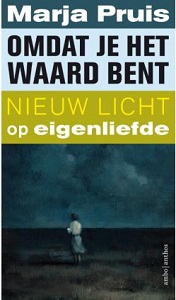
 2188191-b17e2bf7570f9f55d3e42f03272c083a.jpg
Marja Pruis (Amsterdam, 26 oktober 1959)
Cover


De Nederlandse schrijfster Maartje Wortel werd geboren in Eemnes op 26 oktober 1982. Zie ook alle tags voor Maartje Wortel op dit blog.

Uit: Half mens

“Ik heb laatst gelezen dat je ’s ochtends bij het wakker worden al beslist of je diezelfde dag bijvoorbeeld een ijsje gaat eten. Niet bewust, maar iets in je heeft al gekozen. Vandaag mag je ijs.
Je moet niet alles geloven wat ze in de krant zetten, maar nu ik er met terugwerkende kracht over nadenk, weet ik dat het waar is.
Iets in je heeft al gekozen. Zo was het ook bij Michael Poloni. Hij heeft lang moeten wachten. Toch heeft hij uiteindelijk gekregen waar hij naar verlangde, als ik het goed begrepen heb. Hij zag er in ieder geval gelukkig uit, dat kunnen niet alle mensen zeggen. Als ikzelf eens aan iemand vraag: ‘Hoe zie ik eruit vandaag?’ dan zeggen de mensen negen van de tien keer: ‘Weet je zeker dat je het horen wil?’ De tiende is mijn moeder. Zij zegt: ‘Jongen, jij bent een beauty en dat weet je best.’ Dat zijn de dagen waarop ik mijn hoed opzet.
Maar goed, het gaat nu niet om mij. Het gaat om Michael Poloni. Voor hem begon het ongeveer een half jaar geleden met een ongeluk. Het was allemaal al veel eerder begonnen natuurlijk, maar vanaf de zaterdag waarop het ongeluk plaatsvond begon het voor hem pas echt. Iets in hem had al lang daarvoor gekozen. Vandaag mag je ijs. En het besef wat dat te betekenen heeft komt altijd later, als je je ijsje al ophebt, begrijp je?
Laat ik dit vooropstellen: met mij heeft dit hele verhaal uiteindelijk niets te maken. Per toeval werd ik, James Dillard, drieënveertig jaar oud, geboren en getogen in Los Angeles, deelgenoot van dit verhaal, maar langs de zijlijn, en voor een paar maanden maar.
Het was op een dinsdagmorgen, ik had een bagel gegeten, daarna had ik gekakt terwijl ik ondertussen een hoofdstuk las uit The Road to Los Angeles. Ik had mijn tanden gepoetst en overwogen of ik me zou scheren.Ik had koffiegedronken met mijn huisgenote Allijah, een bloedmooi meisje. We zaten aan de straatkant, met de loodsdeur open. Ik keek naar het verkeer en zij vertelde over haar examens, wat me vrij weinig interesseerde, ze had al een vriend. De buurvrouw zei gedag, ze loopt kreupel. Ik vroeg me af of het niet link was dat ze zelf nog in haar auto reed. Ook dacht ik aan wat ik die middag zou gaan doen, en dat alles hetzelfde zou zijn als wat ik gisteren had gedaan en de dag daarvoor en ook de dag daarvoor. Ik deed niets, al mijn hele leven niet. Ik leefde van anticlimax naar anticlimax. Dan kan je in z’n grote stad als Los Angeles wonen maar dat lost niets op.”


 2188191-f356850d1549338c2cc954f7249b2123.png
Maartje Wortel (Eemnes, 26 oktober 1982)


De Engelse dichter, schrijver en biograaf Andrew Motion werd geboren op 26 oktober 1952 in Braintree in Essex. Zie ook alle tags voor Andrew Motion op dit blog.


Laying the Fire

I am downstairs early
looking for something to do

when I find my father on his knees
at the fireplace in the sitting-room
sweeping ash
from around and beneath the grate
with the soft brown hand-brush
he keeps especially for this.

Has he been here all night
waiting to catch me out?
So far as I can tell
I have done nothing wrong.

I think so again
when he calls my name
without turning round;

he must have seen me
with the eyes in the back of his head.

‘What’s the matter old boy?
Couldn’t sleep?’

His voice is kinder than I expect,
as though he knows
we have in common a sadness
I do not feel yet.

I skate towards him in my grey socks
over the polished boards of the sitting-room,

negotiating the rugs
with their patterns of almost-dragons.

He still does not turn round.

He is concentrating now
on arranging a stack of kindling
on crumpled newspaper in the fire basket,

pressing small lumps of coal
carefully between the sticks
as though he is decorating a cake.

Then he spurts a match,
and chucks it on any old how,

before spreading a fresh sheet of newspaper
over the whole mouth of the fireplace
to make the flames take hold.

Why this fresh sheet
does not also catch alight
I cannot think.

The flames are very close.

I can see them
and hear them raging
through yesterday’s cartoon of President Kennedy

and President Khrushchev
racing towards each other in their motorcars
both shouting
I’m sure he’s going to stop first!

But there’s no need to worry.
Everything
is just as my father wants it to be,
and in due time,
when the fire is burning nicely,
he whisks the newspaper clear,

folds it under his arm,

and picks up the dustpan
with the debris of the night before.

Has he just spoken to me again?
I do not think so. I
do not know.
I was thinking how neat he is.
I was asking myself:
will I be like this? How will I manage?

After that he chooses a log
from the wicker wood-basket
to balance on the coals,
and admires his handiwork.

When the time comes to follow him,
glide, glide over the polished floor,
he leads the way to the dustbins.

A breath of ash
pours continuously over his shoulder
from the pan he carries before him
like a man bearing a gift
in a picture of a man bearing a gift.


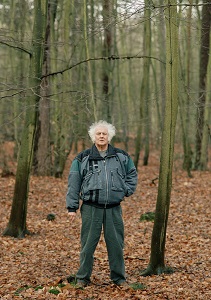
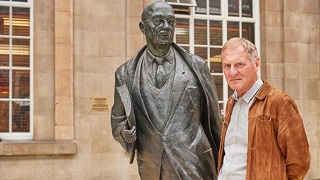
 2188191-aa577525d691fbee23cb385d1b477ebb.jpg
Andrew Motion (Braintree, 26 oktober 1952)
Hier bij een standbeeld van Philip Larkin in Hull 


De Nederlandse dichter Harry M.P. van de Vijfeijke werd geboren op 26 oktober 1946 in Waalre. Zie ook alle tags voor Harry M.P. van de Vijfeijke op dit blog.


Waar de witgeschilde berken

Waar de witgeschilde berken het uitgillen
in hun bladerwolken, geel, een plas,

waarop ik voor het eerst mijn smalte
overwon en op ijzers uithuizig
comfortabel was.

De zwarte vloer, vijver van verre dagen.
Nu mijn vader sterft en ik nog
wat blijf, ga ik mij vast terug
op de vroege vlakten wagen.


De stad. We bleven

De stad. We bleven.
Ooit was er een reden.

Zij had het ongemakkelijk die tijd, de stad.
Er werden ingewanden weggehaald,
geschiedenis bracht ongerief, gewoeker.

Ik werd verwacht te bloeien. Klaproos
op kaalslag. Ik viel niet mee.

We raakten in de pas, het tumult
waarmee ik je bezocht werd milder.

De trouw die ik belijd is er niet een
van het zweren.

Het is liefde, een van goed vaarwater,
rustig en welwillend als een schil.


 2188191-0f752c9a4f340ac190cff8a8b4f3a779.jpg

Harry M.P. van de Vijfeijke (Waalre, 26 oktober 1946)


De Amerikaanse schrijver Stephen L. Carter werd geboren op 26 oktober 1954 in Washington, D.C. Zie ook alle tags voor Stephen L. Carter op dit blog.

Uit: The Impeachment of Abraham Lincoln

“The President was dying.
As the grim news spread through Washington City, angry crowds spilled into the cold, muddy night. Abraham Lincoln had been shot at Ford’s Theatre, on Tenth Street. The wounds were mortal, people were saying. There was no way he could survive. The war was over, the South utterly vanquished, yet somehow its withered hand had reached up into the nation’s capital and extracted this bitter revenge. The crowds became mobs, looking for somebody to hang. Some wanted to burn Ford’s to the ground. Others marched toward Old Capitol Prison, where many leaders of the late rebellion were still being held. Rumors passed from mouth to mouth: The Vice- President had been murdered in his rooms at Kirkwood House. The Secretary of State had been stabbed to death in his mansion on Lafayette Square. Confederate troops were advancing on the city. Or Union troops: nobody seemed to know for sure, and a coup d’état had been rumored for years. Outside Ford’s Theatre, a man in the blood-spattered uniform of an army major and a doctor carrying a candle fought their way into the street. A group bearing Lincoln’s unmoving body followed behind. Mrs. Lincoln, face like chalk, clutched her husband’s stiff hand. People leaned in, trying to see or touch. Men groaned. Women wept. A soldier banged on the door of a row house across the way. They carried the President inside and shut the door. People craned to peer in the windows. Minutes later, Secretary of War Stanton, the most feared man in Washington, arrived in an unguarded carriage and raced inside. Other officials followed. Furious soldiers took up positions on the sidewalk but seemed to have no clear orders. They battered members of the crowd for practice. Other men went in. The people who had been closest to the body passed on the story: the President’s head was a mass of blood.
Meanwhile, the hue and cry had been raised. That actor fellow. Wilkes Booth. He had shot the President and leaped to the stage, then escaped on horseback. Somehow the mob was armed now, looking for someone to whom they might do mayhem.”


 2188191-ba9b95ae25768bf3dd29ee3af0ce5869.jpg
Stephen L. Carter (Washington, 26 oktober 1954)


De Zweedse dichteres en schrijfster Karin Maria Boye werd geboren op 26 oktober 1900 in Göteborg. Zie ook alle tags voor Karin Boye op dit blog.


Evening Stillness

Feel how near Reality dwells.
She breathes near here
on evenings with no wind.
Perhaps when no one looks, she shows herself,

The sun glides over rock and grass.
In her silent play
life's spirit is concealed.
Never as this evening was he so close.

I have met a stranger with silent lips.
If I had reached out my hand
I would have brushed his soul,
as we passed each other with timid steps.


Burning Candles

Now cries the night aloud in need,
with unknown dread a-quake.
Now light I here two candles straight
for eternal darkness' sake.

If the Lord's angels pass by here,
the light will call to them,
then they will hear the flames sing my prayer,
and bear it with them home.

They are warriors who go in armour of fire
with word from the Almighty's house.
Their speech has no words for harsh and sweet.
but for burning candles it has.

That is why they stand on the storm's back
between the whipping wings' din,
that is why they smile at the darkness's power
and meet the cold with disdain.

O Lord my God, O terrible God,
Your mantle's roar booms free.
I pray for flowers and pray for peace -
but give burning candles to me!


Vertaald door David McDuff


 2188191-10c3106ab4c548eb0c2258ec72cf1f38.JPG
Karin Boye (26 oktober 1900 – 24 april 1941) 
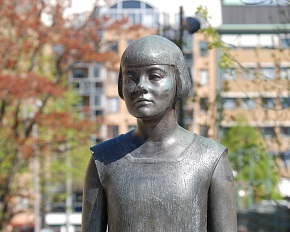
Standbeeld in Göteborg (detail)


De Ierse dichter Trevor Joyce werd geboren op 26 oktober 1947 in Dublin. Zie ook alle tags voor Trevor Joyce  op dit blog.


FROM A PHANTOM HYPERSESTINA (Fragment)

peacocks
seem out
of place
and uneasy
here

large
rattling
tails
folded

eyes
all
neatly
stacked

like tenses
of some
complex
and irregular
verb tabled
in a grammar

could
should
would

or a hand
of cards


 2188191-48e749341fa0cdc8d7c188ba66e10549.jpg
Trevor Joyce (Dublin, 26 oktober 1947)


De Amerikaanse schrijver Pat Conroy werd geboren op 26 oktober 1945 in Atlanta, Georgia. Zie ook alle tags voor Pat Conroy op dit blog.

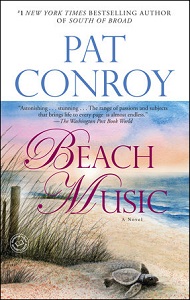
Uit:Beach Music

“I am usually up when the Piazza Farnese awakens. In darkness I brew my coffee and take a cup up to the terrace where I watch first light come over the deer-colored city.
At six in the morning, the man at the newspaper stand arrives and begins arranging magazines beneath his canopy. Then a truck enters the piazza from the west carrying bales of Il Messaggero and other morning papers. The two carabinieri who guard the entrance to the French Embassy switch on the lights of their jeep to begin their slow perfunctory circling of the Palazzo Farnese. Wearing the same expressions, like face cards in a disfigured deck, the carabinieri seem bored and usually you can see the pale glow of their cigarettes against the dashboards as they sit in their cars during the long Roman night. A van carrying fragrant bags of coffee then arrives in front of the Bon Caffe at the same time the owner of the cafe rolls up the steel shutters. His first cup of coffee always goes to the driver of the truck, the second to the owner of the newspaper stand. A small boy, the son of the owner, then takes two cups of black coffee to the carabinieri across the piazza just as the nuns in Santa Brigida begin to stir in the convent across from my building.
While it is still dark beneath the annealed stars and low-seated moon a nun opens the small steel gate in front of the Church of Santa Brigida, an act signifying that Mass is about to start. There is solitude in the fatigue of watching such beginnings and I then ritually count the thirteen churches I can see from my terrace. I was still counting them when I spotted a man who had been following us for the last few days enter the piazza from the Campo dei Fiori.
I slipped behind an oleander bush as the man looked up toward my terrace, then entered the Bon Caffe. I continued to count the bell towers and the four great moony clocks whose hands commemorated the exact moment of their death for Rome to see. I listened with pleasure to the music of the fountains in the piazza.
Across the piazza, a nun moved on the church's terrace this Monday morning, heedless as a moth in her mothering of roses. A brindled cat stalked a pigeon into the first slice of sunlight in the piazza, but a bum clapped his hands and shooed them both away. The man who'd been following me came out of the Bon Caffe and looked my way again. He lit a cigarette, then walked to the newspaper stand and bought a copy of Il Messaggero.
Below me the piazza began to bloom with life as carts rolled into it and pedestrians entered from the side streets. Pigeons called to each other from the stately rows of fleurs-de-lys that stretched along the entablature of the French Embassy. I love both the regularity and austereness of my piazza.”


 2188191-cdc1f0e8a7be1df095f05f4509c83a60.jpg
Pat Conroy (26 oktober 1945 – 4 maart 2016)
Cover


Zie voor nog meer schrijvers van de 26e oktober ook mijn blog van 26 oktober 2014 deel 2.

Geschreven door Romenu om 19:20 Reageer op dit bericht

Meer van Romenu

↑ Terug naar de berichten