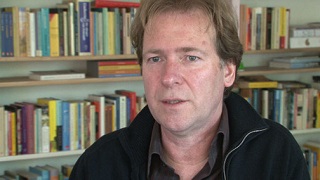
Ester Naomi Perquin, Anthony Hecht, Reinhard Jirgl, Inger Christensen, Susan Sontag, Brian Castro, José Soares, Kálmán Mikszáth, Tino Hanekamp
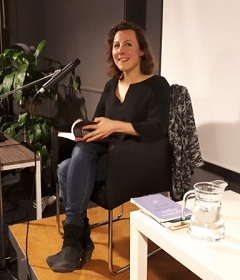
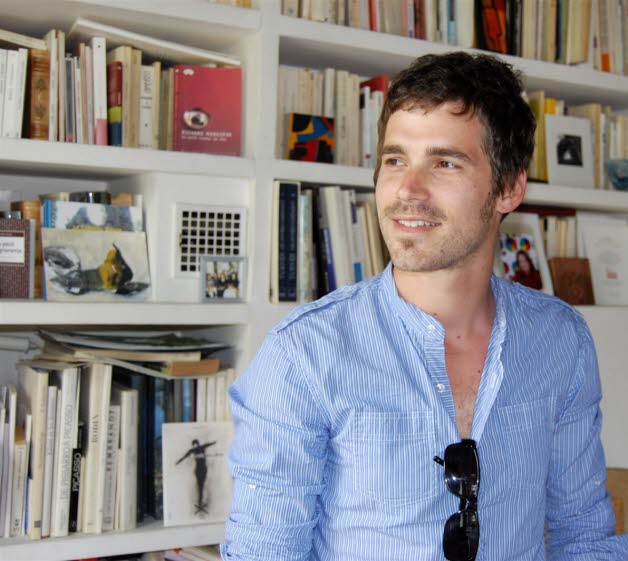
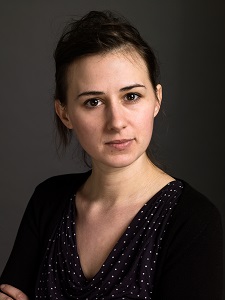
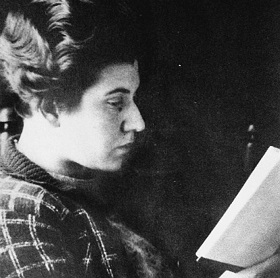
De Nederlandse dichteres Ester Naomi Perquin werd geboren in Utrecht op 16 januari 1980. Zie ook alle tags voor Ester Naomi Perquin op dit blog.
Housekeeping
Teruggekeerd van een wandeling langs de vreemde markten
van de stad, waar ze onder de geurvlag van honing en kaneel
levende aapjes en geplukte eenden verkochten,
trof ik mijn hotelkamer als volgt aan:
De zandkleurige kussens waren geschud, het bed was opgemaakt,
de handdoeken waren vervangen, de vloer was gezogen,
de ramen gelapt, het plafond was gewit, de rozen
op het behang (grote koppen, korte stelen) hadden water gekregen,
mijn man was gebeld om het woord sorry te horen, sorry, sorry, sorry
mijn jurken waren eleganter, mijn laarzen oogden slanker, het gedicht
waar ik die nacht aan begonnen was lag afgemaakt
op de glazen tafel naast het bed
en in een mij onbekend handschrift waren de woorden gevonden
voor de naamloze leegte waarin ik nooit durfde blijven,
waaromheen ik grappend had bewogen, als iemand
die zijn eigen rustplaats meent te zien.
Het was beter dan wat ik ooit had kunnen schrijven, het brak
met iedere herinnering. Toen ik vertrok gaf ik een fooi van
(omgerekend) één volwassen mensenleven
en twee dagen van vertwijfeling.
Gesprek
Op straat zegt een man in zijn telefoon nee zegt niet schreeuwt
wie denk je eigenlijk, haalt adem, ziet mij staan,
wie denk je dat je bent
met je goede manieren zogenaamd die rijke vrienden van je
met je vol geplande week je goede baan
zijn stem breekt het toestel open
die vrouw rolt ineens half over straat, half aangekleed, mascara
uitgelopen, krabbelt overeind, staat verbaasd
en hij begint weer opnieuw
wie denk je dat je bent en kijkt naar mij terwijl hij slaat,
blijft kijken tot ik roep dat is genoeg stop ze ligt
al opgerold ze doet je niks man stop
maar hij is nog niet uitgepraat en kijkt naar mij en vraagt
wie denk je blijft maar doorgaan in zijn handpalm
woorden maken, dat je bent
houdt niet meer op
Winter
Laat het na deze winter nog eens winter zijn.
Geen statig broeden meer. Geen kievitsei.
Geen welbedreven paring of zorgvuldig nest.
Ik hoop dat de kou de grond voorgoed verpest
met alles dat nog kiemen zou daarbij.
Laat straten grauw zoals ze 's winters zijn.
De moddersneeuw van uitgebeende dagen,
twee blauwe kinderwanten naast een wak.
Ik kan geen lammetjes verdragen.
Niets erger dan dat woekerend gemak
waarmee de lente aan het groeien slaat.
Daaronder houdt het ijs een zoontje stil.
Voor al dat leven maakt hij geen verschil.
Er is geen zonlicht dat hem bovenbrengt.
Geen vooijaar dat hem kennen wil.
Ester Naomi Perquin (Utrecht, 16 januari 1980)
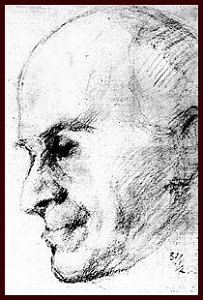
De Amerikaanse dichter Anthony Hecht werd geboren op 16 januari 1923 in New York. Zie ook alle tags voor Anthony Hecht op dit blog.
Birdwatchers Of America
It’s all very well to dream of a dove that saves,
Picasso’s or the Pope’s,
The one that annually coos in Our Lady’s ear
Half the world’s hopes,
And the other one that shall cunningly engineer
The retirement of all businessmen to their graves,
And when this is brought about
Make us the loving brothers of every lout—
But in our part of the country a false dusk
Lingers for hours; it steams
From the soaked hay, wades in the cloudy woods,
Engendering other dreams.
Formless and soft beyond the fence it broods
Or rises as a faint and rotten musk
Out of a broken stalk.
There are some things of which we seldom talk;
For instance, the woman next door, whom we hear at night,
Claims that when she was small
She found a man stone dead near the cedar trees
After the first snowfall.
The air was clear. He seemed in ultimate peace
Except that he had no eyes. Rigid and bright
Upon the forehead, furred
With a light frost, crouched an outrageous bird.
Lot's Wife
How simple the pleasures of those childhood days,
Simple but filled with exquisite satisfactions.
The iridescent labyrinth of the spider,
Its tethered tensor nest of polygons
Puffed by the breeze to a little bellying sail --
Merely observing this gave infinite pleasure.
The sound of rain. The gentle graphite veil
Of rain that makes of the world a steel engraving,
Full of soft fadings and faint distances.
The self-congratulations of a fly,
Rubbing its hands. The brown bicameral brain
Of a walnut. The smell of wax. The feel
Of sugar to the tongue: a delicious sand.
One understands immediately how Proust
Might cherish all such postage-stamp details.
Who can resist the charms of retrospection?
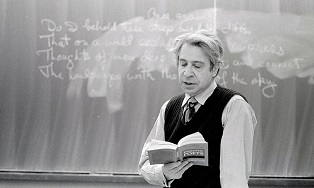
Anthony Hecht (16 januari 1923 – 20 oktober 2004)
De Duitse schrijver Reinhard Jirgl werd op 16 januari 1953 in Oost-Berlijn geboren. Zie ook alle tags voor Reinhard Jirgl op dit blog.
Uit: Mutter Vater
“Eine Wachstube voll Blut. Eine Mauer voll Blut wie seine Haut, die Poren von einem rotschimmligen Schwamm. Seither roch ich diesen kalten dumpfen Geruch, meinte schorfige Haut und dünne Blutfäden zu sehn, wenn er sich die Kleider vom Körper zog. Wären Mörder immer so leicht zu erkennen! Seife und Parfüm sind Erfindungen der Henker aus Gestern für Morgen. Die Welt ohne Parfümerie stinkt nach Abdeckerei. Ich hab ihn nicht mehr an mich gelassen seitdem. Einmal hab ich ihn bedroht mit der Schere, sein Geschlecht, diesen Stachel des Mörders, als er eines Abends mit seinem Geruch zu mir kam. Ein Bild zum Lachen: Mit heruntergelassener Hose er, das Hemd schlotternd um die mageren Knie, starrte er mit schielendem Blick auf die Waffen einer Frau. Er kam selten heim danach und zumeist besoffen. Gewiß hielt er mich für verrückt und sich gesund von Staats wegen. Und wie alle Gesunden hatte er einen Heidenrespekt und eine animalische Furcht vorm Abnormen. Einmal betrank ich mich und legte mich zu Bett, als ich ihn kommen hörte. Wenn dus willst, dann tus jetzt. Sagte ich und drehte das Gesicht beiseite. Er stand in der Tür mit glasigem Blick auf meine gespreizten Schenkel. Dann begann er zu lachen. Und lachte noch, als er mich aus dem Bett zerrte und mit dem Stiefel trat. Ich ahnte, daß diese Fraun im Lager, von denen ich keine rechte Vorstellung hatte, von nun an schwerer unter diesem Mann leiden müßten. Ich weiß nichts von Solidarität mit meinem Geschlecht Frau. Der Teil meiner Rache ist meine Kälte. Die heimlichen Morde im Ehebett. Ich habe ihn gewürgt, daß ich seinen Kehlkopf zerbrechen hörte. Und er ist auferstanden mit dem wurmbleichen Morgenlicht. Ich habe ihm Kinnlade, Zunge und Geschlecht ausgerissen. Ich habe meine Finger wie Dolche in seine Augen und seinen Schädel gebohrt, als seine Hände meine Brüste schändeten. Ich habe seine Haut mit siedendem Öl übergossen, der Mord in der Küche, das ist Humor von einer Frau. Sein Samen für den Ausguß, ein Mal zu wenig, mein Kind!, in jede Pore seiner Haut drang eine Nadelspitze meines Hasses. Und sein Fleisch ist auferstanden unverletzlich aus dem Gestein des Ehebettes. Jeder neue Morgen ein Ostersonntag für den Herrn. Dem Weib bleibt die Tortur ihrer Nächte. Du bist hundertmal in hundert Nächten schon gestorben durch mich, was macht noch das eine Mal. Trauer. Der Brunnen ist versiegt. Was mir geblieben ist von dir sind deine Bücher, Bibliothekar. Das warst du, bevor deine Haut Farbe bekam von der Sonnen-Rune.“

Reinhard Jirgl (Oost-Berlijn, 16 januari 1953)
De Deense dichteres, schrijfster en essayiste Inger Christensen werd geboren op 16 januari 1935 in de stad Vejle aan de oostkust van Jutland. Zie ook alle tags voor Inger Christensen op dit blog.
Blue Poles
Tonight, away begins to go
farther away, and the dream
what do we know of the dream
metallic leaps Jackson Pollock
silvery streams Jackson Pollock
I gaze across the sea
see in the distance your walk and you
pass the Pacific, distant and blue
phallus and Moloch pace my view
on into otherness
on into otherness?
are we in the world after or before
are we or are we not magnetic force
it is apparently me you inform:
genesis woman dream that begins
tonight to go farther away
tonight to reach farther away
metallic leaps Jackson Pollock
silvery streams Jackson Pollock
on across the blue sea
Letter in April IV
Already on the street
with our money clutched
in our hands,
and the world is a white laundry,
where we are boiled and wrung
and dried and ironed,
and smoothed down
and forsaken
we sweep
back
in children’s dreams
of chains and jail
and the heartfelt sigh
of liberation
and in the spark trails
of feelings
the fire eater
the cigarette swallower
come
to light
and we pay
and distance ourselves
with laughter.
Vertaald door Susanna Nied
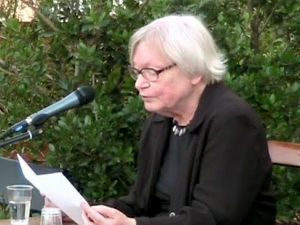
Inger Christensen (16 januari 1935 – 2 januari 2009)
De Amerikaanse schrijfster en essayiste Susan Sontag werd geboren op 16 januari 1933 in New York. Zie ook alle tags voor Susan Sontag op dit blog.
Uit: Reborn: Journals and Notebooks, 1947-1963
“7/29/48
... And what is it to be young in years and suddenly wakened to the anguish, the urgency of life?
It is to be reached one day by the reverberations of those who do not follow, to stumble out of the jungle and fall into an abyss:
It is then to be blind to the faults of the rebellious, to yearn painfully, wholly, after all opposites of childhood's existence. It is impetuousness, wild enthusiasm, immediately submerged in a flood of self-deprecation. It is the cruel awareness of one's own presumption ...
It is humiliation with every slip-of-the-tongue, sleepless nights spent rehearsing tomorrow's conversation, and torturing oneself for yesterday's ... a bowed head held between one's hands ... it is "my god, my god" ... (in lower case, of course, because there is no god).
It is withdrawal of feeling toward one's family and all childhood idols ... It is lying ... and resentment, and then hate ...
It is the emergence of cynicism, a probing of every thought and word and action. ("Ah, to be perfectly, utterly sincere!") It is a bitter and relentless questioning of motives ...
It is to discover that the catalyst, the [Entry trails off at this point.]
8/19/48
What seemed once to be a crushing weight has sharply shifted position, in a surprising tactic, swung beneath my fleeing feet, become a sucking force that drags and tires me. How I long to surrender! How easy it would be to convince myself of the plausibility of my parents' life! If I saw only them and their friends for a year, would resign myself—surrender? Does my "intelligence" need frequent rejuvenation at the springs of other's dissatisfaction and die without it? If I can hold myself to these vows! For I can feel myself slipping, wavering—at certain times, even accepting the idea of staying home for college.
All I can think of is Mother, how pretty she is, what smooth skin she has, how she loves me. How she shook when she cried the other night—she didn't want Dad, in the other room, to hear her, and the noise of each choked wave of tears was like a giant hiccup—what cowards people are to involve themselves, rather, to passively let themselves be involved, by convention, in sterile relationships—what rotten, dreary, miserable lives they lead—
How can I hurt her more, beaten as she is, never resisting?
How can I help me, make me cruel?”
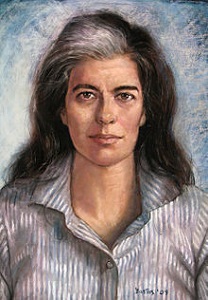
Susan Sontag (16 januari 1933 – 28 december 2004)
Portret door Juan Fernando Bastos, 1994
De Australische schrijver en essayist Brian Castro werd geboren op 16 januari 1950 in Hongkong. Zie ook alle tags voor Brian Castro op dit blog.
Uit:Blindness and Rage (Fragment)
Canto 1
But how to write now in such gloom
in the face of real impending doom?
Should the work be given every attention
to become the focus of constriction?
His heart’s regret
was his life’s invention: to beget
lying and exaggeration
in exchange for deep imagination
when it was a sign of the times
to pretend to the truth,
even if it smacks of youth
to force some easy ABBA rhymes,
without relying on Pushkin’s Onegin
for good taste
after pulp fiction had laid waste
to innocence in the nursery,
pushpins inserted into favourite Teddy
and every friend a Fagin.
Divorce again, says Gracq each morning
while scooping out his avocado,
not meaning to indicate a new world dawning
but the cheery chime of boot-up time
rings well with his bravado.
Today I’m free once more with each new laptop page
to look forward without fear
at the horizon of a limited holiday; no foe,
no rule to fight against the rhyme save
something long suppressed,
sage Oriental respect perhaps,
for time, patience and all its psycho-analytic show,
suppressing atavistic anger
and deep revenge at God knows whom.
A breath.
A death.
It brought him back.
The corner shop opens for afternoon trading.
Long past the pizza for the microwave and
its use-by-date, Gracq has no appetite and
lingers by cancer’s tropic – his fate of late –
attending neither medicine’s ball nor
fortune-cookie fêtes, believes he’s at the meridian
or the End – soon to rave and pitch
a farewell note and bill of lading for the ferryman.

Brian Castro (Hongkong, 16 januari 1950)
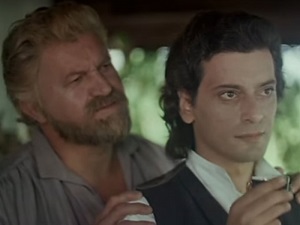
De Braziliaanse schrijver, theaterproducent, talk show host, acteur, schilder en musicus José Soares werd geboren op 16 januari 1938 in Rio de Janeiro. Zie ook alle tags voor José Soares op dit blog.
Uit: Twelve Fingers: Biography of an Anarchist
“Not all of Dragutin's conspiracies were successful. A year earlier, he had sent an assassin to Vienna to eliminate Emperor Franz Josef and the attempt had failed.
Husky and truculent, with an upward-pointing handlebar mustache, Dragutin Dimitrijevic wore his officer's uniform in impeccable fashion. If he were not such a powerful man, he would have been simply an object of ridicule. As an adolescent at the Belgrade Lycée, he had been a brilliant student. Indefatigable, possessed of limitless energy, popular with his peers, he acquired the nickname of Apis, the sacred bull of the ancient Egyptians. The sobriquet would accompany him for the rest of his life.
Ivan Korozec decides to enter this new sect. Dimitri's zeal and the almost fanatical admiration he feels for his father continue to grow. The latter reciprocates, fascinated by the intelligence and intellectual abilities of his son. Dimo appears older than his fifteen years. He stands almost six feet tall, and when he strolls through the streets of Sarajevo women turn their heads to watch him with hungry eyes.
On Friday, December 20, a snowstorm falls on the city. Yielding to his son's repeated entreaties, Ivan takes the youth to a secret meeting of Union or Death. The Bull is present, in violation of his own rules. He is looking for new talent for the ranks of the sect. Dimitri longs for this encounter. The atmosphere is one of excitement and civic fervor. Very near the end of the meeting, around 2 a.m., without being asked, Dimitri interrupts a speaker who was discoursing on the Austro-Hungarian Empire's dominion over Bosnia and makes an impassioned speech about the necessity for more action and less talk.
Apis is enchanted by the impetuous young man. Years before, in 1903, Dragutin had been the head of the conspiratorial officers who invaded the Royal Palace and assassinated the hated King Alexander Obrenovic and his wife, the former prostitute Draga. The colonel's charisma also does not escape the notice of Dimitri, who is pleased that both have almost the same name.
As professor of strategy and tactics at the Military Academy, Dimitrijevic exercises enormous influence on his students, who follow him to the death. Dragutin decides to make Dimo his protégé. He does not wish to see him gravitate toward the Mlada Bosna, the "Young Bosnia" movement that so enraptured university students at the time and has already cost him Gavrilo Princip, a student with a natural propensity for terrorism and a sharpshooter who he had sworn was his work of Pygmalion. Therefore, that night he initiates the following dialogue with Dimitri and Ivan Korozec:
"Ivan, is your son as bold as he seems, or are his words merely the echo from an empty head, as my grandfather used to say?" asks Dragutin, smiling.”

José Soares (Rio de Janeiro, 16 januari 1938)
De Hongaarse schrijver en journalist Kálmán Mikszáth werd op 16 januari 1847 in Szklabonya (tegenwoordig Slowakije) geboren. Zie ook alle tags voor Kálmán Mikszáth op dit blog.
Uit: Annie Bede's Debt (Vertaald door W. B. Worswick)
“The sternness of the judge's face is melting. The picture of the king, and over there that of the Chief of the county, seem gently to encourage her.
In the writ everything would be stated. She had placed it thoughtlessly in the bosom of her dress; she must unfasten her brooch to get at it. How could she, and before all these prying eyes, too! Ah, poor child, even her clasp proved treacherous. It fell to the ground, and, catching the eye of the sun, seemed to laugh at her! How lovely she looked as, stooping modestly, she regained both that and the writ, which also had fallen to the floor.
The stern, hoary head of the presiding justice is turned away; only his big, fat hand reaches out for the parchment.
"It is a judgment," he mumbles, as his piercing eyes scan its pages. "Annie Bede is cited to appear, and to begin to-day the six months' imprisonment to which she has been sentenced."
The girl's eyes fill with tears, and as she raises her handkerchief to them the mourning hood which conceals her black hair slips and allows a heavy braid to unloosen and fall, covering her face, white as a lily before, but now burning with a crimson hue.
"A week ago we received this writ," she stammered, tearfully. "The judge himself brought and explained it. I have come to fulfil the sentence. Law is law!"
The judge glances towards his colleagues, seeks the windows, the floor, the door, and then unconsciously murmurs, "Law is law!" Again he reads the judgment, this time carefully, slowly. No; there it is: "Annie Bede is to be imprisoned during six months of the year for receiving stolen goods."
A dismal moaning is heard without; the fog deepens, and the wind, whistling through the cracks of the door, and turning furiously the leaden circle in the window-pane, shrieks, "Law is law!"
The stern head of the president is seen to nod; his big, fat hand stretches to the bell and rings it, whilst his voice says, in mournful tones, to the court attendant.
"Take Annie Bede to the warder of the prison."
He receives the writ; the girl mutely turns round staggers, and endeavours to speak; her lips only move, but no sound comes forth.”
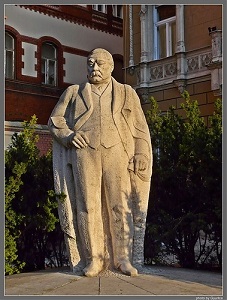
Kálmán Mikszáth (16 januari 1847 – 28 mei 1910)
Standbeeld in Boedapest
Onafhankelijk van geboortedata:
De Duitse schrijver Tino Hanekamp werd geboren in 1979 in Wippra in Saksen-Anhalt. Zie ook alle tags voor Tino Hanekamp op dit blog.
Uit: So was von weg. Produktionsnotizen
„Ich stand am Sterbebett meiner Großmutter, als mein Handy klingelte. Sie war noch fast voll da, hörte zu, nickte, lächelte und sprach zuweilen ein paar verweht wirkende Worte, trotzdem wusste ich, dass ich sie nie wieder sehen würde, als ich unter den tadelnden Blicken meiner Eltern mein Handy aus dem Jackett zerrte, um den Anruf wegzudrücken. Was ich auch getan hätte, wäre der Anrufer nicht mein Lektor gewesen, bzw. der Typ, der mir ohne Vertrag oder Auftrag geholfen hatte, meinen ersten Roman zu schreiben; der mich jede Woche angefleht hatte, die neuen Seiten nicht zu löschen sondern weiterzumachen, bis zum Ende, und dann würde er den Roman den Leuten im Verlag zum Lesen geben, und dann würden wir wissen, ob Kiepenheuer & Witsch den Roman veröffentlichen würde – und das war jetzt der Anruf. Ich entschuldigte mich, ging raus und stürmte kurz darauf wieder rein. Omi, die bringen mein Buch raus! Ich bin jetzt Schriftsteller oder so was in der Art! Meine Großmutter hatte nie verstanden, was ich machte. Keine Ausbildung aber Musikjournalist, was auch immer das war, dann Clubbetreiber, und was machst du eigentlich beruflich, Junge? Und mit deinem Leben? Jetzt lächelte sie. Buch, Roman, Schriftsteller – vielleicht war das irgendwie greifbarer für diese Ostpreußin, die ihr Leben lang nur Groschenheft-Romanzen gelesen hatte. Ich hoffte es. Sehr.
Halbes Jahr später, Omi schon lange tot, in zwei Monaten erscheint der Roman, und ich hasse ihn, schäme mich für jedes Wort, habe Angst, dass Freunde und Bekannte ihn lesen und mich für den Idioten halten, der ich bin – totale Panik. In Anbetracht der Situation nicht ungewöhnlich und zudem wohl die letzten Ausläufer einer besonders narzisstischen, weil von Selbsthass geprägten Adoleszenz. Wie auch immer: Wieder ruft mein Lektor an. Es gäbe da einen Filmproduzenten, dem er vom Roman erzählt und ihm vorab das Manuskript geschickt habe, und der wolle mich jetzt treffen.“

Tino Hanekamp (Wippra, 1979)
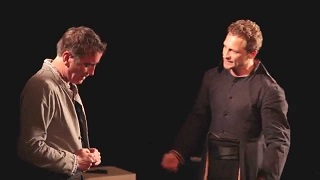
Scene uit de film “So was von da“ uit 2018
Zie voor nog meer schrijvers van de 16e januari ook mijn blog van 16 januari 2017 en ook mijn blog van 16 januari 2016 deel 2 en eveneens deel 3.