Naar de inhoud

Romenu

Over literatuur, gedichten, kunst en cultuur
akke.beakke.be

Berichten van 18 januari 2019 tot 19 januari 2019

Julian Barnes, Bert Natter, Edgar Allen Poe, Edwidge Danticat, Patricia Highsmith
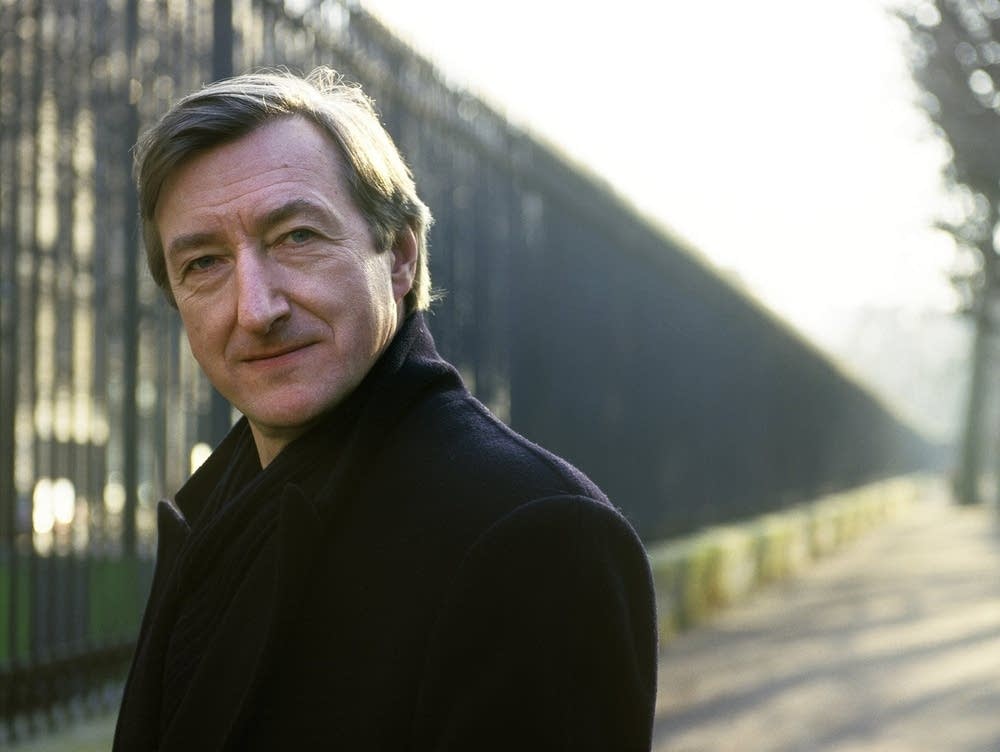
De Engelse schrijver Julian Barnes werd geboren op 19 januari 1946 in Leicester. Zie ook alle tags voor Julian Barnes op dit blog.

Uit: The Noise of Time

“And so, it had all begun, very precisely, on the morning of the 28th of January 1936, in Arkhangelsk. He had been invited to perform his first piano concerto with the local orchestra under Viktor Kubatsky; the two of them had also played his new cello sonata. It had gone well. The next morning he went to the railway station to buy a copy of Pravda. He had looked at the front page briefly, then turned to the next two. It was, as he would later put it, the most memorable day of his life. And a date he chose to mark each year until his death.
Except that—as his mind obstinately argued back—nothing ever begins as precisely as that. It began in different places, and in different minds. The true starting point might have been his own fame. Or his opera. Or it might have been Stalin, who, being infallible, was therefore responsible for everything. Or it could have been caused by something as simple as the layout of an orchestra. Indeed, that might finally be the best way of looking at it: a composer first denounced and humiliated, later arrested and shot, all because of the layout of an orchestra.
If it all began elsewhere, and in the minds of others, then perhaps he could blame Shakespeare, for having written Macbeth. Or Leskov for Russifying it into Lady Macbeth of Mtsensk. No, none of that. It was, self-evidently, his own fault for having written the piece that offended. It was his opera’s fault for being such a success—at home and abroad—it had aroused the curiosity of the Kremlin. It was Stalin’s fault because he would have inspired and approved the Pravda editorial—perhaps even written it himself: there were enough grammatical errors to suggest the pen of one whose mistakes could never be corrected. It was also Stalin’s fault for imagining himself a patron and connoisseur of the arts in the first place. He was known never to miss a performance of Boris Godunov at the Bolshoi. He was almost as keen on Prince Igor and Rimsky-Korsakov’s Sadko. Why should Stalin not want to hear this acclaimed new opera, Lady Macbeth of Mtsensk?
And so, the composer was instructed to attend a performance of his own work on the 26th of January 1936. Comrade Stalin would be there; also Comrades Molotov, Mikoyan and Zhdanov. They took their places in the government box. Which had the misfortune to be situated immediately above the percussion and the brass. Sections which in Lady Macbeth of Mtsensk were not scored to behave in a modest and self-effacing fashion.
He remembered looking across from the director’s box, where he was seated, to the government box. Stalin was hidden behind a small curtain, an absent presence to whom the other distinguished comrades would sycophantically turn, knowing that they were themselves observed.”


 2208880-09e8f20215c75e4c9eb0b643f174653c.jpg
Julian Barnes (Leicester, 19 januari 1946)


De Nederlandse schrijver, uitgever en journalist Bert Natter werd geboren in Baarn op 19 januari 1968. Zie ook alle tags voor Bert Natter op dit blog.

Uit: Hoe staat het met de liefde?

“Begin opnieuw. Steek de sleutel in het slot. Open de voordeur.
Ga het halletje binnen. Vermoed niets. Hoor buiten het geronk van de bus wegsterven. Luister niet naar het gebonk binnen.
Geniet van het onverwachte vrije uur. Voel hoe lekker behaaglijk het is.
Ga verder. Sluit de deur. Stamp op de mat. Gooi die kapotte schooltas onder de kapstok. Doe die wanten uit. En die muts af. Vergeet school, vergeet de kou. Verlies nooit deze onschuld. Trek uit die dikke winterjas.
Duw tegen de deur naar de gang. Baal ervan dat die klemt. Blijf in het halletje staan.
Bedenk wie hier achter zit. Duw nog eens. Sla op de deur. Roep. Schop tegen de deur. Scheld en vloek.
Laat ook maar.
Ga zonder jas, zonder wanten en zonder muts de kou in. Trek de deur in het slot.
Kijk niet naar de overkant van het kruispunt. Weiger daarheen te gaan. Kruip daar niet weg.
Loop om door het gangetje.
Zucht diep.
Hoop dat alles goed komt.
Zie dat aan het huis niets te zien is.
Sta in de tuin. Probeer te glimlachen om de inzakkende sneeuwpop. De fietspomp in zijn hoofd. Goed idee van pap. Denk aan mooie momenten. Bewaar herinneringen. Koester alles wat gebeurde tot wat straks gebeurt.”
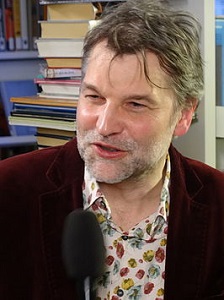

2208880-892c2e7617b77ef8217c4baf155507ac.jpg

Bert Natter (Baarn, 19 januari 1968)


De Amerikaanse dichter en schrijver Edgar Allen Poe werd geboren op 19 januari 1809 in Boston. Zie ook alle tags voor Edgar Allen Poe op dit blog

Uit: The Devil in the Belfry

“Everybody knows, in a general way, that the finest place in the world is--or, alas, was--the Dutch borough of Vondervotteimittiss. Yet as it lies some distance from any of the main roads, being in a somewhat out-of-the-way situation, there are perhaps very few of my readers who have ever paid it a visit. For the benefit of those who have not, therefore, it will be only proper that I should enter into some account of it. And this is indeed the more necessary, as with the hope of enlisting public sympathy in behalf of the inhabitants, I design here to give a history of the calamitous events which have so lately occurred within its limits. No one who knows me will doubt that the duty thus self-imposed will be executed to the best of my ability, with all that rigid impartiality, all that cautious examination into facts, and diligent collation of authorities, which should ever distinguish him who aspires to the title of historian.
By the united aid of medals, manuscripts, and inscriptions, I am enabled to say, positively, that the borough of Vondervotteimittiss has existed, from its origin, in precisely the same condition which it at present preserves. Of the date of this origin, however, I grieve that I can only speak with that species of indefinite definiteness which mathematicians are, at times, forced to put up with in certain algebraic formulae. The date, I may thus say, in regard to the remoteness of its antiquity, cannot be less than any assignable quantity whatsoever.
Touching the derivation of the name Vondervotteimittiss, I confess myself, with sorrow, equally at fault. Among a multitude of opinions upon this delicate point--some acute, some learned, some sufficiently the reverse--I am able to select nothing which ought to be considered satisfactory. Perhaps the idea of Grogswigg--nearly coincident with that of Kroutaplenttey--is to be cautiously preferred.--It runs:- "Vondervotteimittis- Vonder, lege Donder- Votteimittis, quasi und Bleitziz- Bleitziz obsol:- pro Blitzen." This derivative, to say the truth, is still countenanced by some traces of the electric fluid evident on the summit of the steeple of the House of the Town-Council. I do not choose, however, to commit myself on a theme of such importance, and must refer the reader desirous of information to the "Oratiunculae de Rebus Praeter-Veteris," of Dundergutz. See, also, Blunderbuzzard "De Derivationibus," pp. 27 to 5010, Folio, Gothic edit., Red and Black character, Catch-word and No Cypher; wherein consult, also, marginal notes in the autograph of Stuffundpuff, with the Sub-Commentaries of Gruntundguzzell.
Notwithstanding the obscurity which thus envelops the date of the foundation of Vondervotteimittis, and the derivation of its name, there can be no doubt, as I said before, that it has always existed as we find it at this epoch. The oldest man in the borough can remember not the slightest difference in the appearance of any portion of it; and, indeed, the very suggestion of such a possibility is considered an insult. The site of the village is in a perfectly circular valley, about a quarter of a mile in circumference, and entirely surrounded by gentle hills, over whose summit the people have never yet ventured to pass. For this they assign the very good reason that they do not believe there is anything at all on the other side.”
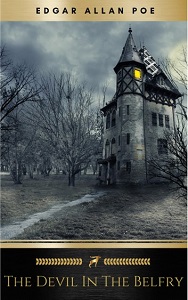
 

 2208880-4d934d6de2d9d92b197bff23cdca9caf.jpg
Edgar Allen Poe (19 januari 1809 – 7 oktober 1849) 
Cover


De Amerikaanse dichteres en schrijfster Edwidge Danticat werd geboren in Port-au-Prince op Haïti op 19 januari 1969. Zie ook alle tags voor Edwidge Danticat op dit blog.


Boat People

We are all in a drowning boat
Happened before at St. Domingue
We are the ones called boat people

We all died long ago
What else can frighten us ?
Let them call us boat people

We fight a long time with poverty
On our islands, the sea, everywhere
We never say we are not boat people

In Africa they chased us with dogs
Chained our feet, piled us on
Who then called us boat people?

Half the cargo perished
The rest sold at Bossal Market
It’s them who call us boat people

We stamp our feet down, the earth shakes
Up to Louisiana, down to Venezuela
Who would come and call us boat people?

A bad season in our country
The hungry dog eats thorns
They didn’t call us boat people yet

We looked for jobs and freedom
And they piled us on again: Cargo—Direct to Miami
They start to call us boat people

We run from the rain at Fort Dimanche
But land in the river at the Krome Detention Center
It’s them who call us boat people

Miami heat eats away our hearts
Chicago cold explodes our stomach
Boat people boat people boat people

Except for the Indians—
What American didn’t get here somehow
But they only want to call us boat people

We don’t bring drugs in our bags
But courage and strength to work
Boat people—Yes, that’s all right, boat people

We don’t come to make trouble
We come with all respect
It’s them who call us boat people

We have no need to yell or scream
But all boat people are equal, the same
All boat people are boat people

One day we’ll stand up, put down our feet
As we did at St. Domingue
They’ll know who these boat people really are

That day, be it Christopher Columbus
Or Henry Kissinger—
They will know us
We who simply call ourselves
People
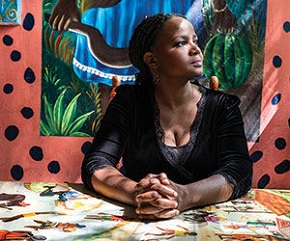
 

 2208880-2c1e730a1dcb9c494729d481558e6cb0.jpg
Edwidge Danticat (Port-au-Prince, 19 januari 1969)


De Amerikaanse schrijfster Patricia Highsmith werd geboren als Mary Patricia Plangman in Fort Worth (Texas) op 19 januari 1921. Zie ook alle tags voor Patricia Highsmith op dit blog.

Uit:Sauce For The Goose

“The incident in the garage was the third near-catastrophe in the Amory household, and it put a horrible thought into Loren Amory's head: his darling wife Olivia was trying to kill herself. Loren had pulled at a plastic clothesline dangling from a high shelf in the garage — his idea had been to tidy up, to coil the clothesline properly — and at that first tug an avalanche of suitcases, an old lawnmower, and a sewing machine weighing God-knows-how-much crashed down on the spot that he barely had time to leap from. Loren walked slowly back to the house, his heart pounding at his awful discovery. He entered the kitchen and made his way to the stairs. Olivia was in bed, propped against pillows, a magazine in her lap. 'What was that terrible noise, dear?' Loren cleared his throat and settled his black-rimmed glasses more firmly on his nose. 'A lot of stuff in the garage. I pulled just a little bit on a clothesline —' He explained what had happened. She blinked calmly as if to say, 'Well, so what? Things like that do happen.' `Have you been up to that shelf for anything lately?' `Why, no. Why?' `Because — well, everything was just poised to fall, darling.' `Are you blaming me?' she asked in a small voice. `Blaming your carelessness, yes. I arranged those suitcases up there and I'd never have put them so they'd fall at a mere touch. And I didn't put the sewing machine on top of the heap. Now, I'm not saying —' 'Blaming my carelessness,' she repeated, affronted. He knelt quickly beside the bed. 'Darling, let's not hide things any more. Last week there was the carpet sweeper on the cellar stairs. And that ladder! You were going to climb it to knock down that wasps' nest! What I'm getting at, darling, is that you want something to happen to you, whether you realize it or not. You've got to be more careful, Olivia — Oh, darling, please don't cry. I'm trying to help you. I'm not criticizing.' 'I know, Loren. You're good. But my life — it doesn't seem worth living any more, I suppose. I don't mean I'm trying to end my life, but —' 'You're still thinking — of Stephen?' Loren hated the name and hated saying it. She took her hands down from her pinkened eyes. 'You made me promise you not to think of him, so I haven't. I swear it, Loren.' 'Good, darling. That's my little girl.' He took her hands in his. 'What do you say to a cruise soon? Maybe in February? Myers is coming back from the coast and he can take over for me for a couple of weeks.”
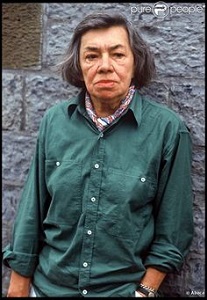
 

 2208880-2ddeb990d48ce6797bee8b7e9da15cee.jpg
Patricia Highsmith (19 januari 1921 – 4 februari 1995)


Zie voor nog meer schrijvers van de 19e januari ook mijn vorige blog van vandaag.


Geschreven door Romenu om 10:18 Reageer op dit bericht

Marie Koenen, Gustav Meyrink, Eugénio de Andrade, Thomas Gsella, Paul-Eerik Rummo

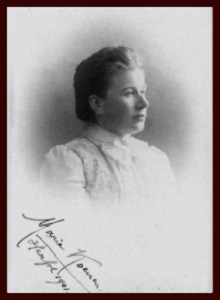
De Nederlandse dichteres en schrijfster Marie Koenen werd geboren in ’s-Hertogenbosch op 19 januari 1879. Zie ook alle tags voor Marie Koenen op dit blog.

Uit: Ouwe Giel

“Ze waren nu allen weg om Trezia mee te begraven.
In het naaste vertrekje waren Sander's vrouw en haar dochter, de geburen, den boel aan 't opruimen.
Ouwe Giel zat bij de schouw, gedoken in zijn versleten matten stoel, - dommelig en met gezonken hoofd.
‘Ze waren nu weg - en 't was stil.’
Dat deed hem weer wat tot zich-zelven komen. Drie dagen lang was 't een aanhoudend gegons in zijn ooren geweest van onzekere, halfgedoofde geluiden; - komen en gaan, gefluister, gemompel, gezoek in kasten en laden.
Ze hadden Trezia in de kist gelegd, met de handen gevouwen om haar paternoster alsof zij zelve ook nog bad.
Als er niemand meer was, stond ouwe Giel op en slofte van zijn stoel in de keuken naar het dompige vertrekje, waar Trezia zoo lag. Hij stond haar eerbiedig te bezien.
Ze lag zoo statig alsof 't een vreemde was, die Giel niet aanging, - haar gezicht was onkenbaar veranderd, zacht en tevreden, een glimlach om den mond, de oogen in berusting gesloten.
Ze lag er tenger als een heel jong meisje, en haar kleine schrale handen, die nooit gerust hadden, baden aldoor. Zoo wit en zoo plechtig lag ze daar met al die stilte om zich heen, een wijden kring van stilte, wie er intrad, sloeg een kruis en zweeg.
Terzijde waren op een tafeltje twee kaarsen aan 't branden bij een kruisbeeld; een wit kommetje met wijwater stond er naast met een palmtakje er in.
De meesten, die kwamen zien of bidden, namen het palmtakje op en sprenkelden een zegen over de doode.
Na een pooze deed Giel dat ook telkens, en dan slofte hij langzaam terug en dook weer in zijn stoel. Iedereen liep in en uit.
Sommigen kwamen even op hem toe en zeiden zoo iets van een troostreden, zonder veel hartelijkheid of medelijden. Ze wisten immers niet zeker, of Giel hen wel verstond, of er wel begrip en treurigheid in zijn hart was. De meesten meden hem, en lieten hem maar stil in zijn hoek suffen, met zijn hoofd voorover en z'n beverige handen gesteund op den stok, dien hij altijd zoo tusschen de knieën geplant hield op de roode plavuizen.”


 2208878-68080b79126c807f1bc36ad952197096.jpg
Marie Koenen (19 januari 1879 – 11 juli 1959)
Op 22-jarige leeftijd


De Oostenrijkse schrijver Gustav Meyrink werd op 19 januari 1868 te Wenen geboren. Zie ook alle tags voor Gustav Meyrink op dit blog.

Uit: Der Golem

„Alle jene Steine, die je in meinem Leben eine Rolle gespielt, tauchen auf rings um mich her.
Manche quälen sich schwerfällig ab, sich aus dem Sande ans Licht emporzuarbeiten – wie große schieferfarbene Taschenkrebse, wenn die Flut zurückkommt, – und als wollten sie alles daran setzen, meine Blicke auf sich zu lenken, um mir Dinge von unendlicher Wichtigkeit zu sagen.
Andere – erschöpft – fallen kraftlos zurück in ihre Löcher und geben es auf, je zu Worte zu kommen.
Zuweilen fahre ich empor aus dem Dämmer dieser halben Träume und sehe für einen Augenblick wiederum den Mondschein auf dem gebauschten Fußende meiner Decke liegen wie einen großen, hellen, flachen Stein, um blind von neuem hinter meinem schwindenden Bewußtsein herzutappen, ruhelos nach jenem Stein suchend, der mich quält – der irgendwo verborgen im Schutte meiner Erinnerung liegen muß und aussieht wie ein Stück Fett.
Eine Regenröhre muß einst neben ihm auf der Erde gemündet haben, male ich mir aus – stumpfwinklig abgebogen, die Ränder von Rost zerfressen, – und trotzig will ich mir im Geiste ein solches Bild erzwingen, um meine aufgescheuchten Gedanken zu belügen und in Schlaf zu lullen.
Es gelingt mir nicht.
Immer wieder und immer wieder mit alberner Beharrlichkeit behauptet eine eigensinnige Stimme in meinem Innern – unermüdlich wie ein Fensterladen, den der Wind in regelmäßigen Zwischenräumen an die Mauer schlagen läßt: es sei das ganz anders, das sei gar nicht der Stein, der wie Fett aussehe.
Und es ist von der Stimme nicht loszukommen.
Wenn ich hundertmal einwende, alles das sei doch ganz nebensächlich, so schweigt sie wohl eine kleine Weile, wacht aber dann unvermerkt wieder auf und beginnt hartnäckig von neuem: gut, gut, schon recht, es ist aber doch nicht der Stein, der wie ein Stück Fett aussieht. –
Langsam beginnt sich meiner ein unerträgliches Gefühl von Hilflosigkeit zu bemächtigen.
Wie es weiter gekommen ist, weiß ich nicht. Habe ich freiwillig jeden Widerstand aufgegeben, oder haben sie mich überwältigt und geknebelt, meine Gedanken?
Ich weiß nur, mein Körper liegt schlafend im Bett, und meine Sinne sind losgetrennt und nicht mehr an ihn gebunden. –
Wer ist jetzt »ich«, will ich plötzlich fragen, da besinne ich mich, daß ich doch kein Organ mehr besitze, mit dem ich Fragen stellen könnte; dann fürchte ich, die dumme Stimme werde wieder aufwachen und von neuem das endlose Verhör über den Stein und das Fett beginnen.
Und so wende ich mich ab.“


 2208878-a9eb0e8c167f142dcded2ac0c7aba202.jpg
Gustav Meyrink (19 januari 1868 – 4 december 1932)
Rond 1886


De Portugese dichter Eugénio de Andrade (eig. José Fontinhas) werd geboren op 19 januari 1923 in Póvoa de Atalaia. Zie ook alle tags voor Eugénio de Andrade op dit blog.


Das Salz der Sprache

Höre, höre: ich habe
noch etwas zu sagen.
Es ist nicht wichtig, ich weiß, es wird
nicht die Welt retten, wird
niemandes Leben ändern – aber wer
ist heute imstande, die Welt
zu retten oder auch nur den Sinn
irgendeines Lebens
zu verändern?
Höre mich an, ich halte dich nicht auf.
Es ist wenig, wie der Nieselregen,
der langsam herniederrinnt.
Es sind drei, vier Wörter, wenige mehr.
Wörter, die ich dir anvertrauen will.
Damit ihr Licht nicht erlischt,
ihr kurzes Licht.
Wörter, die ich sehr geliebt habe,
die ich vielleicht noch liebe.
Sie sind das Haus, das Salz der Sprache.


Vertaald door Curt Meyer-Clason


Avec la mer

J’apporte la mer entière dans ma tête
De cette façon
Qu’on les jeunes femmes
D’allaiter leurs enfants;
Ce ne qui ne me laisse pas dormir,
Ce n’est pas le bouillonnement de ses vagues
Ce sont ces voix
Qui, sanglantes, se lèvent de la rue
Pour tomber à nouveau,
Et en se trainant
Viennent mourir à ma porte..


Le petit Persan

C’est un petit persan
bleu le chat de ce poème.
Comme n’importe quel autre, mon amour
pour cette âme ténue est maternel :
une caresse lèche son pelage,
une autre met le soleil entre ses pattes
ou une fleur à la fenêtre.
Avec griffes, dents et obstination,
il fait une fête de ma vie.
Je veux dire, ce qui me reste d’elle.


Vertaald door Michel Chandeigne e.a.


 2208878-f157923f440437f001b96ce70fa61e42.jpg
Eugénio de Andrade (19 januari 1923 – 13 juni 2005)
Portret door José Viana, z.j.


De Duitse dichter en satiricus Thomas Gsella werd geboren op 19 januari 1958 in Essen. Zie ook alle tags voor Thomas Gsella op dit blog.


Auf und zwischen allen Stühlen

Was da sitzt auf allen Stühlen:
Die da vorn und die da oben
Die Gemachten und die Groben
Die Gesetzten und Bestallten
Sollst du in der Tat nicht loben
Sondern dir vom Leibe halten

Aber zwischen allen Stühlen:
Sohlendreck und Erdnussbrocken
Tüten, Tempos, Streptokokken
All der Abfall all der Pfeifen
Statt in ihrem Dreck zu hocken
Sollst du dir die Stühle greifen


Die ersten Fragen der Menschheit

2.

Papa-a?

Ja, mein Kind?

Wenn in früher Liebe Walten
schönstes Zueinanderhalten
zweier Einsamkeiten grünt;
wenn in später Liebe Pausen
schönstes Voreinandergrausen
früher Liebe Walten sühnt:
Steckt nicht ihr - hoch und juchhei! -
knöcheltief in Phase zwei?

Bitte mal schriftlich.


3.

Papa-a?

Ja, mein Kind?

Wenn wir einst, um nicht zu rosten,
rübermachten aus dem Osten,
um die Welt in Bunt zu sehn;
wenn wir nun vor todesblassen
Arbeitsämtern, Aldi-Kassen
wie im Osten Schlange stehn:
Ging der Schuss (ich frag ja bloß)
nicht dezent nach hinten los?

Dann geh' halt rüber!


 2208878-5db2f712f1c32b39827ae822be47fca7.jpg
Thomas Gsella (Essen,19 januari 1958)


De Estlandse dichter, schrijver en politicus Paul-Eerik Rummo werd geboren op 19 januari 1942 in Tallinn. Zie ook alle tags voor Paul-Eerik Rummo op dit blog.


Landschaft sein, grosszügig Landschaft sein

Landschaft sein, grosszügig Landschaft sein,
auf den Hügeln schäumen die Zapfen in Fichtenwipfeln;
Landschaft, schneeweiß, windspursträhnig,
Landschaft sein, erhabene Landschaft, durchzogen
vom Fluss, Kinderherden trägt auf dem Eis er,
die tollkühn drehn sich im Kreise,
zugleich fällt grün es vom Damm, schneeumweht,
in Röcken und Rüschen das Wasser, Wasserläufer;
Landschaft sein, in der die alte Wollmühle
die Asche dreht gemächlich, und rüttelt
leise dabei… bis in alle Ewigkeit;
Landschaft zu krächzen den hungrigen Krähen;
Landschaft aus Wolfsnacht, Landschaft vor Sonnenlicht,
Landschaft, zu drehen des Ringelspiels Aschenlast,
die Sternwarte zu tragen, das Gewölbe zu tragen aus Glast,
Landschaft sein, Landschaft sein mit aller Sinne Gewicht

In einem Kleinstadtmuseum an der Wand,
strahlende Landschaft, an den Rändern verblassend,
hinter Glas bleichen Münzen-Knochen im Sand,
müde Heimatkundler davor, ein Gähnen hören lassend;
seiend sein, wissend, dass niemals man findet
für deinen richtigen Namen das Wort; wissend,
dass man es immer wird missen;
Landschaft sein, die mit Schneelicht blendet;
Landschaft sein, in Ruhe nach dem Sturm der Schnee,
bis einer, dem das Herz so weh,
durchs Zimmer rast, weil die Brust zerbricht,
das Messer in die Lein wand sticht.


Vertaald door Ralf Thenior


 2208878-12db86a59ac4176148d5ca4d5ac3585a.jpg
Paul-Eerik Rummo (Tallinn, 19 januari 1942)

Geschreven door Romenu om 10:17 Reageer op dit bericht

Tsead Bruinja nieuwe Dichter des Vaderlands

De Nederlandse dichter Tsead Bruinja is de nieuwe Dichter des Vaderlands. De komende twee jaar zal Bruinja gedichten schrijven bij nationale gebeurtenissen en optreden als ambassadeur van de poëzie. Hij volgt Ester Naomi Perquin op. Tsead Bruinja werd geboren in Rinsumageest op 17 juli 1974. Zie ook alle tags voor Tsead Bruinja op dit blog.


sarah & veronica (kollum drachten en afrika)

de jongen van twaalf achter het klasraam weet hoe sarah krijst

sarah is veertig en kaal
sarah heeft een mes in de tas
krijst
sarah van de drie bulten bij het park
sarah heeft een mes in de tas
jakkert een brief op de post
brief uit de tas
krijst

in de studio wordt daar een beat ondergezet met veel galm op de snare
door een drummer die zich grasmaaiend naar het einde snuift
de lamp boven beiden en schijnt op het dorre gras

sarah

ijstaart in de piepschuim doos
en je tantes vieze poedel
de lekkere wijven van veronica
de vale reigers van veronica
een handvol rijst voor de girokinderen
en voor de vliegen op hun ogen
uit afrika

zien ze het niet geef hen dan
de lekkere wijven van veronica
de vale reigers van veronica

een
icoon


Adem

voor wie na dit lichaam
verschijnt en in zijn bed
klimt vannacht

kruip dicht tegen haar aan
kruip dicht tegen hem aan

houd jezelf vast en
luister naar je adem

loop desnoods naar het
koude raam en bevochtig

voor wat na dit lichaam
verdwijnt en geen meer

havent

ik dank je alvast

voor wat na dit lichaam
verdwijnt en geen meer
havent

ik dank je alvast
voor de weg die je was

en blaas
voor wie hier na
voor wat hier na komt

adem


 2208791-d37c5fc18c65d0e4cce1245a745ddc40.jpg
Tsead Bruinja (Rinsumageest, 17 juli 1974)

Geschreven door Romenu om 19:18 Reageer op dit bericht

Peter Stamm, Sascha Kokot, Franz Blei, Jon Stallworthy, Montesquieu, Ioan Slavici, Rubén Darío, Paul Léautaud, Alan Alexander Milne

De Zwitserse schrijver Peter Stamm werd geboren op 18 januari 1963 in Weinfelden. Zie ook alle tags voor Peter Stamm op dit blog.

Uit: Die sanfte Gleichgültigkeit der Welt

„Magdalena musste sich über meine Nachricht gewundert haben. Ich hatte keine Telefonnummer und keine Adresse angegeben, nur die Zeit und den Ort und meinen Vornamen: Bitte kommen Sie morgen um vierzehn Uhr zum Skogskyrkogården. Ich möchte Ihnen eine Geschichte erzählen. Ich wartete beim Ausgang der S-Bahn-Station auf sie. Um Viertel nach zwei war sie noch nicht da, und ich dachte kurz, sie könnte ein Taxi genommen haben. Aber ihre Verspätung hatte nichts zu bedeuten, sie war immer unpünktlich gewesen, nicht auf die aggressive Art, die dem Wartenden zeigen soll, dass seine Zeit weniger wert ist als ihre, eher aus einer Art Zerstreutheit, mit der sie ihr ganzes Leben anging. Ich war sicher, dass sie kommen würde, dass ihre Neugier größer sein würde als ihr Misstrauen. Fünf Minuten später fuhr der nächste Zug ein, und als ich schon dachte, sie sei auch in diesem nicht gewesen, kam sie mit hüpfenden Schritten die Treppe herunter. Ich hatte mich gleich zu erkennen geben wollen, aber kaum sah ich sie, verschlug es mir wieder den Atem wie am Tag zuvor, als ich ihr vor dem Hotel aufgelauert und sie dann doch nicht angesprochen hatte. Sie musste bald dreißig sein, zwanzig Jahre jünger als ich, aber sie sah aus wie ein junges Mädchen, und wer uns zusammen begegnet wäre, hätte glauben können, wir seien Vater und Tochter. Ich ließ sie an mir vorüber- gehen, ohne sie anzusprechen, und folgte ihr in Richtung Friedhof. Sie wirkte nicht wie jemand, der verabredet ist. Sie ging mit schnellen Schritten die Straße hinunter, als sei sie den Weg schon hundertmal gegangen. Ich hatte angenommen, sie werde beim Eingang des Gelän- des warten, aber sie ging hinein und, ohne zu zögern, einen kleinen Hügel hoch, auf dem ein Kreis alter Bäume stand. Am Fuß des Hügels gab es ein riesiges Steinkreuz, dennoch hatte die Anlage etwas Heidnisches, die Landschaft und die Natur wirkten stärker als die sakralen Bauten und alle christlichen Symbole.
Magdalena hatte sich oben auf dem Hügel unter einen der kahlen Bäume gesetzt und schaute mir entgegen, als hätten wir ein Wettrennen gemacht und sie sei die Siegerin. Außer Atem kam ich bei ihr an, und obwohl sie mich noch nie gesehen hatte, schien sie sofort zu wissen, dass ich es war, der sie hierherbestellt hatte. Lena, sagte sie und streckte mir die Hand hin. Christoph, sagte ich und gab ihr etwas irritiert die Hand. Nicht Magdalena? Niemand nennt mich so, sagte sie mit einem Lächeln. Ein ungewöhnlicher Ort für ein Treffen. Ich wollte, dass wir ungestört reden können, sagte ich.“


 2208771-bf236cf854ca4c637323c1909ae53815.jpg
Peter Stamm (Weinfelden, 18 januari 1963)


De Duitse dichter, schrijver en fotograaf Sascha Kokot werd geboren op 18 januari 1982 in Osterburg. Zie ook alle tags voor Sascha Kokot op dit blog.


das Bettzeug bleibt liegen

das Bettzeug bleibt liegen
für ein paar Tage
als gefiederter Abdruck
meiner Bewegung in diesem
Streitfall zwei Meter über
dem Boden schwelt es weiter
wühlen die Kinder deins
und meins darin umher
spielen Burg oder Grotte
so dick gepolstert tut ihnen
nichts weh liegen sie nicht
wund auf diesem Schlachtfeld


die Kinder sind uns abhandengekommen

die Kinder sind uns abhandengekommen
wir kennen ihre Namen nicht
es blieb keine Zeit sie auszuwählen einzustudieren
ihre Zimmer bleiben unbezogen
unsere Körper gehen darin brach
einander unsicher gegenüber
weisen sie uns immer weiter fort
sie scheinen die Routen verlässlich zu kennen
auch wenn wir kaum mehr wissen
was uns hier hält in den kalten Fluren


 2208771-947bbd9f73a6dfb2aa364fcc33d59651.jpg
Sascha Kokot (Osterburg, 18 januari 1982)


De Oostenrijkse schrijver, vertaler en uitgever Franz Blei werd geboren op 18 januari 1871 in Wenen. Zie ook alle tags voor Franz Blei op dit blog.

Uit: Das große Bestiarium der modernen Literatur

Die George

Die George, auch die große George genannt, ist ein hochbeiniger Watvogel, der durch die außerordentlich schöne Proportion seiner Glieder wie auch durch seine Größe weit über seine Genossen im Wasser hinausragt, die es ihm mit Strecken und Recken ihrer kurzen mißgeformten Glieder gleichtun wollen zum großen Vergnügen der zuschauenden Kinder. Aber die George nimmt solches Stelzen der andern lächelnd hin, weil es ihr ihre Einzigartigkeit und Mustergültigkeit beweist. Die George hat Töne, die sie nur im Gehen von sich gibt, und es bekommen diese vom wohlgeordneten Spiel der Glieder eine gefällige Rhythmik. Das Gesicht der George ist von geringem Umfang und wird von ihren Beinen beherrscht, insofern ihr Sehen darüber nicht hinausgeht. Ihr subtiler Organismus macht sie Krankheiten geneigt, die leicht chronisch, aber nicht gefährlich werden. So ist die George dauernd mit der leichten Indisposition einer Wolfskehl behaftet. Den Schmitz, den sie einmal am Bein hatte, hat sie rasch überwunden. Einen irritierenden Gerardy ist sie aber so wenig los geworden wie an ihrer linken Pfote einen Gundelfinger, der sich da breit macht.


Gide, André

ist ein zartgebauter Schüler des Port Royal, aus ihm entsprungen und seitdem – es ist leicht, aus einer Stadt zu entfliehen, aber schwer, dann die rechte Straße zu finden – seitdem müht sich dieses vom Port Royal sublimierte Gewissen um Weg und Wege zwischen Genf und Paris, Rom und Moskau. Es flüchtet bisweilen erschöpft in Gärten, vergeblich von Blumen derbe Früchte dieser Erde erwartend. Oder es eilt ins Parisische und trinkt sich ein ganz kleines Voltairesches Schwippschen an. Manchmal auch bleibt es zwischen Paris und Genf in der Provinz liegen. Die Saiten dieser Kunst, eine Zuflucht, sind über eine offene Wunde seiner Seele gespannt; er schlägt sie wie es nur möglich ist: diskret und mit peinlichster Gewissenhaftigkeit.


 2208771-b7963636269a51689bfb7f3b13cbdd5c.jpg
Franz Blei (18 januari 1871 – 10 juli 1942)


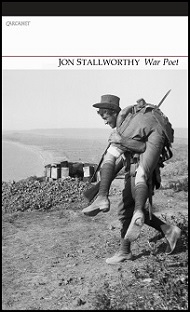
De Engelse dichter en letterkundige Jon Stallworthy werd geboren op 18 januari 1935 in Londen. Zie ook alle tags voor Jon Stallworthy op dit blog.


No Ordinary Sunday

No ordinary Sunday. First the light
falling dead through dormitory windows blind
with fog; and then, at breakfast, every plate
stained with the small, red cotton flower; and no
sixpence for pocket money. Greatcoats, lined
by the right, marched from their pegs, with slow
poppy fires smouldering in one lapel
to light us through the fallen cloud. Behind
that handkerchief sobbed the quick Sunday bell.

A granite cross, the school field underfoot,
inaudible prayers, hymn-sheets that stirred
too loudly in the hand. When hymns ran out,
silence, like silt, lay round so wide and deep
it seemed that winter held its breath. We heard
only the river talking in its sleep:
until the bugler flexed his lips, and sound
cutting the fog cleanly like a bird,
circled and sang out over the bandaged ground.

Then, low-voiced, the headmaster called the roll
of those who could not answer; every name
suffixed with honour — 'double first', 'kept goal
for Cambridge' — and a death — in Spitfires, tanks,
and ships torpedoed. At his call there came through
the mist blond heroes in broad ranks
with rainbows struggling on their chests. Ahead
of us, in strict step, as we idled home
marched the formations of the towering dead.

November again, and the bugles blown
in a tropical Holy Trinity,
the heroes today stand further off, grown
smaller but distinct. They flash no medals, keep
no ranks: through Last Post and Reveille
their chins loll on their chests, like birds asleep.
Only when the long, last note ascends
upon the wings of kites, some two or three
look up: and have the faces of my friends.


 2208771-e8f56b13de2607f4e4866c805b73c50c.jpg
Jon Stallworthy (18 januari 1935 – 19 november 2014)
Cover


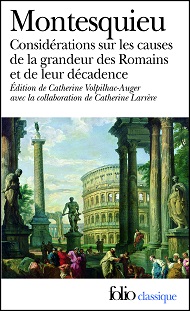
De Franse schrijver en filosoof Charles Louis de Secondat, baron de La Brède et de Montesqieu werd geboren op 18 januari 1689 op het kasteel La Brède bij Bordeaux. Zie ook alle tags voor Montesquieu op dit blog.

Uit: Considérations sur les causes de la grandeur des Romains et de leur décadence

"La ville n’avait pas même de rues, si l’on n’appelle de ce nom la conti¬nuation des chemins qui y aboutissaient. Les maisons étaient placées sans ordre et très petites : car les hommes, toujours au travail ou dans la place publique, ne se tenaient guère dans les maisons.
Mais la grandeur de Rome parut bientôt dans ses édifices publics. Les ouvrages qui ont donné et qui donnent encore aujourd’hui la plus haute idée de sa puissance ont été faits sous les Rois. On commençait déjà à bâtir la ville éternelle.
Romulus et ses successeurs furent presque toujours en guerre avec leurs voisins pour avoir des citoyens, des femmes ou des terres. Ils revenaient dans la ville avec les dépouilles des peuples vaincus : c’étaient des gerbes de blé et des troupeaux ; cela y causait une grande joie. Voilà l’origine des triomphes, qui furent dans la suite la principale cause des grandeurs où cette ville parvint.
Rome accrut beaucoup ses forces par son union avec les Sabins, peuples durs et belliqueux comme les Lacédémoniens, dont ils étaient descendus. Romulus prit leur bouclier, qui était large, au lieu du petit bouclier argien, dont il s’était servi jusqu’alors, et on doit remarquer que ce qui a le plus contribué à rendre les Romains les maîtres du monde, c’est qu’ayant combattu successivement contre tous les peuples ils ont toujours renoncé à leurs usages sitôt qu’ils en ont trouvé de meilleurs.
On pensait alors dans les républiques d’Italie que les traités qu’elles avaient faits avec un roi ne les obligeaient point envers son successeur ; c’était pour elles une espèce de droit des gens. Ainsi tout ce qui avait été soumis par un roi de Rome se prétendait libre sous un autre, et les guerres naissaient toujours des guerres.
Le règne de Numa, long et pacifique, était très propre à laisser Rome dans sa médiocrité, et, si elle eût eu dans ce temps-là un territoire moins borné et une puissance plus grande, il y a apparence que sa fortune eût été fixée pour jamais.
Une des causes de sa prospérité, c’est que ses rois furent tous de grands personnages. On ne trouve point ailleurs, dans les histoires, une suite non interrompue de tels hommes d’État et de tels capitaines.
Dans la naissance des sociétés, ce sont les chefs des républiques qui font l’institution, et c’est ensuite l’institution qui forme les chefs des républiques.
Tarquin prit la couronne sans être élu par le Sénat ni par le peuple. Le pouvoir devenait héréditaire ; il le rendit absolu. Ces deux révolutions furent bientôt suivies d’une troisième."


 2208771-a79cbfa51b95dcd29d4025637570d0b1.jpg
Montesquieu (18 januari 1689 – 10 februari 1755)
Cover


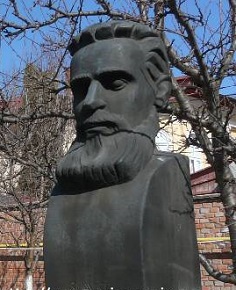
De Roemeense schrijver en journalist Ioan Slavici werd geboren op 18 januari 1848 in Siria. Zie ook alle tags voor Ioan Slavici op dit blog.

Uit: Popa Tanda (Vertaald door Lucy Byng)

“Then Father Trandafir reached this penitential spot. He could not expect to do as the others had done, come one day, stay the next, and depart the third. He was too much out of favour with the archdeacon to imagine that he would send him to another village. He could not remain without a village: a priest without a village—a cart without a wheel, a yoke without oxen, a hat on the top of a wig. He began to think what he must do; he must take things as they were, and stay gladly in Saraceni. It was only a village in name, but no one could say he was a priest without a village. But really a more suitable priest for a more suitable village you could not have found. The poverty of the priest corresponded to the poverty in the homes of his parishioners. From the beginning Trandafir realized one thing: it was much nicer in Butucani than in Saraceni. There the people all had something, and you could always have some of it. In Saraceni all the latches were made of wood. Then the Father reflected: the priest did all the business of the town, but the town took care of the priest's purse. Before long the Father began to feel sure that the people who started by being charitable and hospitable were not born fools. "It is a wise thing when men meet together to comfort and cheer each other. Even our Redeemer began with almsgiving, and the wedding at Cana of Galilee." Thus thought Father Trandafir; but in Saraceni there was neither almsgiving nor hospitality.
"There is one thing," said the Father to himself a little later on, "in a poor village there is no corn for the priest to gather. As long as the people of Saraceni are lazy, so long shall I be hungry!" And he began to think how he was going to make his parishioners industrious. The industrious man eats the stones, makes soup out of the stagnant water, and reaps corn where the hemlock used to grow. "Then"—concluded the priest—"when the cow has fodder she is no longer dry!"

 2208771-6035c52227133dd330f80e222dee2911.jpg

Ioan Slavici (18 januari 1848 – 17 augustus 1925) 
Borstbeeld in Iaşi


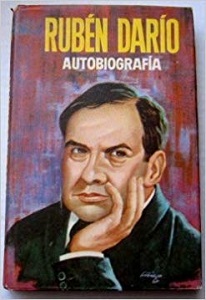
De Nicaraguaanse schrijver Rubén Darío werd geboren in Metapa, tegenwoordig Ciudad Darío, op 18 januari 1867. Zie ook alle tags voor Rubén Darío op dit blog.


Symphony In Grey Major

The sea like a vast silvered mirror
reflects the sky like a sheet of zinc;
distant flocks of birds make stains
on the burnished pale grey background.

The sun, like a round, opaque window
with an invalid's steps climbs to the zenith;
the sea wind relaxes in the shade
using its black trumpet as a pillow.

The waves that move their leaden bellies
seem to moan beneath the pier.
Sitting on a cable, smoking his pipe,
is a sailor thinking of the beaches
of a vague, distant, misty land.

This sea-dog is old. The fiery beams
of Brazilian sun have tanned his face;
the wild typhoons of the China sea
have seen him drinking his bottle of gin.

The iodine and saltpetre foam
long has known his ruddy nose,
his curly hair, athletic biceps,
his canvas cap, his blouse of drill.

Surrounded by tobacco smoke
the old man sees the far off misty land
for which one hot and golden evening
his brig set out with all sails set ...

The siesta of the tropics. The sea-dog sleeps.
Now the shades of grey enfold him.
It is as if an enormous soft charcoal
rubbed out the lines of the horizon's arc.

The siesta of the tropics. The old cicada
tries out his senile, raucous guitar
and the cricket strikes up a monotonous solo
on the single string of his violin.


 2208771-b2cf8dc0158dfacdd0747c9088b5af38.jpg
Rubén Darío (18 januari 1867 – 6 februari 1916)
Cover autobiografie


De Franse schrijver Paul Léautaud werd geboren op 18 januari 1872 in Parijs. Zie ook alle tags voor Paul Léautaud op dit blog.

Uit: Journal littéraire

« 11 mars 1938

Cet illuminé qui se croit un homme d'État, ce niais dans ses vues sociales, ce faible et pleurard, - comme Gide dans son illuminisme pour la Russie des Soviets, s'enthousiasmant sans rien savoir et quand il a vu la réalité, tombant de son haut. Et on voit tous ces coquins politiques se faire photographier en riant (il y a encore deux jours, dans un journal, Pierre Cot et Jean Zay).
Parlé aussi avec Gérin de l'abaissement de tout dans la société d'aujourd'hui. Très curieux, ce garçon de 23 ans, ancien ouvrier mineur, écrivant dans des journaux d'extrême gauche, me disant qu'il cesse peu à peu d'être républicain, démocrate, qu'il faut de l'ordre, de la hiérarchie, chacun à sa place et qu'il découvre peu à peu que la monarchie avait ses mérites et que, pour la liberté, il n'est pas si sûr qu'on ait gagné au change. Ce qui prouve bien que le milieu ne fait rien, mais le tempérament, le caractère, la sensibilité, et qu'on peut être aristocrate tout en étant un ancien ouvrier mineur.
Parlé des atteintes qu'a subies de tout cela la littérature, les moeurs littéraires, la profusion de la production, les éloges déme­surés à tout propos, les rapprochements à chaque instant avec tel écrivain célèbre : on est un nouveau Balzac à bon marché, la médiocrité de la critique, son manque de liberté d'ailleurs, tant par les petits échanges d'intérêts que par le veto des journaux. II arrive à dire qu'il manque un Sainte-Beuve, qui ne serait peut-être plus possible d'ailleurs. »


 2208771-0a6672d6194397edd4b45382a537e822.jpg
Paul Léautaud (18 januari 1872 – 22 februari 1956)
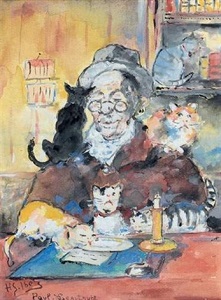
Portret van Léautaud met zijn katten door Henri Gabriel Ibels, z.j.


De Britse dichter en schrijver Alan Alexander Milne werd geboren op 18 januari 1882 in Londen. Zie ook alle tags voor Alan Alexander Milne op dit blog.


Vespers

Little Boy kneels at the foot of the bed,
Droops on the little hands little gold head.
Hush! Hush! Whisper who dares!
Christopher Robin is saying his prayers.

God bless Mummy. I know that's right.
Wasn't it fun in the bath to-night?
The cold's so cold, and the hot's so hot.
Oh! God bless Daddy - I quite forgot.

If I open my fingers a little bit more,
I can see Nanny's dressing-gown on the door.
It's a beautiful blue, but it hasn't a hood.
Oh! God bless Nanny and make her good.

Mine has a hood, and I lie in bed,
And pull the hood right over my head,
And I shut my eyes, and I curl up small,
And nobody knows that I'm there at all.

Oh! Thank you, God, for a lovely day.
And what was the other I had to say?
I said 'Bless Daddy,' so what can it be?
Oh! Now I remember it. God bless Me.

Little Boy kneels at the foot of the bed,
Droops on the little hands little gold head.
Hush! Hush! Whisper who dares!
Christopher Robin is saying his prayers.


Solitude

I have a house where I go
When there's too many people,
I have a house where I go
Where no one can be;
I have a house where I go,
Where nobody ever says 'No';
Where no one says anything- so
There is no one but me.


 2208771-f2eabb96f7aaed08216e6ae38e1c9b25.jpg
Alan Alexander Milne (18 januari 1882 – 31 januari 1956)
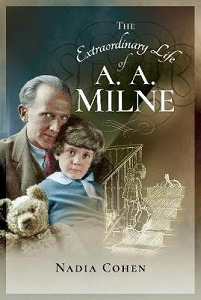
Cover biografie


Zie voor nog meer schrijvers van de 17e januari ook mijn blog van 18 januari 2015 deel 2 en ook deel 3.


Geschreven door Romenu om 18:35 Reageer op dit bericht

Meer van Romenu

↑ Terug naar de berichten