Naar de inhoud

Romenu

Over literatuur, gedichten, kunst en cultuur
akke.beakke.be

Berichten van 19 juni 2019 tot 20 juni 2019

Corpus Christi (Michael Walker)


Bij Sacramentsdag


2247242-dd2b34b900b8de71bcd9851b09245457.jpg 
Corpus in Sevilla door Manuel Cabral Bejarano, 1857


Corpus Christi

Sprinkle me with hyssop and with dew,
To prepare me for the Wedding Feast.
In union with You, I am made new,
Strengthened against the Marks of the Beast.

'This is my body, given up for you, '
We say to one another in the dark,
That I might always do what you would do;
Your breathing is my secret, sacred spark.

Bread of Angels, feed my starving soul!
Your Flesh and Blood alone light up my life.
Tasting You alone can make me whole,
For You alone are peace amidst the strife.

Corpus Christi, crystal carnal crux,
You are steady, though the world's in flux.


2247242-2ae57334487c196a48830f5b4535c9e6.jpg 
Michael Walker (New Plymouth, 1945)
St Andrew's Church in New Plymouth


Zie voor de schrijvers van de 20e juni ook mijn vorige blog van vandaag.

Geschreven door Romenu om 10:51 Reageer op dit bericht

Vikram Seth, Paul Muldoon, Kurt Schwitters, Jean-Claude Izzo, Silke Andrea Schuemmer, Carel van Nievelt, Robert Rozhdestvensky, Laure Wyss, Lillian Hellman

De Indische dichter en schrijver Vikram Seth werd geboren op 20 juni 1952 in Kolkata. Zie ook alle tags voor Vikram Seth op dit blog.


All you who sleep tonight

All you who sleep tonight
Far from the ones you love,
No hands to left or right,
And emptiness above -
Know that you aren't alone.
The whole world shares your tears,
Some for two nights or one,
And some for all their years.


Can't

I find I simply can't get out of bed.
I shiver and procrastinate and stare.
I'll press the reset button in my head.

I hate my work but I am in the red.
I'd quit it all if I could live on air.
I find I simply can't get out of bed.

My joints have rusted and my brain is lead.
I drank too much last night, but now I swear
I'll press the reset button in my head.

My love has gone. What do I have instead? -
Hot-water bottle, God and teddy bear.
I find I simply can't get out of bed.

The dreams I dreamt have filled my soul with dread.
The world is mad, there's darkness everywhere.
I'll press the reset button in my head.

Who'll kiss my tears away or earn my bread?
Who'll reach the clothes hung on that distant chair?
I must, I simply must get out of bed
And press that reset button in my head.


Unclaimed

To make love with a stranger is the best.
There is no riddle and there is no test. -

To lie and love, not aching to make sense
Of this night in the mesh of reference.

To touch, unclaimed by fear of imminent day,
And understand, as only strangers may.

To feel the beat of foreign heart to heart
Preferring neither to prolong nor part.

To rest within the unknown arms and know
That this is all there is; that this is so.


 2247236-15d7bf7f13f3c77ac65ffec7a7df7cb3.jpg
Vikram Seth (Kolkata, 20 juni 1952)


De Ierse dichter en schrijver Paul Muldoon werd geboren in Portadown, County Armagh, in Noord-Ierland op 20 juni 1951, Zie ook alle tags voor Paul Muldoon op dit blog


The Old Country (Fragment)

VII

Every cut was a cut to the quick
what with every feather a feather to ruffle.
Every whitrack was a whitterick.
Everyone was in a right kerfuffle

when from his hob some hobbledehoy
would venture the whitterick was a curlew.
Every wall was a wall of Troy
and every hunt a hunt in the purlieu

of a demesne so out of bounds
every hound might have been a hellhound.
At every lane end stood a milk churn

whose every dent was a sign of indenture
to some pig wormer or cattle drencher.
Every point was a point of no return.


VIII

Every point was a point of no return
for those who had signed the Covenant in blood.
Every fern was a maidenhair fern
that gave every eye an eyeful of mud

ere it was plucked out and cast into the flame.
Every rowan was a mountain ash.
Every swath-swathed mower made of his graft a game
and the hay sash

went to the kemper best fit to kemp.
Every secretary was a temp
who could shift shape

like the river goddesses Banna and Boann.
Every two-a-penny maze was, at its heart, Minoan.
Every escape was a narrow escape.


IX

Every escape was a narrow escape
where every stroke was a broad stroke
of an ax on a pig nape.
Every pig was a pig in a poke

though it scooted once through the Diamond
so unfalt—so unfalteringly.
The threshold of pain was outlimened
by the bar raised at high tea

now every scone was a drop scone.
Every ass had an ass's jawbone
that might itself drop from grin to girn.

Every malt was a single malt.
Every pillar was a pillar of salt.
Every point was a point of no return.


 2247236-b0b529eba34e303cb8d1dec9563b2584.jpg
Paul Muldoon (Portadown, 20 juni 1951)


De Duitse schrijver, dichter en kunstenaar Kurt Schwitters werd geboren op 20 juni 1887 in Hannover. Zie ook alle tags voor Kurt Schwitters op dit blog.


One day

One day
You finish to be a boy.
But you play
Still with your old toy.
You like all the old angels
As you did before,
And think they are girls,
Beautiful girls.
You think they are like you
When you were young
But you are old,
And die and get cold.


Entspannung

Es fällt von mir ab eine kleine weiße Wolke.
Ich liege im Tal unter Lilien und rufe.
Der Hauch ihrer Hand zittert im Wind.
Eine große schwarze Wolke fällt in den Topf.
Daß die Henkersknechte sie sieden,
Daß sie Asche werde


 2247236-8580f77abbc498457465c2638f916ee1.jpg
Kurt Schwitters (20 juni 1887 – 8 januari 1948)
Merzbild - Rossfett door Kurt Schwitters, 1919


De Franse dichter en schrijver Jean-Claude Izzo werd geboren op 20 juni 1945 in Marseille. Zie ook alle tags voor Jean-Claude Izzo op dit blog.

Uit: Chourmo

« Ange nous avait installés sur la terrasse, avec une bouteille de rosé de Puy-Sainte-Réparade. Au menu, petits farcis de tomates, de pommes de terre, de courgettes et d'oignons. J'avais faim, et c'était un délice. J'aime ça, manger. Mais c'est pire quand j'ai des ennuis, et pire encore quand je côtoie la mort. J'ai besoin d'ingurgiter des aliments, légumes, viandes, poissons, dessert ou friandises. De me laisser envahir par leurs saveurs. Je n'avais rien trouvé de mieux pour réfuter la mort. M'en préserver. La bonne cuisine et les bons vins. Comme un art de survivre. Ça ne m'avait pas trop mal réussi jusqu'à aujourd'hui. Loubet et moi gardions le silence. Nous avions juste échangé quelques banalités en mangeant un peu de charcuterie. Il ruminait ses hypothèses. Moi, les miennes. Cûc m'avait proposé un thé, un thé noir. « Je crois que je peux vous faire confiance », avait-elle commencé. J'avais répondu que, pour l'heure, il n'était pas question de confiance, seulement de vérité. D'une vérité à avouer au flic chargé de l'enquête. L'identité de Guitou. — Je ne vais pas vous raconter toute ma vie, expliqua-t-elle. Mais vous comprendrez mieux quand je vous aurai raconté certaines choses. Je suis arrivée en France à dix-sept ans. Mathias venait de naître. C'était en 1977. Ma mère avait décidé qu'il était temps de partir. Le fait que je vienne d'accoucher a peut-être été pour quelque chose dans sa décision. Je ne sais plus. Elle me jeta un coup d'oeil furtif, puis elle attrapa un paquet de Craven A et alluma une cigarette nerveusement. Son regard se perdit dans une volute de fumée. Très loin. Elle poursuivit. Ses phrases s'étiraient parfois en de longs silences. Sa voix s'atténuait. Des mots restaient en suspens, dans l'air, et elle semblait les écarter d'un revers de main en chassant la fumée de sa cigarette. Son corps ne bougeait pas. Seuls ses longs cheveux se balançaient au rythme de la tête, qu'elle inclinait comme à la recherche d'un détail perdu. Je l'écoutai, attentif. Je n'osais croire être le premier à qui elle faisait confidence de sa vie. Je savais qu'au bout de son récit il y aurait un service en échange. Mais, par cette intimité soudaine, elle me séduisait. Et ça marchait. — Nous sommes rentrés, ma mère, ma grand-mère, mes trois soeurs cadettes, l'enfant et moi. Ma mère a eu beaucoup de cran. Vous savez, nous faisions partie de ce qu'on appelait les rapatriés. Ma famille était naturalisée depuis 1930. D'ailleurs, j'ai la double nationalité. Nous étions considérés comme des Français. Mais l'arrivée en France n'eut rien d'idyllique. De Roissy, nous avons été emmenés dans un foyer de travailleurs à Sarcelles. »


 2247236-23e4d417cf30f5f94f9e20ae49a78c3b.jpg
Jean-Claude Izzo (20 juni 1945 – 26 januari 2000)
Cover


De Duitse dichteres, schrijfster en kunsthistorica Silke Andrea Schuemmer werd geboren op 20 juni 1973 in Aken. Zie ook alle tags voor Silke Andrea Schuemmer op dit blog.

Uit: Nixen fischen

„Unter seinem Pullover zeichnete sich deutlich seine fleischige Brust ab. Er schob einen Finger durch das Zopfmuster und befühlte seine Brustwarze, während er sie weiter musterte.
»Studierst du hier?«
Ines räusperte sich. »Erstes Semester.«
Er nickte. »Zu alt für mich. Der gute Knut liebt die frischesten Fischlein – aber der Hempler, der wird seine Schatzkiste öffnen.«
Er wies Ines mit einer leichten Verbeugung in den hinteren Teil des Ladens.
»Hempler ist ein Kollege. Macht in antike Stoffe. Ehrbarer Mann.«
Er schob Ines einen Stuhl hin. Noch bevor sie sich setzen konnte, schubste das kahlrasierte Mädchen das andere, die schlug zurück, sie knurrten und begannen miteinander zu ringen. Unter Fauchen und Jaulen fiel ein Stuhl um, und das Gerangel ging auf dem Boden weiter, so dass Ines ein Stück abrückte.
Seckig verschränkte die Arme vor der Brust und sah zu. Schließlich wies er sie zischend zurecht.
»Pütti! Mümmerle! Au pied! Sofort!«
Ines duckte sich unter seinem schneidenden Tonfall. Seine Hand zeigte neben sich auf den Boden, er blieb in dieser Pose stehen, bis die Mädchen aufstanden und zu ihm trotteten.
Beide waren so blass, dass die Adern an den Schläfen bläulich leuchteten. Die Haut auf den Wangen war trocken und schuppig. Ihre Augen waren dick mit zerlaufenem Kajal geschminkt, die Kahlrasierte hatte eine Sicherheitsnadel im Ohr mit einem Kettchen bis zum Nasenflügel. Sie schmiegten sich an Seckig, dem sie gerade bis zur Brust gingen, und rieben seinen Bauch und seine stockartigen Oberschenkel. Er lachte glucksend, drückte ihnen je einen Schein in die Hand und küsste sie auf den Mund, wobei seine dicke, noppige Zunge zuckte und kreiselte, und scheuchte sie schließlich mit Klapsen auf die mageren Hüften zurück auf ihre Stühle. Da saßen sie wieder unbewegt und schweigend. Er seufzte und rollte mit den Augen.
»Die beiden reizenden Kindchen sorgen für Momente glückseliger Kontemplation. Aber man muss wohl auch ein Auge haben.«
Er streckte Ines erneut die Hand hin.
»Also nochmals und offiziell: Ich bin der Inhaber dieses Etablissements.«
»Ines. Ich komme wegen des Polaroids.«
Sie ließ ihre Hand ganz schlaff werden in seiner, eine feuchte Flosse, damit er sie nicht länger als notwendig hielt, aber es schien ihm nichts auszumachen. Schließlich zog sie ihre Hand zurück und setzte sich.“


 2247236-808b3fbfafc19283ff4d91be09678570.jpg
Silke Andrea Schuemmer (Aken, 20 juni 1973)


De Nederlandse schrijver Carel van Nievelt werd op 20 juni 1843 geboren in Delfshaven, als zoon van een boekhandelaar. Zie ook alle tags voor Carel van Nievelt op dit blog.

Uit: Mijn Angelo. Herinneringen van het Garda-meer

“Ter linkerhand besproeit zij den machtigen, met sneeuw gekroonden Monte Baldo, ter rechter de vervaarlijk uit hare diepte steigerende kalkrotsen van den Giumella den voet. En zuidwaarts heen, waar de schouderen der bergen haar niet meer knellen, verliest zij zich, breed als eene zee, in eenen wazigen horizon van sidderend goud.
Ik wil u niet haasten; ik wil niet ontijdig u den traan van verrukking doen wegwisschen, die bij het aanschouwen dezer heerlijkheid misschien uw blik benevelde. Maar als gij eindelijk weer opstaat - - want het is inderdaad te warm om hier lang te zitten; en prachtiger nog zult gij dit uitzicht vinden tegen den avond, wanneer de gebergten zich gehuld hebben in violette schaduwen, en ds Ora, de krachtige zuidenwind, die hier telken namiddag opsteekt, het lauwe floers zal weggerold hebben van over het water, zoodat gij, in het uren, uren verre zuidelijke verschiet, zelfs de lijnen zult kunnen onderscheiden van het heuvelland tusschen Brescia en Verona - - ik zeg, als gij weer opstaat, en verder wilt, dan raad ik u van den postwagen gebruik te maken, die daar als een deus ex machina juist komt aangerommeld. Gij wendt dan van uw hoofd het zeer dreigende ongeval van een zonnesteek; en tevens verhoogt ge uzelven aanmerkelijk in de schatting van het bedienend personeel der Albergo del Sole te Riva, dat anders, zoo gij aamechtig en ontoonbaar van stof in de voorhalle dezer deftige inrichting uwe verschijning zoudt hebben gemaakt, onvermijdelijk in u een voorwerp zou begroet hebben van spot en verachting.
In snellen draf gaat het afwaarts. Bij het naderen van het stadje klinkt eene forsche muziek u tegen. Hoe groot is uwe verbazing, de ouverture-Freischütz te herkennen, door een uitmuntend militair orkest met vuur en juistheid uitgevoerd! - Het is ook waar, hier heerscht de Duitscher nog. Slechts Germanen kunnen onder zúlk eene hitte muziek van Weber blazen.”


 2247236-fb9ce19cded259522a25db141caef2ed.jpg
Carel van Nievelt (20 juni 1843 – 2 augustus 1913)
Delfshaven


De Russische dichter en schrijver Robert Ivanovich Rozhdestvensky werd geboren op 20 juni 1932 in Kosikha in het district Altai Krai. Zie ook alle tags voor Robert Rozhdestvensky op dit blog.


Nostalgia

One can be nostalgic for homeland,
for the Urals, Bratsk-city, the Don and,
for the deserts, the cliffs and the mountains,
for transparent birch-trees in gardens,
for the fields with storms so severe...
I'm nostalgic for you, my dear.
.
For the mornings when you are awakened,
Your eyes and your shoulders, naked.
For the moments when you are around,
For hot nights when I'm down and out,
For your tears and words and for doubts,
For your smiles and even your shouts!
For your lips,
for bicker and wrangle...
I will fight nostalgia.
I'll struggle.


I am leaving, attacking the platforms,
For some reason,
I yell in the phones!
-Please help me, my darling,
I'm asking
I am nostalgic, you know,
I am gasping!
No reply. You are under bed cover...
You will see it
if I recover.


Vertaald door Alec Vagapov


 2247236-141a3eca59755f91126de7b232525496.jpg
Robert Rozhdestvensky (20 juni 1932 – 19 augustus 1994)
Cover


De Zwitserse schrijfster Laure Wyss werd geboren op 20 juni 1913 in Biel/Bienne. Zie ook alle tags voor Laure Wyss op dit blog.

Uit: Der Zahnstocher – Eine Feriengeschichte

„Als wir uns setzten, entdeckte ich unter meinem Stuhl ein Messer, ein hübsches Messerchen, perlmuttern, weiss, zierlich – wie es sich erwies, als ich es aufhob, um es dem Kellner zu übergeben. Bei ihm würde sich der Besitzer melden, sobald er seinen Verlust entdeckt hätte. «Was, so ein handliches Messerchen, das Ihnen ausserdem wohlgefällt, das behalten Sie doch», meinte die Frau des bernischen Pfarrers. Also wars kein Diebstahl, keine Aneignung fremden Besitzes, vielmehr ein christlich abgesegneter Fund, als ich das Perlmutterne in meine Tasche gleiten liess.
Von jetzt an kam es überall mit, das Messerchen, ich konnte nicht mehr auskommen ohne seine scharfen Klingen, sein Scherchen, seine winzige Pinzette und seinen Zahnstocher aus Horn. Ich steckte das kleine Messer ins Aluminiumköfferchen zum Handwerkzeug, zu den Kugelschreibern und Bleistiften und den Papieren, als ich ins westliche Frankreich in die Schreibferien fuhr. Der metallene Koffer sollte das Arbeitsmaterial vor jeder Unbill einer Reise schützen – eine Illusion, die am Ufer der Vienne, auf dem Parkplatz einer Herberge, zerplatzte, als Diebe die Touristenautos aufbrachen, nach Checks und Devisen suchend. Ihnen fiel das Köfferchen auf, sie nahmens mit. Die Polizei war rasch am Ort, schrieb, notierte, ich Geschädigte auf den Posten, Klage wegen entwendeten Arbeitsmaterials. Gegen unbekannt. «Sie werden das Köfferchen wegwerfen, wenn sie nichts Nützliches darin finden», tröstete der Kommissar, «vielleicht hinter eine Hecke.» Der Hecken in Frankreich gibts viele, ich schritt die nächsten ab, guckte hinter Stauden und Büsche, nichts leuchtete metallen auf.“


 2247236-e275df6caefc2e3330d0cfcb481b654a.jpg
Laure Wyss (20 juni 1913 – 21 augustus 2002)


De Amerikaanse schrijfster en vertaalster Lillian Hellman werd geboren op 20 juni 1905 in New Orleans. Zie ook alle tags voor Lillian Hellman op dit blog.

Uit: The Children’s Hour

“KAREN : No. no, no. That isn't the way things work. Maybe you believe me. I'd never know whether you did or not You'd never know whether you did. either. We couldn't do it that way. Can't you see what would happen? We'd he hounded by it all our lives. I'd be frightened always, and in the end my own fright would make mc would make mc hate you. (Sees slight mosement he makes i Yes. II would. I know it would I'd hate you for what I thought I'd done to you. And I'd hate myself too. It would wow and row until we'd he ruined by it. (Sees him about to speak) Mt Joe, )ou've seen all that yourself. You knew it first.
“CARDIN (softly) : I didn't mean it that way, I don't know.
KAREN (smiles) You're still trying to spare me. still trying to tell yourself that we might be all right again. But we won't be all right. Not ever, ever, ever I don't know all the reasons why. Look. I'm standing here. I haven't changed. (Holds out her handsel My hands look just the same. my face is the same. even my dress is old. We're in a room we've been in so many times before: you're sitting where you always sit: it's nearly time for dinner. I'm like everybody else. I can have all the things that everybody has. I can have you and a baby. and I can go to market, and we can go to the movies, and people will talk to me and (Suddenly 13.1i1CCS the pain in his lace) Oh. I'm sorry. I mustn't talk like that That couldn't he true any more
CARDIN : It could be, Karen. Well make it be like that.
KAREN : No. That's only what we'd like to have had It's what we can't have now. Go home. darling.
CARDIN (with limed : Don't talk like that. No matter what it is, we can't leave each other. I can't leave you_
KAREN . Joe. Joe. Let's do it now and quick; it will be too hard later on.
CARDIN : No, no, no. We love each other. (His voice breaks) I'd give anything not to have asked that question, Karen.”


 2247236-4b0a3877dae6d1eadb91886e8d82f122.jpg
Lillian Hellman (20 juni 1905 – 30 juni 1984)
Scene uit in opvoering in York, 2017


Zie voor nog meer schrijvers van de 20e juni ook mijn blog van 20 juni 2015 deel 2.

Geschreven door Romenu om 10:45 Reageer op dit bericht

Michael Walker

Onafhankelijk van geboortedata

De Nieuw-Zeelandse dichter Michael Walker werd geboren in New Plymouth in 1945. Hij studeerde af aan de Universiteit van Auckland met een BA en MA-graad. Walker doceerde van 1969 tot 2006 Engels en Frans aan een paar Nieuw-Zeelandse middelbare scholen. Hij reisde naar Engeland en Frankrijk in de vroege jaren 1970. Hij woonde een paar jaar in Grenoble waar hij Engelse les gaf. Daar sprak hij meestal Frans, maar had ook tijd om veel Franse romans in paperback te kopen en te lezen. De schrijver, Stendhal, kwam uit Grenoble en woonde daar het grootste deel van zijn leven. Hij las eerst de roman van Stendhal, 'Le Rouge et le Noir' ('The Scarlet and the Black') in Grenoble. Bij terugkeer in Nieuw-Zeeland waren er twee gedichten van hem aanvaard door Literary Arts Press, Los Angeles. Daarna heeft hij jaren geen gedichten meer geschreven. Hij ging lesgeven op South Island en North Island. In 2011 volgde hij een computeropleiding bij de New Lynn-bibliotheek en begon hij weer met het schrijven van gedichten.


For Robin Williams - The Day The Movies Died

"What amidst these, o me, o life? " you must
Have asked yourself one final time before
You left the endless trains of the faithless,
The cities filled with the foolish. Answer:

You are here. Life exists. Identity.
Now, you have contributed your verse:
Since comedy conceals tragedy,
You made us feel better, though you felt worse.

Behind all laughter, there are always tears,
As I still hear you whisper carpe diem,
For movies last beyond our mortal years,
So they are your best in memoriam.

O captain, my captain, gone with the tide,
Your death remains the day the movies died.


The Land Of The Lord

There is a country bordering the sea,
Where deserts meet the gardens' greenery,
And mountains stand for an eternity
Beneath the freedom of an ancient tree.

Here did first begin the human race,
Starting with our parents' cursed embrace,
So God Himself assumed a human face
To rescue us in a new state of grace.

Lo and behold! The Land of the Lord
Is Israel, under His swift sword,
For Earth and Heaven bow down at His Word,
That in the Temple, He may be adored.

Follow where the Son of Man has trod,
That you may taste the Flesh and Blood of God.


 2247233-d844a8a04ffb1e704f3b6128fa93cb8b.jpg
Michael Walker (New Plymouth, 1945)

Geschreven door Romenu om 10:44 Reageer op dit bericht

Steven Herrick, Salman Rushdie, Sybren Polet, Josef Nesvadba, Elke Geurts, Marek Sindelka, Dolce far niente


Dolce far niente


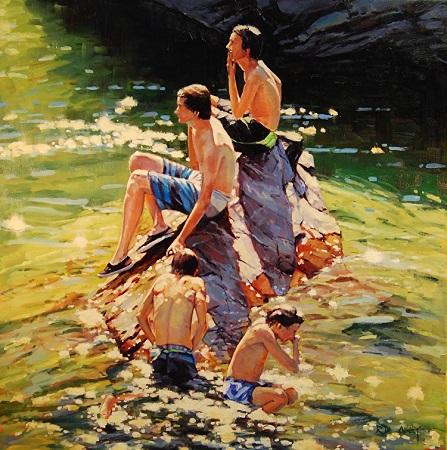
 2247067-25a2327a1cd66b451c296b9ea0dad37b.jpg
The Boys of Summer door Rob Akey, 2014


The Big River

The big river
rolls past our town
at Hobson’s Bend,
takes a slow look
at the houses on stilts
with timber creaking, paint flaking,
at the graveyard hushed
in the lonely shade,
at the fruit bats
dropping mango pulp
into the undergrowth,
at the foundry, and sawmill
grinding under a blazing sun,
at the pub with welcoming verandahs
shaded in wisteria vine,
at Durra Creek surrendering
to the incessant flow,
at Pearce Swamp upstream
on the creek among the willows
and rivergum,
at the storm clouds
rumbling over Rookwood Hill,
at the two boys
casting a line
on the crumbling bank,
at the cow fields
purple with Paterson’s curse,
at the jammed tree-trunks
washed down after summer thunder,
at the shop
with dead flies in the window display,
at the mosquito mangroves
and the sucking sound of mud crabs,
at the children throwing mulberries
the stain like lipstick.
The big river
rolls past our town,
takes a slow look,
and rolls away.


 2247067-9a0414bcab9bac32a8767fd506c75e03.jpg
Steven Herrick (Brisbane, 31 december 1958)
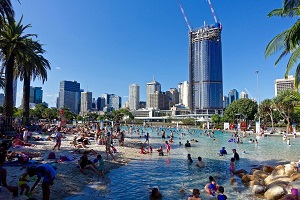
Brisbane


De Indisch-Britse schrijver en essayist Salman Rushdie werd geboren in Bombay op 19 juni 1947. Zie ook alle tags voor Salman Rushdie op dit blog.

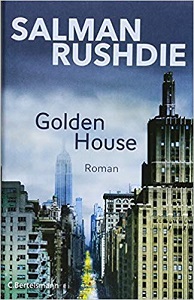
Uit: The Golden House

“Sometimes, watching him, I thought of Dr. Frankenstein's monster, a simulacrum of the human that entirely failed to express any true humanity. His skin was brown leather and his smile glittered with golden fillings. His was a raucous and not entirely civil presence, but he was immensely rich and so, of course, he was accepted; but, in our downtown community of artists, musicians and writers, not, on the whole, popular.
We should have guessed that a man who took the name of the last of the Julio-Claudian monarchs of Rome and then installed himself in a domus aurea was publicly acknowledging his own madness, wrongdoing, megalomania, and forthcoming doom, and also laughing in the face of all that; that such a man was flinging down a glove at the feet of destiny and snapping his fingers under Death's approaching nose, crying, "Yes! Compare me, if you will, to that monster who doused Christians in oil and set them alight to provide illumination in his garden at night! Who played the lyre while Rome burned (there actually weren't any fiddles back then)! Yes: I christen myself Nero, of Caesar's house, last of that bloody line, and make of it what you will. Me, I just like the name." He was dangling his wickedness under our noses, reveling in it, challenging us to see it, contemptuous of our powers of comprehension, convinced of his ability easily to defeat anyone who rose against him.
He came to the city like one of those fallen European monarchs, heads of discontinued houses who still used as last names the grand honorifics, of-Greece or of-Yugoslavia or of-Italy, and who treated the mournful prefix, ex-, as if it didn't exist. He wasn't ex-anything, his manner said; he was majestic in all things, in his stiff-collared shirts, his cufflinks, his bespoke English shoes, his way of walking toward closed doors without slowing down, knowing they would open for him; also in his suspicious nature, owing to which he held daily separate meetings with his sons to ask them what their brothers were saying about him; and in his cars, his liking for gaming tables, his unreturnable Ping-Pong serve, his fondness for prostitutes, whiskey, and deviled eggs, and his often repeated dictum—one favored by absolute rulers from Caesar to Haile Selassie—that the only virtue worth caring about was loyalty. He changed his cellphone frequently, gave the number to almost no one, and didn't answer it when it rang. He refused to allow journalists or photographers into his home but there were two men in his regular poker circle who were often there, silver-haired lotharios usually seen wearing tan leather jackets and brightly striped cravats, who were widely suspected of having murdered their rich wives, although in one case no charges had been made and in the other, they hadn't stuck.”


 2247067-3583029bf484cfebbd20fce29330eecd.jpg
Salman Rushdie (Bombay, 19 juni 1947)
Cover


De Nederlandse dichter en schrijver Sybren Polet (pseudoniem van Sybe Minnema) werd geboren in Kampen op 19 juni 1924. Zie ook alle tags voor Sybren Polet op dit blog.


De geïmmigreerde schaduw

Dan, op een morgen
loopt geruisloos de rivier je kamer binnen,
je staat op,
je neemt plaats in een lichaam
als in een huis dat lang geleden verlaten is,
de ogen staan nog open, maar er groeien microscopisch kleine
bloemen in, enkele achtergebleven gedachten geuren
vaag nog, bijna komt er iets tot leven, er beweegt iets,
en je neemt plaats in een ander lichaam als een huis, bijna
zie je iets bewegen, iets glinstert, en je verandert van lichaam als van huis
en je ontmoet iemand die bewoonbaarder lijkt dan jij;
hij woont in hetzelfde huis,

verwarmt dezelfde droom,
ontdekt hetzelfde brood.
En zie, je pols is niet langer gekneusd, je bent genezen
als in een literatuur van ezelinnemelk, mijn dag knort tevreden
en zelfs je ouder worden is licht als moezelwijn.

Ik zie je slapen en komen, zoals een rivier slaapt en komt,
doornat van de zon, fietsend van de kou,
jij ziet mij slapen en komen: dronken struik, baldadige boom van het seizoen.
Tegen de morgen wordt het even donker:
het knipperen van een oog dat nauwelijks dicht,
liever dag is.

En naarmate de liefde helderder beelden aanneemt,
de wanden met kleur zoomt, de lampen van water aansteekt
en het beschikbare licht gelijkelijk over de dingen verdeelt, -
in die zin, misschien, wordt er iets geboren,
een droom van dezelfde vader,
een plant van dezelfde adem,
een jonge speelse marmot
die van ons drieën is.


De oude natuur - de nieuwe natuur

Let op: je ligt met je hand in de wond
van een wetenschappelijk landschap. Wie weet
ontdek je zo de vrolijke natuurwetenschap:
toekomend lichaam, karakter van cultuur, één-
cellig en ingeboren, ìk erfde het niet.
Opnieuw opgroeiend in bomen, boomwortels
als hagedissen, in eenvoudige betekenissen,
bedenken wij de tekens, de eerste: de boom
een boom, boomwortels als vingers, een bed van
harde vogels en zachte hagedissen.

Onder ons, boven ons is dezelfde zon.
De toekomst groeit als haren op ons hoofd.
De oude hemel van de schedel droomt eronder.


 2247067-1b8179433a2cd825f1e1e936a029c4ad.jpg
Sybren Polet (19 juni 1924 – 19 juli 2015)


De Tsjechische schrijver Josef Nesvadba werd geboren op 19 juni 1926 in Praag. Zie ook alle tags voor Josef Nesvadba op dit blog.

Uit: The Half-wit of Xeenemuende (Vertaald door Iris Unwin)

"He doesn't let anybody else go in there," his mother explained. "That's his kingdom," and she winked conspiratorially at the teacher. "I've watched him through the keyhole sometimes," she went on as she conducted the old man to the gate. "All day long he just plays about with a set of boy's tools and some stuff my husband brought home from the factory for him. It's just harmless play."
"Are you so sure?" the man replied as he looked across the road at the burned-out butcher's shop. "You never can tell with children like that. He's not well, you know. He really ought to be in an institution..."
That made Mrs. Habicht really angry; so he had gone over to the side of the neighbours who hated Bruno!
"Oh, no, not at all. I'm really quite fond of him. I'm sorry for him. But still, I think he'd be happier in a Home."
"Never!" Mrs. Habicht stamped her foot with fury. "Never as long as I live!"
And so the teacher decided to have a look a Bruno's laboratory for himself next day. He went straight round to the veranda at the back of the house. The boy hadn't locked himself in. He'd got a little kitten tied up there and was torturing it with faradic current. The creature was half-dead when the teacher rescued it. Bruno did not want to give it up and they fought each other for it in silence, broken only by the boy's unintelligible grunts. The old man's heart began to pain him. There was only one thing to do. He aimed a blow at the boy's head. Bruno dived into a corner and stared at him with hatred.
"Krumme!" he spluttered. "You Krumme!" Now Bruno's governess had been Miss Krumme. The tutor's name was Brettschneider, and the boy knew that very well. The old man felt a strange horror creeping over him. He did not even begin lessons that day. Avoiding Mrs. Habicht, he went to see her husband at the works.
He was led along endless underground passages, with two armed men preceding him and two behind. It was like being in an anthill that was larger than life. The engineer listened to him impatiently.
"I know the boy has been responsible for a lot of trouble. He's a mischievous lad. But I really can't imagine how he could have had anything to do with either of the tragedies."
"Well, we'll see," said the teacher. "Nothing is going to make me sleep at home tonight. You can keep watch with me in the garden if you like." He lived in a little house near the station.
"You must excuse me. I've other things to think about. More important things..." Mr. Habicht refused the suggestion."


 2247067-7466bc6a5a8636212d6e0e7bae0d2ca8.jpg
Josef Nesvadba (19 juni 1926 – 26 april 2005)
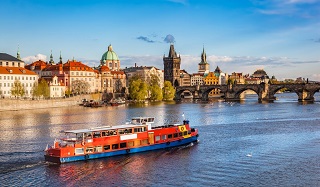
Praag


Onafhankelijk van geboortedata:


De Nederlandse schrijfster Elke Geurts werd geboren in Heijen in 1973. Zie ook alle tags voor Elke Geurts op dit blog.

Uit: Ik nog wel van jou

“Vanaf daar, leunend tegen het aanrechtblad, zag ik de vele omhelzingen die zich in dit halletje hadden afgespeeld aan mij voorbijtrekken.
Vanaf hier zie ik ook hoe ik een paar maanden daarna, in een geknakte houding, onder de kapstok zal liggen, en het er niet alleen maar uitziet alsof ik boven op de schoenen en de lege flessen in de hoek ben gesmeten, maar dat het ook daadwerkelijk zo is.
Man heeft mij van zich afgeworpen. Mijn achterhoofd tegen het kinderkapstokje aan de muur. Mijn wang is rood, mijn slaap bonkt, ik voel de zwelling. Ik huil als een klein kind. ‘Jij wil mij gewoon
wegdoen. Mij?’
Het leven is echt een slechte film. Alleen al daarom is het zaak dat wij mensen er iets beters van maken.
Dit is een slecht verhaal, en als ik niet zou proberen de loop ervan te veranderen, er een goed verhaal van te maken of ten minste iets beters, ben ik als schrijver geen knip voor de neus waard. Dat is
mijn enige taak.
Ik zie hoe ik zijn borstkas met één hand tegen de voordeur zal drukken, mijn knie in zijn ballen stoot, en zijn hoofd, het hoofd dat ik zo lang heb geliefkoosd, wordt helemaal scheefgetrokken, want met die andere hand trek ik zo hard ik kan aan zijn krullen. Hij zal brullen: ‘Kutwijf, jij hebt mijn leven verpest.’ En: ‘Rot op. Ik smijt je het huis uit.’
‘Dat is wat je eigenlijk wilt, hè?’ schreeuw ik. ‘Dat is wat je echt wilt.’
Daarom moeten die haren allemaal tegelijk uit zijn hoofd. Hij kermt. Zo kom ik dus uiteindelijk onder die kapstok terecht.”


 2247067-b71c4b49c2b771785e789dd25e573666.jpg
Elke Geurts (Heijen, 1973)


De Tsjechische schrijver Marek Šindelka werd geboren in 1984 in Polička. Šindelka studeerde naast zijn literaire activiteiten cultuurwetenschappen aan de Karelsuniversiteit, alsmede scenarioschrijven aan de FAMU in Praag. Voor zijn debuut, de dichtbundel “Strychnin a jiné básně” (Strychnine en andere gedichten), ontving hij in 2006 de Jiří-Orten-prijs. In 2008 publiceerde Šindelka zijn eerste roman “Chyba” (De fout), die in 2011 ook als strip verscheen. Daarnaast schreef Šindelka artikelen voor de Tsjechische literaire tijdschriften Souvislosti, A2 en Host, evenals de verhalenbundels “Zůstaňte s námi” (Blijf bij ons), waarvoor hij de 2012 Magnesia Litera Prijs ontving in de categorie proza, en “Mapa Anny” (Anna in kaart gebracht). In 2016 verscheen de tweede roman “Únava materiálu” (Materiaalmoeheid). In 2017 ontving Šindelka opnieuw de Magnesia Litera-prijs voor proza voor deze roman.

Uit: Materiaalmoeheid (Vertaald door Edgar de Bruin)

“Een rugzak plofte in de sneeuw, gevolgd door een jongen. Avond. Gloed aan de einder. Een rauw stuk hemel uitgesneden in het grijs. De adem zichtbaar. Het ijzeren hek fonkelend van de ijzel. Ook de betonmuur fonkelde. Achter de muur een rij ruiten, verlichte vensters, een stralende flat. De jongen kwam vlug overeind, klopte de sneeuw van zijn knieën.
Over een winding van het prikkeldraad hing een deken met een inventarisnummer. Alles heeft een nummer hier, flitste het door zijn hoofd. Hij keek even om zich heen, deed de rugzak om. Er zat een shirtje in, zeep, lucifers, een mes dat hij uit de kantine had gepikt. In zijn zak een zorgvuldig opgevouwen briefje met daarop de naam van een stad in het noorden. Hij moet naar het noorden. Daar ergens zit zijn broer. Maar voor alles moet hij aan een telefoon zien te komen, of ten minste een kaart. Nee. Eerst moet hij de deken van het hek trekken en meenemen, anders snappen ze hem. Hij had hem ook tegen de vrieskou nodig. Zo’n winter heeft hij nog nooit meegemaakt. Hij heeft de deken nodig om niet dood te vriezen.
Hij sjorde aan de deken, maar de prikkeldraadpunten sneden alleen maar steeds dieper in de vezels.
Het had geen zin. In de verte hoorde hij een hond kort blaffen. Even werd het zwart voor zijn ogen. Hij
liet de deken zitten. Zette het op een rennen. Verdween tussen de bomen. Verwondde zijn handen.
Hij had zijn huid aan iets opengehaald. Wreef zijn handpalm schoon met sneeuw. Zoog de wond uit.
Het bloed klopte voelbaar binnen in zijn palm. Zijn ze er al achter gekomen? De deken hing aan het hek, hij keek nog een keer om, maar er was geen tijd. Hij bleef maar rennen. Takken zwiepten langs zijn hoofd, kronkelende barsten van struiken tegen de hemel, boomtakken dor van de vorst. Hij had ze kunnen afbreken.
Het liefst had hij ze allemaal afgebroken, had hij tijd gehad. Hij stampte door de sneeuw. Gleed
uit, maar sprong meteen weer overeind, gaf een trap tegen de eerste de beste boomstam en rennen maar weer. Hij haatte die bomen, maandenlang had hij er door de getraliede ramen van dat gebouw op uitgekeken, kon hij volgen hoe ze hun bladeren verloren, hoe ze hun sapstroom onder de grond terugtrokken,hoe ze breekbaar werden.”


 2247067-27249ea5b5f78f1caf4da83b8d1ca87a.jpg
Marek Šindelka (Polička,1984)


Zie voor de schrijvers van de 19e juni ook mijn blog van 19 juni 2018.


Geschreven door Romenu om 18:11 Reageer op dit bericht

Meer van Romenu

↑ Terug naar de berichten