Naar de inhoud

Romenu

Over literatuur, gedichten, kunst en cultuur
akke.beakke.be

Berichten van 17 november 2011 tot 18 november 2011

Joost Zwagerman, Toon Tellegen, Klaus Mann, Seán Mac Falls, Richard Dehmel
De Nederlandse dichter en schrijver Joost Zwagerman werd geboren in Alkmaar op 18 november 1963. Zie ook alle tags voor Joost Zwagerman op dit blog.


Uit: De houdgreep


“Het gezin Rafferty was niet echt vermogend maar had toch genoeg geld om een au pair in huis te nemen. Zij kwam uit Nederland en heette Adriënne. Meneer en mevrouw Rafferty vonden haar soms wat onhandig en verward. Twee welwillende maar onnozele Oostenrijkse meisjes waren haar voorgegaan, zodat de Rafferty’s Adriënne’s kleine tekortkomingen voor lief namen.
Haar ijver en vooral haar oprechte genegenheid voor de dochtertjes Rafferty wogen ruimschoots op tegen dat kleine beetje verwarring en onhandigheid. Bovendien deelde Adriënne tot mevrouw Rafferty’s vreugde twee van haar meest dierbare liefhebberijen:lezen en spelletjes doen.

(…)


Voor Adriënne was niets vanzelfsprekend, dus ook de werkelijkheid niet. Zou ze een goede fotografe kunnen worden? Ze had geen zin meer om te luisteren. ‘De foto als metafoor.’ Ha! Zijn het niet juist metaforen - die grillige, onbeheersbare diabolo’s waarmee schrijvers, schilders en smachtende pubers lopen te goochelen- die almaar verhullen en redeloze vragen oproepen? Nee, aan Adriënne’s lijf geen kunstenmakerspolonaise. Wat ze wilde was eenvoudig: als Londen dan niet te veroveren viel kon ze nog altijd infiltreren, en de pocketcamera was haar handzaam excuus.
De cursusleider wees naar buiten.
‘Die muur daar,’ zei hij, ‘die heeft iets te zeggen. De topfotograaf ís de muur, zoals hij alles is wat hem omringt. Maar jij, meisje, jij moet om te beginnen een hele goeie vertolker, een monnik worden, a monk with a camera.’


 1034448-97fdfd020bd07a4e8da53469b0bf59c6.jpg

Joost Zwagerman (Alkmaar, 18 november 1963)


De Nederlandse dichter Toon Tellegen werd geboren op 18 november 1941 te Brielle. Zie ook alle tags voor Toon Tellegen op dit blog.


Twee


Twee mensen
De een is aardig, de ander is aardiger.
De een haalt de waarheid boven water,
de ander haalt de waarheid boven water en wringt haar uit.
De een verbergt zich, de ander verbergt zich en is onvindbaar.
De een valt, de ander valt en staat weer op en valt opnieuw.
De een klampt zich aan de ander vast,
de ander klampt zich aan de een vast en krabt hem, bijt hem,
knijpt zijn keel dicht, laat hem niet meer los.
De een denkt aan zijn liefste,
de ander denkt aan zijn liefste en aan de wereld
en aan de congruentie der dingen en de Heilige Augustinus
en hoog oplaaiend vuur.
De een is alleen,
maar zo eenzaam als de ander
is alleen een hond, in een hok, verkommerd.


Ik werd geboren


Ik werd geboren
en iemand kwam aansjokken, zette een ladder
tegen mij aan en klom naar boven
met op zijn rug mijn ziel en mijn gedachten.

Het begon te regenen
en hij sprong naar beneden, holde weg
om te schuilen, riep nog over zijn schouder:
'Wees gelukkig! Wees maar gelukkig!'

De zon verscheen,
maar er klom niemand meer naar boven.
Niemand legde uit hoe ik mijn gedachten
moest gebruiken,
niemand bracht schaduw,
niemand haalde de ladder weg,
niemand zei dat er niemand meer zou komen.


 1034448-5ff268e1c8aa35f6df1464226fdc172b.jpg

Toon Tellegen (Brielle, 18 november 1941)


De Duitse schrijver Klaus Mann werd op 18 november 1906 geboren als oudste zoon van Thomas en Katia Mann. Zie ook alle tags voor Klaus Mann op dit blog.


Uit: Das zwölfhundertste Hotelzimmer


“Zwölfhundertstes Hotelzimmer – sei mir gegrüßt!

Sei mir gegrüßt, mit mäßig gutem Bett, Spiegelschrank, Kommode, wackeligem Schreibtisch;

Mit rosa Nachttischlampe, abgeschabtem Teppich, Wasserkaraffe, Briefpapier, Kofferständer.

Sei gegrüßt, Heimat seit einer halben Stunde, Heimat für zwei, drei oder vierzehn Tage –:

Wirst du mir freundlich gesinnt sein? Werde ich bei dir ausruhen dürfen?

Oder gibt es gleich Aerger, weil der Kellner mich neun geschlagene Minuten warten läßt, seit ich nach meinem Frühstück geklingelt habe?

Neun bittere Minuten, die ich, zornig summend, zwischen Bett und Waschtisch spazierengehe;

Neun verfl uchte Minuten, zwischen Aufstehen und Café complet, die nicht mehr zur Nacht, noch nicht zum Tage gehören;

Was kann ein Tag bringen, der so beginnt?

Schlechte Heimat! Schon ist das Vertrauen dahin, das ich dir zunächst entgegenbrachte. –

Werde ich nach Kleiderhölzern, Tinte, Aschenbecher, Papierkorb erst verlangen müssen, oder ist alles zur Stelle? (Was für eine Heimat wäre denn das, ohne Tinte und ohne Papierkorb!)

Versuchest du ihn zu bluffen oder zu verblüffen, deinen Gast, deinen Schutzbefohlenen –

Oder trachtest du vielmehr danach, sachlich für ihn zu sorgen?

(Bluff scheint mir, wenn ich drei Glocken übereinander angebracht fi nde, für Kellner, Hausburschen, Zimmermädchen – noch dazu mit neckisch erläuternden Bildern, komisch flatterndem Frack des Kellners, Zimmermädchen, sich niedlich machend mit Besen: Es ist aber gleichgültig, auf welche Klingel man drückt, immer erscheint der Angestellte, der gerade nichts andres zu tun hat.)

Wie ist der Nachtportier?

Gestattet er mir, meinen Besuch mit aufs Zimmer zu nehmen, schaut höfl ich beiseite, wenn ich, mit gemachter Selbstverständlichkeit, vorbeischlendere an seiner Loge?

Oder spielt er den Strengen – «bitte sich ins Schreibzimmer zu bemühen, gibt es noch was zu besprechen.»

Wie verhält sich das Bett?”


 1034448-10a14f2274770fb602ddca653fdae3f8.jpg

Klaus Mann (18 november 1906 – 21 mei 1949)

Eind jaren 1920


De Iers-Amerikaanse dichter Seán Mac Falls werd geboren op 18 november 1957 in Boston. Zie ook alle tags voor Seán Mac Falls op dit blog.


The Blue Falcon

The Blue Falcon, cross the spire,
Waits in the gables of the white
House. Wounded in youth by crush
Of air, spent, a wisp perched
In the aerie dark with a view of mountains
Blue as ice under glacier. The wooden
Church from the other side clutches
The sky but the Falcon blue is lost
In a tuft of cloud that bobs but never
Kills. On this strike he is sheathed in stealth
The dull talons slip as they dry
In the tented air, the songbirds at play
In the high-ground underneath warble
And chide but the Falcon cannot hear
The Falcon near. His heart is soft
And muted in the breast, his ears
Are dumb to their tickling-songs.


Before the Falcons time, over
The tilling fields, dropped his world
In the spoils where splendour burst in green,
Rain meant the feathers ran and the woods,
A banquet of game, were bounty's breach
Fording blue currents he was
A fisher in the sun, but the sun
Sank in his drowning sky no store
From plateau to quarry the drought of days
Moved a castle felled in the dancing
Dust, his wings broke in the shuttered
Eye of the sun and etched his form
Into grey silhouette.

Now, the Blue Falcon, jeered
In the branches of the rooted air
Above the yellowed grass, under the pines
And a great blue mountain, stirs a Druid
Shape, vaporous, in the cauldron
Of the attic in the white house
A throw of stones crossways from
The sacred yews of the steeple spire.

.


 1034448-e4daa9d77b3067306b0a0dc87b3ba374.jpg

Seán Mac Falls (Boston, 18 november 1957)


De Duitse dichter Richard Dehmel werd geboren op 18 november 1863 in Wendisch-Hermsdorf. Zie ook alle tags voor Richard Dehmel op dit blog.


Stromüber


Der Abend war so dunkelschwer,
und schwer durchs Dunkel schnitt der Kahn:
die Andern lachten um uns her,
als fühlten sie den Frühling nahn.

Der weite Strom lag stumm und fahl,
am Ifer schoß ein schwankend Licht,
die Weiden standen starr und kahl.
Ich aber sah dir ins Gesicht

und fühlte deinen Atem stehn
und deine Augen nach mir schrein
und - eine Andre vor mir stehn
und heiß aufschluchzen: Ich bin dein!

Das Licht erglänzte nah und mild;
im grauen Wasser, schwarz, verschwand
der starren Weiden zitternd Bild.
Und knirschend stieß der Kahn ans Land.


Ruhe

Nach Verlaine

Auf die Nachricht vom Tode des Dichters


Ein großer schwarzer Traum

legt sich auf mein Leben;

Alles wird zu Raum,

Alles wird entschweben.


Ich kann nichts mehr sehn,

all das Gute, Schlimme;

kann dich nicht verstehen,

o du trübe Stimme.


Eine dunkle Hand

schaukelt meinen Willen,

glättet mein Gewand,

still im Stillen.


 1034448-2d3c1cc37ec623b943fb98d0793d05ec.jpg

Richard Dehmel (18 november 1863 – 9 februari 1920)
Portret door Max Liebermann, 1909


Zie voor nog meer schrijvers van de 18e november ook mijn vorige blog van vandaag.

Geschreven door Romenu om 19:30 Reageer op dit bericht

Eugenio Montejo, Jaap Meijer, Margaret Atwood, William Gilbert, Hans Reimann, Mireille Cottenjé

De  Venezolaanse dichter en schrijver Eugenio Montejo werd geboren in Caracas op 18 november 1938. Zie ook mijn blog van 18 november 2008 en ook mijn blog van 18 november 2009 en ook mijn blog van 18 november 2010.


Earthdom


To be here a few years on earth
with the clouds that arrive, with the birds
dangling from fragile hours.
On the edge, almost adrift,
closer to Saturn, more distant,
while the sun revolves and drags us with it
and the blood circles once more through the depths of its universe
more sacred than the stars.

To be here on earth; no more distant than a tree,
no more inexplicable;
thin in autumn, laden in summer,
with what we are and are not, with shadow,
memory, longing, until the end
(if there is one) voice to voice,
from house to house,
whoever it may be who carries the earth, if they carry it,
or whoever hopes for it, if they keep watch,
each time dividing our common bread
in two, in three, in four,
without forgetting the share for the ant
who is still travelling from remote stars
to be here on time at our table
even though the crumbs are bitter.


Vertaald door Peter Boyle


1034447-1407f108b3c99d13f62c0c2c45c4072d.jpg
Eugenio Montejo (18 november 1938 - 5 juni 2008)


De dichter (pseudoniem Saul van Messel) en historicus Jakob (Jaap) Meijer werd geboren in Winschoten op 18 november 1912. Zie ook mijn blog van 18 november 2008 en ook mijn blog van 18 november 2010.


Boetnbainder


Onwereg blad
woar komstoe heer
boom dij doe zöchst
staait hier nait meer


Zègt blad: is jou
din nait bekind
hou lös ik leef
aan waai'n wind


juli 1945


herkregen vrijheid

maar op zicht

ik wil terug

mijn kamp is dicht


salzburgerf festspiele


een felle vrouw

kijkt mij aan

instinctief voel ik

of mijn jodenster

wel goed zit


 1034447-e70c79581c9ac2697de8c71f9c6e19f5.jpg

Jaap Meijer (18 november 1912 - 9 juli 1993)


De Canadese schrijfster Margaret Atwood werd geboren in Ottawa op 18 november 1939. Zie ook mijn blog van 18 november 2008 en ook mijn blog van 18 november 2010.


Uit: Alias Grace


„About this time I began to notice a change in Mary. She was often late coming to bed; and when she did come, she no longer wanted to talk. She did not hear what I said to her, but appeared to be listening to something else; and she was constantly looking out through doorways, or windows, or over my shoulder. One night when she thought I was asleep, I saw her hiding something away in a handkerchief, under the floorboard where she kept her candle-ends and matches; and when I looked the next day, she being out of the room, I found that it was a gold ring. My first thought was that she had stolen it, which would be more than she'd ever stolen before, and very bad for her if she was caught; though there was no talk in the house of a missing ring.

But she did not laugh and fun as before, nor did she attend to her work in her usual brisk manner; and I became worried. But when I questioned her, and asked if there was some trouble, she would laugh, and say she did not know where I was getting such ideas. But her smell had changed, from nutmegs to salt fish.

The snow and ice began to melt, and a few birds returned, and they began to sing and call; so I knew it would soon be spring. And one day in late March, as we were carrying the clean wash up the back stairs in baskets, to hang it in the drying room, Mary said she was ill; and she ran downstairs and out into the back yard, behind the outbuildings. I set down my basket and followed her, just as I was, without my shawl; and I found her on her knees in the wet snow near the privy, which she had not had time to reach, as she had been overcome by a violent sickness.

I helped her up, and her forehead was damp and clammy, and I said she should be put to bed; but at that she became angry, and said it was something she'd eaten, it must have been yesterday's mutton stew, and now she was rid of it. But I'd eaten the very same thing myself, and felt perfectly well. She made me promise not to speak of it, and I said I would not. But when the same thing happened a few days later, and then again the next morning, I was truly alarmed; for I had seen my own mother in that condition very often, and I knew the milky smell of it; and I was well aware of what was wrong with Mary.“


 1034447-eaedb527a2ac4a653b24f46e3ac6be62.jpg

Margaret Atwood (Ottawa, 18 november 1939)


De Engelse toneelschrijver, librettist en illustrator Sir William Schwenck Gilbert werd geboren in Londen op 18 november 1836. Zie ook mijn blog van 18 november 2008 en ook mijn blog van 18 november 2010.


A Manager's Perplexities


Were I a king in very truth,

And had a son - a guileless youth -

In probable succession;

To teach him patience, teach him tact,

How promptly in a fix to act,

He should adopt, in point of fact,

A manager's profession.

To that condition he should stoop

(Despite a too fond mother),

With eight or ten "stars" in his troupe,

All jealous of each other!

Oh, the man who can rule a theatrical crew,

Each member a genius (and some of them two),

And manage to humour them, little and great,

Can govern a tuppenny-ha'penny State!


Both A and B rehearsal slight -

They say they'll be "all right at night"

(They've both to go to school yet);

C in each act MUST change her dress,

D WILL attempt to "square the press";

E won't play Romeo unless

His grandmother plays Juliet;

F claims all hoydens as her rights

(She's played them thirty seasons);

And G must show herself in tights

For two convincing reasons -

Two very well-shaped reasons!

Oh, the man who can drive a theatrical team,

With wheelers and leaders in order supreme,

Can govern and rule, with a wave of his fin,

All Europe and Asia - with Ireland thrown in!


 1034447-6e6cf642426c14faa29eb718da38e9d8.jpg

William S. Gilbert (18 november 1836 – 29 mei 1911)


De Duitse schrijver en satircus Albert Johannes (Hans) Reimann werd geboren op 18 november 1889 in Leipzig. Zie ook mijn blog van 18 november 2010.


Uit: Die sächsische Lorelei. Sächsische Miniaturen


“In einem Gymnasiom gibt där Härr Konräktor in Onterprima Litäratorgäschichte. »Nathan där Weise« wird gäläsen, kommäntiert, teilweise gälärnt ond von dän Prämanern in Aufsätzen wieder ärbrochen. Ond das sächs Wochen lang. Ändlich ist där Härr Konräktor färtig, ond zosammenfassänd fragt är einen Schölär:


 »Möller, wälchen Eindrock hat ›Nathan där Weise‹ auf Sie gämacht?« -


»Einen tiefen!« - »Falsch! Sätzen Sie sich! Wär mössen sagen: Einen sähr tiefen!«


- Öberschrift: »Der Lährer«.


1034447-793ec6687cbf61936709dfe6e06c0f4f.jpg
Hans Reimann (18 november 1889 – 13 juni 1969)


De Belgische schrijfster Mireille Cottenjé werd geboren in Moeskroen op 18 november 1933. Zie voor onderstaande schrijvers ook mijn blog van 18 november 2008. 


Uit: Vijf jaar geleden overleed Mireille Cottenjé (Interview door Ronny de Schepper en Johan de Belie voor De Rode Vaan)


“TEVEEL SEKS?

- een TV-toestel houdt u buiten de deur vanwege de kinderen, maar u kent waarschijnlijk wel Jan Lenferink, die heeft een programma over kunst, cultuur, seks en wetenschap. Waarmee zouden we dit interview beginnen?

Mireille Cottenjé: Ik ga elimineren, hé. Dus alleszins geen wetenschap, geen kunst, geen cultuur. (Gelach)

- U wordt nogal eens verweten dat er teveel seks in uw boeken zit. Nu is dat bij heel veel mannelijke auteurs het geval, maar dat wordt blijkbaar zonder meer geaccepteerd. Waarom ligt dat voor een vrouw anders?

M.C.: Ik denk dat dit cultuurhistorisch te verklaren is. Nog tot voor twintig, dertig jaar was een vrouw een a-seksueel wezen. Voor Kinsey was men er zich absoluut niet van bewust dat er ook zoiets als vrouwelijke seksualiteit bestond. Mensen die met hun tijd zijn meegegaan weten nu heel goed dat een vrouw net zo goed een seksbeest is als een man. Maar een heleboel mensen zijn blijkbaar nog in die 19-de eeuwse mentaliteit blijven zitten van “seks, dat is uitsluitend voor mannen”. En dat verklaart dan wel sommige reacties.

- Heeft u het gevoel dat u als vrouwelijke auteur in Vlaanderen een speciale positie inneemt? Speciaal ook tegenover de mannen?

M.C.: Ik ervaar dat niet zozeer, ik zal zeker nooit beweren dat ik discriminerend behandeld word. Wel vind ik dat ik vaak het slachtoffer word van erg persoonlijke aanvallen in verband met bepaalde passages uit mijn boeken, maar misschien is dat ook het geval met mannelijke auteurs die in verband met seks ook geen blad voor hun mond nemen. Hoe dan ook, die aanvallen komen niet alleen van oudere mensen die nog helemaal in die Victoriaanse mentaliteit vastgeroest zitten, maar ook van jongeren. Ik heb net een lezing gegeven in de hoogste klassen van een technische school en de allereerste vraag daarna was: waarom gebruikt u in uw boeken zoveel vuile woorden. Nu, bij zo’n vraag val ik omver. Ik zeg: “Vuile woorden, ge moet me eerst eens goed uitleggen wat een vuil woord is, want ik weet dat niet. Wat ik wel weet is dat er vuile dingen bestaan in de wereld. Stront bijvoorbeeld, da’s vuil, dat stinkt en dat is vies, maar het woord stront, daar wil ik aan rieken, dat wil ik eventueel zelfs opvreten, dat doet mij niets.”


1034447-525bd401a21d1f106acfdf7f661b8f04.jpg
Mireille Cottenjé (18 november 1933 - 9 januari 2006)

Geschreven door Romenu om 19:24 Reageer op dit bericht

Auberon Waugh, Dahlia Ravikovitch, Rebecca Walker

De Britse schrijver journalist en polemist Auberon Alexander Waugh werd geboren op 17 november 1939 in Dulverton, Somerset. Zie ook mijn blog van 17 november 2010.


Uit: Auberon Waugh's hilarious memories of the family mansion now for sale


“Returning to my home in Wiltshire after lunch with friends on Easter Day 1966, I found a policeman waiting outside the door with a long face.

Was I Auberon Alexander Waugh of this address?

For a terrible moment, I thought that something had happened to the children, left behind with our help Lolita who spoke no English.

It came as a relief when he said that my father, then 62, had died suddenly at Combe Florey House, the Waugh family home in Somerset.

It transpired that after a Latin mass in the parish church at nearby Wiveliscombe, he had failed to turn up at lunch and been found dead of a heart attack in the downstairs lavatory.

When I arrived at Combe Florey towards midnight, the house still smelled strongly of paraldehyde, the foul substance he took as a sleeping draught. In the heightened awareness of the moment, that familiar, revolting smell seemed to have the odour of sanctity.

That night there was a fire in the house. Somebody had left a door of the Aga in the kitchen open and it became hot, setting various things alight.

Firemen tramped through Combe Florey, squirting things, before being given glasses of Guinness and sent away. My mother Laura, the widow Waugh as she became from that moment, remained in her bedroom and did not emerge through all the night's alarms and excursions.

In the days that followed, my father's body lay in the library, boxed up in a coffin to await burial and attended in shifts by members of the family.

My feeling of relief on hearing of his death remained an ingredient in the mixture of emotions.

In his last year at Combe Florey, he had many of his teeth drawn, choosing to have it done without anaesthetic, for some impenetrable reason of his own (the vulgar new school of literary biographer attributed it to some strain of sexual masochism, but I am not persuaded by this).

In the event, his teeth seem to have been drawn not only physically but also metaphorically. Where before he had been gloomy, bad tempered and on occasions aggressive, he became benign and affectionate, but still his death lifted a great brooding awareness not only from Combe Florey but from the whole of existence.”


 1033862-be8b6c56b7465f51bcce027482dea7b4.jpg

Auberon Waugh (17 november 1939 -16 januari 2001)


De Israëlische dichteres en schrijfster Dahlia Ravikovitch werd geboren op 17 november 1936 in een voorstad van Tel Aviv. Zie ook alle tags voor Dahlia Ravikovitch op dit blog.


THE WINDOW


So what did I manage to do?
Me – for years I did nothing.
Just looked out the window.
Raindrops soaked into the lawn,
year in, year out.
That lawn was soft grass, high class.
Blackbirds strolled across it.
Later, tiny flowers blossomed, fine strings of beads,
most likely in spring.
Later tulips,
English daffodils,
snapdragons,
nothing special.
Me – I didn’t do a thing.
Winter and simmer revolved among blades of grass.
I slept as much as possible.
That window was as big as it needed to be.
Whatever was needed
I saw in that window.


FROM DAY TO NIGHT


Every day I rise from sleep again
as if for the last time.
I don’t know what awaits me,
perhaps it follows logically, then,
that nothing awaits me.
The spring on its way
is like the spring gone by.
I know about the month of May
but pay it no mind.
For me there’s no border between night and day,
just that night is colder
though silence is equal to them both.
At dawn I hear the voices of birds.
I fall asleep easily
out of affection for them.
The one who is dear to me is not here,
perhaps he simply is not.
I cross over from day to night
from day to day
like a feather
the bird doesn’t feel as it falls away.


 1033862-9365dfdce62ce8d0ad746686abfeb27f.jpg

Dahlia Ravikovitch (17 november 1936 – 21 augustus 2005)


De Amerikaanse schrijfster, uitgeefster en politiek activiste Rebecca Walker werd geboren op 17 november 1969 in Jackson, Mississippi. Zie ook mijn blog van 17 november 2010.


Uit: Baby Love


“I’m pregnant.

 I just got off the phone with the nurse from Dr. Lowen’s office. I picked up the old brown Trimline phone that’s been in this retreat cabin of my mother’s forever, and a woman’s voice asked for me and I said, This is she, and the voice said, It’s Becky from Dr. Lowen’s office. And I said, Uh-huh. Then Becky said, The result from the latest test was positive, and I said, Positive? And she said, Yes, you are no longer borderline pregnant.

No longer borderline pregnant? I thought I might fall over. I looked out the window at the leaves of the poplar trees shimmering in the breeze. My eyes settled on a vulture falling from the sky in a perfect spiral. He was flapping then gliding, flapping then gliding as he descended, and I thought to myself: I will remember this moment and that vulture for the rest of my life. I thought to myself: That vulture is a sign. A part of me is dying.


And then the nurse said, Hello? And I said, Yes, I am here. Are you sure I am pregnant? And she said, Yes. And I said, Really? Areyou sure? You’re not going call me back in two hours and say you made a mistake? She said, No. And I said, Well, how do you know? She sighed. It was a ridiculous question, but since she had been telling me for a week that after three blood draws they still couldn’t tell if I was really pregnant, I felt justified. So I pushed. Well, what do you know today that you didn’t yesterday? And she said, The HCG levels are definitely going up. HCG levels? Yes, in the last twenty-four hours the pregnancy hormone count has risen from 700 to over 2,300, and that usually means a healthy, robust beginning.”


1033862-7e355f368685fbd79cb062371ff75cc9.jpg
Rebecca Walker (Jackson, 17 november 1969)


Zie voor nog meer schrijvers van de 17e november ook mijn vorige blog van vandaag.

Geschreven door Romenu om 20:42 Reageer op dit bericht

Joost van den Vondel, Christopher Paolini, Max Barthel, Pierre Véry

De Nederlandse dichter en schrijver Joost van den Vondel werd geboren op 17 november 1587 in Keulen. Zie ook Zie ook alle tags voor Joost van den Vondel op dit blog.


Op Amstelredam


Het IJ en d'Amstel voeren de hoofdstad van Europe,
Gekroond tot Keizerin, des nabuurs steun en hope,
Amstelredam, die 't hoofd verheft aan 's hemels as,
En schiet, op Pluto's borst, haar wortels door 't moeras.
Wat waatren worden niet beschaduwd van haar zeilen?
Op welke markten gaat zij niet haar waren weilen?
Wat volken ziet ze niet beschijnen van de maan,
Zij die zelf wetten stelt de ganse Oceaan?
Zij breidt haar vleugels uit, door aanwas veler zielen,
En sleept de wereld in, met overladen kielen.
De welvaart stut haar Staat, zo lang d'aanzienlijkheid
Des Raads gewetens dwang zijn boze wil ontzeit.


Zomermaand


Bedaagde Zomermaand, men laat geen schaap verlegen;
Indien het gaat vermast, zo neem het op uw schoot:
Maar scheert gij ’t om de wol, zo scheer het niet te bloot,
En was het wit als sneeuw, dat u de Hemel zegen’.
Drijf, vroeg en spa, de kudde in ’t veld, en naar het hok:
Zij loont u met haar melk, en spier, en ruige lok.


Klachten des Poëets


Wat ramp, wat ongeluk plaagt nog mijn grijze haren!
Wat schande moet mij nog, eilacy! wedervaren!
Wat droefheid, wat verdriet, wat leed komt mij nog aan,
In dees mijn wintertijd, die haast zou zijn gedaan!
Wanneer ik overdenk èn ’tgeen ik was vóór dezen,
En wat ik, tot mijn smaad, moet tegenwoordig wezen;
Wanneer ik mij bezie in dees mijn hoogste nood,

Mijn lijden is te zwaar, mijn ongeluk te groot.
Maar doch, indien mij ’t leed, indien de hoge stromen
Van zo veel lijdens mij zal moeten overkomen,
Ik lijd ze, zo ik kan, ik wacht ze met geduld,
Ik voeg mij na de tijd, hoe ’t ongeval ook brult.
Maar gij, Mary! en gij, o rei der Heil’ge Maagden!
Die ’t al, èn lijf èn goed, ook voor de Godsdienst waagden,
Ai, ziet mij gunstig aan, hebt achting op mijn druk
Hebt meelij met mijn lot, en dit mijn ongeluk!
U heb ik toevertrouwd, U heb ik, al mijn dagen,
Nadat ik ben verlicht, mijn liefde toegedragen;
’k Heb U mij toegewijd, en U ik mij nog geef
Ai, maakt weer (want gij kunt), dat ’k eeuwig met U leef!


1033859-111fdbcc08cc627ac7adf0cf20699283.jpg
Joost van den Vondel (17 november 1587 – 5 februari 1679)

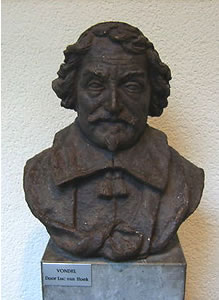
Borstbeeld door Lucas Hoek


De Amerikaanse schrijver
Christopher Paolini werd geboren in Los Angeles County, California, op 17 november 1983. Zie ook mijn blog van 17 november 2008 en ook mijn blog van 17 november 2009 en ook mijn blog van 17 november 2010.


Uit:
Eragon


“Eragon stood with quiet assurance in the dusky moonlight, then strode into the forest toward a glen where he was sure the deer would rest. The trees blocked the sky from view and cast feathery shadows on the ground. He looked at the tracks only occasionally; he knew the way.

At the glen, he strung his bow with a sure touch, then drew three arrows and nocked one, holding the others in his left hand. The moonlight revealed twenty or so motionless lumps where the deer lay in the grass. The doe he wanted was at the edge of the herd, her left foreleg stretched out awkwardly.

Eragon slowly crept closer, keeping the bow ready. All his work of the past three days had led to this moment. He took a last steadying breath and—an explosion shattered the night.

The herd bolted. Eragon lunged forward, racing through the grass as a fiery wind surged past his cheek. He slid to a stop and loosed an arrow at the bounding doe. It missed by a finger’s breadth and hissed into darkness. He cursed and spun around, instinctively nocking another arrow.

Behind him, where the deer had been, smoldered a large circle of grass and trees. Many of the pines stood bare of their needles. The grass outside the charring was flattened. A wisp of smoke curled in the air, carrying a burnt smell. In the center of the blast radius lay a polished blue stone. Mist snaked across the scorched area and swirled insubstantial tendrils over the stone.

Eragon watched for danger for several long minutes, but the only thing that moved was the mist. Cautiously, he released the tension from his bow and moved forward. Moonlight cast him in pale shadow as he stopped before the stone. He nudged it with an arrow, then jumped back. Nothing happened, so he warily picked it up.”


1033859-4dec3e720b7f33d94439865cf90a5041.jpg
Christopher Paolini (
Los Angeles County, 17 november 1983)


De Duitse dichter en schrijver
Max Barthel werd geboren in Dresden-Loschwitz op 17 november 1893. Zie ook mijn blog van 17 november 2008 en ook mijn blog van 17 november 2010.


Der sterbende Soldat


Ich hungerte stets vor den tragenden Stufen
vor dem Tor, das zur Erfüllung führt -
da hat mich der Krieg zu sich gerufen
und hat mich mit allem Hass geschürt. [...]
Verdammt, so ein Hund mit schwarzer Mähne
schlug mir aufbrüllend den Schädel entzwei.
Das Blut quoll bitter durch meine Zähne
ich gurgelte im wehen Geschrei.


1033859-4983b4fbb7610602eea006275da75881.jpg
Max Barthel (17 november 1893 – 28 juni 1975)


Zie voor onderstaande schrijver ook
mijn blog van 17 november 2010.


De Franse schrijver
Pierre Véry werd op 17 november 1900 in Bellon geboren. Zie ook mijn blog van 17 november 2009.

Geschreven door Romenu om 20:36 Reageer op dit bericht

Meer van Romenu

↑ Terug naar de berichten