

Naar de inhoud

Romenu

Over literatuur, gedichten, kunst en cultuur
akke.beakke.be

Berichten van 4 mei 2012 tot 5 mei 2012

J. C. Bloem, Petra Else Jekel, Morton Rhue, Miklós Radnóti, Christopher Morley

Bij 5 mei


1150986-0d2acab741fff6d46454d67dd659f317.jpg
Bevrijding

Monument door Paul Elshout, Geertruidenberg


Na de bevrijding


Schoon en stralend is, gelijk toen, het voorjaar,
Koud des morgens, maar als de dagen verder
Opengaan, is de eeuwige lucht een wonder
Voor de geredden.


In 't doorzichtig waas over al de brake
Landen ploegen weder trage paarden
Als altijd, wijl nog de nabije verten
Dreunen van oorlog.


Dit beleefd te hebben, dit heellijfs uit te
Mogen spreken, ieder ontwaken weer te
Weten: heen is, en nu voorgoed, de welhaast
Duldloze knechtschap –


Waard is het, vijf jaren gesmacht te hebben,
Nu opstandig, dan weer gelaten, en niet
Eén van de ongeborenen zal de vrijheid
Ooit zo beseffen.


1150986-d8b4761c0b50914406a1c7e95e4bda89.jpg
J. C. Bloem
(10 mei 1887 - 10 augustus 1966)


De Nederlandse dichteres
Petra Else Jekel werd in Arnhem geboren op 5 mei 1980. Zie ook alle tags voor Petra Else Jekel op dit blog.


Het Groninger Museum


1

Te zien als luchtspiegeling
in grachtwateroppervlak

met in je gouden woontoren
vierkante appartementen
waar schatbewaarders wonen

drijf je zowel op water als
in lucht nabijheid in

terwijl langs glazen puien schuiven
zij die zeggen: wij kennen het
niet het is ons te nabij.


2

Na in lange sessies eiland reeksen
zweept het Groninger Museum
grachtwater cummulerend golfslag
op.

Afzijdig was degene die
de puzzel paste, uiteen trok,
in water te drijven legde,
gangen groef.

Na bruggen, poorten laat
ingang de bezoeker zakken
naar waar de zoektocht
over paviljoenen start,

zichzelf een route tekent:
zoet en zwaar,
glas en lood,
doorschijnende wanden

en niemand die van bouwen wist.


1150986-24345feebc25b9020c67111ccb6277d3.jpg
Petra Else Jekel (Arnhem, 5 mei 1980)


De Amerikaanse schrijver
Morton Rhue (pseudoniem van Todd Strasser) werd geboren op 5 mei 1950 in New York.
Zie ook alle tags voor Morton Rhue op dit blog.


Uit:
Asphalt Tribe


„NEW YEAR’S EVE

Maggot said we should go up to Times Square to watch the ball drop and pick some pockets, but we never got around to it. Instead we hung out in front of the Good Life Deli like we always did. Maggot, Rainbow, 2Moro, and me. A cold mist drifted out of the dark, the little

droplets sparkling in the streetlights. Maggot and me sat under the awning of the newspaper stand on the corner. The damp matted down our hair. Black puddles dotted the street and steam rose like ghosts from the manhole covers. Rainbow sat cross-legged against the wall, loose strands of blond hair falling out of a blue wool cap, her head nodding almost down to her lap. 2Moro leaned against the streetlight with her arms crossed, not saying anything to anyone one, just waiting for someone to say It was one of those nights.when there wasn’t much traffic on the streets of New York. Most of the New Year’s partiers were done with their stupid celebrations and back in the four-walled cells they called apartments. Prisoners of the system, Maggot said. Now, only the newspaper delivery trucks and taxis passed, their tires making squishy noises on the wet, black pavement. Out here in the cold where we weren’t walled in, we were free to go where we pleased.

“Guess the cops have the night off,” Maggot said, his brown dreadlocks stringy from the mist; his breath a small cloud of fog.

“The rest of the world, too,” muttered 2Moro. She was wearing a red-and-orange patchwork jacket, a tight black skirt, and high black boots. Her short dyed red hair was matted down on her forehead like a cap. The piercings in her ears and eyebrow and nose glinted in the streetlight. Tattooed around her neck was a circle of black barbed wire.“


1150986-ef608518113ca9fb340b37bd7e59d3ec.jpg
Morton Rhue/Todd Strasser (New York, 5 mei 1950)


De Hongaarse dichter en schrijver
Miklós Radnóti werd geboren op 5 mei 1909 in Boedapest. Zie ook alle tags voor Miklós Radnóti op dit blog.


Postcard 2
written October 6, 1944 near Crvenka, Serbia

A few miles away they're incinerating
the haystacks and the houses,
while squatting here on the fringe of this pleasant meadow,
the shell-shocked peasants quietly smoke their pipes.
Now, here, stepping into this still pond, the little shepherd girl
sets the silver water a-ripple
while, leaning over to drink, her flocculent sheep
seem to swim like drifting clouds.


Postcard 3

written October 24, 1944 near Mohács, Hungary

The oxen dribble bloody spittle;
the men pass blood in their piss.
Our stinking regiment halts, a horde of perspiring savages,
adding our aroma to death's repulsive stench.


Vertaald door Michael R. Burch


1150986-3360af490c52d2c182396e19eeaacc23.jpg
Miklós Radnóti (5 mei 1909 – 9 november 1944)


De Amerikaanse dichter, schrijver en journalist
Christopher Morley werd geboren op 5 mei1890 in Haverford, Pennsylvania.
Zie ook alle tags voor Christopher Morley op dit blog.


At the Mermaid Caffeteria


TRUTH is enough for prose:
Calmly it goes
To tell just what it knows.

For verse, skill will suffice-
Delicate, nice
Casting of verbal dice.

Poetry, men attain
By subtler pain
More flagrant in the brain-

An honesty unfeigned,
A heart unchained,
A madness well restrained.


The barren music of a word or phrase


THE barren music of a word or phrase,
The futile arts of syllable and stress,
He sought. The poetry of common days
He did not guess.

The simplest, sweetest rhythms life affords-
Unselfish love, true effort truly done,
The tender themes that underlie all words-
He knew not one.

The human cadence and the subtle chime
Of little laughters, home and child and wife,
He knew not. Artist merely in his rhyme,
Not in his life.


1150986-c81a6c42aa595f86db23a6a77c320788.jpg
Christopher Morley (5 mei 1890 – 28 maart 1957)


Zie voor nog meer schrijvers van de 5e mei ook
mijn vorige blog van vandaag.
Geschreven door Romenu om 18:45 Reageer op dit bericht

George Albert Aurier, Henryk Sienkiewicz, Richard Watson Dixon, Wouter Steyaert, Catullus

De Franse dichter, schilder en criticus George Albert Aurier werd geboren op 5 mei 1865 in Châteauroux (Indre Zie ook alle tags voor George Albert Aurier op dit blog.


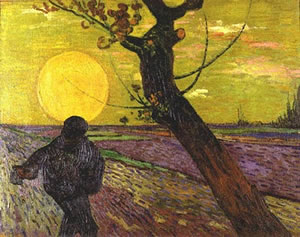
Uit: The Isolated Ones: Vincent van Gogh (Les Isolés : Vincent van Gogh)


„Yet, this respect and his love for the reality of things does not suffice alone to explain or to characterize the profound, complex, and quite distinctive art of Vincent van Gogh. No doubt, like all the painters of his race, he is very conscious of material reality, of its importance and its beauty, but even more often, he considers this enchantress only as a sort of marvelous language destined to translate the Idea. He is, almost always, a Symbolist . . . who feels the continual need to clothe his ideas in precise, ponderable, tangible forms, in intensely sensual and material exteriors. In almost all his canvases, beneath this morphic exterior, beneath this flesh that is very much flesh, beneath this matter that is very much matter, there lies, for the spirit, that knows how to find it, a thought, an idea, and this Idea, the essential substratum of the work, is, at the same time, its efficient and final cause. As for the brilliant and radiant symphonies of colour and line, whatever may be their importance for the painter in his work they are simply expressive means, simply methods of symbolization. Indeed, if we refuse to acknowledge the existence of these idealistic tendencies beneath this naturalist art, a large part of the body of work that we are studying would remain utterly incomprehensible. How would we explain, for example, The Sower that august and disturbing sower, that rustic with his brutally brilliant forehead (bearing at times a distant resemblance to the artist himself), whose silhouette, gesture, and labour have always obsessed Vincent van Gogh, and whom he painted and repainted so often, sometimes beneath skies rubescent at sunset, sometimes amid the golden dust of blazing noons--how could we explain The Sower without considering that idée fixe. that haunts his brain about the necessary advent of a man, a messiah, sower of truth, who would regenerate the decrepitude of our art and perhaps our imbecile and industrialist society?“


 1150976-bb38d307f60ac237aab075ec314e5b9c.jpg

George Albert Aurier (5 mei 1865 – 5 oktober 1892)

Vincent van Gogh, De zaaier


De Poolse schrijver en journalist Henryk Sienkiewicz werd geboren in Wola Okrzejska op 5 mei 1846. Zie ook alle tags voor Henryk Sienkiewicz op dit blog.


Uit: Quo Vadis? (Vertaald door Paul Seliger)


»Sei gegrüßt, Petronius,« sagte der Jüngling, als er mit elastischem Schritte das Tepidarium betrat; »mögen alle Götter dir Glück schenken, namentlich Asklepios und Kypris, denn unter ihrem schützenden Beistande kann dir nichts Übles zustoßen.«

»Willkommen in Rom! Mögest du dich der Ruhe nach dem Kriege erfreuen,« antwortete Petronius, indem er seine Hände aus den Falten des weichen Musselingewebes, das ihn umhüllte, hervorstreckte. »Was gibt es Neues in Armenien, und bist du während deines Aufenthaltes in Asien nicht auch nach Bithynien gekommen?«

Petronius hatte früher Bithynien verwaltet, und was mehr bedeuten wollte, sein Amt mit Strenge und Gerechtigkeit geführt. Dies stand in merkwürdigem Gegensatz zu dem Charakter des Mannes, der wegen seiner Weichlichkeit und seines Hanges zur Üppigkeit allgemein bekannt war; daher liebte er es, sich jener Zeiten zu erinnern, weil sie ein Beweis dafür waren, was aus ihm hätte werden können, wenn er gewollt hätte.

»Ich war zufällig in Herakleia,« entgegnete Vinicius. »Corbulo hatte mich dorthin geschickt mit dem Befehl, Verstärkungen zusammenzuziehen.«

»Ach ja, Herakleia! Ich kannte dort ein Mädchen aus Kolchis, für das ich alle hiesigen geschiedenen Frauen, Poppaea selbst nicht ausgeschlossen, hingegeben hätte. Aber das sind vergangene Geschichten. Erzähle mir lieber, was es Neues an der parthischen Grenze gibt. Wahrlich, diese Vologesus, Tiridates, Tigranes und all diese Barbaren sind mir zuwider, welche, wie mir der junge Arulanus erzählt, bei sich zu Hause noch auf allen vieren kriechen und sich nur in unserer Gegenwart als Menschen gebärden. Aber man spricht jetzt viel von ihnen in Rom, wenn auch nur deshalb, weil es gefährlich ist, von etwas anderem zu sprechen.«

»Der Krieg geht schlecht vorwärts, und wenn Corbulo nicht wäre, so könnte er möglicherweise zu einer Niederlage führen.«


 1150976-1ab5f00035eb85c8d010e1e7a6495caf.jpg

Henryk Sienkiewicz (5 mei 1846 - 15 november 1916)

Geportretteerd door Kazimierz Mordasewicz, 1899


De Engelse dichter Richard Watson Dixon werd geboren in Islington op 5 mei 1833. Zie ook alle tags voor Richard Watson Dixon op dit blog.


Song


WHY fadest thou in death,

Oh yellow waning tree?

Gentle is autumn’s breath,

And green the oak by thee.


But with each wind that sighs

The leaves from thee take wing;

And bare thy branches rise

Above their drifted ring.


 1150976-9e25553c45a72df630169fe134d3b4ad.jpg

Richard Watson Dixon (5 mei 1833 - 23 januari 1900)


Onafhankelijk van geboortedata:


De Vlaamse dichter Wouter Steyaert werd geboren in Gent in het jaar 1982. Zie ook alle tags voor Wouter Steyaert op dit blog.


zij wandelt op iets groens, zij wandelt in zwart
het water achterna. op haar omgekeerde kop
de mensen tegemoet – zij wandelt

op de ogen van de stilte, op vossensokken
andere wandelende mensen zeggen
dat zij zo dun is als een spleet – zo

onschuldig als een foetus – ze zeggen
dat zij vergiftigd is door haar zintuigen
dat het hoofd van haar

op twee verschillende voeten lijkt, twee
verschillende gelijksoortige vissen – met
in haar haar een weinig helium verstopt


 1150976-04b050686fa768bdc88ff8f0220d27a5.jpg

Wouter Steyaert (Gent, 1982)


De Romeinse dichter Gaius Valerius Catullus werd geboren in 87 v. Chr, in Sirmione bij Verona Zie ook alle tags voor Catullus op dit blog.


Carmina


II


Kleine vogel, speeltje van mijn lieveling,
jij, met wie ze zich vermaakt, jij, op haar schoot,
jij, naar wiens snavel ze haar vinger uitsteekt
om hem tot scherpe pikjes te prikkelen,
wanneer ze maar zin heeft, haar blik vonkend van
verlangen naar mij, in een lief spel met jou -
als tedere troost voor haar pijn, denk ik,
zodat de gloed van haar hartstocht tot rust komt -
kon ik toch maar met jou spelen zoals zij,
en het verdriet dat mijn hart drukt verlichten!


Vertaald door Lucette M. Oostenbroek


LI


Hij schijnt mij aan een god gelijk te zijn,
ja, God vergeef mij, meer zelfs dan een god,
die naast u zittend onverzadiglijk
u ziet, en hoort
uw lieven lach, wat mij, verliefden dwaas,
slaat met verbijstering; want, Lesbia,
zoodra ik u aanschouw, verstomt mijn stem,
o Lesbia,
mijn tong verstart, een fijne vlam doortrilt
mijn heele lijf, het ruischend bloed verdooft
mijn ooren, van mijn beide oogen dekt
de nacht het licht.

Niets doen, Catullus, is je heele kwaal.
Niets doen wekt overdreven sentiment.
Niets doen heeft koningsmacht ten val gebracht
en stedenbloei.


Vertaald door A. Rutgers van der Loeff.


 1150976-e35f2b5a3142fe3f9bd9dc2a9304111d.jpg

Catullus (87 v. Chr – 54 v. Chr.)

Catullus bij Lesbia door Sir Laurence Alma Tadema, 1865.


Zie voor nog meer schrijvers van de 5e mei ook mijn blog van 5 mei 2011 deel 1 en eveneens deel 2.

Geschreven door Romenu om 18:34 Reageer op dit bericht

Willem Wilmink, Amos Oz, Christiaan Weijts, Monika van Paemel


Bij 4 mei


 1150318-a10a89d4d6361451c5c00bc7f25e9ca9.jpg

'Channel Crossing to life’ in Hoek van Holland

Monument door Frank Meisler


Een foto


Van die razzia's zijn foto's

Jonas Daniël Meijerplein

waar de Duitse militairen

joden aan het treiteren zijn


Een bange man met keurige schoenen

lange jas en vlinderdas

wordt over het plein gedreven

of het daar een veemarkt was


Kijk, daar staan drie Duitse soldaten

met een spottend lachje bij

en daar kijkt een vierde Duitser

misschien toch beschaamd, opzij


Stel je voor je zag die foto

van de man met vlinderdas

en je zou opeens ontdekken

dat het je eigen vader was


Soms moet ik er ook aan denken

hoe het die andere zoon vergaat

die ontdekte, kijk mijn vader

is die lachende soldaat


 1150318-b2f3c1e34e465d828b6a40c7391926ed.jpg

Willem Wilmink (25 oktober 1936 – 2 augustus 2003)


De Israëlische schrijver Amos Oz, (eig. Amos Klausner) werd geboren in Jeruzalem op 4 mei 1939. Zie ook alle tags voor Amos Oz op dit blog.


Uit: Scenes From Village Life


“The stranger was not quite a stranger. Something in his appearance repelled and yet fascinated Arieh Zelnik from first glance, if it really was the first glance: he felt he remembered that face, the arms that came down nearly to the knees, but vaguely, as though from a lifetime ago.   The man parked his car right in front of the gate. It was a dusty, beige car, with a motley patchwork of stickers on the rear window and even on the side windows: a varied collection of declarations, warnings, slogans and exclamation marks. He locked the car, rattling each door vigorously to make sure they were all properly shut. Then he patted the hood lightly once or twice, as though the car were an old horse that you tethered to the gatepost and patted affectionately to let him know he wouldn’t have long to wait. Then the man pushed the gate open and strode toward the vine-shaded front veranda. He moved in a jerky, almost painful way, as if walking on hot sand.   From his swing seat in a corner of the veranda Arieh Zelnik could watch without being seen. He observed the uninvited guest from the moment he parked his car. But try as he might, he could not remember where or when he had come across him before. Was it on a foreign trip? In the army? At work? At university? Or even at school? The man’s face had a sly, jubilant expression, as if he had just pulled off a practical joke at someone else’s expense. Somewhere behind or beneath the stranger’s features there lurked the elusive suggestion of a familiar, disturbing face: was it someone who once harmed you, or someone to whom you yourself once did some forgotten wrong?   Like a dream of which nine-tenths had vanished and only the tail was still visible.   Arieh Zelnik decided not to get up to greet the newcomer but to wait for him here, on his swing seat on the front veranda.   As the stranger hurriedly bounced and wound his way along the path that led from the gate to the veranda steps, his little eyes darted this way and that as though he were afraid of being discovered too soon, or of being attacked by some ferocious dog that might suddenly leap out at him from the spiny bougainvillea bushes growing on either side of the path.   The thinning flaxen hair, the turkey-wattle neck, the watery, inquisitively darting eyes, the dangling chimpanzee arms, all evoked a certain vague unease.”  


 1150318-bee5c7a3bb001d58c8132e9b3ea6fd14.jpg

Amos Oz (Jeruzalem, 4 mei 1939)


De Nederlandse schrijver Christiaan Weijts werd geboren in Leiden op 4 mei 1976. Zie ook alle tags voor Christiaan Weijts op dit blog.


Uit: De laatste enclave voor de geest. Een dag in het NIAS


“13.00 De reden voor het Limburgs zuurvlees wordt duidelijk: er valt een delegatie van een man of twintig binnen, bijna allemaal met een rugzakje op, merkwaardigerwijs. Navraag leert dat het om een afvaardiging gaat van het P.J. Meertensinstituut, die in onze conference building een workshop over ‘lokale identiteiten’ volgt, en de Limburgse in het bijzonder.
Een cultureel-antropoloog naast me aan tafel, Erik Bähre, is zelf Limburger van geboorte. ‘Zuurvlees wordt traditioneel van paardenvlees gemaakt,’ weet hij. Bij voorkeur van een witte schimmel, antwoord ik.     Erik was gisteravond namelijk op de rug van zo’n dier het terrein op komen rijden, met een mijter, baard en staf, geflankeerd door Jo Spaans (theologe aan de Universiteit Utrecht) als hoofdpiet. Het was voor het eerst in mijn leven dat het er allemaal exact uitzag als in de prentenboeken, compleet met sikkelmaan die door de kale boomtakken scheen.
Gistermiddag had er een lezing over Zwarte Piet op het programma gestaan, die wegens ziekte verviel. Ik vermoed dat anders de jaarlijkse discussie over het racistische karakter van het Sinterklaasfeest aan de orde was gekomen.
We hebben nogal wat fellows uit Nigeria en Kameroen, en dat mijn zoon (2) ze abusievelijk voor Zwarte Piet aanzag, is gênant maar vergoelijkbaar. Toen we echter collectief het ‘Daar wordt aan de deur geklopt’ inzetten, murmelen we wat ongemakkelijk bij de frase: Ook al ben ik zwart als roet, ‘k meen het toch goed.
Voor die Afrikaanse jongens is het hier trouwens al helemaal het paradijs op aarde. Ayo Ojebode (van de universiteit van Ibadan, Nigeria) schrijft er een vermakelijke serie over op de site van de Wereldomroep – ‘Africans going Dutch’. Verbaasd staart hij naar onze fietspaden en trottoirs: ‘We don’t have walkways in most cities and so, animals, beggars, pedestrians, cyclists (okada), car drivers, bus drivers, tanker drivers struggle over the same piece of poor road. (…) In Holland students ask each other, “How’s study?” In Nigeria, students ask “How are you surviving?” As if life is warfare or a plague.’


 1150318-fa895e14e6b3740eb77a1c877f885c8a.jpg

Christiaan Weijts (Leiden, 4 mei 1976)


De Vlaamse schrijfster
Monika van Paemel werd geboren op 4 mei 1945 in Poesele in Oost-Vlaanderen. Zie ook alle tags Monika van Paemel op dit blog.


Uit: De mens in de stroom van de tijd. Het vrouwbeeld in het werk van Hella Haasse


„Toen de leden van het bestuur van de Maatschappij der Nederlandse Letterkunde mij vroegen om ‘het vrouwbeeld’ in het werk van Hella Haasse te bespreken: dat is driemaal vrouwelijk, heb ik overwogen de heren in dit gezelschap te vragen de zaal te verlaten, zodat wij dit onderwerp onder deskundigen konden afhandelen. Ik doe dit niet omdat seksisme mij vreemd is, en vooral omdat noch de persoon noch het werk van Hella Haasse zich voor een dergelijke eenzijdige interpretatie leent.

In de eerste romans van Hella Haasse zijn de hoofdpersonages mannen. Net zoals in het werk van mannelijke auteurs vrouwelijke hoofdpersonages voorkomen. Dat is bij schrijvers, vrouwelijk of mannelijk, niet onnatuurlijk.

Wat bij Hella Haasse meteen opvalt is dat zij ook in haar mannelijke personages de mens, of het menselijke, vóór het seksgebondene stelt. Dit in tegenstelling met het vrouwbeeld zoals wij dat uit het werk van veel schrijvers kennen, waar de stereotiepen, of datgene wat als typisch vrouwelijk geldt, vóór het persoonlijke of het menselijke komt.

In Oeroeg, het prozadebuut van Hella Haasse, staat de ambivalente verhouding tussen het Indische en het Hollandse kind centraal. Is het toeval dat Oeroeg en zijn vriend jongens zijn, of is de ontwikkeling van de hoofdpersonages - de vrienden staan niet alleen emotioneel, maar ook politiek-maatschappelijk tegenover elkaar, in de historische context - eerder een, tussen aanhalingstekens, ‘mannelijk gebeuren’? Oeroeg is tevens het afscheid van het land van herkomst, een afscheid dat ook een breuk is, waardoor een bewustzijnsproces op gang komt dat veelzijdig is, en naast het persoonlijke ook een historische dimensie heeft. Het standpunt van de schrijfster, het omvatten van het algemene in het persoonlijke, waarbij de menselijke verhoudingen belangrijker zijn dan de geslachtelijke, zonder die te miskennen of te onderschatten, is vanaf het eerste werk betekenisvol voor deze auteur.“


 1150318-7652413b856bd680ce3455ca68631d21.jpg

Monika van Paemel (Poesele, 4 mei 1945)


Zie voor nog meer schrijvers van de 4e mei ook mijn vorige blog van vandaag.
Geschreven door Romenu om 18:20 Reageer op dit bericht

Graham Swift, David Guterson, Jan Mulder

De Engelse schrijver Graham Swift werd geboren op 4 mei 1949 in Londen. Zie ook alle tags voor Graham Swift op dit blog.


Uit: Wish You Were Here


“There is no end to madness, Jack thinks, once it takes hold. Hadn’t those experts said it could take years before it flared up in human beings? So, it had flared up now in him and Ellie.

Sixty-five head of healthy-seeming cattle that finally succumbed to the rushed-through culling order, leaving a silence and emptiness as hollow as the morning Mum died, and the small angry wisp of a thought floating in it: Well, they’d better be right, those experts, it had better damn well flare up some day or this will have been a whole load of grief for nothing.
So then.
Healthy cattle. Sound of limb and udder and hoof—and mind. “Not one of them mad as far as I ever saw,” Dad had said, as if it was the start of one of his rare jokes and his face would crack into a smile to prove it. But his face had looked like simply cracking anyway and staying cracked, and the words he might have said, by way of a punchline, never left his lips, though Jack thinks now that he heard them. Or it was his own silent joke to himself. Or it’s the joke he’s only arrived at now; “We must be the mad ones.”
And if ever there was a time when Jack’s dad might have put his two arms round his two sons, that was it. His arms were certainly long enough, even for his sons’ big shoulders—both brothers out of the same large Luxton mould, though with all of eight years between them. Tom would have been fifteen then, but growing fast. And Jack, though it was a fact he sometimes wished to hide, even to reverse, already had a clear inch over his father.
The three of them had stood there, like the only life left, in the yard at Jebb Farm.
But Michael Luxton hadn’t put his arms round his two sons. He’d done what he’d begun to do, occasionally, only after his wife’s death. He’d looked hard at his feet, at the ground he was standing on, and spat.”


 1150315-1c25a2b0d546e94309536bbd2798ea7c.jpg

Graham Swift (Londen, 4 mei 1949)


De Amerikaanse schrijver David Guterson werd geboren op 4 mei 1956 in Seattle. Zie ook alle tags voor David Guterson op dit blog.


Uit: Ed King


How wonderful it was – wonderful and surprising – to be attracted to a guy, to want sex. Diane found, once she was naked with him, that there were things she really liked in his performance, including, foremost, that he was relentlessly, acutely, even obsessively servile. It was fine with Ed to spend a half-hour massaging her feet and squeezing her ankles, followed by nearly equal devoted caressing of her shins and calves; next, moving up, he gave substantial attention to her knees and thighs, and when, in her massage trance, she hoped and believed that his hands would surely go where they would do the most good, Ed didn't go there, he flipped her over instead and massaged, kneaded, stretched, rubbed, pinched, flicked, feathered, licked, kissed, and gently bit her shoulders, neck, back, and butt. Again she believed that he was on the verge of getting a hand between her legs, especially when, while massaging the small of her back, he found the tip of her tailbone. How long was he going to go on with the erotic massage and general body worship without getting to her quim? Would he please just go ahead and do something not frustrating? But she knew, before long, what he had to be waiting for. He was waiting for a display of need. So she took him by the wrist and moved the base of his hand into her pubic hair until his middle fingertip settled on the no-man's-land between her 'front parlor' and 'back door' (those were the quaint, prudish terms of her girlhood), she got him on the node between neighbouring needs (both of which had been explored by johns who almost never tarried). She gave him this particular sign, this clear permission, and he began a careful prodding of her perineum, which was as good a starting place as any for Diane, because it instigated those processes of memory her sexuality required. It triggered memories with the uncanny force of déjà vu, and what she thought of, as Ed slaved away, was a boy from her village who had fingered her adroitly in a greenhouse thick with green tomatoes.”


 1150315-079530f846b238bc9257c4d4b5043b7e.jpg

David Guterson (Seattle, 4 mei 1956)


De Nederlandse columnist, schrijver, ex-voetballer, en televisiepersoonlijkheid Jan Mulder werd geboren in Bellingwolde op 4 mei 1945. Zie ook alle tags voor Jan Mulder op dit blog.


Uit: Tom Boonen (Column in Humo, 17 juni 2008)


“Wat zou Tom Boonen hebben bezield toen hij die coke snoof? Je weet toch dat er vliegende controles bestaan? Je weet toch dat het minste of geringste verkeerde tabletje dodelijk kan zijn voor je carrière?

Spelers in de Bundesliga bijvoorbeeld, draaien elk onschuldig dropje voor een verkoudheid of officieel bij de Duitse voetbalbond aangemelde zalfje tegen een eczeemallergie drie keer om en laten het daarna nog eens testen door een onafhankelijke arts voordat ze het inslikken.

Boonen snuift op een dag tussen twee voorjaarsklassiekers in een gram coke.

Niet wegens het gebruik van doping of drugs (zo zwaar was de dosis niet), maar om de ergerlijke, aan onnozelheid en brutaliteit grenzende slordigheid van deze toprenner zou Quick-Step hem op staande voet moeten ontslaan.

Op de persconferentie las Tom Boonen een door een advocatenteam opgestelde verklaring voor. Hij zei nog altijd het vertrouwen van Quick-Step te genieten, maar voorlopig op 'low-profile' te gaan. Ploegleider Lefevre maakte bekend dat ontslag niet aan de orde was geweest, en: 'Tom gaat nu toch even in de wachtstand.'

In de wachtstand.

Het einde van een wielrenner kon niet treffender onder woorden worden gebracht.

Maar is het het einde?

Nee.“


1150315-566caab3edb3ff11ef33b5de39c93320.jpg
Jan Mulder (Bellingwolde, 4 mei 1945)


Zie voor nog meer schrijvers van de 4e mei ook mijn blog van 4 mei 2011 deel 2 en eveneens deel 3.

Geschreven door Romenu om 18:14 Reageer op dit bericht

Meer van Romenu

↑ Terug naar de berichten