Dolce far niente, Tour de France, Michael Longley, Hilde Domin, Graeme C. Simsion
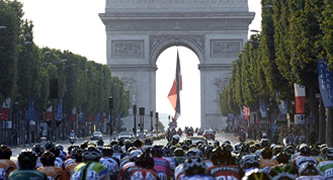
Dolce far niente - Bij de Tour de France
De finish in Parijs
Uit: Rond de 40
“De Tour volgen is in zekere zin een ziekte. Steeds was daar die terugkerende vraag: wat doe ik hier? En steeds weer moest ik het juiste antwoord schuldig blijven, maar dat had ik ook als ik in Italië of Spanje op een hoge berg volkomen vast stond in het verkeer. Als ons vliegtuig net vertrokken was omdat de renners die dag wat langzaam gereden hadden. Als ik ergens in de vochtige mist, in een kleine halfopen cabine in een microfoon zat te babbelen en de levensloop van twee Spanjaarden, een Rus en een Belg zat voor te dragen. De tijd kroop voort en in mijn bonkende achterhoofd klonk de melodie van Jackson Browne’s ‘The Barricades of Heaven’.
Je deed het in de maand juli omdat het de Tour was. Een sympathiek onding. Ooit zei ‘ami’ Jean Marie Leblanc dat de Tour uit zijn voegen ging barsten. Hij zei dat lang geleden en de Tour is alleen maar verder gegroeid en bijna geëxplodeerd. De dranghekken, vroeger nauwelijks aanwezig, reiken nu tot in de hemel. Als journalistieke onderneming moet je je inkopen voor de exclusieve en snelle interviews, de Tour leeft al lang niet meer op de straat.
De romantiek, zo prachtig hoorbaar in de stem van Jean Nelissen, is verpacht aan een gele bank die angstig mooie, langbenige vrouwen op een podium samendrijft. Deze kussende, lachende meiden hebben bodyguards en een privéchauffeur. Van een alpinopet hebben ze nog nooit gehoord. Wie Yvette Horner is? Ach wat!
En toch ga ik weer, voor de veertigste keer. Met optimisme, een blij ge- moed en met mijn zelfgemaakte plakboeken vol uitslagen. En ja, er komt weer een avond dat je hotelkamer de grootte van een schoenendoos zal hebben. Dat al het licht uitvalt, dat het contact met Hilversum er gewoon even niet is, dat de randweg rond Nantes he-le-maal vast staat. Maar dan haal je de schouders op. Ach wat, het is de Tour.
Beter deze vrolijke chaos dan het saaie, grijze bestaan van een loonslaaf elders. In zekere zin is de Tour rock & roll, vrijheid. En die zocht ik blijkbaar in 1973. Met heel veel dank aan Kees Buurman en Bob Spaak, die me de kans gaven in deze chaos te leren overleven.”

Mart Smeets (Arnhem, 11 januari 1947)
De Ierse dichter Michael Longley werd geboren op 27 juli 1939 in Belfast. Zie ook mijn blog van 27 juli 2007 en ook mijn blog van 27 juli 2009 en ook mijn blog van 27 juli 2010.
Marigolds, 1960
You are dying. Why do we fight?
You find my first published poem –
‘Not worth the paper it’s printed on,’
You say. She gave him marigolds –
You are dying. ‘They’ve cut out my
Wheesht – I have to sit down
To wheesht – like a woman’ –
Marigolds the colour of autumn –
I need to hitchhike to Dublin
For Trinity Term. ‘I’ll take you
Part of the way,’ you say,
‘And we can talk if you like.’
And we talk and talk as though
We know we are just in time.
‘A little bit further,’ you say
Again and again, and in pain.
A few miles from Drogheda
You turn the car. We say goodbye
And you drive away slowly
Towards Belfast and your death.
To keep in his cold room. Look
At me now on the Newry Road
Standing beside my rucksack. Och,
Daddy, look in your driving mirror.
Boy-Soldier
The spear-point pierces his tender neck.
His armour clatters as he hits the ground.
Blood soaks his hair, bonny as the Graces',
Braids held in place by gold and silver bands.
Think of a smallholder who rears a sapling
In a beauty spot a burn burbles through
(You can hear its music close to your home)
Milky blossoms quivering in the breeze.
A spring blizzard blows in from nowhere
And uproots it, laying its branches out.
Thus Euphorbus, the son of Pantheus,
A boy-soldier – the London Scottish, say,
The Inniskillings, the Duke of Wellington's –
Was killed and despoiled by Menelaus.
Boat
What’s the Greek for boat,
You ask, old friend,
Fellow voyager
Approaching Ithaca –
Oh, flatulent sails,
Wave-winnowing oars,
Shingle-scrunching keel –
But, so close to home,
There’s a danger always
Of amnesiac storms,
Waterlogged words.

Michael Longley (Belfast, 27 juli 1939)
De Duitse schrijfster, dichteres en vertaalster Hilde Domin werd geboren in Keulen als Hilde Löwenstein op 27 juli 1909. Zie ook mijn blog van 27 juli 2010 en eveneens alle tags voor Hilde Domin op dit blog.
Drei Arten Gedichte aufzuschreiben
1.
Ein trockenes Flußbett
ein weißes Band von Kieselsteinen
von weitem gesehen
hierauf wünsche ich zu schreiben
in klaren Lettern
oder eine Schutthalde
Geröll
gleitend unter meine Zeilen
wegrutschend
damit das heikle Leben meiner Worte
ihr Dennoch
ein Dennoch jedes Buchstabens sei
2.
Kleine Buchstaben
genaue
damit die Worte leise kommen
damit die Worte sich einschleichen
damit man hingehen muß
zu den Worten
sie suchen in dem weißen
Papier
leise
man merkt nicht wie sie eintreten
durch die Poren
Schweiß der nach innen rinnt
Angst
meine
unsere
und das Dennoch jedes Buchstabens
3.
Ich will einen Streifen Papier
so groß wie ich
ein Meter sechzig
darauf ein Gedicht
das schreit
sowie einer vorübergeht
schreit in schwarzen Buchstaben
das etwas Unmögliches verlangt
Zivilcourage zum Beispiel
diesen Mut den kein Tier hat
Mit-Schmerz zum Beispiel
Solidarität statt Herde
Fremd-Worte
heimisch zu machen im Tun
Mensch
Tier das Zivilcourage hat
Mensch
Tier das den Mit-Schmerz kennt
Mensch Fremdwort-Tier Wort-Tier
Tier
das Gedichte schreibt
Gedicht
das Unmögliches verlangt
von jedem der vorbeigeht
dringend
unabweisbar
als rufe es
"Trink Coca-Cola"

Hilde Domin (27 juli 1909 - 22 februari 2006)
Onafhankelijk van geboortedata
De Nieuw-Zeelandse schrijver Graeme C. Simsion werd geboren in in Auckland in 1956. Australië. Zie ook alle tags voor Graeme C. Simsion op dit blog.
Uit: The Rosie Project
“I may have found a solution to the Wife Problem. As with so many scientific breakthroughs, the answer was obvious in retrospect. But had it not been for a series of unscheduled events, it is unlikely I would have discovered it.
The sequence was initiated by Gene’s insisting I give a lecture on Asperger’s syndrome that he had previously agreed to deliver himself. The timing was extremely annoying. The preparation could be time-shared with lunch consumption, but on the designated evening I had scheduled ninety-four minutes to clean my bathroom. I was faced with a choice of three options, none of them satisfactory.
1. Cleaning the bathroom after the lecture, resulting in loss of sleep with a consequent reduction in mental and physical performance.
2. Rescheduling the cleaning until the following Tuesday, resulting in an eight-day period of compromised bathroom hygiene and consequent risk of disease.
3. Refusing to deliver the lecture, resulting in damage to my friendship with Gene.
I presented the dilemma to Gene, who, as usual, had an alternative solution.
“Don, I’ll pay for someone to clean your bathroom.”
I explained to Gene—again—that all cleaners, with the possible exception of the Hungarian woman with the short skirt, made errors. Short-Skirt Woman, who had been Gene’s cleaner, had disappeared following some problem with Gene and Claudia.
“I’ll give you Eva’s mobile number. Just don’t mention me.”
“What if she asks? How can I answer without mentioning you?”
“Just say you’re contacting her because she’s the only cleaner who does it properly. And if she mentions me, say nothing.”
This was an excellent outcome, and an illustration of Gene’s ability to find solutions to social problems. Eva would enjoy having her competence recognized and might even be suitable for a permanent role, which would free up an average of 316 minutes per week in my schedule.
Gene’s lecture problem had arisen because he had an opportunity to have sex with a Chilean academic who was visiting Melbourne for a conference. Gene has a project to have sex with women of as many different nationalities as possible. As a professor of psychology, he is extremely interested in human sexual attraction, which he believes is largely genetically determined.»

Graeme C. Simsion (Auckland in 1956)
Zie voor de schrijvers van de 27e juli ook mijn blog van 27 juli 2011 deel 1 en eveneens deel 2.