Naar de inhoud

Romenu

Over literatuur, gedichten, kunst en cultuur
akke.beakke.be

Berichten van 6 juni 2018 tot 7 juni 2018

Het leven in juni (Marjoleine de Vos)


Dolce far niente


 2152882-d8279d9e96aa59e457559ba949b0ce76.jpg
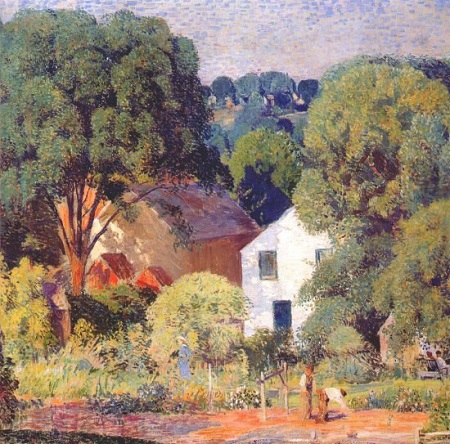
Day in June door Daniel Garber, 1937


Het leven in juni

Om mij heen is alles luidkeels in leven 
de boer op zijn maaier, blatende schapen 
in de esdoorn een zwartkop die roept 
om een vrouwtje, uit bloemkelken klinkt 
het geronk van een bij. 

En ik leef ook maar moet dat zelf zeggen 
want niets van al wat ik waarneem noemt mij. 
Zoals je met vrienden wel praat over vroeger: 
We waren aan zee, in een tent, heel gelukkig - 
vraagt iemand: was jij daarbij? 

Dus ben ik alleen in de tuin in de wereld 
en om mij heen ademt alles en in huis 
zit een man. Dit is het leven, schrijft hij, 
deze ochtend in juni, de zwartkop zingt 
en in de tuin zit zij. 


 2152882-af85992171c9466ce4ad1586100124da.jpg
Marjoleine de Vos (Oosterbeek, 19 april 1957)
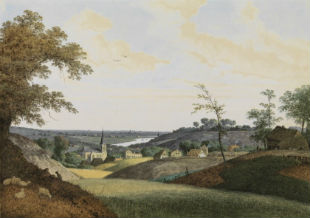
Landschap met gezicht op Oosterbeek met de Rijn in het verschiet - door Josephus Augustus Knip, ca. 1930. Marjoleine de Vos werd geboren in Oosterbeek.


Zie voor de schrijvers van de 7e juni ook mijn vorige blog van vandaag.


Geschreven door Romenu om 14:33 Reageer op dit bericht

Orhan Pamuk, Monika Mann, Nikki Giovanni, Harry Crews, Louise Erdrich, Mascha Kaléko, Jan Engelman, Gwendolyn Brooks, Elizabeth Bowen

De Turkse schrijver Orhan Pamuk werd geboren op 7 juni 1952 in Istanbul. Zie ook alle tags voor Orhan Pamuk op dit blog.

Uit: The Red-Haired Woman (Vertaald door Ekin Oklap)

“The settlement was fifteen minutes on foot from our well. It was the town of Öngören, population 6,200, according to the blue sign with enormous white letters marking the entrance. After two days of ceaseless digging, two meters, we took a break on the second afternoon and went down to Öngören to acquire more supplies.
Ali took us to the town carpenter first. Having dug past two meters, we could no longer shovel out the earth by hand, so like all welldiggers, we had to build a windlass. Master Mahmut had brought some lumber in the landowner’s pickup, but it wasn’t enough. When he explained who we were and what we were up to, the inquisitive carpenter said, “Oh, you mean that land up there!”
Over the following days, whenever we went down to the town from “that land up there,” Master Mahmut made a point of dropping by the carpenter; the grocer, who sold cigarettes; the bespectacled tobacconist; and the ironmonger, who stayed open late. After digging all day, I relished going to Öngören with Master Mahmut for an evening stroll by his side, or to sit in the shade of the cypress and pine trees on some little bench, or at a table outside some coffeehouse, on the stoop of some shop, or in the train station.
It was Öngören’s misfortune to be overrun by soldiers. An infantry battalion had been stationed there during World War II to defend Istanbul against German attacks via the Balkans, and Russian attacks via Bulgaria. That purpose, like the battalion itself, was soon forgotten. But forty years later, the unit was still the town’s greatest source of income, and its curse.
Most of the shops in the town center sold postcards, socks, telephone tokens, and beer to soldiers on day passes. The stretch known among locals as Diners’ Lane was lined with various eateries and kebab shops, also catering to the military clientele. Surrounding them were pastry shops and coffeehouses that would be jammed with soldiers during the day—especially on weekends—but in the evenings, when these places emptied out, a completely different side of Öngören emerged. The gendarmes, who patrolled the area vigilantly, would have to pacify carousing infantrymen and break up fistfights among privates, in addition to restoring the peace disturbed by boisterous civilians or by the music halls when the entertainment got too loud.“

 

 2152875-736a908fce996a8555a6e61fa6deaffa.jpg
Orhan Pamuk (Istanbul, 7 juni 1952)


De Duitse schrijfster Monika Mann werd als vierde kind van Thomas Mann geboren op 7 juni 1910 in München. Zie ook alle tags voor Monika Mann op dit blog.

Uit: Das fahrende Haus

„Fast ohne Unterbrechung zwölf Jahre in einem Land gelebt zu haben – soll ich sagen, daß es die besten Jahre waren? –, reichen aus, ihm Treue und Verbundenheit zu bewahren fürs Leben.
Ein Gesetz der Vereinigten Staaten von Amerika jedoch erlaubt ihrem naturalisierten Bürger nicht mehr als fünf Jahre seiner ununterbrochenen Abwesenheit. Überschreitet er diese Frist, verliert er die Staatsbürgerschaft. Wer aber will den Kontinent so mir nichts, dir nichts wechseln, noch dazu um eines Gesetzes willen, das unserer Zeit entwachsen, nicht würdig scheint? Denn in Europa leben, heißt nicht, fern von Amerika leben, heißt nicht, das verlernen und vergessen, was man in der Neuen Welt gelernt und erfahren und sich errungen hat. Die Länder Europas, sind sie nicht so etwas wie amerikanische Provinzen (nicht zu ihrer Schande sei’s gefragt!), und sind die Vereinigten Staaten Amerikas nicht so etwas wie europäische Ableger? Leben wir nicht in einer Welt, die immer mehr zusammenrückt, die unvermeidlich, bei allem Zaudern und Widerstand sich vereinheitlicht und vereinigt? Während ich meine amerikanische Staatsbürgerschaft niederlege, lese ich Emerson und Whitman, schreibe ich meine «Amerikanische Novelle», denk’ ich an zwölf, wenn nicht immer leichte, so doch helle Jahre in New York und Los Angeles, New England, Vermont und Maine . . . Ja, es ist vor allem Amerikas Licht, das so unvergeßlich ist. Der Himmel der Neuen Welt ist heller als der Himmel der Alten Welt. (Ein grüner Baum wirkt dort dunkler als hier, zuweilen fast schwarz gegen das lichte Blau.)"
 

 2152875-64ff53fb8e3660f64c72c96184474ec2.jpg
Monika Mann (7 juni 1910 – 17 maart 1992) 
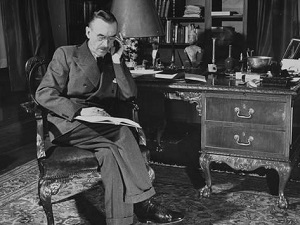
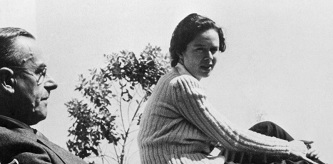
Thomas en Monika Mann, rond 1940


De Amerikaanse dichteres en schrijfster Nikki Giovanni werd geboren op 7 juni 1943 in Knoxville, Tennessee. Zie ook alle tags voor Nikki Giovanni op dit blog.


A Historical Footnote to Consider Only When All Else Fails
(For Barbara Crosby)

While it is true
(though only in a factual sense)
That in the wake of a
Her-I-can comes a
Shower
Surely I am not
The gravitating force
that keeps this house
full of panthers

Why, LBJ has made it
quite clear to me
He doesn't give a
Good goddamn what I think
(else why would he continue to masterbate in public?)

Rhythm and Blues is not
The downfall of a great civilization
And I expect you to
Realize
That the Temptations
have no connection with
The CIA

We must move on to
the true issues of
Our time
like the mini-skirt
Rebellion
And perhaps take a
Closer look at
Flour power

It is for Us
to lead our people
out of the
Wein-Bars
into the streets
into the streets
(for safety reasons only)
Lord knows we don't
Want to lose the
support
of our Jewish friends

So let us work
for our day of Presence
When Stokely is in
The Black House
And all will be right with
Our World

 

 2152875-272db56dfa2b6ad62d97d6647c128273.jpg
Nikki Giovanni (Knoxville, 7 juni 1943)


De Amerikaanse schrijver Harry Crews werd geboren op 7 juni 1935 in Bacon County, Georgia. Zie ook alle tags voor Harry Crews op dit blog.

Uit: Classic Crews: A Harry Crews Reader

“He was smiling, but he’d said it with just the finest edge of contempt, which is the way you are supposed to say it, and I scrambled to follow him, my heart lifting. Byron had heard me ask him much the same thing many times before, because if you change a couple of words, the question will serve in any number of circumstances. And now, in great high spirits, he was giving it back to me. …
“Dad, you remember about the time with the rain?”
“The time about the rain? Hell, son, we been in the rain a lot together.” I was wet and my feet hurt. I wanted to get the tent up and start a fire.
He cut his eyes toward me. Drops of rain hung on the ends of his fine lashes. He was suddenly very serious. What in the hell was coming down here? What was coming down was the past that is never past and, in this case, the past against which I had no defense except my own failed heart.
“We weren’t in it together,” he said. “You made me stand in it. Stand in it for a long time.”
Yes, I had done that, but I had not thought about it in years. It’s just not the sort of thing a man would want to think about. Byron’s mother had gone North for a while and left me to take care of him. He was seven years old and just starting in the second grade. I had told him that day to be home at six o’clock and we should go out to dinner. Truthfully, we’d been out to eat every night since Sally had been gone, because washing dishes is right up at the top of the list of things I won’t do. It had started misting rain at midday and had not stopped. Byron had not appeared at six, nor was he there at 6:45. That was back when I was bad to go to the bottle, and while I wasn’t drunk, I wasn’t sober, either. Lay it on the whiskey. A man will snatch at any straw to save himself from the responsibility of an ignoble action. When he did come home at 7:15, I asked him where he’d been.
“At Joe’s,” he said. But I had known that. I reminded him of when we had said we were going to dinner. But he had known that.
“It was raining,” he said.
I said, “Let’s go out and look at it.”
We went out into the carport and watched the warm spring rain.”
 

 2152875-9bc12c4ac48b763f4a2e050571b28bf8.jpg
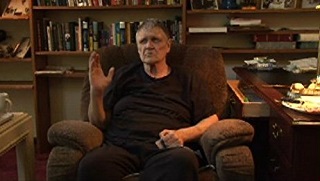
Harry Crews (7 juni 1935 – 28 maart 2012)


De Amerikaanse dichteres en schrijfster Louise Erdrich werd geboren op 7 juni 1954 in Little Falls, Minnesota. Zie ook alle tags voor Louise Erdrich op dit blog.


The King of Owls

It is said that playing cards were invented in 1392 to cure the French king, Charles VI, of madness. The suits in some of the first card packs consisted of Doves, Peacocks, Ravens, and Owls.

They say I am excitable! How could
I not scream? The Swiss monk's tonsure
spun till it blurred yet his eyes were still.
I snapped my gaiter, hard, to stuff back

my mirth. Lords, he then began to speak.
Indus catarum, he said, presenting the game of cards
in which the state of the world is excellent described
and figured. He decked his mouth

as they do, a solemn stitch, and left cards
in my hands. I cast them down.
What need have I for amusement?
My brain's a park. Yet your company

plucked them from the ground and began to play.
Lords, I wither. The monk spoke right,
the mealy wretch. The sorry patterns show
the deceiving constructions of your minds.

I have made the Deuce of Ravens my sword
falling through your pillows and rising,
the wing blades still running
with the jugular blood. Your bodies lurch

through the steps of an unpleasant dance.
No lutes play. I have silenced the lutes!
I keep watch in the clipped, convulsed garden.
I must have silence, to hear the messenger's footfall

in my brain. For I am the King of Owls.
Where I float no shadow falls.
I have hungers, such terrible hungers, you cannot know.
Lords, I sharpen my talons on your bones.

 

 2152875-395f9de52cadd2be76687bfa758be038.jpg
Louise Erdrich (Little Falls, 7 juni 1954)


De Duitstalige dichteres Mascha Kaléko (eig. Golda Malka Aufen) werd geboren op 7 juni 1907 in Krenau of Schidlow in Galicië in het toenmalige Oostenrijk-Hongarije, nu Polen. Zie ook alle tags voor Mascha Kaléko op dit blog.


Langschläfers Morgenlied

Der Wecker surrt. Das alberne Geknatter
Reißt mir das schönste Stück des Traums entzwei.
Ein fleißig Radio übt schon sein Geschnatter.
Pitt äußert, daß es Zeit zum Aufstehn sei.

Mir ist vor Frühaufstehern immer bange.
… Das können keine wackern Männer sein:
Ein guter Mensch schläft meistens gern und lange.
– Ich bild mir diesbezüglich etwas ein …

Das mit der goldgeschmückten Morgenstunde
Hat sicher nur das Lesebuch erdacht.
Ich ruhe sanft. – Aus einem kühlen Grunde:
Ich hab mir niemals was aus Gold gemacht.

Der Wecker surrt. Pitt malt in düstern Sätzen
Der Faulheit Wirkung auf den Lebenslauf.
Durchs Fenster hört man schon die Autos hetzen.
– Ein warmes Bett ist nicht zu unterschätzen.
… Und dennoch steht man alle Morgen auf.

 

 2152875-7c3dd49a0f3886132279b9499e08b08e.jpg
Mascha Kaléko (7 juni 1907 – 21 januari 1975)
Cover


De Nederlandse dichter Johannes Aloysius Antonius Engelman werd geboren in Utrecht op 7 juni 1900. Zie ook alle tags voor Jan Engelman op dit blog.


Gebed in ’t Duister

Heer, behoed haar in de wereld
die ik lang mijn eigen noem.
In haar ogen staat bepereld
met uw eigen dauw de bloem

van een onverwelkbaar minnen
uit de grond der ziel geteeld.
En geen stervling zal bezinnen
op het eeuwig Aanvangsbeeld

lijk uw knecht, die hare leden
in het schemerlicht onthult,
die zich, stamelend gebeden,
aan háár wil alleen vervult.

Lang voor 't eerste dagegloren,
lang na Venus' gouden schijn
kniel ik, uwe stem te horen
uit die weelde, uit die pijn,

uit die tuin, bedekt, bedwereld
met een bloesem van Voorheen.
Heer, behoed haar in de wereld,
doe uw mantel om ons heen!


Klein Air

Morgen drink ik rode wijn,
morgen zal mijn lief hier zijn.
In de warme lampeschijn
zal zij liggen, bleek en fijn.
Wilder dan een springfontein
breek ik uit, en ben weer klein
bij haar leden, zoet satijn,
diepe bedding, dieper pijn.
Morgen drink ik rode wijn,
morgen zal mijn lief hier zijn.
 

 2152875-1ad455f74fd29bfeb79c7cb174797d3b.jpg
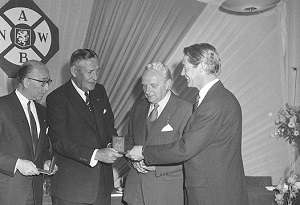
Jan Engelman (Utrecht 7 juni 1900 ;Amsterdam 20 maart 1972)
Engelman helemaal links tijdens de uitreiking van de ANWB-prijs 1958


De Amerikaanse dichteres Gwendolyn Brooks werd geboren op 7 juni 1917 in Topeka, Kansas. Zie ook alle tags voor Gwendolyn Brooks op dit blog.


Speech To The Young : Speech To The Progress-Toward

Say to them,
say to the down-keepers,
the sun-slappers,
the self-soilers,
the harmony-hushers,
"even if you are not ready for day
it cannot always be night."
You will be right.
For that is the hard home-run.

Live not for battles won.
Live not for the-end-of-the-song.
Live in the along.


The Good Man

The good man.
He is still enhancer, renouncer.
In the time of detachment,
in the time of the vivid heather and affectionate evil,
in the time of oral
grave grave legalities of hate - all real
walks our prime registered reproach and seal.
Our successful moral.
The good man.

Watches our bogus roses, our rank wreath, our
love's unreliable cement, the gray
jubilees of our demondom.
Coherent
Counsel! Good man.
Require of us our terribly excluded blue.
Constrain, repair a ripped, revolted land.
Put hand in hand land over.
Reprove
the abler droughts and manias of the day
and a felicity entreat.
Love.
Complete
your pledges, reinforce your aides, renew
stance, testament.
 

 2152875-059c7f6eeb1c8474aa2d570a6f23d9b3.jpg
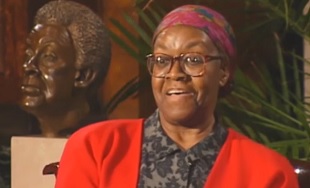
Gwendolyn Brooks (7 juni 1917 – 3 december 2000)
In 1996 


De Ierse schrijfster Elizabeth Bowen werd geboren op 7 juni 1899 in Dublin. Zie ook alle tags voor Elizabeth Bowen op dit blog.

Uit: Friends and Relations

“Now the service was over the afternoon steadily brightened. The open-sided marquee was not, after all, to prove a fiasco. Laurel and Edward, obedient to Mrs Studdart's instructions, took up their position in the morning-room. A playing-card, overlooked, lay face down on the carpet. Edward stooped for it – 'Don't!' she cried, 'leave it!' her heart in her mouth. Better not – Finding themselves still alone Edward and she kissed hastily, with a feverish calm. They had all time, but only the moment. Then Laurel arranged her train in a pool, as she had seen brides do. Mrs Studdart, coming in shortly afterwards, re-arranged it.
'You might hold your lilies,' said Mrs Studdart, who had discovered the sheaf on a hall table specially cleared for the top-hats.
'Oh, Mother, I can't; they're heavy.'
'But don't you think it would be nice, Edward, if she were to hold her lilies?'
'I don't know,' said Edward. 'Do people generally?'
'They'd be such a strain on one arm all the time. You see I can't change them; I must keep my right arm for shaking hands.'
'And shake hands lightly,' said Mrs Studdart, 'don't grip.'
'Did I look ...?'
'Lovely, lovely,' said Mrs Studdart. She was looking round distractedly for a vase and soon found one, a kind of Italian urn in which she arranged the lilies beside the bride.
The house might have been designed for such an occasion. The position of the morning-room was admirable; it had two doors so that the guests could circulate through a chain of rooms. Each, having saluted the bridal pair, was to pass on through the dining-room; through the French window and out by duck-boards into the open- sided marquee. (This was the best of a summer wedding; to make this possible he and she had devoured each other nervously throughout the endless winter of their engagement.) In the dining-room Cousin Richard was to be posted to head the guests off through the window. He would be shot, he said, if he let one past him into the hall.
‘I shall depend upon you, Richard,' said Mrs Studdart. (He had been in the Colonies.) 'For if the two streams mix in the hall and people get squeezed back into the drawing-room and have to pass Laurel all over again, there will be the most shocking confusion.'
 

 2152875-3cfb64d1baa410dc409f639fcdb27cab.jpg
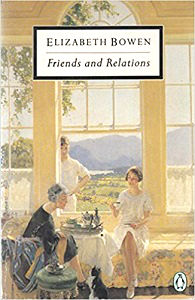
Elizabeth Bowen (7 juni 1899 – 22 februari 1973)
Cover


Zie voor nog meer schrijvers van de 7e juni ook mijn blog van 7 juni 2015 deel 2.



Geschreven door Romenu om 14:30 Reageer op dit bericht

Thomas Mann, Aleksandr Poesjkin, Sarah Dessen, Jean Cayrol, Pierre Corneille, Hendrik van Teylingen, V. C. Andrews, Frank Gericke

De Duitse schrijver Thomas Mann werd geboren in Lübeck op 6 juni 1875. Zie ook alle tags voor Thomas Mann op dit blog.

Uit: Doktor Faustus

„Ich breche aufs neue ab, indem ich mich daran erinnere, daß ich auf das Genie und seine jedenfalls dämonisch beeinflußte Natur nur zu sprechen kam, um meinen Zweifel zu erläutern, ob ich zu meiner Aufgabe die nötige Affinität besitze. Möge denn nun gegen den Gewissensskrupel geltend gemacht sein, was immer ich dagegen ins Feld zu führen habe. Es war mir beschieden, viele Jahre meines Lebens in der vertrauten Nähe eines genialen Menschen, des Helden dieser Blätter, zu verbringen, ihn seit Kinderzeiten zu kennen, Zeuge seines Werdens, seines Schicksals zu sein und an seinem Schaffen in bescheidener Helfersrolle teilzuhaben. Die librettistische Bearbeitung von Shakespeares Komödie »Verlorene Liebesmüh«, Leverkühns mutwilligem Jugendwerk, stammt von mir, und auch auf die textliche Zubereitung der grotesken Opernsuite »Gesta Romanorum« sowie des Oratoriums »Offenbarung S. Johannis des Theologen« durfte ich Einfluß nehmen. Das ist das eine, oder es ist bereits das eine und andere. Ich bin aber ferner im Besitz von Papieren, unschätzbaren Aufzeichnungen, die der Heimgegangene mir und keinem anderen in gesunden Tagen oder, wenn ich so nicht sagen darf, in vergleichsweise und legaliter gesunden Tagen letztwillig vermacht hat, und auf die ich mich bei meiner Darstellung stützen werde, ja, aus denen ich mit gebotener Auswahl einiges direkt in dieselbe einzuschalten gedenke. Letztens und erstens aber — und diese Rechtfertigung war noch immer die gültigste, wenn nicht vor den Menschen, so doch vor Gott: ich habe ihn geliebt — mit Entsetzen und Zärtlichkeit, mit Erbarmen und hingebender Bewunderung — und wenig dabei gefragt, ob er im mindesten mir das Gefühl zurückgäbe. Das hat er nicht getan, o nein.


 2152684-c7840f4888777f994c60b8f7a4896917.jpg
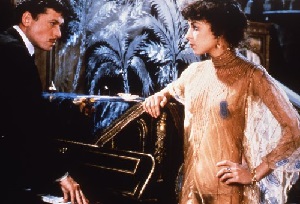
Jon Finch als Adrian Leverkühn en Marie-Hélène Breillat als Marie Godeau;in de film uit 1982


In der Verschreibung der nachgelassenen Kompositionsskizzen und Tagebuchblätter drückt sich ein freundlich-sachliches, fast möchte ich sagen: gnädiges und sicherlich mich ehrendes Vertrauen in meine Gewissenhaftigkeit, Pietät und Korrektheit aus. Aber lieben? Wen hätte dieser Mann geliebt? Einst eine Frau — vielleicht. Ein Kind zuletzt — es mag sein. Einen leichtwiegenden, jeden gewinnenden Fant und Mann aller Stunden, den er dann, wahrscheinlich eben weil er ihm geneigt war, von sich schickte — und zwar in den Tod. Wem hätte er sein Herz eröffnet, wen jemals in sein Leben eingelassen? Das gab es bei Adrian nicht. Menschliche Ergebenheit nahm er hin — ich möchte schwören: oft ohne sie auch nur zu bemerken. Seine Gleichgültigkeit war so groß, daß er kaum jemals gewahr wurde, was um ihn her vorging, in welcher Gesellschaft er sich befand, und die Tatsache, daß er sehr selten einen Gesprächspartner mit Namen anredete, läßt mich vermuten, daß er den Namen nicht wußte, während doch der andere ein gutes Recht zur Annahme des Gegenteils hatte. Ich möchte seine Einsamkeit einem Abgrund vergleichen, in welchem Gefühle, die man ihm entgegenbrachte, lautlos und spurlos untergingen. Um ihn war Kälte — und wie wird mir zumute, indem ich dies Wort gebrauche, das auch er in einem ungeheuerlichen Zusammenhange einst niederschrieb! Einzelnen Vokabeln können Leben und Erfahrung einen Akzent verleihen, der sie ihrem alltäglichen Sinn völlig entfremdet und ihnen einen Schreckensnimbus verleiht, den niemand versteht, der sie nicht in ihrer fürchterlichsten Bedeutung kennengelernt hat.“


 2152684-64ff53fb8e3660f64c72c96184474ec2.jpg
Thomas Mann (6 juni 1875 – 12 augustus 1955)


De Russische dichter en schrijver Aleksandr Poesjkin werd geboren in Moskou op 6 juni 1799. Zie ook alle tags voor Aleksandr Poesjkin op dit blog.

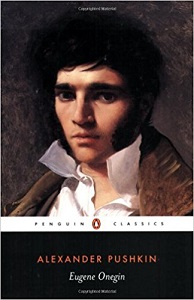
Uit: Evgeny Onegin (Vertaald door G. R. Ledger)

Book 5

I
That year the autumn weather lingered
Over the field and around the yards,
Winter held back, Nature awaited,
In January only snow fell at last
On the third, at night. And waking early
Tatyana saw through the window clearly
The yard all covered with morning whiteness,
The flower beds, roofs, and all the fences;
On the window glass the leaves of frost,
The trees in their winter silveriness,
And cheerful magpies in the snow.
The hills all covered with the soft glow
Of winter's carpet glistening bright,
Around all was shining, all was white.


II
Winter ! The peasant breathes a sigh,
Renews his sledge, and makes his way.
His horse, snorting in the fresh snow
With a finicky trot gets along somehow.
And now the dashing kibitka flies,
In the powdery snow cutting feathery furrows.
The coachman sits huddled upon his box,
In a sheepskin coat and a scarlet sash.
A yard boy runs out, and on his sledge
His favourite 'Dasher' is the driver,
While he himself is the willing puller;
The rascal struggles with frozen hands;
What fun it is, but so painful too,
While his mother scolds him above at the window.


III
But perhaps recollection of winter's scenes
Does not arouse you, gentle reader:
It is all base, lowly, and vulgar Nature,
But not much here of refinement breathes.
Warmed by the inspiration of the Muse,
Another poet, in luxuriant gloss,
Has painted for us the first fallen snow,
And all the shades of winter's sloth.
I am sure that he more than ever enchants you,
Depicting in his flamboyant verse
The charm of a secret rendezvous,
On a sledge; yet to fight I am somewhat averse,
With him, or with that other minstrel
Of the Finnish maiden, as bright as tinsel.


 2152684-21e613a55ed8612841d8006905ffb813.jpg
Aleksandr Poesjkin (6 juni 1799- 10 februari 1837) 
Cover


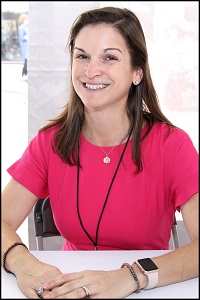
De Amerikaanse schrijfster Sarah Dessen werd geboren op 6 juni 1970 in Evanston, Illinois. Zie ook alle tags voor Sarah Dessen nop dit blog.

Uit: Just Listen

“I taped the commercial back in April, before anything had happened, and promptly forgot about it. A few weeks ago, it had started running, and suddenly, I was everywhere. On the rows of screens hanging over the ellipticals at the gym. On the monitor they have at the post office that's supposed to distract you from how long you've been waiting in line. And now here, on the TV in my room, as I sat at the edge of my bed, fingers clenched into my palms, trying to make myself get up and leave. "It's that time of year again...." I stared at myself on the screen as I was five months earlier, looking for any difference, some visible proof of what had happened to me. First, though, I was struck by the sheer oddness of seeing myself without benefit of a mirror or photograph. I had never gotten used to it, even after all this time. "Football games," I watched myself say. I was wearing a baby-blue cheerleader uniform, hair pulled back tight into a ponytail, and clutching a huge megaphone, the kind nobody ever used anymore, emblazoned with a K. "Study hall." Cut to me in a serious plaid skirt and brown cropped sweater, which I remembered feeling itchy and so wrong to be wearing just as it was getting warm, finally. "And, of course, social life." I leaned in, staring at the me on-screen, now outfitted in jeans and a glittery tee and seated on a bench, turning to speak this line while a group of other girls chattered silently behind me. The director, fresh-faced and just out of film school, had explained to me the concept of this, his creation. "The girl who has everything," he'd said, moving his hands in a tight, circular motion, as if that was all it took to encompass something so vast, not to mention vague. Clearly, it meant having a megaphone, some smarts, and a big group of friends. Now, I might have dwelled on the explicit irony of this last one, but the on-screen me was already moving on. "It's all happening this year," I said. Now I was in a pink gown, a sash reading HOMECOMING QUEEN stretched across my midsection as a boy in a tux stepped up beside me, extending his arm. I took it, giving him a wide smile. He was a sophomore at the local university and mostly kept to himself at the shooting, although later, as I was leaving, he'd asked for my number. How had I forgotten that?”


 2152684-9026fe04a60b8c8d1324c477183b6ea3.jpg
Sarah Dessen (Evanston, 6 juni 1970)


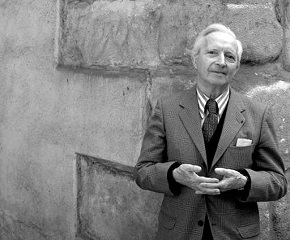
De Franse dichter en schrijver Jean Cayrol werd geboren op 6 juni 1911 in Bordeaux. Zie ook alle tags voor Jean Cayrol op dit blog.


Retour

À feu et à sang
belle fille qui se repent
les oiseaux sont dans le vent
à chercher qui vous attend

À feu et à sang
les villes tendres de la mort
les hauts jardins les fruits les corps
le désastre au premier rang

À feu et à sang
sans qu’on puisse dire une prière
un fleuve qui trouve la barque éphémère
un homme haletant

À feu et à sang
la guerre comme chevreau mort
sur tes épaules et tout ce qui dort
sur la rive d’Avant

À feu et à sang
j’ai de grands vergers qui hantent le soir
j’ai de grands amis qui peuvent me voir
des plaies qui s’en vont

À feu et à sang
la porte n’est jamais fermée
entends-tu au fond de l’année
l’écho, le démon

À feu et à sang
reviens mon enfant
inlassablement.


 2152684-3ee23a435b98e3571497d29dd41bb88c.jpg
Jean Cayrol (6 juni 1911 – 10 februari 2005)


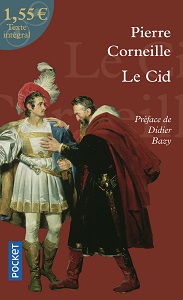
De Franse dichter en schrijver Pierre Corneille werd geboren in Rouen op 6 juni 1606. Zie ook alle tags voor Pierre Corneille op dit blog.

Uit: Le Cid

« LE COMTE
Je l’avoue entre nous, mon sang un peu trop chaud
S’est trop ému d’un mot, et l’a porté trop haut ;
Mais puisque c’en est fait, le coup est sans remède.
DON ARIAS
Qu’aux volontés du roi ce grand courage cède :
Il y prend grande part, et son cœur irrité
Agira contre vous de pleine autorité.
Aussi vous n’avez point de valable défense :
Le rang de l’offensé, la grandeur de l’offense,
Demandent des devoirs, et des soumissions
Qui passent le commun des satisfactions.
LE COMTE
Le roi peut à son gré disposer de ma vie.
DON ARIAS
De trop d’emportement votre faute est suivie.
Le roi vous aime encore ; apaisez son courroux.
Il a dit : « Je le veux ; » désobéirez-vous ?
LE COMTE
Monsieur, pour conserver tout ce que j’ai d’estime,
Désobéir un peu n’est pas un si grand crime ;
Et quelque grand qu’il soit, mes services présents
Pour le faire abolir sont plus que suffisants.
DON ARIAS
Quoi qu’on fasse d’illustre et de considérable,
Jamais à son sujet un roi n’est redevable.
Vous vous flattez beaucoup, et vous devez savoir
Que qui sert bien son roi ne fait que son devoir.
Vous vous perdrez, Monsieur, sur cette confiance. »


 2152684-5978dd4c77ceffa783774647d2c3308f.jpg
Pierre Corneille (6 juni 1606 – 1 oktober 1684)
Cover


De Nederlandse dichter en vertaler Hendrik van Teylingen werd geboren op 6 juni 1938 in IJmuiden. Zie ook alle tags voor Hendrik van Teylingen op ditt blog.


Antoine

In deze winternacht
is de gracht belegd
met een kruimige vacht
van bierschuim en licht.

Geëerde Stoffeerder,
zend thans uw borduurders.
Stuur uwe woerden
en eenden in horden.

Roep op uit de wakken.
Laat ze haast maken.
Dat al wat kan kwaken
guirlanden trappele

rondom de bijt
waarin Antoine, door de hik
van de wal gewipt,
allengs berijpt.


 2152684-0bd5ebe1b7880161445b8eb47a91d59d.jpg
Hendrik van Teylingen (6 juni 1938 – 25 december 1998)
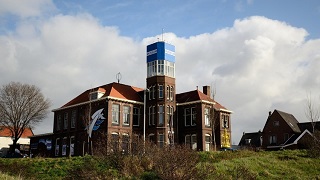
IJmuiden, Het Zee-en Havenmuseum


De Amerikaanse schrijfster V. C. Andrews (eig. Cleo Virginia Andrews) werd geboren in Portsmouth op 6 juni 1923. Zie ook alle tags voor VC Andres en eveneens alle tags voor V. C. Andrews op dit blog.

Uit:Petals on the Wind

“How young we were the day we escaped. How exuberantly alive we should have felt to be freed, at last, from such a grim, lonely and stifling place. How pitifully delighted we should have been to be riding on a bus that rumbled slowly southward. But if we felt joy, we didn’t show it. We sat, all three, pale, silent, staring out the windows, very frightened by all we saw.
Free. Was ever a word more wonderful than that one? No, even though the cold and bony hands of death would reach out and drag us back, if God wasn’t up there somewhere, or maybe down here on the bus, riding with us and looking out for us. At some time in our life we had to believe in someone.
The hours passed with the miles. Our nerves grew frazzled because the bus stopped often to pick up and let off passengers. It stopped for rest breaks, for breakfast, then to pick up a single huge black lady who stood alone where a dirt road met the concrete interstate. It took her forever to pull herself onto the bus, then lug inside the many bundles she carried with her. Just as she was finally seated, we passed over the state line between Virginia and North Carolina.
Oh! The relief to be gone from that state of our imprisonment! For the first time in years, I began to relax—a little.
We three were the youngest on the bus. Chris was seventeen years old and strikingly handsome with long, waving blond hair that just touched his shoulders, then curled upward. His darkly fringed blue eyes rivaled the color of a summer sky, and he was in personality like a warm sunny day—he put on a brave face despite the bleakness of our situation. His straight and finely shaped nose had just taken on the strength and maturity that promised to make him all that our father had been—the type of man to make every woman’s heart flutter when he looked her way, or even when he didn’t. His expression was confident; he almost looked happy. If he hadn’t looked at Carrie he might have even been happy. But when he saw her sickly, pale face, he frowned and worry darkened his eyes. He began to pluck on the strings of the guitar strapped to his shoulder.”


 2152684-97e3e9491d7cf561df7f9dc1873c41dd.jpg
V. C. Andrews (6 juni 1923 – 19 december 1986)
Scene uit de gelijknamige film uit 2014 met Wyatt Nash (Christopher) en Rose McIver (Cathy)


De Nederlandse dichter en publicist Frank Gericke (pseudoniem van Derk Gerhardus Hoek) werd geboren in Hoogvliet op 6 juni 1887. Zie ook alle tags voor Frank Gericke op dit blog.


De naaister

Weken na weken, jaren na jaar, met een duldenden glimlach,
Minzaam, bescheiden en oud, komt zij en zet zich aan 't raam.
Kraaloogend volgde, uit mijn wieg, ik het bezig geheim van heur handen;
Morgen... Wie weet het hoe snel zij ook mijn doodslaken naait?
Wàt verzilvert heur taak, wàt doet haar, van 't deemstren des morgens,
IJvrend tot Helios daalt, 't zonnegoud zaamle' in heur oog?
Dieper dan 't staamrend verstand van den zinnenden dichter, den wijsgeer,
Weet zij hoe de eeuwigheid bloeit, bloeit uit een mensch en zijn taak.


Het renteniertje

Parkwaart stiert hij den tred: hij kiest, onder 't loof der platanen,
'T plekje dat, vroolijk en wijd, uitzicht en lommer hem biedt;
Volgt, met de baby, het meisje, en let hoe de wieletjes glijden; -
Krachtig stort de muziek volkwaart uit schaduw en tent.
Doet, in 't grauw van zijn baard, u zijn blik geen monkellach raden?
Heimelijk loert hij, en lonkt, pinkoogt en monkellacht weêr...
De ure verstilt; de kilte doorhuivert zijn leden... Zoo keert hij
Schoorvoetend weder, en steels pinkt hij uit d' ooghoek een traan.

 2152684-b38ef0f9c8f26d1817470161fc30fce6.jpg
Frank Gericke (6 juni 1887 − 14 december 1976)
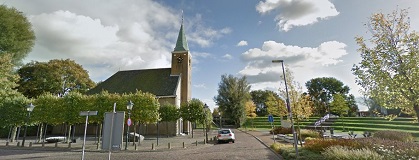
Hoogvliet, kerk


 Zie voor nog meer schrijvers van de 6e juni ook mijn blog van 6 juni 2015 deel 2.

Geschreven door Romenu om 18:19 Reageer op dit bericht

Meer van Romenu

↑ Terug naar de berichten